Volume 2, Issue 3 Aug. -2015
JADD © 2014 http://www.jadd.in
ISRA IMPACT FACTOR: 0.46
Enhancement of Solubility and Dissolution Rate of Fenofibrate by Using Solid
Dispersion Technology
Supriya Shirke*, Manoj Shinde, Archna Savanand
Abstract - Amorphization is a commonly used method to enhance the dissolution of poorly water-soluble drug. In this study Kollicoat IR, a new pharmaceutical excipient developed as a coating polymer for instant release, was evaluated as a carrier in solid dispersions of fenofibrate. The solid dispersions of fenofibrate with kollicoat IR were prepared at ratio 1:1, 1:2 and 1:3 by kneading methods to achieve dissolution rate enhancement. Fourier transform infra red spectroscopy was used to evaluate the interaction or miscibility between the drug and the carrier. The pharmaceutical performance was evaluated by dissolution experiments, performed in 0.1 N HCL+0.05% SLS. The transformation of fenofibrate from crystalline to amorphous state by using Kollicoat IRis considered a promising way to improvement of drug dissolution.
Key words: Kollicoat IR, dissolution rate, amorphous, kneading.
—————————— ——————————
INTRODUCTION
The biopharmaceutics Classification System is used by FDA to classify drugs into categories according to solubility and permeability as High solubility and permeability (class I), High solubility and low permeability (class II), Low solubility and high permeability (class III), Low solubility and low permeability (class IV)[1].Out of newly discovered drugs more than 40% drugs are therapeutically inactive due to poor water solubility. It is one of the serious challenges for successful development and commercialization of drug product in pharmaceutical industry [2]. By improving the drug release profile of these drugs, it is possible to enhance their bioavailability and reduce side effects as a result; the improvement of solubility and dissolution rate of poorly soluble compounds has great importance For improve these problems a variety of strategies have been developed such as particle size reduction, salt formation, polymorphs and pseudo polymorphs, complexation / solubilization using hydrotropes and surfactants and formation of soluble prodrugs [3].
The potential of solid dispersion technology has been well established for hydrophobic agents due to ease of optimization simplicity of preparative method and reproducible result. Solid dispersion refers dispersion of one or more active ingredients in inert carrier at solid state. Once the solid dispersion is exposed to aqueous media and the carrier dissolved, the drug released as very fine colloidal particles [4].
Fenofibrate is anti-hyperlipidemic agent (lipid lowering agent) [5] used to reduce plasma lipid level in the form of lipoproteins and atherosclerosis. Fenofibrate is a class II drug, according to the biopharmaceutical classification system. Due to its very low aqueous solubility and poor dissolution. it can cause formulation problems and limit its therapeutic application by delaying the rate of absorption and onset of action. Fenofibrate being crystalline in nature may also contribute to its low aqueous solubility and has resulted in low bioavailability. The improvement of release rate of poorly soluble drug represents an important challenge.
Drugs with dissolution limited oral absorption might benefit from a larger solid–liquid contact surface area and an increase in saturation solubility. This is well described in the following equation, which is a modification of the well-known Noyes–Whitney relation [6]
dM/dt = AD. (Cs - C) /h Where, dM/dt is dissolution rate,
A is Specific surface area of the drug particle, Supriya Shirke*, Manoj Shinde, Archna
JADD © 2014 http://www.jadd.in D is diffusion coefficient,
h isdiffusion layer thickness, C is saturation solubility and C t is drug concentration at time t.
Both principles form the rationale for the use of solid dispersions, a possible pharmaceutical strategy that can result in increased solubility and dissolution rate. The presence of the carrier improves the contact between the drug and the dissolution medium and inhibits the aggregation and agglomeration. Due to particle size reduction the drug is molecularly dispersed in the carrier. Compared to solid dispersions with separate amorphous drug clusters, these systems have a higher physical stability due to the antiplasticizing effect and protection against recrystalization from the surrounding polymer. Both in terms of dissolution as in terms of stability the solid solutions are favorable systems.
In solid dispersion system up till now there is use of traditional polymer system such as water miscible, hydrophilic polymers etc. So undoubtly there is need to welcome copolymers.
KollicoatIR was employed as carrier in preparation of solid dispersions. It is graft copolymer of polyvinyl alcohol (75% units) and polyethylene glycol (25% units). Its solubility is 40% (w/w) in aqueous systems and 25% (w/w) in a 1:1 ethanol–water mixture; the solubility in non-polar solvents is low [7]. It exhibit good wetting behavior by reducing the surface tension of water, this makes aqueous solution easy to spray. It is an interesting polymer to be used as a carrier for the formulation of solid dispersions. As it is hydrophilic and non-ionic, its solubility does not change along with the gastrointestinal tract [8]. It is slightly surface active [9], which can be useful to maintain supersaturation of poorly soluble drugs in the gastrointestinal tract. Large number of studies has been carried out on solid dispersions but still there is need to explore new carrier material. In order to contribute in the search of new carriers, we have investigated the potential of Kollicoat IR as a polymeric carrier in the formulation of solid dispersions of fenofibrate.
The objective of the present study was to enhance solubility and dissolution rate of fenofibrate using solid dispersion with Kollicoat IR.
MATERIALS AND METHODS
A gift sample of Fenofibrate was received from Alembic pharma Ltd. (Baroda, India) Kollicoat IR was received from BASF Mumbai.
Preparation of solid dispersions:
Solid dispersions and physical mixture of fenofibrate with Kollicoat IR were prepared at (1:1), (1:2), (1:3) ratio by using kneading methods (Table 1).
Physical mixtures:
Fenofibrate and Kollicoat IR were accurately weighed, pulverized and mixed thoroughly by light trituration for 5 min in a mortar. The mixture was passed through a sieve no-60.
Kneading method:
A required amount of fenofibrate and Kollicoat IR
[(1:1), (1:2), (1:3)] ratio were taken in a glass mortar. The mixtures were kneaded thoroughly with a glass pestle by using ethanol for 30 minutes. The mixtures were kept for drying in a desiccator. The hardened mixtures were powdered in a mortar, sieved through a 60-mesh screen, and stored in screw-cap vials at room temperature [10].
TABLE 1: Formulation code with ratio
EVALUATION OF SOLID DISPERSION Percentage yield:
The prepared solid dispersions and physical mixtures were weighed after processing and product yield was calculated by using following equation:- Y= (a/b+c) x 100
Where, a -weight of solid dispersion b -weight of fenofibrate taken
c -weight of polymer (Kollicoat IR) taken for solid Dispersions and physical mixture
Drug content determination:
Amount of drug present in the solid dispersions and physical mixtures was determined by sampling 10mg of solid dispersions and physical mixture in 100 ml of volumetric flask. To this 0.1 N HCl+0.05%SLS was added and the flask was shaken for 10 min, final volume was made up to 100mL with same. From that
Code Formulation F1 1:1 Physical Mixture
JADD © 2014 http://www.jadd.in solution 1mL was transferred to another volumetric
flask of 10 ml and volume was made with same. The amount of drug present was analyzed spectrophotometrically at 290 nm and fenofibrate content was calculated [11].
Saturation solubility study:
The solubility of pure Fenofibrate, physical mixture and solid dispersions was estimated in water, 0.1NHCl+0.05%SLS, .For this saturated solution of drug and formulations were prepared in 10 ml of each solvent. To facilitate maximum solubilization of drug in the solvent at room temperature it was kept in water bath shaker for 24 h at 250 C to achieve equilibrium. The solutions were observed for a clear transparent solution. The amount of drug present in the solvents was estimated using UV visible spectrophotometer at 290 nm after appropriate dilutions[12]. The study was performed in triplicate (n =3).
In-vitro dissolution studies:
To understand the drug release characteristics
In-vitro dissolution study was carried out. Dissolution studies of Fenofibrate in powder form, Solid dispersions and physical mixture were performed by
using (USP) model digital tablet dissolution test
apparatus-(DA-6D Dissolution test apparatus)at the paddle rotation speed of 100 rpm in 900 ml mixture of 0.1NHCl+0.05 SLS .The solid dispersions and Physical mixture equivalent to 40 mg of fenofibrate was weighed using a digital balance and added into
the dissolution medium. At the specified times 5 ml
samples were withdrawn by using syringe filter
(0.45μm) and then assayed for fenofibrate content by
measuring the absorbance at 290 nm using the UV-Visible spectrophotometer (Jasco V530 Japan) . Fresh
medium (5ml), which was prewarmed at 370C, was
replaced into the dissolution medium after each sampling to maintain its constant volume throughout the test.
Fourier transform infrared spectroscopy:
Fourier-transform infrared (FTIR) spectra were obtained by using an FTIR spectrophotometer (Jasco 410, Japan). Samples were mixed with potassium bromide and compressed into discs using hydraulic press. The IR spectra in absorbance mode were obtained in the spectral region 4000-400 cm-1. The FTIR spectra of pure drug, physical mixture and solid dispersions were compared to check any interactions between the drug and polymer or change in the positions of the functional group of the drug.
RESULTS AND DISCUSSION
Drug content and % Yield:
The drug content was determined to evaluate the homogeneity of distribution of drug in physical mixtures and solid dispersions and drug yield was determined to evaluate any loss of drug that occurred during the preparation of mixtures. The results revealed drug content values in the range of 95.8-98.80 % w/w indicating homogenous distribution of the drug in prepared mixtures. The production yield was found satisfactory and ranged from 95.50-98.50% for solid dispersions. The results of % drug content and % drug yield are shown in (Table 2)
TABLE 2: EVALUATION OF SOLID
DISPERSIONS
Fenofibrate solid dispersions bearing different FC= formulation code F1, F2, F3, F4, F5, F6 were evaluated for %DC= drug content, %Y= drug yield.
Saturation solubility study
The results of solubility studies of drug, physical mixture and solid dispersions revealed that there was slightly increase in solubility of physical mixture and significant improvement in the solubility of solid dispersions as compared to pure fenofibrate in 0.1 N HCL+0.05% SLS.
This improvement in drug solubility in formulations may be due to cosolvensy effect of carrier, changes in the crystal forms, structure, and surface modification with hydrophilic Polymer KollicoatIR. The hydrophilic carrier may interact with drug molecule by hydrogen bonding or other types of bonding and this was likely cause for the formation of soluble complexes13,14 The results of the solubility study of solid dispersions, physical mixtures and drug mentioned in (Table 3) and (fig.
FC %DC % Y
F1 95.88±0.09 95.50±0.05
F2 96.20±0.02 98.00±0.06
F3 97.80±0.01 97.00±0.066
F4 98.74±0.020 97.00±0.11
F5 97.86±0.024 98.50±0.035
JADD © 2014 http://www.jadd.in TABLE 3: Solubility Study
Solubility study of drug and solid dispersions was carried out for 24 hrs in 0.1 N HCL+0.05% SLS. All values are mean ± standard deviation of three determinations.
Fig. 1: Saturation solubility of Fenofibrate and their solid dispersions in different solvents.
In-Vitro Dissolution Study
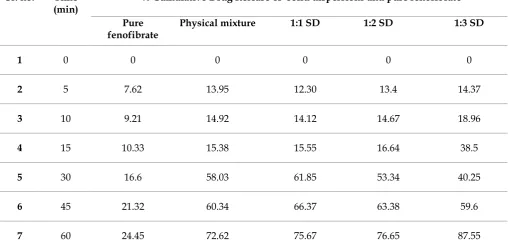
To understand the drug release characteristics from solid dispersions dissolution study was carried out. The results of pure fenofibrate, physical mixture and solid dispersions over the period 60 min were noted. Cumulative percent drug released after 60 min was 72.62%,75.67%,76.65%,87.55% for F-1 ,F4,F5, F-6 respectively and 24.45% in 60 min for pure drug as shown in (fig.2). Dissolution studies revels that there is marked improvement in dissolution rate of fenofibrate from all solid dispersions as compare to pure fenofibrate. The improvement of dissolution rate was possible due to several reasons such as the strong hydrophilic character of Kollicoat IR, which improves the water penetration and the wettability of the hydrophobic fenofibrate and maintain supersaturation of drug, the molecular dispersion of fenofibrate in Kollicoat IRleads to partial miscibility, improving the hydrophilic characteristics of the drug substances through interaction within the polymer, c) reduction in particle size resulting increased surface area [15].
TABLE 4:In-Vitro Dissolution Study
Solubility (µg/ml) Mg/ml
Fenofibrate 54.99±0.02 0.054
PM (1:1) 62.07±0.34 0.062
1:1 SD 66.34±0.12 0.066
1:2 SD 71.30±0.22 0.071
1:3 SD 80.66±0.15 0.080
Sr. no. Time (min)
% Cumulative Drug Release of solid dispersions and pure fenofibrate
Pure
fenofibrate Physical mixture 1:1 SD 1:2 SD 1:3 SD
1 0 0 0 0 0 0
2 5 7.62 13.95 12.30 13.4 14.37
3 10 9.21 14.92 14.12 14.67 18.96
4 15 10.33 15.38 15.55 16.64 38.5
5 30 16.6 58.03 61.85 53.34 40.25
6 45 21.32 60.34 66.37 63.38 59.6
JADD © 2014 http://www.jadd.in
Fig. 2: In-vitro dissolution study of pure drug and formulations
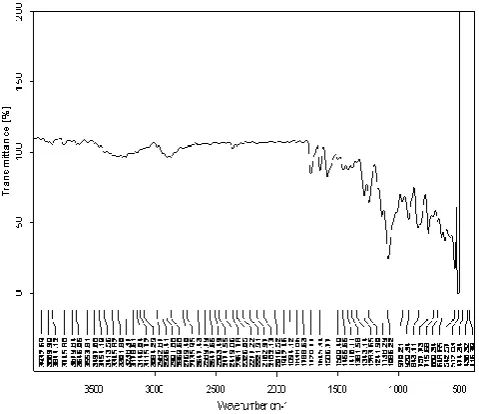
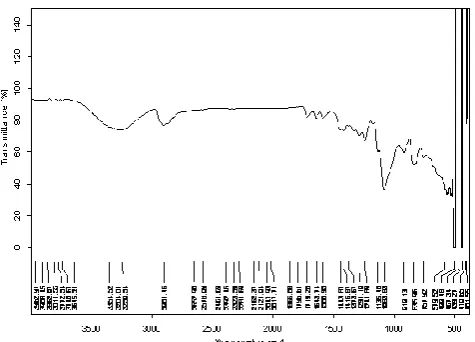
The IR spectra of solid dispersions and physical mixture were compared with spectrum of fenofibrate (fig.3). The IR spectrum of fenofibrate showed characteristic peaks of their respective functional groups. The peak at 2982cm-1 indicates aromatic C-H stretching, peak at 1587 cm-1 indicates C=O stretching whereas, peaks at 1241cm-1 and 1087cm-1 indicates aralkyl and dialkyl ether C-O stretching respectively [1]. The new peaks observed in the range of 2500-3000 cm-1 indicate OH stretching of carboxyl group. The broad peaks observed in the range of 3500-3700. 34cm-1 indicates O-H stretching suggesting hydrogen bonding. These results indicate the crystalline structure of fenofibrate in solid dispersions with Kollicoat IR changes to amorphous form and this is due to fenofibrate molecules interact with Kollicoat IR through hydrogen bonding and make eutectic mixtures [16].
Fig.3: FTIR spectrum of fenofibrate
Fig.4: FTIR spectrum of Kollicoat IR
JADD © 2014 http://www.jadd.in Fig 5: FTIR spectrum of solid dispersion prepared by
kneading method (1:3)
ACKNOWLEDGEMENTS
Authors are thankful to Satara College of pharmacy, Satara for providing the facilities to carrying out this research work, BASF Mumbai, Alembic pharma Ltd. (Baroda, India) for providing gift sample.
REFERENCES
1. Avdeef A, Hoboken NJ. Absorption and Drug Development, Solubility, Permeability, and Charge State. Wiley 2003.
2. Kumar N, Jain AK, Singh C, Agarwal K, Nema RK. Development, characterization and solubility study of solid dispersion of terbinafine hydrochloride. Int. J. Pharm Sci Nanotech 2008;1:171-76.
3. Serajuddin AT, Solid dispersion of poorly water-soluble drugs: earlypromises, subsequent problems, and recent breakthroughs, J. Pharm. Sci1999; 88: 1058–66.
4. Leuner C, Dressman JB. Improving drug solubility for oral delivery using solid dispersions. Eur J Pharm Biopharm 2000; 50:47– 60.
5. Sweetmann SC. Martindale- The Extra Pharmacopoeia, London: The Pharmaceutical Press; 2005.
6. Noyes AA, Whitney WR. The rate of dissolution of solid substances in their own solutions. J Am Chem Soc 1997. 19:930–934.
7. BASF Aktiengesellschaft, Technical Information, Kollicoat IR® 2001.
8. Mooter G, Sandra G, Pieterjan K, Johan A, Jan V ,Vincent M.Characterization of the copolymer poly(ethyleneglycol-g-vinylalcohol) as a Potential carrier in the formulation of solid dispersions. Eur J Pharm Biopharm 2010; 74: 239–47.
9. Christian L, Jennifer D. Improving drug solubility for oral delivery using solid Dispersions. Eur J Pharm Biopharm 2000; 47-60. 10. Mesnukul A,Yodkhum K, Phaechamud T. Solid
dispesion matrixtablet comprising indomethacin- PEG-HPMC fabricated with fusion andmold technique. Ind J Pharm Sci 2009; 71(4):413-20. 11. Mahmoud E, Gihan F, Mohamed F. Improvement
of solubility and dissolution
rate of Indomethacin by solid dispersions in Gelu cire50/13andPEG4000.Saudi Pharmaceutical J 2009; 17: 217–25.
12. Garg A, Sachdeva R and Kapoor G. Comparison of crystalline and amorphous carriers to improve the dissolution profile of water insoluble drug Itraconazole. Int J Pharm Bio Science.2013; 4(1):934-48.
13. Prasad S,
Sarath K. Yandrapu R. Preparation and characteri zation of ITZ solid dispersions for improved oral bioavailability. Int J Chem Tech Res 2010; 2 (1):133-44.
14. Sandrien J, Hector N, Jean P, Mooter G. The use of a new hydrophilic polymer, Kollicoat IR®, in the formulation of solid dispersions of Itraconazole. Eur J pharm sci 2007; 30: 288–294 15. Vasconcelos T, Sarmento B, Costa P.(2007) Solid
dispersions as strategy to improve oral bioavailability of poor water soluble drugs. Drug Discov Today 12:1068-1075.