*Corresponding Author:
Mohammad Yunoos Associate Professor
Department of Pharmaceutical Analysis and Quality Assurance, Bapatla College of Pharmacy, Bapatla, Andhra Pradesh, India. Email: [email protected]
Mobile: +91 7416509726
Research Article
A New Validated Stability indicating Quantitative RP-HPLC Method for
Simultaneous Estimation of Esomeprazole and Levosulpride in Bulk Drug and
Combined Capsule Dosage Form
Mohammad Yunoos* and D.Gowri Sankar
1*Department of Pharmaceutical Analysis, Bapatla College of Pharmacy, Bapatla-522101, Guntur (Dist.), Andhra Pradesh, India. 1
College of Pharmaceutical Sciences, Andhra University, Visakhapatnam-530 003, India.
1. INTRODUCTION
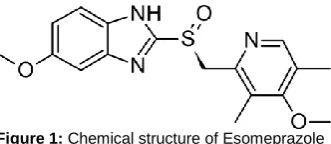
Chemically, Esomeprazoleis (as shown in figure 1), (S )-5-methoxy-2-[(4-methoxy-3, 5-dimethylpyridin-2-yl) methyl sulfinyl]-3H -benzoimidazole. It has molecular formula of C17H19N3O3S and molecular weight is 345.417 g/mol. Esomeprazole, a proton pump inhibitor and anti-ulcer drug, suppresses gastric acid secretion by specific inhibition of the H+/K+-ATPase in the gastric parietal cell. By acting specifically on the proton pump, Esomeprazole blocks the final step in acid production, thus reducing gastric acidity.
Figure 1: Chemical structure of Esomeprazole
Chemically, Levosulpride is (as shown in figure 2), N-[[(2S )-1-Ethylpyrrolidin-2-yl] methyl]-2-methoxy-5-sulfamoyl benzamide. It has a molecular formula of C15H23N3O4S and molecular weight of 341.43 g/mol. Levosulpride is an antiemetic, antidyspeptic and antipsychotic drug. In contrast to most other neuroleptics which block both dopamine D1 and D2 receptors, levosulpiride is more selective and acts primarily as a dopamine D2 antagonist but lack effects on norepinephrine, acetylcholine, serotonin, histamine, or
gamma-aminobutyric acid (GABA) receptors. It is also useful in treatment of gastro-oesophageal reflux disease (GERD), duodenal ulcer and irritable bowel syndrome1.
Figure 2: Chemical structure of Levosulpride
Literature survey reveals that few analytical methods were reported like LC-MS/MS method in biological fluids2, spectrophotometric methods3-8, RP-HPLC methods9-12and HPTLC methods 13in alone or in combination with other drugs in pharmaceutical dosage forms but no simple stability indicating RP-HPLC method for the simultaneous estimation of Esomeprazole (ESMO) and Levosulpride (LEVO) in pharmaceutical dosage forms have been reported so far. Hence author has planned to develop a simple, accurate, precise and sensitive stability indicating RP-HPLC method for the simultaneous estimation of Esomeprazole (ESMO) and Levosulpride (LEVO) in bulk and combined capsule dosage forms and in routine quality control analysis.
2. MATERIALS AND METHODS
2.1 Chemicals
Esomeprazole (ESMO) and Levosulpride (LEVO) were obtained as gift samples from Sun Pharma Ltd., Mumbai. HPLC grade water, methanol and acetonitrile were purchased from E.Merck. Chem.ltd., Mumbai. All the chemicals used were of analytical reagent grade (E.Merck). Fixed dose combination capsule formulation (Sompraz – Abstract
A simple and precise stability indicating RP-HPLC method was developed and validated for the simultaneous determination of Esomeprazole (ESMO) and Levosulpride (LEVO) in bulk and Pharmaceutical dosage forms. Chromatography was carried out on Inertsil ODS 3V C18 (150 x 4.6 mm, 5 particle size) column using a mobile phase of phosphate buffer (KH2PO4) adjusted to pH 5.0 with 0.1 % OPA: Acetonitrile: Methanol (30:60:10 % v/v/v) at a flow rate of 1.0 ml/min. The analyte was monitored using PDA detector at 250 nm. The retention time was found to be 2.390 min and 3.497 min for Levosulpride (LEVO) and Esomeprazole (ESMO) respectively. The proposed method was found to be having linearity in the concentration range of 20-120 µg/ml for Esomeprazole (r2 0.99991) and 37.5-225 µg/ml for Levosulpride (r2 0.99994) respectively. The mean % recoveries obtained were found to be 100.12 % for Levosulpride and 100.24 % for Esomeprazole respectively. Stress testing which covered acid, alkali, peroxide, photolytic and thermal degradation was performed on under test to prove the specificity of the method and the degradation was achieved. The developed method has been statistically validated according to ICH guide lines and found to be simple, precise and accurate with the prescribed values. Thus the proposed method was successfully applied for the stability indicating simultaneous determination of Esomeprazole (ESMO) and Levosulpride (LEVO)in bulk and combined capsule dosage forms and in routine quality control analysis.
ISSN (Online) 2249-6084 (Print) 2250-1029
International Journal of Pharmaceutical and
Phytopharmacological Research (eIJPPR)
[Impact Factor – 0.852]
Journal Homepage: www.eijppr.com
Article info
Article History: Received 13 March 2015 Accepted 10 April 2015
Keywords:
L) containing 75 mg of Levosulpride and 40 mg of Esomeprazole was procured from local market.
2.2 Instrumentation
Quantitative HPLC was performed on Waters technologies 2695 series, PDA detector module equipped with auto injector using empower software. A reverse phase Inertsil ODS 3V C18 (150 x 4.6 mm, 5 particle size) analytical column was used. Weighing was done on shimadzu balance (AX 200) and pH adjustments done using pH meter (Unichem AD102U) was used.
2.3 Chromatographic conditions
Separation and analysis was carried out on Inertsil ODS 3V C18 (150 x 4.6 mm, 5 particle size) column. The optimized mobile phase consisting of phosphate (KH2PO4) buffer (pH adjusted to 5.0 with 0.1 % OPA): Acetonitrile: Methanol in the ratio of 30:60:10 % v/v/v. Flow rate was maintained at 1.0 ml/min. Prior to sample injection, column was saturated with mobile phase for 30 min and injection volume of 20 µl was injected into the chromatographic system using auto sampler mode. The detection response was measured at 250 nm and maintained column at ambient temperature.
2.4 Preparation of mobile phase
Mix phosphate buffer (1.36 g of potassium dihydrogen phosphate was dissolved in 1000 ml of water and then adjusted to pH 5.0 with 0.1 % OPA), acetonitrile and methanol in the ratio of 30:60:10 % v/v/v, sonicated for 5 min, followed by degassing using vacuum filtration containing 0.45 µm membrane filter.
2.5 Preparation of standard stock solution
Accurately weighed and transferred 8 mg of ESMO and 15 mg of LEVO working standards into a 10 ml clean and dry volumetric flask, 3/4th volume of diluent (methanol) was added, sonicated to dissolve for 5 minutes and then made up to the final volume with diluent. From the above stock solution, 1.0 ml was pipette out in to a 10 ml volumetric flask and then made up to the final volume with mobile phase.
2.6 Preparation of sample solution
Twenty capsules (average weight = 417 mg) were accurately weighed and the powder equivalent to 40 mg of Esomeprazole and 75 mg of Levosulpride was accurately weighed and transferred to 50 ml volumetric flask. To this 30 ml of diluent was added and sonicated for 15 min and then made up to the final volume with diluent. From the above stock solution, 1.0 ml was pipetted into a 10 ml volumetric flask and made up to the mark with mobile phase. 20µL of the standard and sample solutions were injected into chromatographic system, chromatograms were recorded and peak areas were measured.
3. Method validation
3.1 System suitability
System suitability was carried out by injecting standard solutions five times into the chromatographic system. The system suitability parameters were then evaluated for tailing factor, retention time and theoretical plates of standard chromatograms.
3.2 Accuracy
The accuracy of the test method was demonstrated by % recovery across its range by making three different concentrations at 50%, 100% and 150% levels using standard addition method where sample preparations were spiked with known amount of standard and then each concentration was injected three times into the chromatographic system.
3.3 System Precision
The system precision was carried out by injecting standard preparations six times into the chromatographic system and calculated %RSD of retention time and peak areas for both ESMO and LEVO.
3.4 Method precision
In method precision, a homogenous sample of a single batch was analyzed by injecting sample solution preparations six times
into the chromatographic system and calculated %RSD of retention time and peak area for both ESMO and LEVO.
3.5 Specificity
Specificity is the ability to assess unequivocally the analytes in the presence of compounds that may be expected to present, such as impurities, degradation products and matrix components. The specificity of the method was assessed by comparing the chromatograms obtained from standard and sample solutions. The retention times of the analytes in standard and the sample solutions were found to be same, so the method was specific and free from interference from excipients present in the capsules.
3.6 Linearity
The linearity of an analytical method was carried out to check its ability to elicit test results that are directly, or by a well-defined mathematical transformation, proportional to the concentration of analyte in samples within a given range. Different concentrations of standard solutions were prepared by diluting aliquots (0.25- 1.5 ml) of standard stock solution (800µg/ml for ESMO and 1500 µg/ml for LEVO) in to 10 ml volumetric flasks to obtained concentrations in the range of 20-120 µg/ml for ESMO and 37.5-225 µg/ml for LEVO and then injected each into the chromatographic system and the chromatograms were recorded.
3.7 Robustness
The robustness of the proposed method was determined by analyzing aliquots from homogenous lots by differing physical parameters like mobile phase composition, flow rate and column temperature. The standard and sample solutions were injected into the chromatograph at varied conditions of flow rate ± 0.2 ml/min, mobile phase buffer pH ± 0.2 units, organic phase composition ± 10% and temperature by + 5 0C.
3.8 Ruggedness (Intermediate precision)
It is carried out by injecting standard preparations six times into the chromatographic system on two different days. %RSD was determined for retention time and peak areas of standard and sample solutions of ESMO and LEVO.
3.9 Forced degradation
Stress testing of the drug substance can help in identify the likely degradation products, which can in turn help to establish the degradation pathways and the intrinsic stability of the molecule. 3.9.1 Acid degradation studies
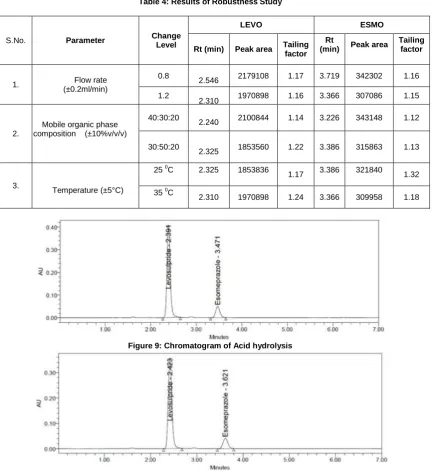
To 1.0 ml of stock solution of Esomeprazole and Levosulpride, 1.0ml of 1N Hydrochloric acid was added and refluxed for 30 min at 60 0C and then neutralized the solution with 1.0 ml of 1N NaOH solution. The resultant solution was diluted with mobile phase in a 10 ml volumetric flask to obtain concentration of 80µg/ml and 150µg/ml respectively. Then 20 µl solutions were injected into the chromatographic system and the chromatograms were recorded to assess the stability of sample as shown in figure9.
3.9.2 Base degradation studies
To 1.0 ml of stock solution of Esomeprazole and Levosulpride, 1.0 ml of 1N sodium hydroxide solution was added and refluxed for 30 min at 60 0C and then neutralized the solution with 1.0 ml of 1N hydrochloric acid solution. The resultant solution was diluted with mobile phase in a 10 ml volumetric flask to obtain concentration of 80µg/ml and 150µg/ml respectively. Then 20 µl solutions were injected into the chromatographic system and the chromatograms were recorded to assess the stability of sample as shown in figure 10.
3.9.3 Oxidation studies
3.9.4 Photolytic studies
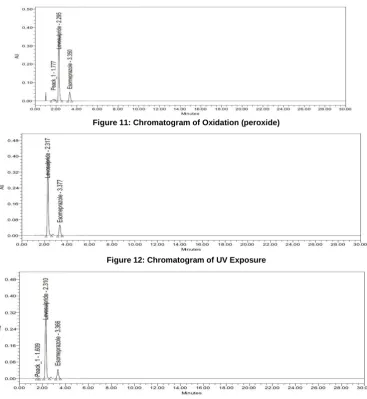
It is carried out by exposing 1.0 ml of stock solution of Esomeprazole and Levosulpride to UV light, by keeping the beaker in UV Chamber for 7 days or 200 Watt hours/m2 in photo stability chamber.The resultant solution was diluted with mobile phase in a 10 ml volumetric flask to obtain concentration of 80µg/ml and 150µg/ml respectively and 20 µl were injected into the system and the chromatograms were recorded to assess the stability of sample as shown in figure12.
3.9.5 Neutral studies
Stress testing under neutral conditions was studied by refluxing in water for 6 h r s at 60ºC. For HPLC study, the resultant solution was then diluted with mobile phase in a 10 ml volumetric flask to obtain concentration of 80µg/ml and 150µg/ml respectively and 20 µl solutions were injected into the system and the chromatograms were recorded to assess the stability of the sample as shown in figure 13.
4. RESULTS AND DISCUSSION
From this study, it was found that a simple, precise, accurate, sensitive and efficient stability indicating RP-HPLC method has been developed and validated for the estimation of Esomeprazole and Levosulpride in bulk and pharmaceutical dosage form. Separation was done by using mobile phase composed of phosphate (KH2PO4) buffer (pH adjusted to 5.0 with 0.1 % OPA): Acetonitrile: Methanol in the ratio of 30:60:10 % v/v/v on Inertsil ODS 3V C18 (150 x 4.6mm, 5µ particle size) at a flow rate 1.0 ml/min using PDA detection at 250 nm. The retention times were found to be 2.390 min and 3.497 min for Levosulpride (LEVO) and Esomeprazole (ESMO) respectively.
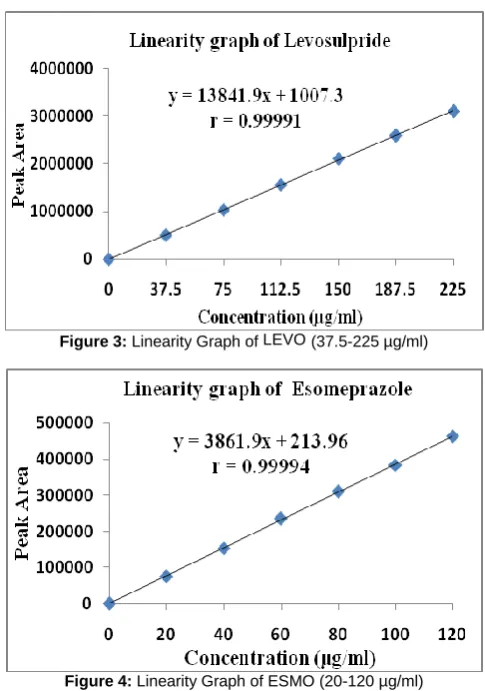
Linearity was evaluated in the concentration range of 20-120 µg/ml for ESMO and 37.5-225 µg/ml for LEVO. The calibration curves of ESMO and LEVO were described by the equation y = 3861.9x + 213.96 and y=13841.9x+1007.3 with correlation coefficient of 0.9999 as shown in figure 3 and figure 4 respectively. The standard and sample chromatograms in the specifity studies are shown in figure 5 and figure 6. The Limit of detection (LOD) and limit of quantification (LOQ) have shown in figure 7 and figure 8. System suitability results are shown in table 1. The %RSD in precision, accuracy and robustness studies were found to be less than 2.0%, indicating that the method is precise, accurate and robust. Accuracy data as shown in table 2. The validation summary parameters and assay results obtained from the marketed formulations are shown in table 3 and robustness study as shown in table 4. The stress testing results for both ESMO and LEVO are shown in table 5 and table 6.
Table 1: System Suitability Results
S. No. System Suitability Parameters Results LEVO ESMO
1 USP Tailing 1.20 1.12
2 USP Resolution (Rs) 7.69
3 Retention time (Rt) min. 2.390 3.497
4 USP Plate Count 6206 7219
Table 2: Accuracy Study
Sample Level Peak area*
Amount added
(mg)
Amount found
(mg)
Mean % Recovery *
± SD
LEVO
50% 1084235 7.5 7.48 99.83 ±0.47 100% 2178645 15.0 15.02 100.12±0.42 150% 3258029 22.5 22.46 99.80± 0.57
ESMO
50% 158392 4.0 4.0 100.03 ±0.65 100% 315722 8.0 7.98 99.78 ±0.41 150% 478543 12.0 12.0 100.08 ±0.37
*Mean of three determinations Linearity
R2 values were found to be 0.9999 and regression equation y = 3861.9x + 213.96 for ESMO and y=13841.9x+1007.3 for LEVO.
Figure 3: Linearity Graph of LEVO (37.5-225 µg/ml)
Figure 4: Linearity Graph of ESMO (20-120 µg/ml) Specificity:
The chromatograms of standard and sample were identical to each other. The blank and placebo injections were also identical without any interference from the excipients.
Figure 5: Typical chromatogram of standard
Table 3: Summary of Validation Parameters of the proposed RP-HPLC Method
Parameter LEVO ESMO
Linearity range
(µg/ml) 37.5-225 20-120
Regression equation y=13841.9x+1007.3 y = 3861.9x + 213.96 Correlation coefficient
(r) 0.99991 0.99994
LOD (µg/ml) 0.182 0.240
LOQ (µg/ml) 0.553 0.727
System precision (%
RSD) 0.62 0.74
Method precision (%
RSD) 0.47 0.53
% Assay 99.49-100.12% 99.88-100.4%
Figure 7: Typical chromatogram of Limit of detection (LOD)
Figure 8: Typical chromatogram of Limit of Quantification (LOQ)
Table 4: Results of Robustness Study
Figure 9: Chromatogram of Acid hydrolysis
Figure 10: Chromatogram of Base Hydrolysis
S.No. Parameter Change
Level
LEVO ESMO
Rt (min) Peak area Tailing factor
Rt
(min) Peak area
Tailing factor
1. Flow rate
(±0.2ml/min)
0.8
2.546 2179108 1.17 3.719 342302 1.16 1.2
2.310 1970898 1.16 3.366 307086 1.15
2.
Mobile organic phase composition (±10%v/v/v)
40:30:20
2.240 2100844 1.14 3.226 343148 1.12
30:50:20
2.325 1853560 1.22 3.386 315863 1.13
3.
Temperature (±5°C)
25 0C 2.325 1853836
Figure 11: Chromatogram of Oxidation (peroxide)
Figure 12: Chromatogram of UV Exposure
Figure 13: Chromatogram of Neutral Studies
Table 5: Degradation Study of Levosulpride
S.
No. Name
Peak Area
Degradation % Assay
% Net Degradation
1 Acid
Hydrolysis 2035493 92.62 6.87
2 Base
Hydrolysis 2064694 93.55 5.94
3 Neutral
degradation 2045895 94.34 4.55
4 Oxidation
(peroxide) 2059185 96.09 3.40
5 UV
Exposure 2030860 98.77 0.72
Table 6: Degradation Study of Esomeprazole
S.
No. Name Peak Area
Degradation % Assay
% Net Degradation
1 Acid
Hydrolysis 314115 92.13 8.75
2 Base
Hydrolysis 311038 92.45 8.43
3 Neutral
degradation 310464 93.11 7.77
4 Oxidation
(peroxide) 312594 94.55 6.33
5 UV
Exposure 313248 98.28 2.60
5. CONCLUSION
From this study it is concluded that the proposed Stability Indicating RP-HPLC method was found to be simple, accurate, precise, rapid and useful for routine analysis of Esomeprazole and Levosulpride in bulk and pharmaceutical dosage form. The statistical parameters and recovery studies were carried out and reported. The obtained results were satisfactory as per ICH guidelines.
6. ACKNOWLEDGEMENT
The authors are grateful to Bapatla College of Pharmacy, Guntur dist., Andhra Pradesh, India for providing research facilities. REFERENCES
1. Francesco Rossi, Angelo Forgione. Pharmacotoxicological aspects of Levosulpiride,
Pharmacological Research, 1995, 31(2), 81–94. 2. Jin-Hee Park, Yoo-Sin Park, Si-Youn Rhim, et al. Rapid
quantification of levosulpiride in human plasma using RP-HPLC-MS/MS for pharmacokinetic and bioequivalence study, Biomedical Chromatography, 2009; 23(12): 1350-1356.
3. Manjunath S, Chouhan V S. Spectrophotometric Estimation of Levosulpiride In Bulk Drug and Formulations, International Journal of Pharmacy And Pharmaceutical Sciences, 2011, 3(2):135 -137.
5. Agrawal Y P, Surya PG, Verma A, et al. Simultaneous estimation of esomeprazole and levosulpiride in solid dosage form, Pelagia Research Library Der Pharmacia Sinica, 2012, 3(3): 337-342.
6. Patel N N, Vyas A S, Patel N K. Development And Validation of Dual Wavelength Method For Simultaneous Estimation of Esomeprazole And Levosulpiride In Combined Capsule Dosage Form, International Journal of Pharmaceutical Research and Bioscience, 2013, 2(2): 219 -230.
7. Jain M S, Agrawal Y S, Chavhan R B, et al. UV Spectrophotometric Methods for Simultaneous Estimation of Levosulpiride and Esomeprazole in Capsule Dosage Form. Asian J. Pharm. Ana., 2012, 2(4): 106-109. 8. Vaghela B, Parmar G, Shah S. Development and
Validation of Derivative Spectrophotometric Method for Simultaneous Estimation of Levosulpiride and Esomeprazole in Capsule Dosage Form, Asian Journal of Research in Chemistry, 2013, 6(2):135-138.
9. Silambarasan S P, R Venkata L. Development of UV Spectrophotometry and RP -HPLC Methods for the Estimation of Levosulpiride in Bulk and in Tablet Formulation, Asian Journal of Research in Chemistry, 2010, 3(3): 542-544.
10. Deulgaonkar YB, Patel JA, Mahajan MP, Sawant SD, A Simple and Validated RP - HPLC method for The Simultaneous Estimation of Levosulpiride And rabeprazole sodium in bulk and pharmaceutical dosage forms, Indo American Journal of Pharmaceutical Research, 2013, 1:1-10.
11. Agarwal NK. Development and Validation of Stability Indicating RP -HPLC Method for Simultaneous Estimation of Levosulpiride and Rabeprazole Sodium,
International Journal of Pharma and Bio Sciences, 2012, 3(4), 718 –726.
12. Shilpa S, Sai Annapurneswari T, Jayathirtha Rao V, et al.Simultaneous Estimation and Validation of Levosulpiride and Rabeprazole Sodium in Bulk and Pharmaceutical Dosage Form by RP-HPLC Method,