Volume 5, Issue 4, April 2016
1123
Comparative Analysis of Control Methods to Improve
Reliability of PV-Wind Hybrid Power System
Deepti Arela, Gaurav GangilAbstract: Wind and solar energy hybrid power generation is
a novel and promising power system. Uncertainty and complexity of the climate make wind and solar hybrid power generation system a complicated system. In this paper, we firstintroduce advanced fuzzy logic controller technology into wind and solarenergy hybrid power generation system, and give a comparative analysis of Maximum Power Point Tracking control method with and without Multi fuzzy logic controller system to improve reliability of pv- wind hybrid system. The simulation results verify that the control strategy not only enable the system to achieve maximum power very well, but also shows great operation in battery charging – disc arching decision.
Key words —wind-solar hybrid generating system; MPPT, Fuzzy
Logic Controller, predictive control method, storage battery; MATLAB/Simulink
I. INTRODUCTION
Wind power generation systems and solar power generation system is, respectively, converting wind and solar power into electric energy, and charging the battery through the controller, then supplying the power to the load by the inverter. Supported by the wind or solar power separately, it is easy to cause the supply and load not too match that l affect the output power quality of the system. In view of the strong complementarily of solar and wind power in the time way, Wind-solar Hybrid Generating System is considered to take full advantage of renewable energy so greatly as to improve the stability and reliability of the power system, and save the cost of the electricity to a certain extent by reducing the capacity of the battery and extending the life of the battery.
In order to improve the generating efficiency of the Wind-solar Hybrid Generating System, it is necessary to make the full of the wind power and photovoltaic power generation as much as possible.
Manuscript received April, 2016.
Deepti Arela Department of Electrical Engineering, Sobhasaria Group of
Institution, Sikar, India. +91-9929417474
Gaurav Gangil Department of Electrical Engineering, Sobhasaria Group of
Institution Sikar, India +919680524374.
Accordingly both the wind and solar power can adopt the Maximum Power Point Tracking (MPPT) method to improve the generating efficiency. The MPPT control has many control methods, such as fixed voltage tracking method, power feedback method, disturbance observer method and so on.
The paper [1] controls the Wind-solar Hybrid Generating System separately according to the output characteristic curve of the wind and solar power. Whereas the control method increase the complexity of the proposed techniques and production cost. So this paper proposed a method by means of controlling the total output power of wind power and photovoltaic power generation by MPPT to tracking the maximum power. By comparing and analyzing a variety of MPPT control algorithm, this paper adopts the Multi fuzzy logic controller system algorithm, which tracks the maximum charging power of the battery pack for realizing the MPPT control of wind and solar system.[2][3]. So when it is lack of sunlight in the morning and evening the MPPT control tracks the maximum power of wind power mainly, otherwise the maximum power of photovoltaic power generation at noon .The FUZZY LOGIC CONTROLLER control tracks the maximum power of wind power mainly, otherwise the maximum power of photovoltaic power generation at noon. By the simulation with MATLAB/SIMULINK tool, it is verified that the control method adopted in this paper not only ensure tracking the maximum power of the wind and solar power generation system on the operating process.
Wind and solar energy power generation set is placed on rich resource areas, such as sea-island, remote region, which demand unmanned operation and remote-monitor. These characteristics ask the control system high reliability. Wemust solve these problems by some new theory and technique. In order to resolve these complicated questions, which cannot be solved by conventional control theory, we design multi-fuzzy logic controller system of wind-solar energy hybrid power generation system based on multi-fuzzy logic controller technology.
Volume 5, Issue 4, April 2016
II. CONVENTIONAL MPPT CONTROL
Wind power generation systems and solar power generation system is, respectively, converting wind and solar power into electric energy, and charging the battery through the controller, then supplying the power to the load by the inverter. In view of the strong complementarily of solar and wind power in the time way, Wind-solar Hybrid Generating System is considered to take full advantage of renewable energy so greatly as to improve the stability and reliability of the power system, and save the cost of the electricity to a certain extent by reducing the capacity of the battery and extending the life of the battery [1].
Wind and solar hybrid is composed of some controllers such as wind power generation, solar power generation, battery and inverter. The double-fed asynchronous is widely used asthe generator in wind power generation, and power electronics interface achieves power regulation and transformation with both bridge-rectifier and DC/DC converter. Because the randomness of wind is strong, a controller is needed to adjustthe speed to ensure the maximum utilization factor of wind power when the wind speed is less than the rated, and ensure the output power of the fan to maintain the rating when the wind speed exceeds rated. When the output power of the fan istoo large, if you still need to charge the battery, then part of the power must be removed through uninstalling the circuit inorder to avoid damage of generation system [4].
The photovoltaic generation part adopts photovoltaic cellarray, and achieves output power regulation and transformation with DC/DC converter. Battery is the reservoircore of the whole photovoltaic generation system, thus itscharge control is rather critical. By detecting voltage and current respectively to realize the maximum power and three-stage charge control of battery. At the beginning of charging, in order to get quick control over the charge of battery, it is charged with the maximum allowable current. Ifthe polarization responses occur at the time the terminal voltage reaches the set value, the charging current should been sured in allowable value [5]. Electric energy generated by wind power and solar power must be converted to the adequate AC and DC by power electronic converter to supply the load. This converter could adopt the circuit composed of the power converters, energy storage of mutual inductance and voltage load.
III. MULTI-FUZZY LOGIC CONTROLLER CONTROL Fuzzy logic controller is a tool entity with self-adaptation and intelligence on behalf of customers or other programs to accomplish a task by the way of initiative service. That is to say, Fuzzy logic controller is an encapsulated
component with independent functions includes its own data and algorithms of operating these datacan accept and process the messages from other Fuzzy logic controllers and also send messages to other controllers, so it is an entity which has its independent problem-solving ability and can change along with the changing environment. Fuzzy logic controller technology is the outcome of artificial intelligence combined with network technology. And multi-fuzzy logic controller system is composed of many interaction fuzzy logic controllers that together accomplish a complicated task on the basis of communication and cooperation one another so as to optimize a system.
Multi-fuzzy logic controller system is a loose coupling fuzzy logic controller network and these fuzzy logic controllers who have autonomous behavior are dispersive in physical unit and in logistic unit.
The Fuzzy Logic Controllers, which associate one another by some protocol, can solve a problem beyond single fuzzy logic controller’s solving ability. It is FUZZY LOGIC CONTROLLER’ goal that disassembles a big complicated system (tool or hardware system) into some mutual, easy managed small systems.
Volume 5, Issue 4, April 2016
1125 Figure 1 shows the multi agent controlled module for
wind solar hybrid power system. The fuzzy logic controller, which is characteristic of “divide and rule”, inter cooperation, is likely to solving some complicated questions. So, we first establish the SIMULINK model by applying multi-fuzzy logic controller technology into the wind and solar energy hybrid power generation system. In this paper, we decomposed SIMULINK into components, which are located in logic or space’s different station; andeach component not only can finish its own task but also can achieve the whole system’s power generation ability by their collaboration.
IV. THE CONTROL THROUGH PI CONTROLLER
PI controller using PSO techniques for autonomous hybrid energy generation/energy storage system is also a major alternate. The autonomous hybrid generation system consisting of wind turbine generators (WTG), solar photovoltaic (PV), diesel engine generators (DEG), fuel cells (FC), battery energy storage system (BESS), ultra electrolyzer (AE) has been considered for simulation studies.
The power system frequency deviates for sudden changes in load or generation or the both. The comparative performance of the controllers installed to alleviate this frequency deviation for different hybrid systems, is carried out using time domain simulation. In practice, PI controller is tuned manually which is difficult and time consuming. The computational intelligence has opened paths to a new generation of advanced process control. Here, PSO is used for optimization of controller gains of the proposed hybrid system. The simulation results demonstrate the effectiveness of the PSO based controller in terms of reduced settling time, overshoot and oscillations. The results are compared with fuzzy logic controller.
V. THE CONTROL THROUGH FUZZY LOGIC CONTROLLER
The proposed management system is designed to manage the power flow between the hybrid power system and energy storage elements in order to satisfy the load requirements. Optimum system based on comparison between PI controller and fuzzy logic controllers. The PI controller is employed to achieve the maximum power point (MPPT) for different types of photovoltaic (PV) panels. The advance fuzzy logic controller is developed to distribute the power among the hybrid system and to manage the charge and discharge current flow for performance optimization. The developed management system performance was assessed using a hybrid system comprised PV panels, wind turbine (WT), battery storage, and proton exchange membrane fuel cell (PEMFC). To improve the generating performance of the PEMFC and
prolong its life, a fuzzy logic controller controls stack temperature. The dynamic behavior of the proposed model is examined under different operating conditions. Real-time measured parameters are used as inputs for the developed system. The proposed model and its control strategy offer a proper tool for optimizing hybrid power system performance, such as that used in smart-house applications.
VI. COMPARITIVE ANALYSIS
The maximum power point tracking (MPPT) control canadjust the working point of the controlled object, to make it always keep running at the near maximum power point. Now according to the output characteristics of wind turbines, here are the main methods, which are used to realize MPPT, control: tip speed ratio control, power signal control, searching for maximum power perturbation control. Here are the main methods for solar MPPT control: the maximum power point observation perturbation method, constant voltage control method, admittance incremental method [7].
Combing withfans and solar cell working characteristic, the paper uniformly use the variable step length disturbance maximum power pointtracking control method to calculate the total output power of fans and solar. Compared to the perturbation observation method of traditional MPPT control, the variable stepdisturbance maximum power searching control method determine the direction of perturbation by comparing a grid cycle average power, thus the error rate of judgment is reduced in a certain extent. We adopt hysteresis comparison method [8] in scene complementary system to achieve the MPPT control and find the maximum battery charging power. In the early time of charging battery, large current charging is used [9]. When the charging current is smaller than the maximum charging current, the maximum power point tracking control is started. Charging electric current and voltage are detected at this timeto obtain the corresponding charging power.
Once the detected charging power provided by the whole power system is larger than the maximum charging power allowed by the battery, circuit is uninstalled to ensure that the battery is not damaged. Known from the characteristics of the fan, power speed curves under a particular wind speed are convex curves. [9] The location of corresponding best tip speed ratio is the fan’s maximum output power point, and every fan can find its best power load curve. According to the relationship of solar battery output power and working voltage, the method of increasing perturbation can also be used to find the maximum power point on the curve.
Volume 5, Issue 4, April 2016
1126
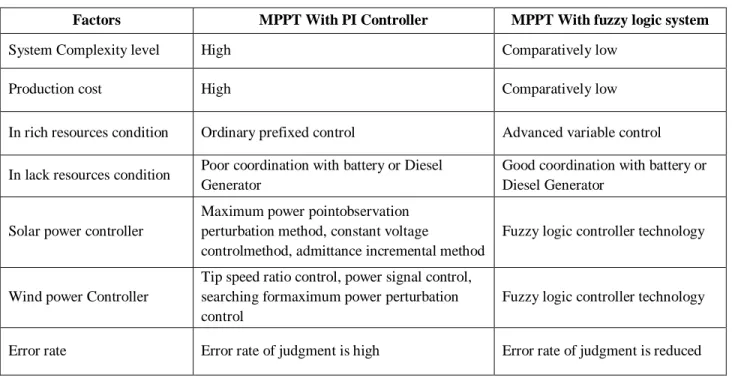
Table 1: Comparative Analysis
Factors MPPT With PI Controller MPPT With fuzzy logic system
System Complexity level High Comparatively low
Production cost High Comparatively low
In rich resources condition Ordinary prefixed control Advanced variable control
In lack resources condition Poor coordination with battery or Diesel Generator
Good coordination with battery or Diesel Generator
Solar power controller
Maximum power pointobservation perturbation method, constant voltage
controlmethod, admittance incremental method
Fuzzy logic controller technology
Wind power Controller
Tip speed ratio control, power signal control, searching formaximum power perturbation control
Fuzzy logic controller technology
Error rate Error rate of judgment is high Error rate of judgment is reduced
Table 1 shows the comparative analysis of MPPT with PI controller and with fuzzy logic system. From the analysis it is quite clear that in terms of various parameters i.e. system complexity level, production cost, solar power controller, wind power controller and error rate MPPT with fuzzy logic system comparatively better than the PI controller. Wind-solar hybrid generating system uses DC/DC converters which adjust the fan and the load matching impedance of the photovoltaic battery array mainly by changing the duty cycle of control signals, thus the output power is changed. In this paper, the basic principle of the variable step disturbance maximum power tracking control is: calculate battery’s average charging power P1 in a cycle by detecting the battery charging voltage and current when the whole power system is in the steady-state operation, the control signal duty cycle is d1. At this time a small disturbances which inevitability leads the output power change is added to control volume.
Current battery average power P2 is detected to compare with pre-disturbance power P1. If P2>P1, the direction of the imposed disturbance is indicated to be right, otherwise, the disturbance direction is opposite.
The next disturbance is provided according to the direction of the disturbance, and the determine perturbation step size is determined according to power change slope. The step length is gradually decreased when the maximum power point is nearby to avoid that the whole search process appears
big oscillations. Search repeatedly until the maximum power point of battery is found. Compared with the traditional disturbance observation, the improved variable step maximum power point tracking method can avoid moving the operating point when light intensity occurs rapid changes, thus the misjudgment of the system and disturbance loss are reduced [10].
When the wind speed is less than starting speed, the maximum power point which is obtained from the whole MPPT control can be regarded as a maximum power operation point of solar panel. When the light is insufficient, the output solar energy is very small, and the obtained maximum power point can be regarded as a maximum power point of wind power.
VII. CONCLUSION
The paper uses the fuzzy logic controller System within the MPPT control algorithm, which isused to search the total maximum power throughout thewind-solar hybrid generating system charging the battery. And the entire wind-solar hybrid
generating system model is set upon the
MATLAB/SIMULINK simulation platform. The simulation results validate that not only the control method can make full use of wind and solar energy resources, but also theoutput current of the whole system is more stable, the volatility is relatively small, and the impact on the battery is reduced.This
Volume 5, Issue 4, April 2016
1127 All Rights Reserved © 2016 IJSETR
control method can provide a reference for the wind-solarhybrid generating system to achieve grid.
REFERENCES
[1] Mohammad asif iqbal, Shivraj Sharma “Analysis and Comparison of Various Control Strategy of Hybrid Power Generation, A Review” IEEE conference iconce[C], kalyani, pp715-72, 2014.
[2] Mohammad asif iqbal, Shivraj Sharma “Multi-Fuzzy logic controller Model Of Hybrid Energy System Implementation”, IASIR, Vol.19, pp. 25-30.
[3] Jiang Chang, Shu-Yun Jia, Modeling And Application Of Wind-Solar Energy Hybrid Power Generation System Based On Multi-Fuzzy logic controller Technology, ICMLC[C],IEEE, pp 1054-1058, 2009.
[4] Xu Peng-wei, Liu Fei, Liu Bang-yin, Duan Shan-xu. Analysis, Comparison and Improvement of Several MPPT Methods for PV system. Power Electronics, 41(5):3-5, 2007.
[5] Wang Feng-shou, Shen Chuan-wen, Meng Yong-qing. Simulating Study of Wind Power System Using the PMSG Based on the MPPT Method [J].Electric Drive, 37(1):6-10, 2007.
[6] Wang Qunjing, Wang Tao, Li Guoli. Research on MPPT for Small-scale Hybrid Photovoltaic-wind System [J].Electric Drive. 39(5):40-43., 2009.
[7] Qi Zhi-yuan, Wang Sheng-tie, TianGui-zhen. Coordination Control of Wind/Pv Hybrid System [J]. Acta Energiae Solaris Sinica, 31(5):654-660, 2010. [8] K. Uhlen, B. A. Foss, and O. B. Gjosaeter, “Robust
control and analysis of a wind-diesel hybrid power plant,” IEEE Trans. Energy Conv., vol.9, no. 4, pp. 701– 708, Dec. 1994.
[9] F. Valenciaga, P. F. Puleston, R. J. Mantz, and P. E Battaiotto, “Anadaptive feedback linearization strategy for variable speed wind energy conversion systems,” Int. J. Energy Res., vol. 24, pp. 151–161, 2000.
[10] K. Tan and S. Islam, “Optimum control strategies in energy conversion of PMSG wind turbine system without mechanical sensors,” IEEE Trans. Energy Conv., vol. 19, no. 2, pp. 392–399, Jun. 2004.
[11] F. Valenciaga, P. F. Puleston, and P. E. Battaiotto “Variable structure system control design method base on a differential geometric approach: Application to a wind energy conversion subsystem,” IEEE Proc.—Control Theory Appl., vol. 151, pp. 6–12, 2004.
[12] M. Chinchilla, S. Arnaltes, and J. C. Burgos, “Control of permanent-magnet genrators applied to variable-speed wind energy systems connected to the grid,” IEEE Trans. Energy Conv., vol. 21, no. 1, pp.130–135, Mar. 2006.