COMMAND 23 MAY 2012 Incorporating Change 1, 2 April 2014 Certified Current 07 June 2016 Personnel FACULTY DEVELOPMENT AND MASTER INSTRUCTOR PROGRAMS COMPLIANCE WITH THIS PUBLICATION IS MANDATORY
ACCESSIBILITY: Publications and forms available on the e-Publishing website at www.e-Publishing.af.mil for downloading or ordering.
RELEASABILITY: There are no releasability restrictions on this publication.
OPR: HQ AETC/A3PV Supersedes: AETCI36-2202,
9 September 2009
Certified by: HQ AETC/A3P (Ms. Bonnie Molina) Pages: 69
This instruction implements AFPD 36-26, Total Force Development. It contains procedural guidance and responsibilities for planning, conducting, and documenting training for instructors and instructional support personnel assigned to basic military and technical training. Guidance applies to instructors who teach formal technical training courses, 737th Training Group (TRG) Readiness and Emergency Management instructors, and training support personnel who perform related instructional functions in Air Education and Training Command (AETC) organizations aligned under Air University (AU), Maxwell AFB AL and 2d Air Force (2 AF), Keesler AFB MS.
The 737 TRG Readiness and Emergency Management instructors will comply with this instruction, except CCAF requirements outlined in Section B, paragraph 21.5. and paragraph 22.2. The 737 TRG will comply with Section M for support personnel. Community College of the Air Force (CCAF) guidelines in this instruction apply to the 737 TRG Military Training Instructor School, a CCAF-affiliated school. This policy does not apply to military training instructors (MTI) teaching Basic Military Training (BMT).
The 937 TRG enlisted medical courses taught on the Medical Education and Training Campus (METC) at Joint Base San Antonio (JBSA) Fort Sam Houston TX will comply only with paragraph 14.2. The 937 TRG Air Force-only Medical Officer and Medical Readiness courses will comply with this instruction in its entirety. The 937 TRG will comply with Section L for instructors, instructor supervisors, and intermediate supervisors, and Section M for support personnel.
CCAF requirements outlined in Section B, paragraph 21.5, and paragraph 22.2 do not apply the Inter-American Air Forces Academy (IAAFA).
AU technical training consists of the chaplain assistant specialty courses.
Continuing accreditation of CCAF through AU by the Southern Association of Colleges and Schools, Commission on Colleges (SACSCOC), is the basis for certain requirements in this instruction. Additionally, Section L contains guidance on conducting master instructor programs for technical training personnel. References to training squadrons include geographically separated units (GSU). The term GSU includes detachments and operating locations.
This instruction applies to all the Air Force Reserve Command (AFRC) and Air National Guard personnel or units attached to AETC in support of technical training.
This instruction does not apply to other service instructors teaching service specific courses on Air Force installations unless specified by applicable memorandum of agreement.
Commanders responsible for implementing this instruction may supplement this instruction to establish specific implementing procedures. All 2 AF units will send waiver requests, recommended changes, and proposed supplements through their training group or wing and 2 AF with a courtesy copy to HQ AETC/A3PV. 2 AF will then forward inputs to HQ AETC/A3PV for final coordination on supplements and disposition of waivers by HQ AETC/A3P. Refer recommended changes to this publication to the Office of Primary Responsibility (OPR) using the AF Form 847, Recommendation for Change of Publication; route AF Forms 847 from the field through the numbered Air Force. Submit requests for waivers to any requirement stated in this instruction in accordance with guidance in AFI 33-360, Publications and Forms Management. Address waiver requests to HQ AETC/A3P. Waiver requests must identify the specific policy requirement to be waived and adverse impact on the mission caused by compliance with the policy requirements. Note: A waiver remains in effect until the approving official cancels it in writing, the publication is revised, or the waiver expires. When the publication is revised, the requester must renew the waiver.
Ensure that all records created as a result of processes prescribed in this publication are maintained in accordance with Air Force Manual (AFMAN) 33-363, Management of Records, and disposed of in accordance with Air Force Records Disposition Schedule (RDS) located in the Air Force Records Information Management System (AFRIMS). See Attachment 1 for a glossary of references and supporting information used in this publication.
SUMMARY OF CHANGES
This interim change updates applicability of this policy; deletes specific course training plan processing (processes moved to AETCI 36-2203)(paragraphs 4.3.2.5, 4.3.2.5.1-4.3.2.5.3, 4.3.2.6); deletes 2 AF faculty development functional manager responsibilities to review and approve course documents (responsibilities moved to AETCI 36-2203)(paragraph 5.3.4); adds specific criteria for retention of T-prefix (paragraph 10.3-10.5); clarifies responsibilities for award and removal of T-prefix (paragraph 11.2-11.3.2); deletes reference to BMT personnel (paragraph 15.2, 16.1); revised paragraphs 18-18.2 to remove reference to MTI; deletes reference
to BMT instructors (paragraph 20); removed reference to Instructor Assistant (paragraph 21.5.3.3); adds requirement for instructors to maintain high standards of conduct, integrity and professionalism (paragraph 21.6); adds guidance for removing instructors from duty pending investigation (paragraph 21.7); clarifies establishment of instructor records (paragraphs 22.1.1, 22.1.2); clarifies disposition of instructors deployed or assigned to extended TDY (22.1.3); deletes note referring to BMT personnel (paragraph 24); updates courses required prior to being assigned to a course development project (paragraph 24.4); clarifies training requirements for Military Working Dog (MWD) course trainers (paragraph 27); revises evaluation requirements for teaching internship (paragraph 30.4.1); revises Air Force doctrine requirements for teaching internship (paragraphs 30.5-30.5.2.3); revises initial teaching qualification process (paragraphs 34.3.2, 34.3.5, 34.3.6, 34.4); revises subsequent teaching qualification process (paragraphs 36.2-36.2.1.2, 36.3); redefines qualification date based on revised teaching qualification process (paragraph 37.2); deletes reference to qualification evaluation (paragraphs 44.1, 45.3); clarifies instructor evaluation schedule and schedule guidance (paragraphs 46-46.2.2); clarifies evaluation documentation for CCAF instructors (paragraph 47.1); clarified continuation training requirements for MWD trainers (paragraph 50.2); deletes BMT requirement (paragraph 48.5); deletes reference to BMT personnel (paragraph 50.3); Updates Section L title; clarifies purpose of master instructor program (paragraph 53); removes BMT instructors from master instructor program eligibility (paragraph 54.1); clarifies master instructor continuing education criteria (paragraph 55.3); clarifies applicability of other courses to master instructor program and approval authority (paragraph 55.3.6); deletes reference to BMT personnel (paragraph 55.4.2); deletes requirement for HQ AETC/A3PV to approve other courses (paragraph 57.2); updates references, forms, acronyms and terms in Attachment 1; and updates required and recommended courses in Attachment 3.
Section A—Faculty Development Units 6
1. Mission. ... 6
2. Teaching and Learning Technology Training. ... 6
3. Technical Training Management System (TTMS) Training. ... 6
4. Faculty Development Management. ... 6
5. Responsibilities: ... 10
Section B—Community College of the Air Force (CCAF) 12
6. CCAF Affiliation. ... 12
7. Designating CCAF Courses. ... 12
8. Student Transcript, Administration, and Record System – Faculty Database (STARS-FD). ... 12
9. Responsibilities: ... 12
Section C—Prefix T Positions 12
10. Purpose of Prefix T. ... 12
Section D—AETC Instructor Categories 14 12. First-Tour Instructor. ... 14 13. Returning Instructor. ... 14 14. Interservice Instructor. ... 14 15. Instructor Supervisor. ... 15 16. Intermediate Supervisor. ... 15 17. Reserve Instructor. ... 16
18. Readiness and Emergency Management Instructor. ... 16
19. Master Instructor. ... 16
20. Non-CCAF Instructor. ... 16
Section E—Instructor Requirements and Processing 16
21. Instructor Requirements: ... 16
22. Initial Instructor Processing: ... 18
Section F—Initial Instructor Training 22
23. Purpose. ... 22
24. Initial Training Requirements. ... 22
25. Additional Initial Training. ... 23
26. Responsibilities: ... 23
27. Instructor Training Course (ITC). ... 23
28. Date Assigned Instructor Duty (DAID). ... 24
Section G—Teaching Internship Program 24
29. Purpose. ... 24
30. Requirements: ... 24
31. Documentation: ... 26
32. Responsibilities: ... 27
Section H—Teaching Qualification (TQ) 27
33. Purpose. ... 28
34. Initial TQ Process. ... 28
35. Initial TQ Progress Review: ... 29
36. Subsequent TQ Process. ... 29
37. TQ Certification and Documentation: ... 30
39. Responsibilities: ... 31
Section I—Subject-Matter Proficiency Testing 31
40. Purpose. ... 31
41. Documentation: ... 32
42. Responsibilities: ... 32
Section J—Instructor Evaluations 32
43. Purpose. ... 32 44. Types of Evaluations: ... 33 45. Conducting Evaluations: ... 33 46. Evaluation Schedule: ... 34 47. Documentation: ... 34 48. Responsibilities: ... 34
Section K—Instructor Professional Development and Continuation Training 35
49. Professional Development. ... 35
50. Continuation Training. ... 35
51. Documentation: ... 36
52. Responsibilities: ... 36
Section L—Technical Training Master Instructor Program 36
53. Purpose. ... 37
54. Program Eligibility: ... 37
55. Program Criteria. ... 37
56. Program Management: ... 39
57. Responsibilities: ... 40
Section M—Support Personnel Requirements and Training 40
58. Support Personnel. ... 41
59. Training Needs Assessment: ... 41
60. Training Selection. ... 41
61. Initial Training ... 41
62. Professional Development and Continuation Training ... 41
63. Training Documentation. ... 42
64. Responsibilities: ... 42
65. Primary. ... 43
66. Other. ... 43
67. Geographically Separated Units (GSU). ... 43
68. Catalog of Available Faculty Training. ... 43
Attachment 1—GLOSSARY OF REFERENCES AND SUPPORTING INFORMATION 44
Attachment 2—MANAGEMENT RESPONSIBILITIES FOR FACULTY DEVELOPMENT 48
Attachment 3—REQUIRED AND RECOMMENDED TRAINING 49
Attachment 4—AETC FORM 10 INSTRUCTIONS 55
Attachment 5—AETC FORM 470 INSTRUCTIONS 57
Attachment 6—INSTRUCTOR EVALUATION GUIDE 58
Section A—Faculty Development Units
1. Mission. Faculty development units provide job preparation and continuation training related to specific job functions of personnel assigned to technical training schools. These personnel include instructors who teach training courses; support personnel who develop, manage, and evaluate training programs; and specific commanders in training organizations.
2. Teaching and Learning Technology Training. Faculty development units provide training that prepares and supports faculty in the use of instructional technology. Instructors are trained to integrate technology in and out of the classroom, while curriculum development managers are trained to be knowledgeable of technological advances in training delivery and to effectively apply the instructional systems development (ISD) process throughout the analysis, design, development, implementation, and evaluation of technology-based training.
3. Technical Training Management System (TTMS) Training. TTMS includes an integrated suite of software tools currently used for course analysis, design, development, documentation, evaluation, and student administration, as well as the hardware infrastructure used to support these software applications. Faculty assigned to technical training groups will receive standardized training on the system in order to comply with the utilization requirements of this technology found in AETCI 36-2203, Technical and Basic Military Training Development, and AETCI 36-2215, Technical and Basic Military Training Administration.
4. Faculty Development Management. A faculty development executive council (FDEC), a faculty development working group (FDWG), and a 2 AF faculty development functional manager (2 AF Fac D FM) provide management oversight of AETC faculty development. The FDEC and FDWG establish the structure and processes for the professional development of faculty and staff members in the technical training environment. Education and training needs are determined by the FDEC and FDWG in a forum comparable to a utilization and training workshop. The functional manager aligns the activities of the FDEC and FDWG with the AETC vision and 2 AF goals.
4.1. Faculty Development Executive Council (FDEC):
4.1.1. The FDEC provides management oversight and shapes the vision for educating and training AETC technical training faculty and staff members. The FDEC reviews and approves the recommendations of the FDWG. The FDEC will meet at least annually. The 2 AF Fac D FM will schedule the executive council meeting.
4.1.2. The FDEC consists of the 2 AF Fac D FM, the 381st Training Group (381 TRG) training director, and one training director from each training wing. The 2 AF Fac D FM and the training directors are the voting members of the FDEC. Note: Training wings with more than one training group will designate one training director to represent the wing as the voting member. The training pipeline manager (TPM) for faculty development courses, technical training policy administrator, and a faculty development flight chief representing each training wing and the 381 TRG attend as advisors.
4.1.2.1. The 2 AF Fac D FM chairs the FDEC, providing input to technical training faculty and staff development and training requirements.
4.1.2.2. The training directors serve as the functional representative for technical training faculty and staff, providing oversight and identifying specific development and training requirements.
4.2. Faculty Development Working Group (FDWG):
4.2.1. The FDWG provides the collective expertise required to ensure faculty and staff training is synchronized with the strategic vision and goals for future Air Force training. The FDWG reviews and analyzes feedback data, occupational surveys, and other inputs to identify training requirements for technical training faculty and staff.
4.2.2. The FDWG consists of the 2 AF Fac D FM, the TPM, technical training policy administrator, and the faculty development chief and subject-matter experts representing each training wing and the 381 TRG.
4.2.2.1. The 2 AF Fac D FM co-chairs the FDWG, providing input to technical training faculty and staff development and training requirements. The 2 AF Fac D FM also provides guidance for standardized course development projects.
4.2.2.2. The TPM co-chairs the FDWG and provides input on faculty and staff development resource and training requirements.
4.2.2.3. The faculty development chiefs provide input on technical training faculty and staff development and training functions. The faculty development chiefs also provide flight-level management of course development projects.
4.2.2.4. The technical training policy administrator and faculty development subject-matter experts serve as advisors to the FDWG.
4.2.3. The 2 AF Fac D FM and the faculty development chiefs are the voting members of the FDWG. The 2 AF Fac D FM has final decision authority over issues that cannot be resolved through collaboration and consensus.
4.2.4. FDWG process includes the following activities: 4.2.4.1. The FDWG will:
4.2.4.1.1. Meet with the FDEC at least annually and will convene ad hoc sessions as required in support of the technical training mission. The 2 AF Fac D FM will conduct, at a minimum, quarterly or teleconferences with the FDWG and others as necessary to address specific areas of concern and enhance communication and support between each faculty development unit.
4.2.4.1.2. Analyze validation summaries, course reviews, student feedback, feedback from instructor supervisors and training development chiefs, inspection reports, annual trend analysis reports, and other requirement inputs prior to the annual FDEC meeting. Results of this analysis will be used to determine if a revision to existing courses or new course development is warranted.
4.2.4.1.3. Assign a training wing or group prime center responsibility for specific standardized faculty development courses.
4.2.4.1.4. Review all standardized and nonstandardized courses.
4.2.4.1.5. Review the course training standard for standardized courses, along with the analysis results, and identify changes necessary to the courses.
4.2.4.1.6. Review standardized courses and identify candidates for conversion to distance learning delivery.
4.2.4.1.7. Review nonstandardized courses for applicability across AETC as standardized courses.
4.2.4.1.8. Identify training requirements needed to meet new educational theory and technological advances and determine the way ahead to meet these requirements.
4.2.4.2. Forward requests for new or revised faculty development training to the 2 AF Fac D FM and TPM for review and action as appropriate. The 2 AF Fac D FM and TPM may schedule the FDWG to meet either in person or through teleconference to address requests for new or revised training.
4.2.4.3. The TPM works to identify and secure resources needed to support new faculty development training requirements.
4.2.4.4. The 2 AF Fac D FM and TPM prepare comprehensive minutes of the FDWG meeting. The 2 AF Fac D FM prepares development taskings for standardized courses and distributes them to the prime and collateral faculty development units with a copy to the TPM.
4.3. Course Development Process for Standardized Faculty Development Courses: 4.3.1. General:
4.3.1.1. Standardized Faculty Development Courses. Standardized faculty and staff training should be generic in nature to facilitate cross utilization of instructor and quota resources. Information in these courses will be taken from applicable Air Force and AETC publications. Standardized faculty development courses are jointly designed and developed to fulfill the educational and performance needs of instructors, instructor supervisors, curriculum development managers, and other training support personnel across AETC as identified by the FDEC and FDWG.
These courses are developed in accordance with AETCI 36-2203 and specific instructions in this publication. This publication takes precedence when processes in this publication pertaining to standardized faculty development courses conflict with AETCI 36-2203.
4.3.1.2. Standardized Course Control Documents. Standardized course control documents for faculty development courses consist of the course training standard, course chart, plan of instruction (including major teaching steps), and measurement plan. The lesson plan part II (teaching guide) will be standardized to the major teaching steps.
4.3.2. Course Development Process:
4.3.2.1. The 2 AF Fac D FM issues the development tasking to the prime and collateral faculty development units based on the needs identified by the FDWG, validated by the FDEC, and documented in the working group/executive council minutes.
4.3.2.2. The prime faculty development unit is responsible for developing the standardized course control documents for the assigned courses. The prime unit works in collaboration with the collateral faculty development units for input, review, and coordination on all course documents. The 2 AF Fac D FM has the final decision authority over issues that cannot be resolved through collaboration and consensus. 4.3.2.3. The prime unit will develop and provide template documents for measurement items, lesson plan part II (below the major teaching steps), and student instructional materials, such as study guides, handouts, multimedia, and audiovisual aids for the assigned courses. Collateral units may modify these template documents to meet local needs. Modifications based on local supplement guidance should be identified as such.
4.3.2.4. The 2 AF Fac D FM will review and approve all standardized course training standards, course charts, plans of instruction, and measurement plans.
4.3.2.5. DELETED. 4.3.2.5.1. DELETED. 4.3.2.5.2. DELETED. 4.3.2.5.3. DELETED. 4.3.2.6. DELETED.
4.3.2.7. The prime faculty development unit will provide copies of the approved training plan and certification memorandum to all collateral faculty development units.
4.3.2.8. Faculty development units will post approved course control documents and course materials for standardized and nonstandardized courses. The 2 AF Fac D FM will provide detailed instructions on procedures for posting course control documents and course materials.
4.3.2.9. Faculty development units provide training management for assigned standardized courses and any nonstandard (locally developed) courses.
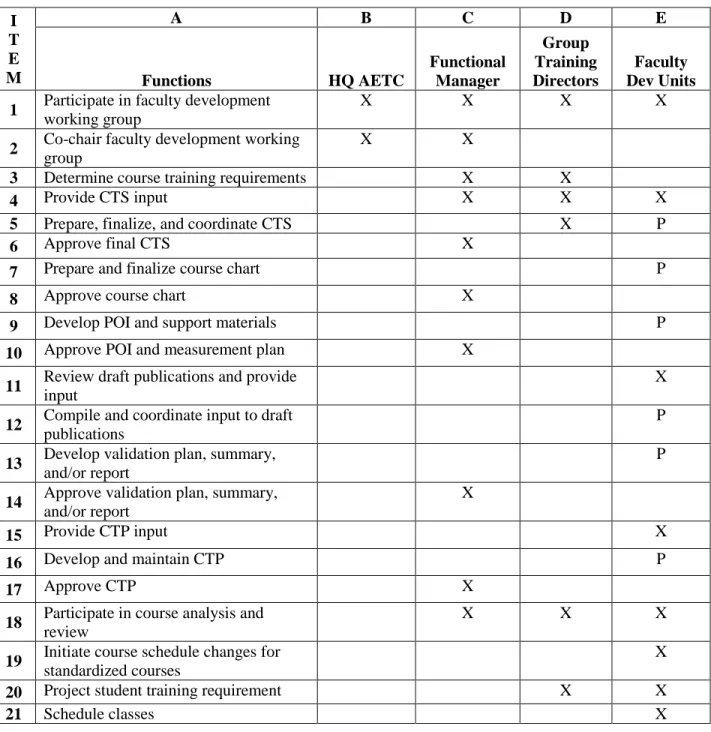
4.3.3. Functions and Responsibilities. Attachment 2 outlines the functions and responsibilities for HQ AETC, 2 AF Fac D FM, group training directors, and faculty development units within the course development process for standardized faculty development courses.
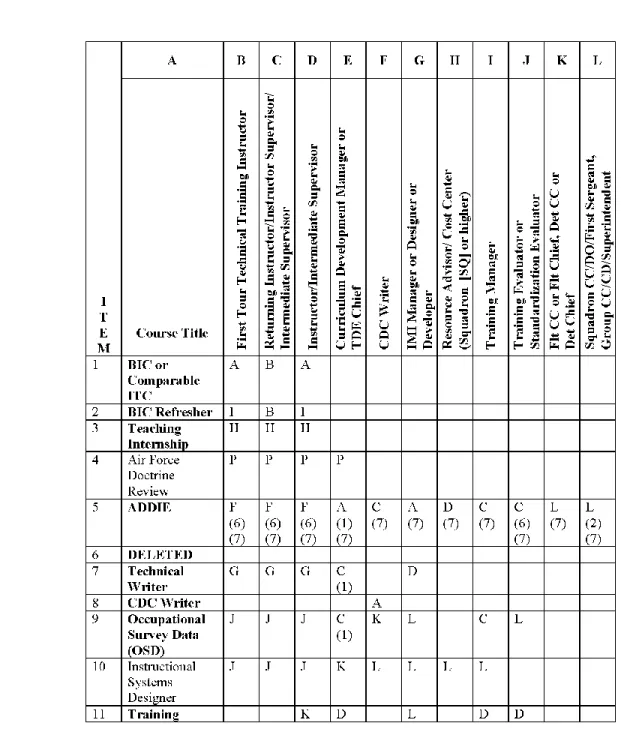
4.3.4. Required and Recommended Courses. Required and recommended faculty development courses are identified in Attachment 3, Table A3.1.
5. Responsibilities: 5.1. The TPM:
5.1.1. Serves as advisor to FDEC and as co-chair of the FDWG.
5.1.2. Provides input on faculty and staff development resource and training requirements.
5.2. The technical training policy administrator serves as an advisor to the FDEC and FDWG.
5.3. The 2 AF Fac D FM:
5.3.1. Serves as chair and voting member of the FDEC. 5.3.2. Serves as co-chair and voting member of the FDWG.
5.3.3. Provides input to technical training faculty and staff development and training requirements.
5.3.4. DELETED.
5.3.5. Provides recommendations to and coordinates on policies impacting faculty development training.
5.3.6. Provides detailed instructions on procedures for posting course control documents and course materials.
5.4. Training directors are voting members of the FDEC and serve as the functional representative for technical training faculty and staff, identifying specific development and training requirements.
5.5. Faculty development flight chiefs: 5.5.1. Serve as advisors to the FDEC.
5.5.2. Serve as voting members of the FDWG, providing input on technical training faculty and staff training functions and assisting in identifying training needs.
5.5.3. Provide flight-level management of course development projects. 5.6. Faculty development units:
5.6.1. Provide initial training courses to prepare new instructors and staff to perform initial duties.
5.6.2. Provide professional development and continuation training courses to enable instructors and training support staff to develop new skills to perform assigned tasks. 5.6.3. Provide standardized faculty development courses listed in Attachment 3, as assigned.
5.6.4. Ensure nonstandardized courses are made available to faculty and support staff across the command.
5.6.5. Train instructors to manage and be proficient in an interactive learning environment, including skills to transition between traditional and nontraditional methods of instruction. Training will include the use of teaching and learning technology available within the training groups, such as interactive video teletraining, interactive multimedia instruction (IMI), virtual reality technology, and webinar.
5.6.6. Provide faculty training on the use of TTMS or other approved learning content management system used in course design, development, documentation, evaluation, and student administration, as available.
5.6.7. Stay abreast of new technologies being incorporated into Air Force courses and identify training needs related to these new technologies for instructors, curriculum development managers, and other personnel in the group or wing.
5.6.8. Collaborate with the instructional technology unit to analyze new and existing faculty development courses, determine the most appropriate delivery mode, and stay abreast of the latest learning technologies available for use by instructors in the classroom; for example, interactive presentation systems, electronic podiums, electronic testing and analysis, advanced software applications, and digital overhead cameras. 5.6.9. Integrate teaching and learning technology into the Basic Instructor Course (BIC) and other professional development and continuation training courses, as applicable. 5.6.10. Develop and present courses by the most effective and cost-efficient means. 5.6.11. Maintain a copy of course control documents for all courses taught. Standardized course control documents posted in accordance with 2 AF procedures will be considered the record set for that course. Prime faculty development units are responsible for ensuring updates to standardized course control documents are distributed, as appropriate. 5.6.12. Provide course change requests to the prime and collateral faculty development units, as applicable. Prime faculty development units will coordinate comments and feedback on the change requests, make appropriate corrections to the affected course control documents and materials, and provide the corrected documents and materials to the collateral faculty development units for implementation.
5.6.13. Make course control documents and course materials for locally developed courses available for use by other training groups or wings.
Section B—Community College of the Air Force (CCAF)
6. CCAF Affiliation. The process of affiliation identifies and describes service schools and educational organizations within the CCAF system. Affiliated schools teach collegiate-level courses contributing to CCAF degree programs, and affiliation enables those schools to mutually share the benefits and responsibilities of the regional accreditation held by CCAF as part of AU. CCAF-affiliated AETC schools must adhere to all requirements outlined in this instruction and in the CCAF Campus Affiliations Policies, Procedures, and Guidelines (PPG), found at https://ccaf.maxwell.af.mil/nonpub/ccaf_pdf/dec/PPG.pdf (hereafter referred to as the CCAF PPG), to ensure the school maintains the quality standards for affiliation and supports the institutional integrity and accreditation of CCAF. The training group, or equivalent, within AETC technical training is synonymous with the term school as used in the PPG.
7. Designating CCAF Courses. CCAF is the OPR for identifying degree-applicable courses. Training managers within affiliated schools forward revised and modified course control documents (plan of instruction and course charts) to CCAF for evaluation.
8. Student Transcript, Administration, and Record System – Faculty Database (STARS-FD). STARS-FD is a CCAF web-based system providing “real-time” faculty documentation. AETC affiliated schools and candidate schools must use STARS-FD to record credentialing information for CCAF faculty. Refer to the CCAF PPG and STARS-FD user manual for more information on documenting each tab of the instructor record. The STARS-FD user manual is available online for viewing and downloading in the Toolbox section of STARS-FD.
9. Responsibilities:
9.1. Training groups or wing will:
9.1.1. Designate, in writing, in addition to the CCAF PPG-mandated affiliated school liaison (ASL), points of contact (POC) within the wing, groups, and/or squadrons to assist the ASL in managing CCAF program requirements.
9.1.1.1. The ASL will provide training to designated POC and instructor supervisors in the use of STARS-FD and the PPG. POC and instructor supervisors may attend the ASL workshop conducted by CCAF.
9.1.1.2. The POC will establish procedures to oversee faculty qualification documentation throughout their assigned training squadrons and/or flights. The POC must work through the group ASL to resolve issues with instructor documentation in STARS-FD.
9.2. Ensure each classroom or lab where a CCAF course is taught is identified as a CCAF classroom.
Section C—Prefix T Positions
10. Purpose of Prefix T. The Air Force specialty code (AFSC) prefix T identifies positions on manpower documents, as well as enlisted airmen and officers serving in, qualified to serve in, or receiving formal instructor training to qualify to serve in formal training instructor positions.
10.1. Do not place personnel in a prefix T position who do not meet the criteria in paragraph 10 or are not designated to receive instructor training and perform teaching duties as their primary function.
10.2. Prefix T should not be assigned to a non-instructor position for purposes of controlling the period of assignment in the job.
10.3. The following criteria may serve as the basis for removal of the T-prefix for AETC officer and enlisted instructors:
10.3.1. Any record of emotional instability, personality disorder, or other unresolved mental health problems that will interfere with performing formal training instructor duties.
10.3.2. Any record of substance abuse.
10.3.3. Any record of substantiated domestic violence or child abuse.
10.3.4. Any record of courts-martial, non-judicial punishment, or administrative action (Letter of Reprimand, Letter of Admonishment, Letter of Counseling, or Record of Individual Counseling) based on sexual assault, sexual harassment, trainee abuse, or unprofessional or inappropriate relationship as defined in AFI 36-2909, Professional and Unprofessional Relationships, and/or AETCI 36-2909, Recruiting, Education, and Training Standards of Conduct.
10.3.5. Any record of courts-martial, non-judicial punishment, or Letter of Reprimand for financial irresponsibility.
10.3.6. Any record of courts-martial, non-judicial punishment, or administrative action (Letter of Reprimand, Letter of Admonishment, Letter of Counseling, or Record of Individual Counseling) reflecting a lack of character or behavioral/emotional control. 10.3.7. Any conviction by general, special, or summary courts-martial.
10.3.8. Any conviction by a civilian court of Category 1, 2, or 3 offenses, or exceeding the accepted number of Category 4 offenses. Note: Category 3 and 4 traffic offenses alone are not disqualifying. Categories of offenses are described and listed in AFI 36-2002, Regular Air Force and Special Category Accessions, Attachment 3.
10.3.9. Having been permanently decertified from AETC formal instructor duties.
10.3.10. Failure to possess an AFSC and skill level commensurate with the instructor position assigned and/or successfully complete an instructor training course. Note: Military Working Dog (MWD) course trainers complete instructor training through OJT. 10.4. The personnel system does not permit carrying prefixes J and T concurrently. Personnel filling full-time instructor positions in specialized courses that are authorized parachute duty will use the prefix J. The criteria in paragraphs 10.3.1.-10.3.10 apply to instructors in these positions. Prefix J and T instructors will be afforded equal consideration for training necessary to perform instructor duties.
10.5. Refer to the Air Force Enlisted Classification Directory (AFECD) or Air Force Officer Classification Directory (AFOCD), located on the Air Force Personnel Center (AFPC) website, for additional information on prefix T.
10.6. For detailed information regarding the prefix T, refer to the Air Force Enlisted Classification Directory (AFECD) or Air Force Officer Classification Directory (AFOCD), as applicable, located on the Air Force Personnel Center (AFPC) website. Both documents are available at https://gum-crm.csd.disa.mil/app/home. (Enter “AFOCD” or “AFECD” in the Search box on the home page.)
11. Responsibilities:
11.1. Training groups or wing will ensure prefix T requirements are met and maintained. 11.2. Training squadron commanders ensure actions are taken to award or remove the prefix T, as appropriate.
11.3. Instructor supervisors or designated personnel will initiate AF IMT 2096, Classification/On-the-Job-Training Action, for award or removal of the prefix T. Process AF IMT 2096 according to current procedures.
11.3.1. Initiate AF IMT 2096 to remove the prefix T from the duty AFSC and control AFSC when instructors are no longer assigned to authorized prefix T positions. Examples include PCS or reassignment to a non-T prefix position within the same wing/group.
11.3.2. Follow procedures in AFI 36-2101, Classifying Military Personnel (Officer and Enlisted), to remove the prefix T from the duty AFSC, control AFSC, and awarded AFSC (P/2/3/4AFSC) when an instructor meets the criteria in paragraphs 10.3.1. through 10.3.10. and a command authority determines the instructor is permanently unsuitable for performance of instructor duty.
Section D—AETC Instructor Categories
12. First-Tour Instructor. First-tour instructors are assignees who do not have experience teaching courses in an AETC formal school setting. First-tour instructors assigned to technical training units will complete BIC. Military training instructors (MTI) will complete the Military Training Instructor course.
13. Returning Instructor. Returning instructors are assignees who have prior experience teaching courses in an AETC formal school setting and have completed an ITC taught by an Air Force organization or other service. Generally, this designation applies to military instructors who return to instructor duty after an interim assignment of 1 year or longer.
14. Interservice Instructor. An interservice instructor is an instructor who teaches consolidated training in an interservice training review organization (ITRO) course, Department of Defense (DoD) agency, or other multi-service school (i.e., Medical Education and Training Campus [METC]). These instructors may be Air Force or other service instructors.
14.1. Other service instructors teaching in an Air Force lead CCAF-degree applicable consolidated course will complete BIC or an equivalent ITC that meets CCAF requirements of 3 semester hours of CCAF-approved instructor methodology. Navy/Marine and Army instructor methodology courses will only be applied if they are recorded on the instructor’s Sailor/Marine American Council on Education Registry (SMART) or Army/American Council on Education Registry (AART) transcript. CCAF makes the final determination on the equivalency of ITCs other than BIC. Note: When sister service requirements drive an
instructor resource bill for BIC, the sister service can choose to re-validate their requirements or provide the instructor resource. Sister service instructor resource issues for BIC will be adjudicated with HQ AETC/A3T and HQ AETC/A3P.
14.2. When an Air Force interservice instructor teaches in a consolidated course managed by another service, DoD agency, or multi-service school (i.e., METC), guidance for training requirements, designation of the training provider, the instructor evaluation process, and other instructor requirements should be outlined in the memorandum of agreement (MOA). The instructor is trained and evaluated according to the managing service’s criteria or school MOA. Note: Air Force instructors teaching Air Force-service unique courses on the METC follow the METC MOA and applicable policies.
15. Instructor Supervisor. The instructor supervisor is a qualified instructor whose responsibilities are to perform instructor duties and to supervise and evaluate other instructors.
15.1. Technical training instructor supervisors must be qualified in a minimum of 80 hours of instruction in the course or courses they supervise and must maintain qualification and proficiency in the portion or portions of the course or courses they are qualified to teach. Hours may be in one course (for example, one 80 hour block or two 40 hour blocks within a single course) or a combination of hours from several courses (for example, one 40 hour course plus one 40 hour block in a different course). Supervisory duties must not preclude the instructor supervisor’s primary duty as an instructor. Note: Instructor supervisors in the 982 TRG and IAAFA are required to maintain qualification and proficiency in courses in their AFSC. They are not required to maintain qualification or proficiency in courses outside their AFSC.
15.2. DELETED.
15.3. On rare occasions, a person may be assigned to an instructor supervisor position without prior instructor experience. Under these circumstances, the instructor supervisor must meet all of the requirements of a first-tour instructor and cannot perform instructor evaluations while in student instructor status.
16. Intermediate Supervisor. The intermediate supervisor or equivalent is a qualified instructor whose responsibilities are to perform instructor duties and coordinate the efforts and activities of instructor supervisors when the squadron commander determines the span-of-control of the flight commander or chief is excessive and warrants the position.
16.1. One level above the instructor supervisor, but below the flight commander or chief, the intermediate supervisor position requires the same training and qualifications as the instructor supervisor.
16.2. Technical training intermediate supervisors must be qualified in a minimum of 80 hours of instruction in the course or courses they supervise and must maintain qualification and proficiency in the portion or portions of the course or courses they are qualified to teach. Hours may be in one course (for example, one 80 hour block or two 40 hour blocks within a single course) or a combination of hours from several courses (for example, one 40 hour course plus one 40 hour block in a different course). Supervisory duties must not preclude the intermediate supervisor’s primary duty as an instructor. Note: Intermediate supervisors in the 982 TRG and IAAFA are required to maintain qualification and proficiency in courses
in their AFSC. They are not required to maintain qualification or proficiency in courses outside their AFSC.
17. Reserve Instructor. Reserve instructors are members of an AFRC unit assigned to assist the training mission. Reserve instructors receive training necessary for their designated position. CCAF requirements will apply when reserve instructors are assigned to CCAF degree-applicable courses. Reserve instructors fall into two primary categories: individual reservist and unit-assigned reservist.
17.1. Individual reservist instructors are members of the individual ready reserve assigned or attached to AETC training squadrons to augment instructor manning during wartime mobilization.
17.2. Unit-assigned reservist instructors are members of AFRC units providing training within AETC training wings or groups.
18. Readiness and Emergency Management Instructor. Readiness and emergency management instructors are personnel with the 3E9X1 AFSC assigned to provide BMT trainees the fundamental skills to defend against chemical, biological, radiological, nuclear, and high-yield explosive (CBRNE) attacks. Readiness and emergency management instructors are designated as non-CCAF instructors. They are required to complete BIC or other approved ITC, a teaching internship, and complete teaching qualification. Although readiness and emergency management instructors are not required to obtain an academic degree, they are highly encouraged to do so.
18.1. DELETED. 18.2. DELETED.
19. Master Instructor. Master instructors are qualified instructors who have demonstrated sustained training delivery and professional growth above the minimum AETC training and performance requirements. Pursuit of master instructor status can begin immediately after completion of BIC or an approved ITC. Specific requirements for achieving master instructor status are outlined in Section L.
20. Non-CCAF Instructor. Non-CCAF instructors are instructors described in paragraphs 12-19 above assigned to teach a non-CCAF-credit awarding course. Officers who teach officer-only courses, BMT readiness and emergency management instructors, and IAAFA instructors (to include partner nation guest instructors) are examples of instructors in this category.
Section E—Instructor Requirements and Processing 21. Instructor Requirements:
21.1. Instructors teaching CCAF accredited courses must possess, as a minimum, an associate degree, preferably in the discipline (Air Force specialty), from a regionally or nationally accredited postsecondary institution. Note: For instructors teaching non-CCAF accredited courses, a degree is not mandatory, but is strongly encouraged.
21.2. If an instructor’s degree is not in the teaching discipline, his or her record must provide evidence of expertise applicable to the subject matter to be taught. This expertise will be demonstrated by documented qualifications and training in the subject matter taught, years of
work experience in the field, licensures and/or certifications, awards in the field, publications in the field, or any other information that demonstrates expertise in the teaching discipline. 21.3. DoD civilian and contract instructors teaching CCAF courses must possess, as a minimum, an associate degree and appropriate academic preparation or academic preparation combined with work experience prior to employment. Academic preparation and work experience must be relevant and applicable to the subject matter taught. Refer to the CCAF PPG for additional information.
21.4. Other Service Instructors. Other service (Army, Navy, Marine Corps, or Coast Guard) instructors assigned to teach CCAF courses at consolidated or collocated training locations must meet CCAF requirements. Other service instructors must complete BIC or an equivalent ITC that meets CCAF requirements, complete a teaching internship, and possess, as a minimum, an associate degree, preferably in the discipline, from a regionally or nationally accredited postsecondary institution.
21.4.1. GSUs with other service instructors assigned to teach CCAF courses who require BIC will contact their parent group’s faculty development unit to arrange training. The faculty development unit will coordinate the proper quota and funding for the other service instructor training in accordance with the applicable MOA.
21.4.2. Newly assigned, non-degreed, other service enlisted instructors will be counseled by the Education Services Center and enrolled in the degree program that allows for earliest degree completion.
21.5. Non-degreed CCAF Course Instructors:
21.5.1. Non-degreed military instructors assigned to teach CCAF degree-applicable courses must complete their associate degree as soon as possible within 12 months of the date assigned instructor duty (DAID). A degree completion contract will be initiated during initial instructor processing. Non-degreed CCAF instructors will have tuition, books, and fees (to include transcripts) paid for by AETC to complete an associate degree. Non-degreed military instructors may receive reimbursement for fees associated with foreign degree credentials evaluations.
21.5.2. Non-degreed other service instructors who teach CCAF degree-applicable courses are governed by the ITRO standard MOA requirements on degree completion. 21.5.3. Managing Non-degreed CCAF Course Instructors:
21.5.3.1. Instructor supervisors must closely monitor non-degreed instructors to ensure satisfactory progress toward and completion of an associate degree, and verify the degree is posted to their STARS-FD record within 12 months of the DAID. If a non-degreed instructor does not complete all CCAF instructor qualifications (including an associate degree or approved exceptional qualifications in lieu of degree [EQILD] status) within 12 months of the DAID, the instructor is no longer authorized to teach CCAF courses. Refer to the CCAF PPG for more information on EQILD. 21.5.3.2. Instructor supervisors will review the degree status of all non-degreed instructors no later than the beginning of the 10th month following the DAID. If the non-degreed instructor will not complete his or her degree requirements within 12
months of the DAID, refer the instructor to the school commander for appropriate action.
21.5.3.3. If the instructor is unable to complete his or her degree within the required timeframe, the school commander must: (1) recommend the instructor for EQILD status according to CCAF PPG or (2) remove the instructor from instructor duties in CCAF degree-applicable courses.
21.5.3.4. Instructor supervisors must notify the group ASL, who will notify the CCAF affiliated school manager (ASM), when a non-degreed instructor fails to meet all CCAF instructor qualification requirements.
21.5.3.5. Training groups or wing will ensure supervisors address progress toward degree completion during performance feedback sessions and mentoring programs with non-degreed instructors.
21.6. Instructors teaching technical training courses must maintain high standards of conduct, integrity, and professionalism as prescribed in AFPD 1, Air Force Culture, AFPD 36-29, Military Standards, AFI 1-1, Air Force Standards, AFI 36-2909, Professional and Unprofessional Relationships, and AETCI 36-2909, Recruiting, Education, and Training Standards of Conduct. Failure to maintain these standards may result in removal from instructor duty and administration of appropriate disciplinary action.
21.7. Instructors facing allegations of violating the standards of conduct, integrity, and professionalism prescribed in AFPD 1, AFPD 29, AFI 1-1, AFI 2909, and AETCI 36-2909 will be removed from instructor duty and interaction with students pending investigation. Upon completion of the investigation, the commander will determine if the instructor may return to or be removed from duty.
22. Initial Instructor Processing: 22.1. Instructor Record:
22.1.1. Qualification records are required for all military, civilian, and contract instructors teaching AETC technical training courses. The instructor supervisor will maintain instructor records for all assigned instructors.
22.1.2. Establish an instructor record for all newly assigned instructors within 5 duty days of arrival at the school. The date the instructor record is established is considered the Date Assigned School (DAS).
22.1.2.1. If the instructor will teach a CCAF credit-awarding course, establish the instructor record in STARS-FD. Refer to STARS-FD user manual for information on establishing a new instructor record.
22.1.2.2. If the instructor will teach a non-CCAF credit-awarding course, establish the instructor record in STARS-FD or use AETC Form 10, Instructor Training/Proficiency Record, according to local procedures.
22.1.2.3. Do not establish an instructor record for guest lecturers, subject-matter experts, or speakers of opportunity.
22.1.3. Document assigned courses, subject-matter proficiency testing or verification, instructor evaluations, training courses attended, development projects, awards,
licensures, and certifications in the instructor record. Maintain the instructor record for the duration of assignment to instructor duty. For instructors deployed or on extended TDY, refer to the CCAF PPG for additional guidance. Note: Instructor records must be removed from the STARS-FD within 5 duty days of the instructor’s removal from instructor duty due to permanent change of station or permanent change of assignment to a non-T prefix position.
22.1.4. Responsibilities:
22.1.4.1. Training groups or wing will:
22.1.4.1.1. Ensure procedures are in place to properly initiate and maintain STARS-FD instructor records and supporting documents.
22.1.4.1.2. Ensure proper disposition of supporting documents maintained in STARS-FD instructor records.
22.1.4.1.3. Establish procedures for maintaining instructor records for non-CCAF instructors. Documentation may be maintained in STARS-FD or on AETC Form 10, AETC Form 470, Teaching Internship Log, and AETC Form 281, Instructor Evaluation Checklist, as applicable. AETC Form 10, AETC Form 470, and AETC Forms 281 may be maintained in either electronic or hard copy format. Note: Training groups or wing must be a CCAF affiliated school to use STARS-FD to maintain faculty documentation for non-CCAF instructors. Non-affiliated schools will not use STARS-FD to maintain faculty documentation.
22.1.4.1.4. Establish procedures for disposition of documents that cover reassignment of personnel and routine purging of records according to Air Force RDS if not maintained in STARS-FD.
22.1.4.2. Instructor supervisors will:
22.1.4.2.1. Ensure AETC Form 10, AETC Form 470, and AETC Form 281 are properly initiated and maintained, as applicable. See Attachment 4 for instructions on completing the AETC Form 10. See Attachment 5 for instructions on completing the AETC Form 470. See Attachment 6 for instructions on completing the AETC Form 281.
22.1.4.2.2. Ensure proper disposition of documents.
22.1.4.2.3. Assume responsibility for the security of an instructor’s personal information within the instructor records.
22.2. CCAF Specific Processing Requirements:
22.2.1. Supervisors will ensure instructors assigned to teach CCAF credit awarding courses receive an overview of CCAF program requirements during initial instructor orientation. Supervisors will ensure the instructor assignee has access to, has read, and understands:
22.2.1.2. The Air University Faculty Handbook policies to include academic freedom, nonattribution, academic integrity, and academic honor code. The faculty handbook is available at http://www.au.af.mil/au/catalogs.asp.
22.2.1.3. Supervisors will ensure instructors complete a memorandum confirming the instructor has access to, has read, and fully understands the CCAF PPG and faculty handbook policies. The memorandum must include the instructor’s signature and the date he or she received the initial briefing and documents. Use the sample confirmation memorandum provided in the STARS-FD Toolbox. Local modifications to the sample memorandum must be approved by CCAF prior to use. Upload the signed memorandum to the Documents tab of the STARS-FD instructor record within 30 calendar days of DAS.
22.2.2. Degree Completion Contract. Supervisors will initiate a degree completion contract on all non-degreed military instructors during initial instructor orientation and direct the instructor to the Education Services Center for education counseling (see paragraph 22.2.3.) within 30 calendar days of DAS.
22.2.2.1. Use the degree completion contract in STARS-FD. This contract pulls degree status information from the instructor’s CCAF STARS student record, providing a “real time” degree status for the instructor. A sample of the STARS-FD degree completion contract can be found in the STARS-FD user manual.
22.2.2.2. The degree completion contract must include the college courses, College-Level Examination Program (CLEP) and/or Defense Activity for Nontraditional Education Support (DANTES) tests, and any other exams required for the completion of the instructor’s CCAF associate degree or other applicable associate degree program. The Education Services Center counselor will identify these requirements on the contract during the education counseling process.
22.2.2.3. The non-degreed instructor, the supervisor, and the squadron commander will complete and sign the degree completion contract within 30 calendar days of the instructor’s assignment to the affiliated school.
22.2.2.4. Supervisors will monitor non-degreed instructors’ degree progress and completion. Address degree progress and completion as part of the Air Force mentoring process.
22.2.2.5. The degree completion contract is a living document and must be updated as courses/tests are completed to accurately reflect requirements remaining for degree completion. The instructor supervisor may make minor changes or updates to the contract provided the degree completion date is not changed. The instructor supervisor and other identified personnel must review and approve changes if the degree completion date is changed.
22.2.2.6. Upload the signed degree completion contract to the Documents tab of the STARS-FD instructor record. Retain and update, as necessary, until verification of the instructor’s awarded degree is made in STARS-FD. The instructor’s degree should be completed and posted to CCAF STARS within 12 months after the DAID. Delete the degree completion contract upon verification of the awarded degree.
22.2.3. Education Counseling. Non-degreed military instructors must receive degree completion counseling from the Education Services Center within 30 calendar days of DAS.
22.2.3.1. During education counseling, the instructor will schedule the CLEP or DANTES subject standardized tests, as well as any other exams for college credit, applicable to the degree program. Completion of all applicable general and subject exams is recommended within 60 calendar days of the instructor’s arrival at the affiliated school.
22.2.3.2. Non-degreed instructors will complete all exams recommended by the Education Services Center before taking any alternate exams.
22.2.3.3. Sponsors will encourage individuals identified for instructor duty to obtain education counseling from the Education Services Center prior to departing their losing base to develop a degree completion plan and to start CLEP/DANTES and other tests as determined by the education counselor.
22.3. Training Needs Assessment. Supervisors will complete a training needs assessment for all instructors, instructor supervisors, and intermediate supervisors. The training needs assessment will be completed during the initial instructor orientation for newly assigned instructors and supervisors. For first-tour instructors and supervisors, focus on formal training and education needs for the assigned position. For returning instructors and supervisors, also include an instructional skills assessment as part of the training needs assessment. Note: The training needs assessment is a living document. Supervisors will update the training needs assessment as training is completed. Re-assess training needs as the scope of responsibilities change, duties are re-aligned, or training requirements change.
22.3.1. The supervisor plans formal training by assessing the required and recommended training courses that instructor, instructor supervisor, and intermediate supervisor assignees in specific positions need to successfully perform their duties unassisted. Required and recommended training is outlined in Attachment 3.
22.3.2. Supervisors compare previous military and nonmilitary training, and previous education to the instructor or supervisor’s current job requirements. This process identifies formal training needed to be an instructor or supervisor, to include specific position requirements for instructors, instructor supervisors, and intermediate supervisors who teach courses that apply toward a CCAF degree.
22.3.3. Instructional Skills Assessment:
22.3.3.1. Supervisors will assess returning instructor’s presentation delivery, academic counseling, and other skills required for the current instructor job. The supervisor will use the assessment to determine the level of instructor refresher training necessary. The supervisor will document his or her assessment and training decision as part of the training needs assessment and file according to local procedures.
22.3.3.1.1. If the period of separation from instructor duty is less than 1 year and the supervisor determines the instructor’s skills are still satisfactory, the instructor does not need to complete refresher training.
22.3.3.1.2. If the period of separation from instructor duty is less than 1 year and refresher training is determined to be necessary, the supervisor will schedule the returning instructor for either an instructor refresher course or a comprehensive ITC course, as applicable.
22.3.3.1.3. If the period of separation from instructor duty is more than 1 year, and the supervisor determines the instructor’s skills are still satisfactory, the instructor does not need to complete a comprehensive ITC. Instead, the supervisor will schedule the instructor to complete an instructor refresher course. 22.3.3.1.4. If the period of separation is more than 1 year and the supervisor determines the instructor’s skills are not satisfactory, the supervisor will schedule the instructor to complete a comprehensive ITC course.
22.3.3.2. Assess returning instructors who have previously completed a teaching internship and have at least an associate degree to determine if, for refresher purposes, repeating the requirements of the teaching internship program would be beneficial.
22.3.4. Training Selection. Supervisors explore and select training resources that most effectively address training needs within the required timeframe. HQ AETC/A3PV must approve training selected outside of that offered by faculty development units, and the training must enable the assignee to work independently and stay current in the duties of the assigned position.
22.3.5. Documentation. Document the training needs assessment for instructors, instructor supervisors, and intermediate supervisors according to local procedures.
Section F—Initial Instructor Training
23. Purpose. Initial instructor training provides the framework for instructor assignees to gain the knowledge and skills needed to become increasingly independent in performing the duties of the instructor position. The training focuses on developing skills that will enable instructor assignees to deliver classroom, laboratory, dormitory, or drill instruction.
24. Initial Training Requirements. Initial training consists of required courses necessary to prepare instructors and instructor supervisors to perform their assigned duties without assistance.
24.1. Initial training for instructors consists of completing the ITC and teaching internship. These formal courses prepare new instructors for initial teaching duties. Initial training also includes teaching qualification in the assigned block or blocks of a course. In addition, training on motivational training procedures will be provided, if applicable. First-tour instructors must be scheduled for their ITC as soon as possible following the instructor’s DAS.
24.2. Initial training for returning instructors consists of completing the ITC or an instructor refresher course and the teaching internship per paragraphs 22.3.3. – 22.3.3.2. The specific training required is determined during the training needs assessment. Initial training also includes teaching qualification in the assigned block or blocks of a course. In addition, training on motivational training procedures will be provided, if applicable.
24.3. Individuals assigned as instructor supervisors or intermediate supervisors must complete the Training Supervisor course as part of their initial training prior to performing supervisory duties in the position in addition to the requirements in paragraphs 24.1. or 24.2., as applicable.
24.4. Instructors, instructor supervisors, and intermediate supervisors assigned as subject-matter experts to course development projects must also complete Analysis, Design, Development, Implementation, and Evaluation (ADDIE) and Technical Writer courses prior to being assigned to the course development project.
24.5. Instructors and instructor supervisors assigned to administer, teach, develop, manage, or evaluate Type 6 Distance Learning courses must complete the applicable E-Learning training modules specified in Attachment 3 as part of initial training.
25. Additional Initial Training. Initial training may be supplemented by web-based Standardized Training and Resources Suite and E-Learning training modules available through the Advanced Distributed Learning Service (ADLS). Supplements to this instruction may identify additional initial training necessary to fulfill local job knowledge and skill requirements for instructors and instructor supervisors. Additional training may be sought by supervisors in order to meet unique training requirements.
26. Responsibilities:
26.1. Training groups or wing will ensure initial training courses are available and initial training requirements are met.
26.2. Training squadrons ensure first-tour and returning instructors are scheduled for ITC as soon as possible following the instructor’s DAS.
26.3. Supervisors will:
26.3.1. Schedule personnel for initial training.
26.3.2. Monitor instructor’s training progress and document status of accomplishments. 27. Instructor Training Course (ITC). New instructor assignees (CCAF and non-CCAF) require a comprehensive ITC that contains fundamental instructor competencies to include, but not limited to: teaching methodologies, questioning techniques, and academic counseling. Returning instructors require either a comprehensive ITC or an instructor refresher course based on the supervisor’s instructional skills assessment. Note: Military Working Dog (MWD) course trainers complete instructor training through OJT and are not required to complete a comprehensive ITC.
27.1. The following courses meet the ITC requirements: the BIC taught within the faculty development units at Goodfellow AFB TX, Keesler AFB MS, Lackland AFB TX, Sheppard AFB TX, and Vandenberg AFB CA; the MTI course at Lackland AFB; the IAAFA basic instructor course (applies to IAAFA only), and professional military education (PME) instructor courses. These courses include other Air Force topics required for instructors, such as core values, professional relationships, sexual assault and prevention, hazing, and motivational training procedures (if applicable). Note: Refer to paragraph 14 for guidance on interservice instructor training.
27.2. Submit a waiver request to HQ AETC/A3PV if a needs assessment determines a new assignee’s previous education, training, and/or experience may justify a waiver of the requirement to complete an ITC. Approval authority will be HQ AETC/A3PV (non-CCAF instructors only) or HQ AETC/A3PV and CCAF/DEC (CCAF instructors), as applicable. An example would be an instructor with a teaching degree, training experience outside of AETC, and/or extensive experience in speaking and briefing.
27.3. Submit requests to HQ AETC/A3PV for use of alternative ITC. Approval authority will be HQ AETC/A3PV (non-CCAF instructors only) or HQ AETC/A3PV and CCAF/DEC (CCAF instructors), as applicable.
28. Date Assigned Instructor Duty (DAID). Instructors are assigned to instructor duties upon completion of an approved ITC. The earliest date an instructor can be assigned to instructor duties is the next duty day following completion of an approved ITC. The latest date is no later than 6 months after completion of an approved ITC. An instructor cannot teach, administer tests, or perform student counseling prior to establishing a DAID.
28.1. Instructor supervisors determine the DAID based on the availability of classes necessary for teaching qualification.
28.2. For returning instructors, if refresher training is necessary, the instructor’s DAID will be established after completion of the refresher training.
Section G—Teaching Internship Program
29. Purpose. The teaching internship program is an experiential program designed to give new instructors practical teaching experience and classroom management skills under the supervision of a qualified instructor/trainer or instructor supervisor. Participants exercise their newly acquired instructor skills and gain practical experience in classroom and/or laboratory instruction, lesson plan preparation, multimedia audiovisual aids preparation and use, test administration, and academic counseling.
29.1. A teaching internship is required for all instructors except when Air Force instructors are teaching at interservice schools hosted by another service.
29.2. Enter newly assigned instructors who have not taught in Air Force basic military or technical training in the internship on their DAID.
29.3. Returning instructors who have not completed the teaching internship in their prior assignment will be entered on their DAID.
29.4. When used as refresher training, instructors will not be formally entered in the teaching internship program. Supervisors may use the AETC Form 470 to track progress in the refresher training.
29.5. Minimum period for the internship is 3 months from the DAID. Maximum period is 12 months from the DAID.
30. Requirements:
30.1. A minimum of 180 hours instructor-related experience is required to satisfy internship program requirements. During this period, instructors receive close supervision and frequent evaluations. Teaching internship requirements are divided into the following areas:
30.1.1. Supervised teaching. The instructor must complete 120 contact hours of supervised teaching in an actual classroom and/or laboratory setting with students.
30.1.1.1. The instructor must complete an ITC and teaching qualification before supervised teaching hours can be logged for internship credit. See Section H for guidance on teaching qualification.
30.1.1.2. The instructor/trainer or instructor supervisor will monitor the instructor the first time the instructor teaches each new lesson, including the administration of exams and critiques, when applicable, in any block of the assigned course. Note: This requirement may be met during the teaching qualification process. Thereafter, the instructor supervisor or instructor/trainer will periodically sit in the instructor’s class and provide feedback on the instructor’s performance for the duration of the internship.
30.1.2. Curriculum/lesson plan development and preparation. The instructor must complete 30 hours of lesson plan preparation. Lesson plan preparation includes, but is not limited to, familiarization with course control documents, multimedia development and use, subject-matter research, and instruction planning. Instructors will personalize their lesson plan, as applicable, as part of teaching qualification (refer to paragraph 34.3.3.).
30.1.3. Teaching qualifications. The instructor must complete 30 hours of teaching qualifications experience in the following areas: test administration and review, academic counseling of students, instructor performance feedback, and instructor subject-matter proficiency testing. Instructors must complete 1 or more hours in each of the topic areas. Note: This requirement may be met during the teaching qualification process.
30.1.3.1. Test administration and review training consists of the entire test administration process. The instructor must receive familiarization training on test construction, correlation of tests with their associated course control documents, pre-test briefings, pre-test administration procedures, post-pre-test procedures, pre-test control and security, test analysis, and effective use of student critiques prior to administering a test to any student.
30.1.3.2. Academic counseling of students consists of formal and/or informal student counseling. Training will include the familiarization of approaches to counseling, mandatory academic counseling for failure of course objectives, proper documentation, and follow-up actions.
30.1.3.3. Instructor performance feedback consists of formal feedback provided by the instructor supervisor and documented on the AETC Form 281. Performance feedback is part of the teaching qualification and formal evaluation processes.
30.1.3.4. Instructor subject-matter proficiency testing assesses the instructor’s knowledge of the subject material and includes the successful completion of all formal measurements for the block or blocks of the course the instructor will be qualified to teach. These measurements consist of, but are not limited to, block tests, progress checks, end-of-course tests, and computer-based tests. Instructors will complete subject-matter proficiency testing as part of teaching qualification (refer to paragraph 34.3.4.).