UC Santa Barbara
UC Santa Barbara Electronic Theses and Dissertations
Title
Modeling Eye Tracking Data with Application to Object Detection
Permalink
https://escholarship.org/uc/item/556687hq
Author
Shanmuga Vadivel, Karthikeyan
Publication Date
2014
UNIVERSITY of CALIFORNIA Santa Barbara
Modeling Eye Tracking Data with Application to Object
Detection
A dissertation submitted in partial satisfaction of the requirements for the degree
Doctor of Philosophy in
Electrical and Computer Engineering by
Karthikeyan Shanmuga Vadivel
Committee in charge:
Professor B. S. Manjunath, Chair
Professor Kenneth Rose Professor Miguel Eckstein
Professor Shivkumar Chandrasekaran Professor Scott Grafton
The dissertation of Karthikeyan Shanmuga Vadivel is approved.
Professor Kenneth Rose
Professor Miguel Eckstein
Professor Shivkumar Chandrasekaran
Professor Scott Grafton
Professor B. S. Manjunath, Committee Chair
Modeling Eye Tracking Data with Application to Object Detection
Copyright c2014
by
To Amma, Appa, Keerthana and Renuka
Acknowledgements
The last six years at UC Santa Barbara have been among the most exciting phases of my life. I got the chance to make several life long friends and travel to new places, and met my wife.
First, I would like to thank Prof. Manjunath for giving me the opportunity to work in his lab during the last five years. I have been lucky to work on several interesting projects in a variety of fields related to computer vision and pattern recognition and it was his vision which enabled me to work on thought provoking problems. He has always been a pillar of support and his patience and positive outlook were vital in getting through challenging times during the journey. Though he has a busy schedule, he has always been very approachable. He has had tremendous impact in shaping my research outlook and the way I approach new problems.
Next, I want to thank my lab-mates, several of them have contributed directly or indirectly to this thesis. Eye tracking features prominently in this thesis and there was considerable groundwork laid by other lab-mates which I benefited from. The eye tracker was purchased as a part of the camera network project and I want to acknowl-edge Office of Naval Research (ONR) grant which made it possible and the effort put in by the group to set up this infrastructure. The eye tracker was initially used by students who did an internship in summer in Vision Research Lab and their mentors especially Carlos Torres who helped me set up the eye tracker. Further, our research proposal
primarily contributed by Dr. Carter De Leo, Prof. Manjunath and Prof. Grafton was funded by Institute for Collaborative Biotechnologies (ICB) which laid the foundation for me to work on eye tracking enhanced computer vision, a relatively unexplored re-search area.
In the research projects related to my thesis, several lab-mates actively collaborated in the formulation and experimental analysis of the ideas. I want to thank Dr. Vignesh Jagadeesh for the invaluable discussions which significantly contributed to this thesis. I especially want to thank Thuyen Ngo for his collaboration in my final project. He is very dedicated and efficient and was of great help in the experimental design and obtaining publishable results. I am looking forward to working more with him in the future during my stay at UC Santa Barbara as a post-doctoral researcher. I also want to thank Renuka who has been very involved in brainstorming new ideas, performing experiments and reviewing my articles.
I have been fortunate enough to work on a plethora of problems beyond my thesis during my PhD at UC Santa Barbara. During my first two years, I worked on different problems related to subspace analysis. I closely collaborated with Dr. Swapna Joshi and Prof. Grafton during this time. Dr. Swapna Joshi is a great mentor and friend and she greatly helped me transition from a student to a researcher. We have discussed countless ideas during her PhD at UCSB and she greatly helped me develop technical writing skills and research maturity. I have also collaborated with lab-mates on several
projects. I would like to thank Dr. Diana Delibaltov, Dr. Emre Sargin, Dr. Aruna Jammalamadaka, Dr. Santhoshkumar Sunderrajan, Dr. Thomas Kuo, Utkarsh Gaur and Lakshmanan Nataraj who I directly collaborated in projects with and obtained co-authored publications. I also want to thank Dr. Anindya Sarkar, Dr. Pratim Ghosh, Dr. Luca Bertelli, Dr. Jiejun Xu and Dr. Zefeng Ni for their critical inputs to my projects during my PhD. Additonally I have had several interesting technical discussions with Archith John Bency, Amir Mohaymen, Dmitry Fedorov, Chris Wheat, Niloufar Pourian which gave exposure to new ideas and techniques.
Additionally I want to thank my summer internship mentors - Dr. Felix Fernandes, Dr. Ankur Saxena, Dr. Zhan Ma and Dr. PoLin Lai at Samsung Telecommunica-tions America and Dr. Jiyun Byun and Dr. Ken Sullivan at Mayachitra Inc. - for the opportunity to work on exciting projects. I also want to thank my summer in-terns Michael Stephens and Taylor Sanchez, who helped implement critical parts of my research projects. I want to thank my dissertation committee members Prof. Scott Grafton, Prof. Kenneth Rose, Prof. Miguel Eckstein and Prof. Shiv Chandrasekaran for their support and brainstorming sessions which significantly contributed to this thesis.
Finally, I want to acknowledge the research grants that supported this work: W911NF-09-0001 from the U.S. Army Research Office, N00014-12-1-0503, NSF III-0808772 and OIA-0941717.
Curriculum Vitæ
Karthikeyan Shanmuga Vadivel
September 2014 Doctor of Philosophy
Department of Electrical and Computer Engineering University of California, Santa Barbara
December 2009 Master of Science
Department of Electrical and Computer Engineering University of California, Santa Barbara
July 2008 Bachelor of Technology
Department of Electrical Engineering
Indian Institute of Technology Madras, India
Field of Study
Computer Vision, Pattern Recognition and Image Processing
Experience
2008-2014 Research/Teaching Assistant
University of California, Santa Barbara 2013 Research Intern
Mayachitra Inc., Santa Barbara, CA 2011 Research Intern
Samsung Research Lab, Richardson, TX
Publications
S. Karthikeyan, Vignesh Jagadeesh, Renuka Shenoy, Miguel Eck-stein, B.S. Manjunath : From Where and How to What We See, ICCV 2013
S. Karthikeyan, Vignesh Jagadeesh, B.S. Manjunath : Learn-ing bottom up text attention maps for text detection usLearn-ing stroke width transform, ICIP 2013
S. Karthikeyan, Vignesh Jagadeesh, B.S. Manjunath : Learning top down scene context for visual attention modeling in natural images, ICIP 2013
Santhoshkumar Sunderrajan S. Karthikeyan and B.S. Manjunath: Robust Multiple Object Tracking by Detection with interacting Markov Chain Monte Carlo, ICIP 2013
Diana Delibaltov, S. Karthikeyan., Vignesh Jagadeesh, B.S. Man-junath, Robust Biological Image Sequences Analysis using Graph based Approaches, Asilomar Conference on Biological Image Analysis and Microscopy 2012.
S. Karthikeyan, Diana Delibaltov, Utkarsh Gaur, Mei Jiang, David Williams B.S. Manjunath: Unified Probabilistic framework for simultaneous detection and tracking with application to bioim-age sequences, ICIP 2012
S. Karthikeyan, Swapna Joshi B.S. Manjunath Scott Grafton: Intra-class Multi output Regression based subspace analysis ICIP 2012
S. Karthikeyan, Felix Fernandes, Zhan Ma, PoLin Lai, Ankur Saxena: Perceptual similarity based robust low-complexity video fingerprinting ICIP 2012
S. Karthikeyan, Mehmet Emre Sargin, Swapna Joshi, B.S. Man-junath, Scott Grafton: Generalized Subspace based High dimen-sional Density estimation, ICIP 2011
S. Karthikeyan, Utkarsh Gaur, B.S. Manjunath and Scott Grafton: Probabilistic subspace based learning of shape dynamics modes for multi-view action recognition, ICCV Workshop 2013
Lakshmanan Nataraj, S. Karthikeyan, Gregoire Jacob, B.S. Man-junath: Malware Images : Visualization and Automatic Classifi-cation, VizSec 2011
E. Alegre, M.T. Garcia-Ordas, V. Gonzalez-Castro, S. Karthikeyan-Vitality assessment of boar sperm using N Concentric Squares Resized (NCSR) texture descriptor in digital images, IBPRIA 2011
Swapna Joshi, S. Karthikeyan, B.S. Manjunath, Scott Grafton, and Kent Kiehl: Anatomical Parts-Based Regression Using Non-Negative Matrix Factorization, CVPR 2010
Vignesh Jagadeesh, S. Karthikeyan and B.S. Manjunath: Spatio-Temporal Optical Flow Statistics (STOFS) for Activity Classi fication, ICVGIP 2010
Aruna Jammalamadaka, Swapna Joshi, S. Karthikeyan, B.S. Man-junath: Discriminative Basis Selection using Non-negative Ma-trix Factorization, ICPR 2010
Jinal Shah, Rama Kowsalya, Ish Kumar Dham, S. Karthikeyan, Maitreyi Addala, Subham Banerjee, Rahul Maitra, PRP based
flows for AC characterization for TDL coverage validation, Texas Instruments India Technical Conference, 2007
Patents
Felix Fernandes, S. Karthikeyan, Zhan Ma, PoLin Lai, Ankur Saxena: Apparatus and Method for Robust Low Complexity Video Fingerprinting, Publication number WO 2013036086 A2
Abstract
Modeling Eye Tracking Data with Application to Object Detection
by
Karthikeyan Shanmuga Vadivel
This research focuses on enhancing computer vision algorithms using eye tracking and visual saliency. Recent advances in eye tracking device technology have enabled large scale collection of eye tracking data, without affecting viewer experience. As eye tracking data is biased towards high level image and video semantics, it provides a valuable prior for object detection in images and object extraction in videos. We specifically explore the following problems in the thesis: 1) eye tracking and saliency enhanced object detection, 2) eye tracking assisted object extraction in videos, and 3) role of object co-occurrence and camera focus in visual attention modeling.
Since human attention is biased towards faces and text, in the first work we propose an approach to isolate face and text regions in images by analyzing eye tracking data from multiple subjects. Eye tracking data is clustered and region labels are predicted using a Markov random field model. In the second work, we study object extraction in videos using eye tracking prior. We propose an algorithm to extract dominant vi-sual tracks in eye tracking data from multiple subjects by solving a linear assignment
problem. Visual tracks localize object search and we propose a novel mixed graph as-sociation framework, inferred by binary integer linear programming. In the final work, we address the problem of predicting where people look in images. We specifically ex-plore the importance of scene context in the form of object co-occurrence and camera focus. The proposed model extracts low-, mid- and high-level and scene context fea-tures and uses a regression framework to predict visual attention map. In all the above cases, extensive experimental results show that the proposed methods outperform cur-rent state-of-the-art.
Contents
List of Tables xv
List of Figures xvi
1 Introduction 1
1.1 Motivation . . . 2
1.2 Overview of proposed methods . . . 6
2 Eye tracking review 11 2.1 Eye tracking data basics . . . 15
2.2 Eye Trackers . . . 18
2.3 Eye tracking setup . . . 22
2.4 Eye tracking in proposed research . . . 24
3 Eye tracking enhanced object detection in images 26 3.1 Introduction . . . 28
3.2 Faces and Text Eye Tracking Database . . . 31
3.3 Faces and Text Localization from Eye Tracking Data . . . 34
3.4 Performance of Face and Text Localization . . . 42
3.5 Applications . . . 47
3.6 Discussion, Summary and Future Work . . . 53
4 Eye tracking assisted object extraction from videos 56 4.1 Introduction . . . 58
4.2 Eye tracking dataset on videos . . . 61
4.3 Proposed approach to extract objects from videos using eye tracking prior 62 4.4 Experimental results . . . 72
4.6 Future Work . . . 79
5 Saliency enhanced computer vision 80 5.1 Introduction . . . 81
5.2 Background: Stroke Width Transform . . . 84
5.3 The Proposed Approach to learn text attention maps . . . 86
5.4 Experiments and Results . . . 90
5.5 Summary . . . 99
6 Role of scene and camera context in visual attention modeling 101 6.1 Introduction and related work . . . 103
6.2 Eye Tracking Dataset on Light Field images . . . 107
6.3 Analysis of eye tracking dataset . . . 109
6.4 Visual attention model for light field images . . . 121
6.5 Experiments and Results . . . 129
6.6 Summary and future directions . . . 137
7 Conclusions and Future Work 140 7.1 Future Work . . . 143
List of Tables
3.1 Indicates performance of cluster and image level face and text detec-tion from the eye tracking samples.We notice that the recall (marked in bold) is high suggesting that the proposed approach seldom misses face and text detections in images. This is achieved at a sufficiently good precision ensuring that this method can be valuable to localize ROI to reduce the search space for computationally expensive face and text detectors. . . 46
3.2 Comparison of the performance of the proposed text detector with eye tracking prior and baseline SWT. There is significant gain in the pre-cision (∼37% compared to baseline) for a small loss in recall (∼2%). This results in improved overall F-Measure. . . 52
4.1 Comparison of the performance of our multiple object extraction al-gorithm with active segmentation using fixations [68]. We also selec-tively compare the performance of different sub-blocks of our model. We notice that both the object extraction module and eye tracking data contribute equally to extract objects which attract visual attention. . . . 73
5.1 Comparison of the performance of our algorithm and SWT . . . 96
6.1 Comparison of the performance of Judd et al. [10] with the proposed approach to predict the best 2D image from a Lytro image . . . 136
List of Figures
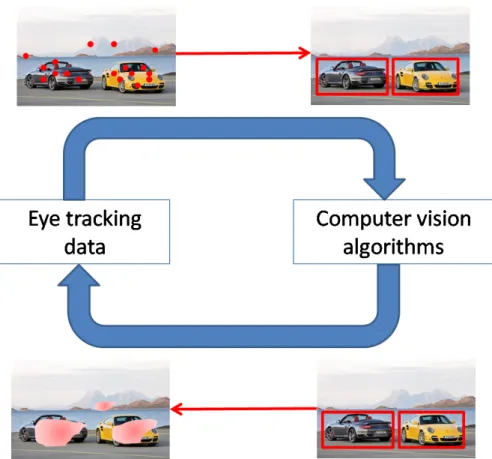
1.1 Block diagram illustrates the primary theme of this thesis. We want to explore problems where eye tracking data can improve computer vi-sion problems related to object extraction in images and videos. Addi-tionally, we also want to investigate the inverse scenario of how object detection can benefit the prediction of eye tracking data in images. . . . 3
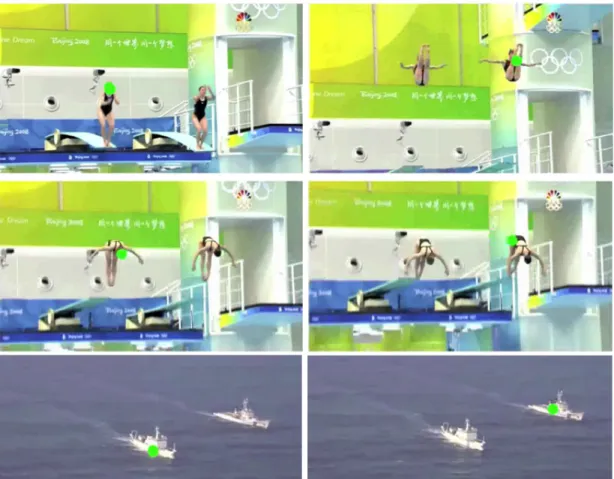
1.2 Figure overlays eye tracking data (shown as green circular dot) from a subject onto video frames from two different video sequences. We notice that eye tracking data in this free viewing task is biased towards objects in the scene and attention shifts from one object to another. . . 5
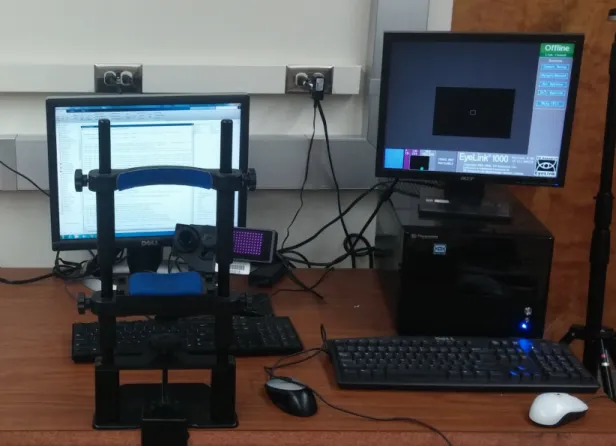
1.3 This image shows the eye tracker setup used in the proposed work. Detailed description of the eye tracker setup is discussed in Chapter2 . 6
1.4 Lists the computer vision algorithms which we aim to improve using the hybrid eye tracking object detection algorithms. (Left) Text detec-tion in natural scenes (Center) Dog and Cat detecdetec-tion (Right) Object extraction in videos . . . 7
2.1 Study by Yarbus which indicates the importance of the task which the person is asked to perform on eye movements [102] . . . 14
2.2 Example eye tracking data on images during a free viewing task. Eye movement data on images typically consists of alternate fixations and saccades. The fixations are represented by circles and the saccades are represented by lines. The fixations indicate information gathering stage from an image region. The saccades indicate attention shifts from one fixation to another. The entire eye movement sequence is called a visual scanpath. . . 17
2.3 Example of electrooculography based eye tracker [16]. . . 21
3.1 Left to right: 1. Input image. 2. Eye Tracking fixation samples from multiple subjects overlaid on the image 3. The eye tracking regions identified by the proposed algorithm as faces (blue) and text (green) 4. The final detection outputs of face and text detector focusing on the priors provided by eye tracking. . . 28
3.2 Examples of images from our dataset consisting of text, human faces, dogs, cats and other background objects . . . 32
3.3 Shows example of faces and text in two scenarios each. The fixations are marked as red points and saccades as blue lines. Multiple faces in the image where we consistently observe inter-face saccades (top left).A large single face where several saccades are observed in the eyes, nose vicinity (top right). Text with four words where a dense saccadic presence is observed between words (bottom left).A clip from one of the images showing a single word, whose cluster takes a nearly elliptical shape (bottom right). . . 34
3.4 Visualizing the text MRF potentials. 1. (Top left) Input image. 2. (Top right) Eye tracking samples overlay 3. (Bottom Left) Clustered eye tracking fixation locations from multiple subjects overlaid on the image 3. (Bottom Right) Visualizing the unary and interaction potentials of the clusters for the text MRF. The unary is color coded as green, the bright values indicating high unary potentials of a cluster belonging to text class. The interaction is marked by the blue lines between clusters, whose thickness is indicative of text-text interaction magnitude. . . 40
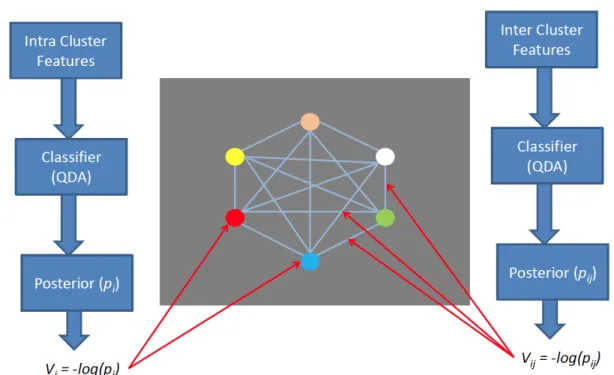
3.5 Indicates the process to calculate the unary and the pairwise potentials. The unary potentials are computed as −log of posterior probabilities obtained from a quadratic discriminant analysis classifier from intra-cluster features. In similar vein, the pairwise potentials are obtained from inter-cluster features . . . 43
3.6 Left: Input image with the ground truth for face (blue) and text (green). Center: Clustered eye tracking data overlay on input image. Right: Face (blue) and text (green) cluster labels propagated from ground truth.
44
3.7 Examples of good face detections from the proposed algorithm. Red fixation points correspond to face and blue corresponds to background. (a) In the presence of salient distracting object (shoe) the face (cat) is re-liably detected. (b) We notice that even in challenging scenarios where multiple faces are present, the proposed approach detects reliably. . . . 45
3.8 Examples of good text detections from the proposed algorithm. Red fixation points correspond to text and blue corresponds to background. (a) Text line is reliably detected even in the presence of several other fixations near the region of interest. (b) Text is detected correctly in the presence of more salient object (person face). . . 45
3.9 Example scenario where the proposed approach fails to detect face (left) and a text word (right). The eye tracking samples detected as face in (a) and text in (b) are shown in red and the samples detected as background (both (a) and (b)) are indicated in blue. . . 46
3.10 Example cat and dog face (blue box) and body (green box) detections from the proposed algorithm. . . 48
3.11 Plotting Average Precision (AP) of Cat head (top left) Dog head (top right), Cat Body (bottom left) and Dog Body (bottom right). The pro-posed (green) and baseline (red) curves are plotted against the detector threshold of deformable parts model. The maximum AP of baseline and proposed algorithm is comparable in all cases, however, the AP of the proposed approach is higher than baseline in high recall scenarios (low detector threshold) for both the head and body detectors of cats and dogs. Therefore, on an average the proposed approach is more stable over the detector threshold parameter than the baseline. . . 49
3.12 An example scenario where the head detector of the proposed approach (b) operating only in the attention region (c) marked in blue outper-forms the baseline cat head detector (a). The baseline detector has a false detection as noticed in (a). Finally, red points in (c) denotes the cluster identified as face/head from which the blue attention region is constructed. . . 50
3.13 Examples of images where the proposed text detection approach per-forms reliably. . . 52
3.14 Two example scenarios ((a)-(c) and (d)-(f)) where SWT results ((a) and (d)) are outperformed by the proposed approach ((b) and (e)). The at-tention regions ((c) and (f)) shows the eye tracking samples classified as text in red and the ROI used by the text detector in blue. Therefore, as the false positive portion in SWT (red boxes in (a) and (d)) is re-moved by the generated text attention region, we obtain better detector precision in these images. . . 53
4.1 A simple illustration of the proposed problem. Given a video sequence, we collect eye tracking data in the sequence from multiple subjects and utilize this information to extract visually salient objects. . . 61
4.2 Illustrates some example frames from the videos in the eye tracking dataset collected from Chen Xiph.org, GaTech and SegTrack datasets. We note that the dataset consists of single and multiple stationary and moving objects with moving and stationary backgrounds. . . 63
4.3 Block diagram of the proposed approach to extract multiple objects from videos using eye tracking prior. The top row indicates the eye tracking processing stage. The bottom row is the multiple object ex-traction framework guided by the visual tracks. . . 64
4.4 Illustrates that the saccades in the direction of optical flow are probable object saccades (smooth pursuit) and should be utilized along with the fixations for object localization. Saccades not in the direction of optical flow indicate attention shift from one object to another and can be pruned. 65
4.5 The spatio-temporal graph to extract multiple objects is highlighted here. The temporal costs shown in blue indicate inter-frame cost to connect a path through two bounding boxes in successive frames. The intra-frame spatial costs are indicated in green. They aim to penalize extraction of the same object in multiple paths. . . 70
4.6 Shows example results using the proposed approach to extract multi-ple objects represented by bounding boxes. We see the proposed ap-proach is able to localize different visually salient objects in the video sequences with reasonable accuracy. . . 75
4.7 Shows example results from the proposed approach after applying grab-cut based video segmentation to the extracted multiple object bounding boxes. We see the proposed approach is able to segment multiple ob-jects in the video sequences with reasonable accuracy. . . 76
4.8 Shows some segmentation results using [68]. We notice that in the top row, when the fixation slightly positioned outside the object of interest, [68] breaks down. In addition, the algorithm suffers from similar issues in the bottom row as well as not being robust to the presence of the occluding pole. . . 77
5.1 Left to right: 1. Input image. 2. Text attention map derived using visual attention features. 3. The text detection output indicated by the blue rectangle. Best viewed in color. . . 82
5.2 Left to right: 1. The input image. 2. Stroke Width Transform Image. 3. Connected components and geometric filtering. 4. Final Detections (blue boxes). Best viewed in color. . . 86
5.3 Example of visual attention features computed in an image. . . 87
5.4 Block diagram of the training(top) and test (bottom)modules of the vi-sual attention based learning paradigm. . . 89
5.5 Left column shows the input image, center column corresponds to hu-man fixation map and the right column illustrates the proposed text at-tention map. The text atat-tention maps are similar to human fixation map on text centric images. Note that eye fixations only includes foveal or central vision and peripheral vision is not captured. Therefore, as row 1 and 3 only have a single word, eye tracking results are biased towards the center of the word and therefore does not entirely overlap with our text attention map. Moreover, the text attention maps reliably localize the text regions. . . 93
5.6 Example detections (blue boxes) in images from ICDAR dataset. Best viewed in color. . . 97
5.7 Illustrates two example scenarios where our algorithm (left) outper-forms SWT (center). The text attention maps (right) clearly ignores regions where SWT detects false positives. The detections are shown in blue rectangles. Best viewed in color. . . 98
5.8 An example image (left) where the proposed algorithm fails and the corresponding attention map (right). In this image the background is very similar to text region, hence, the text attention map fails to localize the text region. The missed detections are shown in red rectangles and the false positive detections in blue rectangles. Best viewed in color. . . 98
6.1 Left-Right. Top-Bottom (1) Image with background person in focus (2) Top 10% attention regions in the image from eye tracking data (3) Image with foreground text in focus (4) Top 10% attention regions in (3). We notice a significant shift in attention across two images of the same scene . . . 104
6.2 Plot of focus change with attention change. We notice that there is no-ticeable correlation (shown by red line) between visual attention change and change in camera focus. The correlation is represented by the best line fir to this data which has a slope of 0.27. . . 108
6.3 Examples of images from our dataset consisting of faces, text, people, animals and car etc. at different focus depths. . . 111
6.4 Two 2D images from a Lytro image and the corresponding binary focus maps to their right. . . 112
6.5 Examples manual object annotations . . . 114
6.6 Attention density in 23 manually annotated objects in-focus (blue) and out-of-focus (green). Objects in focus consistently have higher atten-tion density than out-of-focus objects . . . 114
6.7 Average initial fixation time in 23 manually annotated objects in-focus (blue) and out-of-focus (red). Objects in focus consistently have lower average time to first fixation compared to out-of-focus objects . . . 116
6.8 Visual attention consistency across multiple focus images (Focus ROC curve) . It is shown in reference to the human ROC curve which mea-sures the consistency among fixations in the same image across multi-ple subjects. . . 118
6.9 Row 1 and 2 shows examples of cases where camera focus significantly alters visual attention. We notice categories such as text can have a sig-nificant change in the manner in which we view images if their focus attributes change. Rows 3 and 4 highlights examples where camera fo-cus does not significantly alter visual attention. In row 3, the out of focus faces also attract significant attention. In row 4, there is only one salient object in the center of the image and therefore attracts consider-able attention irrespective of camera focus. . . 119
6.10 The plot shows the consistency of visual attention in the images shown in Fig6.9 . . . 120
6.11 An example high level object layout with N=3 and the corresponding 9 scene context feature maps . . . 124
6.12 (a) Has only one salient object (small car) and (b) has one salient object (large). However (c) has both the salient objects. We observe the large face significantly draws attention (green overlay) away from the small car in (c). Best viewed in color. . . 125
6.13 Comparison of the performance of the proposed approach with other state-of-the-art visual attention and saliency algorithms using ROC curves. Our approach outerforms other algorithms by a significant margin. How-ever, we still notice considerable gap between machine and human per-formance. . . 131
6.14 Each row contains ground truth attention map (Blue overlay) with a focus setting followed by corresponding predicted visual attention map (Red overlay). The results are shown on two Lytro images (rows) each under two focus settings . . . 132
6.15 Weights of scene context features compared to average non-context fea-ture . . . 134
6.16 Regression weights of different objects in in-focus and out-of-focus ob-ject categories. We notice this plot is similar to the average attention density plot in Figure6.6 . . . 135
6.18 Left column indicates the input image. The center column indicates the visual attention map and the right column indicates the region in focus. An analysis of row 1 and 2 indicates that the image in row 1 has higher visual attention in the focused region than image in row 2. In addition we notice that image in row 3 has higher attention in the focused region than image in row 4. Therefore, input image in row 1 and row 3 are preferable to row 2 and row 4 respectively as they capture larger visual attention in the region of focus. . . 138
Chapter 1
Introduction
“We live in a wonderful world that is full of beauty, charm and adventure. There is no end to the adventures we can have if only we seek them with our eyes open”.
Jawaharlal Nehru
Recently, there has been significant advancement in eye tracking technology. Cur-rent eye trackers have become affordable, accurate and easy to use. These eye trackers do not require the head to be constrained in a specific position and can collect the data in standard viewing postures. This has enabled large scale low-cost availability of such data from multiple subjects especially in multimedia settings. This information can be
extremely beneficial to computer vision algorithms and eye tracking guided computer vision algorithms have become a relevant topic of interest. These hybrid techniques have two design challenges. The first challenge is to effectively identify useful infor-mation from the eye tracking data for the task (computer vision problem) one is trying to solve. Secondly, a guiding mechanism needs to be designed that utilizes this eye tracking information to further aid the computer vision task at hand. In addition, in this thesis, we are also interested in predicting eye tracking data given an image. Specifi-cally, we explore the importance of two factors, camera focus and object co-occurrence to improve the prediction of where people look in images.
1.1
Motivation
The primary goal of this thesis is to understand the how visual saliency and eye tracking based input can enhance computer vision algorithms and vice versa. Humans are adept at visual tasks and tapping into the contextual information utilized by humans to perform high level tasks can be a valuable tool to develop better computer vision algorithms. In addition, better high level image semantic understanding can benefit algorithms modeling human visual attention, which can help in effective prioritization of information content in images and videos. Figure1.1visually illustrates the primary theme of the thesis.
Figure 1.1: Block diagram illustrates the primary theme of this thesis. We want to ex-plore problems where eye tracking data can improve computer vision problems related to object extraction in images and videos. Additionally, we also want to investigate the inverse scenario of how object detection can benefit the prediction of eye tracking data in images.
Human visual attention is typically attracted towards high level semantics in images and videos. Figure 1.2 shows examples of eye tracking data obtained from a subject while performing a free viewing task in videos. As the eye tracking data is naturally biased towards objects, in this thesis we aim to improve computer vision algorithms related to object detection in images and object extraction in videos as shown in Figure
sig-nificant improvement over state-of-the-art. Eye tracking based contextual information has become practically feasible owing to recent advancements in eye tracking technol-ogy. The modern state-of-the-art eye trackers are affordable without compromising the precision of expensive laboratory eye trackers. Moreover, advancements in sensing and eye localization algorithms have enabled eye tracking acquisition without constrains on head movements effectively simulating real world viewing of scenes without affecting the experience of the viewer. Therefore, it is feasible to obtain eye tracking data from multiple subjects, especially when we are dealing with popular multimedia content. An illustration of the eye tracker used in all the experiments in this thesis is shown in Figure
1.3.
Additionally, visual saliency based contextual information only incurs a computa-tional overhead of computing the saliency maps, however reducing the search space for object detectors can mitigate some of this additional processing. In order to im-prove eye tracking prediction using computer vision algorithms, we explore two forms of contextual information to improve current state-of-the-art visual attention predic-tion algorithms. First, we investigate the importance of scene context, utilizing object co-occurrence to improve state-of-the-art visual attention model. We also study how camera focus affects visual attention. Recently, light field cameras which capture the entire 3-D light field and camera focus can be altered post image capture, have become popular and we propose models which utilizes camera focus to identify interesting
re-Figure 1.2: re-Figure overlays eye tracking data (shown as green circular dot) from a subject onto video frames from two different video sequences. We notice that eye tracking data in this free viewing task is biased towards objects in the scene and atten-tion shifts from one object to another.
gions in images. Our method improves over state-of-the-art to predict visual attention which do not explicitly utilize this information.
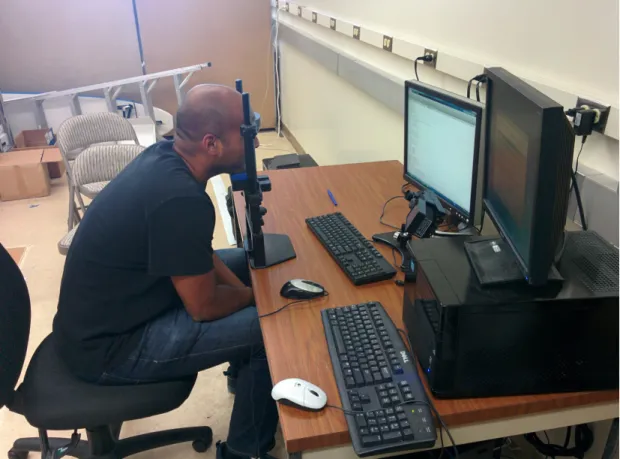
Figure 1.3: This image shows the eye tracker setup used in the proposed work. De-tailed description of the eye tracker setup is discussed in Chapter2
1.2
Overview of proposed methods
As faces and text regions in images primarily attract visual attention, in Chapter3, we aim to predict face and text regions by analysing eye tracking data. Additionally, we utilize this eye tracking prior to localize the search space for object categories in images. In this work we introduce a dataset with emphasis on faces and text, however containing adequate representation from non-faces and non-text as well. We collect
Figure 1.4: Lists the computer vision algorithms which we aim to improve using the hybrid eye tracking object detection algorithms. (Left) Text detection in natural scenes (Center) Dog and Cat detection (Right) Object extraction in videos
eye tracking data from multiple subjects and cluster the fixation component using mean shift clustering. We extract several inter- and intra-cluster features from these clusters. The face/text identification problem is modeled as a cluster labeling problem over a fully connected Markov Random Field. The unary and the pairwise potentials are learnt using Support Vector Machines. This prior localizes the search space for face and text regions. In the face detection problem, we focus on dog/cat faces as traditional detectors fail for these categories. Our hybrid eye tracking object detector outperforms the base algorithms in detecting faces and text.
In Chapter4, we extend the the theme of improving object detection using eye track-ing prior to videos. Specifically we target object extraction from videos and evaluate the performance gains by utilizing eye tracking priors. This problem presents interest-ing applications in multimedia annotation and multiple object extraction where recent advances in technology has laid the foundation to obtain eye tracking data without
in-terfering with viewer experience. This work primarily consists of two modules
• Extraction of dominant eye tracking patterns from user data
• A novel framework for multiple object extraction
First, we extract dominant consistent eye tracking patterns (visual tracks) from user data. This provides us with two forms of information, coarse localization of object po-sition and the number of objects in the video. We utilize a two-step association process to build visual tracks. In the first step the eye tracking data is clustered using 3-D mean shift algorithm to get visual tracklets. The visual tracks are formed by associating the visual tracklets by solving a linear assignment problem. These visual tracks are utilized in the second module to extracts objects
The second module is is designed to extract multiple objects from a video based on building a mixed graph which has both directed and undirected edges. The nodes are represented by candidate bounding boxes derived from objectness, scored using a combination of objectness, optical flow and eye tracking prior. The graph consists of directed edges which connect the nodes across successive frames as well as undirected edges within (intra) a frame. The directed edges model inter-frame bounding box char-acteristics such as appearance, position, motion and visual track properties, enabling consistent object tracking across candidate objects. Additionally, the intra-frame costs ensure overlapping bounding boxes representing the same object is not extracted in
different paths. The overall path extraction is solved using integer programming in a mixed graph framework. The final object contours are obtained by a 3-D graph cut based video segmentation algorithm. The proposed algorithm outperforms prior dom-inant object extraction state-of-the-art as well as prior work on eye-tracking fixation based tracking.
In Chapter5, we explore the ability of saliency algorithms to improve text detec-tion in natural scenes. Human attendetec-tion is naturally biased towards text regions and we want to investigate the utility of low-level visual attention features which mimic human attention in localizing text regions in natural scenes. Additionally, text regions have characteristic visual attention properties and we aim to understand this using our algorithm. Our approach basically learns a text attention map using a Support Vector Machine from multiple visual saliency maps which prunes the search space for text detection. Our algorithm gives priority to regions where text detection typically fails. This approach improves the precision of state-of-the-art text detector.
The following Chapter6sheds light on improving state-of-the-art visual attention models using scene context information. We explore two forms of contextual infor-mation, object co-occurrence and camera focus to improve visual attention prediction from multiple subjects. We extract object co-occurrence maps coupled with camera fo-cus based information to represent scene context features. A regression based attention prediction algorithm predicts the final visual attention map. The proposed algorithm
outperforms state-of-the-art saliency and visual attention algorithms as they do not di-rectly model these contextual inter-relationships. Finally in Chapter7, we provide the conclusions and directions for future research in saliency and eye tracking enhanced computer vision.
Chapter 2
Eye tracking review
“The eyes are the amulets of the mind”.
W.R. Alger
The primary aim of this thesis is to improve computer vision algorithms using eye tracking data. This chapter reviews current work on eye tracking and describes the experimental setup used in this dissertation research.
2.0.1
Brief History of eye tracking
Eye tracking is the process of measuring the motion of the eye relative to the head position. The device designed to measure eye movements is an eye tracker. Eye track-ers are popular devices in visual system research. Eye tracktrack-ers have been extensively
used in psychology, cognitive linguistics and product design. The study of eye move-ments began in the 1800s. In 1879, Louie ´Emile Javal observed that during reading task, eye movements do not involve smooth sweeping of eyes along the text as pre-viously understood, instead it involves a series of rapid stop and go motion patterns. This observation led to considerable research on eye movements during reading task to understand the stop duration, word positions which have consistent eye movement stops, and the duration of the stops in various scenarios. One of the early intrusive eye trackers was built by Edmund Huey which uses a contact lens with a hole for pupil. The aluminum pointer connected to the lens was used to record eye movements. His primary study was dedicated to the reading task. The first non-intrusive eye tracker was built by Guy Thomas Buswell, which recorded light rays reflected from the eyes using a film to calibrate eye movements and his research focused on reading and picture viewing.
Critical findings in eye tracking research was performed by Alfred Yarbus, where he identified that task which a subject is performing plays an important role in determining eye movement patterns. The famous image from Yarbus’s work shown in Figure 2.1
elucidates the importance of top-down task influence in eye movements. He concluded that human attention is often attracted towards unusual and incomprehensible elements in images. Also, additional time spent on perception is not used to examine secondary elements, but to re-examine important details.
In the 1970s reading research took prominence again and in 1980 Just and Car-penter proposed that “There is no appreciable lag between what is fixated and what is processed” which is also called the strong eye-mind hypothesis. This hypothesis is typically assumed by eye tracking researchers and our work was well, which basically means when a subject fixates at a scene or an object, she/he also thinks about it only during the recorded fixation duration. However this assumption is questionable in sit-uations where covert attention plays a critical role when a subject is observing which he/she is not looking at using peripheral vision. This situation however disassociates the relationship between eye movements and cognitive processing.
Due to advancement in processing power of modern computers, the 1980s also signaled the genesis of eye tracking in human computer interaction. The application domain was primarily targeted towards physically challenged users. However, recently eye tracking has been extensively used to evaluate the design of interfaces. This pro-vides a solid platform to test the ease of use of a computer interface and helps quantify their intuitiveness. Eye tracking technology has also been a useful tool to evaluate the utility of websites to communicate information effectively. It is also becoming pop-ular in human computer interaction (HCI) where scanpaths are utilized to build gaze-contingent displays, also known as gaze-based interfaces. Online advertising is another field where eye tracking technology will have a significant impact in the near future.
Figure 2.1: Study by Yarbus which indicates the importance of the task which the person is asked to perform on eye movements [102]
2.1
Eye tracking data basics
Human eye movements show considerable variation in static and dynamic scenes. In static scenes, eye movements consist of discrete jumps between information gath-ering stages. In Figure 2.2, which represents reading task in a static scene, we notice circles representing the information gathering stage and horizontal lines indicating shift in attention from one word to another. The circles are called fixations and the jumps from one fixation to another is called a saccade. We seldom observe smooth eye move-ment patterns in static scenes.
However in dynamic scenes, when a subject is observing a moving object, we notice smooth eye movement transitions, called smooth pursuit. This is another voluntary manner in which humans can shift gaze in addition to saccadic movements which is also prevalent in dynamic scenes. In this situation, smooth pursuit and fixations represent the information gathering stage from an object and the saccades denote shift in attention from one object to another in the dynamic scene.
In addition, eye tracking data also consists of micro-saccades. Micro-saccades are typically observed in prolonged visual fixations. They are small, jerk-like, involuntary eye movements, similar to miniature versions of voluntary saccades. There is still no consensus on the role of micro-saccades in visual perception, thought several theories exist. The study of micro-saccades acts as a diagnostic test for conditions such as Attention Deficit Hyperactivity Disorder (ADHD).
We note that the central one or two degrees of the visual angle (the fovea) provide the bulk of visual information; the input from larger eccentricities (the periphery) is less informative. Hence, the locations of fixations along a scanpath indicate which information regions on the stimulus are processed during an eye tracking session. On average, fixations last for around 200 ms during the reading of linguistic text, and 350 ms during the viewing of a scene. Additionally, preparing a saccade towards a new goal takes around 200 ms. Research has suggested that there is about 100-250 millisecond lag in eye movements following visual attention.
Eye tracking studies have shown that human overt visual attention, which eye track-ers measure, is highly biased towards high level semantics in a scene. Additionally, among semantic objects, there is conclusive evidence that face and text categories pri-marily attract visual attention. Visual scanpaths are typically useful for analyzing cog-nitive intent, interest, and salience. Other biological factors (age, gender, race) affects the scanpath as well. However, we note that current technologies cannot predict the ex-act cognitive process given eye movement patterns, for example eye movements over an object may indicate several emotions, however there is no known technique to extract this information from eye movements. Therefore, additional verbal cues are sometimes obtained in eye tracking experiments.
Figure 2.2: Example eye tracking data on images during a free viewing task. Eye movement data on images typically consists of alternate fixations and saccades. The fixations are represented by circles and the saccades are represented by lines. The fixations indicate information gathering stage from an image region. The saccades in-dicate attention shifts from one fixation to another. The entire eye movement sequence is called a visual scanpath.
2.2
Eye Trackers
Eye trackers are devices that measure eye movements and they fall into the follow-ing three categories
• Optical tracking
• Eye attached tracking
• Electric potential based tracking
2.2.1
Optical tracking
Optical tracking is the most popular form of current eye tracking technology. This is a non-contact method where infrared light reflected from the eye is captured by an optical sensor. Typically the pupil and the first corneal reflection are tracked over time. In the beginning a known calibration pattern is presented in the screen which helps localize the exact eye gaze location with good accuracy. Recently more sensitive eye trackers which monitor the location of retinal blood vessels are also being developed. Optical tracking technology has required head position to be stable when tracking the eye movements. Recent developments in calibration and head tracking has enabled free head movement while localizing eye position. This is a significant step which enables collection of eye tracking data over long duration without discomfort to the subject. These remote eye trackers automatically track the head as well as the eye movements
are becoming commercially available . In addition manufacturing costs of the eye track-ing devices have drastically reduced in the past few years thereby improvtrack-ing the utility of these eye trackers in the commercial sector and going beyond being expensive labo-ratory equipment. Optical eye tracking technology has been used in all the experiments conducted in this dissertation work.
Head mounted eye trackers and chin rest based eye trackers which require the head to be stable have been popular in the past decade. Early eye trackers used a sam-pling rate of at least 30 Hz. Today many video-based optical eye trackers run at even 1000/3000 Hz, which is needed in order to capture the details of the very rapid eye movement in neurological studies.
2.2.2
Electric potential based tracking
Eyes act as a dipole with the positive pole in the cornea and the negative pole at the retina. This produces a steady electric field which is measured by placing elec-trodes around the eyes. Two pairs of contact poles called an electrooculogram (EOG) are placed around the eye which measures this electric signal. The dipole orientation changes when the eyes move from the center position to the periphery. As the retina and the cornea approaches opposite electrodes, there is a change in the measured EOG potential signal. These changes can be related to eye movements. Typically horizontal and vertical potentials are measured by separate electrodes. A third EOG component is
the radial EOG channel, which is the average of the EOG channels referenced to some posterior scalp electrode. This radial EOG channel is sensitive to the saccadic spike potentials from the extra-ocular muscles at the onset of saccades, and allows reliable detection of even miniature saccades. An example EOG based eye tracking setup is shown in Figure2.3.
However the primary limitation of EOG is that it cannot accurately predict where exactly a person is looking at due to noise in electric potential measurements. But, it can accurately measure saccadic eye movements associated with gaze shifts and blinks. It consumes low power, is available as a wearable system and is robust to lighting conditions. In addition, sleep activity can be monitored as it does not require the eyes to be open while recording the eye activity.
2.2.3
Eye attached tracking
In this technique an attachment to the eye is used and the movement of the attach-ment is measured which indicates eye moveattach-ments. Typically specialized contact lenses which have embedded magnetic field sensor or mirror is used as attachment. However, eye attached tracking assumes that the contact lens does not slip during eye rotation.
2.3
Eye tracking setup
In our experiments we use the video based eye tracker Eyelink 1000 as it can accu-rately track where subjects look in a variety of setups. Specifically we utilize the tower mounted setup with a chin-rest as it ensures comfortable viewing in a short period of time coupled with high eye tracking accuracy. The eye tracking setup consists of a host computer and a display computer. The eye tracker host computer processes the eye tracking data and automatically computes fixations and saccades in real time at a high sampling rate of about 1000 samples per second. The host computer is a part of the Eyelink eye tracker.
The display computer is a device where the visual stimuli is presented to the viewer, which is typically a computer used by the programmer to design the eye tracking ex-periments. The host and a display computers are connected using a duplex cable which can transfer data to and from the host and display computers. The eye tracker also consists of an infra-red camera which collects an infra-red video which is processed by the host computer. The host computer detects the pupil and the first corneal reflection to decipher where a subject is looking in the display screen. To enable this, calibration is performed every time a subject places his/her head on the chin-rest where a series of 9 points is shown in the display screen and the pupil and the first corneal reflection positions are monitored.
pro-Figure 2.4: Illustrates the eye tracker setup using Eyelink 1000 eye tracking device
vided by SR-Research, the company which manufactures Eyelink. The experiment builder software provides a few basic block based setups for collecting eye tracking data and it acts a good guiding tool to learn how one can design eye tracking experi-ments. In addition, to design complex experiments where the data presentation might be adaptive, psychtoolbox is recommended instead. In addition, SR-Research also pro-vides a data viewer to visualize the eye tracking data overlaid on the stimulus post data collection from a subject.
We now outline briefly the work-flow in an eye tracking experiment. After identi-fying the hypothesis which we want to test, we collect a visual stimuli database, fol-lowing which the experiment is designed using the experiment builder software. As fatigue plays an important role in the chin-rest eye tracker (head is constrained in a spe-cific position), one must ensure that every data collection session is divided into smaller sub-sessions and the subjects gets sufficient rest before continuing the experiment. The eyetracking data for each subject is stored in EDF (Eyelink Data File) format. This is a highly compressed binary format, intended for use with SR Research Eyelink viewers and applications. The EDF file can be converted to a text based ASC file by a transla-tor program known as EDF2ASC. The ASC files may be viewed with any text editransla-tor. Further, we wrote Perl scripts to process the ASC files line by line to extract useful information which we required for further analysis.
2.4
Eye tracking in proposed research
There has been limited research to tap into the potential of eye trackers in com-puter vision. However, several eye tracking based research studies have concluded that high level semantic categories primarily attract visual attention and therefore eye tracking naturally can provide weak supervision in several computer vision problems related to object search. In Chapters2and3of this thesis we design algorithms which
can outperform state-of-the-art object search algorithms in images and videos utilizing eye tracking information obtained in a free viewing scenario. We hope the proposed paradigm eventually bridges the semantic gap between computer vision algorithms re-lated to object search and human performance.
Chapter 3
Eye tracking enhanced object
detection in images
“We see the world, not as it is, but as we are - or, as we are conditioned to see it”.
Stephen R. Covey
Eye movement studies have confirmed that overt attention is highly biased towards faces and text regions in images. In this work we explore a novel problem of predicting face and text regions in images using eye tracking data from multiple subjects. The problem is challenging as we aim to predict the semantics only from eye tracking data without utilizing any image information. The proposed algorithm spatially clusters eye
tracking data obtained in an image into different coherent groups and subsequently models the likelihood of the clusters containing faces and text using a fully connected Markov Random Field (MRF). Given the eye tracking data from a test image, the learnt MRF predicts potential face/head (humans, dogs and cats) and text locations reliably. Furthermore, the approach can be used to select regions of interest for further analysis by object detectors for faces and text. The hybrid eye position/object detector approach achieves better detection performance and reduced computation time compared to using only the object detection algorithm. We also present a new eye tracking dataset on 300 images selected from ICDAR, Street-view, Flickr and Oxford-IIIT Pet Dataset from 15 subjects.
This Chapter is organized as follows. In Section3.1we introduce the problem and relevant related work. The faces and text eye tracking dataset is presented in Section
3.2. The proposed approach to classify eye tracking data into face and text regions is described in Section 3.3 followed by the experimental results for eye tracking based localization in 3.4. The applications to improve state-of-the-art object detection al-gorithms is illustrated in 3.5. Finally, the summary of the work and future research directions are discussed in Section3.6.
3.1
Introduction
Wearable eye tracking devices are becoming popular [15, 14] and will soon be mainstream. They provide a platform to collect eye tracking data in a non-intrusive way when people observe multimedia content, such as web browsing. This additional infor-mation from multiple subjects can potentially be useful for challenging large scale mul-timedia annotation problems. Towards this, we propose a technique to obtain image-level scene semantic priors from eye tracking data, which will reduce the search space for multimedia annotation tasks.
Figure 3.1: Left to right: 1. Input image. 2. Eye Tracking fixation samples from multiple subjects overlaid on the image 3. The eye tracking regions identified by the proposed algorithm as faces (blue) and text (green) 4. The final detection outputs of face and text detector focusing on the priors provided by eye tracking.
to-wards faces and text [17]. The first step toto-wards obtaining scene semantic prior from eye tracking information alone is to build models that predict face and text regions in images, which is the primary focus of this work. This information is useful to improve the speed and precision of state-of-the-art detectors for challenging categories such as text, cats and dogs. We note that the performance of state-of-the-art cat and dog de-tectors [74] in turn depends on head (face) detection algorithm which can be enhanced using eye movement information.
Related Work
Humans are able to swiftly process a rich stream of visual data and extract informative regions suitable for high level cognitive tasks. Therefore, there has been significant amount of research on human inspired visual attention models [51,39, 53, 56]. These approaches typically predict the attention in different regions of an image given low-level saliency maps and high-low-level image semantics. In contrast, the proposed problem in spirit models the converse situation of predicting image semantics from eye move-ment data.
There have been some recent efforts which model top-down semantics by simul-taneously utilizing both image and eye movement information. In this regard, Subra-manian et al. [86] extract high-level information from images and verbal cues, (faces, face parts and person) and model their interrelationships using eye movement fixations and saccades across these detections. Mishra et al. [68] propose an active segmentation
algorithm motivated by finding an enclosing contour around different fixations. The proposed approach distinguishes itself as it aims to speed up algorithms for high-level semantics from eye movement data alone. Bulling et al. [16] propose an activity clas-sification method in office environments (copying text, reading, browsing web, taking notes, watching video) using eye movement data collected using electrooculography. As most of these activities follow a standard repetitive pattern, the method in [16] pre-dicts the activities reliably for each person individually. However, due to variability in the manner in which different people view images, our approach differs from [16] and we require data from multiple observers to predict image semantics reliably. Cerf et al. [18] provide an algorithm to decode the observed image using eye movement scan-path data. However, their approach models the problem by proposing a metric between multiple saliency maps obtained from the image and the scanpath data. The saliency map generation problem again requires processing the entire image and is inherently different from the proposed approach. We make three contributions in this work
a. We propose an algorithm to localize face and text regions in images using eye track-ing data alone. The algorithm basically clusters the eye tracktrack-ing data into meantrack-ing- meaning-ful regions using mean-shift clustering. Following which various intra- and inter-cluster fixation and saccade statistics are computed on these inter-clusters. The final cluster labels are inferred using a fully connected MRF, by learning the unary and interaction potentials for faces and text from these statistics.
b. We demonstrate the ability of these face and text priors to improve the speed and precision of state-of-the-art text [32] and cat and dog detection [74] algorithms.
c. We also present a new eye tracking dataset, collected on images from various text, dogs and cats datasets. The dataset consists of 300 images from 15 subjects.
Figure3.1outlines the pipeline of the proposed approach.
3.2
Faces and Text Eye Tracking Database
We collected an eye tracking dataset, with primary focus on faces (humans, dogs and cats) and text using Eyelink 1000 eye tracking device. The image dataset consists of 300 images collected from ICDAR datasets (text) [61], Street view dataset (text) [96] and Oxford-IIIT Pet dataset (dogs and cats) [75] and flickr images [53]. The text images are gathered from two different datasets to ensure considerable variability in scene context. The flickr images provide sufficient representation for images without text or faces (including dogs and cats) in both indoor and outdoor scenes. The overall image dataset consists of 61 dogs, 61 cats, 35 human faces, 246 text lines and 63 images without any text or faces. Figure 3.2 highlights examples for images from different categories from the dataset. The images are of dimension 1024×768 and were viewed by 15 subjects (between ages 21 and 35). The viewers sat 3 feet away from a 27 inch screen and each image was shown for 4 seconds followed by 1 second viewing
a gray screen. The subjects were informed that it was a free viewing experiment and instructed to observe regions in images that gather their interest without a priori bias. Also, eye tracking calibration was performed every 50 images and the entire data was collected in two sessions (150 images each). This dataset can be downloaded from
http://vision.ece.ucsb.edu
Figure 3.2: Examples of images from our dataset consisting of text, human faces, dogs, cats and other background objects
Humans eye movement scanpaths typically consists of alternating fixations and sac-cades. Fixations represent information gathering sequences around an interest region and saccades indicate transitions between fixations. The eye tracking host computer samples the gaze information at 1000 Hz and automatically detects fixations and sac-cades in the data. Therefore, we have around 4000 samples per subject for every image. The fixation samples typically account for 80% of the entire data. In our analysis we
only use the fixation samples and henceforth refer to these fixation samples as the eye tracking samples. The eye tracking device also clusters the fixation samples and iden-tifies fixation and saccade points. We refer to these points as fixations and saccades hereafter. The average number of fixations and saccades per image across subjects can vary from 8 to 19. In our experiments, the first fixation and saccade was removed to avoid the initial eye position bias due to the transition gray slide in the experimental setup.
Face Regions: The dataset consists of faces of multiple sizes, varying from about 40×40 to 360×360 pixels. In small face images, subjects look at the face as a whole. On the other hand, in larger faces there are several saccades across eyes, nose and mouth regions. As expected, face regions consistently attract attention from viewers. In addition we notice that the initial saccades are invariably directed towards face re-gions across subjects. In images consisting of multiple faces, rapid scanpaths moving across different faces is a common phenomenon. Figure 3.3 illustrates examples fea-turing some of these effects.
Text Regions: Text regions are present in various styles, fonts, sizes, shapes, lighting conditions and with occlusions from foreground objects in our image dataset. In text regions consisting of a single word, the subjects typically fixate around the center of the word and the different fixations take a nearly elliptical shape. In multiple words, we observe saccadic scanpaths from one word to another as subjects typically read the
different words sequentially. Figure 3.3 illustrates some example text regions in our image dataset.
Figure 3.3: Shows example of faces and text in two scenarios each. The fixations are marked as red points and saccades as blue lines. Multiple faces in the image where we consistently observe inter-face saccades (top left).A large single face where several saccades are observed in the eyes, nose vicinity (top right). Text with four words where a dense saccadic presence is observed between words (bottom left).A clip from one of the images showing a single word, whose cluster takes a nearly elliptical shape (bottom right).
3.3
Faces and Text Localization from Eye Tracking Data
The aim is to identify face and text regions in images by analyzing eye tracking in-formation from multiple subjects, without utilizing any image features. Eye movements are organized into fixations and saccades. The information gathering phase is
rep-resented by the fixations, which typically group around different semantic/interesting regions as shown in Figure3.3. Therefore, we first cluster all the fixation regions using the mean-shift clustering technique [25]. We chose mean-shift clustering as it does not require the number of clusters and is fairly robust to multiple initializations for the se-lected bandwidth (50 pixels). The text and face region detection problem is mapped to a cluster labeling problem. Therefore, we compute inter-cluster and intra-cluster statis-tics and model the labeling problem using a fully connected Markov Random Field (MRF).
Let the ithcluster in an image be denoted by Ci. The 2D eye tracking samples
(fixation samples) within the cluster are represented by Ei. The fixations (fixation
points) and saccades in the entire image are denoted by F and S respectively. The fixations belonging to the ith cluster are denoted by Fi and the saccades originating
from ith and terminating in the jth by S
i,j. Finally, the fixations provided by every
individual person k in clusteri is augmented giving Fk
i and the corresponding times
(0-4 seconds) representing the beginning of the fixations in cluster i is given by Tik.
The following features are used to represent inter-cluster and intra-cluster properties.
3.3.1
Intra-cluster features
a. Number of fixations and eye tracking samples: |Fi|,|Ei|
c. Shape and orientation of the cluster by ellipse approximation. Letλ1,λ2 andv1,v2
denote the two eigenvalues and eigenvectors respectively of the cluster such that
λ1 > λ2. Shape of the cluster is encoded by λλ21. The orientation is expressed as
|∠v1|
d. The ratio of the eye tracking sample density in the cluster compared to its back-ground. Let cluster Ci be approximated by the minimum rectangle Ri containing
all the cluster points. The rectangular region centered aroundRi which is twice its
width and length is defined asDi. Hence, the background region, Bi, aroundRi is
expressed asDi\Ri. The final feature is computed as
|{Ei∈Bi}|
|{Ei∈Ri}|
e. Number of incoming, outgoing and within-cluster saccades, represented byP
∀j6=i|Sj,i|,
P
∀j6=i|Si,j|and|Si,i|respectively
f. The number of incoming, outgoing and within-cluster saccades, (frome) where the saccade angle to the X-axis is less than 30 degrees (almost horizontal)
g. The percentage of incoming, outgoing and within-cluster saccades (from e) which are almost horizontal
h. Median of the time of first visit to the cluster across multiple subjects: mediank mini Tik
i. Median of the number of times each person visits a cluster: mediank(
Fik
)
These features essentially aim to capture the eye movement attributes typical of face and text regions described in Section 3.3. The features indexed a,b,c,d and e in the above list are important basic features where text and face regions exhibit characteristic responses. Featuresfandgare more characteristic of text regions with multiple words as nearly horizontal inter-word saccades are prevalent. Finally, features h and i are more relevant to face regions which typically immediately attract viewer attention. In addition subjects also tend to visit the face multiple times after fixating at other regions in the image, which is captured by featureiin the aforementioned list.
3.3.2
Inter-cluster features
In addition to intra-cluster features, pairwise inter-cluster features also provide use-ful information to identify face and text regions. In the presence of multiple faces, subjects indicate saccadic activity across the different faces. Moreover, in text images with multiple words, inter-word saccadic activity is quite common. Therefore, the fol-lowing saccade centric features are computed across clusters.
1. Number of saccades from theithtojthcluster,|Si,j|and vice versa
2. Number of almost horizontal saccades (where the saccade angle to the X-axis is less than 30 degrees) from clusteritojand vice versa
4. The number of saccades, horizontal saccades and percentage of horizontal saccades from the left cluster to the right cluster
5. Distance between the clusters
In total, we have 13 inter-cluster features to represent saccadic properties across multiple clusters. Specifically, the inter-cluster features1,2 and 3from the list above are useful indicators of face-face and text-text regions. Also, feature 4 is targeted to capture text regions as subjects typically read text from left to right.
Data: Input Images{Ii}, Eye Tracking Samples{Ei}, Fixations{Fi}, Saccades{Si}ground truth labels for faces and text{Li},i∈[1...N]
Result: Face Cluster IDsi, Text Cluster IDsi,i∈[1...N]
Notation :Superscript - image number. Subscripts - cluster IDs Precomputing Cluster Features:
fori= 1→Ndo
Ci= Mean Shift Clustering(Ei);
forj = 1→ |Ci|do Fintrai j= Intra-cluster-features(Cji,Fji,Sji) ; Clabi j= Cluster-labels(Lij,Cji); fork=j+ 1→ |Ci|do Finteri jk= Inter-cluster-features(Cij,Fji,Sji,Cki,Fki,Ski) end end end
Learning to classify Clusters into Face and Text regions:
fori= 1→N do
TestIndex =i; TrainIndex ={1,2, ..., N} \ {i};
[Unary Potentials Face, Unary Potentials Text] = QDA(FintraTestIndex,FintraTrainIndex,ClabTrainIndex);
[Pairwise Potentials Face, Pairwise Potentials Text]= QDA(FinterTestIndex,FinterTrainIndex,ClabTrainIndex);
Face Cluster IDsi= MRFface(Unary Pot. Face, Pairwise Pot. Face);
![Figure 2.3: Example of electrooculography based eye tracker [16].](https://thumb-us.123doks.com/thumbv2/123dok_us/1314892.2675773/44.918.256.693.339.808/figure-example-electrooculography-based-eye-tracker.webp)