Escuela
Politécnica
Superior
Artificial Intelligence for
Videogames with Deep
Learning
Grado en Ingeniería Multimedia
Trabajo Fin de Grado
Autor:Adrián Francés Lillo Tutor/es:
José García Rodríguez Alberto García García Junio 2019
Artificial Intelligence for
Videogames with Deep Learning
A research on the practical applications of Deep Learning
for Game Development
Author Adrián Francés Lillo
Supervisors José García Rodríguez
Department of Computer Technology (DTIC)
Alberto García García
Department of Computer Technology (DTIC)
Grado en Ingeniería Multimedia
Escuela
Politécnica
Superior
Abstract
In this project, we propose different techniques for developing Artificial Intelligences for videogames using Deep Learning models, with a special focus on the usage of neural networks for the development phase of a videogame.
To reach this point, we started the creation of a Deep Learning development pipeline, capable of integrating neural networks inside of the Unity game engine initially de-veloped in Python. For the Python part of the project, we used mostly Keras and Tensorflow for the neural network training, with a special focus on compatibility and ease of use.
As background for our work, we carried out an extensive research about the current approaches inside and outside of the game development industry. We studied known cases where videogames are being used in the deep learning industry as a tool for research and experimentation, with well known examples such as AlphaStar, capable of defeating professional players on the game Starcraft II, or OpenAI Five, who has recently defeated the world champions on the game Dota 2.
We have also analyzed the status of the development of Artificial Intelligence inside the videogames industry, and the usage of Deep Learning as a part of the development process of videogames. We went through famous examples of usage of Artificial In-telligence as part of game development, especially pointing out games relationed with Deep Learning in some way.
Moreover, we have analyzed the current problems and flaws that a Deep Learning driven development of a game’s artificial intelligence may have, and suggested guide-lines for either application on a production environment or further experimentation.
Finally, we integrated the neural networks created on an Android videogame called HardBall, developed by From The Bench Games, S.L.. We used the Artificial In-telligence created to emulate the behavior of a Non-Playable Character inside of the game, with the intention to substitute the previous Artificial Intelligence with a neural network capable of learning and playing the game.
Acknowledgments
As one of the most important stages on the life of this student comes to an end, I would like to take a moment to show my gratitude to everyone who has helped me reach this point.
In first place, it is hard to find words capable of expressing my gratitude towards my supervisors, José and Albert, who have guided, helped and inspired me through the whole year. Thank you for giving me this opportunity, this work wouldn’t be the same without you.
In addition to this, I would like to thank the From The Bench Games, S.L.team for their collaboration in this project. Especially to Pedro Pérez, for his support during our collaboration.
I would like to thank all the people from the 3D Perception Lab for sharing this experience with me and helping me when I needed. Thanks to Sergiu, Fran, Pablo, John, Andrés, Plácido, Jordi, Carlos, Álvaro and Groot. This journey was much better accompanied by great people. Additionally, I would like to thank my friends from Multimedia Engineering, specially to Nacho, for sharing all this year with me, and my companions from Wasted Horchata: Alexei, Pablo, Luis and Laura; the time with you was the best. Also I would like to thank all my friends, who have endured not seeming me while I was chasing this dream, specially to my roleplaying group, who have lost their dungeon master many times this year because of it. Thank you Arturo, Daniel, Manu and Álvaro.
I would also like to express my gratitude to all the good teachers who have inspired me through my student years, either in the University or before. I was not always the best student, but you always were the best teachers.
Finally, I wish to thank all the game developers who, with their hard work and dedication, have inspired me to develop this project. You made a small children dream with the impossible, and this is the result.
Last but not least, I would like to thank my family, for raising me, supporting me, teaching me and loving me; and my girlfriend Mónica for her inconditional love and affection. You encourage me to become better every day. To them I dedicate this thesis.
“The only way of discovering the limits of the possible is to venture a little way past them into the impossible.”
Arthur C. Clarke
Contents
1 Introduction 1
1.1 Overview . . . 1
1.2 Motivation . . . 1
1.3 Related Works . . . 2
1.4 Proposal and Goals . . . 3
1.5 Schedule . . . 3
1.6 Outline . . . 4
2 Materials 5 2.1 Introduction . . . 5
2.2 Software . . . 5
2.2.1 Software for Deep Learning . . . 7
2.2.1.1 Tensorflow . . . 7
2.2.1.2 Keras . . . 8
2.2.2 Software for game development . . . 9
2.2.2.1 HardBall . . . 9
2.2.2.2 Unity . . . 11
2.2.3 Software for integration . . . 12
2.2.3.1 TensorflowSharp . . . 12
2.2.3.2 ML-Agents Toolkit . . . 13
2.3 Hardware . . . 16
3 Related Works 19 3.1 Introduction . . . 19
3.2 Artificial Intelligence in the Videogame Industry . . . 19
3.3 Introduction to Deep Learning . . . 23
3.4 Deep Learning approaches inside the videogame industry . . . 34
4 Implementation and Experiments 43 4.1 Introduction . . . 43
4.2 Analysis of the current state of HardBall . . . 44
4.3 Creation of a Deep Learning development pipeline . . . 47
4.4 Training of Neural Networks . . . 52
4.4.1 Convolutional Neural Network . . . 52
4.4.2 Artificial Neural Network . . . 55
xii Contents
4.4.3 Long Short-Term Memory . . . 62 4.4.4 Summary . . . 63 5 Conclusion 65 5.1 Conclusions . . . 65 5.2 Highlights . . . 66 5.3 Future Work . . . 67 Bibliography 69
List of Figures
1.1 Gantt diagram of the project timeline. . . 4 2.1 Tensorflow graph visualized using Tensorboard. Image obtained from
Tensorflow.org. . . 7 2.2 HardBall cover image. Obtained with the permission ofFrom The Bench
Games S.L. . . . 10 2.3 Screenshot of a game of HardBall’s 2v2 mode. Obtained with the
per-mission ofFrom The Bench Games S.L. . . . 10 2.4 Unity logo. The Unity engine can be downloaded from https://unit
y.com/, from where this logo was obtained. . . 11 2.5 General structure of a learning environment in ml-agents toolkit v0.5.
It features an Academy in communication with an external Python pro-gram through the Python Application Propro-gram Interface (API), four dif-ferent Brains(one Internal, one Heuristic and two Externals) and seven different agents attached to those brains. Image obtained from the pa-per ”Unity: A General Platform For Intelligent Agents” [1]. . . 14 2.6 Pre-built environments provided by the ML-Agents Toolkit. Image
ob-tained from ML-Agents Toolkit repository under the License Apache 2.0
(https://github.com/Unity-Technologies/ml-agents). . . 15
3.1 Scatter areas for the four different ghosts in Pac-Man. Each color defines the area where the ghost with the corresponding color moved when they were in scatter mode. Image obtained from https://dev.to/code2bi
ts/pac-man-patterns--ghost-movement-strategy-pattern-1k1a . 20
3.2 Example of different enemy movements when Pac-Man is near. It show-cases a range of behaviors from more aggresive enemies, like Blinky, to more defensive or even evasive others, like Clyde. Image obtained from
https://dev.to/code2bits/pac-man-patterns--ghost-movement-strategy-pattern-1k1a . . . 22
3.3 Screenshot of the game Façade, where the player, non-visible, is talking to an Non-Playable Characters (NPC) called Grace, in the centre of the screen. The words that appear in the picture have been written by the player, and don’t follow any guideline or restriction from the game. The NPCs of the game interact with the player words using a Natural Language Processing (NLP) system. . . 22
xiv List of Figures
3.4 Structure of a perceptron. It contains the Inputs, defined from x1 toxn,
the weights, defined from W1 to Wn, a Summation, with the resulting
value z, and an Activation Function, with the resulting value a. Source:
https://medium.com/@stanleydukor/neural-representation-of- and-or-not-xor-and-xnor-logic-gates-perceptron-algorithm-b0275375fea1 . . . 24 3.5 Architecture of a neural network composed of three layers: An Input
layer with four elements, a fully connected hidden layer with five nodes and an output layer with one node. Image obtained from astroml.org. . 25 3.6 Example of a convolution operation in a 2D matrix. An Input I of size
7×7is convoluted by a kernel K of size 3×3, producing the resulting matrix I∗K, of size 5×5. Image obtained from the source: ”Detection and Tracking of Pallets using a Laser Rangefinder and Machine Learning Techniques” [2]. . . 27 3.7 Effect of a 3×3 emboss kernel over a grayscale image (a). The feature
map (b) gives the illusion of depth by emphasizing the differences of pixels in a given direction, in this case, the left-to-right and top-to-bottom diagonal. . . 28 3.8 Global (a) and local (b) connectivity for a hidden neuron over a16×16
input. Each connection (in gray) learns a weight. Figure obtained from ”3D Object Recognition with Convolutional Neural Networks” [3] with the permission of the author. . . 29 3.9 Max Pooling and Average Pooling operations over a12×12feature map
using a filter size of 4×4 and a stride of 4×4. Figure obtained from ”3D Object Recognition with Convolutional Neural Networks” [3] with the permission of the author. . . 29 3.10 Structure of the VGG16 Network, a convolutional neural network trained
for an image classification task, which was presented in 2014 with state-of-the-art results [4]. Image obtained from Neurohive.io . . . 30 3.11 Architecture of a Recurrent Neural Networks (RNN). At the left, we can
see the wrapped structure, where each outputs serves as the input of the next iteration. At the right, we can see the same structure unwrapped, over several activations. Image obtained from https://colah.github
List of Figures xv
3.12 Architecture of a Long Short-Term Memory (LSTM) cell. It receives the input of the network, Xt, the previous short term memory, ht−1 and the previous long term memory,Ct−1 and produces the cell output,
ht, the new short-term memory, ht, and the new long-term memory,
Ct. It contains a Forget Gate, composed of the firstσ and the following
product; a Learn Gate, composed of the centralσ, a tanh and a product; a Remember Gate, the central addition symbol and finally the Use Gate, composed of the last σ, the last tanh and the final product. Image obtained from Wikipedia.org under the Creative Commons License. . . 33 3.13 Two of the games used in ”Playing Atari with Deep Reinforcement
Learning” [5] as a testing environment for the algorithm presented. In those two games, along with the game Enduro, the deep learning agent obtained better results than an expert human with deep knowledge of the game. Images obtained fromWikipedia.org and YouTube.com. . . . 35 3.14 Screenshot of the game Starcraft II. It shows the match between
AlphaS-tar and TLO, a professional SAlphaS-tarcraft II player of Team Liquid. Image obtained from
https://deepmind.com/blog/alphastar-mastering-real-time-strategy-game-starcraft-ii/ . . . 37
3.15 Estimate of the Match Making Rating (MMR) of the different AlphaStar agents in the AlphaStar League. The levels at the right of the graph are the skill levels of the human online ranking of the original game. Image obtained from
https://deepmind.com/blog/alphastar-mastering-real-time-strategy-game-starcraft-ii/ . . . 38
3.16 Screenshot of the match between OpenAI and OG, current world cham-pions of Dota 2. The image corresponds to the first game of the two played, and depicts OpenAI destroying OG’s base. . . 39 3.17 Example of three different levels, or floors, in the Obstacle Tower
Chal-lenge. The above images show the agent observation, used for the train-ing, and also what an human agent would see if he played the game, while the images below show the floor layouts, of increasing complexity. Image obtained from https://blogs.unity3d.com/es/2019/01/28/ obstacle-tower-challenge-test-the-limits-of-intelligence-systems/ . . . 41 3.18 Player’s pet in the gameBlack & White 2. Image obtained fromhttps:
//www.gamefront.com/games/black-and-white-2 . . . 42
4.1 Grayscale image used for the training of Convolutional Neural Networks (CNN)s in HardBall. It depicts the player in the bottom left of the image, and his companion above him. The ball is placed at the centre, and the two enemies, both with the same grayscale color, in the right of the image. The field has a size of112×59. Obtained with the permission of From The Bench Games S.L. . . . 46
xvi List of Figures
4.2 Screenshot of SoccerTwos, a learning environment provided by ML-Agents Toolkit. It features two teams of two players, from the red team and the blue team, trained each one to work with a different personality. One is trained to score goals, while the other is trained as a goalkeeper. The training of both agents has been done using Deep Reinforcement Learning (DRL) techniques. . . 48 4.3 Screenshot of CNN-Input interface inside Unity. From top to bottom, it
allows to configure the following aspects: Load a Neural Network model in binary format, select the type of neural network we are going go execute, setting the number of rows and columns of the input image’s size in the case we are using an image as an input, set the starting position (X and Y coordinates), width and height of the field in case we are going to normalize the input, selecting the number of game iterations between each inference from the neural network, showing the graph loaded in Unity’s terminal for debug purposes, and finally it allows to normalize the input data, in the case it is numerical and not an image. 51 4.4 Target (a) and obtained (b) histograms of the training. It depicts the
influence of the negative variable in the outcome of the whole network. Data obtained with the permission of From The Bench Games, S.L. . . 55 4.5 Histogram of the target value ”angle” for the dataset used in the training
process of the Artificial Neural Networks (ANN). Data obtained with the permission of From The Bench Games, S.L. . . . 56 4.6 Histograms of an ANN model before (a) and after (b) saving it. The
data obtained in the Subfigure (b) should be the same as the one at Subfigure (a). It clearly highlighs the presence of a bug in the saving process. Data obtained with the permission of From The Bench Games, S.L. . . . 57 4.7 Sequence of movements the player’s companion, identified by a blue
area, does at the beginning of the game. In the images (a) and (b) we can observe how the bot moves to the ball, identifying it and trying to fight over its control. In image (c), although the ball has not been taken the bot identifies that it must go back to defend. However, in the end it gets lost, as we can see in (d). Images obtained with the permission of From The Bench Games, S.L. . . . 60
List of Tables
4.1 Structure of a data entry, as recorded in HardBall’s closed beta database. Players position’s are recorded in Unity coordinate system, and the range of them vary in function of the field size and position. Player forward values are set in a range from -1 to 1, and ilustrate a coordinate system using the player as the reference point. It shows the current position where the player is moving, according to the data obtained from the player’s joystick. Finally, both booleans only record the information of those events at the current frame, therefore if a player shoots the ball, only in that frame and not in the following ones the Shoot value is set to one. Obtained with the permission of From The Bench Games S.L.. 45 4.2 Comparison of the three models developed by From The Bench Games
(FTB) before the start of this project. The model size is expressed in Megabytes (MB), and uses the binary version of the models as the reference. Validation Accuracy and Validation Loss were recorded as obtained from Keras using Medium Squared Error (MSE) for validation. Validation Loss for the Shooting model was not recorded. Obtained with the permission ofFrom The Bench Games S.L. . . . 46 4.3 Comparison in terms of performance between the different CNN models
developed based on the initial FTB Neural Network. The values in the frames per second column represent the mean values, obtained through a period of time of 60 seconds. Obtained with the permission of From The Bench Games S.L. . . . 54 4.4 Comparison of model’s validation loss between the different ANN
ap-proaches developed. The values correspond to the best performing neu-ral network with each approach, but do not show the average perfor-mance of each approach. Obtained with the permission of From The Bench Games S.L. . . . 59
Listings
4.1 Loading and saving of a Deep Learning model in C# . . . 49 4.2 Inference code for a loaded neural network in C# . . . 50 4.3 Structure of the CNN developed by FTB prior to the start of the project.
It is the model used for predicting the movement of the agent in degrees. It presents a typical CNN structure, with a couple of convolutional layers, followed by a Max Pooling layer and a couple of fully connected layers, with a Flatten layer for preparing the input previously. We can find Batch Normalizaton layers too between some of them [6]. It is programmed in Python, using Keras Sequential API. Code obtained with the permission ofFrom The Bench Games, S.L. . . . 53 4.4 Final model developed with an ANN architecture. The hyperparameters
and structure was defined using the procedure explained previously. The neural network is defined by an input layer, seven hidden layers and an output layer, all defined with Keras Functional API. The optimizer chosen is the Stochastic Gradient Descent. . . 58 4.5 Final model developed with an LSTM architecture. Both the structure
and hyperparameters were obtained from extensive experimentation. The network is composed of a single Input layer and a hidden LSTM layer composed of one node, all defined with Keras Functional API. The optimizer chosen is the Stochastic Gradient Descent. . . 62
1 Introduction
This first chapter introduces the main topic of this work. It is organized in six different sections: Section 1.1 sets up the framework for the thesis, Section 1.2 explains the motivation of this work, Section 1.3 exposes a state of the art of existing Deep Learning solutions in the Videogame industry, Section 1.4 sets down the proposal developed in this work, Section 1.5 ex-plains the planned schedule of this work, and finally Section 1.6 details the structure of this document.
1.1 Overview
In this Bachelor’s Thesis, we have explored the Artificial Intelligence field applied to videogames and how can fit the Deep Learning field there. For that reason, we have reviewed the different approaches of Deep Learning applied to the game development industry, and we have drawn conclusions from them. We have also implemented many different deep learning approaches inside the same videogame and compared its results, either from a performance and from a behaviour point of view, both looking at the perspective of the player and the game developer. Finally, several conclusions and ideas to improve the current development of deep learning inside the field have been proposed.
1.2 Motivation
This document presents the work that was carried out to prove the knowledge acquired during the Bachelor’s degree in Multimedia Engineering taken at the University of Alicante between the years 2014 and 2019. The motivation of this work stems from diverse sources.
First, a collaboration with From The Bench Games, S.L. was pursued. Concretely, helping with the development of Deep Learning bots and Artificial Intelligence related tasks, especifically in the development process of a mobile game. This possibility, allowing us to collaborate with an industry project in a production environment was a big opportunity for this research, since it allowed us to check the obtained results with a real-world application being used globally. This also allowed us to see the difference of approaches between the academic world and the industry.
2 Introduction
Secondly, on a personal level, the idea of this project was born by the motivation of the student to research about Artificial Intelligence in the videogame industry. Finally, the last reason behind the motivation of this work is the learning of a new field: Deep Learning in this case, and the improvement of the knowledge in the field of Artificial Intelligence (AI).
1.3 Related Works
Although in recent years a high number of advancements inside the Deep Learning field have been made using videogames as a platform for research, we have seen that almost none of them have approached the task of using those neural networks as part of the development process of a game’s Artificial Intelligence. Instead, they have focused on developing models able to play and replicate human behaviour, but not agents capable to interact with humans during their play and enhace their experience.
Known examples of this are the emergence of Deep Reinforcement Learning intelli-gences capable of playing classic Atari 2600 games [5] in the year 2013, where in some games they were capable of defeating human experts by obtaining better scores than them in the games.
More known examples are the emergence of AlphaGo [55] first and AlphaZero [56]. AlphaGo was capable of defeating a world champion of Go, a classic board game, achievement never made before by a machine. On the other hand, AlphaZero, which was capable of playing different games, such as Go, Shogi and Chess, defeated the best AIs until then on each one of the games. All the learning of AlphaZero was done by playing against itself in those games.
Finally, since the start of this project, new and great examples of Deep Learning usage for videogames with research purposes have appeared. First, AlphaStar [60], a successor of both AlphaGo and AlphaZero developed by the DeepMind Team, was capable for the first time of defeating two professional Starcraft II players, a Real Time Strategy videogame. Later, OpenAI Five [15], an Artificial Intelligence capable of collaborating and cooperating with other AIs or humans, defeated three professional Dota 2 teams, being one of them the current Dota 2 world champion and showing never seen before advancements in the field of Artificial Intelligence in terms of cooperation. Although we can cite many advancements developed in the recent years combining games, specially videogames, and the development of newer, better AIs with Deep Learning and Deep Reinforcement Learning techniques, the same advancements have not been seen on the development of Artificial Intelligence for game development. In this work we will explore the reasons behind that difference of development and try to explore solutions to overcome that gap.
1.4. Proposal and Goals 3
1.4 Proposal and Goals
The main purpose of this project is to present improvements in the practical applica-tions of Deep Learning techniques inside the game development industry, specially in the development of agents, and compare their functionality with tradicional agents in the game development field, such as those developed with Decision Trees or Behaviour Trees.
For that reason, the objectives of this work are the following:
• Review the current state of the art on the development of AI for videogames. • Explore the most common Deep Learning techniques relevant to this project. • Analyze the most recent Deep Learning solutions inside the videogame industry. • Create a Deep Learning development pipeline capable of supporting the
integra-tion of neural networks inside the game engine of our choice.
• Train and compare Deep Learning models with different approaches, with the purpose of training an agent capable of playing a chosen videogame.
1.5 Schedule
The proposed goal will be carried out in a timespan of eight months. Starting at the beginning of the project in October, we will move through the different stages of the development, including an internship in From The Bench Games, S.L. in the period between November and January, and finishing the project by the date of 30th May. The different stages of the development can be seen in Figure 1.1.
We can observe that the first stage of the development is a learning stage, where we will research about Artificial Intelligence (AI) applied to the videogame industry first. Later, we will investigate about Deep Learning techniques relevant for our work as they come up, and in parallel about Deep Learning applications relationed with videogames.
Then, in parallel with the research process, we will start the development of the project, in the dates accorded with From The Bench Games, S.L. for the internship period. In that internship, we will first create a Deep Learning development pipeline to carry out our work, and in parallel to maintaining that pipeline we will create neural networks to solve the task proposed by the company.
Finally, the last months of this project will be focused on the redaction of the different parts of this document. The redaction not only includes the development of each chapter, but the creation of figures and the obtention of data from the work done previously to present it appropiatedly.
4 Introduction
Figure 1.1: Gantt diagram of the project timeline.
1.6 Outline
The structure of this document is the following: Chapter 1 serves as the introduction of the project and its motivations, stating the current structure of this document and the objectives to be accomplished. Chapter 2 describes the hardware and software tools that are going to be used in the project. Chapter 3 reviews the most current approaches, further detailing the most relevant ones and highlighting the main lines of research in this field. Then, in Chapter 4 the implementation is presented and the main methods implemented are tested and compared. Finally, in Chapter 5 conclusions are extracted from this project and future lines of research are presented.
2 Materials
In this chapter we describe the different technologies we used in this work. The chapter is divided in: Section 2.1, where we summarize the context of this chapter, Section 2.2, where we describe in detail each of the software technologies used in this work, and Section 2.3, where the hardware used in this project is presented.
2.1 Introduction
To be able to approach this work, we need the support of many different technologies. First, since we want to approach the development of a videogame’s artificial intelligence, we need a video game in a development stage, in which to research, and their related development tools to interact with.
Furthermore, we need the technologies to be able to develop different deep learning models and the libraries to migrate those models into the current game engine, in order to integrate the research process in the game development workflow. All the software technologies needed for this project will be addressed in Section 2.2.
Finally, to be able to develop our project and train different neural networks, and to be able to compare succesfully different implementations too, we will need a certain number of hardware tools. Mostly, we will need hardware platforms for the development of the project and the training of the neural networks on the one hand, and devices for testing purposes on the other hand. All the hardware used on this project will be presented in Section 2.3.
2.2 Software
In this section we will describe the different technologies which were used for the development of this project.
For the development of the different Deep Learning models we have implemented, we took both Python and C# as our programming language of choice, depending on the part of the development pipeline we worked on at the moment. As a tool for version control we used GIT, with a repository hosted on BitBucket.org, and Visual Studio Code as our IDE of choice.
As for the rest of the software used in this project, it can be divided in three cat-egories: software for Deep Learning, software for game development and software for
6 Materials
integration. For the development of Deep Learning models we will use two libraries: Tensorflow and Keras, since it will be done mostly on Python with the support of existent Deep Learning solutions and examples.
On the other hand, HardBall, as our game, and Unity, as our game engine, will be our choices for the game development software needed. This will make C# as the language for the game development stage, as it is one of the most common in the videogame industry.
Finally, for integration of these two parts, we will use two libraries: TensorflowSharp and ML-Agents Toolkit, that are specially designed for purposes closer to what we need. They will serve as a bridge between the Python part and the C# part of the code.
Tensorflow and Keras will be used to create our different Deep Learning models, and they both will be our Deep Learning part of the development process. We will mainly work on Keras for developing our models, in order to streamline the workflow. Since we are going to focus on the development of very different Deep Learning approaches, we are going to need the ease of development provided by Keras, that will allow us to focus on the definition of those models rather than the internal implementation. As Keras needs one low-level Deep Learning library as their background, we will choose Tensorflow, since it is the most compatible with our already established development process in C#. We will also use some of the Tensorflow’s tools for saving and exporting our models in the different formats required, and to visualize the models we created.
In order to integrate those models in a production environment, we need a game in a development stage. At this point, we could chose to develop one game for our research purposes, or search for an existing solution. Thanks to the collaboration of FTB, we had access to HardBall. HardBall is a multiplayer football game for Android devices that confronts players in one-on-one or two versus two matches. It also features different player powers. The intention of FTB was to develop a bot using Deep Learning for the companion in the two versus two game mode, and one for the enemy in both game modes too. This served perfectly for the purpose of this research, since it had all the qualities we wanted.
HardBall was being developed in Unity, a game engine based on C#. For that reason, all the development of the AI for that game will be done in Unity too, including the Deep Learning models and their integration on the game. We will use most of Unity’s tools for different aspects of our development, such as scripting, building and profiling our application’s performance.
The C# integration of the Tensorflow models will be done in TensorflowSharp, since it provides C# bindings for the Tensorflow library and allows us to communicate Ten-sorflow with Unity, to ease our development process. We will also use TenTen-sorflowSharp as our inference engine, to obtain our model predictions from Unity when needed.
For further experimentation and research inside Unity, we are going to use their tool ML-Agents Toolkit, which allows to work with Machine and Deep Learning models inside Unity natively. Even though its focused on Deep Reinforcement Learning mainly,
2.2. Software 7
its structure will serve us as a basis for developing the implementation of our models inside Unity.
2.2.1 Software for Deep Learning
2.2.1.1 Tensorflow
Tensorflow [7] is an open source software library for numerical computation in the way of data flows, where data, organized in multidimensional arrays called tensors, is moved through a series of mathematical operations following a graph structure. It was developed by the Google Brain team as a tool for Machine Learning development, and released as an open software library (Apache 2.0 license) in 2015, rapidly growing into one of the most active repositories of Github. Nowadays, despite Tensorflow’s initial purpose, it is mostly used for the research and development of Deep Learning models. According to Github’s data [8] Tensorflow’s official repository was ranked as
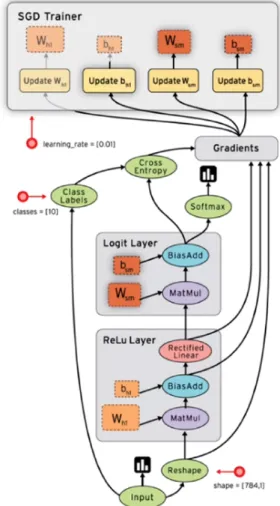
Figure 2.1: Tensorflow graph visualized using Tensorboard. Image obtained from Tensor-flow.org.
8 Materials
the third bigger repository in terms of number of contributors, and also some of its derived repositories where among the fastest growing of all the platform.
Tensorflow’s core is mainly developed in C++, and provides a higher-level interface in Python, although it supports more interfaces in other languages such as C++, Go and Java. It also supports, due to its architectural design, building and deploying graphs either on a Central Processing Unit (CPU) or a Graphic Processing Unit (GPU).
As mentioned before, Tensorflow works with the structure of a data flow graph. In this structure, the data is moved through cells containing different operations to be applied to the data. In the Figure 2.1 we can see a visual representation of one Tensorflow graph obtained with TensorBoard, an open source tool contained inside of Tensorflow’s library for obtaining visual representations of graphs. In that figure, we can see how the data, organized into tensors, is moved through cells which contain mathematical operations, suchs as matrix multiplications and additions. Moreover, we can observe that some of those cells, called layers, are composed of smaller cells. This is because Tensorflow is based on the idea that any kind of operations, independently from its complexity, can be expressed as a group of basic functions and primitive operations. This approach has many advantages for the development of Deep Learning models, because it allows to calculate the derivative of each operation individually and apply the chain rule, which is very useful for the loss functions based on gradient descent methods, a common approach in modern Deep Learning. It also helps to parallelize the operations between different GPUs/CPUs and to divide the model into different paths for different purposes.
Tensorflow is compatible with many different formats for saving and loading its models. The most used of them is the checkpoint, which lets us save a graph already trained or halfway through training, allowing to restore different training points of a model and compare its performance along the training period.
An aditional number of tools is provided by Tensorflow for further functionality. Some of those tools are the already mentioned Tensorboard, for graph visualization through a web interface; FreezeGraph, to convert our models into different supported formats, converting the operations variables into constants; and TransformGraph to apply transformations, such as removing operations no longer needed, to our already saved models.
2.2.1.2 Keras
Keras [9] is a high level Deep Learning open source framework developed by François Chollet in 2015. The aim of Keras is to serve as a middleware between the user and another Deep Learning library supported by Keras, which in this context is called backend, allowing for a faster prototyping and an easier development of Deep Learn-ing models. Because of this, Keras allows the user to define a Deep LearnLearn-ing model interacting only with their own API, and then Keras is responsible for building that same model for the chosen backend.
2.2. Software 9
The backends supported by Keras are Tensorflow, Theano [10] and Computational Network Toolkit (CNTK). It allows the user to interact directly with the chosen back-end through Keras, without almost no operating differences between them.
Keras defines two different APIs to create Deep Learning models with: the Sequential API and the Functional API. The Sequential API consists of a linear stack of layers, and is created just by passing a list of layers and an input shape for the first one. The rest of the shapes can be obtained automatically with shape inference. The Functional API allows more complex models, since you can build multi-output models or models with shared layers. For building a model with the Functional API, you need not only to define a list of layers, but also to state which layer precedes each other, being responsible for matching the shapes between all layers. This system allows the user to have more control over each layer and the internal structure of the network, designing more complex models without much more effort.
Keras provides a number of the most common datasets for an easier access and experimentation in a varied number of topics, such as MNIST, CIFAR10 and the IMDB Movie Review Sentiment Classification. It also provides a number of the most common and well-known models for prediction and feature extraction. Those models are made available with pre-trained weights, and among them we can find the ResNet [11], InceptionV3 [12], VGG [4] and more aditional networks.
2.2.2 Software for game development
2.2.2.1 HardBall
HardBall is an indie football game for Android devices developed by FTB in Unity. HardBall is a fast-paced game with a cartoon aestethic which consists of a mix between football and air-hockey. It is inspired on the popular browser game HaxBall. In HardBall, users can compete in both one-on-one or two versus two matches, both with and against AI bots or other online players. HardBall is targeted to a wide range of mobile devices, both high-end and low-end cell phones.
To explain what a typical game of HardBall consists of, we are going to take Figure 2.3 as a reference, which depicts a screenshot of HardBall’s two versus two game mode. In that game mode, the player is identified with a yellow marker, his companion with a blue marker and the two enemy players with a red marker. Also, we can see the ball in the centre of the field. At the top of the image, we can see the score of each team, and between them the time left until the game ends. Furthermore, on every top corner we can see the team’s name (in this case, we are playing against an AI bot), and their division (the lower the number is, the more experience the player has in HardBall).
The range of actions each player can make is limited to a few. First, the player can move in every direction around them with a joystick. In addition, they can kick, which means that if the ball is in contact with the player, it will be shot in the player’s opposite direction, bouncing in the edges of the field if the case occurs. Finally, the
10 Materials
Figure 2.2: HardBall cover image. Obtained with the permission ofFrom The Bench Games S.L.
player can also use a special power, selected from a list of a few before the game starts, such as speeding up or pushing away enemy players from him. This special power is the only action other players, such as his companion or the enemy players, are not allowed to do.
At the moment of the start of this project, the system used to take decisions for the
Figure 2.3: Screenshot of a game of HardBall’s 2v2 mode. Obtained with the permission of
2.2. Software 11
AI bots was a Decision Tree, which we will see in more detail in chapter 4. Besides, it is important to notice that this version does not differentiate between friendly or enemy behaviour, because all the bots in the game, whichever the team they are on, use the same decision tree for all of its functionability.
Moreover, this same version was published in Google Play in a closed Beta state and collected different data from the players, with the intention of building a private dataset for training agents with Deep Learning methods. The data is collected using a script integrated inside of Unity, and stored in a private database. The information that is recorded is the game mode, the position of every one of the players and the ball in Unity’s coordinate system, and boolean variables for different actions, such as if the player has shot the ball or if a goal was scored. This information is stored for every iteration of the game loop, for every game.
2.2.2.2 Unity
Figure 2.4: Unity logo. The Unity engine can be downloaded fromhttps://unity.com/, from where this logo was obtained.
Unity is a cross-platform game engine developed by Unity Technologies. Even though the main purpose of the engine is the development of 3D videogames, it is also compati-ble with 2D games, as well as simulations, animations and applications that require 3D solutions in general. Unity first version was released in 2005, and it has been updated frequently since then. Currently, three big major versions are released every year, with the name of the version being the year of its release and the version number in that year (for example, 2018.2).
Unity development is mainly done with the C# programming language, despite having had other compatible languages in the past, like Javascript and the in-house language UnityScript. Currently, Unity supports two different runtimes: .NET 3.5 and .NET 4.6, although it is recommended that all new projects start to use the latter. Alongside with it, it supports C# 6 version of the programming language. Recently, Unity has released the new Burst compiler, capable of translating some portions of its
12 Materials
C# code into high-performing native code. An example of its usage was shown in the project Megacity [13], where a procedurally generated city with hundreds of meshes, AI agents and sounds is rendered in real time.
Unity’s internal structure follows the component architectural pattern, where every object in the scene is defined by the number of components attached to it. In this structure, a component can be an independent piece of information or functionability, for example, a 3D mesh or an audio source. In Unity, all objects present in a project are contained inside a scene, where it is organized following a tree structure.
According with data [14], the engine is considered one of the most popular and used game engines in the market, specially in the independent game development scene, and in the development for mobile applications. It stands out in the development for Augmented Reality (AR) and Virtual Reality (VR) devices too.
Moreover, it is also one of the most used game engines in education and research, supported through the brand Unity Labs. Among its topics of research we can find VR, AR, computer visualization, AI and Deep Learning. Through Unity Labs, Unity supports multiple projects for research applied to the engine. For Deep Learning, Unity has specialized support with the library ML-Agents Toolkit. For more information about ML-Agents, check the Subsection 2.2.3.2.
Unity provides support for building projects for 29 different platforms. Among them we can find all the most common operating systems for PC architectures (Windows, Linux, Mac), and also most of the gaming consoles in the market (PlayStation 4, XBOX One) and mobile platforms (Android, iOS, Windows Phone), along with other platforms such as VR headsets and web-based applications.
2.2.3 Software for integration
2.2.3.1 TensorflowSharp
TensorflowSharp is an open source (MIT License) library created in 2017 by Miguel de Icaza, which serves as .Net binding for the Tensorflow library. This allows to interact directly with Tensorflow using a strongly-typed API both in C# and F#. This library surfaces all the low-level Tensorflow library, although it does not include a high-level API like the Python layer on the Tensorflow library, falling in a middle area and serving as a cumberstone for the high level operations usually defined on the Python part.
TensorflowSharp allows the user to import models developed in Keras and Tensor-flow, trained or not, feed them with data and run inference on them. Because of this, it facilitates the process of deploying those models in production environments developed in .NET languages.
TensorflowSharp’s main functionality comes from the TFGraph class, which serves to load and manipulate pre-trained models. The library also provides the TFTensor data class to natively work with multi-dimensional data arrays in C#, and to provide such data to the mentioned TFGraph class for inference.
2.2. Software 13
However, it is important to remark that, even when TensorflowSharp is fully func-tional for loading and infering predictions from a pre-trained model, training a new model is not supported, since it does not provide optimizer classes or functions. For that reason, it is usually recommended to do that step natively in Tensorflow, and only use TensorflowSharp for the deployment stage.
2.2.3.2 ML-Agents Toolkit
ML-Agents Toolkit [1] is an open source project developed by Unity Technologies that serves as a tool for the creation and usage of Deep Learning models inside of Unity. The library works as a plugin for the Unity Engine, and allows to use games and simulations developed in Unity as environments for training agents. Although ML-Agents is mainly focused on Deep Reinforcement Learning, it can be used for imitation learning, neuroevolution and other machine learning methods too.
The library provides a number of tools to define learning environments inside the Unity Editor. Agents main functionality is composed of two packages, the ML-Agents Software Development Kit (SDK) and a Python API. The core functionality, included in the SDK, allows to create a learning environment. In ML-Agents context, a learning environment is a Unity Scene where a number of agents, observations and a particular policy is defined, either for inference or for training new agents. On the other hand, the Python API serves to interface between the engine and Python, allowing to control built environments from there.
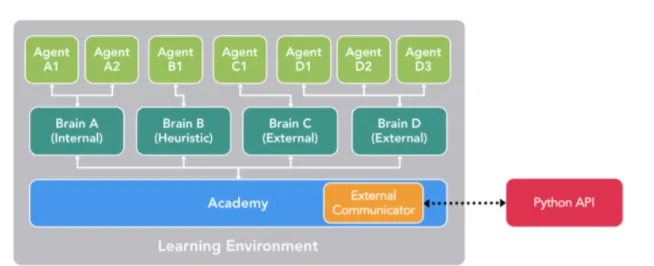
In the Figure 2.5 we can observe a visual representation of the components a Learning Environment defined by ML-Agents has. In that figure, we can differenciate three types of Unity components: Agent, Brain and Academy.
An Agent Component is a Unity GameObject placed in a scene, usually in a GameOb-ject with a visualizable mesh associated with. Every Agent is responsible for collecting observations from the scene and for executing actions in that environment. Every Agent must be linked to a single Brain, which is responsible of taking the decisions for them.
A Brain Component is also a Unity GameObject placed in a scene, but unlike the Agent component, it is usually not attached to a rendered object nor one with addi-tional functionability. A Brain provides the policy which the Agents asociated with follow. A Brain can be attached to any number of Agents, but only the Agents with a valid observation and action space can be attached to it. Although the types of Brains have changed in following versions, as of the version 0.5 of ML-Agents (the one mainly used in this project) there are four different types of Brains: Player, Heuristic, Internal and External.
A Player Brain is, as it name suggests, a Brain whose actions are mapped into keys and actions controlled by the player of the game. This is specially useful for testing the Agents actions when developing a learning environment. A Heuristic Brain is one with the logic hand-coded by extending the Decision class. It requires to define a script
14 Materials
Figure 2.5: General structure of a learning environment in ml-agents toolkit v0.5. It fea-tures an Academy in communication with an external Python program through the Python API, four different Brains(one Internal, one Heuristic and two Ex-ternals) and seven different agents attached to those brains. Image obtained from the paper ”Unity: A General Platform For Intelligent Agents” [1].
where to delegate the decision process of the Brain.
Both External and Internal Brains are prepared to be used for usage with Deep Learning algorithms. On the one hand, an External Brain is one used for training using the environment, usually controlled through the Python API. On the other hand, an Internal Brain is used for creating Agents with an already trained Brain which we do not want it to keep learning. Internal Brains also allow to load a pre-trained model in
.bytes format for inference, even when it has not been trained as an External Brain. Finally, the last component of the library is the Academy Component. The Academy Component is responsible to orchestrate all the Agents and Brains in a Unity scene. A learning environment must contain one, and only one Academy in usage. The Academy will be responsible for initializing the environment and setting the values of the training, such as the vector of data the Players are going to collect from the environment or the number of frames accumulated by the Agents before a new inference is done by its associated Brain. An Academy is also responsible of communicating with the Python API, since it controlls all the learning environment.
In the following ML-Agents versions, the External and Internal Brains have been combined in the Learning Brain, which can be set to Training Mode, which works similarly to the External Brain, or to Inference Mode, instead of the Internal Brain. Moreover, the format a Brain expects to receive has changed in recent versions too, from the .bytes format to the .nn format.
On the other hand, until ML-Agents version 0.7, the library relied on Tensorflow-Sharp for running the models and obtaining predictions, which required to install it in the project too. Starting with the version 0.7 release, ML-Agents provides his own
2.2. Software 15
in-house Inference Engine, replacing the usage of TensorflowSharp in the project, and no longer requiring it as a dependency. Unity Inference Engine is focused on cross-platform compatibility and performance, with a small size (600KB), better for working on certain platforms such as mobile or some embedded systems.
Along with this functionalities, ML-Agents also provides a large number of example environments with pre-trained agents, both for learning about the library features and to serve as a starting point for further research on Reinforcement Learning tasks. These environments provide examples of ML-Agents multiple functionalities, such as single or multi-agent scenarios and discrete or continuous action spaces. A general view of some of the examples provided in the Toolkit can be seen in Figure 2.6. Although is not the purpose of this section to describe in detail each paper, its important to remark that one particular environment, called Soccer Twos, shows a little version of a two versus two football game with one player and one goalkeeper in each team.
Figure 2.6: Pre-built environments provided by the ML-Agents Toolkit. Image obtained from ML-Agents Toolkit repository under the License Apache 2.0 (https://gi thub.com/Unity-Technologies/ml-agents).
ML-Agents also provides a number of built Reinforcement Learning algorithms and modules, to serve as a base of experimentation for further research. Among the algo-rithms provided by Unity, we can find Proximal Policy Optimization (PPO), a state of the art Deep Reinforcement Learning algorithm used by OpenAI for the development of OpenAI Five [15], a Deep Learning Bot trained to play a videogame (Defense Of
16 Materials
The Ancients 2) competitively. This algorithm is provided with the option to extend it using a LSTM Cell and a Intrinsic Curiosity Module. Finally, an implementation of Behavioral Cloning, a simple Imitation Learning algorithm is provided too.
A number of projects have shown the usage of ML-Agents in production environ-ments with success. A demo game was built by the Unity team to showcase the usage of the library with the name of Puppo, The Corgi [16]. There, a little dog called Puppo is trained to move and interact with the player using only a Reinforcement Learning algorithm and a set policy. The movement was developed using Unity’s physics engine, therefore making the dog learn to walk in the process. Other projects have been built since then by external partners using ML-Agents. One remarkable example is Snoopy Pop [17], a mobile arcade game of the bubble shooter genre, which was trained to emulate a user playing the game.
2.3 Hardware
Apart from all the software tools needed to develop this project, it also needs hardware devices, both for training the neural networks developed and for testing the game, both in computers or mobile devices. For that reason, two different machines have been used for this project: a computer, that is going to be used for all the development process and the testing on Windows platforms, and a mobile phone compatible with Android, that will be our testing device for the final versions of the game.
The technical details of the Windows computer used on this project are the following: • CPU: Intel® Core™ i5-7300HQ / 4 Cores 2.50 GHz
• GPU: NVIDIA® GeForce® GTX950M / 2GB GDDR5 VRAM • RAM: 8GB DDR4 2133MHz
• Storage: 1TB 7200rpm SATA
The technical details presented here are the ones that result relevant for the training and testing of the project. For that purpose, the main priority when choosing our hardware is obtaining the fastest processing speed possible, because we expect the training process to be a large part of the development time and it could impact the schedule of the work the most. Since the technologies we planned to use already support the usage of GPU-based training, both CPU and GPU result important here, since both could be used for the training process. Moreover, for testing purposes the processing units result the most relevant parts of the hardware, since we will compare the number of frames per second produced by the game at different points of the development, and for that reason, the better the CPU and GPU are, the bigger the framerate is.
Finally, both rapid access memory and hard-drive storage can impact the speed of the workflow: RAM will allow us to load larger amounts of data on memory simultaneously
2.3. Hardware 17
at the time of training, and the storage device will let us to load and save faster new files from memory, and also in larger quantities. RAM will also impact the performance at the time of testing, in a same way as explained with the CPU and GPU.
For testing on mobile platforms, a Xiaomi Redmi 4X has been chosen, with the following technical details:
• CPU: Qualcomm MSM8940 Snapdragon 435 / Octa-core 1.4 GHz • GPU: Qualcomm Adreno 505 / 450 MHz
• RAM: 4GB • Storage: 64GB
• Battery: Li-Po 4100 mAh
Since this device is only planned to be used for testing purposes, the most relevant parts of it are the CPU, GPU and RAM, since we will look at the framerate obtained by playing HardBall on it at different points of the development. The battery becomes relevant too, because we will use that as a way of comparing battery consumption between different versions of the software.
3 Related Works
In this chapter, we review the current state of the art in the Deep Learning field applied to game development. The chapter is divided in four different sections. Section 3.1 sets the context of the chapter. Section 3.2 summarize and analyze the development of Artificial Intelligence for videogame devel-opment. Later, in Section 3.3 the most relevant Deep Learning techniques to this work are introduced and explained. Finally, in Section 3.4, the relevant Deep Learning work applied to the Videogame Industry is exposed.
3.1 Introduction
In the following sections, we review most modern deep learning works applied to the game development industry. This is mainly extracted from the most relevant Deep Learning and Game Development journals and conferences. Both projects that use games as a platform for research and projects that use Deep Learning techniques for its Artificial Intelligence are taken in consideration.
3.2 Artificial Intelligence in the Videogame Industry
Artificial Intelligence in the videogame industry has been one key aspect in the field, and its relation with it is almost as old as game development itself. Even before of the existence of videogames, AI was applied to game environments to research about the limits and possibilites of computers in solving tasks that seemed to require intelligence. A good example of this can be found on Alan Turing, the father of computer science, who reinvented and adapted the Minimax algorithm for playing Chess [18].
Since then, many researches carried in early AI have used game environments, mostly classic board games like Checkers and Chess, to push forward the limits of the field. Important milestones related to this are the defeat of the Checkers World Champion in 1994 [19], work that later ended solving Checkers on 2007 [20], and the defeat of the Chess World Champion Gary Kasparov in 1997 by IBM’s Deep Blue [21], with a highly-adapted and modified version of Minimax.
AI in the videogame industry is not only used for research, using videogames as more complex game scenarios with a defined set of rules, instead they are mostly used as a tool of game developers themselves. In opposition to popular belief, the first videogames did not feature a single player mode, instead they were mostly two versus
20 Related Works
two games where one human played against other. Examples of this are popular games such as Pong, Space Raceor Gotcha, mostly developed in the 1960s and early 1970s.
But soon after that, games with a single player mode started to appear, usually replacing the figure of the enemy played with a very simple AI composed of a predefined behavior that all enemies blindly followed. We can mention games like Speed Race, which also was the first vertical scrolling videogame, or Qwak!, as examples of this early use of Artificial Intelligence in videogames. Moreover, due to all enemies having, tipically, the same predefined behavior, a random element was added usually to achieve a false sense of intelligence in the enemies, and avoid the players to feel that they were facing always the same predefined rival.
The rise of video games as entertainment and the popularization of them among the population soon increased the demand of more engaging experiences, in pair with the development of better machines, capable of creating bigger games with better graphics. It was during this time, known as the golden age of arcade video games [22], that we can find examples of more complex AI, with remarkable examples like Space Invaders, which had distinct enemy patterns, an increasing difficulty level and in-game events based on the player’s input, and Galaxian, which included enemy maneuvers who breaked out of formation to act independently, oppositedly to what was usual in games until then.
A very important example contemporary of that time is Pac-Man, which featured different personalities for the enemies of the game [23]. In Pac-Man, the player faced the task of collecting a number of points in a maze, while avoiding four ghosts, each
Figure 3.1: Scatter areas for the four different ghosts in Pac-Man. Each color defines the area where the ghost with the corresponding color moved when they were in scatter mode. Image obtained from https://dev.to/code2bits/pac-man-patterns--ghost-movement-strategy-pattern-1k1a
3.2. Artificial Intelligence in the Videogame Industry 21
one of a different color, whose contact was typically lethal to the player under most circumstancies. Because of the structure of the game, most of the game engage and fun for the player relied on the AI developed for it.
To achieve the task of developing an Artificial Intelligence capable of showcasing different personalities for the four enemies of the game, while still being possible to work in a computer of that time at the frequency required by a videogame, a general scope intelligence was developed. This general purpose AI worked as a simple finite state machine, with three different states: Chase, Scatter and Frightened.
Chase was the state in which the ghosts behaved most of the time, trying to reach the player’s position to make him lose a life and potentially finish the game. Scatter was a game state introduced to give the player a little break, making the enemies move to a different corner of the map, thus being less aggresive with the player and expanding over the map. Finally, Frightened was triggered when the player collected one of the four items, spread over the map, that allowed him to kill ghosts when in contact with them, for a short time after picking the item.
This finite state machine worked in the same way for all four ghosts; but two main differences were introduced to make them have different personalities, apparently. First, the time when each ghost entered scatter mode was predefined, and different, for each of them. Also, it moved them to a different corner of the map, making consequently some of the ghost seem more evasive because they used to move away from the player sooner or more frequently. In Figure 3.1 its possible to observe the areas where each enemy moved when they behaved in scatter mode.
Finally, the element which made a bigger impact on player’s perception of different enemy personalities was in the Chase mode. When a ghost selected where to move in an intersection, it usually was done with a random choose, influenced by predefined probabilities. Those probabilities where influenced depending on Pac-Man’s position, but those probabilities where different for each one of the ghosts. In the Figure 3.2 its possible to see those differences of behaviors due to the influence of Pac-Man in each ghost surroundings.
Its in the example of Pac-Man that we can identify an important difference between traditional Artificial Intelligence and game AI. While the main objective of traditional AI is to obtain better, more consistent intelligences, capables of coping with complex real-world problems, game AI is instead focused on the illusion of intelligence a player perceives. Because of this, big differences of application can be found between the academic world and the industry. Due to this, many experts have complained about the use of the term AI when talking about game AI, because of the difference between the academic and the industry approaches [24].
Since then, always at a slow pace, more and more traditional AI techniques started to be more used in the game industry. At the beginning of the 1990s, and coinciding with the emergence of new game genres, tools like finite state machines, decision trees, fuzzy logic [25] and, later, behavior trees, supposed important milestones in the development of game AI [26] [27].
22 Related Works
Figure 3.2: Example of different enemy movements when Pac-Man is near. It showcases a range of behaviors from more aggresive enemies, like Blinky, to more defensive or even evasive others, like Clyde. Image obtained from https://dev.to/cod e2bits/pac-man-patterns--ghost-movement-strategy-pattern-1k1a
Because of the own nature of video games and the players demands of bigger, more visually appealing games, game AI development was initially relegated to the back-ground. The computational cost of creating bigger and better looking game worlds, with better physics simulations, forced game developers to choose between dedicating
Figure 3.3: Screenshot of the game Façade, where the player, non-visible, is talking to an NPC called Grace, in the centre of the screen. The words that appear in the picture have been written by the player, and don’t follow any guideline or restriction from the game. The NPCs of the game interact with the player words using a NLP system.
3.3. Introduction to Deep Learning 23
most of the CPU capabilities to graphics or AI, therefore making game AI development much more slower than the graphical part. Because of that, is possible to identify a clear evolution of videogames from year to year looking at the visuals, but when the AI is in the spotlight, the evolution is much more slower.
The emergence of modern GPUs, capable of rendering complex game-world scenarios with ease, left more room for the development of better game AIs. Also, the importance of the development of good AIs inside the industry has changed drastically, and now big game studios usually have dedicated teams to the development of Artificial Intelligence for their games [28].
Thanks to this, in recent years we have seen the presence of big milestones in the development of AI inside the industry. Good examples of that are games like Façade
[29], a game fully developed around its AI, with special focus on Natural Language Processing (NLP), due to it being a conversational adventure where the player is capa-ble of communicating with two different Non-Playacapa-ble Characters (NPC) writing with the keyboard, like if he was talking to real people. A screenshot of this game can be seen in Figure 3.3.
Moreover, it is also possible to find working examples of early presence of learning intelligences, and specifically, Neural Networks, in the videogame industry. Two famous cases are the game seriesCreaturesand the game seriesBlack & White, which combined machine learning techniques with emergent behavior and behavior trees to create NPCs capable of learning from the players actions. In fact, the learning aspect of the game
Black & White has been considered that it was very advanced in its time, integrating learning algorithms in the gameplay in a way that nowadays has not been replicated yet.
3.3 Introduction to Deep Learning
Deep Learning is an artificial intelligence field derived from Machine Learning that is concerned with algorithms inspired by the structure and function of the brain. Deep Learning can be explained as a subset of Machine Learning, composed by multiple (deep) layers of neurons with the intention of imitating the structure of the brain. Therefore, most of the Deep Learning methods use ANNs, which are general purpose functions with a graph structure capable of, given an expected input, learn its corre-spondent output and generalize that knowledge to input never seen before [30].
To explain in further detail the functionality of an ANN, we need to look at the structure of a single artificial neuron, known as the perceptron. The perceptron is a structure invented by Frank Rosenblatt to represent an artificial binary neuron [31] and its mainly aimed at the task of lineal classification through very simple learning algorithms.
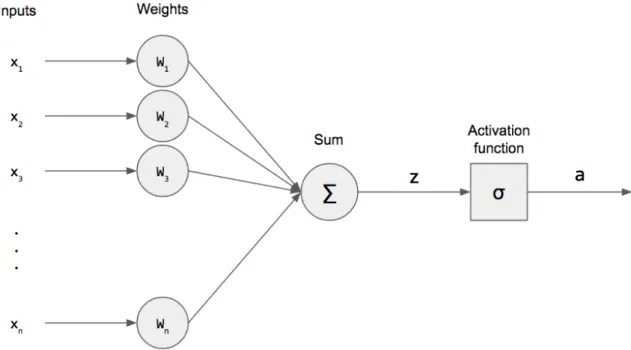
In order to see in more detail the internal architecture of a perceptron, we can look at Figure 3.4, where a structure of a multi-input perceptron is depicted. There, we can
24 Related Works
identify four different elements or steps which, in total, compose a perceptron: Inputs, Weights, Summation and, optionally, Activation Function. The Inputs, which can be of any length as long as its always the same for the same perceptron, are the numerical values we are going to provide to the perceptron in order to make him predict an output. When the Inputs are provided to the perceptron, each of them is multiplied to its correspondent weight, which the perceptron must have initialized previously. In this step, a bias term can be added to gain more control over the output of the perceptron. After that, we proceed to the Summation of all the result values we just obtained from the previous multiplications, obtaining a single value. This value may be considered the output of the perceptron, but it is possible to modify that obtained value with an activation function, which will be useful for mapping the obtained value to a certain range where the output is expected, in addition to allowing for a better training when several perceptrons are connected in different layers.
Figure 3.4: Structure of a perceptron. It contains the Inputs, defined from x1 to xn, the
weights, defined from W1 toWn, a Summation, with the resulting value z, and
an Activation Function, with the resulting value a. Source: https://medium .com/@stanleydukor/neural-representation-of-and-or-not-xor-and-xnor-logic-gates-perceptron-algorithm-b0275375fea1
Now that we understand the basic structure of a perceptron, its easier to explain the training process which happens in all these algorithms, and results in what we know as Machine Learning. As we saw before, the perceptron mainly provides a number of weights, usually initialized with a random value, equal to the number of inputs. When we do all the perceptron process with an input which we already know its
3.3. Introduction to Deep Learning 25
expected output, its possible to compare the difference between that expected output and the output from the perceptron. That difference, which we call error, can be moved backwards through this structure, computing the partial derivatives of the error with regards to each weight, and therefore obtaining how we should update each weight to obtain the desired output. This process is known as gradient descent.
This algorithm has been proved useful in the past, and supposed the cornerstone for the development of Machine Learning first, and Deep Learning later, as the artificial neuron depicted here has been the basis for the development of ANNs. In Artificial Neural Networks, we can usually find many layers of neurons, tipically with hundreds or thousands of neurons each, capable of generalizing to very complex problems where humans have struggled in the past.
To further understand the structure of a neural network, we can look at Figure 3.5. This image, very similar to the perceptron figure, depicts the structure of an ANN with three layers, each composed of one or more perceptrons, identified here as a single node, with the exception of the Input Layer. As we can see in the figure, in modern neural networks the neurons are structured in layers, where each neuron receives as input all of the previous neurons in order (as depicted the Figure 3.4 in the first step) and produces a single output, which will serve as the input for the next layer. It should be noted that neurons do not interact with other neurons from the same layer
Figure 3.5: Architecture of a neural network composed of three layers: An Input layer with four elements, a fully connected hidden layer with five nodes and an output layer with one node. Image obtained from astroml.org.
As said before, the first layer, known in Deep Learning terminology as Input Layer, does not contain an initial array of weights and an activation function. Instead of that, each node in the Input Layer contains a single value ready to be provided to the network. Following the Deep Learning terminology commonly used in the field, each
26 Related Works
of the layers between the Input Layer and the last layer, known as the Output Layer, are known as Hidden Layers. Although the scheme shows a neural network with only one hidden layer, its common to have many more, as we can find in networks such as Inception V3 [12], with 48 layers, and ResNet-101 [11], with 101 layers in total.
Subsequently, when an input is carried through the network to obtain an output, the mathematical operations ocurring internally are dense matrix multiplications [32], where the data vector is multiplied by the weights of every neuron, and, therefore, obtaining a different matrix of values in each layer. For that reason, its importan