Procedia Computer Science 100 ( 2016 ) 907 – 914
1877-0509 © 2016 Published by Elsevier B.V. This is an open access article under the CC BY-NC-ND license (http://creativecommons.org/licenses/by-nc-nd/4.0/).
Peer-review under responsibility of the organizing committee of CENTERIS 2016 doi: 10.1016/j.procs.2016.09.242
ScienceDirect
Conference on ENTERprise Information Systems / International Conference on Project
MANagement / Conference on Health and Social Care Information Systems and Technologies,
CENTERIS / ProjMAN / HCist 2016, October 5-7, 2016
Towards Infrastructure for Knowledge-based Decision Support in
Clinical Practice
Ilya I. Syomov
a, Ekaterina V. Bologva
a,*, Sergey V. Kovalchuk
a,
Alexey V. Krikunov
a, Olga M. Moiseeva
b,a, Maria A. Simakova
b,aa
ITMO University, 49 Kronverksky Pr., St. Petersburg, 197101, Russia
bFederal Almazov North-West Medical Research Centre, 2 Akkuratova street, St. Petersburg 197341, Russia.
Abstract
This article presents the results of a study aimed at a developing an approach to the design of information infrastructure of medical institutions that use knowledge-based clinical decision support systems (CDSS). As a source of knowledge, we mainly consider the data stored in medical information system (MIS). The authors attempted to formulate an approach that will be flexible enough to allow engineers to realize almost any scenario of decision-support. To illustrate its practical use, we describe its application to one of the problems now being actively solved in the course of cooperation between ITMO University and Federal Almazov North-West Medical Research Centre, namely - development of a CDSS for the diagnostics of pulmonary arterial hypertension.
© 2016 The Authors. Published by Elsevier B.V.
Peer-review under responsibility of SciKA - Association for Promotion and Dissemination of Scientific Knowledge. Keywords: clinical decision support systems; knowledge extraction; pulmonary hypertension; echocardiography analysis; electronic health records; information infrastructure; knowledge-based decision support
1. Introduction
Nowadays technologies for creating decision support systems (DSS) in various subject domains are well developed. However, often application of the existing approaches to design DSS health care and medical is faced
* Corresponding author. Tel.: +7-952-351-9936.
E-mail address: [email protected]
© 2016 Published by Elsevier B.V. This is an open access article under the CC BY-NC-ND license (http://creativecommons.org/licenses/by-nc-nd/4.0/).
with significant difficulties for several reasons considered further with respect to Russian hospital practice. First of all, medical information systems (MIS) in use often do not provide the functionality of DSS or the possibility to add such options. DSS deployment with existing MIS will complicate doctors’ work because with filling paper records and entering data into MIS they will have to double the data in the CDSS. In addition, there is currently no understanding of which processes primarily need the support of DSS. And a list of such processes may vary depending on the medical center, and even change over time. This means that applying known approaches to the development of DSS requires a special design of a new decision support system for each specific task. Therefore, DSS should be introduced with minimal changes in the user interface.
On the other hand, extracting knowledge from medical texts is a significant problem as well (especially in the Russian language). Firstly, the vast majority of methods and algorithms are designed to extract knowledge from well-structured data. However, data in modern clinical practice (especially with the lack of computerization in medical centers) is characterized by weak structure, e.g. data is stored in different formats, in different storages, and there are texts in natural language, handwritten texts and etc. Implementation of a medical information system allows data to be stored in a more centralized and structured way, but doesn’t solve the problem. Secondly, the most recent text processing tools in natural language are focused on work with Germanic and Romanic languages, which is why it is difficult to process Russian texts automatically using these tools.
Another important requirement of CDSS is effective functionality in the semantic and technological heterogeneity of the data as received online, and available in the databases of MIS. To overcome the constraints expressed above, it is necessary to combine existing approaches to building CDSS at various levels. In particular, conceptual hybridization of DSS, which provides integration of models, data, knowledge, documents, and communication capabilities, is necessary, because classic methods to design CDSS usually choose one of these classes of objects as central to the construction of the overall system architecture. But in the context of the current challenges, it is necessary to integrate the objects of all classes: a) Different models (simulation, statistical, numerical); b) Heterogeneous data sets (electronic and paper medical records); c) Different types of knowledge (recoverable in automatic or automatic modes, or provided experts explicitly); d) Communication facilities for coordination of actions of geographically remote specialists, and so on.
Design technologies of modular CDSS that can be integrated and adopted to medical center business processes have evolved. Such technologies allow a new CDSS to be constructed, or supplement the existing ones (with readymade modules), providing them with self-study based on MIS data. And self-study will: a) Reduce the cost of and implementation and introduction; b)Provide the adaptation of medical center’s business processes.
In this paper, we propose a conceptual approach to the organization of infrastructure for knowledge-based decision support systems in clinical practice based on our previously expressed ideas1.
2. Related works
One of the key areas of advanced CDSS and overall health technology is P4 medicine2. P4 medicine and System Medicine (a more general concept)3 determine the need to integrate a wide range of conceptual, methodological, and technological approaches and solutions within a unified information technology interdisciplinary system. Cloud computing concept4, Big Data, and data/information fusion5 are the technological foundations of such systems in data processing. These concepts unify and integrate computing resources, distributed processing resources of Big Data, heterogeneous data sources, and information. These technologies are actively used in various fields of science and industry, but their application to clinical decision support systems is more sporadic.
The clinical decision support system’s design6 has an extensive history and a wide range of solution classes. There is a lot of research on the effectiveness of clinical DSS7, as well as attempts to develop general recommendations for their construction8. The book9 mentions that utilization of CDSS benefits in clinical practice is associated with additional barriers. For example, if CDSS is diagnostic, it is a separate application, which leads to the duplication of data entry to CDSS and MIS. To resolve this issue, decision-making features have already been implemented in some commercial MISs. However, the migration to new MIS as well as the development of a new system that combines the functionality of DSS and MIS, leaves an unresolved issue of using the data of the system. Based on numerous publications about the CDSS design, the authors in the paper10 assert that a new CDSS should be developed, on the one hand, to be easy to use, on the other hand, to limit the possibility to ignore the issued
recommendations. According to the Agency for Healthcare Research and Quality, many aspects of optimal implementation of clinical decision support systems in MIS remain unclear and require further research11. The problem of data-based business process identification is applied in many fields12, including medicine13, and DSS in medicine14. The problem of developing models of a configurable business process is tackled by many authors15. Although the model of the clinical episode is more complicated than a business process model, we cannot directly apply these methods as they are. Furthermore, in the assessment of the future development of CDSS6, the authors predict that the various modules of building DSS will increasingly appear and will be publicly available on the Internet. So, in near future, CDSS should have well-tested and proven capabilities, and even will use existing DSS as a basis for new ones. In addition, the accessibility of open modules will allow to expand the list of business processes available to support decision making.
Separately, it should be noted that the area of medical decisions support has individual characteristics. It defines psychological, organizational and legal aspects of decision-making related to the lives and health of patients and the personal responsibility of a doctor. Thus, the work16 is devoted to the peculiarities of clinical decision-making within the area of expertise of a doctor. Keeping in mind that the area of medical knowledge differs by: a)Weak structure; b) Set of diverse requirements and recommendations (international, Russian, local); c) Periodic appearance of critical updates in the knowledge (for example, the work17 describes a number of medical practices canceled during the period 2001-2010).
The problem of extraction of medical knowledge has its own characteristics and is connected with the input format of the data and its (often) partial or complete structure and nature18,19. Automatic20 or semi-automatic21 extracted knowledge forms the knowledge base, that is the basis for a CDSS22,23 and further research. There are standards for structuring and storing the clinical knowledge: single instruments and whole platforms are designed for the extraction of knowledge from medical data24 Knowledge Bases and annotated corpus of texts are used as a basis for such instruments25. Their significant drawback is that they are designed to work with data that has a relatively clear structure, while the unstructured data is still puzzling researchers20,21. Natural language processing tools are targeted primarily to work with Germanic languages26, which means Slavic language branch analytics use only a part of the available options. However, there are recent works dedicated to the processing of medical data in Russian27, where the authors solve the problem of extracting information from medical records and offer architecture of integrated intelligent analysis of medical data.
Currently, the modern tools, techniques, and algorithms for negotiation of limitations described in the introduction are well developed. However, a general approach to CDSS implementation that will overcome all of the obstacles above, requires detailed study and further investigation.
3. Infrastructure for knowledge-based decision support
CDSS implementation into clinical practice requires medical institution information infrastructure to be adapted properly. Below, we propose the organizational principle for the information infrastructure of a medical institution that uses multifunctional modular knowledge-based CDSS. It is based on the idea of monitoring the infrastructural elements, data streams and working scenarios by using a control Kernel.
3.1. Conceptual architecture
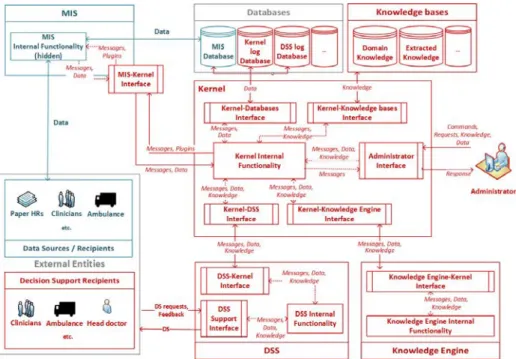
The idea presented below (Fig. 1.) is intended to help the engineer organize the information infrastructure in a way that exploits a modern self-learning knowledge-based CDSS that uses actual clinical data. Basic elements that make up the infrastructure are described as well as relationships between them.
The authors sought to provide a description of the principle on a high enough abstraction level that within if it was possible to implement almost any scenario of decision support, and, at the same time, "low" enough to avoid any possible ambiguities about the correspondence between real-world objects and parts of the infrastructure.
It is assumed that in its initial state, the medical institution information infrastructure (teal contours) consist of the following elements: MIS, which receives data from external data sources and provides data access to the data recipients (which might also act as data sources) - doctors, paper EHRs, ambulances, etc. All actual data are being stored in the MIS database.
Fig. 1. Conceptual architecture.
The widened infrastructure (red contours), is aimed at the maintenance of CDSS operation, providing its services to decision support recipients, consisting of several elements that communicate with each other via messages, data and formalized knowledge in accordance with infrastructure internal protocol. The Knowledge Engine (KE) carries out all knowledge extraction operations. Data and knowledge routing, both stored at corresponding databases and knowledge bases, as well as receiving data from MIS database, are carried out by the Kernel which is capable of managing infrastructure workflow in standalone mode or under the control of the administrator. Below we will examine each of the infrastructure elements in more detail.
The role of Decision Support Recipients is suitable for doctors, as well as the service and administrative staff of medical institutions., Knowledge extraction algorithms, user-CDSS interaction scripts, required CDSS modules, and feedback collection mechanisms are being determined depending on the specificity of the recipient’s job and their initial data needs.
Clinical Decision Support System contains a library of models and tools. In fact, this is a set of smaller DSSs, gathered in one place, and their composition and realization is a matter of meeting the needs of a particular user, who interacts with CDSS via the user interface. Through the Kernel, CDSS is provided with the parameters of models, formalized knowledge of the patient’s conditions, etc. CDSS, in turn, sends its logs back into the Kernel, user feedbacks knowledge and other information, depending on the implementation of the specific CDSS module.
Knowledge Engine is a set of modules designed to process medical data and extract formalized knowledge. The specific implementation of modules and structure are determined by the developer’s needs and depends on the type of data stored in the MIS and the formalized knowledge structures required.
The Kernel provides the KE with MIS data and, if needed, knowledge and data stored in other knowledge bases and databases. The latter play the role of metaknowledge and metadata required to extract new knowledge from the collection of raw data.
The infrastructure includes several Databases: a Kernel logs base and CDSS logs base (mentioned earlier). The first one is required in order to provide administrators with information for infrastructure state control and analysis. The second one is required for quality assurance of decision support and the identification of errors in the models used by the CDSS. It is understood that depending on specific implementations, the list of databases may be extended, but these two are considered necessary.
In turn, we propose that Knowledge Bases: the domain knowledge base (medicine, in this case), and the base of knowledge that have been extracted in the course of data processing are necessary. The first base cannot be changed or updated from inside of the infrastructure, and it can only be used as a repository of completely verified, and reliable scientific knowledge. Second base, or rather, a class of knowledge bases, stores the knowledge extracted in the course of Knowledge Engine and CDSS in a formalized way. This includes personalized status information of patients, model parameters defined and redefined during CDSS module self-learning, etc.
The Kernel’s functions are to route data flows within the infrastructure in accordance with its internal protocol, and to provide the infrastructure administrator the ability to change the configuration of the connected modules.
Being connected with MIS via some interface, the Kernel has the ability to access the MIS database. On a deeper level of integration, this interface can extend the MIS user interface with some simple decision support plug-ins that control the completion and structure of user input, for example, a spell-checker that, corrects typing errors or a primitive rule-based system that controls the dosage of prescribed drugs.
The Administrator monitors the state of the infrastructure and configures its individual elements. The Kernel administrator is able to access all the elements of the infrastructure. They can connect and disconnect CDSS and KE modules, edit the content of knowledge bases and databases, or change their logical structure, and load new workflow scenarios into Kernel. The administrator is first and foremost a role that might be implemented either by a human or by a sophisticated enough algorithm.
3.2. Knowledge-cycle
In this section, we describe our view of the general "life cycle" of the knowledge extracted from the MIS data, regardless of the particular application. The described sequence of steps, however, is not the only one possible, and can be supplemented, or conversely, reduced, depending on the content of the specific scenario being implemented within the infrastructure.
Initially, the raw data, containing some knowledge in an implicit form, and information about the data origin, enter the Kernel by means of MIS-Kernel interface. The Kernel routes the raw data in the Knowledge Engine, where, if necessary, analysis and preprocessing is implemented. Using information about the origin of data received from the Kernel, the Knowledge Engine applies the appropriate modules or knowledge search and extraction, which return the knowledge contained in the data, in a formalized representation.
Formalized knowledge is validated if necessary, in order to avoid conflicts with existing knowledge. First of all, this concerns the verification of compliance for a certain set of rules representing some fundamental real-world information. Secondly, if the knowledge is relevant to a certain object (e.g. a patient), it is checked for conflicts between the new knowledge and the previously extracted knowledge about that particular object.
Valid formalized knowledge is being routed by the Kernel to corresponding a knowledge base and added to existing knowledge. Then, according to the current scenario, knowledge might be transferred to the CDSS or Knowledge Engine (in the latter case - as a metaknowledge) where it is used for decision support or extraction of some new knowledge based on already available knowledge.
The resulting knowledge can be updated and complemented in several ways: on the basis of feedback from the CDSS user, as a result of the Knowledge Engine (both by knowledge extraction from the new data, and by searching cumulative knowledge distributed across multiple knowledge bases), or directly by the infrastructure administrator. 3.3. Self-learning scenario
At the initial stage, the DSS uses the data stored in MIS with the implemented integration procedure. Based on the data, an initial model of outpatient episode is identified. This model reflects the existing business processes of the medical center. At the same time, an "ideal" model of outpatient episode is generated on the basis of rules and regulations selected (defined) by an expert or decision maker. After comparison of the models, mismatches between the "ideal" and the initial models are identified. The decision maker gets information about the discrepancy between the current situation and the desired one (e.g., mismatch EMR to regulations).
The system provides a set of functional modules that can be integrated with MIS for supporting decision-making (and clinical practice in general) in order to eliminate mismatches. After the decision maker has chosen and
customized the required functions, the DSS will integrate the required modules into MIS and merge existing models with the new ones. At the first iteration, the proposed procedure fits decision making models using the existing data. Within the following steps of models merging, self-learning of DSS is performed. This can be done in order to assess the effectiveness of the DSS module integration with MIS, or when new or updated rules and regulations are introduced.
4. PAH detection problem via self-learning knowledge-based CDSS
As an example of the above approach, we present a recently launched study realizing a self-learning knowledge-based CDSS that is designed to solve the problem of early diagnosis of a pulmonary arterial hypertension (PAH).
Pulmonary hypertension is a group of diseases that are heterogeneous in their etiology and pathogenetic mechanisms, combined on the basis of increase in pulmonary artery pressure28. The presence of pulmonary hypertension has always been associated with a poor prognosis, as it leads to rapid development of severe right heart failure and premature death of patients. The emergence of specific therapy for pulmonary arterial hypertension in the last decade significantly improved the prognosis of patients with this disease. Therefore, the selection of potential candidates for further examination and specific therapy appointments in case of diagnosis verification becomes an important medical and social problem. In recent years, the two-dimensional echocardiography has been proposed as the primary method of pulmonary hypertension screening and diagnostics29.
4.1. Initial data
Our initial data is anonymous patient EHRs for the period from 2008 to 2014 (more than 200,000 unique patients) provided by Federal Almazov North-West Medical Research Centre.
At the stage of the early analysis of EHR data we have evaluated distributions by age for essential hypertension and hypertensive heart disease for cardiological patients treated during 2014 (Fig. 2.).
Fig. 2. Essential hypertension (I10) and hypertensive heart disease (I11) distributions by age.
Echocardiography is performed for all cardiological patients during outpatient and inpatient examination. The results of echocardiography are entered into the MIS in the form of numerical values and medical descriptive text in the Russian language.
4.2. Extracting patient-specific knowledge
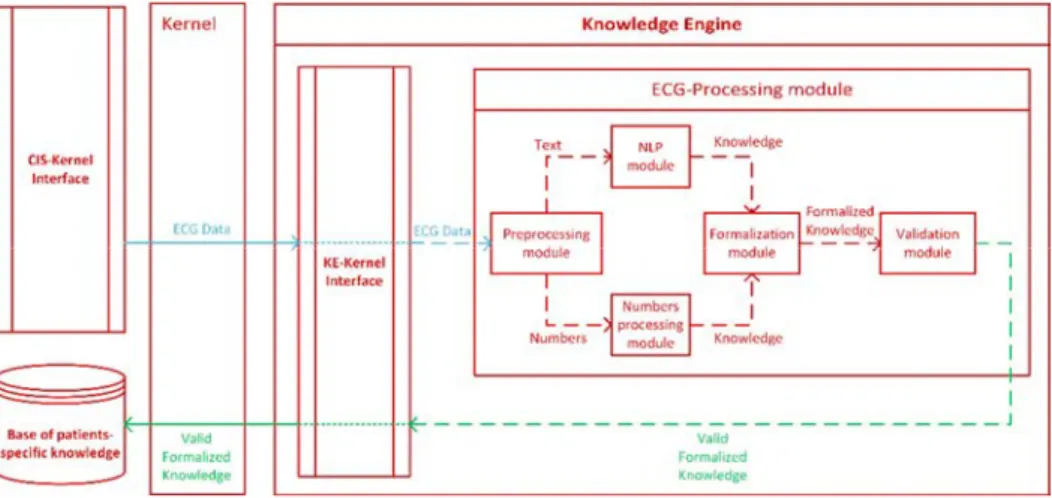
These echocardiography results are getting into the Kernel through MIS-Kernel interface and then being routed to the Knowledge Engine by the Kernel. The Knowledge Engine interface transmits the data to the echo processing module (Fig. 3.). At the pre-processing stage, data is separated into textual and numerical parts. The textual part is sent to the natural language processing module, while the numerical part is sent to the module designed to extract knowledge from echocardiogram amounts. Knowledge extracted from both parts is transmitted to the module, which returns some structure representing formalized knowledge suitable for storage in the knowledge base and further use in CDSS. Then, formalized knowledge goes through a validation process for compliance with information about the real world, earlier information about the patient to avoid possible contradictions.
The resulting validated and formalized knowledge is passed back to the Kernel through the Knowledge Engine interface and is routed through the Kernel to the appropriate knowledge base.
Fig. 3. Scheme for patient-specific knowledge extraction from echocardiographic data.
4.3. CDSS development
The system provides support in decision-making on the appointment of a further in-depth examination to the patient in order to clarify the genesis of pulmonary hypertension.
Development of the system will be implemented in several steps, as described below:
1. Form the base of knowledge about patient conditions using existing echocardiography results data from MIS (as described in Sec. 4.2).
2. Compose the knowledge base containing rules for the selection of patients with probable PAH. The base is then connected to the Kernel by the administrator.
3. Apply rules from the base composed in Step 2, Knowledge Engine selects patients who are likely to have PAH from a knowledge base prepared in Step 1, and returns the sample to the administrator through the Kernel. 4. The resulting sample is verified by medical professionals and then used for training and choosing the most
suitable classifying model. If necessary, patient selection rules might be updated and a new sampling might be made, thus redirecting us back to Step 2.
5. Develop CDSS module which uses the model selected in Step 4. The administrator connects the developed module to the CDSS and loads the parameters of the model into the appropriate knowledge base. The new module is becoming available through CDSS user interface. During the use of CDSS, the decision support recipient returns their feedback about successful and unsuccessful classification cases to the system. Received feedback is being used for knowledge update and model self-training.
5. Conclusion and future work
The proposed approach facilitates the implementation of different scenarios of knowledge extraction from medical data and clinical decision support within a single information infrastructure. We described the key elements of the infrastructure, their purpose, and possible scenarios of interaction in a conceptual manner.
Authors leave the implementation details of each infrastructure element at the discretion of an engineer. But conceptual architecture is open for discussion and can be expanded if it is required by the particular application. We believe that the proposed approach can be used by engineers as a "starting point" for the design of information infrastructure of medical institutions using DSS in clinical practice.
Further work will be focused on the implementation of CDSS modules, Knowledge Engine, and their union within an integrated information infrastructure of medical institutions. Moreover, the development of tools of
knowledge extraction from poorly structured and unstructured medical data (in particular, medical texts in Russian) is planned. We also consider the possibility of working to develop, refine, and revise some aspects of the proposed approach.
Acknowledgements
This paper is financially supported by Government of Russian Federation, project "Big data management for computationally intensive applications" (project #14613).
References
1. Kovalchuk S V, Knyazkov K V, Syomov II, Yakovlev AN, Boukhanovsky A V. Personalized Clinical Decision Support with Complex Hospital-Level Modelling. Procedia Comput Sci. 2015;66:392-401. doi:http://dx.doi.org/10.1016/j.procs.2015.11.045.
2. Sobradillo P, Pozo F, Agusti A. P4 Medicineௗ: The Future Around the Corner. Arch Bronconeumol. 2011;47(1):35-40. doi:10.1016/j.arbres.2010.09.009.
3. Kirschner M. Systems Medicineௗ: Sketching the Landscape. Methods Mol Biol. 2016;1386:3-15. doi:10.1007/978-1-4939-3283-2. 4. GTSI. Cloud Computing: Building a Framework for Successful Transition.; 2009.
5. Foo PH, Ng GW. High-level Information Fusionௗ: An Overview. J Adv Inf Fusion. 2013;8(1):33-72.
6. Musen MA, Middleton B, Greenes RA. Clinical Decision-Support Systems. Biomed Informatics. 2014:643-674. doi:10.1007/978-1-4471-4474-8.
7. Bright T, Wong A, Dhurjati R, Bristow E.Effect of Clinical Decision-Support Systems A Systematic Review.Ann Intern Med.2012;157:29-43. 8. Foster KR, Koprowski R, Skufca JD. Machine learning, medical diagnosis, and biomedical engineering research - commentary. Biomed Eng
Online. 2014;13(1):1-9. doi:10.1186/1475-925X-13-94.
9. Berner E, Lande N La, Spooner A, et al. Clinical Decision Support Systems: Theory and Practice. 2nd ed. (Berner E, ed.). New York: Springer; 2007.
10. Blum D, Raj SX, Oberholzer R. Computer-Based Clinical Decision Support Systems and Patient-Reported Outcomesௗ: A Systematic Review.
Patient. 2015;8(5):397-409. doi:10.1007/s40271-014-0100-1.
11. Patient Safety Primer Computerized Provider Order Entry. Agency For Healthcare Research and Quality. https://psnet.ahrq.gov/primers/primer/6/computerized-provider-order-entry. Published 2014.
12. Aalst WMP Van Der, Reijers HA, Weijters AJMM, Dongen BF Van. Business process miningௗ: An industrial application. Inf Syst. 2007;32:713-732. doi:10.1016/j.is.2006.05.003.
13. Mans R, Schonenberg H, Leonardi G. Process Mining Techniquesௗ: an Application to Stroke Care. Stud Health Technol Inform. 2008;136:573-578.
14. Chae YM, Kim HS, Tark KC, Park HJ. Analysis of healthcare quality indicator using data mining and decision support system. Expert Syst Appl. 2003;24(2):167-172.
15. Assy N, Chan NN, Gaaloul W. An Automated Approach for Assisting the Design of Configurable Process Models. IEEE Trans Serv. 2015;8(6):874-888.
16. Mandrola J. Doctor Doesn’t Always Know Best. http://www.medscape.com/viewarticle/849689. Published 2015.
17. Prasad V, Vandross A, Toomey C, Cheung M. A Decade of Reversal: An Analysis of 146 Contradicted Medical Practices. Mayo Clin Proc. 2013;88(8):790-798.
18. Overbeek R, Rocha MP, Fdez-riverola F. Diagnostic knowledge-extraction from MedlinePlus: An Application for Infectious Diseases. In:
Advances in Intelligent Systems and Computing. Springer; 2015:79-87.
19. Zasada SJ, Wang T, Haidar A, et al. IMENSE: An e-infrastructure environment for patient specific multiscale data integration, modelling and clinical treatment. J Comput Sci. 2012;3(5):314-327. doi:10.1016/j.jocs.2011.07.001.
20. Fan J, Kalyanpur A. Automatic knowledge extraction from documents. IBM J Res Dev. 2012;56(3):1-10.
21. Reuss P, Althoff K, Henkel W, Pfeiffer M. Semi-automatic knowledge extraction from semi-structured and unstructured data within the OMAHA project. Case-Based Reason Res Dev. 2015:336-350.
22. Sanchez E, Toro C, Graña M. Integrating Electronic Health Records in Clinical Decision Support Systems. Smart Innov Syst Technol. 2015;45:407-416.
23. Humphreys D, Lindberg D, Schoolman H. The Unified Medical Language Systemௗ: An Informatics Research Collaboration. J Am Med Assoc. 1998;5(1):1-11.
24. Aronson AR. Effective Mapping of Biomedical Text to the UMLS Metathesaurusௗ: The MetaMap Program. AMIA Symposium 2001. 2001:17-21.
25. Friedman C. A Broad-Coverage Natural Language Processing System. AIMA Symposium 2000. 2000:270-274.
26. Dale R, Palmer D, Hippisley A, Ljunglof P, Wiren M. Handbook of Natural Language Processing. 2nd ed. (Indurkhya N, Damerau F, eds.). CRC Press; 2009.
27. Shelmanov AO, Smirnov I V., Vishneva EA. Information Extraction From Clinical Texts in Russian. In: Computational Linguistics and Intellectual Technologies: Annual International Conference “Dialog.” ; 2015:17.
28. Galiè N, Chairperson ESC, Humbert M, et al. 2015 ESC / ERS Guidelines for the diagnosis and treatment of pulmonary hypertension. Eur Respir J. 2015;46(4):903-975. doi:10.1183/13993003.01032-2015.
29. Vallerie V. McLaughlin, Shah SJ, Souza R, Humbert M. Management of Pulmonary Arterial Hypertension. J Am Coll Cardiol. 2015;65(18):1976-1997.