A Manual on
Monitoring and Evaluation for
Alternative Development Projects
Contents
List of Contents Page
Foreword 1
Preface 3
Introductory Session 5
Module 1 : Conceptual Framework for 9
Alternative Development
Module 2 : Designing and Implementing 29
the Alternative Development Project Monitoring
Module 3 : Designing and Implementing Alternative 41
Development Project Evaluation
Module 4 : People’s Participation: How do we go about it? 57
Module 5 : Data Analysis, Interpretation and Presentation 73 Instruments
Module 6 : Field Testing for Monitoring & Evaluation 89 Tools and Methods: Gaining Practical
Experiences
Appendix I : Programme of Training 117
Foreword
It’s about LeadershipAlternative development is about development, for sure. But it is first about “Alternative”.
Alternative means change. It is impossible to hope that people involved in illicit crop production willingly engage in an alternative venture, to be supported by their ignorance on market conditions, by their lack of food security, public health and often widespread illiteracy.
That is why leadership plays a fundamental role in providing a cornerstone for rural commitment to alternative livelihoods.
More often than not, leadership is about a strong group of village leaders, who wish to guide their people in pilot alternative income generating activities and have the technical know how to be credible and effective.
And there training becomes the real engine of successful alternative development ventures. The Regional Centre for East Asia and the Pacific is glad to share our know-how and good practices in this field.
Sandro Calvani UNODC Representative
Preface
Monitoring and evaluation can be effective tools to enhance the quality of project planning and management. Monitoring helps project managers and staff to understand whether the projects are progressing on schedule and to ensure that project inputs, activities, outputs and external factors are proceeding as planned. Evaluation can be a tool to help planners and managers assess to what extent the projects have achieved the objectives set forth in the project documents.
This manual intends to provide some basic information and practical guidelines on project monitoring and evaluation in order to enhance better understanding on project monitoring and evaluation. All modules in this manual were used for the regional training on Monitoring and Evaluation for Alternative Development Projects and have been revised and simplified for distribution to interested project planners, managers and field staff. It is hoped that the manual will serve as their reference to acquire better understanding on project monitoring and evaluation and to obtain some practical guideline on the design and implementation of project monitoring and evaluation. We also hope that the manual will enhance the capacity of the planners and managers to understand both qualitative and quantitative approaches to project evaluation and to be able to discuss with project evaluators on the needs and requirements for their project evaluation and to fully comprehend the results of the evaluation from both qualitative and quantitative methods. I would like to thank the team of resource persons from Chiang Mai University for their contributions to the regional training and the development of this manual.
Sanong Chinnanon
Contents
List of Contents Page
Foreword 1
Preface 3
Introductory Session 5
Module 1 : Conceptual Framework for 9
Alternative Development
Module 2 : Designing and Implementing 29
the Alternative Development Project Monitoring
Module 3 : Designing and Implementing Alternative 41
Development Project Evaluation
Module 4 : People’s Participation: How do we go about it? 57
Module 5 : Data Analysis, Interpretation and Presentation 73 Instruments
Module 6 : Field Testing for Monitoring & Evaluation 89 Tools and Methods: Gaining Practical
Experiences
Appendix I : Programme of Training 117
INTRODUCTORY SESSION*
1. INTRODUCTION
“Golden Triangle” continues to be the main source of global opium production. Its potential capacity for the world supply is estimated at 1,237 tons of raw opium, equivalent to 76% of total world production. This also means approximately that a total of 123,000 ha of critical mountain land is required for opium cultivation in Southeast Asia. The current efforts with Alternative Development (AD) strategy have been implemented throughout the region with national government and international community. In support to the on-going AD Projects, the United Nations Office on Drugs and Crime (UNODC) Regional Centre in cooperation with the Australian Government has supported sub-regional activity on Alternative Development Cooperation in East Asia (C96) since the year 2000. As part of the present work plan, a regional training on Project Monitoring and Evaluation (M & E) has been readily endorsed by the Project Coordination Committee to strengthen national capacity with support to AD personnel and Project staff.
The need for Project M & E training was expressed at the annual meeting of the Project Coordination Committee (PCC) for Alternative Development Cooperation in East Asia in Luang Prabang on 11 March 2002. In response to the need, Regional Centre for East Asia and the Pacific, led by Dr. Sanong Chinnanon, has initiated the training project document for working with host institutes in Thailand. The International Centre (IC) of Chiang Mai University has agreed to serve as host institute and academic staffs from the University has formed up an interdisciplinary team to assist the training. The training workshop has been designed for implementation between 11-16 November 2002, in Chiang Mai province of northern Thailand.
2. PROJECT OBJECTIVES
The objective of the Regional Training Workshop is to provide some basic knowledge and gain a better understanding as well as practical skills for project managers and staff from Alternative Development (AD) Projects. Participants have been recruited from the member countries of the Southeast Asia Sub-region where Alternative Development Strategy is being utilized to prevent and eliminate the cultivation of illicit drug crops. This Training Workshop is expected to enable
participants to plan and implement monitoring and evaluation tasks as part of project management and implementation.
3. WORKSHOP STRUCTURE, DESIGN AND TRAINING PROCESS
This Regional Training Workshop is organized into 5 training modules:
Module 1: Overview and Conceptual Framework for Alternative Development
Module 2: Design and Implementation of Alternative Development Project Monitoring
Module 3: Design and Implementation of Alternative Development Project Evaluation
Module 4: People’s Participation in Alternative Development Project Monitoring and Evaluation
Module 5: Data Analysis, Interpretation and Presentation
Module 6: Field Testing for Monitoring and Evaluation Tools and Methods: Gaining Practical Experiences
In short, the Training Workshop consists of 3 major components to include conceptual framework of alternative development, the basic principle of project monitoring and evaluation with specific reference to development and drug control projects and the design and implementation of monitoring and evaluation. The overall training process may be illustrated in a flow diagram as shown in Figure 1.
Conceptual Framework on Alternative Development (AD)
Increase Understanding in Monitoring and Evaluation
For AD Projects
Increase Capacity for the
Monitoring and Evaluation for AD Projects
Tools and Methods for Field Test: Data collection Monitoring and Evaluation and data analysis
Group Presentation, Report Write up And Communicating Results
FIGURE 1. The Design and Process of the Training Workshop on Monitoring and Evaluation for Alternative Development (AD) Projects.
Tools and methods for project monitoring and evaluation will be introduced and discussed with examples from countries in the region. Resource persons have already prepared training modules and materials for presentation to encourage small group discussion among the participants. In addition, a field training session will be arranged in a Hmong village in Mae Rim district of Chiang Mai province. The outcome of the above activity would enable participants to plan for data collection, carry out analysis as well as reporting.
Participants are expected to bring with them their Project Document for
review and exchange view and experience in implementation of AD Projects in their own countries. Following short presentation on the conceptual framework, monitoring and evaluation approaches, including field tools and methods. The Training Workshop has been designed to encourage group dynamic with intensive small group discussion and interdisciplinary teamwork. Resource persons will be organized to assist the participants, group discussion, data collection, analysis and reporting.
4. VENUE OF THE TRAINING WORKSHOP
The International Center (IC) of Chiang Mai University offers the venue for the workshop with lodging facility for workshop participants. The Centre is within proximity to the Health Center, a standard swimming pool at the Rincome Amari Hotel and diversity of dining places. It is a walking distance to one of the major shopping mall, Kad Suan Kaew.
5. PARTICPANTS AND RESOURCE PERSONS
About 30 project managers and key personnel in charge of monitoring and evaluation of AD Projects in Laos, Myanmar, Thailand, Vietnam and Yunnan in China are expected to participate in the training. An interdisciplinary team from Chiang Mai University and Regional Office in Bangkok will be formed as a resource person team for the training and fieldwork. Relevant implementing agencies for Highland Development Projects in the area will be invited to provide project briefing, field assistance and other necessity to facilitate the participants.
MODULE 1:
CONCEPTUAL FRAMEWORK FOR
ALTERNATIVE DEVELOPMENT PROJECTS
*1.1 SCOPE OF THE MODULE
This training module describes the conceptual framework for alternative development projects on the basis of alternative development (AD) paradigm. The holistic concept of AD is introduced and discussed in relation to the historical development and evolution of the concept. Extension of the concept to project implementation, monitoring and evaluation is also described with the linkage to the national context. Overall conceptual framework for alternative development is presented and discussed. A case of Ky Son Project in Vietnam is chosen as an example of AD project in the region to illustrate the application of AD concepts and conceptual framework for project implementation during 1996-2000.
1.2 LEARNING OBJECTIVES
At the end of the discussion, participants in the training workshop are
expected to
(1) gain a better understanding of AD principles and concepts; (2) learn about the diversity and complexity of AD Projects;
(3) have capacity to conceptualize the analytical framework for
monitoring and evaluation of AD projects in their own country; and (4) be able to effectively apply AD concepts for project monitoring and
evaluation in diverse biophysical, social and cultural setting.
1.3 INTRODUCTION
Alternative development (AD) is a recent development paradigm and the term was, perhaps, introduced by UNODC in the middle of 1990s. The root of the AD concept may be dated back to late 1940s when the Chinese Government had successfully eliminated the cultivation of illicit opium poppy in the major growing area such as in the southwestern part of the Mainland China, i.e., Yunnan province (McCoy 1972 and Rerkasem 2000). It was not until the early of 1970s that the idea
*
of crop substitution has come up in the development scene to suppress opium production in one of the World export of opium, the Golden Triangle (White 1972). At that time, the cash crop commodity approach was dominated in AD projects, the upper part of northern Thailand in particular. Through over 30 years of lessons and experience, the idea of alternative development has begun to emerge in the late 1990s and this has been used as the basis for intervention of UNODC projects, other national and external supported projects to suppress or eradicated opium production in the country.
This training module is organized to provide some basic concepts and discuss conceptual framework for monitoring and evaluation of AD projects in the region. Lessons and experiences have been drawn from past development efforts in the region. It is, then, followed by a review of major approaches to AD and example of application AD in Ky Son Project of Vietnam.
1.4 THE MEANING OF ALTERNATIVE DEVELOPMENT (AD)
In the past, Alternative Development means different thing to different people in the field of illicit crops and drug control programmes. Much of experiences are carried out in the field within the different local and national contexts, and the conditions have led to a unified concept of Alternative Development (AD) in the transition period to 1990s. It is now possible to talk about a common meaning of AD with a definition that has been now endorsed by the United Nations General Assembly at its twentieth special session in June 1998. The United Nations General Assembly Special Session (UNGASS) defined Alternative Development (AD) as
“….. a process to prevent and eliminate the illicit cultivation of plants containing narcotic drugs and psychotropic substances through specifically designed rural development measures and the context of sustained national economic growth and sustainable development efforts in countries taking action against drugs, recognizing the particular socio-cultural characteristics of the target communities and groups, within the framework of a comprehensive and permanent solution to the problem of illicit drugs”
For practical purposes, AD is the process through which prevention,
reduction and elimination of illicit cultivation of drug crops are achieved by specifically designed rural development measures that are aimed at providing lawful, economically viable and sustainable means of income as well as an improved livelihood to rural communities (Boonwaat 2001). The definition contains elements of the campaign against drugs, the various aspects of social and economic development on sustainable basis and the most important element, the
participation by local people. Therefore, AD may be considered as a national tool for drug control and specific development in national framework with active people participation.
1.4.1 Basic Principles Underlying Alternative Development Concept
The most significant outcome of UN General Assembly Special Session in June 1998 is the endorsement of action plan on International Cooperation of the Eradication of Illicit Crops and Alternative Development. The plan stresses the importance of integration between AD programme and law enforcement measures. To elaborate this further, UNODC (2001) raises 3 points relating AD concept to policy implication as follows:
(1) the need to achieve socio-economic pacification and stabilization of areas affected by the domination and violence of drug traffickers, (2) the need for expediency, in order to proceed with the eradication of
illicit crops cultivation and reduction of drug supply, in offering real subsistence alternatives, as in most cases farmers’ livelihood strategies depend on illicit crop production, and
(3) the necessity of ensuring collaboration between consuming and
producing countries in addressing the drug problem in a balance and coordinated approach.
The first point is clearly shown to be the major difficulties in AD. It refers to the need for simultaneously balancing in a complementary fashion, drug control and pacification objectives on the one hand and economic development and social stabilization objectives, on the other. The second point is, perhaps, the keystone of AD activities, connotes the principle of “necessary compensation” to help small farmers find and adopt alternative means of subsistence as well as economic and social development. The third point is the basis of the “share responsibility” principle, where AD activities presuppose to be co-financed by the drug-producing and drug-consuming countries.
1.4.2 Contents and Objectives of Alternative Development
At national level, two interrelated objectives are guiding AD intervention. The main objectives to which AD activities contribute, are (a) to reduce the supply of raw materials for drug production, and (b) to consolidate a licit economy, allowing regions to return to the mainstream economic and social development of the country. At the project level, AD objectives have become more specific and limited, and related to various strategic components. To much lesser or greater extent in all AD projects, these components include:
(1) Income substitution (economic and productive strategy);
(2) Establishment of conditions of peace and legality (political strategy); (3) Strengthening farmers’ organizations (organizational strategy); (4) Improving quality of life of the people involved (social strategy);
(5) Dissemination of sustainable development models (environmental
strategy); and
(6) Empowering community in the fight against drug (social strategy).
1.4.3 Operational Framework for Project Monitoring and Evaluation
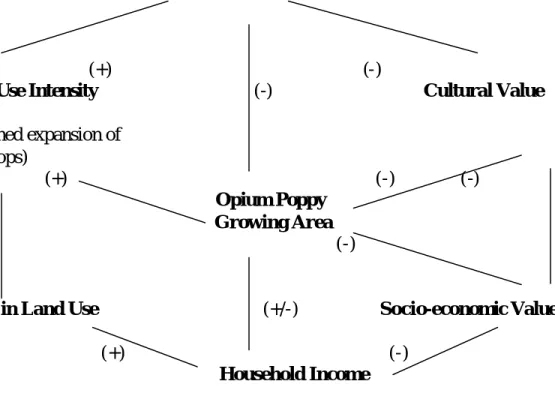
As the nature AD project is a process development approach, monitoring and evaluation of AD projects would require the understanding of the process being going on. The operational framework based on some of the above strategies may be hypothetically developed for AD arguments as shown in Figure 1.
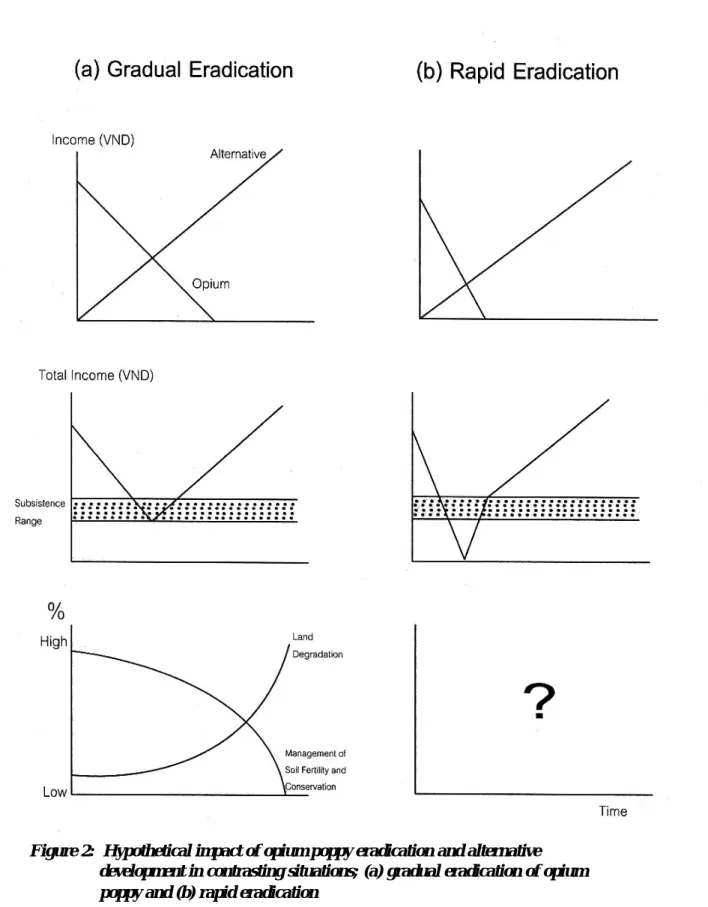
Introduction of AD activity would be expected to reduce opium poppy growing area significantly. Further reduction may involve law enforcement in order to keep eradication strategy continues with national policy. With cash crop promotion to replace opium poppy cultivation, unplanned demand of land for cash crops may increase rapidly. Increasing demand of good land for commercial agriculture could potentially result in land use conflicts with the community, between community and between lowland and upland communities. Intensive use of sloping land without proper soil and water conservation may lead to severe land degradation at local and watershed scale, threatening ecosystem sustainability. Rapid reduction of opium poppy may have both positive and negative income to farming households. Without people participation, the rapid reduction would have negative impact on local households and their food security (Figure 2). If this happens, social sustainability of the former opium poppy growing households is under threatening.
The overall result may jeopardize AD efforts. Cultural erosion is another aspect that has often been raised in AD projects. Increased income may push the former opium addicts in the community to shift from opium to other drugs. In the case of northern Thailand, for example, official records have shown drastic increase in the number of drug users with heroin at the beginning of opium eradication to methamphetamine and others.
1.5 APPROACHES TO ALTERNATIVE DEVELOPMENT
As already mentioned earlier, AD may be traced back to as far as the late 1940s, and the evolution of AD approach stems from the idea of crop substitution in 1970s to integrated highland development in 1980s to community-based approach in 1990s. As lessons and experiences build up, the complexity of AD approach increases through AD interventions for the past over 30 years.
1.5.1 Crop Substitution Approach (1970s)
In early 1970s, UN started Crop Substitution Programme in northern Thailand as a target area to eradicate opium poppy cultivation in the Golden Triangle, one of the major opium production areas in the world. The approach was based on the identification of potential cash crops for the biophysical advantages of the opium growing area, e.g., high altitude with favourable temperature to a wide range of sub-tropical to temperate annual and perennial crops, fruit trees and vegetables. Production technology is often packaged with the most potential crops from opium growers. Apart from the monitoring and evaluation of the potential cash crops, opium survey has been the major tool for project monitoring and evaluation. Law enforcement is often lagged behind the development of alternative crops to ensure sustainable reduction of opium poppy area. The success of crop substitution programme and law enforcement in the region varies widely between country to country (Table 1). The earlier projects with dominant crop substitution approach may take as long as 30 to 50 years. In contrast, recent AD projects in the region may take as short as 6 years, i.e., Vietnam. Rapid reduction of opium growing area in remote area with poor marketing structure may have negative impact on household food security.
AD Activities & Law Enforcement Measures
(+) (-)
Land Use Intensity (-) Cultural Value
(Unplanned expansion of cash crops) (+) (-) (-) Opium Poppy Growing Area (+) (-)
Conflict in Land Use (+/-) Socio-economic Value
(+) (-)
Household Income
FIGURE 1: Sustainable challenge of AD Projects and Interrelationship between Project Strategies.
Figure 2: Hypothetical impact of opium poppy eradication and alternative development in contrasting situations; (a) gradual eradication of opium poppy and (b) rapid eradication
TABLE 1: Opium growing area and AD experiences in Southeast Asia sub-region
Country/Target Area Opium Growing Area in
2000 (ha)
Years of AD Experience
China (Yunnan province) 0 >50 (1949)
Thailand (Northern Thailand) 1,486 >30 (1969)
Myanmar 130,300 20 (1980)
Laos (Northern part) 27,000 12 (1989)
Vietnam (Highlands) 600 6 (1993)
Source: Rerkasem (2000)
The hybrid between deve lopment and law enforcement is often referred to as a “carrot and stick”* approach in AD projects. This approach could have negative impact to people participation and community empowerment, and the results of alternative development could turn out to be a failure (Gilbert and Rerkasem 2002 and Armenta et. al. 2002). Although the crop substitution has been used since the early stage of international campaign against drugs, it remains one of the major components of AD project with respect to eradication and income generation objectives. In northern Thailand, the Royal Project is the pioneer in development and promotion of crop substitution to opium poppy. The Project was initiated in 1969 with strong financial and research supports. Up to present, the Project has achieved its opium eradication objective with successful introductions of the wide range of “new” cash crops, temperate fruit trees and vegetables, and high value cut flowers for crop substitution programme. The Project contains strong marketing component integrated with production. It has successfully developed large-scale marketing structure connected to private sectors and its own outlets throughout the country. Marketing is one of the major weaknesses in crop substitution program.
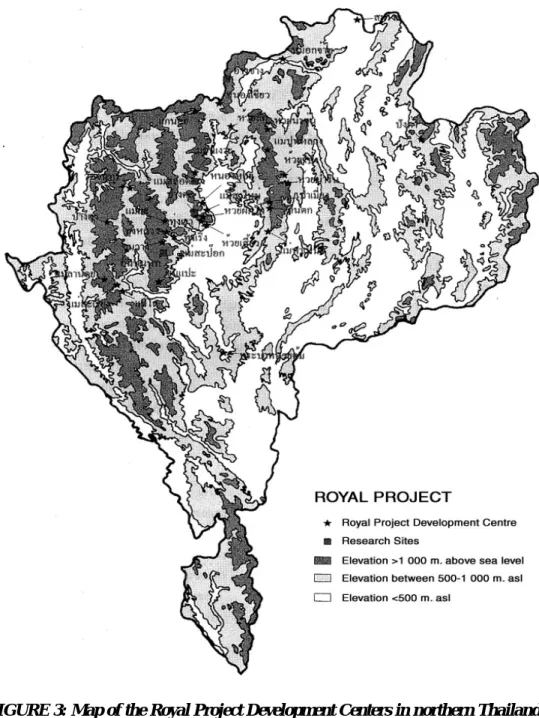
Many projects have failed after termination period. With reduction of external support to alternative development in Thailand, the Royal Project has become the major development agency for former opium growing communities in the country. The Project has recently integrated into the mainstream development of national policy with financial support from government. There are several extension projects under 35 development centres in former opium growing area of Chiang Mai, Chiang Rai, Lamphun, Mae Hong Son and Phrayao provinces (Figure 3). This covers a total area of 1982 sq.km2 in 257 villages with population of almost 100,000 people in the Project.
*
1.5.2 Integrated Rural Development Approach (1980s)
The approach was introduced and built on the experiences and lessons learned from crop substitution programmes in 1970s (e.g., Jinawat 2001, Renard 2001 and Kampe and Iamprapai 2002). The integrated rural development approach with a label of “Highland Development Project (HDP)” was implemented to meet the basic needs of target population. There were a large number of externally assisted projects during this period. These HDP Projects employed area approach for planing and intervention based on the First Masterplan for Highland Development in Opium Producing Areas: 1985-91 (ONCB 1985). The overall target areas for opium eradication were mapped out for the intervention of HDP projects (Figure 4). The overall goal of the First Masterplan was to cover about 60 % of total opium growing area in the country. A monitoring system of opium growing area was set up with satellite images and ground check.
With coordination at all levels in government structure, access to government support and services improved greatly in the remote hill areas. Education and health services have developed successful model for interventions, e.g., the Hill Area Education Model and the Community Health Programme with extensive health centres and volunteer workers for the hill tribes. Infrastructure development was provided to improve rural life, communication and transportation of agricultural produces e.g., feeder roads, small-scale irrigation and domestic water supply. Monitoring and evaluation of AD project in the context of rural development project has to be seen in multidimensional nature
1.5.3 The Emergence of Participatory Approach in Alternative Development Projects (1990s)
Although participatory approach was gradually adopted, it was not until 1990s when projects began to see the importance of people’s participation on pr oject achievement. Without active people’s participation little would be accomplished. The participatory approach was increasingly significant where community began to encounter conflict in use and management of natural resources. In areas where production pressure on land is increasing rapidly due to demand for various uses including conservation, the social problem leading to conflicts in land use would be inevitable and the problem may be detected at different scales depending upon the severity of the problem and biophysical limitation.
The conflicts may be occurring at local scale within the community, between communities at local level or between lowland and upland communities at watershed level. The problem of land use conflicts is becoming to be fairly
common with the region (Rerkasem, 2002). Resolution to the conflicts could be found in the process of participatory land use planning and community-based watershed management (e.g., TG -HDP 1998). Similarly, the increasing demand on drugs in certain areas, e.g., heroin and ATS, the introduction of Community-Based Drug Abuse Control (CB-DAC) would offer alternative measure for control and prevention the drug problem in the community.
FIGURE 3: Map of the Royal Project Development Centers in northern Thailand. Source: Royal Project Document
For Thailand in 1997 for example, the Cabinet authorized the ONCB to apply CB-DAC measures in 1,145 villages that had been identified as having severe drug addiction problem (Kampe and Iamprapai, 2002)
1.5.4 Alternative Development (2000s)
From lessons and past experiences of UN-intervention and campaign against illicit opium poppy cultivation in the region, the integrated strategies of alternative development and the parallel law enforcement have been suggested for project implementation in the year of 2000. Although the linkages between drugs and development is not new but the efforts have been addressed to the supply problem with the dominated crop substitution approach.
The framework for alternative development is then the combination of supply reduction, demand reduction and law enforcement strategy. AD approach is becoming more holistic with broader perspective (Berg 1998). The success in alternative development depends upon the national framework for AD, conditions in intervention, support and cost effectiveness. Conditions for development in a given country or area need to be taken into account and alternative development has to be linked to other development issues and activities.
In area where narcotic drugs are produced, governments have little control or their political will to interfere is of limited. In such the area, local counterpart institutions are often lacking. It may be doubtful whether alternative development is feasible under this condition. Forced eradication of opium poppy cultivation may be in conflict with development. The inclusion of demand reduction in alternative development is to address the problems of local drug use. Alternative development is not just merely rural development but sustainable human development. In summary, comprehensive assessment of past experiences and lessons in alternative development in Asia (Berg 1998) has shown that
4 alternative development, where carried out in a meaningful way and supported by governments with political will to control drugs, it can be expected that AD would contribute significantly to a reduction in opium poppy cultivation;
4 alternative development, when measured against the quantity of opium reduced, could be costly and time consuming;
4 alternative development, when measured against its contribution to opium poppy reduction and to overall rural development, has been rather successful and cost effective.
1.6 CONCEPTUAL FRAMEWORK OF ALTERNATIVE DEVELOPMENT
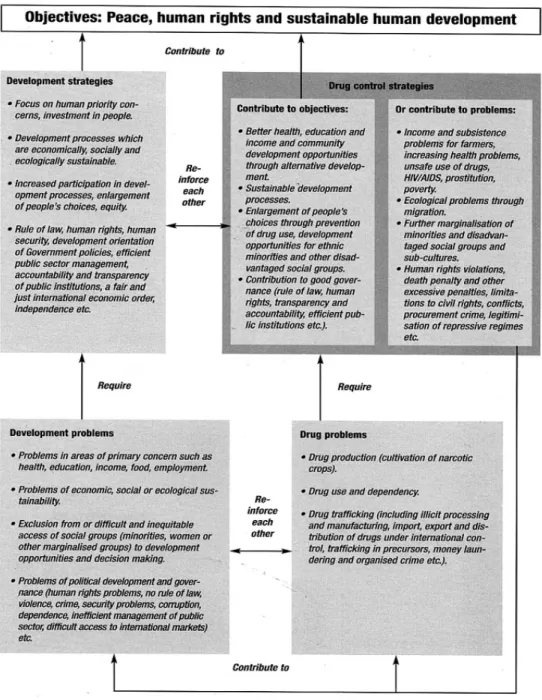
On a whole, a conceptual framework for alternative development may include:
First, development as sustainable human development;
4 focus on people priority and their basic needs,
4 ensuring ecological, but also social and cultural sustainability,
4 participation in and equitable access of people to economic, social, cultural and political processes that af fect their lives,
4 the need for good governance, that is governance which include participatory, transparent, accountable, effective and equitable, and that promotes the rule of law and human rights,
Second, development as a tool for drug control;
4 alternative development for supply reduction,
4 demand reduction,
4 law enforcement,
Third, drug control as a tool for development;
4 measurable impact on basic needs and human priority,
4 measurable impact on social, economic and ecological sustainability,
4 measurable impact on participation and equitability,
4 measurable impact on good governance.
The interrelationships between the above strategies may be summarized in Figure 5.
1.7 KY SON PROJECT: A CASE EXAMPLE OF AD 1.7.1 Site Description
Ky Son is one of the early UN-projects in the region where AD principles and concepts have been used to design and implement the Project in 1996-2000. The Project was officially inaugurated in May 1996 with a total of US$3.8 million from UNODC and VND 5.0 billion from the Government of Vietnam. The Committee for Ethnic Minorities and Mountainous Areas (CEMMA), which is directly attached to the National Policy Decision, represents Project counterpart.
Ky Son is a remote district in Truong Son highlands of Vietnam. It locates at the end of highway no. 7A and shares the border with Xieng Khouang province of Laos. The total area is estimated at <200 000 ha but only a maximum of 15 % is suitable for cultivation. It is not surprising that the natural forest and land resources are degrading at rapid rates.
FIGURE 5: Conceptual framework for AD Projects in Southeast Asia. Source: Berg (1998)
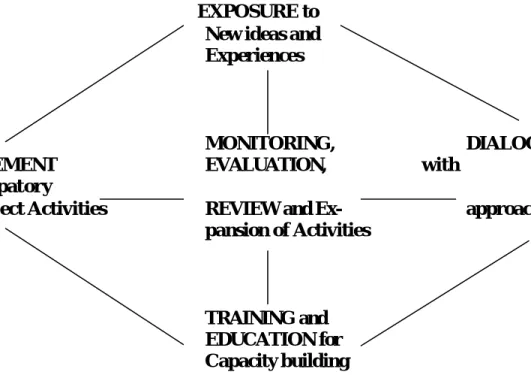
EXPOSURE to New ideas and Experiences
MONITORING, DIALOGUE
IMPLEMENT EVALUATION, with
participatory
of Project Activities REVIEW and Ex- approach pansion of Activities
TRAINING and EDUCATION for Capacity building
FIGURE 6: Project’s implementation strategy, monitoring and evaluation with active local Participation: the Ky Son Modality.
Source: Boonwaat (2001)
With the existing poor infrastructure and road network for transportation, the area is one of the remote highlands in the country. The advantage of biophysical setting has made Ky Son as one of the major opium poppy growing area in the region. Opium poppy survey in 1993 showed that planted area of opium was as high as 2,800 ha. After the intervention of the Project, growing area of opium dropped sharply to insignificant level at 98.5 ha in 1997. Complete eradication was obtained after the second year of project implementation.
1.7.2 Project Objectives
Apart from alternative development objectives, the Ky Son Project was designed to strengthen national capacity to bring about the significant socio-economic changes, enabling smallholders to eliminate illicit cultivation of opium poppy and drug abuse. The Project was, then, serving as a model for opium poppy growing areas in Vietnam. Replicability is also essential to Project objectives.
1.7.3 Project Activities and Monitoring
At the outset of implementation, the Project has been able to conceptualize the overall framework for management, implementation, monitoring and evaluation (Figure 6). The Project employs active local participation to ensure sustainable development over the long run. The local participation is the core approach and it is applied to the Project at all stages of project cycle. The application of the approach is iterative process with active participation of Project beneficiar ies, other stakeholders including local district officers
The full scale of Project review, monitoring and evaluation took place after the actual implementation of specific activity. The implementation strategy of the Project was designed as a development process with 4 major elements as follows. (1) Exposure that enables smallholders to have access to new ideas and
successful experiences.
(2) Dialogue which enables smallholders to exchange their ideas or experiences based on their own and new enrichment from exposure. This process allows smallholders’ decisions to solve their own priorities. This requires participatory needs assessment and needs prioritization. In the process, community work plan might be developed to address local priorities. The linkage between community and district work plans could be matched to eliminate duplication and encourage the compliments.
(3) Training was offered to increase local capacity building in achieving work plans.
(4) Implementation was selective with key smallholders in the key communes to illustrate positive results for future large-scale extension phase.
Project monitoring, evaluation and review were carried out at all stages in the process in order to ensure effective implementation of Project activities. The identified activity was, then, started with some selected numbers of smallholders in strategic communities for demonstration of Project activity. For economic development activity, the Project has been able to implement and offer diverse options for alternative income and household food security to opium poppy. These options include
4 Improved upland rice for self-sufficiency
4 Improved paddy systems with HYV and supplement water supply
4 Development of legume for sustainable agriculture and food supplement
4 Improved cassava for improved feeds and high yielding with stress
4 Improved maize for livestocks
4 Improved potato for income generation
4 Introduction of industrial crops, e.g., Arabica coffee, improved tea and other annual or perennials
4 Improved fruit trees and ve getables for home gardens
4 Development of alternative agroforests for household requirement and sustainable practice
4 Development of social forests for community management, utilization and environmental conservation
4 Introduction of honey bees for alternative income generation
4 Livestock breed improvement
4 Livestock feed improvement
4 Livestock disease control and prevention system
4 Improved marketing
4 Handicraft for alternative income
The above Project activity is highly diverse with elements of subsistence, combination crops and livestock, income generation alternatives from agriculture or non-agriculture, natural resource management and so on. The success could be evaluated with community participation at all levels, i.e., individuals, households, community, district offices and so on. Project invited some 14 national institutions and NGOs to provide technical assistance and monitor demonstration activity. In the iterative process of Project monitoring and evaluation, further expansion of Project activity could occur independently without Project support, e.g., farmers-to-farmers mechanism, contractual systems of producers and consumers and so on. Nevertheless, preparation of support for further expansion of Project activity will have to be available with strategic planning and implementation.
Project also employed heavy input from external consultants at all stages of Project cycle. External assistance was part of Project design and implementation. Ky Son Project also established active coordination and collaboration with national law enforcement agencies. The balance between alternative development and law enforcement for eradication has been kept between the Project and coordinating agencies with regular review and evaluation.
1.8 CONCLUSIONS
This traini ng module outlines the conceptual framework for Alternative Development projects. It is based on the continuing process in developing Alternative Development (AD) paradigm. AD is a holistic concept and development approach. It differs from other development approaches, e.g., community
development or rural development paradigms. It has gone through a long process of over 30 years with lessons learned, experiences gained and future challenges. In this development process, the conceptual framework of AD shifted from merely a crop substitution programme to integrated rural development programme to complex alternative development programme. Apart from the distinction of AD project as drugs and drug control nature, AD addressed socially and economically sustainable human development with benign environmental setting. The Project is a vehicle for national and international policy to campaign against drugs and crime. Overall conceptual framework for alternative development is presented and discussed. A case of Ky Son Project in Vietnam is chosen as an example of AD project in the region to illustrate the application of AD concepts and conceptual framework for project implementation during 1996-2000.
1.9 REFERENCES
Armenta, A., Jelsma, M., Blickman, T., Montanes, V. and Vargas, R. 2002. A
failure balance alternative development and eradication. Drugs & Conflict Debate Paper No. 4. 12 p. (http:www.tni.org)
Berg, C. 1998. Drugs and Development in Asia. A background and discussion paper. Division 4500, Rural Development/Drugs and Development Programme, GTZ. 74 p.
Boonwaat, L. 2001. An overview of alternative development and illicit crop
eradication policies,strategies and actions in the region. In: Proceedings of a
regional seminar on Alternative Development: Sharing Good Practices
Facing Common Problems. Pp.129-148. Bangkok: UNODC-Regional Centre for Asia and the Pacific.
Gibert, R. and Rerkasem, K. 2002. Community empowerment in alternative
development: prerequisite for success or mutually exclusive concepts? Official Website of the International Conference on the Role of Alternative Development in Drug Control and Development Cooperation. 7-12 January 2002. Feldafing, Munich, Germany 16 p. (http:www.UNODC.org) Jinawat, P. 2001. Thailand country paper. In: Proceedings of a regional seminar
on Alternative Development: Sharing Good Practices Facing Common Problems. Pp.63-72. Bangkok: UNODC-Regional Centre for Asia and the Pacific.
Kampe, K. and Iamprapai, P. 2002. Assessment of experience with alternative development in the Thai Highlands: 30 years of evlolution. ? Official
Website of the International Conference on the Role of Alternative
Development in Drug Control and Development Cooperation. 7-12 January 2002. Feldafing, Munich, Germany 13 p. (http:www.UNODC.org) McCoy, A. M. 1972. The Politics of Heroin in Southeast Asia. Singapore: Harper
and Row Publishers.472 p.
ONCB 1983. A Masterplan for Opium Poppy Cultivating regions of Thailand. Bangkok: Office of Narcotics Control Board and the United Nations Fund for Drug Abuse Control.
Renard, R. 2001. Opium Reduction in Thailand 1970-2000. A Thirty-Year
Journey. Chiang Mai: Silkworm Book for UNODC Regional Centre for East Asia and the Pacific.
Rerkasem, K. 2000. Regional perspectives on alternative development (AD). Paper prepared for UNODC seminar on Cooperation for Alternative Socio-Economic Development to Replace Opium Poppy Cultivation. 22-23 March 2000. Hanoi, Vietnam. 7 p.
Rerkasem, K. 2002. Land use in Greater Mekong sub-region. In: M. Kaosa-ard and J. Dore (eds) Social Challenges for the Mekong Region. Chiang Mai: SRI Publication. (In Preparation)
Royal Project 1993. Basic data for 35 Royal Project Development Centres. Chiang Mai: the Royal Project.
TG-HDP 1998. Community-based natural resource experiences. A proceedings of international workshop. Chiang Mai: Thai-German Highland Development Programme.
UN/ODCCP 2001. Alternative development in the Andean area: the UNODC
experience. New York:ODCCP Study on Drug and Crime Guidelines. 76 p. Vogel, P. and Boonwaat, L. 2001. Ky Son alternative development project in
Vietnam. In: Proceedings of a regional seminar on Alternative
Development: Sharing Good Practices Facing Common Problems. Pp. 123-128. Bangkok: UNODC-Regional Centre for Asia and the Pacific. White, P. T. 1985. The poppy – for good and evil. National Geographic
MODULE 2
:
DESIGNING AND IMPLEMENTING
THE ALTERNATIVE DEVELOPMNT PROJECT MONITORING
*
2.1 SCOPE OF THE MODULE
This training module defines designing, implementing and gives reasons for carrying out the alternative development (AD) project monitoring. The design elements of monitoring system are also discussed. The principles and guidelines of an efficient and effective monitoring system are presented in relation to the AD project monitoring. Key concepts and content are applied as a continuation of the group activities. At the end of this module, self-evaluation questions are provided to assess the trainee’s learned knowledge, skills and competencies based on the learning objective stated.
2.2 LEARNING OBJECTIVES
After completing this module 2, t he participants shall be able to:
1) Gain more understanding about the conceptual framework and basic principle of the AD project monitoring
2) Design and apply the effective project monitoring system under various setting such as diversion of biophysical, social and culture environment
3) List a set of guidelines of key process and strategies for an effective monitoring system in line with their respective AD project documents
2.3 INTRODUCTION
Project is a set of planned undertaking that is designed to achieve a specific objective with given resources and within a specific time period. The objective of the project is the explicit and/or implicit of aims or goals. The resources are project inputs without regard to technical, financial or human resources. The project time frame is the time period that AD project started and ended, therefore it is not an on-going activity or a routine work. Meanwhile the program is a group of projects that will lead to the achievement of a
*
Presented by Satiean Sriboonruang and Chaiwat Roongruengsee, Chiang Mai University Chiang Mai, Thailand
broader scope of some policy results such as the elimination or alleviation of existing problems.
Progress reporting is necessary for all AD projects because it provides information for all stakeholders on the status of projects. Therefore, it is necessary to monitor the project implementation in order to report what is happening in the project. Information from monitoring results is reported to decision-makers for the necessary actions. These monitoring concepts have been applied extensively in the development work and form an essential part of the project planning and management. Project logical framework analysis facilitates the monitoring of projects by establishing linkages between the immediate objectives, outputs, activities and inputs of the project more clearly in a logical manner as sho wn in figure 2.1
Figure 2.1: Logical relation between inputs, activities, outputs, objectives and project goal
2.4 PROJECT CYCLE
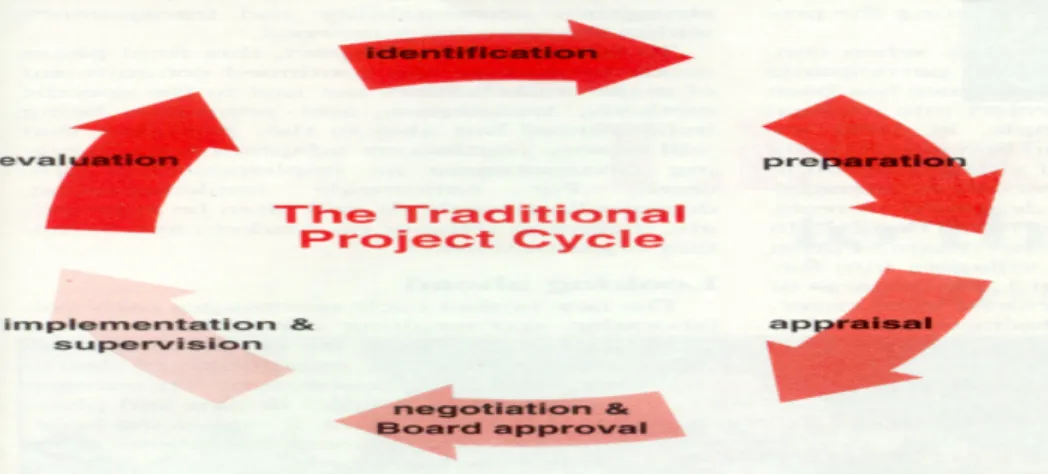
The terms used for the stage explanation of project cycle might vary considerably. But in his module, it will divide the stages of project cycle into six stages, namely project identification, project formulation, project appraisal, project approval, project implementation and project evaluation (figure 2.2). But for the new concept of the World Bank for project cycle, it divides the
OBJECTIVE
OUTPUT
INPUTS
ACTIVITIES
GOAL
OBJECTIVE
OUTPUT
ACTIVITIES
INPUTS
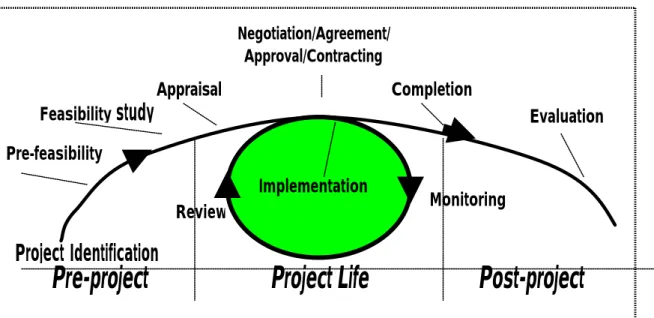
stages of project cycle into four stages, namely project listening, project piloting, project demonstration and project mainstreaming. However, for more intuitively, the project cycle also divides into various stages according to the time frame of project namely, pre-project, project life and post project (figure 2.4).
The project is usually started from a broad idea and then later on it develops to be the first proposal. After it becomes the first proposal, it is debated, analyzed and further detailed. The project formulation may take time and sometimes incorporates a structural pre-investment study. Therefore, after passing the stages of project pre-feasibility study, project feasibility study and project appraisal, the project implementation stage will follow after the proposal is approved. Within the project implementation stage, the objectives, resources and the project time frame may change, but at the end of project some reflections about its outcome and impacts will be revealed.
Figure 2.2: Conventional project cycle
Figure 2.4: Details of conventional project cycle
2.5 UNDERSTANDING AND SETTING UP MONITORING AND EVALUATION SYSTEM
There used to be negative perceptions on monitoring and evaluation system such as cumbersome, a waste of valuable time among the professionals who work with the social services and development project/programs involving the project monitoring and evaluation. However, presently, these professionals including practitioners become enthusiastic supporters of the system because of the following reasons. Firstly, they understand that the main purpose of monitoring and evaluation (M&E) is the project improvement. Secondly, the recognition that M&E can be tailored to fit the specific needs of a project and its budget. And thirdly, they have a better understanding and mastery of the actual M&E processes.
Generally and in principle, the M&E can offer the following circumstances and/or situation:
ü Monitoring assesses the quality, quantity and timeliness of the project input
ü Monitoring identifies operational constraints to project effectiveness thus helping planners and project managers improve implementation
ü Monitoring determines if a process or service, e.g. food fortification or illicit drug control is meeting national or some other accepted standards
ü Monitoring provides information to improve project targets
ü Evaluation helps to identify effects that are attributable to the project
ü Monitoring and evaluation meet donor accountability requirements
Implementation Negotiation/Agreement/ Approval/Contracting Completion Appraisal Feasibility
study
Pre-feasibilityProject Identification
Monitoring Review Evaluationü Monitoring and evaluation serve as a vehicle to increase community participation
ü Monitoring and evaluation inform decision-making on the future of a project
The body of social science known as evaluation research is the systematic collection of information on the design, implementation and the effect of projects on the targeted populations (Rossi and Freeman, 1993). Ideally, the system and its process are divided into an ongoing monitoring system and periodic evaluation with the some special studies designed to answer some specific questions about the project. Monitoring is different from evaluation. M&E have different objectives but are related. Therefore, they require different design and implementation.
2.6 MONITORING DEFINITIONS
During the project implementation stage, it is necessary to monitor its development and progress. Monitoring is a planning and management tool which provides the project management with regular and continuous feedback that can be used to make decisions, manage the project more successfully and plan for better project activities in the future. Monitoring is a crucial part of the project management that will be carried out to observe the progress of the project implementation and to ensure that inputs, activities, outputs and external factors (such as the project assumptions) are proceeding according to the plan. Moreover, monitoring is also a tool to identify problems, which may occur during project implementation so that corrective measure could be taken before the project is affected adversely. Most funding agencies require some form of progress report that indicate or demonstrate the project achievements throughout the project life and at the termination of project. Good monitoring will also allow the project to be effectively evaluated, therefore it is a continuous process and periodic surveillance (for both observation and vigilance) of the project implementation.
Monitoring is concerned primarily with ongoing data collection and review of the AD project implementation on a regular basis throughout the life of project. The monitoring system can be used to assess the following AD project’s indicators:
ü the quality of project inputs and services, the timeliness of service delivery
ü the extent that project activities reach the targeted individuals and communities
ü the cost involved in implementing the project/program
ü the extent to which actual implementation of AD project coincides with the AD project implementation plan
ü the overall progress, development and barriers of project implementation which are important input for the AD project supervision.
Monitoring data are often entered into the management information system (MIS) which, in turn provides information in an easy-to-use format to keep track of the AD project activities, budget and personnel. Information generated by the project monitoring system provides valuable clues where problems are occurring, why operation are succeeding or faltering and which specific aspects of the AD project need to be adjusted in order to improve targeting, coverage and implementation. Moreover, since the monitoring information is collected and reviewed at regular intervals, area of concern can be addressed as they arise and collective measures can be instituted, thus improving the chances for the AD project success.
However, one important characteristic of the AD project monitoring is that, in a well-functioning project, most data and information are already collected for the programmatic purposes so that establishing a monitoring system should not impose an additional burden. In an AD project for reduction of illicit drug crop cultivation, this would include ongoing reduction monitoring data, as well as, information on activities involving drug control dimension, income generation dimension, social and cultural dimension and environmental dimension. Another example, such as the integrated community-based nutrition project, the necessary data would include growth monitoring data, information on activity attendance, supplement, distribution and clinic referrals. While the monitoring information is used primarily for management decisions, it is also important to provide contextual information for evaluation.
Project monitoring clearly serves the interests of project/program funders, project manager and their staff and all the project beneficiaries, all of whom benefit from the improvement of project operations. However, some fears may cause resistance to project monitoring and evaluation. Project managers and staffs might fear of losing their jobs. Beneficiaries might be also anxious of losing their benefit when the funders find the negative impact from the monitoring and evaluation. Overcoming such resistance in monitoring is not always possible. However, experiences suggest that resistance can be reduced if the stakeholders of a project are involved in planning the monitoring process and reviewing the monitoring data. Since monitoring data are essential to effective AD project management, all projects should have a monitoring system in place.
2.7 REASONS FOR PROJECT MONOTORING AND USEFULNESS OF PROGRESS REPORTS
There are various reasons that make the monitoring activities important and the progress report necessary. The monitoring is a crucial part of the project management as it is carried out to observe the progress of the project implementation in order to ensure if inputs, activities, outputs and project assumptions are proceeding according to the plan and if they are progressing forwards achieving the project objective. Monitoring is also a tool to identify problems that may occur during the project implementation, therefore the corrective measures could be taken before the project is affected adversely. Moreover, as a result of the monitoring, the progress reports provide a major information i nput to the project reviews.
2.8 PRINCIPLES AND GUIDELINE FOR MONITORING
As part of the project management, monitoring of inputs, activities and outputs should be implemented for the whole duration of the project. Assumptions that were made within the project logical framework should be monitored to ascertain their effect on the achievement of the stated outputs and objectives. The work plan indicates which activities are ongoing and should be monitored for the project progress. The monitoring plan should set measurable indicators of inputs, the activities and outputs to be used as milestones or performance standard for monitoring.
The example of measurable indicators of
inputs
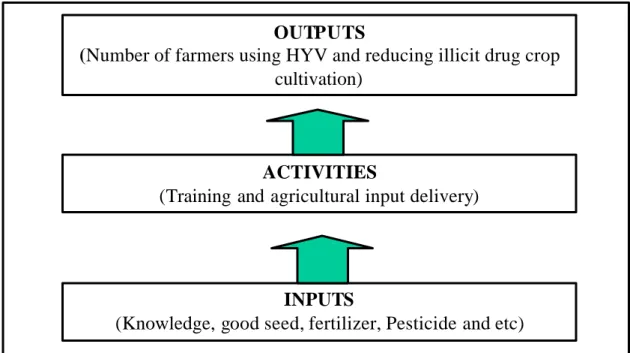
in the case of AD project is the number of farmers receiving knowledge, the number of farmers using good seed, the distributed amount of fertilizer and pesticide and the amount the good seeds planted. The example of measurable indicators in the case ofAD project activities
are the number of training courses conducted, the number of farmers trained and the number of farmers who have access to the agricultural inputs delivered. The example of measurable indicators foroutputs
of the AD project is the number of farmers using high yield variety (HYV), the number of farmers using high and more productive techniques and the number of farmersreducing illicit drug crop cultivation (see figure 2.5).
Figure 2.5: An example of inputs, activities and outputs of the AD project
A system of the self-monitoring such as a
self-monitoring
format of an annual work plan and the management information system (MIS) is needed and more desirable. The most important aspect is the early problem identification so that the corrective measures or actions can be taken at the good and appropriate time before the problems become too serious. Table 2.2 indicates the example of self-monitoring format of an annual work plan for the AD project. General guidelines for the project monitoring is, as it concerns with project management, it deals mainly with three aspects of the project over which it has control namely, input-activities-outputs as show in figure 2.6.Assumptions
in the project logical framework should be also monitored to ascertain their effect on the achievement of the stated outputs and objectives. Assumptions could be an event, a condition or a decision which is necessary for project success, but which is largely or completely beyond the control of project management. However, the table 2.1 also indicates the guideline and some example of framework for the AD project monitoring and evaluation in term of inputs, outputs, outcomes, impacts and benefits. The project logical framework and in particular the work plan indicate which activities are ongoing and should be monitored in progress.Monitoring is carried out at different levels. Monitoring information at the field level is regularly submitted to the project manager and all stakeholders for their considerations. Regular meeting of staff concerned with the project implementation is often the best means of monitoring at the field level and linking to higher management level such as steering committee. The results of
OUTPUTS
(Number of farmers using HYV and reducing illicit drug crop cultivation)
ACTIVITIES
(Training and agricultural input delivery)
INPUTS
written monitoring reports have to be balanced with the provision of sufficient information to project staff level, manager and steering committee levels, but should not take too much extra time from project implementations. All project staff should be involved in the monitoring process.
Figure 2.6: Monitoring projects and their assumptions
Table 2.1: An example of framework for the AD project monitoring and
evaluation in term of inputs, outputs, outcomes, impacts and benefits
Inputs Outputs Outcomes Impacts Benefits
Assumptions Assumptions Resources used to support the primary activities of the project Expectations regarding the effectiveness and quality of the project inputs The delivery of goods and services Expectations regarding the ways these goods and services will be used by the target population Changes in behavior and practices Links to the provision of goods and services to impact Drugs status measures Effects resulting directly from project outputs or indirectly through outcomes Broader effects Effects resulting from achievement of impacts, usually in combination with other factors INPUT; Resources ACTIVITIES; process OUTPUTS OBJECTIVE Assumption; precondition
Assumption about the context
Assumption about the context
GOALS
Assumption about the context
Will under given Will under given Will under given Will under given
Be sufficient to perform the Be sufficient to produce the Be sufficient to contribute the Be sufficient to achieve the
2.9 CONTENT AND EXAMPLE OF CASE STUDY
Examples for the monitoring process and strategies will be drawn from the presentation and discussion of the country participants and their AD project documents.
Table 2.2: An example of an annual work plan in monitoring form
Responsible Body
Output/Expected Outcome/Major Activities/Activities
Lead Support Timing
Progress (what has been achieved?) /Results *(Have any problems occurred?) Action to be taken** (what action will be taken to overcome the problem) Output (as stated in the
project log frame), Expected Outcome/Indicators/Ma jor Activities/ Activities ……… ……… ………
*Progress/results: what ha been achieved? Have any problem occurred? **Action to be taken: What action will be taken to overcome the problem?
2.10 SELF-EVALUATION QUESTION AND EXERCISES A) After completing Module 2, please answer the following questions:
- What are the objectives of monitoring?
- What are the conceptual frame work of the project monitoring? - What are the differences between reach and impact?
- What are the differences between monitoring and evaluation? - What are the general principles of monitoring?
- How often is monitoring carried out? - What is monitoring?
- What items have to be monitored?
- What are the steps for setting up the project monitoring system? - What are the frequent problems in tracking intermediate indicators? - What are other issues emerged in tracking outcomes and impacts? - Who should conduct project monitoring?
- Who will monitor the project, outsider or insider?
- What are weaknesses and strengths in using the outsider or insider monitor? - Why do we need for the effective monitoring?
- What are the components of project monitoring design? - Who did monitoring for specific items?
- How was project reporting done-formally or informally?
- What are the quantitative and qualitative components of monitoring?
- What are the differences between project inputs, outputs, outcome and impacts?
- What are the differences between final indicators and intermediate indicators of the project?
- Who is supposed to read the project reports? - Do they read them? If not, why not?
B) Identify indicators according to the types that are relevant to the AD project (Using the conceptual framework as mentioned in module 1 as a guideline)
C) Identify key considerations for the following questions in the AD project monitoring
Questions to be asked Key Considerations
What are the objectives of the project?
How well are the target groups identified and reached? How to use the indicators?
Goal: ……… Impact Outputs Outcomes Inputs Final indicators Intermediate indicators
Effects on dimensions of well-being (……….)
Access to, use of and satisfaction with services (……… ………..) Good service generated
(………)
Financial and physical indicators of resources provided (……….)
2.11 REFERENCES
Abbot, J. and Guijt, I., 1998, Changing Views on Change: Participatory Approaches to Monitoring the Environment. SARL Discussion Paper 2, London: IIED
Adamchak, Susan, Band, Katherine, et. Al. 2000., A Guide to monitoring and Evaluation Adolescent Reproductive Health Programs: Tool Series 5, Washington. DC:
Benus, J. and L. Orr , 2000., Study of Alternative Quantitative Evaluation Methodologies. Working Paper. ABT Associates, Washington D.C.. Provides an overview of the importance of conducting evaluations, evaluation techniques and who should conduct evaluations.
Casley, Dennis J. and Krishna Kumar,1987., Project Monitoring and Evaluation in Agriculture. Washington, D.C.: World Bank.
Dar, A. and Z. Tzannatos ,1999., Active Labor Market Programs: A Review of the Evidence from Evaluations. Social Protection: a discussion paper No. 9901. Provides a brief overview of ALMPs and e valuation techniques and presents cross-country evidence on the impacts of different ALMPs.
Estrella, M. and Gaventa, J., 1998., Who counts reality? Participatory
Monitoring and Evaluation: a literature review, IDS Working Paper No 70, Brighton: IDS
IIED, 1998, Special Issue on Participatory Monitoring and Evaluation. PLA Notes 31, London: IIED
NEF, 1998, Communities Count, A step by step guide to Community Sustainability Indicators, London: NEF
Operations Evaluation Department, World Bank, 1995., Monitoring and
Evaluation Plans in Staff Appraisal Reports in fiscal year 1995. Report No. 15222, December 1995.
UNAIDS, WHO, 2000., National AIDS Programs: A Guide to Monitoring and Evaluation, Chapel Hill, N.C: Carolina Population Center.
UNODC, Training on Monitoring and Evaluation for AD project, Training Document.
MODULE 3
:
DESIGNING AND IMPLEMENTING ALTERNATIVE
DEVELOPMENT PROJECT EVALUATION
*3.1 SCOPE OF THE MODULE
Similar to module 2, this training module defines designing, implementing and gives reasons for caring out the alternative development (AD) project evaluation. The design elements of project evaluation system are discussed. The principles and guidelines of an efficient and effective evaluation system are presented in relation to the AD project. Key concepts and content units are applied as a continuation of the group activities. At the end of this module, self-evaluation questions are provided to assess the trainee’s learned knowledge, skills and competencies based on the learning objective stated.
3.2 LEARNING OBJECTIVES
After completing module 3, the workshop participants shall be able to:
1) Gain more understanding about conceptual framework and basic principle of the AD project evaluation
2) Design and apply the effective project evaluation system under various setting such as diversion of biophysical, social and cultural environments
3) List a set of guidelines and strategies for an effective evaluation system in line with the AD project
3.3 INTRODUCTION
Effective project management and implementation would ensure that necessary information on the status of the project is provided to the stakeholders. For AD projects, various kinds of reports could be considered. They include the inception report, the interim report, the project termination report and the project impact evaluation report. In addition to monitoring, it is essential to carry out project evaluation to assess the extent of project development towards achieving the specified objectives. Information obtained from evaluation process will be reported to the project manager and higher
*
Presented by Satiean Sriboonruang, Faculty of Economics, Chiang Mai University, Chiang Mai, Thailand
level of policy decision-makers for the important and necessary corrective actions. These concepts of project evaluation have been applied extensively in development work and form an essential part of project planning and management. Logical framework of project analysis facilitates the evaluation of all AD projects by establishing linkages between the goals, immediate objectives, outputs, activities and inputs of a project more clearly in a logical manner as shown in figure 2.1 of the module 2.
3.4 OBJECTIVE OF EVALUATION
Evaluation in project operations is carried out for at least 3 purposes as follows : First it provides information for decision-making on any improvements needed for project management and implementation. Second it assesses the results of the project/program to demonstrate to what extent the project/program has achieved its objectives. Third it serves as a mean to empower the communities and other project stakeholders of the AD projects. The flows of information are central to evaluation process and constitute an empowerment agenda that includes transparency (availability and access to information), accountability (use and application of information) and inclusion/participation (where communities are given control over decision-making) including decisions on the appropriate criteria and indicators to judge the performance of service provision
For a flexible and responsive AD project, evaluation needs to be more than just a reporting mechanism, but it serve s as a management tool and as a means of advancing the project goals for accountability, transparency and partnership. The evaluation systems should incorporate both statistical data and feedback from the participatory assessments. Moreover, the evaluations should be done continuously through every phase of the project such as inception, interim and termination or completion periods. Systematic evaluation of project/program processes and outcomes are particularly important where project/programs are being scaled up. Evaluation systems also supply the necessary information and feedback so that potential bottlenecks or problems are identified and overcome early before becoming constraints to project expansion and replication.
3.5 EVALUATION DEFINITIONS
Evaluation is a field of applied science that seeks to understand how successful the projects are and to what extent they fulfill the objectives. The