White Dwarf Variability With gPhoton: Pulsators
By: Michael A. Tucker, Scott W. Fleming, Ingrid Pelisoli, Alejandra Romero, Keaton J. Bell, S.O.
Kepler,
Daniel B. Caton
, John Debes, Michael H. Montgomery, Susan E. Thompson, Detlev
Koester, Chase Million, and Bernie Shiao
Abstract
We present results from a search for short time-scale white dwarf variability using gPhoton, a time-tagged data
base of GALEX photon events and associated software package. We conducted a survey of 320 white dwarf
stars in the McCook–Sion catalogue, inspecting each for photometric variability with particular emphasis on
variability over time-scales less than 30 min. From that survey, we present the discovery of a new pulsating
white dwarf: WD 2246-069. A Caii K line is found in archival ESO spectra and an IR excess is seen in WISE W1
and W2 bands. Its independent modes are identified in follow-up optical photometry and used to model its
interior structure. Additionally, we detect UV pulsations in four previously known pulsating ZZ Ceti-type (DAVs).
Included in this group is the simultaneous fitting of the pulsations of WD 1401-147 in optical, near-ultraviolet
and far-ultraviolet bands using nearly concurrent Whole Earth Telescope and GALEX data, providing
observational insight into the wavelength dependence of white dwarf pulsation amplitudes.
Michael A Tucker, Scott W Fleming, Ingrid Pelisoli, Alejandra Romero, Keaton J Bell, S O Kepler,
Daniel B
Caton
, John Debes, Michael H Montgomery, Susan E Thompson, Detlev Koester, Chase Million, Bernie Shiao,
White dwarf variability with gPhoton: pulsators, Monthly Notices of the Royal Astronomical Society, Volume
475, Issue 4, April 2018, Pages 4768–4780, https://doi.org/10.1093/mnras/stx3297. Publisher version of
record available at: https://academic.oup.com/mnras/article/475/4/4768/4772883
White dwarf variability with gPhoton: pulsators
Michael
A.
Tucker,
1,2ܠ
Scott
W.
Fleming,
3,4Ingrid
Pelisoli,
5Alejandra
Romero,
5Keaton
J.
Bell,
6S.
O.
Kepler,
5Daniel
B.
Caton,
2John
Debes,
3Michael
H.
Montgomery,
7Susan
E.
Thompson,
3,8,9Detlev
Koester,
10Chase
Million
11and
Bernie
Shiao
31InstituteforAstronomy,UniversityofHawaiiatManoa,2680WoodlawnDr,Honolulu,HI96822,USA 2DepartmentofPhysicsandAstronomy,AppalachianStateUniversity,525RiversSt,Boone,NC28608,USA 3SpaceTelescopeScienceInstitute,3700SanMartinD,.Baltimore,MD21218USA
4CSRA,3700SanMartinDr,Baltimore,MD21218,USA
5InstitutodeF´ısica,UniversidadeFederaldoRioGrandedoSul,91501-900PortoAlegre,RS,Brazil 6Max-Planck-Institutf¨urSonnensystemforschung,Justus-von-Liebig-Weg3,D-37077G¨ottingen,Germany 7DepartmentofAstronomy,UniversityofTexasatAustin,Austin,TX78712,USA
8NASAAmesResearchCenter,MoffettField,CA94035,USA
9SETIInstitute,189BernardoAvenueSuite100,MountainView,CA94043,USA
10Institutf¨urTheoretischePhysikundAstrophysik,Universit¨atKiel,D-24098Kiel,Germany 11MillionConceptsLLC,POBox119,141MarySt,Lemont,PA16851,USA
A B S T R A C T
We present results from a search for short time-scale white dwarf variability using
gPhoton, a time-tagged data base ofGALEXphoton events and associated software package. We conducted a survey of 320 white dwarf stars in the McCook–Sion catalogue, inspecting each for photometric variability with particular emphasis on variability over time-scales less than∼30 min. From that survey, we present the discovery of a new pulsating white dwarf: WD 2246-069. A CaIIK line is found in archival ESO spectra and an IR excess is seen in WISE
W1 andW2 bands. Its independent modes are identified in follow-up optical photometry and used to model its interior structure. Additionally, we detect UV pulsations in four previously known pulsating ZZ Ceti-type (DAVs). Included in this group is the simultaneous fitting of the pulsations of WD 1401-147 in optical, near-ultraviolet and far-ultraviolet bands using nearly concurrent Whole Earth Telescope andGALEXdata, providing observational insight into the wavelength dependence of white dwarf pulsation amplitudes.
Key words: techniques: photometric – stars: oscillations – white dwarfs – ultraviolet: stars.
1 I N T R O D U C T I O N
White dwarf (WD) stars are the final stage in stellar evolution for low and intermediate mass stars; over 95 per cent of stars in the Milky Way will end their lives passively as WDs. These stars are essen-tial to understanding star formation history and offer insight into galactic evolution. Increasingly, they are also being used to probe the formation and destruction of exoplanets (Jura2003; Zuckerman et al. 2010; Koester, G¨ansicke & Farihi2014; Vanderburg et al.
2015), since their diffusion time-scales are much shorter than their evolutionary time-scales (Alcock, Fristrom & Siegelman 1986; Paquette et al.1986; Koester2009a). A subset of WDs are sub-ject to g-mode instabilities, which manifest in pulsations and en-able detailed studies of the WD’s internal structure (e.g. Fontaine & Brassard2008, and references therein).
E-mail:[email protected]
†Participant of the STScI 2015 Summer REU Program.
1.1 Pulsating WDs
When the upper layers become partially opaque, WDs exhibit non-radial, multiperiodic, g-mode pulsations. There are three main types of WD pulsators, each with its own respective spectral type, bulk atmospheric composition, and temperature range: the ZZ Ceti class (DAV, hydrogen-dominated atmosphere; Landolt1968), the V777 Her class (DBV, helium-dominated atmosphere; Winget et al.1982), and the GW Vir class (DOV, carbon-oxygen-helium mixed atmo-sphere; McGraw et al.1979). Another WD class, the DQ pulsators (Dufour et al. 2007), whose atmospheres are carbon-dominated with little hydrogen or helium, may represent a fourth class of pul-sator (Fontaine, Brassard & Dufour2008; Montgomery et al.2008), although other effects may be the cause of variability for these objects (Dufour et al. 2008; Montgomery et al.2008; Williams et al.2013).
The DAV class is the most prolific, with over 180 stars confirmed to date, effective temperatures ranging from 10 500–12 500 K for
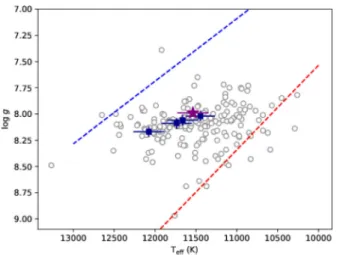
Figure 1. Location of ZZ Ceti stars listed in Bognar & Sodor (2016). Known DAVs are grey circles and DAVs in this paper are plotted as blue squares. WD 2246-069, the new pulsator described here, is plotted as a purple star. The dotted lines indicate the location of the empirical red and blue edges of the instability strip referred by Tremblay et al. (2015).
logg∼8 (Gianninas, Bergeron & Ruiz2011). An up-to-date census of DAVs is shown in Fig.1. The DBV class is driven by the re-combination of partially ionized helium, compared to partially ion-ized hydrogen for DAV stars, and therefore, have a higher effective temperature range of 24 000–27 000 K. These pulsators are signifi-cantly less abundant with 23 DBVs confirmed. GW Vir stars are the hottest pulsator class, having effective temperaturesTeff>75 000 K
and sparsely populated with 22 documented to date. The number of confirmed pulsators in each class is taken from Kepler & Romero (2017).
Most recently, extremely low mass DA WDs (so-called ‘ELM’ WDs,0.2 M) have been found to pulsate due to convective mixing driven by partial ionization in the atmosphere (Hermes et al.
2012,2013; C´orsico & Althaus2014; Bell et al.2017). Maeda & Shibahashi (2014) theorize that there is a class of pre-white dwarfs, DAO, that should pulsate between 30 000–120 000 K, but these have yet to be confirmed with observation. More information on WD pulsation characteristics and driving mechanisms can be found in the review by Fontaine & Brassard (2008), and a brief overview of more recent WD pulsation discoveries is provided by Fontaine et al. (2014).
1.2 Peculiar WDs: IR excess and metal lines
A significant amount of WDs also exhibit metal lines in their at-mospheres, classified as ‘DAZs’, with an estimated∼20 per cent (Zuckerman et al.2003) of DA WDs falling into this subcategory. These metals are thought to arise from circumstellar accretion of a debris disc, as the majority of DA WDs have gravitational settling time-scales of a few thousand years. These debris discs likely stem from planetesimals that passed within the tidal disruption radius of the WD (Jura2003; Zuckerman et al.2007; Klein et al.2010; Debes, Walsh & Stark2012).
Since these metal lines likely arise from an accretion source (i.e. a debris or gas disc), these WDs often exhibit infrared (IR) flux excess Kilic et al.2006; Farihi et al.2010). Studies have detected both gas discs and dust discs encircling WDs, detectable in mid-IR photometry and spectra. Currently,∼3–5 per cent of known WDs feature some form of IR excess due to a disc, depending on which survey is used (e.g. Farihi, Jura & Zuckerman2009; Chu et al.
2010; Debes et al.2011; Barber et al.2014; Rocchetto et al.2015;
Bonsor et al.2017), although there may be a correlation between WD properties (age, temperature, progenitor) and disc prevalence (Koester et al.2014). However, this is not to be confused with WDs having IR excesses from cool, substellar companions (e.g. Farihi et al.2005; Hoard et al.2007). Farihi et al. (2014) attempted to detect emissions from the population of planetesimals feeding the debris disc, which would likely be at a radiusr∼1–100 au, around G29-38 (Zuckerman & Becklin1987) using ALMA and Herschel to no avail. Most recently, a circumbinary debris disc was found around SDSS J155720.77+091624.6, a binary system composed of a WD and L-type brown dwarf in a 2.27-h orbit (Manser et al.2016; Farihi, Parsons & G¨ansicke2017), adding to the possible configurations of WD debris discs and their planetesimal environments.
Arguably, the richest astrophysical WD systems are pulsating WDs that also have metal lines and/or IR excess indicative of circumstellar discs. These systems allow for precise measure-ments of the WD interiors, the physics of the accreting material, and the chemical composition of that material. There are cur-rently four pulsating WDs with documented IR excesses: G29-38 (Zuckerman & Becklin1987), GD 133 (Jura, Farihi & Zuckerman
2007), WD 1150-153 (Kilic & Redfield2007), and PG 1541+651 (Kilic et al.2012). Three of these systems also exhibit metal lines in their spectra, the one exception being PG 1541+651, for which there is currently no published optical spectrum. Kilic et al. (2012) analysed optical and NIR photometry plus a low-resolution NIR spectrum of PG 1541+651 to derive the properties of the circum-stellar debris, including temperature and radius of the disc.
There have been studies on the effects of pulsations on metal line equivalent widths (EW) with theoretical predictions by Mont-gomery et al. (2008) expecting the EW to vary based on amount of accreted material on the surface of the WD ‘hotspot’. This can be used to map the distribution of metals, and by assumption the accretion rate, across the surface of the WD. This process was per-formed by Thompson et al. (2010) on G29-38, the metallic pulsator prototype, with the conclusion that the accretion may be polar in-stead of equatorial as previously thought (Montgomery et al.2008) and raises the possibility that accretion geometry may change with time, although this has yet to be confirmed with future analysis.
1.3 WD Pulsation Studies WithGALEX
Since precision asteroseismology requires high cadence photometry over many hours, pulsating WD observations have been predomi-nantly conducted in the optical from the ground. The majority of UV light is blocked by Earth’s atmosphere, so most UV data is taken by space-based observatories. In space, the duty cycle is con-ducive to long time series photometry, but telescope time itself is at a premium. AlthoughGALEX’s photon-counting detectors have the ability to perform time series photometry, the temporal capabilities were mostly untapped until the release of thegPhotondata base (Million et al.2016), which facilitated access to calibrated data at the photon-event level.
We presentgPhotonlight curves in the NUV and, where avail-able, the FUV, for five pulsating WDs from the McCook-Sion Cat-alog (McCook & Sion1999) whose atmospheric parameters are listed in Table1. It is worth mentioning the discrepancies between Teffand loggmeasurements for the same stars across multiple
stud-ies. For example, WD 1258+013 was studied most recently by both Gianninas et al. (2011) and Tremblay, Bergeron & Gianninas (2011), who derived two different sets of values forTeffand logg:
{11 990±187 K,8.11±0.05} and {11 400±50 K,8.15±0.02}, respectively. While the loggvalues match within 1σ uncertainties, theTeffdo not by a few hundred Kelvin. Additionally, this same star
Table 1. Stellar parameters for the 5 DAVs. RA is in hh:mm:ss and DEC is in dd:mm:ss. Effective temperature and surface gravity measurements are 3D corrected per Tremblay et al. (2013). Post-correction uncertainties are assumed to be the same as those reported by the reference.
WD ID RA (α) DEC (δ) Teff(K) log(g) Ref.
1258+013 13 : 01 : 10.52 +01 : 07 : 40.05 11 444±176 8.02±0.05 Gianninas et al. (2011) 1401−147 14 : 03 : 57.11 −15 : 01 : 09.63 12 077±190 8.17±0.05 Gianninas et al. (2011) 1625+125 16 : 28 : 13.25 +12 : 24 : 51.11 11 662±187 8.06±0.05 Gianninas et al. (2011) 2246−069 22 : 48 : 40.04 −06 : 42 : 45.27 11 537±50 7.99±0.02 Koester et al. (2009) 2254+126 22 : 56 : 46.16 +12 : 52 : 49.62 11 735±185 8.09±0.05 Gianninas et al. (2011)
was included in the SSDS DR 7 White Dwarf catalogue (Kleinman et al.2013) which modelled the star as havingTeff=11 099±34 K
and logg=8.15±0.02. Some of these disparities can be attributed to the variable nature of the stellar surface for pulsating WDs, espe-cially the fluctuations in temperature. Yet the lack of a clear consen-sus among three independent studies in 2 yr showcases the need for more comparisons between different sets of spectroscopically de-rived atmospheric parameters. Fuchs et al. (2017) is a recent study of how spectroscopic parameters can change due to various observa-tional factors and how to mitigate such discrepancies. Addiobserva-tionally, comparisons between spectroscopically derived parameters and as-teroseismologically derived parameters need to be conducted as evident by the differences for the new pulsating WD 2246-069 (e.g. Table5). To maintain consistency, the atmospheric parameters in Table1were all derived using spectroscopy, taken from the same source when possible and 3D corrections applied corresponding to Tremblay et al. (2013). Comparisons between different studies of the same star was facilitated by the Montreal White Dwarf Database (MWDD; Dufour et al.2017).
Of the five pulsators in our survey, four are previously known pulsators and one is newly identified. To our knowledge, these are the first UV light curves for the stars in question. BecauseGALEX observations are limited by the orbital parameters of the spacecraft (see Section 2), each continuous light curve is a maximum of 30 min long, although some targets were observed many times over the course of the mission. WD pulsation amplitudes are normally larger in the UV compared to the optical, by up to an order of magnitude, facilitating their detection (Bergeron et al.1995). Comparisons of UV-to-optical pulse heights can be used to identify and classify modes when conducting asteroseismology (Robinson et al.1995; Kepler et al.2000; Nitta et al.2000; Kotak et al.2003; Thompson et al. 2004), a notoriously difficult activity even with months of observations in the optical (e.g. Provencal et al.2012).
In Section 2, we describe our target selection and the sources of our UV and optical data. In Section 3, we present thegPhoton light curves of three previously known WDs: WD 1258+013, WD 1625+125, and WD 2254+126. In Section 4, we conduct a joint analysis of WD 1401-147 using optical data nearly concurrent with thegPhotonUV observations, comparing the UV-to-optical flux ratio of the strongest frequencies to theoretical models. In Section 5, we present WD 2246-069, a newly identified WD pulsator that also has evidence of an IR excess and metallic pollution via a CaIIfeature
in its spectrum. Finally, in Section 6 we summarize our results.
2 DATA R E T R I E VA L A N D R E D U C T I O N 2.1 GALEX
TheGalaxy Evolution Explorer(GALEX) space telescope operated from 2003 until its decommission in 2013, with the primary goal
of studying star formation histories in galaxies (Martin et al.2005; Morrissey et al.2005). During its 10-yr lifespan,GALEXobserved ∼77 per cent of the sky at various depths in both the near-ultraviolet (NUV, 1771–2831 Å) and far-ultraviolet (FUV, 1344–1786 Å) si-multaneously, utilizing two on-board microchannel-plate (MCP) photon-counting detectors. These MCPs record the time and posi-tion of each photon event with a time-stamp accuracy of at least 5 ms.GALEXconducted observations on the night side of each orbit, each lasting 1500–1800 s. During each of these ‘eclipses’, GALEXcould observe one or several parts of the sky, with each location called a ‘visit.’ For deeper surveys, visits lasted nearly the full eclipse (up to 30 min), while for shallower surveys each visit lasted only a few minutes, allowing the telescope to point to multiple locations during a single eclipse.
GALEX conducted several survey missions of varying depths throughout its lifespan. The All-sky Imaging Survey (AIS) aver-aged ten 100–200 s visits per eclipse with an AB magnitude limit of ∼21. The Medium Imaging Survey (MIS) is composed of a single visit taken over an entire eclipse with a magnitude limit of∼23. The Deep Imaging Survey (DIS) co-added visits over approximately 20 orbits with exposure times totalling∼8 h. Field selection was con-strained by the detector’s maximum count rate of 5000 counts s−1.
GALEXwas also equipped with low-resolution grism spectroscopy capabilities in both bands.
A comprehensive overview of the original GALEXcalibration pipeline and available data products is discussed in Morrissey et al. (2005, 2007) and Million et al. (2016). In 2011, NASA ceased direct support forGALEXand transferred ownership to the California Institute of Technology for the so-called ‘CAUSE’ phase, during which time data was collected and retained by each project’s principal investigators until the spacecraft’s decommission.
2.2 gPhoton
gPhoton(Million et al.2016) is a data base and software package that produces high cadence calibrated photometry forGALEXby leveraging the 5 ms photon counting nature of theGALEX micro-channel plate detectors. ThegPhotondata base currently con-tains all direct imaging data from the NASA-funded portion of the GALEXmission and is hosted at the Mikulski Archive for Space Telescopes (MAST). A comprehensive overview of thegPhoton data retrieval process, calibration pipeline, and software tools is available in Million et al. (2016) and on the project webpage.1Our
work was conducted using version 1.28.2 of thegPhoton soft-ware. We include ourgPhotonoutput files for each target and a script containing our light curve commands as supplemental on-line material.
2.3 Follow-up optical observations
Follow-up observations of the candidate pulsating WD, DA WD 2246-069 (see Section 5), were taken at Appalachian State Univer-sity’s Dark Sky Observatory (DSO) 32-inch telescope and the 1.6 m Perkin-Elmer Telescope at Observat´orio do Pico dos Dias (OPD), in Brazil. At DSO, an Apogee Alta U42 CCD camera with 50 s exposures was used to collect∼8h of data across three nights of observations. Due to the faintness of the target and cadence needed to verify variability, the Lum filter was used (a clear filter with an IR blocker to prevent fringing). Images were dark and bias-subtracted and flat-field corrected before performing aperture photometry with Mira Pro X64,2Version 8 (Software; Mirametrics, Inc.2016).
The target was also observed for two nights at OPD, 2016 July 12 and 15, with an Andor iXon CCD and a red-blocking filter (BG40). The CCD has a quantum efficiency of about 60 per cent at 4000 Å, a wavelength region where the pulsations have significant amplitude (about tens of milli-modulation intensity, mmi, see equation 1), so it is suitable for observing pulsating WDs. We observed WD 2246-069 for about 4.25 h on the first night, with an integration time of 15 s plus about 1 s for readout. On the second night we observed for about 5.6 h, with an interruption of 45 min due to clouds. The integration time was again 15 s, but frame transfer was used, reducing the readout to less than 0.1 s.
All the images from OPD were bias-subtracted and flat-field cor-rected. Aperture photometry was done using theDAOPHOTpackage
inIRAF. A neighbouring non-variable star of similar brightness was
used to perform differential photometry. Observation times were corrected to the barycentric celestial reference system to allow the analysis of data for both nights together.
3 P R E V I O U S LY K N OW N P U L S AT O R S
Light curves for each target created withgPhotonshow variability with time-scales consistent with asteroseismic pulsations, but due to the short observational baseline (20–30 min) pulsation frequencies cannot be measured with sufficient precision to identify modes that are present. Brief mode analysis was performed on each target’s UV light curves and several signals in the resulting Fourier Transforms match expected WD pulsation periods, and sometimes even match previously reported optical periods at first approximation, however, the short observational baseline prevents any definite conclusions on the validity of these detections. For each target, we show the gPhotonNUV and, where available, FUV light curves. We ex-clude all bins withgPhotonquality flags greater than zero, which indicate one or more warning conditions that, in our experience, are best treated as unusable data. We also exclude any bins that have less than 60 per cent effective exposure time, i.e. a bin that has less than 6 s of data in a 10-s bin.
When analysing variability of targets withgPhoton, it is impor-tant to check for false positives due to time dependent sampling of the detector response over the course of aGALEXdither, which is undersampled (and therefore incompletely corrected) by theGALEX flat. As such, there can be flux variability strongly correlated to source position on the detector. This can be checked by examining the Fourier spectra of the mean position of events from the centre of the detector (detrad, an output column fromgPhoton). This ef-fect is often most severe for bright targets in the non-linear response regime of the MCPs or for objects near the detector edge where the
2http://www.mirametrics.com
response is less well characterized. For both of these conditions, gPhotonproduces warning flags, but such correlations may not be limited to only these situations, and even minor effects matter when looking for low-amplitude variability. We have compared the power spectra of detector position with the flux series and did not find any correlated peaks or aliases.
We note that WD 1645+325 (V777 Her, GD 358), the DBV-class prototype (Winget et al.1982) has{1861, 1922}s of{FUV,NUV} data ingPhotonand does show pulsation-like variability, but the target is in the non-linearity regime in both bands, where detector effects tend to dominate the light curves. As such, we omit this target, but note that if a methodology to correct the non-linearity effects is developed these data should be re-examined.
When analysing the light curves for these targets, the fluxes are converted to mmi by:
fluxmmi=[(flux/median(flux))−1.0]×1000, (1)
where 1 mmi=0.1 per cent variability. 3.1 WD 1258+013
Also known as HE 1258+0123 and V439 Vir, the star is a DA WD first identified as a pulsator candidate on the basis of its location in the HR diagram from spectroscopic effective temperature and surface gravity measurements (Teff=11 410 K, logg=8.04;
Berg-eron et al. 2004). Their follow-up optical photometry confirmed its pulsating nature, identifying four peaks in the power spectrum of their 3.3-h light curve, at periodsP={744.6, 1092.1, 528.5, 439.2} s, in order of descending amplitude. This target was in-cluded in the ensemble analysis of Romero et al. (2012), who in-cluded two additional periods in their compilation of known modes (P =628.0 and 881.5 s).
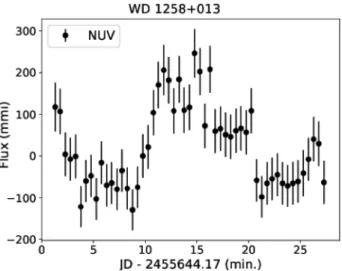
WD 1258+013 is covered by a total of 13 co-add footprints in GALEXfrom 2004–2011, however, only two of these co-adds are well -suited for variability searches. Eight of the co-adds were part of the shallow AIS survey, each having less than 120 s of continuous data. Of the remaining five, three of them are positioned such that the target is too close to the edge of the field of view, where edge effects tend to dominate. This leaves two epochs:∼411 s in both FUV and NUV on 2004 April 17 and∼1594 s in NUV on 2011 March 23. Unfortunately, the earlier observations with both bands in 2004 are shorter than any known pulsation periods, so we show only the 2011 data (Fig.2). For this target, 30 s bins were used instead of the 10 s bins used for the other targets to maintain adequate counts per bin.
3.2 WD 1625+125
Also known as HS 1625+1231, this target was confirmed to be a ZZ Ceti pulsator by Voss et al. (2006) using photometric selection. Several frequencies were identified, the five largest amplitude pe-riods are{862, 534, 385, 2310, 426}s in order of decreasing am-plitude. This star was also included in the compilation by Romero et al. (2012) which featured eight of the ten periods identified by Voss et al. (2006) as independent modes.
WD 1625+125 is covered by fiveGALEXco-add footprints, four of which contain both NUV and FUV data and one that has only NUV data. Of the five total, all but the last one are too short for asteroseismic purposes. The last, having∼1700 s of available data in both bands, was observed on 2008 June 6 and is shown in Fig.3. The optical data observations by Voss et al. (2006) were taken on 2005 May 15, roughly 3 yr before theGALEXobservations.
Figure 2. gPhotonNUV light curve for WD 1258+013. Time is in min-utes relative to the reference JD.
Figure 3. gPhotonFUV (top) and NUV (bottom) light curves for WD 1625+125. Time is in minutes relative to the reference JD.
3.3 WD 2254+126
Also known as GD 244, first speculated to pulsate by Fontaine et al. (2001) based on optical spectra. Time series photometry revealed at least four excited modes with periods ranging 200−300 s.
WD 2254+126 is covered by five GALEX co-add footprints, four of which contain both NUV and FUV data and one that has only NUV data. Of the five total, two of them have observation times greater than 500 s that can be searched for pulsations: an 845-s observation on 2004 August 27 in both bands and a 1588-s observation on 2004 September 30 in both bands (Figs4and5).
4 W D 1 4 0 1 - 1 4 7 : A C A S E O F S I M U LTA N E O U S O P T I C A L A N D U V DATA F R O M W E T A N D GALEX
Also known as IU Vir and EC14012-1446, this star is a well-studied DA WD. It was first identified as a ZZ Ceti from photometric ob-servations in the optical by Stobie et al. (1995), who measured five independent modes along with multiple combination frequencies. Further asteroseismic study by Handler et al. (2008), using 200 h of multisite optical photometry, identified 19 independent frequencies. The most recent observing results come from more than 300 h of
Figure 4. gPhotonlight curve from 2004 August for WD 2254+126. The FUV light curve is in blue, the NUV light curve is in black. Time is in minutes relative to the reference JD.
Figure 5. gPhotonlight curve from 2004 September for WD 2254+126. The FUV light curve is in blue, the NUV light curve is in black. Time is in minutes relative to the reference JD.
Whole Earth Telescope (WET; Nather et al.1990) observations by Provencal et al. (2012), who also identified 19 independent frequen-cies, though not all the same ones as those in Handler et al. (2008). By combining observations from observatories distributed in lon-gitude, multisite campaigns like the WET suffer less aliasing than multi-night observations from a single site. Provencal et al. (2012) utilize information from the combination modes (amplitudes and phases), mean period spacings and rotational splitting, and non-linear light-curve fitting (also utilizing harmonics and combination frequencies; Montgomery et al.2010) for mode identification, but these different methods produce some conflicting results. Chen & Li (2014) performed additional asteroseismic analysis based on the combined set of pulsation frequencies of Handler et al. (2008) and Provencal et al. (2012), putting their own constraints on mode iden-tification.
WD 1401-147 is included in a total of threeGALEXco-add foot-prints, two of which contain both FUV and NUV and one contains only NUV data. Two of these are from the shallow AIS survey and have less than 120 s of continuous data. The remainingGALEX
Table 2. Fit parameters for WD 1401-147 corresponding to Fig.7. See Section 4 for an explanation of the fitting process and mode selection proce-dure. Provencal ID refers to the modes identified in Provencal et al. (2012) for WD 1401-147 and subsequently found in the WET data.
Freq. (µHz) Period (s) ABG40(mmi) m Provencal ID
1633.907 612.029 22.2±0.6 1 1 1 1774.989 563.383 5.1±0.6 1 1 5 1887.405 529.827 19.3±0.6 1 0 2 1891.141 528.781 4.2±0.6 1 −1 2b 2504.896 399.218 8.0±0.6 1 0 4 2508.060 398.714 5.1±0.6 1 −1 4a 1548.148 645.932 9.4±0.6 1 0 3 1521.574 657.213 1.3±0.6 1 1 3a
observation of WD 1401-147 is especially interesting, because it was acquired nearly simultaneously with the optical WET data of Provencal et al. (2012), starting only a few hours after the end of the WET observing run enabling a direct comparison of optical to UV pulsation amplitudes.
4.1 Wet data
The amplitudes of some pulsation modes of WD 1401-147 were observed to vary on time-scales as short as days during the 36-d span of WET observations (Provencal et al.2012). To ensure the comparability between data sets, we restrict our comparative analysis to the last four nights of WET data, which were obtained with the Laborat´orio Nacional de Astrof´ısica (LNA) 1.6-m tele-scope at the Pico dos Dias (OPD) Observatory in Brazil through a red-blocking BG40 filter on 2008 April 26–29. The start of the GALEXobservations begin less than 5 h after the final exposures of the WET campaign. We utilize the frequency solution of the larger WET data set to avoid selecting the wrong alias peaks in this subset of the data, and validate the comparability of pulsation amplitudes by demonstrating agreement between model predictions and the GALEXobservations
We fit the optical light curve with a script that includes a parametrized treatment of the convection zone’s non-linear response to pulsations, which produces harmonic and combination frequen-cies in the data. This approach was first introduced by Montgomery (2005), with subsequent development that includes the application to multimodal pulsators (Montgomery et al.2010). At each time-stamp, the net effect of pulsations on the emergent stellar spectrum is calculated by integrating over the stellar surface where the local flux is represented by the spectroscopic models of Koester (2010). We then multiply this net spectrum by an atmospheric transmission model and the BG40 filter throughput to finally produce a simulated optical light curve.
We include eight independent frequencies in our fit to the Brazil WET data, corresponding to IDs 1, 2, 2b, 4, 3, 3a, 4a, and 5 in table 2 of Provencal et al. (2012), in order of decreasing amplitude. The identified modes are outlined in Table2of this manuscript. The star was modelled as having an averageTeff=12, 077 K and
logg=8.17 with 3D corrections (Tremblay et al.2013). We model the modes based on themandvalues supported by the results from non-linear light curve fitting to the entire WET run in the analysis of Provencal et al. (2012). Our best fit to the last four nights of WET observations is displayed in Fig.6.
Figure 6. Best non-linear light curve fit to the last four nights of WET observations of WD 1401-147 that includes eight independent frequencies (see the text). Time on thex-axis is displayed in units of hours since the start of WET observations from Brazil at BJED 2454582.69057. Relative flux on they-axis is in units of mmi (equation 1).
Table 3. UV-to-optical pulsation amplitude ratios.
Spherical degree =1 =2 =3 =4
ANUV/ABG40 2.26 2.68 9.67 1.14
AFUV/ABG40 6.55 8.73 47.31 1.43
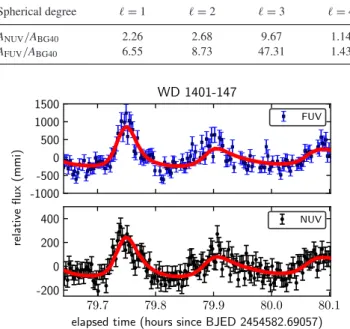
Figure 7. gPhotonlight curves in FUV (top) and NUV (bottom) for WD 1401-147. The red curves show the predicted UV light curve based on the fits made to the nearly-concurrent optical WET data. Units of mmi are taken from equation (1).
4.2 GALEXdata
Since theGALEX observation was made less than 5 h after the final observations of the WET run, we can propagate our best fit to the Brazil data forward to the GALEX observations for a unique comparison of UV-to-optical pulsation amplitudes. We run theGALEXlight curves through the WET analysis pipeline WQED (Thompson & Mullally 2013) to apply identical barycentric and leap-second corrections, so that the optical and UV data can be aligned in phase.
Table3gives expected-dependent amplitude ratios for indepen-dent modes in theGALEXpassbands relative to the BG40 optical observations. The amplitude ratios are based on pulsating WD mod-els from Montgomery (2005), and Montgomery et al. (2010) and utilizing atmosphere models from Koester (2010). Restricting the possiblemandvalues to be consistent with the Provencal et al. (2012) light-curve solution, the results are entirely consistent with theGALEXobservations. Fig.7shows thegPhotonFUV (top)
Figure 8. gPhotonFUV light curve for WD 2246-069. Time is in minutes relative to the reference JD.
Figure 9. gPhotonNUV light curves of WD 2246-069 for all observations with more than 120 s of data. Units of mmi are taken from equation (1). and NUV (bottom) light curves, with the predicted UV light curve based on the best-fitting model from the optical WET observations shown as the red curves. This level of agreement supports that the measured pulsations are not=3 or=4, since the UV-to-optical amplitude ratios are very different for these spherical degrees (Table3), and reinforces the assumption that WD pulsations are not expected to change on time-scales of a few hours (unless undergo-ing a newly discovered pulsational outburst phenomenon Bell et al.
2015,2016; Hermes et al.2015).
5 W D 2 2 4 6 - 0 6 9 , A N E W LY I D E N T I F I E D W D P U L S AT O R
This survey discovered the pulsations of WD 069 (HE 2246-0658, J224840.063-064244.52), although its atmospheric properties and effective temperature are published in Koester et al. (2009) and are well within the instability strip (Fig.1). WD 2246-069 is covered by sixGALEXfootprints, three of which have both FUV and NUV data, while three have only NUV data. Since this is the first time this star has been identified as a pulsator, we show most of the gPhotondata (Figs8and9). The one exception is the earliest GALEXvisit, which was a shallow AIS tile that had only 112 s of
Figure 10. Optical light curve obtained at the OPD 1.6 m telescope of WD 2246-069. Top panel shows data for the first night (12 July 2016), bottom panel for the second night (2016 July 15).
Figure 11. Fourier transform of the WD 2246-069 light curve obtained at OPD (Fig.10). The original Fourier transform is shown in light grey; the other colours represent new Fourier transforms after subtracting the found periods. The solid black line shows the last Fourier transform, when nothing is found above the 4Adetection limit (dashed black line).
data. We obtained follow up optical data at DSO and at OPD to confirm the pulsations with longer baselines.
5.1 Identification
Spectra taken by Koester et al. (2009) put WD 2246-069 at Teff=11 371±187 K and logg = 8.186 ± 0.06, right in the
heart of the ZZ Ceti instability strip (Fig. 1). TheGALEX UV light curve acquired usinggPhotonshowed pulsations, but the baseline and gaps between observations make it suitable only for detecting variability. To verify the pulsating nature of the target, we obtained optical photometry using the 32-inch telescope at the DSO. The DSO light curve exhibits statistically significant variations of ∼0.1 mag. Due to the faintness of the target (V≈16), instead of the ideal 10 s cadence for pulsating WDs an integration time of 50 s was required, resulting in sampling the light curve at various places between peaks and troughs. However, the DSO data confirms the variable nature of WD 2246-069 and more precise photometry was taken at OPD to conduct asteroseismology and mode identification. The OPD optical light curve is shown in Fig.10for the two observed nights. The Fourier transform of the data is shown in Fig.11.
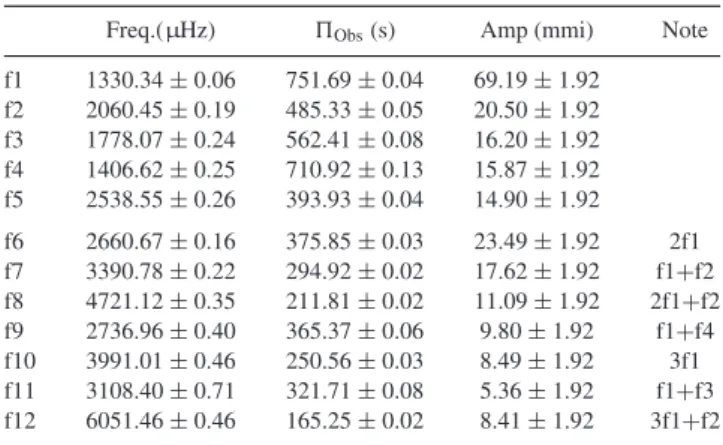
Table 4. Frequency spectrum from optical observations at Pico dos Dias Observatory corresponding to Fig.11.
Freq.(µHz) Obs(s) Amp (mmi) Note
f1 1330.34±0.06 751.69±0.04 69.19±1.92 f2 2060.45±0.19 485.33±0.05 20.50±1.92 f3 1778.07±0.24 562.41±0.08 16.20±1.92 f4 1406.62±0.25 710.92±0.13 15.87±1.92 f5 2538.55±0.26 393.93±0.04 14.90±1.92 f6 2660.67±0.16 375.85±0.03 23.49±1.92 2f1 f7 3390.78±0.22 294.92±0.02 17.62±1.92 f1+f2 f8 4721.12±0.35 211.81±0.02 11.09±1.92 2f1+f2 f9 2736.96±0.40 365.37±0.06 9.80±1.92 f1+f4 f10 3991.01±0.46 250.56±0.03 8.49±1.92 3f1 f11 3108.40±0.71 321.71±0.08 5.36±1.92 f1+f3 f12 6051.46±0.46 165.25±0.02 8.41±1.92 3f1+f2 5.2 Asteroseismological analysis
Our determination of accurate pulsation frequencies is complicated by extrinsic uncertainties from cycle count ambiguities. The spectral window displayed in the inlay of Fig.11depicts the alias structure caused by the 3-d gap between OPD observations. The aliases are finely spaced by roughly 3.9µHz, and the envelope of power drops below 50 per cent relative amplitude near 35µHz. Selecting the in-trinsic frequency among these alias signals is non-trivial. We follow the method of adopting the highest amplitude alias associated with each pulsational signal. Photometric noise or signal interference may cause an inaccurate alias of the true pulsation frequency to have the highest amplitude; therefore, the frequencies quoted in Table4may be off by some integer multiples of the 3.9µHz ex-trinsic error; i.e. this is one of many viable frequency solutions. We quote only the formal, intrinsic uncertainties on each signal frequency in Table4(Montgomery & Odonoghue1999).
From the Fourier analysis applied to the optical data from OPD we obtain 12 signals above 4A, whereAis the average amplitude of the Fourier transform. Five signals are identified as independent modes, while the remaining seven signals are identified as harmon-ics or combination frequencies that arise from non-linearities in the light curve. We used the Period04 Fourier analysis software (Lenz & Breger2005) to derive our frequency solution. With each mode selected, we improved our best-fitting, least-squares solution and computed a new Fourier transform of the residuals to search for additional significant signals. We included significant harmonic and combination frequencies as soon as their parent modes were selected, otherwise we selected the pulsation signals in decreasing order of amplitude. We selected the highest peak in the alias struc-ture of each independent pulsation mode for the solution listed in Table4, while forcing the harmonic and combination frequencies to be exact multiples and sums of the pulsation frequencies. For the dominant signal near 1330.3µHz, the two highest aliases had essentially the same amplitudes. While the lower frequency alias at 1326.4µHz was marginally stronger, we selected the 1330.3µHz peak because it produced harmonic and combination frequencies that match closer to the observed highest amplitude aliases.
Using the modes classified as independent modes in Table4
(f1–f5), we perform an asteroseismological fit. We employed an updated grid of ZZ Ceti models from Romero et al. (2012,2013) and minimize the quality functionSdefined as:
S= N i=1 [th k −obsi ]2×wi N i=1wi , (2)
Table 5. Structure parameters characterizing the asteroseis-mological best-fitting model for WD 2246-069. Also listed are the theoretical periods corresponding to the best-fitting model, along with the harmonic degree and radial order.
Param. Spect. Seism.
M/M 0.599±0.015 0.745±0.020 Teff 11 537±50 K 11 649±160 K logg 7.99±0.02 8.251±0.028 MH/M – 4.26×10⁻⁶ MHe/M – 6.61×10⁻³ S – 0.999 s Theo k 751.775 8 1 16 561.515 7 2 21 392.279 2 2 14 712.923 3 1 15 484.474 1 2 18
whereNis the number of observed modes andwiare the amplitudes.
Since we do not have an identification of the harmonic degree from observations, we penalize the modes with=2 by a weight N=2/N=1, whereN=2andN=1are the number of quadrupole
and dipole modes in a given model, respectively. As a result of our seismological study, we obtain a best-fitting model characterized by a stellar mass of 0.745±0.020 Mand an effective temperature of Teff=11 649±160 K. The structure parameters characterizing our
best-fitting model are listed in Table5. For comparison, we include the spectroscopic parameters and stellar mass determined from the mass–radius relations in Romero et al. (2012,2013) for C/O core WDs. Also, we list the theoretical periods with the corresponding harmonic degreeand radial orderk.
The seismological effective temperature is somewhat higher, but in good agreement with the spectroscopic determinations. On the other hand, seismology gives a stellar mass ∼25 per cent higher than the spectroscopic value. Note that, as discussed in Section 1, the atmosphere values can change with time due to the variable nature of the stellar surface for pulsating WDs. Also considering that the available spectra have low S/N and their quoted uncertainties are the internal uncertainties from the fitting procedure, we suspect that the real uncertainties in the spectroscopic determination are underestimated.
Conversely, due to the aforementioned 3.9µHz extrinsic uncer-tainty in the determination of independent modes, the asteroseismo-logical fit is not considered a perfect solution either. While great care was taken to select the correct peaks in the FT (Fig.11), selecting the right peaks among the aliases is a non-trivial task. Taking the pe-riods determined in Table4at face value, the quality function value for the representative model isS=0.999 s, with a mean difference of 0.85 s between theoretical and observed periods. We consider this model a good fit to the data, but provide both sets of parameters in Table5due to the uncertainties in both the spectroscopic and asteroseismic fits.
5.3 Spectral feature
We obtained the spectra observed as part of the SPY Type Ia pro-genitor search (Koester et al.2001; Napiwotzki et al.2001) and later re-analysed by Koester et al. (2009) to determine the atmospheric properties of the observed WDs. These spectra were taken using UVES (Dekker et al.2000) on the VLT and retrieved from the ESO
Figure 12. Top: One of the UVES spectra of WD 2246-069 showing broad H absorption lines typical of a DA WD. A boxcar smoothing was applied, and a few of the worst residual artefacts linearly interpolated over, for display purposes. The green, dashed vertical line in both panels indicates the rest position of the CaIIK line. Bottom: Both UVES spectra centred on the CaIIK absorption line. They have been heliocentric (but not gravitational redshift) corrected, and show no major radial velocity shift between the two epochs.
data archives to check for radial velocity variability or the presence of any potential metal lines. We find a CaIIK absorption line feature in both spectra, taken roughly a year apart (Fig.12). There is no evidence of any large RV shift between the two epochs, but given the long baseline and the fact that there are only two spectra we can not definitively rule out RV variability, which could indicate the presence of a bound, unseen companion.
After applying heliocentric corrections (as recorded in the ESO FITS headers) we checked to see whether the RV shift of the CaII
K line matches the cores of the Balmer lines. We fit a Gaussian to both the Ca line and the centres of the Balmer lines (∼±7Å around the rest wavelength). Fig.13shows the RV shift of Hα, Hβ, and Hγ (red points) compared to the CaIIline for both epochs. In this
figure, the average across all three Balmer lines is also shown as a horizontal red line, and the associated 1σ uncertainties are shown as the dashed red lines. The CaIIRV shift is the solid black line,
with the 1σuncertainty shown as the dashed black line.
We find that the Balmer line shifts match the CaIIline to within the fit uncertainties, which are on the order of 10–15 km s−1due
to both the intrinsic width of the Balmer lines and the low signal to noise of the spectra (median signal to noise of ∼5 across the spectral orders). We also checked the RV shifts of the other Balmer lines available in the ESO spectra and find they are also consistent with the CaIIRV shift to within the fit uncertainties, however, the fit
uncertainties are larger and don’t impact the average result across all the Balmer lines significantly, so they are not shown in Fig.13
for clarity.
A key question is whether this CaIIfeature is coming from the
WD or is an ISM feature. There are only a handful of pulsating WDs with metal lines present in their atmospheres (e.g. G29-38, GD 133, WD 1150-153; Koester, Provencal & Shipman1997; Koester et al.
Figure 13. Comparisons between the RV of the CaIIabsorption feature at 3933.6 Å with the RV of the Balmer lines. Red points are RVs from Hα, Hβ, and Hγ. The red solid line and red dotted lines indicate the average Balmer line RV and 1σ uncertainties, respectively, for each epoch. The black solid line and black dotted lines indicate the RV of the CaIIline
and 1σ uncertainties, respectively. The RV of the CaIIfeature and the H
lines match within 1σindicating, among other evidence, that the CaIIline
is photospheric and not an ISM feature. The spectra are not corrected for gravitational redshift due to the mass uncertainty.
2005). There are a couple lines of evidence that the CaIIfeature seen in the ESO spectra are coming from WD 2246 and is not an interstellar medium (ISM) absorption line. First and foremost, the Balmer line shifts agree with the CaIIRV shift (Fig.13). Secondly,
we checked the Local ISM Kinematic Database3(Redfield & Linsky
2008) and find only one LISM cloud (the LIC) that intersects our tar-get’s coordinate, and that has a velocity of−3.2±1.4 km s−1, which
is∼3σfrom our measured CaIIRV even when the higher gravita-tional redshift of−44 km s−1(corresponding toM
WD=0.745 M)
is applied. Given the proximity of the WD (∼50 pc based on our SED fit in Section 5.4), only a local ISM cloud could be responsible for such a feature if it did not originate from the WD itself.
Koester (2009b) determined the diffusion time-scale for the metal polluted pulsator G29-38 to be∼0.8 yr. G29-38 is very similar to WD 2246-069 with a slightly lower loggso we take this diffusion time-scale as a upper constraint for WD 2246-069. The presence of metals on the surface often indicate an accretion source due to the short lived nature of such features. All existing evidence suggests this CaIIfeature is coming from the WD itself. Additional high
signal to noise, high-resolution spectroscopy would be able to (a) further confirm the CaIIK line matches the velocity of the H line
cores (b) check for any Doppler variability in the CaIIK line, and
(c) check for additional, weaker metal lines at other wavelengths.
5.4 IR excess
We construct a spectral energy distribution (SED) using available catalogue photometry. In the UV, we make use of the ‘GCAT’
Table 6. Available catalogue fluxes used to analyse WD 2246-069’s SED. See the description in Section 5.4 for references.
Band System λeff(µm) Mag. Source
FUV AB 0.153 18.348±0.037 GCAT NUV AB 0.227 17.492±0.013 GCAT PS1_g AB 0.487 16.880±0.008 PanSTARRS PS1_r AB 0.622 17.000±0.006 PanSTARRS PS1_i AB 0.755 17.250±0.004 PanSTARRS PS1_z AB 0.868 17.430±0.010 PanSTARRS PS1_y AB 0.963 17.532±0.014 PanSTARRS VHS_y Vega 1.020 16.988±0.015 VHS VHS_J Vega 1.252 16.998±0.020 VHS VHS_H Vega 1.645 17.010±0.045 VHS VHS_Ks Vega 2.147 17.061±0.090 VHS
WISE_1 Vega 3.353 16.750±0.102 AllWISE WISE_2 Vega 4.603 16.114±0.202 AllWISE WISE_3 Vega 11.56 >12.473a AllWISE WISE_4 Vega 22.09 >8.860a AllWISE
Notes.a95 per cent confidence limits determined by the WISE data reduction pipeline.
catalogue of uniqueGALEXsources produced by M. Seibert and available at MAST4as a High Level Science Product. In the
op-tical, we make use of the PanSTARRS (Kaiser et al.2010) DR1 object catalogue (Flewelling et al.2016) to getg,r,i,z,yfluxes using the ‘PSF’ magnitudes in the catalogue. In the near-infrared, we make use of the VISTA Hemisphere Survey (VHS; McMahon et al.2013) to get (y,J,H,Ks) fluxes. We matched WD 2246-069
with source ID 472553457122 in the DR4 release of the merged catalogue of sources, and used the available aperMag3 (2 arcsec diameter) magnitudes. In the mid-infrared, we make use of the AllWISE catalogue,5 which combines data from the cryogenic
(Wright et al.2010) and post-cryogenic (Mainzer et al.2011) phases of the WISE mission. Our source is detected in theW1andW2 bands, where we use the available ‘w1pro’ and ‘w2pro’ magnitudes when analysing the target. Only weak upper limits on theW3and W4fluxes are available, and are not used in our analysis. Table6
summarizes the catalogue fluxes used in our analysis. 5.4.1 Possibility of contamination
A preliminary SED fit showed an excess in the two WISE bands at∼3σ. This is significant, because only a few ZZ Ceti stars are known to have an IR excess [among them, G29-38 (Zuckerman & Becklin1987; Reach et al.2005), GD 133 (Jura et al.2007), WD 1150-153 (Kilic & Redfield2007), and PG 1541+651 (Kilic et al.
2012)]. Other possibilities are that it could be a background AGN, or an artefact in the WISE data. We create image cutouts using the available data to check for any background companions that might be contaminating the photometry (Fig.14). The source appears extended in both the AllWISE and UNWISE (unblurred WISE co-adds; Lang2014; Meisner, Lang & Schlegel2017) images, so it is possible the excess is due to an artefact, although we note the flag that marks extended sources is not set in the AllWISE catalogue, and the photometric quality flags forW1and W2are ‘A’ and ‘B’, respectively, indicating no major quality issues. The WISE photometry was subject to the passive deblending routine, as tracked by the ‘nb’ flag in the catalogue, to correct the photometry
4https://archive.stsci.edu/prepds/gcat/
5http://wise2.ipac.caltech.edu/docs/release/allwise/
Figure 14. Image atlas of WD 2246-069. Top row:gPhotonNUV counts, PanSTARRSg, PanSTARRSy, and VHSKs. Bottom row: AllWISEW1, AllWISEW2, UNWISEW1, and UNWISEW2. The green and red circles in thegPhotonpanel are the photometric aperture and background annuli used in gAperture. The ellipses placed near the source in the UNWISE panels have radii equal to the FWHM of the WISE PSF inW1andW2. The AllWISE images are convolved using a model of these PSF’s, a process that is not performed in the UNWISE images. The size of the green bars pointing to WD 2246-069 in each image are 18 arcsec, for scale. A full resolution version of this image is available in the online manuscript.
for blending from resolved sources further than 1.3 times the full width at half-maximum (FWHM).
The WISE (W1−W2) colour is redder than+0.3, thus WD 2246 lies beyond the cut-off used by Hoard et al. (2013) to identify dusty WDs. While it is possible the WISE excess may be caused by a background object, this is unlikely for a few reasons. The photo-centres of the catalogue positions were checked to ensure the WISE position is consistent with the optical sources. The WISE coordinate is within 1.5 arcsec of the SDSS and PanSTARRS positions, well within the WISE PSF. The source is not extended in theKsimage
from VHS, so if the WISE excess is caused by a background object it would have to be extremely faint in the near-IR.
We also check the possibility of a chance alignment with a back-ground galaxy. One of the more recent studies investigating the density of AGN in WISE data is Assef et al. (2013), who find a density for objects withW2<17.11 of 130±4 deg−2, using the selection criteriaW1− W2≥0.8. Encapsulating WD 2246-069 within a 15 arcsec×15 arcsec box, the probability of an AGN in this region isP ∼0.2 per cent. Since the AGN density determined by Assef et al. (2013) extends to AGN withW2<17.11 and the measuredW2 magnitude of WD 2246 is∼16.1, this probability is really an upper limit. A more stringent statistical limit could be placed using the non-detection of an extended source in the other bands, notablyKs.
5.4.2 SED fitting
To investigate whether this excess could be caused by a faint com-panion, we fit the SED with synthetic models. To construct the composite SED, we make use of VOSA (Bayo et al.2008) to con-vert the catalogue fluxes into units of erg s−1cm−2Å−1. The WD
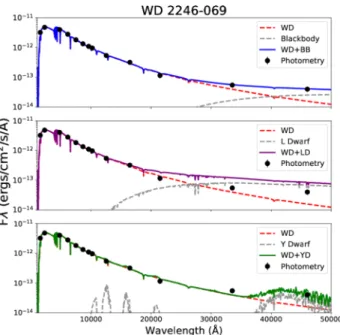
model is taken from an updated version of Koester (2010), where we select the model that is closest to the parameters derived from the asteroseismology. We make use of BT-Dusty models (Allard et al.2012) and Y dwarf synthetic spectra (Burrows et al.2003) to add the spectra of low-mass, stellar secondary components and compare with the SED. We find that an approximate distance of
Figure 15. Top: Composite SED of a WD+blackbody (BB) component withTeff≈670 K and surface area∼2Rjup. This is the best fit to all of the
photometry listed in Table6. Note that the size of each photometry point is greater than or equal to the associated uncertainty in all the panels. Middle: Composite SED of a WD+L dwarf (LD; Allard, Homeier & Freytag2012) withTLD=1 000 K and an assumedRLD=1Rjupwhich is a conservative
lower limit. The WD+LD SED contributes too much radiation in the WISE
W1andW2bands to match the observed IR excess. Bottom: Composite SED of a WD+Y dwarf (YD; Burrows, Sudarsky & Lunine2003) companion withTYD=686 K and a model-computed radius ofRYD∼1.2Rjup. The WD
+YD SED matches the WISEW2excess but does not contribute enough radiation in theW1band to match the observed photometry.
50 pc results in a good match between the theoretical spectra and the observed fluxes, after scaling the models by (r/d)2, whereris
the star’s radius anddis the distance to the system. For the WD, we use a radiusr=0.0107 R, which is computed from the WD model to be consistent with a structure in equilibrium. For the low-mass L dwarf companion, we assume r=1RJup as a canonical value.
For the Y dwarf companion, we use the computed model radius of r≈1.2Rjup. We do not take into account extinction, but note that
from the PanSTARRS 3D dust mapping (Green et al.2015), the es-timated visual extinction at a distance of 100 pc is onlyAV∼0.01,
assuming a total-to-selective ratioRV=3.1.
Fig.15 shows the catalogue fluxes, the WD model, and three possible sources for the WISE excess: a blackbody component (top), a low-mass L dwarf companion (middle) and a Y dwarf companion (bottom). We find a blackbody component withTeff≈670 K and
surface area∼2Rjupmatches the WISE excess well in both bands.
We conclude that it is unlikely that the WISE excess is caused by a bound L dwarf companion because the lowest mass model available (Teff=1 000 K, logg=5.0, solar abundances; Allard et al.2012)
contributes too much IR radiation in both WISE bands to match the observed fluxes.
Following the blackbody fit solution of≈670 K, two Y dwarf models from (Burrows et al. 2003) with similarTeff are used to
create synthetic composite spectra of a possible WD +Y dwarf system. The cooler Y dwarf spectra fit all observed photometry well with the exception of the WISEW1band for which both models exhibit flux 2σ–3σbelow observed. The Y dwarf model presented in Fig.15corresponds to theTeff=686 K model but it is noted that
theTeff=620 K Y dwarf model also presents a similar match to the
photometry. A valid scenario includes high mid-IR extinction in the ISM caused by dust grains, which is unaccounted for in Green et al. (2015), and might allow for a good fit with an L dwarf companion, but seems unlikely.
6 C O N C L U S I O N
We have conducted the first UV photometric WD survey for short time-scale variability using thegPhotondata base and software. We report the detection of pulsations in five WDs: four previously known from other studies and one new pulsator. To our knowledge, these are the first image-based UV light curves for all these sys-tems. There are two systems in this survey that stand out: WDs 1401-147 and 2246-069. WD 1401-147 is a unique case due to the near concurrent observations between the optical WET data from Provencal et al. (2012) and ourGALEXUV data, which allows for direct UV-to-optical amplitude comparison. The fit of the optical data was then used to predict the UV light curve and compared with thegPhotondata, with excellent agreement, confirming that the dominant spherical degree of the modes must be=1 or 2. The findings are discussed in Section 4.
WD 2246-069 is a pulsating WD first identified in this survey from itsgPhotonUV light curve. Optical data were taken at DSO and OPD to confirm its pulsating nature and perform asteroseismic analysis (Figs10and11, Tables4and5). Although WD 2246-069’s loggandTeffvalues are published in Koester et al. (2009), placing
it in the heart of the empirical instability strip (Fig.1), no publica-tions regarding its pulsation characteristics could be found. After confirming its pulsating nature, optical data from OPD was used to determine the star’s independent modes and perform asteroseismol-ogy (Tables4and5).
Archival data show that this star also has a CaIIK absorption
feature (Fig.12), and an apparent mid-infrared excess in the WISE W1andW2bands (Fig.15). An intriguing explanation is the pres-ence of a circumstellar debris disc/accretion source around the star. Follow-up observations with better signal-to-noise spectra and/or additional data in the infrared will be able to confirm this scenario, which would add WD 2246-069 to the still very small list of ZZ Cetis that have both a disc and metal lines in their atmospheres.
As this star is one of just a few ZZ Ceti stars that possess both an IR excess matching that of a debris disc and metal lines in its optical spectrum, it provides unique insight into the interplay between a pulsating host star and its environment. In particular, detailed modelling of the WD pulsations combined with infrared time series photometry can constrain the geometry of the debris disc (Graham et al.1990; Patterson et al.1991). Patterson et al. (1991) investigated the simultaneous photometric optical and IR variability of G29-38, the class prototype, finding some but not all of the WD’s pulsations are also found in the mid-IR. This indicates that the debris disc responds to some of WD’s pulsations, yet curiously not all of them. One hypothesized explanation for the selective nature of the IR pulsations would requirem=0 for the IR-detected modes (Graham et al.1990), however, Patterson et al. (1991) find that a very unusual geometric orientation is needed to confirm this.
Besides IR photometric studies, time series spectroscopy of pul-sating WD with metal lines can use the variations in the EW of these metal lines to determine the accretion geometry of the sys-tem, which has only been applied to a single system by Montgomery et al. (2008) and Thompson et al. (2010), who interestingly found conflicting results. Further work expanding this sample is necessary for completing our understanding of WD accretion scenarios and possible progenitors.
Additionally, DAVs and pulsating WDs in general are useful in probing the interior structure of WD stars. Since the conditions of WD interiors cannot be recreated in the laboratory at this time, these stars allow the study of degenerate stellar material and its properties, especially with relation to energy transport mechanisms. A comprehensive overview of the physics involved is given by Althaus et al. (2010a) with research examples including Althaus et al. (2010b) and Romero et al. (2017).
We have presented a new way to discover variable WDs using the gPhoton data base and software. While this project studied a sub-sample of the Mccook-Sion catalog, similar searches for pulsating white dwarfs using other WD catalogues as a starting point, such as SDSS, can yield further insight.
AC K N OW L E D G E M E N T S
The authors would like to thank Richard O. Gray for his comments on the manuscript, and Eilat Glikman & Dave Sanders for their suggestions regarding WISE AGN densities.
Some of the data presented in this paper were obtained from the Mikulski Archive for Space Telescopes (MAST). STScI is operated by the Association of Universities for Research in Astronomy, Inc., under NASA contract NAS5-26555. Support for MAST for non-HST data is provided by the NASA Office of Space Science via grant NNX09AF08G and by other grants and contracts.
This research has made use of the NASA/IPAC Infrared Science Archive, which is operated by the Jet Propulsion Laboratory, Cal-ifornia Institute of Technology, under contract with the National Aeronautics and Space Administration. Based on observations ob-tained as part of the VISTA Hemisphere Survey, ESO Program, 179.A-2010 (PI: McMahon). This publication makes use of VOSA, developed under the Spanish Virtual Observatory project supported from the Spanish MICINN through grant AyA2011-24052. This research has made use of the SIMBAD data base (Wenger et al.
2000), operated at CDS, Strasbourg, France. This research has made use of the VizieR catalogue access tool, CDS, Strasbourg, France. The original description of the VizieR service was published in Ochsenbein, Bauer & Marcout (2000). This publication makes use of data products from the Wide-field Infrared Survey Explorer, which is a joint project of the University of California, Los Angeles, and the Jet Propulsion Laboratory/California Institute of Technol-ogy, funded by the National Aeronautics and Space Administration. The Pan-STARRS1 Surveys (PS1) and the PS1 public science archive have been made possible through contributions by the Institute for Astronomy, the University of Hawaii, the Pan-STARRS Project Office, the Max-Planck Society and its participating insti-tutes, the Max Planck Institute for Astronomy, Heidelberg and the Max Planck Institute for Extraterrestrial Physics, Garching, The Johns Hopkins University, Durham University, the University of Edinburgh, the Queen’s University Belfast, the Harvard-Smithsonian centre for Astrophysics, the Las Cumbres Observa-tory Global Telescope Network Incorporated, the National Central University of Taiwan, the Space Telescope Science Institute, the National Aeronautics and Space Administration under Grant No. NNX08AR22G issued through the Planetary Science Division of the NASA Science Mission Directorate, the National Science Foun-dation Grant No. AST-1238877, the University of Maryland, Eotvos Lorand University (ELTE), the Los Alamos National Laboratory, and the Gordon and Betty Moore Foundation.
K.J.B. and M.H.M. acknowledge support from NSF grant AST-1312983. IP and ADR acknowledge support from CNPq-Brazil.
R E F E R E N C E S
Alcock C., Fristrom C. C., Siegelman R., 1986, ApJ, 302, 462
Allard F., Homeier D., Freytag B., 2012, Phil. Trans. R. Soc. A, 370, 2765 Althaus L. G., C´orsico A. H., Isern J., Garc´ıa-Berro E., 2010a, A&A Rev.,
18, 471
Althaus L. G., C´orsico A. H., Bischoff-Kim A., Romero A. D., Renedo I., Garc´ıa-Berro E., Miller Bertolami M. M., 2010b, ApJ, 717, 897 Assef R. J. et al., 2013, ApJ, 772, 26
Barber S. D., Kilic M., Brown W. R., Gianninas A., 2014, ApJ, 786, 77 Bayo A., Rodrigo C., Barrado Y Navascu´es D., Solano E., Guti´errez R.,
Morales-Calder´on M., Allard F., 2008, A&A, 492, 277
Bell K. J., Hermes J. J., Bischoff-Kim A., Moorhead S., Montgomery M. H., Østensen R., Castanheira B. G., Winget D. E., 2015, ApJ, 809, 14 Bell K. J. et al., 2016, ApJ, 829, 82
Bell K. J. et al., 2017, ApJ, 835, 180
Bergeron P., Wesemael F., Lamontagne R., Fontaine G., Saffer R. A., Allard N. F., 1995, ApJ, 449, 258
Bergeron P., Fontaine G., Bill`eres M., Boudreault S., Green E. M., 2004, ApJ, 600, 404
Bergeron P. et al., 2011, ApJ, 737, 28
Bognar Z., Sodor A., 2016, Inf. Bull. Var. Stars, 6184
Bogn´ar Z., Papar´o M., Moln´ar L., Plachy E., S´odor ´A., 2015, in Dufour P., Bergeron P., Fontaine G., eds, ASP Conf. Ser. Vol. 493, 19th European Workshop on White Dwarfs. Astron. Soc. Pac., San Francisco, p. 245 Bonsor A., Farihi J., Wyatt M. C., van Lieshout R., 2017, MNRAS, 468,
154
Burrows A., Sudarsky D., Lunine J. I., 2003, ApJ, 596, 587 Chen Y. H., Li Y., 2014, MNRAS, 443, 3477
Chu Y.-H., Gruendl R. A., Bilikova J., Riddle A., Su K. Y.-L., 2010, in Werner K., Rauch T., eds, AIP Conf. Ser. Vol. 1273, Spitzer Surveys of IR Excesses of White Dwarfs. Am. Inst. Phys., New York, p. 461 C´orsico A. H., Althaus L. G., 2014, ApJ, 793, L17
Debes J. H., Hoard D. W., Wachter S., Leisawitz D. T., Cohen M., 2011, ApJS, 197, 38
Debes J. H., Walsh K. J., Stark C., 2012, ApJ, 747, 148
Dekker H., D’Odorico S., Kaufer A., Delabre B., Kotzlowski H., 2000, in Iye M., Moorwood A. F., eds, Proc. SPIE Vol. 4008, Optical and IR Telescope Instrumentation and Detectors. SPIE, Bellingham, p. 534 Dufour P., Liebert J., Fontaine G., Behara N., 2007, Nature, 450, 522 Dufour P., Fontaine G., Liebert J., Williams K., Lai D. K., 2008, ApJ, 683,
L167
Dufour P., Blouin S., Coutu S., Fortin-Archambault M., Thibeault C., Bergeron P., Fontaine G., 2017, in Tremblay P.-E., Gaensicke B., Marsh T., eds, Astronomical Society of the Pacific Conference Series Vol. 509, 20th European White Dwarf Workshop. p. 3 (arXiv:1610.00986) Farihi J., Becklin E. E., Zuckerman B., 2005, ApJS, 161, 394 Farihi J., Jura M., Zuckerman B., 2009, ApJ, 694, 805 Farihi J., Hoard D. W., Wachter S., 2010, ApJS, 190, 275
Farihi J., Wyatt M. C., Greaves J. S., Bonsor A., Sibthorpe B., Pani´c O., 2014, MNRAS, 444, 1821
Farihi J., Parsons S. G., G¨ansicke B. T., 2017, Nature Astron., 1, 0032 Flewelling H. A. et al., 2016, preprint (arXiv:1612.05243)
Fontaine G., Brassard P., 2008, PASP, 120, 1043
Fontaine G., Bergeron P., Brassard P., Bill`eres M., Charpinet S., 2001, ApJ, 557, 792
Fontaine G., Brassard P., Dufour P., 2008, A&A, 483, L1
Fontaine G., Bergeron P., Brassard P., Charpinet S., Dufour P., Giammichele N., Randall S. K., Van Grootel V., 2014, in Guzik J. A., Chaplin W. J., Handler G., Pigulski A., eds, IAU Symp. Vol. 301, Precision Asteroseis-mology. p. 273
Fuchs J. T., Dunlap B. H., Clemens J. C., Meza J. A., Dennihy E., Koester D., 2017, in Tremblay P.-E., Gaensicke B., Marsh T., eds, ASP Confer. Ser. Vol. 509, 20th European White Dwarf Workshop. Astron. Soc. Pac., San Francisco, p. 263
Gianninas A., Bergeron P., Ruiz M. T., 2011, ApJ, 743, 138
Graham J. R., Matthews K., Neugebauer G., Soifer B. T., 1990, ApJ, 357, 216