X-ABNF: Name-Bindings of ABNF
specifications for custom code generation
Thomas Kistel and Ralf Vandenhouten
University of Applied Sciences WildauInstitute of Telematics
Bahnhofstrasse, 15745 Wildau, Germany
Abstract—ABNF is a language for the definition of the formal syntax of technical specifications and is widely used for the defini-tion of textual protocol messages of many Internet protocols. The automatic generation of parser classes for ABNF specifications is currently very limited, because ABNF only defines the transfer syntax of the text messages and does not define names for the set of production rules. The lack of name definitions within ABNF rules does not allow to automatically generate expressiveness and meaningful program code from ABNF specifications. In this paper we present X-ABNF, which is a domain-specific language (DSL) for the definition of name-bindings for ABNF rules. The name-bindings with X-ABNF facilitates to generate concise and meaningful code for an ABNF specification. Additionally, we show that the name-binding can also be used for language extensions through macro programming to dynamically access ABNF encoded text data within source code. We have used Xtext and Xtend for the implementation of the language grammar of ABNF and X-ABNF, which provides good tool support and automatically code generation capabilities.
I. INTRODUCTION
The Augmented BNF for Syntax Specifications (ABNF) [1] is a grammar language to define the formal syntax of technical specifications. ABNF is widely used for the specification of textual messages of many Internet protocols. Although ABNF is very popular and a relatively compact language there is insufficient tool support (e.g. advanced editing, syntax highlighting, validation and error reporting) for software de-velopment. Furthermore an important task is to automatically generate program code for different general purpose languages (GPL) like Java or C++ to decode/encode data according to an ABNF specification.
Besides many IETF Internet protocols ABNF is also appli-cable for different vertical industry notations like NMEA1 or EDIFACT2 for example. The integration of a NMEA or EDI-FACT parser into software applications is mostly done through specific software libraries, which provides a set API functions and classes to parse, serialize and manipulate NMEA, EDI-FACT or other text encoded data. Software libraries in general typically also include much functionality, which may not be required by the software application. Further libraries may also make use of sophisticated design patterns that have influences, or more seriously, violates the overall software architecture. Another option for the integration of ABNF parsers into
1http://www.nmea.org
2http://www.unece.org/cefact/edifact/welcome.html
software applications, is to create an own parsing library that best fits to the surrounding software application. For text-based protocols the creation of a specific parser can be a tedious and error prone task.
The main problem of transforming ABNF into source code of a GPL is that ABNF defines the transfer syntax of text-based messages. Therefore ABNF only consists of a set of production rules, and the context-free grammar of ABNF does not define any names (except for the rule itself), whereas the context-free grammar of a GPL defines names for class, variable or method declarations. This name issue leads to a semantic gap between ABNF and a GPL. Therefore existing parser generators for ABNF like APG [2] or aParse [3] only provide raw parsing capabilities of ABNF files and generic access methods.
In this paper we present X-ABNF, an approach to close the semantic gap between ABNF and GPL’s by using domain spe-cific modelling. X-ABNF is a domain-spespe-cific language (DSL) that we have built on top of an ABNF parsing framework. X-ABNF allows to define variable names for X-ABNF constructs and a mapping mechanism to GPL procedures. We have used the Xtext framework [4] and the Xtend language [5] for the implementation of our approach. Currently we have developed a code generator of X-ABNF for the Java programming language, but code generation for other languages can be later included as well. In summary our solution makes the following contributions:
1) IDE functions: Provision of common IDE functions like advanced editing capabilities for ABNF and X-ABNF files with syntax highlighting, code completion and validation rules.
2) Code Generation: The generation of program code for ABNF data is highly adaptable through the X-ABNF file. In the X-ABNF file each rule and rule reference can be mapped to specific names. Therefore the resulting program code is very concise and expressive by making less usage of library code.
3) Macro programming: Macro programming is known from the Lisp programming language and can be used for language extensions at compile time. We have imple-mented macro programming with Active Annotations, a language feature of the most recent version (2.4) of the Xtend language. With X-ABNF and macro programming it is possible to access ABNF encoded text data at
compile time, which is a very useful mechanism for software testing with real protocol data.
In the next section we introduce the main concepts of ABNF and outline those aspects, which are important for our presented approach. In section III we describe our solution in detail. In section III-A we present the IDE features for editing ABNF and X-ABNF files, in section III-B we explain how the code generation is done, and in section III-D we introduce the details on the macro programming. In section IV we compare our solutions with other ABNF parsing frameworks and finally, section V concludes this paper and outlines future work.
II. THEABNFSPECIFICATION
ABNF is a context-free grammar that is a modified version of the Backus-Naur Form (BNF). ABNF allows the specifica-tion of so called Rules, each rule having an identifying name on the left hand-side of the rule. The right hand-side of a rule is the rule’s definition that can be aConcatenation,Alternation, Repetition or an Element. Elements can also be grouped or optional. An element is either a name reference to another rule, a character or terminal value. Terminals can be specified as binary, decimal or hexadecimal values and are mapped to a specific encoding. For example the ABNF specification [1] outlines that the terminal values %d13 or %x0D specify the decimal and hexadecimal representation of the carriage return in US-ASCII.
According to [1] the differences between BNF and ABNF involve the naming of rules, repetitions, alternatives, order-independence and value-range. Repetitions in BNF for ex-ample have to be specified via recursion. In BNF it is not possible to specify an upper bound to explicitly termi-nate the recursion. ABNF in contrast allows the definition of repetitions with upper and lower bounds. For example the rule IPv4address = 1*3DIGIT "." 1*3DIGIT "." 1*3DIGIT "." 1*3DIGIT specifies the syntax of an IPv4 address, where each part can contain one (lower bound) to three (upper bound) digits. In comparison the ruleHostname = 1*ALPHA has a repetition with no upper bound, i.e. in-finitive number of ALPHA’s. The rules DIGIT and ALPHA in turn can be specified with an alternation (DIGIT = "0" / "1" / "2" / ... "8" / "9"orALPHA = "a" / "b" / ... "z" / "A" / "B" / ... "Z") that is also possible in BNF. ABNF additionally allows the specification of value ranges (i.e.DIGIT’ = %x30-39andALPHA’ = %x41-5A / %x61-7A). The hexadecimal value representations are mapped into a specific character set (e.g. US-ASCII). Therefore the rules DIGIT and DIGIT’ or ALPHA and ALPHA’ are equiv-alent. The value ranges of ABNF are similar to regular expressions, but less expressive.
III. SOLUTION
The transformation of an input source into a target language, i.e. the transformation of an ABNF documnent into a GPL (e.g. Java) code, is a typical compiler construction task. The first phase of compiler construction is characterized by the creation of a parser that transforms the input sequence into an
abstract syntax tree (AST). The AST can then be traversed to generate code. In this chapter we explain the creation of the parser for ABNF documents and the surrounding IDE support. Then we describe how code generation is done with the X-ABNF mapping language. In the third part we explain, how the implemented parsing and code generation technology with X-ABNF can be used for macro programming. We use the NMEA 0183 standard [6], whose syntax can be described with ABNF, to demonstrate the implementation details.
A. ABNF parser and workbench
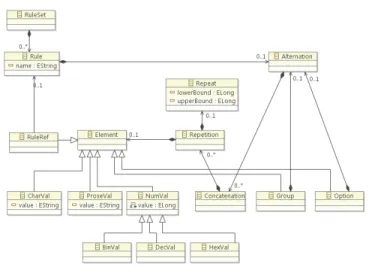
As mentioned above, we used the Xtext framework [4] for the implementation of an ABNF parser and surrounding tool support for the Eclipse workbench. Xtext is a metamodel-based framework for the implementation of DSL’s like ABNF or ASN.1 [7] [8]. The corner stone of implementing a language with the Xtext framework, is to define an EBNF-like grammar file. Xtext uses this grammar file to generate Parser, Lexer, an EMF Ecore metamodel, Editor and other Eclipse workbench functions. The underlying parser/lexer technology of Xtext is ANTLR [9] [10], a two phase LL(*) parser, which creates the concrete syntax of the language. The Xtext framework translates the Xtext grammar file, into a grammar description of ANTLR. In Xtext, the parsing result, i.e. the abstract syntax tree, is represented by an EMF metamodel. Figure 1 shows the metamodel of the abstract syntax of ABNF.
Fig. 1. Metamodel of ABNF
The entry point of the metamodel is a RuleSet, which contains a set of Rule elements. Each Rule contain Alternation elements, an Alternation itself contains Concatenationelements, which concatenates Repetition elements. A Repetition refers to an ABNF Element and can optionally have a Repeat variable. An ABNF Element can either be a CharVal (a String),ProseVal,NumVal(i.e. binary, decimal or hexadecimal values), a reference to another rule (RuleRef), anOption or aGroup.OptionandGroup elements refer to Alternation.
Optional elements in ABNF can be declared in two ways, either by anOptionor aRepetitionelement with
lower/up-per bound set to 0/1. Therefore Rule1 = 0*1"optional" and Rule2 = ["optional"] are equivalent, but have a different representation in the abstract and concrete syntax (i.e. Rule1 is represented by a Repetition, whereas Rule2 is represented by anOption element). In the back end phase of a compiling process, e.g. for code generation (see section III-B), those ambiguities can be simplified.
Besides lexing and parsing, i.e. the transformation of tokens into an abstract syntax tree (sentences), another important step in the front end phase of a compiler is the semantic analysis of the language. With the Xtext framework this can be done through validation rules. We have implemented validation rules to check for unique rule names and to validate the input sequences of theNumVal elements.
Fig. 2. Specification of a NMEA message
The created workbench provides reasonable IDE features for editing ABNF files. We customized the default implemen-tation of the generated Xtext framework for custom syntax highlighting, code completion, code formatting, outline view and most importantly syntax and error validation. Through the implementation of a linking mechanism it is possible to split an ABNF specification into multiple files. That allows to refer an ABNF rule that is defined in a separate file to avoid duplicate code. Figure 2 shows the specification of the NEMA message GPGLL (Geographic Position - Latitude/Longitude) with the created workbench editor. We will refer to this message specification in the next sections.
B. Code generation
Code generation is a part of the backend phase of a compiler, which usually creates machine or interpreter code. In our implementation the code generation phase creates Java source code. In MDSE terms, code generation is also referred to as a model to text (M2T) transformation [11], because generally a M2T generator may not only create programming code, but also other artefacts like configurations, database or user-interface scripts.
Model to text transformation can have different strategies [12] [13]. Figure 3 shows two different strategies. In strategy ’a’ the source model (the metamodel of ABNF) is directly transformed into the target model (Java code). In this strategy it is possible, but difficult to add optimization procedures. There-fore many compilers create an intermediate model (strategy
Fig. 3. Strategies of a code generator
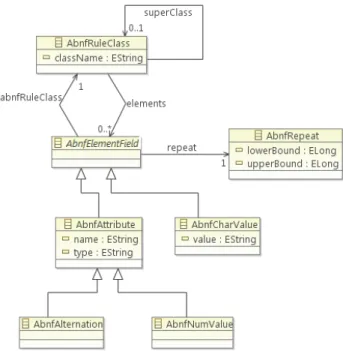
’b’) before the target model is created. Figure 4 shows the intermediate model of the ABNF code generator. Each ABNF Rule is represented by an AbnfRuleClass, e.g. the ABNF rule GPGLL of the NMEA example (see figure 2) is trans-formed to an instance of AbnfRuleClass with className = "GPGLL". EveryElement (see figure 1) will be translated into anAbnfElementField. AnAbnfElementFieldstores a repeat variable (AbnfRepeat) with lowerBound and up-perBound. The default value is 1/1, optional elements will be stored as 0/1, Repeat elements are directly mapped to AbnfRepeat.
Fig. 4. Intermediate model of the code generator
An AbnfElementField is an abstract class, the con-crete subclasses are AbnfCharValue and AbnfAttribute. An AbnfCharValue is just a representation of CharValue (see metamodel in figure 1). An AbnfAttribute stores a reference to another rule in the type variable, the name variable can be either derived by the type or by a name binding, which we will describe in section III-C. The rule referenceFloatfor example (line 8 in the NMEA example in figure 2) is translated into anAbnfAttribute(type=Float,
name=float). Alternations in ABNF are transformed into instances of AbnfAlternation, which is a subclass of AbnfAttribute. An AbnfAlternation contains a list of values of type AbnfElementField. Alternations that are references to other rule definitions will be transformed to superClass instances of an AbnfRuleClass. In the NMEA example of figure 2 the NMEA class will be the super class of GPGLL,GPGGA andGPRMC. Objects of typeNumVal in the metamodel (i.e. binary, hexadecimal or decimal values) will be translated into AbnfNumValof the intermediate model.
In summary the intermediate model (figure 4) is an opti-mized structure of the ABNF metamodel (figure 1). Optional elements and repetitions of the metamodel are transformed into repeat elements in the intermediate model, group elements are completely removed because they are only necessary for struc-turing ABNF data. The intermediate model is used to generate the code artefacts of the target programming language. Table I shows how the main elements of the intermediate model are represented in Java code.
TABLE I
TRANSFORMATION OF INTERMEDIATE MODEL TO CODE
Intermediate model Java representation
AbnfRuleClass Object class
AbnfAttribute Class field with setter and getter method AbnfAlternation Enum class
The code generator creates a Java class for each AbnfRuleClass. A generated Java class consists of a field section, where each AbnfAttribute will become a Java field with a corresponding setter- and getter-method. If the upper bound of the AbnfRepeat is greater one, the type of the Java field will be java.util.List. An AbnfAlternation is transformed to a Java Enum class, where each value of theAbnfAlternationwill be an Enum value. For each AbnfElementField (i.e. AbnfAttrbute, AbnfAlternation,AbnfNumValueandAbnfCharValue) a read/write entry is generated in the read/write method.
Listing 1 shows a snippet of the generated Java classes for theNMEAandGPGLLrules in the NMEA example of figure 2. public class GpGll extends AbstractNmeaObject
{
private Float latitude;
// other fields ...
public Float getLatitude() { return latitude;
}
public void setLatitude(Float latitude) { this.latitude = latitude;
}
// other setter/getter
// and read/write methods ...
}
Listing 1. Generated Java class for GPGLL
C. Name binding with X-ABNF
An important requirement on code generation is that the resulting source code is understandable for the user, i.e. the source code has clear names for classes, methods and fields. In contrast, the ABNF grammar does not define names (except for the rules), but only the transfer syntax. In the NMEA example of figure 2 theGPGLLrule defines aFloatvariable, the semantic information of the name of that variable cannot be derived from the ABNF specification, which would lead to a semantic gap between the ABNF specification and the generated source code.
To close this gap we have developed X-ABNF that is a DSL for defining name bindings for ABNF. X-ABNF allows the definition of a Generator model and a Binding model. Table II explains the elements of the generator and binding model of X-ABNF.
TABLE II
ELEMENTS OF THEX-ABNF GENERATOR ANDBINDING MODEL
Model element Description
file A reference to the ABNF file. language The target language that should be
generated (currently only Java is sup-ported).
package An optional specification of the pack-age of the resulting code.
encoding An optional specification of the encod-ing that should be used (default is US-ASCII).
RuleBinding A binding of an ABNF rule to a specific class name. A RuleBinding can contain several AttributeBindings.
AttributeBinding A binding of an ABNF element (i.e. an AbnfAttributeof the intermedi-ate model) to a specific field name in the target class.
ClassBinding A binding of an ABNF rule to a target library class.
The specification of a RuleBinding allows the defini-tion of class names for ABNF rules. In our NMEA ex-ample (see listing 1) the rule NMEA is bound to the name AbstractNmeaObjectbecause this class is an abstract super class ofGPGLL,GPGGAandGPRMC. AnAttributeBinding allows the definition of a specific name for an ABNF rule reference (e.g. the firstFloatvariable of theGPGLLis bound to the namelatitude, because it specifies the latitude of a GPGLL message).
TheClassBindingcan be used to statically bind an ABNF rule to an existing library class. TheClassBindingdefinition also defines a method binding that provides the object conversion. In the target source code the method that is bound in the class binding is called to convert the input sequence (i.e. a String). This way the rule Float of the NMEA example is bound to the Java class Float with the method binding java.lang.Float.valueOf(java.lang.String). The code generator ensures that every ABNF rule Float is then converted into an object of java.lang.Float. This mechanism allows to define predefined classes for specific ABNF rules that can be reused for different ABNF
specifications. We have also implemented static validation rules that ensure that the class bindings are valid and refer to existing classes and methods in the library path. Figure 5 shows the X-ABNF specification for the NMEA example that is used to generate the code in listing 1.
Fig. 5. X-ABNF specification of the NMEA
In the code generation progress the generator consults the X-ABNF specification to derive the name of a specific ABNF rule or rule reference. The name bindings are derived when the intermediate model is transformed into the target code. D. Macro programming
Macro programming is a language-extension mechanism and gained popularity with the Common Lisp programming language. OpenJava [14] introduced macro programming as a language extension mechanism for Java at compile time, which uses some features of OpenC++ [15]. Erdweg [16] dis-cussed macro programming in the context of domain-specific programming/languages and compared different approaches (also OpenJava among others). Macro programming is a useful mechanism for several purposes. [5] and [14] claim that macro programming can help to substitute redundant ”boilerplate” code that is necessary to use design patterns [17]. This is because many design patterns require the implementation of a skeleton of several classes that interact in a specific way. For example the Observer pattern [17] requires the implementation of an Observer interface that can be attached to a subject class. The subject class notifies a concrete Ob-server implementation on internal state changes. Usually the Observer pattern requires the implementation of at least four different classes. This programming overhead can be reduced with macro programming.
We argue that macro programming is also very useful for protocol development, because the implementation of a communication protocol for a software application also re-quires to test the implementation and the conformance to the protocol specification. Implementation and conformance tests often require the development of Mock Objects, which are dummy classes that emulate real code [18]. The development of Mock Objects for protocol messages that behave like real messages can be a complicated and tedious task.
The recent version (2.4) of the Xtend language [5] allows the specification of Active Annotations that are an imple-mentation of macro programming for Xtend that is similar to OpenJava [14]. The Xtend language is build on top of the Java language and therefore has many features of Java (e.g. declarations of classes, methods and fields). The Xtend compiler transforms an Xtend class into a Java class and creates Java source code.Active Annotationscan be declared in Xtend source files like regular Java annotations. TheActive Annotations specify a processor class, which acts as a call-back class for the Xtend compiler. The Xtend compiler calls the processor class to extend the Xtend language with a macro at compile time. Therefore the processor reads the content of a declared Active Annotation and provides specific language extensions for the given class. Listing 2 shows the definition of theAbnfDataannotation that can be declared as anActive Annotation on Xtend type declarations.
@Target(ElementType.TYPE)
@Active(AbnfDataProcessor.class) public @interface AbnfData {
String file(); String data(); }
Listing 2. Java Annotation AbnfData
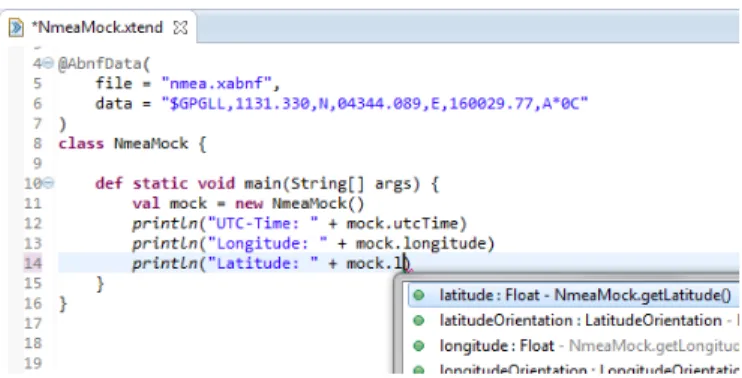
The Annotation @Active(AbnfDataProcessor.class) specifies the call-back processor class for the Xtend compiler. The content of the AbnfDataannotation is the specification of afileattribute that must refer to a XABNF file. Thedata attribute specifies concrete data whose content is defined by an ABNF grammar. Figure 6 shows an example for anAbnfData annotation with NMEA message data.
Fig. 6. Class NmeaMock with AbnfData annotation
In theNmeaMockexample class thefileattribute refers to thenmea.xabnf file, which must be located in the same direc-tory as the Xtend file. Thedataattribute contains a concrete GPGLL message that is part of the NMEA-ABNF specifica-tion. The AbnfDataProcessor class (see Listing 2) parses the GPGLL message with the information of thenmea.xabnf file. The processor class uses Java Reflection to dynamically instantiate the required parser classes (GpGll.java in our example) that were generated by the code generator (see section III-B). The processor creates extension methods for
all get-methods of a parser class. The result of a get-method is determined by invoking the corresponding method of the parser class via Java Reflection. Informally spoken, the proces-sor class ofAbnfDataannotation passes the NMEA message of the annotation to the generated parser classes by invoking the parser classes via Java Reflection. The get-methods and the results of this invocation is dynamically inserted into the resulting Java code of the Xtend class. This mechanism allows the programmer to instantiate the methods of the parser class within the Xtend class. In our example (see figure 6) the result ofmock.getLatitude()is the float value ”1131.330”, which is retrieved from the data attribute of theAbnfData annotation.
IV. RELATEDWORK
As indicated in the introduction section I the ABNF gram-mar only describes the transfer syntax of text-based messages, instead of their abstract syntax and encoding rules. Existing parsers for ABNF like APG [2] or aParse [3] therefore only provide generic access and simple validation methods for ABNF documents. A similar approach to generic parsing solutions is the generation of regular expressions from ABNF grammars [19]. Schulz [20] discusses the issue of the mixture of abstract and transfer syntax in ABNF in the context of conformance testing of text-based protocols. He solves this problem with a derivation of abstract protocol type definition by mapping ABNF rules to TTCN-33types. This solution has the drawback that the mapping also has to be specified, and it depends on a different technology (i.e. TTCN-3).
V. CONCLUSIONS
In this paper we have presented X-ABNF, which is a domain-specific language (DSL) for the definition of name-bindings of a given ABNF specification. The definition of name-bindings for ABNF through X-ABNF allows to handle ABNF like a programming language with variable identifiers. We have shown that the name-binding is particularly useful for generating ABNF parser classes for ABNF specifications that is understandable for the programmer. Additionally we outlined how the name-binding of X-ABNF can be used with macro programming for language extensions at compile time. We have used Active Annotations, a language feature of Xtend, to implement the language extension. This mechanism enables the programmer to access ABNF data in Xtend classes. Our implementation of the ABNF and X-ABNF grammar with the Xtext framework also provides a state-of-the-art tool support and good integration with Eclipse EMF.
In the future we plan to improve the implementation of the code generator. Currently the transformation of the ABNF metamodel to the intermediate model is implemented with Xtend. This transformation can also be done by a model transformation language like ATL [21]. Furthermore we plan to extend the use of theAbnfDatanot only on type definition, but also on method definitions. This allows to specify ABNF
3http://www.ttcn-3.org
encoded text messages on method level, which would improve the implementation of unit test classes.
The source code of the described project is online available at http://code.google.com/p/moses-project.
Acknowledgements
This work is funded by the German ministry for education and research (BMBF) in the ongoing projectMOSES - Mod-ellgetriebene Software-Entwicklung von vernetzten Embedded Systems (FKZ 17075B10).
REFERENCES
[1] Internet Engineering Task Force (IETF), “Augmented bnf for syntax specifications: Abnf,” January 2008. [Online]. Available: http://tools.ietf.org/html/rfc5234
[2] I. Coast to Coast Research. Apg – abnf parser generator. [Online]. Available: http://www.coasttocoastresearch.com
[3] parse2. aparse - parser generator for augmented bnf. [Online]. Available: http://www.parse2.com
[4] Eclipse Foundation. Xtext project website. [Online]. Available: http://www.eclipse.org/Xtext
[5] Xtend project website. [Online]. Available: http://www.eclipse.org/xtend [6] National Marine Electronics Association, “Nmea 0183 - standard for
interfacing marine electronic devices, version 4.10.”
[7] International Telecommunication Union (ITU), “Abstract syntax notation one (asn.1) - specification of basic notation,” 13.11.2008.
[8] T. Kistel and R. Vandenhouten, “A metamodel-based asn.1 editor and compiler for the implementation of communication protocols,” Wis-senschaftliche Beitr¨age TH Wildau, pp. 61–66, 2013.
[9] Antlr website. [Online]. Available: http://www.antlr.org
[10] T. Parr,The Definitive ANTLR reference guide: Building domain-specific languages. Raleigh [ etc.]: The Pragmatic bookshelf, op. 2007. [11] J. C. Flores Beltran, B. Holzer, T. Kamann, M. Kloss, S. A. Mork,
B. Niehues, and K. Thoms, Modellgetriebene Softwareentwicklung: MDA und MDSD in der Praxis. Frankfurt [Main]: Entwickler.press, 2007.
[12] Z. Hemel, Lennart C. L. Kats, and E. Visser, “Code generation by model transformation,” inProceedings of the 1st international conference on Theory and Practice of Model Transformations. Zurich and Switzer-land: Springer-Verlag, 2008, pp. 183–198.
[13] M. V¨olter and B. Kolb, “Best practices for model-to-text transforma-tions,” 11.10.2006.
[14] M. Tatsubori, S. Chiba, M.-O. Killijian, and K. Itano, “Openjava: A class-based macro system for java,” in Reflection and Software Engineering, ser. Lecture Notes in Computer Science, W. Cazzola, R. Stroud, and F. Tisato, Eds. Springer Berlin Heidelberg, 2000, vol. 1826, pp. 117–133.
[15] S. Chiba, “A metaobject protocol for c++,”SIGPLAN Notices, vol. 30, no. 10, pp. 285–299, 1995.
[16] S. T. Erdweg, “Extensible languages for flexible and principled do-main abstraction,” Dissertation, Philipps-Universit¨at Marburg, Marburg, 06.03.2013.
[17] E. Gamma, R. Helm, and R. E. Johnson,Design patterns: Elements of reusable object-oriented software. Reading and Mass: Addison-Wesley, 1995.
[18] T. Mackinnon, S. Freeman, and P. Craig, “Endo-testing: unit testing with mock objects,” inExtreme Programming examined, ser. The XP series, G. Succi and M. Marchesi, Eds. Boston: Addison-Wesley, 2001, pp. 287–301.
[19] M. Thomson. abnf2regex. [Online]. Available: https://github.com/martinthomson/abnf2regex
[20] S. Schulz, “Derivation of abstract protocol type definitions for the conformance testing of text-based protocols,” inTesting of Communi-cating Systems, ser. Lecture Notes in Computer Science, R. Groz and R. Hierons, Eds. Springer Berlin Heidelberg, 2004, vol. 2978, pp. 177–192.
[21] F. Jouault and I. Kurtev, “Transforming models with atl,” inSatellite Events at the MoDELS 2005 Conference, ser. Lecture Notes in Computer Science, J.-M. Bruel, Ed. Springer Berlin Heidelberg, 2006, vol. 3844, pp. 128–138.