The Open University’s repository of research publications
and other research outputs
Capturing and Exploiting Citation Knowledge for the
Recommendation of Scientific Publications
Thesis
How to cite:
Khadka, Anita (2020). Capturing and Exploiting Citation Knowledge for the Recommendation of Scientific Publications. PhD thesis The Open University.
For guidance on citations see FAQs.
c
2020 The Author Version: Version of Record
Copyright and Moral Rights for the articles on this site are retained by the individual authors and/or other copyright owners. For more information on Open Research Online’s data policy on reuse of materials please consult the policies page.
C A P T U R I N G A N D E X P L O I T I N G C I TAT I O N K N O W L E D G E F O R T H E R E C O M M E N D AT I O N O F S C I E N T I F I C
P U B L I C AT I O N S
Anita Khadka
Thesis submitted in fulfilment of the requirements for the degree of Doctor of Philosophy
Knowledge Media Institute
Faculty of Science, Technology, Engineering & Mathematics The Open University
A B S T R A C T
With the continuous growth of scientific literature, it is becoming in-creasingly challenging to discover relevant scientific publications from the plethora of available academic digital libraries. Despite the current scale, important efforts have been achieved towards the research and development of academic search engines, reference management tools, review management platforms, scientometrics systems, and recom-mender systems that help finding a variety of relevant scientific items, such as publications, books, researchers, grants and events, among others.
This thesis focuses onrecommender systems for scientific
public-ations. Existing systems do not always provide the most relevant scientific publications to users, despite they are present in the
recom-mendation space. A common limitation is the lack of access to the
full content of the publicationswhen designing the recommendation methods. Solutions are largely based on the exploitation of metadata (e.g., titles, abstracts, lists of references, etc.), but rarely with the text of the publications. Another important limitation is the lack of time awareness. Existing works have not addressed the important scenario of recommending the most recent publications to users, due to the challenge of recommending items for which no ratings (i.e., user
pref-erences) have been yet provided. The lack of evaluation benchmarks
also limits the evolution and progress of the field.
This thesis investigates the use of fine-grained forms of citation knowledge, extracted from the full textual content of scientific
design and develop new recommendation methodsthat incorporate such knowledge, individually and in combination.
By conducting offline evaluations, as well as user studies, we show how the use of citation knowledge does help enhancing the perform-ance of existing recommendation methods when addressing two key tasks: (i) recommending scientific publications for a given work, and (ii) recommending recent scientific publications to a user. Two novel evaluation benchmarks have also been generated and made available for the scientific community.
D E C L A R AT I O N
I declare that this thesis has been composed solely by myself and that it has not been submitted, either in whole or in part, in any previous application for a degree. Except where otherwise acknowledge, the work presented is entirely my own.
Somewhere, something incredible is waiting to be known. — Carl Sagan
A C K N O W L E D G M E N T S
I have received a great deal of support and assistance throughout my PhD journey. I would like to acknowledge those amazing people who have walked with me during this adventure. First of all, I would like to show my gratitude to my excellent supervisor Dr Miriam Fernandez for her immense patience towards me. Her continuous support and guidance in how to rigorously think and write in academia have reshaped my research thinking process. The meetings with her always had a calming effect during the years, when I am lost and in panic mode, she has always been there to help me, both technically and emotionally. I am very grateful to her believing in me and taking me under her wings and supporting me especially during the toughest time of my PhD study. I could not have completed this journey and this thesis without her exemplary supervision and support.
I would equally like to thank and show my gratitude to my external supervisor Dr Ivan Cantador, with whom I had the honour to work with. He is the most intelligent and diligent researcher I had a chance to work with and I am very grateful for such an opportunity. His expertise, guidance, feedback and invaluable discussion in the research topics have undoubtedly had a great impact on the quality of this work.
Her door was always open for me to have guidance and support. I am immensely grateful to Prof. Marian Petre for her support when I was going through the toughest time of this PhD. She has played a huge part in many ways in my PhD study. No matter how many times I thank her, it would not be enough. I am very thankful for Prof. Petre for her work in assisting and supporting the community of research students like me. I am one of the fortunate ones to directly attend her PGForum sessions which helped me develop my research skills.
My gratitude is also extended to my examiners Dr Paul Mulholland and Dr Saúl Vargas Sandoval for their insightful and invaluable com-ments and feedback, which helped improve this thesis. I am thankful to my third party monitor Dr Trevor Collins for his support. I would also like to thank all my friends and colleagues in both the Knowledge Media Institute and Computing and Communications departments. Even though most of us work in different domains, I always enjoyed the company and conversations during these years.
I gratefully acknowledge the funding received towards my PhD study from the Knowledge Media Institute.
Finally, special recognition and thanks go out to my husband Saurav, for his support and help in many aspects of my work: code/bug fixing, proofreading etc. Most importantly, his patience throughout this journey and walking by my side.
C O N T E N T S
i i n t r o d u c t i o n a n d l i t e r at u r e r e v i e w
1 i n t r o d u c t i o n 5
1.1 Motivation 5
1.2 Research Questions, Hypotheses and Contributions 10
1.3 Research Methodology 17
1.4 Thesis Outline 20
1.5 Terminology 22
1.6 Publications 23
2 r e c o m m e n d e r s y s t e m s 25
2.1 Overview of Recommender systems 26
2.2 Brief History of the Recommender systems 27
2.3 Components of Recommender Systems 30
2.3.1 Modelling Users and Items 30
2.3.1.1 Item and Item representation 30
2.3.1.2 User and User profiles 31
2.3.2 The Recommendation Task 31
2.3.2.1 Rating Prediction 31
2.3.2.2 Item Ranking 32
2.3.3 Sources of User Preferences 32
2.3.3.1 Explicit Feedback 33
2.3.3.2 Implicit Feedback 33
2.4 Recommendation Techniques 34
2.4.1 Recommendation Methods: From the Algorithmic
Perspective 35
2.4.1.1 Memory-based Recommendation
Meth-ods 35
2.4.1.2 Model-based Recommendation
Meth-ods 35
2.4.2 Recommendation Methods: From the Data
Ex-ploitation Perspective 36
2.4.2.1 Content Based Filtering (CBF) 36
2.4.2.2 Collaborative Filtering (CF) 40 2.4.2.3 Hybrid Approaches 46 2.5 Evaluation 49 2.5.1 Evaluation Methods 50 2.5.1.1 Offline Evaluation 50 2.5.1.2 Online Evaluation 52 2.5.2 Evaluation Metrics 53
2.5.2.1 Error-based Evaluation Metrics 53
2.5.2.2 Ranking-based Metric 54
2.5.3 User-centric Evaluation Aspects 57
2.6 Open Challenges 59
2.6.1 Understanding and Gathering User Preferences 59
2.6.2 Data Sparsity 60 2.6.3 Cold Start 61 2.6.4 Trust 62 2.6.5 Explainability 62 2.6.6 User-centric evaluation 62 2.7 Conclusion 63 3 s c i e n t i f i c p u b l i c at i o n r e c o m m e n d e r s y s t e m s 65
3.1 Survey Scope and Methodology 66
c o n t e n t s xi
3.2.1 Recommending Scientific Publications For a Given
Piece of Work 70
3.2.2 Recommending Scientific Publications For a User 72
3.3 Citation Knowledge 73
3.4 Item and Target Modelling 77
3.4.1 Item Modelling 77 3.4.2 Target Modelling 79 3.5 Recommendation Methods 82 3.5.1 Content-based filtering (CBF) 84 3.5.2 Collaborative filtering (CF) 85 3.5.3 Hybrid 87 3.6 Evaluation 89 3.6.1 Evaluation Methods 89 3.6.2 Evaluation Datasets 91 3.6.3 Evaluation Metrics 96 3.7 Discussion 97 ii p r o p o s e d s o l u t i o n s 4 r e c o m m e n d i n g s c i e n t i f i c p u b l i c at i o n s f o r a g i v e n p i e c e o f w o r k u s i n g c i tat i o n c o n t e x t a n d c i ta -t i o n p r o x i m i -t y 113 4.1 Introduction 114 4.2 Dataset Building 116 4.3 Proposed Approach 118 4.3.1 Citation Knowledge 118
4.3.2 Proposed Recommendation Methods 121
4.3.2.1 Citation Proximity (CP)
4.3.2.2 Citation Proximity-Context (CPC)
Re-commendation Method 126
4.4 Evaluation 131
4.4.1 Citation Proximity (CP) Recommendation Method 132
4.4.1.1 Evaluation Set-up 132
4.4.1.2 Evaluation Results 134
4.4.2 Citation Proximity-Context (CPC)
Recommend-ation Method 136
4.4.2.1 Evaluation Set-up 136
4.4.2.2 Evaluation Results 138
4.5 Discussion and Conclusions 140
5 r e c o m m e n d i n g s c i e n t i f i c p u b l i c at i o n s f o r a u s e r
u s i n g c i tat i o n g r a p h, c i tat i o n c o n t e x t, c i tat i o n
s e c t i o n a n d c i tat i o n i n t e n t i o n 145
5.1 Introduction 146
5.2 Dataset Building 149
5.2.1 Collecting Data 149
5.2.2 Modelling Authors, Papers and Citations 152
5.2.3 Modelling User Preferences 153
5.3 Proposed Approach 154
5.3.1 Citation Knowledge 156
5.3.2 Proposed Methods 158
5.3.2.1 Hybrid Recommendation Method: hyb 159
5.3.2.2 Hybrid Recommendation Method:
hyb-Sec 160
5.3.2.3 Hybrid Recommendation Method:
hy-bIntent 161
5.3.2.4 Hybrid Recommendation Method:
c o n t e n t s xiii
5.4 Evaluation 164
5.4.1 Evaluation Set-up 164
5.4.2 Evaluation Results: Hyb & HybSec
Recommend-ation Methods 171
5.4.3 Evaluation Results: HybIntent & HybIntentSec
Recommendation Methods 177
5.5 Discussion and Conclusion 182
iii d i s c u s s i o n, c o n c l u s i o n a n d f u t u r e w o r k
6 d i s c u s s i o n s, c o n c l u s i o n s a n d f u t u r e w o r k 189
6.1 Discussion 191
6.1.1 Recommendation of Scientific Publications 192
6.1.2 Citation Knowledge 194
6.1.3 Exploitation of Citation Knowledge for the
Re-commendation of Scientific Publications 195
6.1.4 Evaluation of Recommender Systems for
Sci-entific Publications 198
6.2 Future Work 200
6.3 Conclusion 202
iv a p p e n d i c e s
a a p p e n d i x 207
a.1 Features for Item modelling 207
a.2 Database schema diagram 210
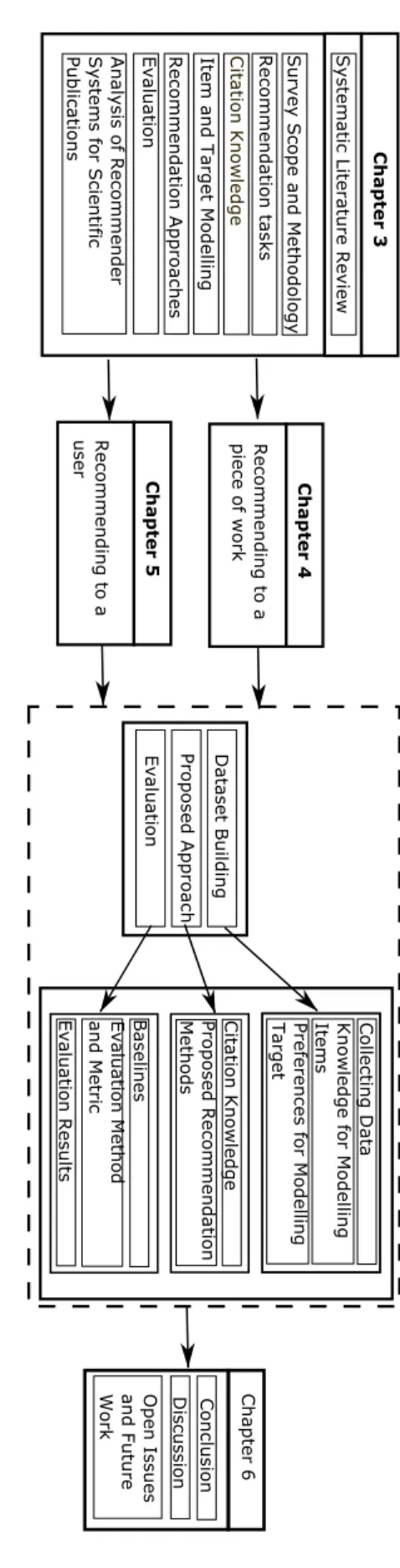
Figure1.1 Pipeline of our work under each chapter. Ar-rows pointing to the same block mean two
chapters are sharing same structure 18
Figure3.1 Recommendation tasks distribution 69
Figure3.2 Different recommendation tasks distribution
within a piece of work type 71
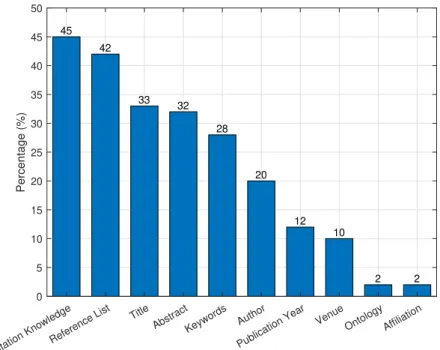
Figure3.3 Features that are employed in the literature for
modelling items 79
Figure3.4 Different types of citation knowledge that are
employed in the literature for modelling items 80
Figure3.5 The statistics of different evaluation methods
employed by the reviewed works 90
Figure4.1 A toy example for our proximity based
hypo-thesis. 117
Figure4.2 Illustration of Citation Proximity [85] 119
Figure4.3 A toy example of a citation context formed
from citing, preceding and succeeding
sen-tences 120
Figure4.4 Model diagram of the proposed citation
prox-imity (CP) recommendation method. Solid ar-rows indicate data flow and dashed arar-rows ex-hibit data details at that particular steps. 122
Figure5.1 Capturing citation knowledge 153
Figure5.2 Modelling user preferences 155
Figure A.1 A schema diagram of the database created in
Chapter5 211
L I S T O F TA B L E S
Table 1.1 Terms and phrases used in the thesis
inter-changeably 23
Table 2.1 Examples of diverse recommender systems and
their corresponding domains 29
Table 2.2 user-item rating matrix 61
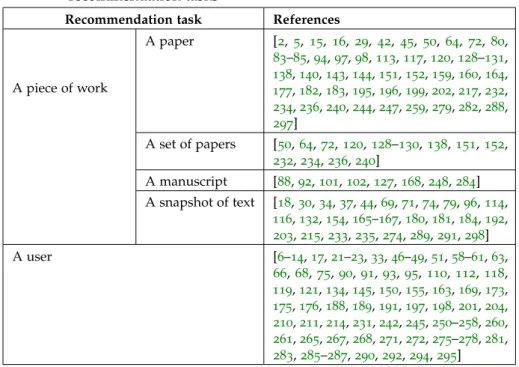
Table 3.1 List of reviewed papers that are categorised
based on different recommendation tasks 69
Table 3.2 Reviewed papers categorised into
recommend-ation task and their utilisrecommend-ation of different types
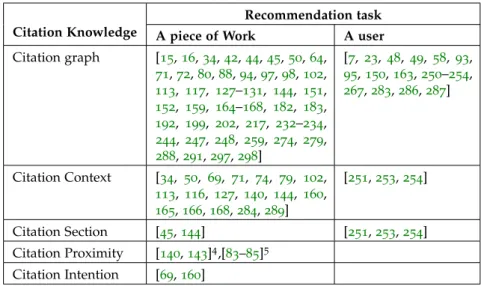
of citation knowledge. 76
Table 3.3 List of reviewed papers utilising different
as-pects of citation knowledge to model items. CG stands for Citation graph, CC stands for cita-tion context, CS stands for citacita-tion seccita-tion, CP stands for citation proximity and CI stands for
citation intention 80
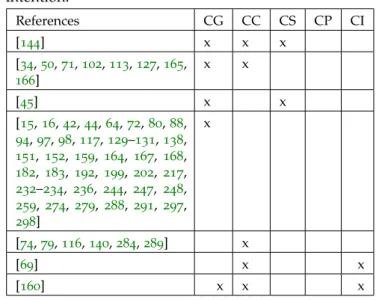
Table3.4 List of reviewed papers utilising different no-tions of citation knowledge for modelling as a target (a piece of work). CG stands for cita-tion graph, CC stands for citacita-tion context, CS stands for citation section, CP stands for cita-tion proximity and CI stands for citacita-tion
inten-tion. 83
Table3.5 List of reviewed papers in different
recom-mendation approaches 84
Table3.6 List of reviewed papers categorised based on
recommendation approaches and their utilisa-tion of different noutilisa-tions of citautilisa-tion knowledge. Here, CG stands for Citation graph, CC stands for citation context, CS stands for Citation sec-tion, CP stands for citation proximity, CI stands
for Citation intention 87
Table3.7 Publicly available datasets for academic
recom-mender systems. Where,PDFavstands for
Port-able Document Format (PDF) document
avail-able and UPHav represents the availability of
authors’ publications history 93
Table3.8 Types of citation intention proposed by prior
l i s t o f ta b l e s xvii
Table 3.9 List of reviewed papers categorised based on
target preferences when the target is a piece
of work. Here, Ci stands for Citing, Ti stands for Title, Ab stands for Abstract, Ke stands for Keywords, Au stands for Author, Ve stands for Venue, Py stands for Publication year, Ft stands for Terms from free text, Tx stands for
Tax-onomy, Ck stands for Citation knowledge 105
Table 3.10 List of reviewed papers categorised based on
target preferences when the target is a user. Here, A stands for authoring, B stands for browsing, T stands for tagging, Bm stands for bookmarking, Sc stands for scoring, Rd stands for reading, Cl stands for clicking, R stands for rating, V stands for viewing, D stands for downloading, P stands for has profile, Sr stands for searching, Ac stands for accessing, Sh stands for sharing, Vo stands for voting, Cm stands for commenting, An stands for annotating, Ci
stands for citing 107
Table 4.1 List of parameters extracted from a parsed
sci-entific publication 123
Table 4.2 Precision at three different levels. For each
metric, a gray scale is used to highlight higher (dark gray) and lower (white) precision values. Higher precision values are represented in bold
font. 134
Table4.4 nDCG results at 3rd and 5th for the proposed method and baselines. For each metric, a gray scale is used to highlight high (dark gray) and
low (white) values. 139
Table4.5 Cronbach’s alpha interpretation table [86] 140
Table5.1 List of hybrid methods and various citation
knowledge they utilised 159
Table5.2 An example of the combination of citation
in-tention and citation section that are applied in Equation (5.7). Here,BKGandIntroductionare
chosen as citation intention and citation section
respectively. 163
Table5.3 Experimental results of the baselines and
pro-posed hybrid recommendation methods. A gray scale is used to highlight better (dark gray) and worst (white) values for each each metric (column). For every metric, the best values are in bold. Here, P stands for precision, R stands for recall, M stands for Mean Average Precision (MAP) and N stands for Normalised
Discoun-ted Cumulative Graph (nDCG). 173
Table5.4 Experimental results of the baselines and
pro-posed hybrid recommendation methods. A gray scale is used to highlight better (dark gray) and worst (white) values for each each metric (column). For every metric, the best values are in bold. Here, P stands for precision, R stands for recall, M stands for MAP and N stands for
l i s t o f ta b l e s xix
Table 5.5 McNemar hypothesis significance test results
between the baseline and the proposed
meth-ods. 176
Table 5.6 Experimental results of the baselines and
pro-posed hybrid recommendation methods includ-inghybIntent. A gray scale is used to highlight better (dark gray) and worst (white) values for each ranking metric. For every metric, the best values are highlighted in bold. Here, P stands for precision, R stands for recall, M stands for
MAP and N stands for nDCG. 178
Table 5.7 Experimental results of the baselines and
pro-posed hybrid recommendation methods
includ-ing competitive part ofhybIntentand
hybIn-tentSec. A gray scale is used to highlight better (dark gray) and worst (white) values for each ranking metric. For every metric, the best val-ues are highlighted in bold. Here, P stands for precision, R stands for recall, M stands for
MAP and N stands for nDCG. 179
Table 5.8 McNemar hypothesis significance test results
between the baseline and the proposed
Table A.1 List of reviewed papers utilising different item features for modelling item profiles. Ti stands for Title, Ab stands for Abstract, Ke stands for Keywords, Au stands for Author, Af stands from Affiliation, Pd stands for Publication date, Ve stands for Venue, Tx stands for Taxonomy, Rl stands for Reference list, Ck stands for Citation
A C R O N Y M S
ACMDLAssociation for computing Machinery Digital Library
APAverage Precision
CBFContent Based Filtering
CFCollaborative Filtering
CPCitation Proximity
CPA Citation Proximity Analysis
CPCCitation Proximity-Context
CPICitation Proximity Index
FM Factorisation Machine
GROBIDGeneRation Of Bibliographic Data
IBCFItem-based Collaborative Filtering
LDA Latent Dirichlet Allocation
LSALatent Semantic Analysis
MAEMean Absolute Error
MAPMean Average Precision
MF Matrix Factorisation
ML Machine Learning
MRRMean Reciprocal Rank
nDCGNormalised Discounted Cumulative Graph
PDFPortable Document Format
PHOAKSPeople Helping One Another Know Stuff
RMSERoot Mean Square Error
RSRecommender Systems
SPRSScientific Publication Recommender Systems
SVDSingular Value Decomposition
TEIText Encoding Initiatives
TF-IDFTerm Frequency Inverse Document Frequency
Part I
1
I N T R O D U C T I O N
A general overview of the thesis is provided in this chapter. Section1.1
motivates the research problem and summarises existing progress and limitations reported in the literature. Section1.2defines the scope of
the study by stating the addressed research questions and key contri-butions of this research. Section1.3outlines the research methodology
carried out in the thesis. Section 1.4 describes the structure of this
document and Section 1.5 lists the terms and phrases used in the
thesis interchangeably. Lastly, Section 1.6lists the publications that
resulted from the research undertaken in the thesis.
1.1 m o t i vat i o n
With the continuous growth of scientific literature, it is becoming more and more challenging to discover relevant scientific publications from the plethora of available academic digital libraries.
A recent report by the International Association of Scientific, Tech- Information overload problem
nical and Medical Publishers1
claims the existence of 33,100 active
scholarly peer-reviewed English-language journals in mid-2018(plus
a further9400non-English-language journals), collectively publishing over three million papers per year. The report also states that the pro-duction of scientific publications is steadily increasing at a 4% annual rate. March2020statistics from one of the well-known digital libraries
1 https://www.stm-assoc.org/2018_10_04_STM_Report_2018.pdf
– the Association for computing Machinery Digital Library (ACMDL) [109]– show numbers in the order of181,692books,74,545theses and 26,251proceedings. It is also relevant to highlight that more than100
academic databases and search engines, including academic journals, institutional repositories, archives, or collections or scientific articles, are currently available.2
Given the scale of digital scholarly information currently available, a
Existing solutions
wide range of efforts have been invested in the last decade to discover, analyse and exploit digital contents. Those efforts range from the de-velopment of academic search engines like Google Scholar3
, CiteSeer4
and PubMed5
, reference management tools (e.g. JabRef6
, Zotero7
),
review management platforms [273], scientometrics systems -which
analyse the impact of scientific literature [106]-, and Recommender Systems (RS) for scientific publications, books, authors, events and patents, among others [19,84].
All these solutions are needed to facilitate the efficient discovery, management and analysis of relevant research [66,183,202,254], help-ing researchers and practitioners to concentrate on existhelp-ing approaches and resources, and avoid the unnecessary duplication of previous re-search efforts [34]. Search engines are designed to find relevant content
for a given query [224]. Reference management tools help users to
record bibliographic citations, generating databases of bibliographic references that can then be filtered, selected or exported to facilitate the creation of reference lists for scientific articles, reports, etc. Review management platforms help with the automatic assignment of
sci-2 https://en.wikipedia.org/wiki/List_of_academic_databases_and_search_ engines 3 https://scholar.google.co.uk/ 4 https://citeseerx.ist.psu.edu/index 5 https://www.ncbi.nlm.nih.gov/pubmed/ 6 www.jabref.org 7 www.zotero.com
1.1 m o t i vat i o n 7
entific papers to reviewers [70]. Scientometrics systems measure and analyse scientific literature, including the impact of research papers and academic journals, or the impact of research institutions [106, 157]. Finally, RS help to provide personalised suggestions of relevant academic resources (publications, patents, events, etc.) to users [123].
In this thesis, our focus is on the research and development of Recommender
Systems
novel RS for scientific publications. The recommendation of sci-entific publications is an important and timely problem. Personalised recommendations can help researchers to keep up-to-date with the latest scientific discoveries in their fields [19,213], provide junior re-searchers with key papers to help them familiarise with the concepts of a particular research field [72,126], or help researchers and practi-tioners to find relevant papers for their work, e.g. by finding relevant references for an ongoing manuscript.
Over the last decade, multiple works have emerged that address the
recommendation of scientific publications. These works have focused Various
recommendation tasks
on a variety of recommendation tasks including: (i) recommending relevant papers for a given user [189,267], (ii) recommending relevant papers for a given paper [140,160], (iii) recommending relevant papers for a particular snapshot of text (title, abstract, free research related text etc.) [30,116], (iv) recommending relevant papers for a particular collection of papers [72,236], and (v) recommending relevant papers for an undergoing manuscript (i.e., a paper yet to be published) [102, 248]. While the first task –recommending relevant papers for a given user– focuses on the traditional RS problem, where items (i.e., research publications) are recommended to users (researchers) based on their preferences (expressed as or extracted from e.g. previous publications, topics of interest, etc.), the rest of the tasks do not have users (but a paper, a set of papers, a snapshot of text, or an ongoing manuscript)
astargetsof the recommendations, enabling the discovery of relevant scientific publications to help with a specific piece of work.
In this thesis, we aim to address both main scenarios: (i) the
re-Addressed tasks
commendation of relevant scientific publications to a user and (ii) therecommendation of relevant scientific publications for a specific piece of work (defined in this thesis as a scientific publication).
Regarding the recommendation of relevant scientific publications to users, while most of the existing solutions recommend relevant papers
The time aspect
to users independently of the time when such papers were published, in this thesis we address the real-world problem of recommending recently published papers [95]. This is a particularly challenging scenario where traditional recommendation methods such as collabor-ative filtering are not effective, since they are not able to recommend the latest, most recent papers which have not previously seen, rated or cited. In the recommender systems literature, this problem is known as “new item cold start.” This problem has barely been addressed
in the context of academic recommendations. The concept of time
has been previously studied to better define and delimit long-term vs. short-term preferences when capturing the researchers’ interests [252], and to suggest papers to researchers with no previous activity (i.e., new researcher) [112]. However, to the best of our knowledge, only a few works [95,272] have addressed the problem of recommending the most recently published scientific work, i.e., new publications.
In addition, while existing recommendation methods for scientific publications explore a wide range of metadata to generate user and
Citation knowledge
item profiles from which recommendations are generated (e.g., title, abstract, keywords, authors, publication venues, bibliographies, and citation graphs among authors and papers) [19,26,102], full-text has not been as widely used. It is important to highlight that full-text
1.1 m o t i vat i o n 9
of scientific articles is often stored behind paywalls, and hence, it is not possible to freely access it. However, with the emergence of
the open access movement8
, many scientific publications have now become publicly available, providing an exciting opportunity for a fine-grained exploration and use of their content [71,102].
Motivated by this situation,the thesis explores the use of full-text of publications to capture and exploit the knowledge provided by citations. Citations (or papers cited within a given paper) capture important and relevant work, as authors carefully choose their ref-erences [45, 254]. Therefore, citations can play an important role on comprehending the authors’ preferences (research interests) [115]. In this context, our main hypothesis is that the exploitation of cita-tion knowledge can help improving the recommendacita-tion of scientific publications.
We, therefore, investigate how citation knowledge could be
cap-tured and exploited to support the discovery of relevant scientific publications. Among the captured citation knowledge we include (i) the citation-graph (where nodes represent papers and edges represent relations between such papers based on their citations), (ii) citation section (section within the publication where the citation appears), (iii) citation proximity (distance between citations), (iv) citation context (text surrounding the citation), and (iv) citation intention (purpose with which the citation is made - compare, criticise, etc.). We explore such forms of citation knowledge, individually and in combination, providing an in-depth analysis of their strengths and limitations.
In the subsequent sections, we describe the main research questions and contributions behind this work in Section 1.2, the followed
re-8 https://open-access.net/en/information-on-open-access/
search methodology in Section1.3, Section1.4presents the outline of
this thesis, various terminologies interchangeably used this thesis are stated in Section1.5, and lastly the publications backing up this work
are presented in Section1.6.
1.2 r e s e a r c h q u e s t i o n s, h y p o t h e s e s a n d c o n t r i b u t i o n s
The main research goal investigated in this thesis is:
Investigating whether and how citation knowledge could be used to improve the performance of recommender systems for scientific publications.
The main focus of this thesis is enhancing the performance of RS for scientific publications by investigating a series of recommenda-tion methods that utilise a wider norecommenda-tion of citarecommenda-tion knowledge. Our research can be summarised in four key research questions. To invest-igate the first two, we have conducted a systematic literature review of existing works on RS for scientific publications (–see Chapter 3).
Research related with the last two questions is based on the empirical investigations (–see Chapters4and5).
RQ1: Which types of citation knowledge have been used in RS for scientific publications?
This research question aims to investigate the different types of citation knowledge that have been previously used in the literature. Our hypothesis is that, due to the lack of access to the full content of publications, previous works have explored only a limited notion of citation knowledge and hence, more fine-grained characterisations of this knowledge can be extracted, exploited and modelled to enhance the performance of recommendation of scientific publications.
1.2 r e s e a r c h q u e s t i o n s, h y p o t h e s e s a n d c o n t r i b u t i o n s 11
HP1: A limited notion of citation knowledge has been used so far in
the research and development of RS for scientific publications.
To address this research question, we have conducted a systematic literature review of RS for scientific publications. We have defined and launched a number of formal queries to collect relevant literature from the Elsevier Scopus9
and ISI Web of Knowledge10
digital libraries. These queries are aimed to extract literature aboutrecommender systems
and scientific publications. Details about the queries are described in
Chapter3. In particular, from the queries we obtained 741 scientific
publications. We conducted a manual filtering of such publications to ensure that they were related to our topic of research interest, reviewing a final number of 202 publications. Our contributions on this line of work are:
• Conducting a systematic literature review on RS for scientific
publications.
• Identifying the different types of citation knowledge that have been used in the literature of RS for scientific publications. • Proposing more fine-grained characterisations of citation
know-ledge by exploiting the full textual content of publications.
RQ2: Which are the different recommendation tasks that have been proposed in the literature of RS for scientific publica-tions, and how citation knowledge has been applied for each of these tasks?
The purpose of RS is to suggest relevant items to a user (identified by a personal profile). In the context of RS for scientific publications,
9 https://www.scopus.com/
a user profile sometimes captures the preferences of a particular in-dividual, but it can also capture the characteristics of a piece of work for which recommendations are made. Based on the target of the recommendation, we can differentiate five different recommendation tasks in the literature: (i) recommending scientific publications for a specific user [47,189,252,253,267], (ii) recommending scientific pub-lications for a specific paper [160,183], (iii) recommending scientific publications for a particular snapshot of text (title, abstract, etc.) [30, 116], (iv) recommending scientific publications for a manuscript under development [102,248] and, (v) recommending scientific publications for a set of specific papers [72,150,241]. While the first task focuses on the need of recommending relevant scientific publications to a user, the other four tasks focus on the need of recommending relevant scientific publications for a particular piece of work.
In this thesis, we investigate the use of citation knowledge to address
both problems. Chapter 4 focuses on exploring the use of different
types of citation knowledge to recommend scientific publications for a particular piece of work. In our case, this piece of work is identified by a specific paper. Chapter5addresses, on the other hand, the use of
citation knowledge to recommend relevant scientific publications to a user.
Our hypothesis when investigating this research question is that dif-ferent recommendation tasks exist in the literature of RS for scientific publications and that each of these tasks presents specific limitations, particularly related to the exploitation of citation knowledge.
HP2: Different recommendation tasks exist in the literature of RS for
scientific publications, and particular limitations exist on how citation knowledge has been used for each of the such tasks.
1.2 r e s e a r c h q u e s t i o n s, h y p o t h e s e s a n d c o n t r i b u t i o n s 13
To address the above research question and to test our hypothesis, we have conducted a systematic literature review following the same methodology specified inRQ1. Our contribution on this line of work are:
• Identifying the different recommendation tasks that exist in the literature of RS for scientific publications.
• Identifying key limitations on how citation knowledge has been
used for each of the existing recommendation task.
RQ3: When addressing the task of recommending scientific publications for a particular piece of work, can citation know-ledge help improving existing RS?
When investigating RQ1and RQ2, we identified different
recom-mendation tasks with two main objectives: (i) recommending scientific publications to a user, and (ii) recommending scientific publications for a specific piece of work, where this piece of work can be captured by a paper, a set of papers, a snapshot of text (title, abstract, free
research related text, etc.), or an ongoing manuscript. In RQ3, we
focus on the recommendation of scientific publications for a specific piece of work (defined in our case as a research paper).
For this particular use case, we propose two novel notions of citation knowledge, namely citation proximity and citation context, and use them to improve existing recommendation methods. We hypothesise that papers that are cited in close proximity within the content of a scientific publication are related. Relations captured via citation proximity can therefore be used to enhance the recommendation of scientific publications. Similarly, the text around a citation (i.e., citation context) can help to better capture the topic of a cited paper, and whether this topic is similar to the one of the target paper (or piece
of work for which recommendations are being made). Our hypothesis is that citation context can help establishing topic similarity, and hence also providing more relevant recommendations.
HP3: Citation proximity and citation context can be used to enhance
existing recommendation methods when addressing the task of recom-mending scientific publications for a particular piece of work.
To address RQ3and test HP3, we have designed two experiments
where (i) we defined novel notions of citation knowledge (in this case, citation proximity and citation context), (ii) we proposed new recommendation methods that integrate such notions of citation know-ledge, individually and in combination, and (iii) we tested whether those notions of citation knowledge do indeed help to enhance the performance of the existing recommendation methods. Evaluations have conducted by means of user studies. This research is extensively
described in Chapter4. Our key contributions can be summarised as:
1. Utilising two novel notions of citation knowledge (citation
prox-imity and citation context).
2. Proposing novel recommendation approaches that incorporate
citation proximity and citation context to address the task of recommending scientific publications for a particular piece of work (defined in our thesis as a scientific publication).
3. Assessing how our proposed methods compare against standard
recommendation approaches by means of user studies. RQ4: When addressing the task of recommending recent sci-entific publications to a user, can citation knowledge help im-proving existing RS?
This research question focuses on the objective of recommending scientific publications to a user. When investigating RQ1and RQ2we
1.2 r e s e a r c h q u e s t i o n s, h y p o t h e s e s a n d c o n t r i b u t i o n s 15
observed that, while existing approaches had focus on recommending papers to a user independently on when those papers were published, very few approaches had focused on the problem of recommending recent scientific publications to a user. This is a particularly relevant problem since it is focused on keeping users up to date with the most recent literature. It is also a particularly difficult problem, since traditional recommendation methods, such as collaborative filtering, do not work in this particular case. These methods are not able to recommend the latest, most recent papers, since these papers have not been previously seen, rated or cited. In the RS literature, this problem is known as “new item cold start,” and it has barely been addressed in the context of academic recommendations.
We propose to address this problem by means of defining and incorporating four types of citation knowledge to enhance existing recommendation methods. In particular, we propose the use of: (i) citation section, i.e. section of the paper where the citation is placed (introduction, related work, conclusions, etc.), (ii) citation context, i.e. text around the citation, (iii) citation graph, i.e. where nodes represent papers and edges represent relations between such papers based on citations, and (iv) citation intention, i.e. intention with which the citation is made –to provide background, to compare papers, etc. Each of these types of citation knowledge captures valuable information that may help improving the recommendation of scientific publications to users. User profiles are defined by considering the publication history of the users. Our key research hypothesis can be defined as:
HP4: Citation section, citation context, citation intention and citation
graph are notions of citation knowledge that can help enhancing exist-ing recommendation methods when addressexist-ing the task of providexist-ing personalised recommendations of recent scientific publications to a user.
To address RQ4and test HP4, we have designed two experiments in which we (i) defined novel notions of citation knowledge (in this case, citation section, citation context, citation intention and citation graph), (ii) proposed new recommendation methods that integrate such notions of citation knowledge, individually and in combination, and (iii) tested whether those notions of citation knowledge do indeed help to enhance existing recommendation methods. Evaluations have conducted by creating a ‘gold standard’ dataset and testing the per-formance of our proposed recommendation methods against multiple baselines. This research is extensively described in Chapter5. Our key
contributions can be summarised as:
• Utilising novel notions of citation knowledge (citation section, citation context, citation graph and citation intention).
• Propose novel recommendation approaches that incorporate
the above types of citation knowledge in isolation and in com-bination to address the task of recommending recent scientific publications to a user.
• Creating a new ‘gold-standard’ dataset to assess the performance of RS in the particular scenario of recommending recent and relevant scientific publications to a user.
• Conducting a rigorous evaluation of our proposed
recommenda-tion methods by comparing them against multiple baselines by using the previously generated gold-standard dataset.
1.3 r e s e a r c h m e t h o d o l o g y 17
1.3 r e s e a r c h m e t h o d o l o g y
This section (see Figure1.1) briefly summarises the research
method-ology followed to answer the research questions posed in this thesis. These research questions required both theoretical and empirical in-vestigations.
For our theoretical investigations (RQ1 and RQ2), we conducted
a literature review of RS (see chapter2) and of the particularities of
the area of RS for scientific publications (see chapter3). We analysed
the literature from different dimensions concentrating particularly on (i) the proposed recommendations tasks, (ii) how items and targets (e.g., users) profiles are built to target such recommendation tasks, (iii) the proposed recommendation methods, and (iv) their evaluation (evaluation methods, metrics, datasets, etc.). Within this analysis, we also concentrated our efforts on investigating the different notions of citation knowledge extracted and used for the recommendation of scientific publications. This literature review helped us to identify multiple gaps in the domain and hence, unexplored research direc-tions.
For our empirical investigations, we concentrated on the two most popular recommendation tasks: (i) the recommendation of scientific publications for a given piece of work chapter4, and (ii) the
recom-mendation of scientific publications for a user chapter 5. To target
these two tasks, we explored the use of different types of citation knowledge both, individually and in combination. To conduct this empirical research we considered the following steps:
1. Dataset Building: This is a first crucial step where data needs
Recommendati on tas ks Cita tion K nowledge Item and T arget Modell ing Recommendati on Approa ches Evalua tion Analysi s of Recomm ender Systems for Scienti fic Publica tion s Survey Scope a nd Methodol ogy Data set Buil ding Propos ed Approac h Evalua tion Collecting D ata Knowledge for Model ling Items Preferenc es for M odelling Tar get Cita tion K nowledge Propos ed Recommenda tion Methods Evalua tion Res ults Systemati c Liter atur e Review Recommending to a piece of wor k Recommending to a user Chapter 4 Chapter 3 Chapter 5 Disc ussion Concl usion Open Issues and Future Work Chapter 6 Baseli nes Evalua tion M ethod and Metr ic Figur e 1 . 1 : Pipeline of our w ork under each chapter . Arr o ws pointing to the same block mean tw o chapters ar e sharing same structur e
1.3 r e s e a r c h m e t h o d o l o g y 19
existing datasets can not be reused, new datasets are created. This process contains three important steps, including:
a) Collecting and Parsing Data: In this step, digital copies of scientific publications are collected. In general, scientific publications are in Portable Document Format (PDF) format. Data extractors are created to parse such files and extract information, as well as citation knowledge from them. b) Modelling Items: Features are extracted to model scientific
publications and to present them in a machine readable format (vector, matrices, etc.).
c) Modelling Targets (e.g., user profiles): Targets’ profiles are built by considering a variety of features and are also presented in a machine readable format.
2. Proposed Recommendation Approach: We proposed a variety
of recommendation approaches that incorporate citation know-ledge to address the above mentioned tasks. To develop such approaches we:
• Selected and extracted citation knowledge: Exploring and
selecting various types of citation knowledge to address the specific recommendation task.
• Proposed Recommendation Method: Investigate and
pro-pose various recommendation methods that integrate the previously selected citation knowledge.
3. Evaluation: Measures the performance of the developed
recom-mendation methods. When conducting evaluations we follow various steps:
• Baseline Selection: We selected the baselines to validate the performance of the proposed methods.
• Evaluation Method and Metric: We selected the most
ap-propriate evaluation method and evaluation metrics. • Evaluation Results: We analysed the obtained results after
comparing our proposed recommendation methods against the selected baselines using the chosen evaluation method and metric. This analysis aims to answer our RQs.
We then reflect on the conducted theoretical and empirical research, discuss the strengths and limitations of the conducted work and propose new research directions.
1.4 t h e s i s o u t l i n e
This section presents the structure of the thesis, which is divided into three major parts as follows.
Part I: Background and Literature ReviewIn this first part of the thesis, we introduce the addressed problem, as well as our research questions and hypothesis. We also summarise existing works in the literature and present (i) an overview of the area of RS, and (ii) a systematic review of the specific field of RS for scientific publications. Chapter2provides fundamental background knowledge for under-standing RS in general. We start with a brief history of RS, followed by the essential components of RS, existing popular recommendation approaches and methods, and traditional evaluation methods and metrics.
Chapter3presents a systematic literature review of the field of RS for scientific publications. A comprehensive overview of existing works,
1.4 t h e s i s o u t l i n e 21
as well as an in-depth analysis of their strengths and limitations is provided in this chapter, addressing the first two research questions of this thesis (RQ1and RQ2).
Part II: Proposed Empirical Solutions
This part of the thesis focuses on presenting our proposed ap-proaches for the two key recommendation scenarios identified in the literature of RS for scientific publications: (i) recommending scientific publications for a given piece of work, and (ii) recommending scientific publications for users.
Chapter 4 addresses RQ3, the use of citation knowledge for the re-commendation of scientific publications for a particular piece of work (characterised as a paper). Two notions of citation knowledge are proposed to address this task (citation proximity and citation context), capturing relations among publications based on citation distance and topical similarity. Novel recommendation methods that incorporate this knowledge are proposed and compared against existing methods by means of user studies.
Chapter5addresses RQ4, the use of citation knowledge for the recom-mendation of recent scientific publications to a user. Four notions of citation knowledge are proposed to address this task (citation section, citation graph, citation context and citation intention). These types of citation knowledge capture a variety of information about users’ pref-erences and the relations among publications. Novel recommendation methods that incorporate this knowledge are proposed and compared against baseline methods by means of a previously generated evalu-ation benchmark. This benchmark, along with the proposed notions of citation knowledge, and the novel recommendation methods that incorporate this knowledge, are the key contributions of our work.
Part III: Discussion, Conclusion and Future WorkIn this last part of the thesis, we reflect on our proposed notions of citation knowledge, and present our proposed recommendation methods and conducted experiments. We discuss how our experiments answer our research questions and support or reject our hypotheses. Existing challenges and open lines of work are also discussed, paving the way for new research in the field.
Chapter6presents an in-depth discussion of our work, its strengths and limitations. We describe how the conducted work has helped us to answer the research questions, and the key challenges we met along the way. We also discuss the main outcomes of this thesis as well as the key future research directions that could be further explored.
1.5 t e r m i n o l o g y
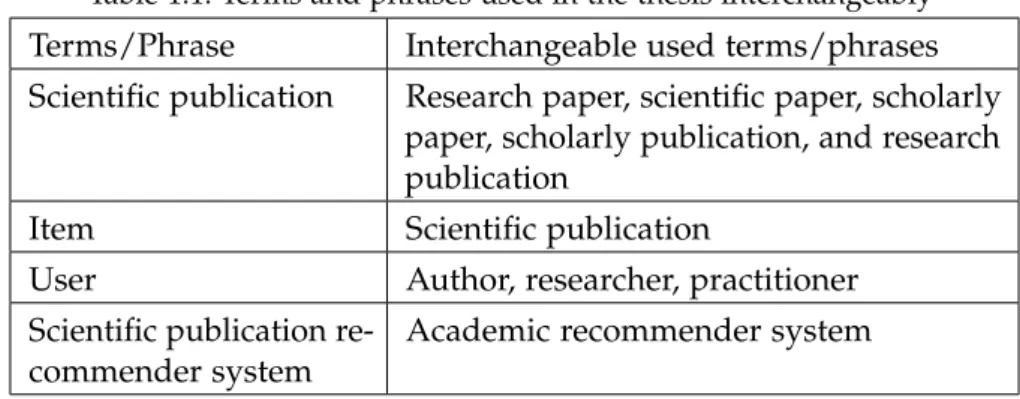
In terms of nomenclature, please note that the following terms and ex-pressions are used interchangeably along the thesis (see table1.1). We
particularly acknowledge that academic recommender systems refer to a wider variety of systems focused not only on scientific articles, but on the recommendation of reviewers, scientific venues, etc. How-ever, for simplicity, when we mention academic recommender systems in this manuscript explicitly refer to those systems that recommend scientific publications.
1.6 p u b l i c at i o n s 23
Table1.1: Terms and phrases used in the thesis interchangeably
Terms/Phrase Interchangeable used terms/phrases
Scientific publication Research paper, scientific paper, scholarly
paper, scholarly publication, and research publication
Item Scientific publication
User Author, researcher, practitioner
Scientific publication re-commender system
Academic recommender system
1.6 p u b l i c at i o n s
The work in this thesis have been published in the following peer-reviewed venues. These publications are linked to the two main technical chapters presented in this thesis.
Publication related to Chapter4:
• Petr Knoth and Anita Khadka. 2017. Can we do better than
co-citations? - Bringing citation proximity analysis from idea to practice in research article recommendation. In Proceedings of the 2nd Joint Workshop on Bibliometric-enhanced Information
Retrieval and Natural Language Processing for Digital Libraries, (BIRNDL ’17), at the 40th ACM SIGIR conference.
• Anita Khadka and Petr Knoth. 2018. Using citation-context to
reduce topic drifting on pure citation-based recommendation.
In Proceedings of the 12th ACM Conference on Recommender
Systems (RecSys ’18),362-–366.
DOI:https://doi.org/10.1145/3240323.3240379
Publications related to Chapter5:
• Anita Khadka, Iván Cantador and Miriam Fernández. 2020.
of recent scientific publications. In Proceedings of the 12th In-ternational Conference on Language Resources and Evaluation (LREC ’20).
• Anita Khadka, Iván Cantador and Miriam Fernández. 2020.
Cap-turing and Exploiting Citation Knowledge for Recommend-ing Recently Published Papers. In Proceedings of the Semantic technologies for smart information sharing and web
2
R E C O M M E N D E R S Y S T E M S
Recommender Systems (RS) are proactive software tools that intend to help users discover relevant items, by narrowing down a large collection to the selective relevant item(s) [38,223]. As mentioned in Chapter1, information overload is a challenging problem for different
domains. As a result, the use of RS is growing in a diverse and wider
set of communities, including e-commerce (e.g., Amazon.com1
, eBay2
, Netflix3
, Spotify4
, YouTube5
), academia (e.g. researchers, publishers), education (e.g., students, teachers, schools, university), broadcasting (e.g. e-newspapers – BBC6
, Google news7
, Reuters news8
) and others. The use of recommender systems benefits to both service providers
and end users [123]. With regards to service providers, RS can help Purposes of RS them by recommending products to potential customers, improving
user satisfaction [73,82,125,223] and user fidelity [223] (e.g. providing extra care for returning customers by rewarding with loyalty vouchers, for example). It can also help diversifying the products offered to the customers and increasing their sales [223]. As for the users, RS can help them to discover relevant items (e.g., cheaper travel packages) [222], or obtain personalised recommendations [223].
1 www.amazon.com 2 www.ebay.com 3 www.netflix.com 4 www.spotify.com 5 www.youtube.com 6 https://www.bbc.co.uk/news 7 https://news.google.com/?hl=en-GB&gl=GB&ceid=GB%3Aen 8 https://uk.reuters.com/ 25
This chapter provides an overview of RS. The structure and content of this chapter is inspired by the following references [41,266].
We start with the formalisation of the recommendation problem in Section2.1, followed by a brief history of RS in Section2.2where we
describe the key milestones in the development of RS. In Section2.3,
we present the different components of RS including: modelling of
users and items, recommendation tasks, etc. Sections 2.4 and 2.5
present a variety of existing recommendation techniques and various evaluation settings for RS respectively. We list multiple open chal-lenges yet to be resolved in the domain in Section 2.6, followed by
Section2.7which concludes this chapter.
2.1 ov e r v i e w o f r e c o m m e n d e r s y s t e m s
We formulate the recommendation problem based on [3] as follows:
Let u,u1,u2, ...,um ∈ Ube the set of all the users of a recommender The recommendation
problem and its formulation
system, wheremis the total number of users andi,i1,i2, ...,in∈ I be
the set of all items in the system’s database containing nthe number of items, which are accessible to users inU. Let f : U×I → Rbe a utility function for measuring usefulness of an item from the set I to a user who belongs toUandRis an ordered set of real numbers . Then,
for each user u ∈ U, the objective of the recommender system is to
find an item i0 ∈ I which is yet to be known by the useruand that
maximises the user’s utility function. More formally,
∀u∈U, i0u=arg max
i∈I
f(u,i) (2.1)
2.2 b r i e f h i s t o r y o f t h e r e c o m m e n d e r s y s t e m s 27
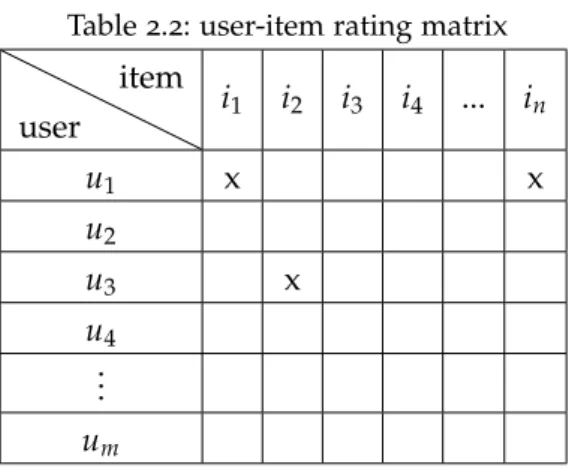
The utility of an item is represented as an interaction which indicates the usefulness of an item to a user. It can vary based on the application however, such interaction is usually aratingeither given by the user or assigned by the system. It is important to highlight that the utility function f is not defined on the entire user-item space (U×I) but on some subset of the data. This is due to the fact that not all users assign ratings to all the items that they have interacted previously. Thus, f
needs to be extrapolated to the whole user-item space (U×I). For
this, the recommendation system needs to estimate the ratings for the items which have not been rated yet. Once the unknown ratings are known, recommendations to a user can be made in two ways 1) by choosing an item with highest rating score or2) by providing
an ordered list of items based on the rating score [3]. Section 2.4
discusses various techniques used to define such utility functions and to assess the unknown ratings and Section2.5shows how to validate
the performance of such techniques.
2.2 b r i e f h i s t o r y o f t h e r e c o m m e n d e r s y s t e m s
In the early 90s, Goldberg et al. [87] introduced the idea of a system Early works on
recommender systems
to act as a mediator where users do not need to know each other to
receive recommendations. They developed a system namedTapestry
which filters through annotated items (e.g. news articles, emails) and recommends related items to the matching mailing list of like-mined users. This system disseminates users’ interests and computes similar-ities among users by following the heuristic oflike-minded people share
similar interests. Following this idea, several recommendation based
projects have been developed. TheGroupLens system[220] suggested
time a user reads a Usenet News article, this shows the user has a preference towards that article. By capturing those preferences as ratings and using the ratings of similar readers, personal preferences were generated as a part of the article header. TheRingo system[239] provided recommendations for music artists (or musicians) using a similar technique of [220]. The Video recommender [105] employed a similar approach of like-minded users as [220] to support recommend-ations through e-mails and the web among a virtual community of movie lovers. The People Helping One Another Know Stuff (PHOAKS) system recommended news articles from the internet [262].
By the late90s, RS had gained popularity in both academia and in-dustry. In academia, several research workshops and conferences were established. Examples of these conferences include Recommender
Progress in the RS
research community Systems (RecSys)9
, which quickly became the premium conference on recommender systems, and other mainstream highly ranked confer-ences, such as Special Interest Group on Information Retrieval (SIGIR) or The Web conference10
, which started to include tracks and sessions on recommender systems.
On the Industry side, companies started to deploy RS to attract customers and increase their revenues [205]. In addition, several
com-Netflix Challenge
petitions became prominent. A key competition for the development of RS has been the Netflix challenge.11
A million dollar prize incent-ive was offered as a part of this challenge where participants were asked to improve the performance of the Netflix’s in-house software
applicationCineMatchsystem by 10%. This competition boosted the
design and development of recommendation methods which are now embedded in a wide range of commerce and content applications
9 https://www.recsys.acm.org/
10 https://www.thewebconf.org/
2.2 b r i e f h i s t o r y o f t h e r e c o m m e n d e r s y s t e m s 29
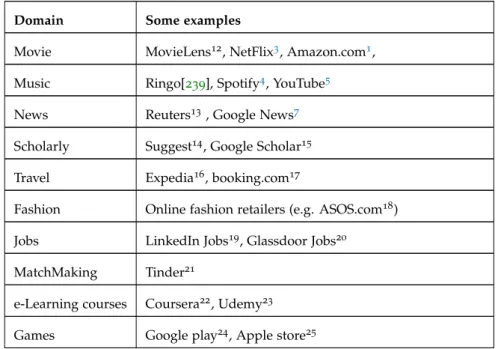
Table2.1: Examples of diverse recommender systems and their
correspond-ing domains
Domain Some examples
Movie MovieLens12
, NetFlix3
, Amazon.com1
,
Music Ringo[239], Spotify4, YouTube5
News Reuters13 , Google News7 Scholarly Suggest14 , Google Scholar15 Travel Expedia16 , booking.com17
Fashion Online fashion retailers (e.g. ASOS.com18
)
Jobs LinkedIn Jobs19
, Glassdoor Jobs20
MatchMaking Tinder21
e-Learning courses Coursera22
, Udemy23
Games Google play24
, Apple store25
(both online and offline). In Table2.1, we list some of the existing RS
and the domains on which they have been applied.
Even though these systems initially started based on the idea of
like-mined users(i.e. user similarity), approaches have now expanded
to include a broader range of methods including content similarity, and hybrid methods combining content and user similarities. The research field keeps evolving not only with the development of new recommendation methods, but also with the refinement of evaluation
12 https://movielens.org/ 13 https://uk.reuters.com/ 14 https://www.mendeley.com/ 15 https://scholar.google.com/ 16 https://www.expedia.com/ 17 https://www.booking.com 18 https://www.asos.com/ 19 https://www.linkedin.com/jobs/ 20 https://www.glassdoor.co.uk/Job/ 21 https://tinder.com/ 22 https://www.coursera.org/ 23 https://www.udemy.com/ 24 https://play.google.com/ 25 https://apps.apple.com/
methodologies and metrics and the application of RS to new domains and diverse forms of data. We discuss the emergence of recommend-ation problems, the evalurecommend-ation of approaches and the progress on evaluation methods in the following sections.
2.3 c o m p o n e n t s o f r e c o m m e n d e r s y s t e m s
A recommender system helps its users by discovering potential relev-ant items for them. In the process, several components play a vital part in understanding users’ requirements for delivering potential desir-able items to the users. Hence, users, items and their interactions are an important part of any RS. In the following sections, we introduce the various components involved in the recommendation process.
2.3.1 Modelling Users and Items
Every recommender system needs to comprehend its users and items for the provision of personalised recommendations. RS model users by creating user profiles based on their preferences and model items by creating item profiles based on their features. Below we introduce both items and users along with the essential information required to create their profiles.
2.3.1.1 Item and Item representation
‘Item’ is the general term that is used to denote what the system
recommends to users [171]. Items vary based on the objectives of
RS. For example, movies in movie recommendations, books in book recommendations etc. RS capture features of items and based on
2.3 c o m p o n e n t s o f r e c o m m e n d e r s y s t e m s 31
these features, items’ profiles are created. For instance, for a movie, movie features such as actors, genre, title, synopsis of the movie can be considered. To build items’ profiles, features are represented in variety of formats including vectors [134], matrices [49,97,183] etc.
2.3.1.2 User and User profiles
’User’ is the general term that is used to denote the target of the recom-mendation. RS create users’ profiles by inferring users’ preferences (interests). One common approach of gathering users’ interests is to collect interactions between users and items in the system such as purchasing, downloading, commenting, and rating. Users’ profiles are created using such users’ interactions [223].
2.3.2 The Recommendation Task
This section defines different ways of recommendation delivering mechanisms to users, usually known as the recommendation task. In the early days of RS development, RS were viewed as tools to predict ratings for items provided by users. With the continuous development in the domain, the focus has shifted towards delivering a list of ranked items that are relevant to users, so that users can pick the most relevant items to them. We introduce both types of recommendation tasks below:
2.3.2.1 Rating Prediction
As already mentioned, early works concentrated towards estimating ratings for items which are yet to have rated by the users and recom-mend the item with the highest rating score. One of the notable works that focus on the accurate rating prediction is the Netflix challenge.
The competition was sponsored by the media streaming company Net-flix, where they offered a million dollar incentive to those (researchers and industry practitioners) who can develop a recommendation al-gorithm that is able to increase the performance of the Netflix system
CineMatchby 10% by predicting the ratings of users to items.
2.3.2.2 Item Ranking
Analogous to the rating prediction task, the item ranking task aims to generate an ordered list of relevant items that are useful to the users. When a user wants to discover something then one expects to get a list of relevant items rather that one item which has a highest match [56]. For instance, if the predicted item is already known by the user then the recommendation has clearly failed to help the user. However, if the user is given a list (– Top Nranked list where Nis the number of matched (high score) items) then the user has a choice to discover relevant item(s) from many (i.e. a recommendation list of items).
2.3.3 Sources of User Preferences
To generate personalised recommendations of items that are tailored to an individual’s preferences, RS require information about users,
Data source for user
modelling specifically their past interactions with the system. Such interactions
are considered as evidence of the users’ choices or users’ feedback. To accurately extrapolate the utility function in Equation (2.1) , RS need
enough user-item interaction data [125,223]. These interactions can be categorised into two types, namely explicit feedback and implicit feedback.
2.3 c o m p o n e n t s o f r e c o m m e n d e r s y s t e m s 33
2.3.3.1 Explicit Feedback
Preferences towards items explicitly expressed by the users are termed
as explicit feedback [124]. Such feedback is usually provided in
different forms [223,229], such as:
• scalarratings (– e.g. 1-5stars with1being negative feedback and
5being the highest positive feedback),
• ordinalratings (– e.g. Likert scale selections : strongly disagree,
disagree, neutral, agree and strongly agree)
• Binaryratings (– e.g. Good or bad, positive or negative, like or
dislike)
Explicit ratings are considered to be difficult to collect as systems have to rely on their users to provide feedback. It is likely that without rewards users may not be motivated to provide feedback explicitly. Even when users explicitly provide feedback they tend to provide it for those items that they like (i.e., positive but not negative feedback is generally provided) [179]. In addition, providing explicit feedback requires a considerable amount of cognitive effort by the users and, summing their experiences in a single rating, or even in a ordinal rating, may be challenging for some users [124,280].
2.3.3.2 Implicit Feedback
Feedback inferred from users’ actions is referred as implicit feedback.
Some examples of implicit feedback include browsing sessions [118,
188,189], purchase history, reading lists [210,214] etc. Unary rating (– e.g. if a user buys an item then 1 otherwise 0, which means no information or preference is provided) is one of the widely applied implicit feedback methods in the domain [223].
Even though this type of feedback is comparatively easier to collect (– generally if the recommender systems are already in the production stage), collecting implicit feedback also faces substantial challenges. For example,no negative preferences can be gathered from implicit feedback: Since this feedback is collected based on users’ interactions and these interactions are generally considered as an indication of the users’ positive preferences, no feedback is gathered about the users’ negative preferences. If a user does not interact with a particular item that does not necessarily mean the user dislikes the item. Some applications, however, allow blocking or banning certain content, which may be considered as negative feedback. Nonetheless, such feedback is not available on all recommendation scenarios and/or applications. In addition, the fact that a user interacts with a particular item does not necessarily mean that the user has a positive preference towards such item, such interactions may be the result of inadvertent actions (e.g. browse, download, click-bait etc.) [237,252]. It may also be the case that the user dislikes the item after having interacted with it (i.e after purchasing, downloading etc.). Such interaction can inject noise into the data.
2.4 r e c o m m e n d at i o n t e c h n i q u e s
Since the first proposition of automated RS in the early90s, the domain is progressing continuously. As a result, multiple recommendation techniques have been proposed and developed. This section presents various recommendation techniques categorised based on two per-spectives. They are an algorithmic perspective and adata exploitation
perspective. While the algorithmic perspective depends on the
2.4 r e c o m m e n d at i o n t e c h n i q u e s 35
user, the data exploitation perspective relies on the type of informa-tion that has been exploited concerning the user-item interacinforma-tions to compute item relevance.
2.4.1 Recommendation Methods: From the Algorithmic Perspective
From the algorithmic perspective, recommendation methods are clas-sified into two types, namelymemory-basedandmodel-based.
2.4.1.1 Memory-based Recommendation Methods
Memory-based recommendation methods are heuristic-based methods
where a recommendation task (e.g item relevance computation) is Memory-based
recommendation methods
performed based on the entire collection of previously rated items by the users [3,103,228]. They rely on heuristics to directly estimate item relevance. This heuristic nature makes these methods easier to implement and maintain [103,220]. Due to the use of entire collection while generating recommendations, the results are assumed to be more accurate. However, the use of these methods may not always be feasible, particularly when it comes to large amounts of data. Examples of memory-based techniques include: cosine similarity [35, 228] and Pearson correlation [220,239].
2.4.1.2 Model-based Recommendation Methods
Model-based recommendation methods can work with a subset of the
data. They use Machine Learning techniques to learn a model which Model-based
recommendation methods
is then applied to the recommendation tasks (e.g. item relevance computation) [125].
Some of the prominent model-based methods include: Bayesian networks [35], Singular Value Decomposition (SVD) [31], Latent factor