© 2005 International Monetary Fund
Real Exchange Rates in Developing Countries:
Are Balassa-Samuelson Effects Present?
EHSAN U. CHOUDHRI AND MOHSIN S. KHAN*
There is surprisingly little empirical research on whether Balassa-Samuelson effects can explain the long-run behavior of real exchange rates in developing countries. This paper presents new evidence on this issue based on a panel-data sample of 16 developing countries. The paper finds that the traded-nontraded pro-ductivity differential is a significant determinant of the relative price of nontraded goods, and the relative price in turn exerts a significant effect on the real exchange rate. The terms of trade also influence the real exchange rate. These results pro-vide strong verification of Balassa-Samuelson effects for developing countries [JEL F31, F41]
T
he well-known analyses of Balassa (1964) and Samuelson (1964) provide an appealing explanation of the long-run behavior of the real exchange rate in terms of the productivity performance of traded relative to nontraded goods. Basi-cally, the argument is that as the productivity of traded goods rises relative to that of nontraded goods, there will be a tendency for the real exchange rate to appreci-ate. Balassa-Samuelson effects are generally thought to be the key source of observed cross-sectional differences in real exchange rates (i.e., the same currency prices of comparable commodity baskets) between countries at different levels of*Ehsan U. Choudhri is Chancellor’s Professor at Carleton University in Canada. Mohsin S. Khan is Director of the Middle East and Central Asia Department at the IMF. The authors would like to thank Robert Flood, Aasim Husain, Jean Le Dem, Gene Leon, Gian Maria Milesi-Ferretti, Nkunde Mwase, Sam Ouliaris, Miguel Savastano, and anonymous referees for helpful comments and suggestions, and Mandana Dehghanian and Tala Khartabil for excellent research assistance.
income per capita.1There is considerable empirical research on Balassa-Samuelson
effects based on time-series data, but this research has been confined to industrial countries.2 The time-series evidence on the working of the Balassa-Samuelson
mechanism for developing countries has been largely unexplored.3One reason for
this neglect is that sectoral price and productivity data are not readily available for developing countries. To address this problem, this paper makes use of recently available data from a number of sources to assemble a suitable data set for devel-oping countries, which is used to obtain new time-series evidence on the operation of Balassa-Samuelson effects in these countries.
Our data set includes time-series data from 1976 to 1994 for 16 countries.4
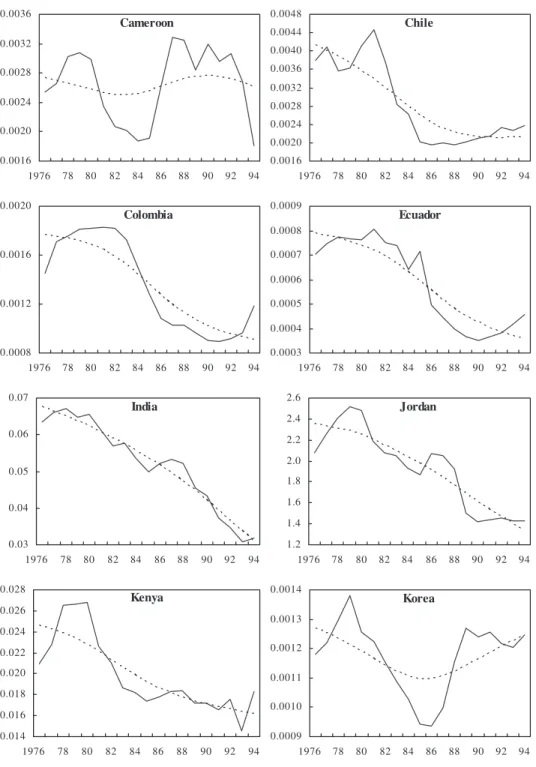
The behavior of the dollar real exchange rate for each country during this period is shown in Figure 1. The figure also displays the long-run component of the real exchange rate series based on the Hodrick-Prescott filter. As the figure shows, the long-run component registers large changes over the sample period for a number of countries. It is, thus, interesting to examine whether Balassa-Samuelson effects have played an important role in causing these long-term movements. For many countries, the figure also exhibits large fluctuations around the long-term trend. Some of these movements represent currency crises in response to speculative attacks. Our empirical analysis attempts to control for the effect of short-run dynamics in order to identify long-run Balassa-Samuelson effects.
Balassa-Samuelson effects can be embedded in a variety of models. These effects are typically derived within a static model, but they can be easily incorpo-rated in the dynamic framework of the new open economy macroeconomic mod-els.5Using a framework compatible with the new open economy macroeconomic
approach, this paper derives two steady-state relations that capture key channels of the Balassa-Samuelson mechanism. The first relation links the real exchange rate to relative prices of nontraded goods at home and abroad. Under certain condi-tions, this relation includes the terms of trade as an additional determinant of the real exchange rate.6The second relation explains the relative price of nontraded
1For a review of the evidence and a discussion of alternative explanations, see Edwards and Savastano
(1999). See also Bergin, Glick, and Taylor (2004), who point out that although recent data reveal a strong association between national price levels and income per capita, this association disappears in historical data going back 50 years or more.
2See, for example, Canzoneri, Cumby, and Diba (1999), and Lane and Milesi-Ferretti (2002). 3See, however, Ito, Isard, and Symansky (1997), who use time-series data to explore the
Balassa-Samuelson hypothesis for Asia-Pacific Economic Cooperation (APEC) economies that include some developing countries.
4This set includes 14 countries at low- and medium-income levels and 2 high-income economies
(Republic of Korea and Singapore) that had lower income levels at the beginning of the sample period.
5These models tend to focus on the short- to medium-term dynamics arising from nominal rigidities
and have not paid much attention to long-run Balassa-Samuelson influences. Benigno and Thoenissen (2003), however, do use a new open economy macroeconomic model to explore the effect of a productiv-ity improvement in the traded-goods sector on the United Kingdom real exchange rate.
6The relation assumes that the law of one price holds for each traded good in the long run. The real
exchange rate for the traded-goods basket, however, need not be stationary and could influence the rela-tion if weights for individual traded goods differ between the home and foreign countries. Our empirical procedure accounts for this possibility.
Cameroon 0.0016 0.0020 0.0024 0.0028 0.0032 0.0036 78 80 82 84 86 88 90 92 94 Chile 0.0016 0.0020 0.0024 0.0028 0.0032 0.0036 0.0040 0.0044 0.0048 78 80 82 84 86 88 90 92 94 Colombia 0.0008 0.0012 0.0016 0.0020 78 80 82 84 86 88 90 92 94 Ecuador 0.0003 0.0004 0.0005 0.0006 0.0007 0.0008 0.0009 78 80 82 84 86 88 90 92 94 India 0.03 0.04 0.05 0.06 0.07 78 80 82 84 86 88 90 92 94 Jordan 1.2 1.4 1.6 1.8 2.0 2.2 2.4 2.6 78 80 82 84 86 88 90 92 94 Kenya 0.014 0.016 0.018 0.020 0.022 0.024 0.026 0.028 78 80 82 84 86 88 90 92 94 Korea 0.0009 0.0010 0.0011 0.0012 0.0013 0.0014 1976 1976 78 80 82 84 86 88 90 92 94
Real dollar exchange rate (1994 CPI = 100 for all countries) Long-term component (based on Hodrick-Prescott filter) Source: See Appendix II.
1976 1976
1976 1976
1976 1976
Figure 1. Selected Developing Countries: Real Exchange Rate Behavior, 1976–94
Malaysia 0.32 0.36 0.40 0.44 0.48 0.52 0.56 78 80 82 84 86 88 90 92 94 Mexico 0.16 0.20 0.24 0.28 0.32 0.36 78 80 82 84 86 88 90 92 94 Morocco 0.08 0.10 0.12 0.14 0.16 0.18 0.20 78 80 82 84 86 88 90 92 94 Philippines 0.024 0.028 0.032 0.036 0.040 0.044 0.048 0.052 78 80 82 84 86 88 90 92 94 South Africa 0.16 0.20 0.24 0.28 0.32 0.36 0.40 78 80 82 84 86 88 90 92 94 Singapore 0.50 0.52 0.54 0.56 0.58 0.60 0.62 0.64 0.66 78 80 82 84 86 88 90 92 94 Turkey 0.00003 0.00004 0.00005 0.00006 0.00007 0.00008 78 80 82 84 86 88 90 92 94 Venezuela 0.004 0.006 0.008 0.010 0.012 0.014 0.016 78 80 82 84 86 88 90 92 94
Real dollar exchange rate (1994 CPI = 100 for all countries) Long-term component (based on Hodrick-Prescott filter) Source: See Appendix II.
1976 1976
1976 1976
1976 1976
1976 1976
goods. Following Canzoneri, Cumby, and Diba (1999), we use restrictions on pro-duction technology to derive a simple form of the relation, which makes the labor productivity differential between traded and nontraded goods the main determi-nant of the relative price of nontraded goods. The technology restriction used to obtain the second relation is not needed to derive the first relation.
An important limitation of the use of labor productivity to represent long-term changes in technology is that the long-run value of this variable can also be affected by permanent shifts in demand.7This problem may not be too serious if technology
shocks are the key source of permanent shocks affecting labor productivity. Tests of the Balassa-Samuelson hypothesis are typically based on a single relation relat-ing the real exchange rate directly to the productivity differential. Such a relation can be derived by combining our two relations. However, separate estimation of the two relations provides additional tests of the Balassa-Samuelson model and is use-ful in identifying the sources of departures from this model.
As the time series for individual countries in our sample are not very long, we pool these series across countries to estimate our relations. Recent panel-data econometric techniques are used to identify long-run effects in these relations. The results provide strong evidence that the Balassa-Samuelson mechanism operates in developing countries. Using the United States as the reference country, we find that U.S.–developing country differences in the relative price of nontraded goods and the terms of trade are significant determinants of the real exchange rate in the long run. The differences in the labor productivity differential, moreover, exert a significant long-run effect on the relative-price differences. One puzzling result is that the estimated effect of the relative-price variable is greater and that of the labor productivity variables smaller than the predicted value. We suggest explana-tions based on data problems to account for these discrepancies between estimated and predicted values.
I. Theoretical Framework
This section outlines a framework to provide theoretical underpinnings for our empirical analysis. As we are concerned with long-term effects, we do not model short-run dynamics but focus on steady-state relations under complete adjustment of wages and prices. We consider a multicountry framework, with each country using fixed endowments of labor and capital to produce traded and nontraded goods under perfect competition.8 We focus on two special models of the pattern of
traded-goods production. The first model follows the standard Balassa-Samuelson formulation and assumes that each country is diversified and produces all traded goods. The second model assumes that each country is specialized in the production of a country-specific traded good, as in Armington’s (1969) model. We discuss
7One way to deal with this problem is to use an index of total factor productivity instead of labor
pro-ductivity. Data constraints for developing countries, however, prevent us from using this approach.
8Our framework can be readily extended to incorporate monopolistic competition. As such an
exten-sion would make little difference to the long-run relations derived in the paper, we assume perfect com-petition for simplicity.
below only the part of the model that is needed to derive the relations used in our empirical analysis.
Basic Setup
Households in country isupply a fixed amount of labor and maximize the follow-ing expected lifetime utility:
where δis the discount factor, and Ciτrepresents a consumption index for period
τ. The consumption index is defined as
where CTiand CNi are the subindices for consumption bundles of traded and non-traded goods,γiis the share of traded goods in aggregate consumption, and time subscripts are dropped for simplicity. The traded-goods basket is also assumed to be a Cobb-Douglas index of m(> 1) goods:
where CiTjis the amount consumed of traded good j,and θijrepresents the share of the good in the basket.
Let Pidenote the consumer price index, and Pi Tand P
i
Nthe price indices for traded and nontraded goods. Using equations (1) and (2), we define Piand PiT as the cost-minimizing prices of Ciand CiT, which are given by
The pattern of production for traded goods is characterized by either diversi-fication (with each country producing all traded goods) or specialization (with each country producing a different traded good). In the case of specialization, we use the same index for a country and its traded good (i.e., good iis produced by country i). Letting YiNand YiTjdenote outputs of the nontraded and jth traded good, we assume the following Cobb-Douglas production function for these goods:9
Yi A K L N i N i N i N N N =
( ) ( )
α β , ( )5 Pi P T i Tj j m i j =∏
=1( )
θ. ( )4 Pi Pi P T i N i i =( ) ( )
γ 1−γ , ( )3 C C i i j T i Tj i j j m =∏
=1(
θ)
θ , ( )2 Ci Ci C T i N i i i i i i =( ) ( )
γ −γ(
γ(
−)
−γ)
γ γ 1 1 1 , ( )1 Et U C t i t = − ( ) = ∞∑
δτ τ τ ,9The Cobb-Douglas form of the production function is used below to derive a simple relation between
the relative price of nontraded goods and the labor productivity differential. Canzoneri, Cumby, and Diba (1999) discuss more general production conditions, which would also imply such a relation.
where KiNand LiNrepresent the amounts of capital and labor used in the produc-tion of the nontraded good, while KiTjand LiTjare the corresponding amounts for the traded good j.If there is specialization,KiTj=L
iTj=0 for i≠j.
Let country 1 be the reference country, and define Si as the exchange rate of country i(expressed as the price of country i’s currency) with respect to country 1. We distinguish between the short and long run in the present model. The short run is characterized by nominal rigidities in the form of sticky wages and prices. The long run, on the other hand, represents steady-state equilibrium with full adjust-ment of wages and prices. In the short run, nominal rigidities can cause departures from the law of one price and the marginal productivity condition for labor. We assume below that there are no departures from these relations in steady state. We focus on the steady-state behavior of variables to derive Balassa-Samuelson effects. A tilde over a variable is used to denote the steady-state value of the variable.
Assuming that the law of one price holds in steady state, we can link steady-state prices of traded goods in different countries as follows:
Also, assume that the marginal productivity condition is satisfied in steady state. Thus, letting Widenote the wage rate, and using equations (5) and (6), we have
where the second equality in equation (8) holds only for traded good i under specialization.
Key Relations
We now derive key relations in the log-linear form. Using lowercase letters to denote values in logs, we define the consumption-based log real exchange rate as
Next, we use equation (3) to decompose the log real exchange rate as
where qiT≡si+pi T−p
1
Tis the log real exchange rate for traded goods. Using equa-tion (4), we can express this variable as
qi s p p T i j i i Tj j Tj j m =
∑
=1θ(
+)
−θ1 1 . ( )11 qi qi p p p p T i i N i T N T = + −(
1 γ)
(
−)
− −(
1 γ1)
(
1 − 1)
, (10) qi≡ + −si pi p1. ( )9 Wi N Yi L P Y L P N i N i N j i Tj i Tj i Tj =β(
)
=β(
)
, (8)) S Pi i P Tj Tj = 1 . ( )7 Yi A K L Tj i Tj i Tj i Tj j j =( ) ( )
α β , ( )6The traded-goods price in logs can be linked to export and import price indices as
where piXand pi
Mare the price indices for goods for which country iis, respectively, a net exporter and net importer, and θiXis the share of the export good in the traded-goods bundle.10Note that in the specialization case,p
iX=pi Tiand θ
iX= θii.
Let rpi denote the log relative price of nontraded goods to domestically pro-duced traded goods. In the diversification case, rpi = piN − piT, since all traded goods are produced domestically. Thus, for this case, equation (7) and the steady-state versions of equations (10) and (11) imply the following long-run relation for the real exchange rate:
The Balassa-Samuelson analysis is often simplified by the assumption that expen-diture shares are the same everywhere. In this simple case,θji= θ
j
1for all j,γi= γ1,
and equation (13) can be expressed simply as q˜i=(1 − γ1)(rp˜i−r p˜1).
In the case of specialization, rpi = pi N − p
i
Ti, since only traded good i is produced in country i.Using equation (12) and recalling thatpiTi=piX, we obtain rpi=piN−piT−(1 − θiX)(piX−pi
M). Then, letting tt
i≡piX−pi
Mdenote the log terms of trade and using equation (7) along with equations (10) and (11) for steady state, we derive the following long-run relation for the specialization case:
Note that even if a country has the same expenditure shares as the reference coun-try, the terms of trade differential (tt˜i−tt˜1) would affect the long-run real exchange
rate in addition to the relative-price differential (rp˜i − rp˜1). This effect arises
because, in each country, the terms of trade influence the price of the traded-goods basket relative to that of the traded good produced at home.
The first term on the righthand side of equations (13) and (14) represents the log real exchange rate for traded goods in steady state,q˜iT. This term will not equal zero and may exhibit nonstationary behavior if the composition of a country’s traded-goods basket differs from that of the reference country. In the case of het-erogeneous expenditure shares,q˜iTrepresents an additional channel through which the terms of trade influence the real exchange rate, regardless of whether there is diversification or specialization.11In our empirical analysis based on panel data,
qi i p rp r j j Tj j m i i =
∑
=1(
θ −θ1)
1 + −(1 γ ) − −(1 γ1) pp tt tt i X i i X 1 1 1 1 1 1 1 1 14 + −(
θ)
( −γ ) − −(
θ)
( −γ ). ( )) qi i p rp r j j Tj j m i i =∑
=1(
θ −θ1)
1 + −(
1 γ)
− −(
1 γ1)
pp1. ( )13 pi p p T i X i X i X i M =θ + −(
1 θ)
, (12)10Letting Eiand Iirepresent sets of country i’s export and import goods, we define pX
i ≡ θTijpTij/ θX i,θXi= θTij,j∈Ei, and pMk ≡ θTikpTik/(1 − θXi),k∈Ii. 11Although q˜T i = (θ j i− θ j
1)p˜T1j in equations (13) and (14), we can also relate it to the terms of
trade by using equation (12) to express:q˜T
i =s˜i+p˜Mi −p˜M1 + θXi tt˜i− θX1tt˜1. j m = ∑ 1 k ∑ j ∑ ∑j
however, we do not link q˜iTto the terms of trade; instead, we use time effects to control for variations in this variable.
Next, the relative price of nontraded goods can be related to the productivity differential between domestically produced traded and nontraded goods. We define the log labor productivity in the two sectors as
where ωijis the weight for good j’s labor productivity in the aggregate labor pro-ductivity index for traded goods. In the specialization case,ωijequals one for j=i and zero otherwise. Let lpi≡lpiT −lpiNdenote the labor productivity differential between traded and nontraded goods. In defining the diversification labor pro-ductivity index in steady state, we use the same weights as those in the price index for traded goods. Thus, let ωij= θijunder diversification; and ωii=1 for j=i and ωij=0 for j≠iunder specialization. Using equation (8) and steady-state ver-sions of equations (4), (15), and (16), we can express the steady-state relative price as
where ϑ equals in the case of diversification and logβi − logβNin the case of specialization.
II. Empirical Implementation Data
We use a number of sources to put together a developing economies panel-data set that includes time series from 1976 to 1994 for 16 countries.12Traded goods are
assumed to consist of manufacturing and agriculture sectors. Nontraded goods represent all other sectors. The United States is chosen as the reference country. The real exchange rate is based on consumer price indices and represents the real value of a currency in terms of U.S. dollars.
Although our classification of the traded- and nontraded-goods sectors is sim-ilar to the one used for industrial countries, one potential problem is that a sub-stantial portion of the agriculture sector (and possibly of the manufacturing sector) in developing countries may consist of traditional activities producing nontraded goods. Another problem is that the quality of labor is likely to vary considerably across sectors in developing countries, and our labor productivity measure (based on employment figures unadjusted for quality changes) does not account for this
θi β β j j m j N =
∑
1 log −log rpi= +ϑ lpi, (17) lpi y l N i N i N ≡ − , (16) lpi y l T i j j m i Tj i Tj ≡∑
=1ω(
−)
, ( )15variation.13 We are unable to address these issues because of data limitations.
However, we explore below certain implications of these measurement problems for the estimation of the empirical model.
Empirical Model
To undertake panel-data tests of the Balassa-Samuelson relations, we assume that long-run parameters are the same across our developing country set (D).14Thus,
we set θiX= θXand γ
i= γfor i∈D.However, to allow for possible differences in expenditure shares between developing and industrial countries, we do not require U.S. (country 1) parameters to be the same as those for our developing country sample.
The following two equations are estimated to test for Balassa-Samuelson effects:
where rpdit=rpit−rp1t,ttdit=ttit−tt1t, and lpdit=lpit−lp1tare, respectively, the log differences in the relative price of nontraded goods, the terms of trade, and the traded-nontraded productivity ratio between developing country iand the United States; µiand ψiare country-specific fixed effects while κtand χtare common time effects; and uitand vitare error terms. Time effects represent the influence of com-mon time-specific (short- and long-run) factors, and error terms capture the effects of short-term deviations from steady state (that are not included in time effects).
Equation (18) is derived from equations (13) and (14). Under our assumption that θij= θjfor i∈D,time effects in equation (18) would control for movements in q˜itT(= (θij− θ1j)p˜1Tj) arising from parametric differences between developing countries and the United States. In the presence of time effects, equation (18) nests the diversification and specialization cases with τ =0 under diversification and τ =(1 − θX)(1 − γ) > 0 under specialization.15In both cases,π =(1 − γ) > 0.
j m =
∑
1 rpdit=ψ χ λi+ +t lpdit+v iit, ∈D, (19) qit=µ κi+ +t πrpdit+τttdit+uit, (18)13If intersector labor quality differences are not taken into account, the marginal productivity
condi-tion equacondi-tion (8) would not be satisfied and there would be departures from the relative price equacondi-tion (19) based on this condition. Another limitation of the data on labor inputs is that employment measures for the manufacturing, agriculture, and other (nontraded-goods) sectors come from different sources, and are not fully comparable. Also, note that labor productivity for traded goods is simply measured as the ratio of total output to total employment in the traded-goods sector. For the diversification case, this index does not fully conform to the theoretical index used in equation (17), since the implicit weights for individual traded goods in this index could differ from the weights used in the traded-goods price index.
14We later allow these parameters to vary between developing countries at different income levels. 15In the estimation of equation (18), if time effects do not fully capture changes in q˜T
itbecause of
dif-ferences in expenditure shares across countries,τcould also pick up the effect of the terms of trade via q˜T it
Equation (19) is based on equation (17). In this equation,λ =1. The absence of Balassa-Samuelson effects would imply that π = τ = λ =0.16
Although the long-run parameters in equations (18) and (19)—π, τ, and λ— are constrained to be the same across developing countries, these relations allow the short-run dynamics (reflected in the time-series behavior of the error terms) to be different across countries. The explanatory variables—rpdit,ttdit, and lpdit— can be stationary, trend-stationary, or nonstationary. In the case of trend-stationary behav-ior, equations (18) and (19) can be modified to include a time trend. Coefficients of time trends in the two relations would be homogeneous across countries and depend on the long-run parameters.17Note that if the explanatory variables are
inte-grated or trend-stationary, then qitwould also be integrated or trend-stationary. In this case, Balassa-Samuelson effects would cause permanent departures from the purchasing power parity.
As discussed above, our measure for the traded-goods sector (i.e., agriculture plus manufacturing) may be too broad for developing countries and could include nontraded goods. As discussed in Appendix I, the measured relative price of non-traded goods in this case would understate the true relative price and bias the relative-price coefficient upward in equation (18). This measurement problem would not lead to a systematic bias in the estimation of equation (19), since the measured value of the traded-nontraded productivity differential would also understate its true value. A more serious problem for estimating equation (19) is that the labor productivity measure is not adjusted for quality variation. Appendix I also shows that the estimated effect of the measured labor productivity differen-tial would be biased downward if there is a positive association between the aver-age labor quality and the true labor productivity.
III. Results Estimation
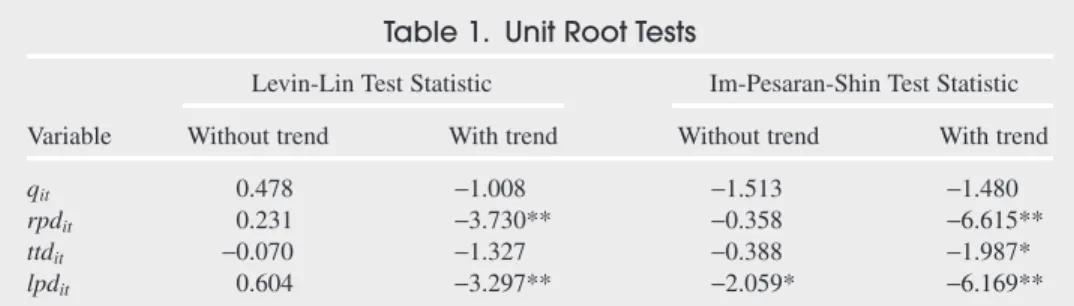
Before estimating equations (18) and (19), we examine whether the variables in these relations contain a unit root or not. Table 1 shows the results of two tests of a unit root in panel data. In the first test (LL), based on Levin and Lin (1993), the null hypothesis of a unit root is tested against the alternative of a homogeneous auto-regressive coefficient. The second test (IPS), based on Im, Pesaran, and Shin (2003), tests the unit root null against a more general alternative of a heterogeneous autoregressive coefficient. Both tests indicate that qit contains a unit root (with or
16Tests of Balassa-Samuelson effects could also be based on alternative versions of equations (18) and
(19) that exclude U.S. variables—rp1t,tt1t, and lp1t—and are expressed as qit=µ*
i+ κ*t+ πrpit+ τttit+u*it,
and rpit= ψ*
i+ χ*t+ λlpit+v*it. However, we estimate relations in the form that includes U.S. variables
because this form allows us to explore whether U.S. variables exert an effect additional to their effect via
rpdit,ttdit, and lpdit.
17Letting rpdit=g1t+rpd′
it,ttdit=g2t+ttdit′, and lpdit=g3t+lpdit′, we can restate equations (18) and
without a time trend).18 For the remaining variables, the tests are sensitive to
whether a time trend is included or not. In the absence of a trend, the unit root hypothesis is not rejected for rpdit and ttditby both the LL and IPS tests, and for lpditby the LL test. However, if a trend is present, both tests indicate that rpditand lpditare not integrated, and the IPS test indicates that ttditis also not integrated.
We first consider the basic form of equations (18) and (19), which does not include a time trend. In this case, since there is indication of nonstationary behav-ior for variables in these relations, we also undertake tests for co-integration. We use two parametric tests, the panel t-test and the group t-test, suggested by Pedroni (1999). The panel t-test rejects the hypothesis that there is no co-integration for the vector (qit, rpdit), but does not reject this hypothesis for vectors (rpdit, lpdit) and (qit, rpdit, ttdit). The group t-test rejects the no-co-integration hypothesis for all three vectors.19The group t-test (unlike the panel t-test) does not constrain the first-order
correlation in the residuals to be homogeneous under the alternative hypothesis and is more relevant for our model, which allows the short-run dynamics to vary across countries. The test’s failure to reject the hypothesis of no co-integration for the above vectors supports the Balassa-Samuelson model’s implication that a long-run relation exists between the real exchange rate and relative prices (and possibly the terms of trade) as well as between relative prices and productivity ratios. We next estimate Balassa-Samuelson effects in these relations.
We estimate equations (17) and (18) by Dynamic Ordinary Least Squares (DOLS), which is an appropriate framework for estimating and testing hypotheses for homogeneous co-integrating vectors.20The relations are estimated in the
fol-lowing form:
Table 1. Unit Root Tests
Levin-Lin Test Statistic Im-Pesaran-Shin Test Statistic
Variable Without trend With trend Without trend With trend
qit 0.478 −1.008 −1.513 −1.480
rpdit 0.231 −3.730** −0.358 −6.615**
ttdit −0.070 −1.327 −0.388 −1.987*
lpdit 0.604 −3.297** −2.059* −6.169** Notes: qitis country i’s dollar real exchange rate in logs, while rpdit, ttdit, and lpditrepresent, respectively, log differences in the relative price of nontraded goods, the terms of trade, and the traded-nontraded labor productivity ratio between country iand the United States.
* indicates significance at the 5 percent level, and ** at the 1 percent level.
18Because of the assumption of homogeneous autoregressive coefficients, the LL test is encompassed
by the IPS test. The results of the IPS test, however, are not conclusive. Although the test does not reject the unit-root hypothesis for qitat the 5 percent level, it does indicate rejection at slightly higher levels (p-value
=0.069 with trend and p-value =0.065 without trend).
19For vectors (qit, rpdit), (rpdit, lpdit), and (qit, rpdit, ttdit), the panel-t test statistic is −1.730*, −1.093,
and 0.278, respectively. The corresponding statistic for the group-t test is −2.074*, −1.955*, and −1.959.* An asterisk indicates significance at the 5 percent level.
where nis the number of lags and leads used for the first-difference terms. Coeffi-cients of these terms capture the short-run dynamics. We allow the short-run dynamics to be heterogeneous (i.e., let ξir,ζir, and ϕirdiffer across i). We test the null hypotheses that π = τ =0 in equation (20) and λ =0 in equation (21) against the alternative hypotheses that these variables are positive.
If a linear trend is included, unit root tests suggest that the explanatory vari-ables in equations (18) and (19) are not integrated. We, thus, also consider the trend-stationary setting for estimating these relations. DOLS is a useful estimating procedure even in this case. Since first-difference terms are included in this pro-cedure, the coefficients of level terms represent long-run effects. Therefore, we estimate equations (20) and (21) with trend variables to identify long-run Balassa-Samuelson influences in the trend-stationary case.
Basic Results
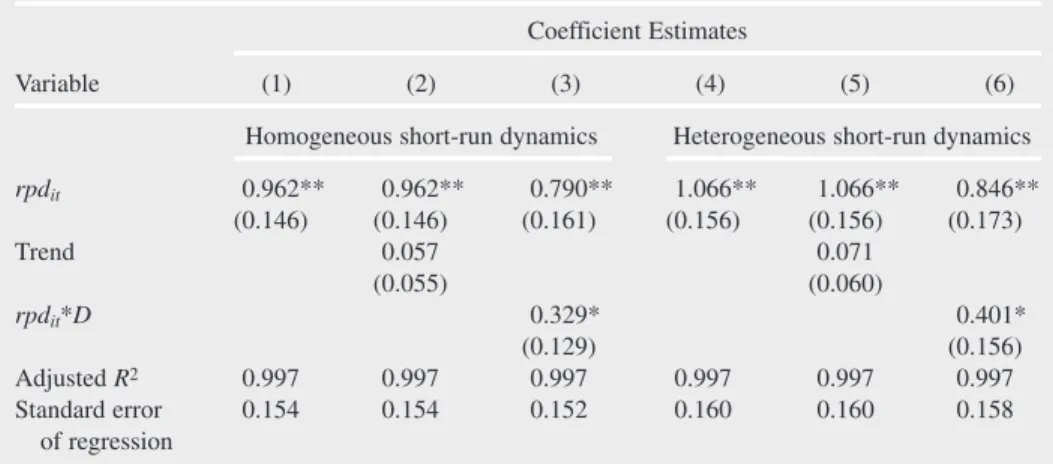
Tables 2 and 3 present DOLS estimates of different variants of the real exchange rate equation with one lag and one lead of the first-difference terms.21 Table 2
shows the estimates of the equation for the diversification case excluding the terms of trade variable, and Table 3 for the specialization case including this variable. For both cases, we report the results for homogeneous as well as heterogeneous short-run dynamics. Regressions 1 and 4 in these tables show estimates of the basic form of the equation without a time trend. In all of these cases, the effect of the relative-price variable is positive and significant. The predicted value of this variable’s coefficient equals 1 − γ (which represents the share of the nontraded-goods sector). The estimated value, however, is greater than unity in most cases. The small size of our sample (based on only 19 years of data for each country) is a concern; it could be a source of bias in DOLS estimates. As discussed above, however, the discrepancy between the predicted and estimated values could reflect an upward bias arising from defining the traded-goods sector too broadly.22The
results also show that the terms of trade variable exerts a positive and significant
rpdit i t lpdit r n ir lpdi,t r vit n =ψ χ λ+ + +
∑
=− ϕ ∆ + + ′, ((21) qit=µ κi+ +t πrpdit+τttdit+ r n ξir∆rpdi,t r+ +ζir∆ttddi,t r uit n + =−(
)
+ ′∑
, (20)21The short length of each time series makes it difficult to explore the possibility that the short-run
dynamics involve higher lags and leads. Indeed, there are not enough degrees of freedom to estimate equa-tion (20) with addiequa-tional lags and leads in the case of heterogeneous dynamics. In the case of homoge-neous dynamics, however, we did estimate equations (20) and (21) with two lags and leads, and found little difference in the results.
22The magnitude of the bias depends on the extent to which the share of the traded-goods sector is
overestimated. For our sample, the average share of manufacturing and agriculture in GDP is 35 percent. It is interesting to note that the true share of traded goods does not have to be much below this value to imply that the estimated coefficient of the relative price variable is greater than unity. For example, if about 30 percent of manufacturing plus agriculture sectors in fact consist of nontraded goods, so that the actual share of traded goods is 22.5 percent, then (as shown in Appendix I) the estimated coefficient of rpdit
Variable (1) (2) (3) (4) (5) (6) Homogeneous short-run dynamics Heterogeneous short-run dynamics
rpdit 0.962** 0.962** 0.790** 1.066** 1.066** 0.846** (0.146) (0.146) (0.161) (0.156) (0.156) (0.173) Trend 0.057 0.071 (0.055) (0.060) rpdit*D 0.329* 0.401* (0.129) (0.156) Adjusted R2 0.997 0.997 0.997 0.997 0.997 0.997 Standard error 0.154 0.154 0.152 0.160 0.160 0.158 of regression
Notes: The dependent variable is qit(see notes to Table 1 for the definitions of variables). All regressions include country-specific and time-specific dummy variables as well as first differences of each explanatory variable at time t, t−1, and t+1. Coefficients of the first-difference terms are con-strained to be the same across countries under homogeneous dynamics, and unconcon-strained under heterogeneous dynamics. White heteroskedasticity-consistent errors are shown in parentheses. Dis a dummy variable, which equals one for low-income developing countries and zero for others. The num-ber of observations equals 256. * indicates significance at the 5 percent level, and ** at the 1 percent level (using a one-sided test for rpditand a two-sided test for other variables).
Table 3. The Exchange Rate Relation with the Terms of Trade Coefficient Estimates
Variable (1) (2) (3) (4) (5) (6)
Homogeneous short-run dynamics Heterogeneous short-run dynamics
rpdit 1.111** 1.111** 0.851** 1.217** 1.217** 0.834** (0.143) (0.143) (0.163) (0.204) (0.204) (0.251) ttdit 0.300** 0.300** 0.477** 0.332** 0.332** 0.565** (0.091) (0.091) (0.103) (0.129) (0.129) (0.141) Trend 0.063 0.111 (0.054) (0.075) rpdit*D 0.407** 0.601* (0.143) (0.271) ttdit*D −0.348** −0.407 (0.123) (0.209) Adjusted R2 0.997 0.997 0.998 0.997 0.997 0.997 Standard error 0.142 0.142 0.139 0.152 0.152 0.148 of regression
Notes: The dependent variable is qit(see notes to Table 1 for the definitions of variables). All regressions include country-specific and time-specific dummy variables as well as first differences of each explanatory variable at time t, t−1, and t+1. Coefficients of the first-difference terms are con-strained to be the same across countries under homogeneous dynamics, and unconcon-strained under heterogeneous dynamics. White heteroskedasticity-consistent errors are shown in parentheses. Dis a dummy variable, which equals one for low-income developing countries and zero for others. The num-ber of observations equals 246. * indicates significance at the 5 percent level, and ** at the 1 percent level (using a one-sided test for lpditand ttdit, and a two-sided test for other variables).
effect when introduced in the real exchange rate equation (see Table 3). This find-ing is consistent with the specialization version of the model, in which each coun-try produces a different good.
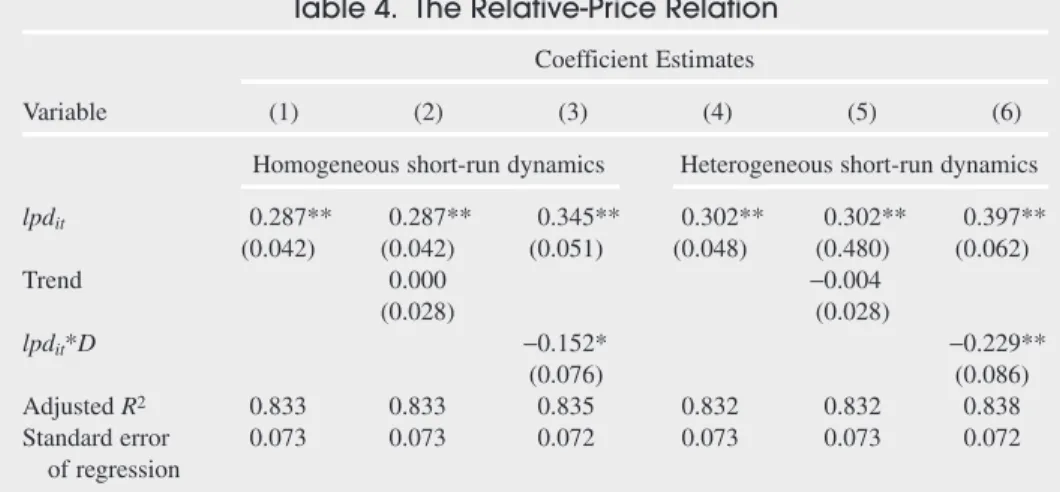
Table 4 shows the results for estimating the relative-price relation by DOLS. Regressions 1 and 4 in this table estimate the basic form of the relation without a time trend. The effect of the labor productivity index in both regressions is positive and significant. But the estimated values of its coefficients in the two regressions are substantially below the predicted value of unity. One possible explanation of this result, suggested above, is that measuring employment without adjustment for quality changes leads to a downward bias in the productivity coefficient.23 Other
limitations of employment data and the small sample size could also have con-tributed to a bias in the estimates of the productivity coefficient.
Tables 2–4 also report the results for the trend-stationary case, in which a homogeneous linear trend (with the same coefficient across countries) is included in the two relations. The tables show (see regressions 2 and 4 in each table) that the coefficient of the trend variable is insignificant in all cases, and the introduction of this variable in the regressions makes no difference to the estimates of Balassa-Samuelson parameters. We also introduced heterogeneous trends in the two rela-tions, but this variation made little difference to the results.
Further Analysis
Our empirical model includes time effects to allow the effect of U.S. variables to be different from that of developing countries variables because of parametric dif-ferences. Time effects are, in fact, significant in both relations. Nevertheless, we also estimated the two relations without time effects but did not find a substantial difference in results. We further examined whether the results are sensitive to vari-ation in income levels across countries. To explore this question, we divided the developing country sample into high- and low-income groups, and tested whether coefficients of Balassa-Samuelson variables differ between the two groups.24
Regressions 3 and 6 in Tables 2–4 show the results of these tests. These regressions include interactions between explanatory variables and a dummy variable for the low-income group. Thus, coefficients of the variables show the effects for the high-income group, and interaction terms represent the additional effects for the low-income group. Interestingly, the results show that the effect of the relative-price variable (in the real exchange rate regressions) is significantly higher for the low-income group, while the effect of the labor productivity differential (in the relative-price regressions) is significantly lower. The departures from predicted values are,
23The downward bias arises because unobserved labor quality is assumed to be positively related to
true labor productivity. It is not clear, however, how much bias would be produced by this relation. According to Appendix I, the magnitude of the bias would depend on the elasticity of labor quality with respect to true labor productivity (ρ). This elasticity would need to be 2.3 to generate, for example, an esti-mate of the productivity coefficient equal to 0.3.
24The classification of countries in the two groups is based on average income per capita for the
thus, more pronounced for low-income countries. Since data problems are likely to be more severe for the developing countries at the lower end of the income scale, this finding supports our suggested explanation that the estimates of Balassa-Samuelson effects are biased because of measurement errors. The results also indi-cate that the terms of trade effect is smaller for the low-income group.25
The conventional tests of Balassa-Samuelson effects are based on a single relation that links the real exchange rate directly to the labor productivity index. To derive such a relation, we combine equations (18) and (19) to obtain
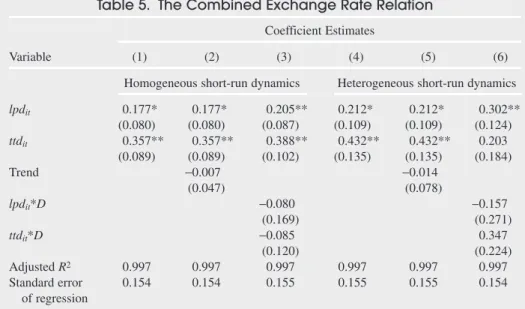
where µ′i=µi+ πψi,κ′t= κt+ πχt, and u′it=uit+ πvit. For the purpose of compari-son with the existing literature, we also present results for the single-equation ver-sion of our two relations. Table 5 reports DOLS estimates of six variants of equation (22), which are similar to those shown in Tables 2– 4. Note that the esti-mates of the coefficients of the labor productivity and terms of trade variables in the DOLS version of equation (22) need not fully conform to the estimates of these
qit= ′ + ′ +µ κi t πλlpdit+τttdit+ ′uit, (22)
25Thus, the support for the specialization version seems to be weaker for the poorer developing
coun-tries. This result may seem paradoxical, as production and exports of low-income countries tend to be less diversified. However, specialization could also mean production of goods (e.g., sophisticated manufac-tured products) that are significantly differentiated from goods produced elsewhere. Poor countries may be less specialized in this sense.
Table 4. The Relative-Price Relation Coefficient Estimates
Variable (1) (2) (3) (4) (5) (6)
Homogeneous short-run dynamics Heterogeneous short-run dynamics
lpdit 0.287** 0.287** 0.345** 0.302** 0.302** 0.397** (0.042) (0.042) (0.051) (0.048) (0.480) (0.062) Trend 0.000 −0.004 (0.028) (0.028) lpdit*D −0.152* −0.229** (0.076) (0.086) Adjusted R2 0.833 0.833 0.835 0.832 0.832 0.838 Standard error 0.073 0.073 0.072 0.073 0.073 0.072 of regression
Notes: The dependent variable is rpdit(see notes to Table 1 for the definitions of variables). All regressions include country-specific and time-specific dummy variables as well as first differences of each explanatory variable at time t, t−1, and t+1. Coefficients of the first-difference terms are con-strained to be the same across countries under homogeneous dynamics, and unconcon-strained under heterogeneous dynamics. White heteroskedasticity-consistent errors are shown in parentheses. Dis a dummy variable, which equals one for low-income developing countries and zero for others. The num-ber of observations equals 256. * indicates significance at the 5 percent level, and ** at the 1 percent level (using a one-sided test for lpditand a two-sided test for other variables).
variables in equations (20) and (21) because of the use of different variables to control for short-run dynamics.26The results indicate that the labor productivity
coefficient in the single-equation version is significant in all cases, but its value tends to be smaller than the product of the estimates of πand λ (obtained from regressions of equations (20) and (21)). The terms of trade coefficient also differs somewhat from the estimate of τ based on equation (20) and is significant in all cases except regression (6) in the table. The effect of the two variables is no longer significantly different between the high- and low-income groups. For the labor productivity variable, this result (that its coefficient,πλ, does not differ between the two income groups) is consistent with the earlier findings that πis higher and
λis lower for the low-income group.
During our sample period, currency crises involving large exchange rate depre-ciations occurred in a number of countries. Adverse economic conditions during crisis times could have caused comovements in exchange rates, labor productivity, and relative prices. This paper uses an estimation procedure that attempts to dis-entangle long-run Balassa-Samuelson effects from short-run correlations produced
26The DOLS version of equation (22) includes first differences of ttdit(which do not appear in
equa-tion (21)) but does not include those of rpdit(which enter equation (20)).
Table 5. The Combined Exchange Rate Relation Coefficient Estimates
Variable (1) (2) (3) (4) (5) (6)
Homogeneous short-run dynamics Heterogeneous short-run dynamics
lpdit 0.177* 0.177* 0.205** 0.212* 0.212* 0.302** (0.080) (0.080) (0.087) (0.109) (0.109) (0.124) ttdit 0.357** 0.357** 0.388** 0.432** 0.432** 0.203 (0.089) (0.089) (0.102) (0.135) (0.135) (0.184) Trend −0.007 −0.014 (0.047) (0.078) lpdit*D −0.080 −0.157 (0.169) (0.271) ttdit*D −0.085 0.347 (0.120) (0.224) Adjusted R2 0.997 0.997 0.997 0.997 0.997 0.997 Standard error 0.154 0.154 0.155 0.155 0.155 0.154 of regression
Notes: The dependent variable is qit(see notes to Table 1 for the definitions of variables). All regressions include country-specific and time-specific dummy variables as well as first differences of each explanatory variable at time t, t−1, and t+1. Coefficients of the first-difference terms are con-strained to be the same across countries under homogeneous dynamics, and unconcon-strained under het-erogeneous dynamics. White heteroskedasticity-consistent errors are shown in parentheses. Dis a dummy variable, which equals one for low-income developing countries and zero for others. The number of observations equals 246. * indicates significance at the 5 percent level, and ** at the 1 percent level (using a one-sided test for lpditand ttdit, and a two-sided test for other variables).
by temporary shocks (such as those leading to currency crises). However, to address the concern that our method may not have adequately removed the influence of cri-sis shocks, we explore the sensitivity of our results to inclusion of cricri-sis periods. To identify crisis periods, we follow Kaminsky, Reinhart, and Vegh (2004), who define a crisis year as a year in which there is a 25 percent or higher monthly depre-ciation that is at least 10 percent higher than the previous month’s depredepre-ciation.27
Using their crisis data, we reestimate our basic regressions, excluding the observa-tions for crisis years.28Note that since our regressions include one lag and one lead
of each explanatory variable’s first differences (which are not available for the year of the crisis and the following year), the exclusion window for these regressions is generally four years for a single crisis.29 Longer periods are excluded for
coun-tries with multiple crises. In fact, for three councoun-tries—Ecuador, Turkey, and Venezuela—there were not enough observations to estimate country-specific dynamics. These countries were, thus, excluded from regressions with hetero-geneous dynamics.
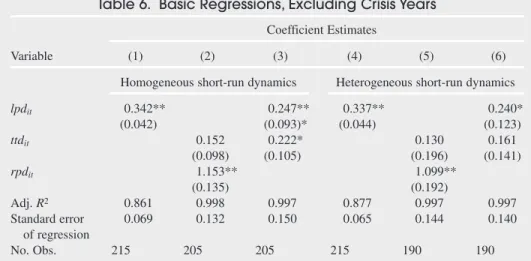
Table 6 presents the results of basic regressions based on data for crisis-free periods for both the two- and one-equation versions of the model (see columns 1–2 and 4–5 of the table for the two-equation version and columns 3 and 6 for the one-equation version). As the table shows, the effect of the basic Balassa-Samuelson variables—the relative-price and labor productivity indices—remains robust even after excluding crisis periods. The effect of the labor productivity variable, in fact, becomes stronger. The terms of trade effect, however, becomes weaker and is insignificant in most cases. Thus, the results on the influence of the terms of trade on the real exchange rate are sensitive to whether crisis periods are included or not. Although our regressions generally exclude four years for a crisis, this period may not be considered long enough to fully remove the effect of a crisis shock.30To deal
with this concern, we explored additional variations that introduced longer exclu-sion windows or excluded all the data for countries that faced multiple crises within the sample period.31These variations further reduced the sample size but still did
27See Frankel and Rose (1996) for a discussion of the usefulness of this measure of crisis for
emerg-ing economies. For industrial countries, Eichengreen, Rose, and Wyplosz (1996) use an alternative mea-sure based on a weighted average of changes in the exchange rate, international reserves, and interest rates. This measure is designed to develop a crisis index that would include unsuccessful speculative attacks (which do not change the exchange rate but lead to a loss of international reserves and/or a rise in the inter-est rate). We need, however, to identify only successful attacks that could cause co-movements between the exchange rate and other variables and potentially bias our results. Thus, international reserves and interest rates may not be useful indicators for our purposes. For developing countries, moreover, interest rate data are generally lacking and international reserve changes are often an inadequate measure of exchange market intervention.
28See Appendix II for a list of crisis years for our sample.
29For example, if the crisis year is 1982, the period from 1981 to 1984 is excluded from the regression.
A shorter period would need to be excluded if the crisis occurs in the first or last two years of the sample.
30Estimates of half-life for shocks to the real exchange rate, for example, typically range from three
to five years.
31In the first variation, we also dropped the observations for one year before and one year after the
cri-sis year, which generally extended the regression exclusion window for a cricri-sis to six years. Four countries— Mexico, Ecuador, Turkey, and Venezuela—experienced multiple crises. These countries were excluded from the sample in the second variation.
not much affect our results about the robustness of the effect of the labor produc-tivity and relative-price variables.
IV. Conclusions
The Balassa-Samuelson hypothesis would seem to be especially relevant for devel-oping countries where relative prices and productivities are likely to be more vari-able. Yet, there is little or no empirical evidence on whether Balassa-Samuelson effects can successfully explain long-run movements of the real exchange rate in developing countries. This paper presents new time-series evidence for developing countries on the presence of Balassa-Samuelson effects. To test for these effects, we estimate two long-run relations: relative prices (of nontraded goods) affect the real exchange rate in one relation, and labor productivity differentials (between traded and nontraded goods) affect relative prices in the second relation. Terms of trade also affect the real exchange rate (in the first relation) under certain conditions. A key finding of this paper is that the labor productivity differential exerts a signif-icant effect on the real exchange rate via its influence on the relative price of non-traded goods.32The paper also finds that terms of trade are a significant determinant
32Previous work (for example, Lane and Milesi-Ferretti, 2004), using GDP per capita as a proxy for
the labor productivity differential, has not found a systematic effect of the productivity variable on real exchange rates in developing countries. We believe that we are able to identify this effect by using a more appropriate measure of labor productivity differential based on sectoral data.
Table 6. Basic Regressions, Excluding Crisis Years Coefficient Estimates
Variable (1) (2) (3) (4) (5) (6)
Homogeneous short-run dynamics Heterogeneous short-run dynamics
lpdit 0.342** 0.247** 0.337** 0.240* (0.042) (0.093)* (0.044) (0.123) ttdit 0.152 0.222* 0.130 0.161 (0.098) (0.105) (0.196) (0.141) rpdit 1.153** 1.099** (0.135) (0.192) Adj. R2 0.861 0.998 0.997 0.877 0.997 0.997 Standard error 0.069 0.132 0.150 0.065 0.144 0.140 of regression No. Obs. 215 205 205 215 190 190
Notes: The dependent variable is rpditfor regressions in columns (1) and (4), and qitfor other regressions (see notes to Table 1 for the definitions of variables). All regressions include country-specific and time-country-specific dummy variables as well as first differences of each explanatory variable at time t, t−1, and t+1. Coefficients of the first-difference terms are constrained to be the same across countries under homogeneous dynamics, and unconstrained under heterogeneous dynamics. White heteroskedasticity-consistent errors are shown in parentheses. * indicates significance at the 5 percent level, and ** at the 1 percent level (using a one-sided test).
of the real exchange rate. This finding, however, is sensitive to whether the sam-ple includes crisis periods or not.
Although the effect of relative-price and labor productivity variables operates in the direction indicated by the Balassa-Samuelson hypothesis, the effect of rela-tive prices is stronger and that of productivity differentials weaker than the predicted value. The paper also finds that the departures from predicted values are larger for developing countries with lower income levels. We suggest an explanation that attributes these results to biases caused by measurement problems. These problems are likely to be more pronounced in countries with lower incomes and, thus, could account for differences in estimated Balassa-Samuelson effects between countries at low and high income levels.
Our tests of the Balassa-Samuelson explanation are based on two long-run relations, which are derived from theory under fairly general conditions and can be implemented empirically for developing countries. One important caveat for our formulation is that labor productivity is used to capture the effect of permanent technology shocks emphasized by the Balassa-Samuelson theory. This measure could also pick up the influence of permanent demand shocks. Disentangling the influence of permanent demand and technology shocks on long-run labor produc-tivity would be an interesting topic for future research. Further theoretical and empirical analysis could also extend the framework considered here and explore the role of additional factors.33 Such analysis is beyond the scope of this paper.
The results of this paper do suggest that the Balassa-Samuelson mechanism is an empirically useful framework for investigating the long-run behavior of the real exchange rate for developing countries.
APPENDIX I
Potential Biases Due to Measurement Problems Traded-Goods Sector Measure Includes Nontraded Goods
Using a hat over a variable to denote the measured value, let the measured traded-goods price be pˆT
it= φpNit+(1 − φ)pTit, 1 > φ> 0, where φis the weight for the nontraded goods that are
improperly included in the traded-goods sector measure. The measured relative price of non-traded goods is then related to the true price as rpˆit=pN
it−pˆTit =(1 − φ)rpit. Let the
corre-sponding relation for country 1 be rpˆ1t=(1 − φ1)rp1t, with 1 > φ1≥0. Using these relations
and letting rpˆdit=rpˆit−rpˆ1t, we can express equation (18) in the text as
where κ′t= κt+ π[1/(1 − φ) −1/(1 − φ1)]rpˆ1tand π′ = π/(1 − φ). Thus, if rpˆditis used instead of
rpditin equation (18), its coefficient would be biased upward.
Note that this problem need not introduce a systematic bias in equation (19). For example, if we also have lpˆT
it= φlpNit+(1 − φ)lpTit, then lpˆit=lpˆTit−lpNit=(1 − φ)lpit. Using this relation
qit =µ κi+ ′ + ′t πrpdˆ it+τttdit+uit,
33For example, Lane and Milesi-Ferretti (2004) explore the theoretical link between the real exchange
rate and net foreign assets, and provide evidence that the net foreign assets position is an important deter-minant of the real exchange rate for developing (as well as developed) countries.
and the corresponding one for country 1, we can show that the use of measured values in equa-tion (19) would not bias the estimate of the effect of labor productivity differential.
Measured Employment Not Adjusted for Labor Quality
Express the amount of effective labor in sector Z=T, N,as LZ
it=EZitLˆZit, where LˆZitis the actual
(measured) quantity of labor and EZ
it is the average quality or efficiency of labor. The
measured labor productivity is related to the true productivity (in logs) as lpˆZ
it=yZit−lˆZit=lpZit
+eZ
it. Suppose that efficiency is positively correlated with true labor productivity. Assume that
this relation takes the simple form eZ
it= ρlpZit,ρ> 0. Recalling that lpit=lpTit−lpNit, it follows
that lpit=lpˆit/ (1 + ρ). Let lp1t=lpˆ1t/(1 + ρ1),ρ1≥0, be the corresponding relation for
coun-try 1. Using these relations and letting l pˆdit=l pˆit−lpˆ1t, we can express equation (19) in the
text as
where χ′t= χt+ λ[1/(1 + ρ) −1/(1 + ρ1)]l pˆ1tand λ′ = λ/(1 + ρ). Thus, the use of l pˆditinstead
of lpditin the text equation (19) would bias the effect of the productivity variable downward.
APPENDIX II Data Appendix
The data set consists of a number of annual time series for 16 developing countries and the United States. All series cover the time period 1976–94. The selection of developing countries and the choice of the time period are dictated by the availability of data.
Definitions and Data Sources
The U.S. dollar exchange rate (S) and the consumer price index (P) are from IMF International Financial Statistics (IFS). The export and import price indices (PX, PM) represent the
price/unit-value series from IFSor, if IFSdata are not available, export and import price defla-tors from the IMF World Economic Outlook database. These indices are used to calculate the terms of trade. The terms of trade data are not available for Singapore for the years 1976–78 and for Turkey for the years 1985–88.
Measures of the labor productivity differential and the relative price of nontraded goods are based on sectoral data on output, employment, and prices. Traded goods are represented by man-ufacturing and agriculture sectors, and nontraded goods by all other sectors. Value added in con-stant local currency units is used to measure outputs of traded- and nontraded-goods sectors (YT,
YN). Labor inputs in the two sectors (LT,LN) represent the number of persons employed in each
sector. Price indexes for traded and nontraded goods (PT,PN) are price deflators derived from
value-added data in current and constant local currency units. For the United States, all of these series are from the Organisation for Economic Co-operation and Development (OECD) Struc-tural Analysis (STAN) database. For developing countries, the series,YT,YN,PT, and PNare
from World Bank World Development Indicators(WDI). The price deflator for services and so on, which accounts for the bulk of the nontraded-goods sector, is used to estimate PN. The data
on total employment in manufacturing are from the World Bank Trade and Production database.34
A short gap in these data for Cameroon was filled by linear interpolation. Employment in
agri-rpdit=ψ χ λi+ ′ + ′t lpdˆ it+νit,
culture is derived from value added per worker and total value-added series given in WDI. LTis
defined as the sum of employment in manufacturing and agriculture obtained from the above sources. LNis measured residually as the difference between total labor force (also from WDI)
and LT. A limitation of the employment data is that employment in agriculture, manufacturing,
and other (nontraded-goods) sectors is not measured on a consistent basis. Labor productivity measures for traded- and nontraded-goods sectors equal YT/LTand YN/LN, respectively.
Income Groups
The 16 developing countries were divided into low- and high-income groups according to aver-age GDP per capita (from WDI) for the sample period. Low- (high-) income group represents countries with per capita income smaller (greater) than $2,000 in 1995 U.S. dollars. The coun-tries in each group are listed below.
Low-Income Group High-Income Group
Cameroon Chile
Colombia Republic of Korea
Ecuador Malaysia
India Mexico
Jordan Singapore
Kenya South Africa
Morocco Turkey
Philippines Venezuela
Country Crisis Years
Cameroon 1994 Chile 1985 Ecuador 1982, 1985–86, 1988 Mexico 1976, 1982, 1994 Philippines 1984 Turkey 1978–80, 1994 Venezuela 1984, 1986, 1989, 1994
List of Crisis Years
According to the crisis data used in Kaminsky, Reinhart, and Vegh (2004), crisis occurred in the following years for our sample countries from 1976 to 1994. (Their data set does not include Singapore, but this country did not experience a crisis in this period according to their criterion.)
References
Armington, Paul S., 1969, “A Theory of Demand for Products Distinguished by Place of Production,”IMF Staff Papers,Vol. 16, pp. 159–78.
Balassa, Bela, 1964, “The Purchasing Power Parity Doctrine: A Reappraisal,” Journal of Political Economy,Vol. 72, pp. 584–96.
Benigno, Gianluca, and Christoph Thoenissen, 2003, “Equilibrium Exchange Rates and Supply-Side Performance,”Economic Journal,Vol. 113, No. 486, pp. 103–24.
Bergin, Paul, Reuven Glick, and Alan M. Taylor, 2004, “Productivity, Tradability, and the Long-Run Price Puzzle,” NBER Working Paper No. 10569 (Cambridge, Massachusetts: National Bureau of Economic Research).
Canzoneri, Matthew B., Robert E. Cumby, and Behzad Diba, 1999, “Relative Labor Productivity and the Real Exchange Rate in the Long Run: Evidence for a Panel of OECD Countries,”Journal of International Economics,Vol. 47, No. 2, pp. 245–66.
Edwards, Sebastian, and Miguel A. Savastano, 1999, “Exchange Rates in Emerging Economies: What Do We Know? What Do We Need to Know?” NBER Working Paper No. 7228 (Cambridge, Massachusetts: National Bureau of Economic Research).
Eichengreen, Barry, Andrew Rose, and Charles Wyplosz, 1996, “Contagious Currency Crises: First Tests,”Scandinavian Journal of Economics,Vol. 98, pp. 463–84.
Frankel, Jeffrey A., and Andrew K. Rose, 1996, “Currency Crashes in Emerging Markets: An Empirical Treatment,” Board of Governors of the Federal Reserve System, International Finance Discussion Paper No. 534 (Washington: Federal Reserve).
Im, Kyung So, M. Hashem Pesaran, and Yongcheol Shin, 2003, “Testing for Unit Roots in Heterogeneous Panels,”Journal of Econometrics,Vol. 115, No. 1, pp. 53–74.
Ito, Takatoshi, Peter Isard, and Steven Symansky, 1997, “Economic Growth and Real Exchange Rate: An Overview of the Balassa-Samuelson Hypothesis in Asia,” NBER Working Paper No. 5979 (Cambridge, Massachusetts: National Bureau of Economic Research).
Kaminsky, Graciela L., Carmen M. Reinhart, and Carlos A. Vegh, 2004, “When It Rains, It Pours: Procyclical Capital Flows and Macroeconomic Policies,” NBER Working Paper No. 10780 (Cambridge, Massachusetts: National Bureau of Economic Research). Kao, Chihwa, and Min-Hsien Chiang, 2000, “On the Estimation of a Cointegrated Regression
in Panel Data,”Advances in Econometrics,Vol. 15, pp. 179–222.
Lane, Philip R., and Gian Maria Milesi-Ferretti, 2002, “External Wealth, the Trade Balance, and the Real Exchange Rate,”European Economic Review,Vol. 46, No. 6, pp. 1049–71. ———, 2004, “The Transfer Problem Revisited: Net Foreign Assets and Real Exchange
Rates,”Review of Economics and Statistics,Vol. 86, No. 4, pp. 841–57.
Levin, Andrew, and Chien-Fu Lin, 1993, “Unit Root Tests in Panel Data: New Results,” University of California at San Diego, Discussion Paper No. 93–56 (San Diego: UCSD). Mark, Nelson C., and Donggyu Sul, 2002, “Cointegration Vector Estimation by Panel DOLS
and Long-Run Money Demand,” NBER Technical Working Paper No. 287 (Cambridge, Massachusetts: National Bureau of Economic Research).
Nicita, Alessandro, and Marcelo Olarrega, 2001, “Trade and Production, 1976–99,” World Bank Policy Research Working Paper No. 2701 (Washington: World Bank).
Pedroni, Peter, 1999, “Critical Values for Cointegration Tests in Heterogeneous Panels with Multiple Regressors,”Oxford Bulletin of Economics and Statistics,Vol. 61, pp. 653–70. Samuelson, Paul A., 1964, “Theoretical Notes on Trade Problems,”Review of Economics and