Aachen
Department of Computer Science
Technical Report
Automatic Abstraction for Bit-Vectors
using Decision Procedures
The publications of the Department of Computer Science of RWTH Aachen University are in general accessible through the World Wide Web.
Automatic Abstraction for Bit-Vectors
using Decision Procedures
Von der Fakult¨at f¨
ur Mathematik, Informatik und
Naturwissenschaften der RWTH Aachen University
zur Erlangung des akademischen Grades eines
Doktors der Naturwissenschaften genehmigte Dissertation
vorgelegt von
Diplom-Informatiker
J¨
org Brauer
aus
Rendsburg
Berichter: Professor Dr.-Ing. Stefan Kowalewski
Professor Dr. Dr. h.c. Reinhard Wilhelm
Tag der m¨
undlichen Pr¨
ufung: 25. September 2013
J¨org Brauer
Verified Systems International GmbH brauer@verified.de
Aachener Informatik Bericht AIB-2013-14 Herausgeber: Fachgruppe Informatik
RWTH Aachen University Ahornstr. 55
52074 Aachen GERMANY ISSN 0935-3232
Abstract
This dissertation is concerned with abstract interpretation of programs whose semantics is defined over finite machine words. Most notably, the considered class of programs contains executable binary code, the analysis of which turns out demanding due to the complexity and the sheer number of involved operations. Challenging for correct yet precise abstract interpretation of binary code are transfer functions, which simulate the execution of any concrete operation in a program in an abstract domain. Crucially for correctness, over- and underflows need to be supported faithfully.
This dissertation argues that transfer functions and abstractions for sequences of operations over finite machine words can precisely and efficiently be generated, which contrasts with classical methods that depend on handcrafted transfer functions. To support this statement, we present an approach that eliminates the time-consuming process of manually deriving transfer functions altogether. The core of our methods are specifications of the concrete semantics of sequences of operations, which are given in propositional Boolean logic. By utilizing SAT and SMT solvers, which can determine satisfiability of Boolean formulae, we show how to automatically synthesize optimal abstractions from such semantic specifications. The practicality of our method is highlighted using abstractions generated for a variety of numerical domains that are frequently used in abstract interpretation. The abstract domains considered in this dissertation are, most notably, intervals, value sets, octagons, convex polyhedra, arithmetical congruences, affine equalities, and polynomials of bounded degree. Importantly, all presented techniques automatically handle finiteness of machine words, which manifests itself in over- and underflows.
Once the analysis of a program has terminated, an abstract interpreter often emits a warning that highlights a potential error in the analyzed program. Since abstract interpretation computes an over-approximation of the states reachable in a concrete execution, such a warning may be spurious. For this setting, we present variations of our methods, which compute complete abstractions. Then, it is possible to provide guarantees about actually reachable states, which allows us to do both, identify a warning as spurious or generate a legitimate counterexample trace.
Zusammenfassung
Diese Dissertation ist im Fachgebiet der abstrakten Interpretation angesiedelt und besch¨aftigt sich mit der Analyse von Programmen, deren Semantik ¨uber endli-chen Registern definiert ist. Insbesondere beinhaltet diese Klasse von Programmen ausf¨uhrbaren Maschinencode, dessen Analyse sich wegen der Komplexit¨at und An-zahl der Operationen anspruchsvoll gestaltet. Eine Herausforderung f¨ur korrekte und zugleich pr¨azise abstrakte Interpretation von Maschinencode stellen Transferfunk-tionen dar, welche die Ausf¨uhrung aller konkreten Operationen eines Programmes in einer abstrakten Dom¨ane simulieren. Insbesondere m¨ussen ¨Uber- und Unterl¨aufe von Registern modelliert werden, um die Korrektheit der Analyse zu gew¨ahrleisten.
Die in dieser Dissertation vertretene Kernthese ist, dass Transferfunktionen f¨ur Sequenzen von Operationen ¨uber endlichen Registern pr¨azise und effizient generiert werden k¨onnen. Diese These steht im Gegensatz zu klassischen Verfahren, welche den Entwurf von Transferfunktionen vornehmlich als manuellen Prozess vorsehen. Um diese These zu untermauern, pr¨asentieren wir einen Ansatz in dem der zeitaufwendi-ge Entwurf von Transferfunktionen entf¨allt. Im Mittelpunkt unseres L¨osungsansatzes steht eine Spezifikation der Semantik einer Sequenz von Operationen in Form von Boolescher Logik. Mit Hilfe von Werkzeugen, welche die Erf¨ullbarkeit aussagen-logischer Formeln ¨uberpr¨ufen, synthetisieren wir aus einer Spezifikation in einem automatischen Prozess Abstraktionen mit maximaler Aussagekraft. Die Praktika-bilit¨at dieses Ansatzes zeigen wir f¨ur eine Vielzahl numerischer Dom¨anen, welche h¨aufig in der abstrakten Interpretation eingesetzt werden, insbesondere Interval-le, Wertemengen, Oktagone, konvexe Polyeder, arithmetische Kongruenzen, affine Gleichungen und Polynome beschr¨ankten Grades. Hierbei wird die Endlichkeit der Register, welche sich in ¨Uber- und Unterl¨aufen manifestiert, automatisch modelliert. Ist die Analyse eines Programms abgeschlossen, so wird von einem Analyse-werkzeug unter Umst¨anden eine Warnung ausgegeben, welche einen potentiellen Fehler im analysierten Programm anzeigt. Da abstrakte Interpretation auf Basis von
¨
Uberapproximation eine Obermenge der erreichbaren Zust¨ande eines Programms be-rechnet, kann solch eine Warnung unberechtigt sein. F¨ur dieses Szenario pr¨asentieren wir Varianten der vorgestellten Algorithmen, welche vollst¨andige Abstraktionen generieren, so dass sich Garantien ¨uber tats¨achlich erreichbare Zust¨ande ableiten lassen. Auf dieser Basis k¨onnen sowohl unberechtigte Warnungen identifiziert als auch Gegenbeispiele generiert werden, welche einen fehlerhaften Pfad anzeigen und somit die zugrundeliegende Warnung validieren.
Acknowledgements
First and foremost, I would like to thank my advisor Prof. Dr.-Ing. Stefan Kowalewski for offering me the opportunity to join his group and to write my dissertation thesis. He provided me a great degree of freedom to find my own dissertation topic, assisted me whenever I needed his advice, and supported my scientific progress in any possible way. I really appreciate the trust and responsibility I was offered despite the fact that I have only taken my first steps in academia. I also want to thank Prof. Dr. Dr. h.c. Reinhard Wilhelm for agreeing to serve on my examination committee, and also for inviting me to visit his group in Saarbr¨ucken to both, present my work and exchange ideas.
In the past three years, the person who had the most impact on my life as a scientist has been Dr. Andy King from the University of Kent in Canterbury. Our contact started through a short email containing a few questions of mine about one of his papers, and he directly invited me over to visit him in Canterbury. His overwhelming enthusiasm, his attitude towards research, and his drive for improvement have been extremely inspiring. He is a great host and a fantastic teacher, too, and has the ability of vividly explain some of the most obscure theoretical concepts I have ever seen. It is needless to say that over the past years he has become much more than a co-author to me, and I have really enjoyed the research visits to Canterbury.
I sincerely thank all members of the Embedded Software Laboratory for a very friendly working atmosphere, which has contributed a lot to this thesis. Most importantly, I have to thank Sebastian Biallas for many interesting discussions, related or unrelated to my research. Furthermore, I thank Dr. Bastian Schlich for convincing me to join the [mc]squareproject in the first place. Even though he
decided to leave academia several years ago, working with him for the first 1,5 years of my doctoral studies has been both, interesting and helpful.
I also want to thank Thomas Reinbacher, FH-Prof. Dr. Ing. Martin Horauer and Prof. Dr. Andreas Steininger from Vienna. Working with them on so many different topics was a great pleasure. The same holds for Prof. Kim G. Larsen whom I want to thank for giving me the opportunity to visit his group in Aalborg, Denmark for a total of three months. This stay helped me a lot broadening my understanding of verification beyond abstract interpretation. Dr. Ralf Huuck from NICTA introduced me to the world of static program analysis and was always willing to give me some advice, which was particularly helpful in the first year of my dissertation work. Similarly, Dr. Thomas Noll from the Lehrstuhl Informatik 2
in Aachen was of great help and a very pleasant and productive co-author. We had many interesting discussions on verification and he was always willing to share his experiences. I also enjoyed the interesting discussions with Dr. Axel Simon from the Technical University of Munich on the implementation of abstract interpreters and our joint work on backward reasoning. Finally, Prof. Dr. Dr. h.c. Wolfgang Thomas has put a lot of effort into the research training group AlgoSyn, which (together with his inspiring talks) I really appreciate.
My dissertation work was supported financially by a number of sources, including
the Deutsche Forschungsgemeinschaft through the DFG research training group
1298Algorithmic Synthesis of Reactive and Discrete-Continuous Systems and the DFG Cluster of Excellence onUltra-high Speed Information and Communication, German Research Foundation grant DFG EXC 89. My work has been supported financially through a Royal Society Travel Grant, reference TG092357, and a Royal Society Project Grant, reference JP101405. I am very grateful for this support.
Furthermore, I want to thank my family, most notably my parents Karl-Ernst and Roswitha. They have always been extremely supportive, not limited to my time in Aachen. Last but certainly not least, I want to thank my beloved wife Sarah, who has been both very supporting and understanding in the last couple of years, no matter how little time I had. I suppose that living with someone whose mind circles around his dissertation topic all day and night is not always easy. Of course, my cute little dogs Pebbles and Leela shall not be forgotten either.
J¨org Brauer Achim, November 2013
Contents
1 Introduction 1
1.1 Abstract Interpretation of Machine Arithmetic . . . 2
1.2 The Drive for Automatic Abstraction . . . 2
1.3 Automatic Abstraction and Quantification . . . 3
1.4 Automatic Abstraction using Boolean Formulae . . . 4
1.5 Abstraction using Varieties of Domains . . . 6
1.6 Contributions . . . 6
1.7 Outline . . . 7
1.8 Bibliographic Notes . . . 8
2 Existential Quantification as Incremental SAT 9 2.1 Prime Implicant Generation . . . 11
2.1.1 Dual-Rail Encoding for Implicant Generation . . . 12
2.1.2 Computing Implicants of Fixed Length . . . 13
2.1.3 Formal Correctness . . . 15
2.2 Anytime Quantifier Elimination . . . 17
2.2.1 Worked Example . . . 18
2.2.2 Formal Correctness . . . 21
2.3 Two-Phase Quantifier Elimination . . . 22
2.3.1 Worked Example . . . 22
2.3.2 Formal Correctness . . . 26
2.4 Experiments . . . 27
2.4.1 Benchmarks . . . 28
2.4.2 Anytime Quantifier Elimination . . . 28
2.4.3 Two-Phase Quantifier Elimination . . . 30
2.5 Related Work . . . 32
2.5.1 Consensus Method and Binary Resolution . . . 32
2.5.2 Complexity of Prime Implicant Generation . . . 34
2.5.3 Hybrid Methods and McMillan’s Method . . . 34
2.5.4 Methods based on Prime Implicants and Cubes . . . 35
2.5.5 Methods for Quantified Boolean Formulae . . . 36
Contents
3 Control Flow Reconstruction using Boolean Logic 37
3.1 Block-Level Abstraction . . . 40
3.1.1 Bit-Blasting Blocks . . . 40
3.1.2 Value Set Abstraction using Incremental SAT Solving . . . . 41
3.1.3 Deriving Pre- and Postconditions . . . 45
3.2 Program-Level Abstraction . . . 48
3.2.1 Overview . . . 49
3.2.2 Forward Analysis with Invariant Refinement . . . 51
3.3 Experiments . . . 55 3.3.1 Benchmarks . . . 55 3.3.2 Results . . . 57 3.3.3 Comparison . . . 58 3.4 Related Work . . . 58 3.4.1 Platform-Specific Decompilation . . . 58
3.4.2 Control Flow Reconstruction by Abstract Interpretation . . . 60
3.4.3 Control Flow Reconstruction in Model Checking and Testing 61 3.4.4 Path-Sensitive Abstract Interpretation . . . 61
3.5 Discussion . . . 62
4 Automatic Abstraction of Bit-Vector Formulae 63 4.1 Separation of Modes . . . 67
4.1.1 Detecting Feasible Modes . . . 68
4.1.2 Incremental Feasibility Checks . . . 69
4.2 Symbolic Abstractions for Bit-Vectors . . . 71
4.2.1 Octagons . . . 71
4.2.2 Convex Polyhedra . . . 78
4.2.3 Non-Optimal Polyhedral Abstraction . . . 81
4.2.4 Arithmetical Congruences . . . 83
4.2.5 Affine Equalities . . . 85
4.2.6 Bounded Polynomials . . . 91
4.3 Flexible Bit-Widths by Extrapolation . . . 94
4.3.1 Templates for Extrapolation . . . 95
4.3.2 Extrapolation for Octagons . . . 96
4.3.3 Extrapolation for Affine Equalities . . . 97
4.4 Experiments . . . 97
4.4.1 Benchmarks . . . 98
4.4.2 Intervals (αVint) . . . 99
4.4.3 Octagons (αV oct) . . . 99
4.4.4 Convex Polyhedra (αconvV ) . . . 99
4.4.5 Arithmetical Congruences (αV a-cong) . . . 102
4.4.6 Affine Equalities (αV aff) . . . 102
Contents
4.4.7 Polynomial Equalities (αV
poly) . . . 106
4.4.8 Extrapolation . . . 106
4.5 Discussion . . . 106
5 Transformers for Template Constraints 111 5.1 Lifting Equalities to Template Domains . . . 113
5.1.1 Lifting Affine Equalities to Intervals . . . 113
5.1.2 Lifting Affine Equalities to Octagons . . . 116
5.1.3 Lifting Polynomial Equalities to Intervals . . . 117
5.1.4 Lifting Polynomial Equalities to Octagons . . . 120
5.2 Characterizing Linear Templates using Quantification . . . 122
5.2.1 Specifying Optimal Intervals using Quantifiers . . . 123
5.2.2 Generalization . . . 124
5.3 Interleaved Abstraction and Refinement . . . 126
5.3.1 Optimal Affine Updates on Octagons . . . 126
5.3.2 Inferring Polynomial Equalities for Octagons . . . 129
5.3.3 Optimal Affine Updates on Arithmetical Congruences . . . . 130
5.4 Affine Transformers for Non-Affine Relations . . . 132
5.4.1 From Convex Polyhedra to Intervals . . . 133
5.4.2 From Convex Polyhedra to Octagons . . . 134
5.4.3 Interleaving Polyhedral Abstraction and Maximization . . . . 134
5.5 Experiments . . . 135
5.5.1 Lifting and Transformation . . . 135
5.5.2 Quantification . . . 136
5.5.3 Interleaved Abstraction . . . 136
5.6 Related Work . . . 137
5.6.1 Generation of Symbolic Best Transformers . . . 138
5.6.2 Modular Arithmetic . . . 139
5.6.3 Polynomial Relations . . . 141
5.6.4 Summary-based Program Analysis . . . 142
5.7 Discussion . . . 142
6 Complete Transformers 145 6.1 Backward Analysis for Counterexamples . . . 147
6.2 Worked Example . . . 148
6.2.1 Deriving Complete Abstractions . . . 148
6.2.2 Extending Complete Abstractions . . . 148
6.2.3 Disjunctive Extensions . . . 149
6.3 Formalization . . . 150
6.3.1 Algorithm . . . 150
Contents
6.4 Experiments . . . 154
6.4.1 Effects of Domain Combinations . . . 154
6.4.2 Complete Extrapolation . . . 155
6.5 Related Work . . . 155
6.5.1 Counterexamples in Model Checking . . . 156
6.5.2 Counterexamples in Abstract Interpretation . . . 156
6.5.3 Completeness in Abstract Interpretation . . . 157
6.6 Discussion . . . 158
7 Conclusion 159 7.1 Discussion . . . 159
7.2 Summary . . . 161
1 Introduction
In model checking [8, 64], the behavior of a system or program is formally specified as a model that describes how state changes as the system progresses. All paths through the model are then exhaustively checked against its requirements, which are typically expressed in some temporal logic [97, 181]. The detailed nature of the requirements entails that the program is simulated in a fine-grained way, sometimes down to the level of individual bits [69, 208, 231]. This approach, however, may lead to state explosion since the number of states in a system is exponential in the number of system variables, the sizes of their domains, and the number of concurrent components [67]. Verification efforts based on such a fine-grained representation of the system may therefore be prohibitively expensive. Because of the complexity of this reasoning, there has been much interest in representing states and transitions of a program symbolically [51, 52], e.g., as Boolean functions [47]. This approach enables states that share some commonality to be represented without duplicating their commonality. Such methods have thus promoted the dispersal of model checking [67] and have found applications in both, hardware and software verification.
By way of comparison, the key idea in abstract interpretation [77] is to abstract away from the detailed nature of states. Then, a program analyzer operates over classes of states which are related in some sense, rather than individual states. If the number of classes is small, then all paths through the program can be examined without incurring the problems of state explosion. For example, abstract interpretation for asserting safety properties typically summarizes traces into collections of states, thereby trading the ability to distinguish traces — which is a necessity for verifying temporal logic formulae — for computational tractability. The classes of states themselves are drawn from a so-called abstract domain, which typically exhibits the structure of a (semi-) lattice. When constructed carefully, the classes of states can preserve sufficient information to prove correctness of the system. Yet, often so many details are lost when working with classes that the technique cannot infer any useful information. In these situations, the program analyzer generates a spurious warning. These so-called false positives are a major hindrance for the practical applicability of program analyzers [24], except those crafted for a specific application domain [83–85].
1 Introduction
1.1 Abstract Interpretation of Machine Arithmetic
The precision of abstract interpretation frameworks [80], although sound by con-struction, critically depends on the expressiveness of the classes as well as the class transformers chosen to model the operations that arise in the program. Class transformers are also known as transfer functions [134]: they express how a program statement transforms a class on input into a class on output. If an input is described by a class, then the transfer function is required to simulate the execution of the instruction by computing a class which faithfully describes the output. Traditionally, transfer functions have been designed manually for each operation and each abstract domain, prior to the analysis, albeit following some well-established design principles (cp. [77, Sect. 9.2.3]). Handcrafting transfer functions, however, is difficult [115],
es-pecially when the instructions are low-level, diverse, and operate over finite machine words [186, Sect. 3]. This is because classes are themselves expressed as high-level geometric concepts such as affine [136] or polyhedral [82, 166, 224] spaces, thereby presenting a semantic gap that needs to be bridged.
1.2 The Drive for Automatic Abstraction
Recently, there has been increasing interest in computing transfer functions in a fully automatic way as part of the analysis itself [31, 32, 39, 144, 145, 197, 228– 230], which is usually implemented on top of a decision procedure that computes the desired abstractions. The most descriptive transfer functions are also called symbolic best transformers [197], and the process of deriving them (and also non-optimal ones) is referred to as automatic abstraction. The high degree of automation clearly provides a way to tame the aforementioned gap between the concrete and the abstract semantics of low-level programs. Another motivation for automatic abstraction stems from the desire to reason about basic blocks, i.e., sequences of program statements, as a whole, rather than single operations. This approach was advocated by King and Søndergaard [144, 145] for linear congruences [115] in the context of verifying bit-twiddling code. Most notably, they have shown that this technique can greatly improve precision of the abstraction when there is a tight coupling between the different instructions that constitute a basic block.
To illustrate the value of block-wise abstraction compared to classical abstraction of single operations, consider a concrete operationg:C→C in a program, which is simulated using an abstract analoguef :D→D. Here, C andD denote domains of concrete values and abstract descriptions, respectively. Then, f is designed to faithfully model its concrete counterpartg in the following sense: ifd∈Dabstracts a concrete value c∈C, then the result of applyingg to c is abstracted by applying f tod. Now suppose that a basic block is formed of noperations g1, . . . , gn, and
1.3 Automatic Abstraction and Quantification
each concrete operation gi has its own abstract counterpartfi. Suppose too that the concrete input to the sequencec∈C is described by an input abstractiond∈D. Then, the result of applying then concrete operations to the concrete inputc is described by applying the composition of thenabstract transfer functionsf1, . . . , fn tod, i.e., (gn◦. . .◦g1)(c) is abstracted by (fn◦. . .◦f1)(d).
However, it is important to appreciate that a more descriptive result can be obtained by deriving a single transfer function f for the basic block as a whole, designed so thatf abstracts the entire sequencegn◦. . .◦g1. To illustrate the gain in
precision, consider a program fragmentXOR R0 R1; XOR R1 R0; XOR R0 R1which
swaps the contents of two registers R0 and R1 without involving a third. If the involved operations are abstracted on their own using the domain of equalities, then the outcome of the block is unknown because an exclusive-or instruction considered in isolation does not preserve equality. By way of contrast, block-wise abstraction reveals thatR0on output equalsR1on input, and vice versa. Of course, basic blocks are program-dependent, whereas instructions are not. Such an approach thus relies on automation rather than human intervention [31, 32, 144, 145, 167].
1.3 Automatic Abstraction and Quantification
The process of block-wise abstraction, however, critically depends on some form of quantification, and thus, on quantifier elimination algorithms [31, 167, 168]. Consid-ering again XOR R0 R1; XOR R1 R0; XOR R0 R1, block-wise automatic abstraction deals with the problem of finding a relation between registersR0andR1on input and
the values of the same registers on output. If the semantics of the above program fragment is expressed as a logical formula, intermediate variables within the block are required to express the relationship between the inputs and the outputs. In the above block, the value of R0 after the firstXOR instruction is an exemplar of such an intermediate variable. To obtain a direct relationship between the inputs and outputs, it is necessary to eliminate these variables, which are existentially quantified. The relationship is then direct in the sense that intermediate variables, which occur in the semantic specification, are removed, giving a formulation that describes the outputs of the block as a transformation of the inputs.
Monniaux [167, 169] has addressed the vexing question of automatic abstraction by focussing on linear template domains [206]. He showed that, if the concrete operations are expressed as piecewise linear functions, then it is possible to derive transformers for blocks and loops by quantifier elimination. To illustrate the role of quantification in his approach, suppose a block mutates a variable x, depending on the values of inputs y and z. To derive a transfer function for intervals, it is necessary to ascertain how the maximal value of x on exit from the block, denoted xu, relates to the extremal values of y andz, respectively, likewise denoted y`,yu,
1 Introduction
z`, and zu. The value of xu can be specified in logic, asserting that:
1. for all values of y andz such thaty` ≤y≤yu andz`≤z≤zu, the value ofx is smaller than or equal to xu, and
2. for some value of y and zsuch that y`≤y≤yu andz` ≤z≤zu, the variable x takes the value ofxu.
Since the “for all” can be expressed with universal quantification and the “for some” is expressed with existential quantification, these requirements are naturally formalized as a specification with alternating quantifiers. Quantifier elimination is then applied to find a direct linear relationship between the maximal valuexu ofxon exit of the block and the extremal values ofy and z on entry. A direct relationship between the minimal value x` ofx and the extremal values of y andz can be found analogously. This construction is ingenious but no polynomial elimination algorithm is known for piecewise linear systems, or is ever likely to exist [57], and indeed, quantifier elimination remains a computational bottleneck.
1.4 Automatic Abstraction using Boolean Formulae
By way of comparison, this dissertation focusses on the problem of computing symbolic best transformers for programs whose semantics is specified over finite bit-vectors, which is akin to reasoning about assembly or binary code, rather than piecewise linear systems. We suggest to express the semantics of programs in the computational domain of propositional Boolean formulae — an idea that is familiar in model checking [69] where it is colloquially referred to as bit-blasting — and directly benefit from impressive progress on automatic decision procedures such as SAT or SMT solvers. Since bit-vector formulae are more expressive than piecewise linear formulae, one would expect automatic abstraction to be at least as difficult; or even harder, since these formulae are discrete. From a theoretical point of view, this is a reasonable expectation. Yet, careful engineering and elegant ideas have advanced SAT and SMT solvers to the point they can rapidly decide satisfiability of structured problems involving thousands of variables and clauses [50].
In essence, it is our thesis that SAT and SMT solving, as an elementary mechanism for reasoning about correctness of programs whose semantics is expressed over finite machine words, has become a practical and scalable proposition to implement and compute abstract interpretations. One advantage of this approach is that it is amenable to instructions whose semantics is presented as Boolean formulae. This advantage dovetails with the rise in popularity of SAT-based (bounded or unbounded) model checking since propositional encodings are readily available for instructions [39, 69, 111, 186]. Encodings for other, non-standard operations, can easily be derived from commonly known templates [19, 39, 43, 214]. When
1.4 Automatic Abstraction using Boolean Formulae
representing the semantics of real-world programs using piecewise linear systems, it is often unclear how to express some instructions (such as bitwise exclusive-or), whereas a specification in Boolean logic can be derived straightforwardly.
By reformulating the approach described by Monniaux [167, 169] in Boolean logic, we obtain a collection of different methods that avoid the computational problems associated with eliminating universally quantified variables from linear systems. Whereas automatic abstraction for linear systems relies on complicated elimination algorithms, this is different for Boolean formulae in conjunctive normal form (CNF). To illustrate, consider computing∀x:ϕ, whereϕ= (x∨ ¬y)∧(¬x∨y∨ ¬z). By expanding the formula to eliminate x, we obtain:
∀x:ϕ = ϕ[x7→0]∧ϕ[x7→1] = (¬y)∧(y∨ ¬z)
Observe that ∀x : ϕ can likewise be obtained directly from ϕ by removing all literals that involve x from ϕ. This is no coincidence, and indeed the approach can be applied to any formula in CNF not containing a vacuous clause [148]. The simplicity of universal quantifier elimination, however, contrasts with the difficulty of existential elimination. Yet, as one contribution of this dissertation, we will see that it is possible to efficiently implement this operation using algorithms [33, 42] which are based on incremental SAT solving [242].
Crucially for performance, we also provide methods that avoid quantifier elim-ination altogether. Then, a solver is repeatedly invoked to find models of a Boolean formula. This approach contrasts with that of deriving a formula that specifies abstract relations directly on the bit-level. As an example, consider an octagonal inequality x+y ≤ d [166]. The constant d ∈ Z is characterized as
d = min{c ∈ Z | ∀x : ∀y : P(x, y) ⇒ (x+y ≤ c)} where P(x, y) is a predicate
constraining x andy. Further, given a machine with word-lengthw, the maximal value of a register in an unsigned interpretation is 2w−1. We can thus derive a constraint 0≤d≤2·(2w−1) ford, which can be expressed disjunctively as:
(0≤d≤2w−1) ∨ (2w ≤d≤2·(2w−1))
To determine which disjunct characterizes d, it is sufficient to test the formula
∃x:∃y:P(x, y)∧(x+y≥2w) forsatisfiability. If satisfiable, then 2w ≤d≤2·(2w−1) is entailed byd, and 0≤d≤2w−1 otherwise. We proceed by decomposing the new characterization into a disjunction and repeating this step w times to givedexactly. Hence, reformulating the problem as a sequence of queries to a SAT solver finesses the problem of quantifier elimination. An attractive property of this approach is that the method will profit directly from any future progress made on off-the-shelf SAT and SMT solvers [94, 159], which are readily (and freely) available.
1 Introduction
1.5 Abstraction using Varieties of Domains
A further compelling attribute of our approach is that the interdependence between the low-level description of the concrete semantics of a program and its high-level geometric abstraction is dissolved. Given a logical formulation of the concrete semantics of program statements, we present a framework which supports the generation of transformers for virtually any abstract domain, solely limited to those of finite height, and derive dedicated procedures that efficiently compute abstractions of bit-vector relations for a set of different abstract domains. The aforementioned limitation to finite domains indeed is an insignificant one for reasoning about bit-vector programs since state can always be represented finitely (the termination problem, e.g., is decidable and countable [75, App. B]). Using this method, a large number of abstract interpretations can be derived directly from the concrete semantics of the program without human intervention; in this dissertation, we present methods for intervals, value sets, arithmetical congruences, octagons, convex polyhedra, affine equalities, and polynomial equalities of bounded degree.
Support for a set of abstract domains is indeed a key feature of our approach, as state-of-the-art abstract interpreters such as Astr´eerely on combinations of
abstract domains to keep the number of spurious alarms at a minimum [83–85]. This is because the domains can capture different behaviors, and the framework of abstract interpretation provides a way to combine the information discovered by each abstract domain using a construction known as the reduced product [77, 86], or variations thereof. Automatic abstraction on top of Boolean logic thus provides a suitable technology not only to tame the difficulty of handcrafting transfer functions, but also reduces the workload for supporting different abstract domains.
1.6 Contributions
The key contributions of this thesis are:
• We present two algorithms for existential quantification on propositional Boolean formulae in CNF using incremental SAT solving. The first algorithm is designed to be anytime — it can be interrupted prematurely — whereas the second one dismisses this property in favor of efficiency.
• We show that quantifier elimination can form part of SAT-based value set anal-ysis, which we apply to automatically compute invariants from unstructured binary code to recover a sound, yet precise, control flow graph.
• We adapt the formulation of automatic abstraction based on Monniaux [167, 169] to the setting of quantified Boolean formulae, thereby benefiting from a tractable form of universal quantification for CNF [148, Chap. 9.2.3].
1.7 Outline
• We further provide algorithms which compute the least sound abstraction of a propositional Boolean formula in different abstract domains using incremental SAT solving. Specifically, we support value sets, intervals, octagons, convex polyhedra, arithmetical congruences, affine equalities, and bounded polyno-mials. For efficiency, these algorithms exploit the structure of the underlying abstract domains, and thus outperform general-purpose ones [197].
• We study different techniques to derive transformers from the aforementioned abstractions. These transfer functions then express, e.g., how an octagon on input into is transformed into an octagon on output using a polynomial map.
• We provide a technique for extrapolation, based on the observation that programs defined using the same instructions but over differing bit-widths frequently exhibit a high degree of similarity. Yet, deriving abstractions for bit-vectors of width, say, 64 is challenging performance-wise. We therefore show how to extract small-scale abstractions from small bit-vectors — e.g., of width 8 — and then lift these relations to wider bit-vectors.
• We propose a technique to find legitimate traces that reveal actual defects using backward analysis. To do so, we present an algorithm that converges onto a complete abstraction from below. Resting backward analysis on completeness then allows us to compute weakest preconditions, which is required to classify a counterexample trace as either spurious or legitimate.
In summary, this thesis presents techniques that automatically generate abstractions of programs defined over finite machine words. Given a logical characterization of the basic blocks that constitute the program, abstractions and transformers are computed, rather than designed manually. This entails that a program analyzer based on our methods needs to provide (1) logical characterizations of the program statements, (2) an algorithm that provides fixed-point iteration, and (3) implemen-tations of standard lattice operations such as join in the abstract domains used. The cumbersome and difficult part of implementing and evaluating the concrete operations of a program in an abstract setting is avoided altogether.
1.7 Outline
Expositionally, our contributions are laid out as follows. First, Chap. 2 presents two algorithms for SAT-based existential quantifier elimination. Then, Chap. 3 presents a method that uses our quantification technique to compute interval and value set abstractions from executable code. These abstractions are then used to reconstruct jump targets from the binary, thereby providing a sound approximation of the control flow graph. The following Chap. 4 focusses on abstractions for the
1 Introduction
domains of octagons, convex polyhedra, arithmetical congruences, affine equalities, and polynomial equalities of bounded degree. For each abstract domain, a dedi-cated abstraction procedure is provided. From the abstractions, we derive transfer functions that express how an abstract state on input to a block is mapped to an abstract state on output, which is detailed in Chap. 5. Whereas Chap. 4 and Chap. 5 focus on sound abstractions, Chap. 6 targets the problem of computing complete abstractions so as to infer definitive counterexample traces. The aforementioned chapters each contain experimental results and comparisons to related work. Finally, this dissertation concludes with a discussion in Chap. 7.
1.8 Bibliographic Notes
This dissertation is, at least to some extent, based on work that we have described in refereed publications. Lines of argumentation similar to those used in this chapter have been used to motivate our work in [31–35]. Prime implicant generation, which is described in Chap. 2.1, is part of algorithms presented in two conference papers [33, 42]. Following, Chap. 2.2 and Chap. 2.3 are based on these two publications. Likewise, Chap. 3, which presents a SAT-based value set analysis for control flow reconstruction, is based on two papers [41, 187]. The abstraction procedure for octagons in Chap. 4.2.1 was first presented in [32], whereas affine abstraction in Chap. 4.2.5 was introduced in [31]. The characterization of transformers as quantified Boolean formulae in Chap. 5.2 has first been described in [31]. However, the technique presented in [31] used resolution-based quantifier elimination, rather than the SAT-based techniques employed in this thesis. An extended article [34], which generalizes the paper [32], is currently under review. Chapter 6, which describes the generation of complete abstractions, is inspired by a conference publication, too [35]. However, [35] relies on state representations and transformers in Boolean logic, whereas Chap. 6 presents novel, complete abstractions for domains such as affine equalities. All techniques for reasoning about relations between program variables are based on relational encodings for bit-vector programs, which are heavily inspired by the AVR and Intel MCS-51 microcontroller instruction sets. We have described similar encodings in previous works [31, 32, 34, 35, 39, 43, 187].
During the course of our doctoral studies, we have worked in different areas which are not directly related to this dissertation. Most notably, we have worked on state-space reductions for explicit-state model checking based on static analy-sis [25, 118, 119, 188, 189, 191, 210, 211], on verification techniques for programmable logic controllers [26–28, 209], on control-structure refinement using abstract inter-pretation [38], on pointer analysis and low-level memory models [22, 36], on stack analysis [37], and on runtime verification of microcontroller code [190, 192–194].
2 Existential Quantification as
Incremental SAT
The problem of eliminating variables from Boolean formulae using existential quan-tification is ubiquitous in formal verification [2, 29, 75, 103, 104, 152, 164]. The benefit of novel, improved algorithms which solve this problem is thus not limited to our indicated applications in automatic abstraction of bit-vector programs. As a concrete scenario, consider predicate abstraction [107], from which we take an example that we develop in what follows. In predicate abstraction, a finite set of predicates is used to express properties of — and relationships between — program variables at different points in the program. An abstract state of the program in this domain can then be described by a cube — a conjunction of literals — over the set of predicate symbols, and likewise a set of states as a disjunction of cubes. As in symbolic model checking [51, Sect. 2], existential quantifier elimination then arises during the computation of successor states. Adapting an example from [152], suppose predicates X = {x1, . . . , x6} and Y = {y1, . . . , y6} express state at two
consecutive program points. Further, suppose the transition relation between the states at these two program points is expressed as a Boolean function over X∪Y:
µ =
¬(x2∧y2)∧ ¬(y1∧y2)∧((x4∧x6)⇒y1) ∧
(x3 ⇔y4)∧(x4 ⇔y3)∧(x5 ⇔y6)∧(x6 ⇔y5)
If the set of states at one program point is described by the formula
ξ =
(x1∧ ¬x2∧x3∧ ¬x4∧x5∧ ¬x6) ∨
(x1∧ ¬x2∧ ¬x3∧x4∧ ¬x5∧x6)
then the state at the next program point is given as∃X :ξ∧µ. Existential quantifier elimination, which is in this context also referred to as image computation, then amounts to removing from ξ∧µall information pertaining to the variables in X. The operation thus yields a formula that ranges only over the predicatesY.
Quantifier Elimination using Model Enumeration This chapter is concerned with techniques for computing a quantifier-free formula ∃X:ϕin CNF using incremental SAT solving, where X and Y are sets of propositional variables and ϕ is itself presented in CNF. The quadratic nature of each transformation step renders the
2 Existential Quantification as Incremental SAT
application of traditional techniques such as binary resolution impractical whenX is large compared to vars(ϕ) [148, Chap. 9.2.3]. Sometimes, binary decision diagrams (BDDs) are used to compute ∃X : ϕ [47, 51, 102]. Yet, SAT-based techniques are favored when the set of of variables Y = vars(ϕ)\X is small compared to
vars(ϕ) [50, 152]. Such techniques invoke a SAT solver to find a model of ϕ, and then extract a cube
c1 = (Vy1∈Y1y1) ∧ (Vy2∈Y2¬y2)
for which ϕ∧c1 is satisfiable and Y1 and Y2 partition Y, i.e., Y1 ∩Y2 = ∅ and
Y1∪Y2 =Y. Then,c1 entails ∃X:ϕ, formally c1 |=∃X :ϕ. The blocking clause
¬c1 is then added to ϕ to give ϕ∧ ¬c1 and the process is repeated to enumerate
all such cubes c1, . . . , cn. During enumeration, the cubes c1, . . . , cn are typically stored in a BDD which converges onto ∃X:ϕfrom below. Each intermediate BDD clearly under-approximates ∃X : ϕ. A CNF representation of Wn
i=1ci can then be extracted from the BDD, e.g., by following all (conjunctive) paths d1, . . . dm in the BDD which lead to the false leaf and negating the disjunctionWm
i=1di to give
Vm
i=1¬di in CNF. In his seminal work on SAT-based unbounded symbolic model
checking, McMillan [164, Sect. 1] critiqued this approach by pointing out that: “CNF and SAT-based quantifier elimination can be exponentially more efficient than [..] BDDs in cases where the resulting fixed points have compact representations in CNF, but not as BDDs.”
BDDs have been used to store the cubes as it is believed that they offer a time- and space-efficient data structure for storing the image, i.e., the quantifier-free formula. Further, contemporary BDD packages such as Cudd[226] orBuddy [72] provide
built-in support to convert a BDD into CNF. BDDs can thus straightforwardly be combined with SAT-based approaches to quantifier elimination. However, this does not preclude computing CNF directly, especially if the size of the CNF is smaller than that of the BDD [164, Sect. 6].
Contributions Our contribution can be considered a response to the agenda set by McMillan. It consists of two novel methods for computing the image as a compact CNF formula. The novelty of our algorithms, compared to those of McMillan and others, is that they do neither require modifications to a solver nor integration with BDDs. They can thus compactly be implemented on top of existing SAT engines using a few hundred lines of program code only. In both approaches, the quantifier elimination problem is reduced to that of finding cubes of minimal size, each of which entails∃X:ϕ. We show how this problem can be encoded as a SAT instance if properly combined with sorting networks so as to obtain cardinality constraints (see Chap. 2.1). This encoding is the key ingredient of both algorithms. Yet, the
2.1 Prime Implicant Generation
• The first algorithm (see Chap. 2.2) is designed to incrementally produce a sequence of formulae that converges onto ∃X : ϕ from above. Hence, the algorithm possesses the attractive anytime property, i.e., it “[..] can be terminated at any time and will return some answer [..] in some well-behaved manner as a function of time” [92, Sect. 3]. Such algorithms can thus be preempted prematurely without compromising soundness [23].
• The second algorithm (see Chap. 2.3) decomposes the elimination problem into two phases. First, prime implicant enumeration is applied to compute a DNF representation of ∃X :ϕ, followed by CNF conversion using the same technique. The former phase is non-interruptible (the latter phase still is), but the algorithm is more efficient.
We show that our formulation finesses the need for a complicated quantifier elimina-tion procedure such as the DPLL-style algorithm by McMillan [164, Sect. 2] or model enumeration using heuristics by Lahiri et al. [152, Sect. 3.2]. Furthermore, with a BDD-based approach, the sizes of the BDD itself and of the resulting CNF formula (and thus the runtime needed to compute it) are very sensitive to the variable ordering (cp. [49, 70]). This holds true even when dynamic reordering is applied. By way of comparison, the algorithms described herein actually produce a compact CNF representation without the application of heuristics, thereby challenging the belief that BDDs are necessary for existential quantifier elimination.
Structure of the Presentation Each of the key ingredients of this chapter, namely, prime implicant generation as well as the two different quantifier elimination algo-rithms, is presented in its own section. In each section, the algorithm is presented by means of a worked example, followed by a discussion of formal correctness arguments. Experimental results are then presented in Chap. 2.4. Finally, the chapter concludes with a presentation of related work in Chap. 2.5 and a discussion in Chap. 2.6.
2.1 Prime Implicant Generation
An implicant of a propositional Boolean formulaϕis a cubecsuch that c|=ϕ and
vars(c)⊆vars(ϕ), i.e., every model ofcis also a model of ϕ. A prime implicant of ϕ, in turn, is an irreducible cube that entailsϕ. Therefore, shortest prime implicants deliver the most descriptive under-approximations ofϕ among all implicants. The key idea behind both techniques for quantifier elimination is thus to compute shortest prime implicants of a propositional Boolean formula∃X :ϕso as to rapidly converge onto the set of solutions of ∃X :ϕ. To do so, it is necessary to draw the literals in each implicant c only from variables in Y. This chapter presents a dual-rail transformation [48] of the problem which serves this task. Then, the transformed
2 Existential Quantification as Incremental SAT
formula is passed to a SAT solver and the resulting model is turned into a prime implicant of ∃X :ϕ. The encoding is further paired with sorting networks [146] to enforce cardinality constraints [95] on the sizes of the implicants. The force of this construction is that it allows us to derive shortest prime implicants of∃X :ϕ automatically using SAT solving; it is thus fundamental for the algorithms presented in Chap. 2.2 and Chap. 2.3. We build towards this technique using ϕ= (ξ∧ν) from the introduction and demonstrate how to compute prime implicants of ∃X :ϕ. 2.1.1 Dual-Rail Encoding for Implicant Generation
To compute an implicant of∃X :ϕusing SAT solving, it is first necessary to convert ϕinto CNF, for which we introduce a set of fresh Tseitin variablesT [178, 234]. The fresh variables are themselves existentially quantified. The according transformation yields a formula ψ which is equisatisfiable to ϕ. Then,vars(ψ) =X∪Y ∪T and suppose thatY ={y1, . . . , yk}. We introduce two disjoints sets
Y+={y1+, . . . , y+k} Y−1={y1−, . . . , y−k}
of fresh variables and replace each occurrence of the positive literalyi in ψ withyi+. Likewise, we replace each occurrence of ¬yi inψ with y−i . To ensure thatyi+ and yi− cannot hold simultaneously, the transformed formula is further augmented with:
Vk
i=1(¬yi+∨ ¬y−i )
Let τ(ψ) denote this syntactic transformation, which yields a formula in CNF that is defined over propositional variables V =X∪Y+∪Y−∪T. The intuitive idea behind this transformation is to construct a formula that has the same models as ψ but does not force each variableyi ∈Y to be assigned either 0 or 1. Instead, a model ofτ(ψ) may contain assignments of 0 foryi+ as well as foryi−. Such a case entails that the model holds for either value of yi, i.e., its validity does not depend on yi. Passing τ(ψ) to a SAT solver yields a modelm1 :V →B, such as:
m1 = x17→1, x2 7→0, x3 7→1, x47→0, x5 7→1, x67→0 y1+7→0, y+2 7→0, y3+7→0, y+4 7→1, y+5 7→0, y6+7→1 y1−7→1, y−2 7→1, y3−7→1, y−4 7→0, y−5 7→1, y6−7→0
Note that the Tseitin variablesT have been omitted for the purpose of presentation. The same modelm1 can be represented as a subset of V, namely:
{v∈V |m1(v) = 1}
Henceforth, we shall use both representations interchangeably. Then, the variables inm1∩(Y+∪Y−) define a conjunction of literals ρY(m1) over the variablesY as:
ρY(m1) = V{yi |y+i ∈m1∩Y+} ∧ V {¬yi|yi−∈m1∩Y−} = (¬y1∧ ¬y2∧ ¬y3∧y4∧ ¬y5∧y6)
2.1 Prime Implicant Generation
The cube ρY(m1) entails ∃X :ϕ as well as ∃X :∃T :ψ. However, please observe
that ρY(m1) is not a prime implicant of∃X:ϕbecause the SAT solver could also
have produced a model m2 defined as:
m2 = x17→1, x2 7→0, x3 7→1, x47→0, x5 7→1, x6 7→0 y1+7→0, y+2 7→1, y3+7→0, y4+7→1, y+5 7→0, y6+7→1 y1−7→1, y−2 7→0, y3−7→1, y4−7→0, y−5 7→1, y6−7→0
Then,ρY(m2) = (¬y1∧y2∧ ¬y3∧y4∧ ¬y5∧y6) andρY(m2)|=∃X :ϕ. From this
we can also deduceρY(m1)∨ρY(m2)|=∃X:ϕ, and simplification gives:
ρY(m1)∨ρY(m2) = (¬y1∧ ¬y3∧y4∧ ¬y5∧y6)
We clearly have (¬y1∧ ¬y3∧y4∧ ¬y5∧y6)|=∃X:ϕ. This entails thatρY(m1) and
ρY(m2) are both reducible implicants of∃X :ϕ, since (¬y1∧ ¬y3∧y4∧ ¬y5∧y6)
provides a more descriptive under-approximation of∃X:ϕthan ρY(m1) orρY(m2)
in separation. In the following section, we will therefore refine this encoding and demonstrate how to systematically infer shortest prime implicants.
2.1.2 Computing Implicants of Fixed Length
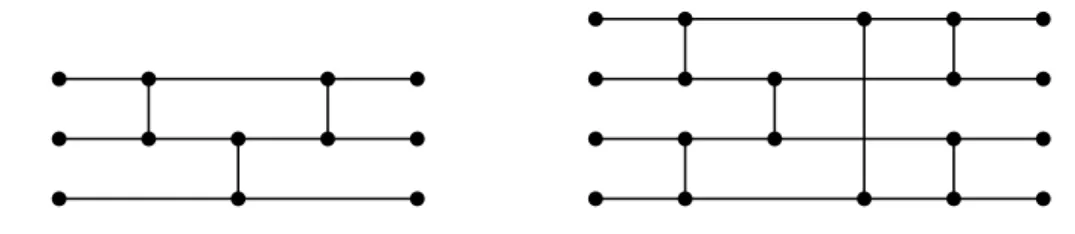
To derive shortest prime implicants, we turn to sorting networks [146]. Examples of sorting networks for 3 and 4 bits are given in Fig. 2.1. The 3-bit sorter on the left-hand side of Fig. 2.1 has 3 input bits on the left and 3 output bits on the right. It also contains 3 comparison operations, indicated with vertical bars, which compare and if necessary swap bits. A comparator assigns its outgoing upper bit to the maximum of its two incoming bits and its outgoing lower bit to the minimum. Since maximum and minimum in this context correspond to the logical symbols ∨ and∧, a comparator with incoming bitsi1 andi2 as well as outgoing bitso1 ando2
can be encoded propositionally as the formula:
(o1 ↔i1∨i2)∧(o2 ↔i1∧i2)
The value of a sorting network is that it can be applied to express the sum of k propositional variables in no more than 12k(dlog2(k)e+ 1) ternary clauses where the sum is represented in a unary fashion [95]. The 3-bit sorter in Fig. 2.1, for instance, over inputs I ={i1, i2, i3}, outputs O={o1, o2, o3} and internal auxiliary
bits A={a1, a2, a3}, can be encoded propositionally as:
σ3 = (a1↔i1∨i2) ∧ (a2 ↔i1∧i2) ∧ (a3↔a2∨i3) ∧ (o3↔a3∧i3) ∧ (o1 ↔a1∨a3) ∧ (o2↔a1∧a3)
2 Existential Quantification as Incremental SAT
Moreover, by instantiating the output bits to fixed unary value, a cardinality constraint can be obtained. For example, by constraining the output bits of the 4-bit sorter to 1100, a cardinality constraint is derived which ensures that exactly 2 of the 4 input bits to the sorter are set. Constraining the output bits to 1110 would ensure that exactly 3 input bits are set. Such cardinality constraints can be imposed in conjunction with the formula τ(ψ) in order to enforce the discovery of the shortest implicants first, and thereby prevent redundant implicants to be found. Returning to the example discussed in the previous section, we observe that the aforementioned redundancy by implicants ρY(m1) and ρY(m2) would not have
occurred, had the SAT solver first found the following model:
m3 = x17→1, x2 7→0, x3 7→1, x47→0, x5 7→1, x67→0 y1+7→0, y+2 7→0, y3+7→0, y+4 7→1, y+5 7→0, y6+7→1 y1−7→1, y−2 7→0, y3−7→1, y−4 7→0, y−5 7→1, y6−7→0
To guarantee that shortest prime implicants are found first, we introduce a set Y± = {y1±, . . . , y±k} of fresh variables. These variables serve as inputs to a k-bit sorting network. Each variableyi±∈Y± indicates whethery+i or yi− appears in the implicant; if so,y± evaluates to 1, and to 0 otherwise. To connect the y+i andyi− variables to the respectiveyi±, a conjunction Vk
i=1θi is introduced, where: θi = yi±⇔(yi+∨y−i )
= (¬y±i ∨yi+∨y−i )∧(y±i ∨ ¬yi+)∧(yi±∨ ¬yi−)
Given a k-bit sorter σk with output variables{o1, . . . , ok}, a formula whose models describe implicants of ∃X: ϕof length` with 1≤`≤k is obtained by augmenting τ(ψ) with a constrained sorting network as follows:
τ`(ψ) = τ(ψ)∧σk∧ Vk i=1θi ∧V` i=1oi ∧Vk i=`+1¬oi
Sinceτ`(ψ) is unsatisfiable forl∈ {1, . . . ,4}, we deduce that∃X:ϕdoes not possess implicants shorter than 5. Testing τ5(ψ) for satisfiability yields the modelm3 as
above, which defines:
ρY(m3) = (¬y1∧ ¬y3∧y4∧ ¬y5∧y6)
Adding a blocking clause ¬ρY(m3) to ϕsuppresses both, m1 and m2. Note that
although the clauses (V`
i=1oi)∧(Vki=`+1¬oi) must be rescinded once all the impli-cants of length`have been found, this sub-formula is itself a cube. The force of this is that SAT solvers support assumptions which are cubes. The assumption is added to the instance, thereby binding some variables, but these bindings are discarded once a model is found, in readiness for the next call to the solver. Conveniently,
2.1 Prime Implicant Generation
Figure 2.1: Sorting networks for 3 and 4 bits; vertical bars indicate comparators this lightweight version of incremental SAT is sufficient to support the above algo-rithm. To summarize, we have thus far introduced a transformation map τ for a dual-rail encoding which, if paired with sorting networks and respective cardinality constraints, can be used to derive shortest prime implicants of ∃X:ϕ.
2.1.3 Formal Correctness
To prove the formula transformations introduced so far correct, letBoolV denote the class of propositional formulae over the set of variablesV. Suppose that two disjoint sets X and Y partitionV, i.e., X∩Y =∅ andX∪Y =V. We shall now consider the problem of computing an implicant of ∃X :ϕ where the formula ϕ∈ BoolV is presented in CNF. The transformation is formalized as a map τ on the set of literals LitV = {v,¬v | v ∈ V}. This map is, in turn, defined in terms of sets of propositional variables Y+ ={y+ |y ∈Y} and Y− ={y− |y∈Y} for which we assume thatY+∩Y−=∅and (Y+∪Y−)∩V =∅.
Definition 2.1. The literal transformation map τ :LitV → LitY+∪Y−∪X and its
inverse τ−1 :LitY+∪Y−∪X →LitV are defined as follows:
τ(l) = y+ :l=y and y∈Y y− :l=¬y andy ∈Y l :otherwise τ−1(l) = y :l=y+ andy∈Y ¬y :l=y− andy∈Y l :otherwise
A clause is considered to be a set of literals to simplify the lifting of the literal transformation map to clauses. Thus, if a clause is merely a set C ⊆ LitV then τ(C) ={τ(l)|l∈C}. Likewise, τ can be lifted to a formula ϕ⊆℘(LitV). Given a set W ⊆ LitV of literals, we sometimes use VW as a shortcut for the formula V
w∈Ww. Likewise, we sometimes use W
W forW
w∈Ww.
Definition 2.2. Let F ⊆ ℘(LitV) and let ϕ = V{WC | C ∈ F}. The formula transformation map τ :℘(LitV)→℘(LitX,Y) is defined:
τ(ϕ) = V
{W
τ(C)|C∈F} ∧V
2 Existential Quantification as Incremental SAT
An implicant ofϕis a cube csuch that c|=ϕ. Our interest is in cubes which are non-trivial, that is, cubes that do not contain opposing literals. The classes of cubes over literals from V andX∪Y+∪Y− are given through the following definition.
Definition 2.3. The classes of non-trivial cubes are defined below:
CubeV = C⊆LitV ∀v∈V :{v,¬v} 6⊆C CubeX,Y = C∪C0 C ∈CubeX ∧ C0⊆Y+∪Y− ∧ ∀y∈Y :{y+, y−} ∩C0 6=∅ ∧ {y+, y−} 6⊆C0
The literal transformation mapτ is lifted to cubes by likewise considering these to be sets of (implicitly conjoined) literals. The transformation relates cubes with literals drawn from LitV to cubes with literals drawn from Y+∪Y−∪LitX. The above definitions allow us to state equivalence between cubes over the original formula ϕ and those obtained by applying the formula translation τ(ϕ).
Proposition 2.1 (Equivalence). Let F ⊆ ℘(LitV) and let ϕ = V{WC |C ∈ F} denote a formula in CNF. Further, put ϕ0=V
{W
τ(C)|C∈F}. Then: 1. IfD∈CubeV and (VD)|=ϕthen (Vτ(D))|=ϕ0.
2. IfD0 ∈CubeX,Y and(V
D0)∧ϕ0 is satisfiable then(V
τ−1(D0)|=ϕ. Proof of Proposition 2.1. We prove correctness of the two statements separately.
1. Let C ∈ F. Since we have (V
D) |= ϕ, it follows that (V
D) |= (W
C). We then have to consider the following four different cases:
• Supposex∈D∩C and x∈Y. Thenx+∈τ(C)∩τ(D).
• Suppose¬x∈D∩C and x∈Y. Thenx− ∈τ(C)∩τ(D).
• Supposex∈D∩C and x∈X. Then x∈τ(C)∩τ(D).
• Suppose¬x∈D∩C and x∈X. Then ¬x∈τ(C)∩τ(D). Hence (V τ(D))|= (W τ(C)) whence (V τ(D))|=ϕ0 as required. 2. Let C∈F. Since (V D0)|=ϕ0 it follows that (V D0)|= (W τ(C)).
• Supposex+∈D0∩τ(C) and x∈Y. Then x∈C∩τ−1(D0).
• Supposex−∈D0∩τ(C) and x∈Y. Then ¬x∈C∩τ−1(D0).
• Supposex∈D0∩τ(C) and x∈X. Then x∈C∩τ−1(D0).
• Suppose¬x∈D0∩τ(C) and x∈X. Then ¬x∈C∩τ−1(D0). Hence (V
τ−1(D0))|= (W
C) whence (V
2.2 Anytime Quantifier Elimination
The following corollary of the above relates implicants with literals drawn from
LitY to the satisfiability of the transformed clause set. It ultimately provides a correctness argument for the transformation mapτ as used in the example.
Corollary 2.1(Correctness). LetF ⊆℘(LitV)and letϕ=V{WC|C ∈F}denote a formula in CNF. Further, put ϕ0 =V
{W
τ(C)|C∈F}. Then:
• If D∈CubeY and (V
D)|=∃X:ϕ then(V
τ(D))∧ϕ0 is satisfiable.
• If D0 ∈Cube∅,Y and (VD0)∧ϕ0 is satisfiable then (Vτ−1(D0))|=∃X:ϕ. Let sat(ϕ) ⊆ ℘(V) denote the set of models of ϕ. The following result can the straightforwardly be adapted to the encoding τ`(ϕ), which is identical to τ(ϕ) equipped with sorting networks. Observe thatτ(ϕ) does not include any cardinality constraint on the size of the implicants, hence the need to define shortest implicants in terms of an implicant no longer than any other.
Corollary 2.2(Shortest Implicants). Letϕ=V
{W
C|C ∈F}whereF ⊆℘(LitV}. Then D ∈ CubeY is a shortest implicant of ∃X :ϕ iff D = ρ(M? ∩(Y+∪Y−)) where
1. M?∈sat(τ(ϕ))
2. |M?∩(Y+∪Y−)| ≤ |M∩(Y+∪Y−)| for allM ∈sat(τ(ϕ))
2.2 Anytime Quantifier Elimination
This chapter shows how over-approximation using shortest prime implicants can be applied to eliminate X={x1, . . . , xn} from∃X :ϕ. In particular, we show how a SAT solver can be repeatedly called to compute a sequence of CNF formulae h0, h1, . . . that converge onto ∃X :ϕfrom above in the sense that ∃X :ϕ entails
each intermediate formula hi. Furthermore, each hi+1 strictly entails hi, so that the sequence is ultimately stationary. However, each hi is free from all variables in X, hence this approach has the attractive property that generation of the sequence h0, h1, . . . , ht can be stopped prematurely, at any time t, without sacrificing sound-ness. This leads to a so-called anytime (orinterruptible [23, Sect. 2.6]) formulation of projection that compares, in some sense, favorably against resolution and model enumeration, which lead to all-or-nothing, monolithic approaches. Specifically, if g0 =ϕandgi+1is obtained fromgiby applying resolution to remove another variable xi∈X of fromϕ, then it is only the final formula gn that is free fromX. Moreover, the number of clauses in gi does not necessarily decrease as i increases, and the size of intermediate gi can be significantly larger than both ϕ and its projection gn. By way of contrast, the size of the hi increases monotonically as the sequence converges. We thus show how to systematically construct a sequence h0, h1, . . . , ht which converges onto∃X:ϕfrom above using shortest prime implicants.
2 Existential Quantification as Incremental SAT
2.2.1 Worked Example
The algorithm converges onto∃X:ϕfrom above by incrementally conjoining clauses
¬ν1, . . . ,¬νn formed from shortest prime implicants ν1, . . . , νn of ¬∃X :ϕ. Short clauses are likely to remove more models from the approximation than long ones, thereby encouraging rapid convergence. In this example, consider ϕdefined as:
ϕ = (¬x∨z)∧(y∨z)∧(¬x∨ ¬w∨ ¬z)∧(w∨ ¬z)
Put X ={z} and Y ={w, x, y}. To derive an over-approximation of ∃X:ϕ, our algorithm operates on ¬ϕ rather than ϕ directly. First, ¬ϕ is turned into CNF using additional, fresh variablesT ={t1, . . . , t4}. Tseitin’s method is used for this
conversion, which yields a formula ψ. By construction, ψ is equisatisfiable to ¬ϕ:
ψ = (x∨t1) ∧ (¬z∨t1) ∧ (¬y∨t2) ∧ (¬z∨t2) ∧ (x∨t3) ∧ (w∨t3) ∧ (z∨t3) ∧ (¬w∨t4) ∧ (z∨t4) ∧ (¬t1∨ ¬t2∨ ¬t3∨ ¬t4)
The Tseitin variableti indicates whether a truth assignment violates theith cube of
¬ϕ. Applying the transformationτ given in Def. 2.1 then yields:
τ(ψ) = (x+∨t1) ∧ (¬z∨t1) ∧ (y−∨t2) ∧ (¬z∨t2) ∧ (x+∨t 3) ∧ (w+∨t3) ∧ (z∨t3) ∧ (w−∨t4) ∧ (z∨t4) ∧ (¬t1∨ ¬t2∨ ¬t3∨ ¬t4) ∧ (¬w+∨ ¬w−) ∧ (¬x+∨ ¬x−) ∧ (¬y+∨ ¬y−)
Existential Quantification by Filtering
To see howτ(ψ) can be applied to find an over-approximation of ∃X:ϕ, observe: ν |=∀X:∃T :ψ ⇔ ¬∀X :∃T :ψ|=¬ν
⇔ ∃X :¬∃T :ψ|=¬ν
⇔ ∃X :ϕ|=¬ν
Hence, to find an over-approximation of ∃X:ϕ, it suffices to find an implicant of
∀X :∃T :ψ. To find such an implicant, observe that ∀X :∃T :ψ|=∃X :∃T :ψ. Every implicant ν of ∀X :∃T :ψ is thus also an implicant of ∃X :∃T :ψ. Since the τ map allows us to derive implicants of∃X:∃T :ψ, this suggests a strategy in which the implicants of∃X :∃T :ψare filtered to find the implicants of∀X :∃T :ψ. The check∃X :ϕ|=¬ν amounts to deciding whether the conjoined formulaϕ∧ν is
2.2 Anytime Quantifier Elimination
unsatisfiable. Thus, a test for unsatisfiability can be used for filtering. To illustrate, suppose that a SAT solver produces the following solution to the formula τ(ψ):
m1 = w+ 7→ 0, w− 7→ 1, x+ 7→ 0, x− 7→ 0, y+ 7→ 0, y− 7→ 0, z 7→ 1, t1 7→ 1, t2 7→ 1, t3 7→ 1, t4 7→ 0
The cube ρY(m1) = (¬w) entails ∃X :∃T :ψ, and therefore, it remains to check
whether∃X :ϕ|=¬ρY(m1). Sinceϕ∧ρY(m1) is satisfiable, the cube is discarded; it
does not entail∀X :∃T :ψ. However, before discarding the cube, the formulaτ(ψ) is augmented with (¬w−∨x+∨x−∨y−∨y+) to preventρY(m1) from being found again.
This blocking clause can be interpreted as an implicationw−→(x+∨x−∨y−∨y+), which ensures that any cube subsequently found that entailsρY(m1) also has more
literals than ρY(m1). Applying a SAT solver then yields a model
m2 = w+ 7→ 0, w− 7→ 0, x+ 7→ 1, x− 7→ 0, y+ 7→ 0, y− 7→ 0, z 7→ 0, t1 7→ 0, t2 7→ 1, t3 7→ 1, t4 7→ 0
and hence ρY(m2) = (x). Since ϕ∧ρY(m2) is unsatisfiable, we conclude that
∃X :ϕ|=¬ρY(m2), hence ¬ρY(m2) constitutes an over-approximation of ∃X:ϕ.
The blocking clause ¬x+ is then added to τ(ψ) to prevent any cube that entails
ρY(m2) being found. Note that this blocking clause differs in structure from the one
imposed previously. Indeed, the number of literals in the clause is merely nwheren is the number of literals in the cube. In the previous case, the number of literals in the blocking clause is 2· |Y| −n. Reapplying a SAT solver yields a further model
m3 = w+ 7→ 0, w− 7→ 1, x+ 7→ 0, x− 7→ 0, y+ 7→ 0, y− 7→ 1, z 7→ 1, t1 7→ 1, t2 7→ 1, t3 7→ 1, t4 7→ 0
which defines the cube ρY(m3) = (¬w∧ ¬y). Since ϕ∧ρY(m3) is unsatisfiable,
it again follows that ∃X :ϕ|=¬ρY(m3), which refines the over-approximation of
∃X :ϕto the conjunction (¬ρY(m2))∧(¬ρY(m3)). The blocking clause (¬w−∨¬y−)
is then added to the augmented formula at which point one final application of the solver indicates that the conjoined formula is unsatisfiable. Hence, convergence onto
∃X :ϕhas been obtained from above where:
∃X:ϕ = ¬ρY(m2)∧ ¬ρY(m3)
= (¬x)∧(w∨y)
Terminating the procedure early, before ρY(m3) is computed, would yield the
2 Existential Quantification as Incremental SAT
than (¬x)∧(w∨y). Thus, the method is diametrically opposed to resolution: In the resolution-based scheme, the projection is found in the last step only after all variables have been eliminated one after the other. In the above SAT-based scheme, a clause in the projection space is obtained in the first step, as in a parallel form of elimination, which is subsequently refined by adding further clauses.
Search-Space Reduction using Instantiation
In the example discussed so far, a SAT solver generates a spurious candidateρY(m1)
for an implicant, which is then refuted by checkingϕ|=¬ρY(m1). This scheme is
based on the observation that every implicant of ∀X:∃T :ψis also an implicant of
∃X :∃T :ψ, where in the case of the exampleX={z}. However, observe that
∀X:∃T :ψ |= ∃T :ψ[z7→0]
whereψ[z7→0] denotes the formula obtained by replacing each occurrence ofz in ψ with the truth value 0. We refer to this operation as instantiation. Therefore, every implicant of ∀X:∃T :ψ is also an implicant of∃T :ψ[z7→0]. The formula
∃T :ψ[z7→0] is not only a simplification of∃T :ψ, but∃T :ψ[z7→0] will possess fewer models, and hence fewer implicants, than ∃X : ∃T : ψ provided ψ 6|= ¬z. Consider again the formula τ(ψ) with the instance τ(ψ[z 7→ 0]) = τ(ψ)[z 7→ 0]. Recall that originally the candidate implicantρY(m1) = (¬w) was derived, which
was then refuted because ∃X : ϕ 6|= ¬ρY(m1). This candidate is suppressed by
the instantiation and is not a model of τ(ψ)[z 7→ 0]. It turns out that 13 SAT instances are required to converge onto ∃X:ϕ, whereas operating onτ(ψ)[z7→0] and τ(ψ)[z7→1] only requires 9 and 10 SAT instances, respectively. Interestingly, the formulae derived for these cases are equivalent but different. For τ(ψ)[z7→0], we obtain the limit (¬x)∧(w∨y) as expected, but operating onτ(ψ)[z7→1] yields (w∨y)∧(w∨ ¬x)∧(¬w∨ ¬x). This result is equivalent to (¬x)∧(w∨y) as (w∨ ¬x)∧(¬w∨ ¬x) can be simplified to (¬x).
Search-Space Reduction using Multiple Instantiations
Instantiating the variables of X with truth values can decrease the number of spurious implicants that are generated. This suggests instantiating ψin different ways, then combining the instantiations to limit the search space. Thus, the basic idea is to derive multiple instantiations, say,τ(ψ)[z7→0] and τ(ψ)[z7→1] and solve:
µ = τ(ψ)[z7→0]∧τ(ψ)[z7→1]
In case of|X|= 1,µis equivalent to∀X:τ(ψ). Care is needed to avoid accidental coupling between the Tseitin variables in different instantiations. This can be