Extensible Proof Engineering
in Intensional Type Theory
The Harvard community has made this
article openly available.
Please share
how
this access benefits you. Your story matters
Citation Malecha, Gregory. 2015. Extensible Proof Engineering in Intensional Type Theory. Doctoral dissertation, Harvard University, Graduate School of Arts & Sciences.
Citable link http://nrs.harvard.edu/urn-3:HUL.InstRepos:17467172
Terms of Use This article was downloaded from Harvard University’s DASH repository, and is made available under the terms and conditions applicable to Other Posted Material, as set forth at http://
nrs.harvard.edu/urn-3:HUL.InstRepos:dash.current.terms-of-use#LAA
Extensible Proof Engineering in Intensional
Type Theory
a dissertation presented by
Gregory Michael Malecha to
The Harvard School of Engineering and Applied Sciences in partial fulfillment of the requirements
for the degree of Doctor of Philosophy in the subject of Computer Science Harvard University Cambridge, Massachusetts November 2014
©2014 - Gregory Michael Malecha All rights reserved.
Thesis advisors: Greg Morrisett & Adam Chlipala Gregory Michael Malecha
Extensible Proof Engineering in Intensional Type Theory
AbstractWe increasingly rely on large, complex systems in our daily lives—from the computers that park our cars to the medical devices that regulate insulin levels to the servers that store our personal information in the cloud. As these systems grow, they become too complex for a person to understand, yet it is essential that they are correct. Proof assistants are tools that let us specify properties about complex systems and build, maintain, and check proofs of these properties in a rigorous way. Proof assistants achieve this level of rigor for a wide range of properties by requiring detailed certificates (proofs) that can be easily checked.
In this dissertation, I describe a technique for compositionally building exten-sible automation within a foundational proof assistant for intensional type theory. My technique builds on computational reflection—where properties are checked by verified programs—which effectively bridges the gap between the low-level rea-soning that is native to the proof assistant and the interesting, high-level prop-erties of real systems. Building automation within a proof assistant provides a rigorous foundation that makes it possible to compose and extend the automa-tion with other tools (including humans). However, previous approaches require using low-level proofs to compose different automation which limits scalability. My techniques allow for reasoning at a higher level about composing automation, which enables more scalable reflective reasoning. I demonstrate these techniques through a series of case studies centered around tasks in program verification.
Contents
1 Introduction 1
1.1 Formal Logic . . . 4
1.2 Intuitionistic Type Theory as a Logic . . . 6
1.3 Automation . . . 10
1.4 Overview of the Dissertation . . . 15
2 Background 17 2.1 Gallina: Coq’s Logic . . . 18
2.2 Constructing Proofs withLtac . . . 26
2.3 Proof by Computational Reflection . . . 28
2.4 Related Work . . . 34
3 Open Semantic Reflection 39 3.1 The Lambda Core . . . 40
3.2 Semantic Openness & Tautologies . . . 46
3.3 Meta-level Dependency & Monad Simplification . . . 57
3.4 Unification Variables & Backward Reasoning . . . 66
3.5 Related Work . . . 73
4 Engineering Reflective Automation 81 4.1 Coq’s Reduction Mechanisms . . . 82
4.3 Crafting Proof Terms for Computational Reflection . . . 93
4.4 Reification: Building Syntax for Semantic Terms . . . 99
5 Case Study: Program Verification in Bedrock 104 5.1 Bedrock by Example . . . 106
5.2 Reflective Verification in Bedrock . . . 110
5.3 Evaluation . . . 118
5.4 Related Work . . . 125
6 Rtac: A Reflective Tactic Language 130 6.1 Compositional Tactics . . . 132
6.2 Core Tactics . . . 142
6.3 Performance . . . 146
6.4 Related Work . . . 152
7 Case Study: Embedded Logics for Imperative Programs 156 7.1 Describing Axiomatic Logics with Charge! . . . 158
7.2 Reifying Type Classes . . . 160
7.3 Case Study: Verifying Imperative Programs . . . 163
7.4 Future Avenues and Ongoing Applications . . . 170
8 Conclusions 172 8.1 Avenues for Future Work . . . 173
8.2 Final Thoughts . . . 176
Author List
The work described in Chapters 4 and 5 was joint with Thomas Braibant and Adam Chlipala.
To my wife, who is always there with a smile.
Acknowledgments
I would like to thank my advisors, Prof. Greg Morrisett and Prof. Adam Chli-pala, for their guidance and insight related to the work presented here and the other projects that I worked on during my graduate career. Greg has always been full of insights and remarks that helped me find where I was and led me in interesting directions. And it was through my work with Adam that the ideas in this disserata-tion first emerged.
My undergraduate reasearch advisor, Prof. Walid Taha, provided my first expo-sure to both computer science research and functional programming. He help lay the foundations of my knowledge which was the seed that started me on the path to graduate school.
My collaborators Ryan Wisnesky, who helped me disentangle “Coq” from de-pendent type theory, and Thomas Briabant, who helped me understand compu-tational reflection. Jesper Bengston and Josiah Dodds have been great collabora-tors onRtacand its application to imperative program verification. Nothing helps make things more useful than users. And I thank the people in Maxwell-Dworkin 309 for many years of interesting conversations, collaborations, and fun.
Finally, I would like to thank my wife, Elizabeth Smoot Malecha, who was and is a constant source of joy and inspiration. And I thank my parents, Michael and Karen Malecha, for constantly teaching, encouraging, and supporting me in my many endeavors.
1
Introduction
Software is a pervasive part of our lives, from the flight control systems on airplanes to “apps” that entertain us on the bus. Despite this, at a formal level, we do not un-derstand what most of it does. Methodologies for software development espouse unit tests and test-driven development as engineering “best practices,” but these do not convey a complete understanding of software. Rather, these methodolo-gies extrapolate “correctness” from a collection of observations (test cases) in the style of random variables in statistics where, in reality, there is nothing random about correctness.
While this approach has served us well for many years, its flaws are becoming apparent. In days before network computing there was no incentive to break your software. Now, when global financial markets, utility grids, mass communication, and social media are run by computers, the importance of robust and correct soft-ware is more apparent than ever.
“Correctness” is one point on a spectrum of properties about systems. Because “correctness” is a system-dependent property, it is often difficult to build fully au-tomatic tools that can express and prove these properties. Instead, programming languages research has focused, with great success, on shallow properties that can be stated and often proved in a program-agnostic way. For example, type sys-tems, both static and dynamic, can guarantee run-time invariants such as type and memory safety [130]. These properties are so fundamental to abstraction and rea-soning that researchers have developed tools to back-port some of these proper-ties [5,51,79] to existing software using binary rewriting and instrumented com-pilers.
However, systems that provide high-level properties out of the box often come at a cost. High-level run-time systems such as Microsoft’s .Net [4] and Oracle’s Java [2] as well as type safe languages such as OCaml [146] and Haskell [145] prevent or make it difficult to exploit low-level properties of the underlying sys-tem. For example, only recently did real-time garbage collection make program-ming real-time systems in Java possible [20]. And even now, the overhead of fea-tures such as garbage collection can drain resources such as power, which prevents us from using these systems to their full potential. In many cases, optimization comes from exploiting problem-specific knowledge, but when working in high-level systems these properties cannot always be represented at the high high-level and are not always seen by general-purpose compilers. For example, algorithms such as union-find [64] can judiciously use imperative features to obtain asymptotic performance improvements over purely functional code. While this use of imper-ative features is safe, leveraging it in a purely functional language such as Haskell in a transparent way requires leveraging unsafe features of the language. An escape hatch for the brave is to enter the realm of the “under-specified.”
Outside of these very general properties, researchers have developed analyses that automatically reason about software systems. For example, model checking and abstract interpretation provide ways to abstract systems to make exhaustive search possible in very large or unbounded systems. While often completely auto-matic, as systems grow these approaches become increasingly expensive. Further,
pieces of these systems are property-dependent, with entire areas of research ded-icated to building new abstractions to capture specific properties. While frame-works exist for composing these properties, it is not clear that these domains can capture arbitrarily rich properties such as “a path exists through the graph” or “this compiler transformation is correct” while still being completely automated.
These approaches are focused on automated techniques for solving a problem. However, they achieve this automation by sacrificing expressivity. Since shallow properties are often sufficient, in practice this works well, but when more reason-ing is necessary to go the extra mile from “safe” to “correct” these techniques often fall short. Take, for example, a program that manipulates matricies. Safety of the program might guarantee only that matrix sizes match up when performing ad-dition or multiplication. Correctness, on the other hand might require reasoning that a particular function correctly implements LU-decomposition, which, in turn, requires stating what it means for a matrix to be lower-triangular.
What is needed to solve these problems is a foundational technique for build-ingand reasoningabout arbitrarily complex properties. While calculus is thelingua francaof most engineering disciplines, logic is the foundation of computer science. The last twenty years has seen a massive growth in automated reasoning systems. Logic tools such as SAT and SMT solvers [24,68,76], model checkers, and inter-active proof assistants make it possible to approach problems that were previously too large too understand on our own.
In this dissertation I focus on the task of building domain-specific automation within foundational proof assistants. Proof assistants provide rich logical foun-dations, but their automation necessarily is unable to solve all problems that can be stated. However, the richness of the logic provides techniques for building ex-tremely useful domain-specific automation. In this dissertation I develop a set of abstractions and building blocks for composing this domain-specific automation.
ThesisOpen computational reflection in intensional type theories can lower the cost of writing trustworthy, scalable, and customizable automation.
In the rest of this chapter I explain what this means, and in the rest of the dis-sertation I justify it. I begin with a brief overview of formal logic, presented from a computer science point of view (Section 1.1). Of particular interest is how formal logics capture meaning, which reduces reasoning, especially checking existing rea-soning, to an algorithm. From this foundation I explain the term “intensional type theory” (Section 1.2), focusing on its relationship to logic and then what makes it intensional (as opposed to extensional). Finally, I give an overview of computa-tional reflection and how it can facilitate scalable proofs of interesting properties within rich logical theories (Section 1.3.2). I conclude the chapter by outlining the remainder of the dissertation (Section 1.4).
1.1
Formal Logic
A logic is a system of inference rules that describes how to justify a conclusion from a collection of facts. Socrates’smodus ponensexample is probably the best known example of a logical inference:
All men are mortalandSocrates is a manimpliesSocrates is mortal. This sentence uses the two facts “All men are mortal” and “Socrates is a man” to conclude that “Socrates is mortal.”
Making logic “formal” means giving it syntactic (i.e. based on the shape or form) rules for what constitutes a valid inference. In a formal syntax, I would write Socrates’ statement as
(∀m,Manm→Mortalm)∧(Man Socrates)→Mortal Socrates.
Matching this up with the English above illuminates the differences. First, I have eliminated as much of the English as possible. While useful as a communication mechanism, the nuances of the English language are difficult to make precise. For example, the previous statement uses both the singular “man” and the plural “men.” Only our knowledge of the irregularity of the word “man” connects these two,
syntactically different, objects. As part of eliminating the English, I have replaced statements of being with predicates. For example, I converted “Socrates is a man” toMan Socrates. While less natural to read, the uniformity of the representation exposes high-level structure that will be essential for reasoning.
Continuing in the theme of syntax and building on its uniformity, it is useful to give a syntax to proofs in addition to logical assertions. A convenient way of writing and visualizing logical inferences is using inference rules phrased in the style of natural deduction. As an inference rule, Socrates’ statement would be written as:
Manm→Mortalm Manm MP
Mortalm
At the highest level, this rule can be read as an implication named using the text on the right (MP). It states that if the top two statements, “Manm→Mortalm” and “Manm”, are derivable, then the bottom statement, “Mortalm”, is also derivable. Free variables, e.g.m, are implicitly universally quantified, allowing us to instanti-ate the above rule to prove that I am mortal.
Man Gregory →Mortal Gregory Man Gregory
MP
Mortal Gregory
We can complete this proof by proving the premises. The left premise (statement above the line) is the interesting part of Socrates’ statement, while the right hand side is an axiom of the system. Thus, we can combine the inference rules into the following proof tree.
Socrates
Man Gregory→Mortal Gregory Man Gregory Fact
Mp (Gregory)
Mortal Gregory
1.1.1 Machine Checkable Proofs & The Trusted Computing Base While this level of rigor might seem excessively pedantic, it enables algorithmic manipulation of both propositions and their proof. This in turn enables us to scale reasoning to drastically larger problems by using computers to check, and some-times even build, the proofs.
The critical factor to consider when trusting justifications attested by a puter is the size of the “trusted computing base.” That is, what is the size and com-plexity of the software that must be trusted in order to trust that a statement is true?
The explicit syntax for propositions and proofs makes it possible to implement a checker for these rules in a relatively simple manner. This checker makes it possible to separate the complexities of finding a proof from the relatively simple process of checking it. Thus a relatively small proof checker can serve as the trusted comput-ing base for arbitrarily large and sophisticated proofs as long as they are expressible in the logic. For example, recent verification results for proving full correctness properties for systems use proofs that are more than 5x the size of the system they verify [85,96,98,103,110]. Extrapolating these techniques to a multi-million line operating system results in hundreds of millions of lines of proof—far too much to verify by hand. Even a thousand line proof checker results in a 100,000x reduction in the size of the trusted code. This allows us to focus our attention on the checker’s correctness so that we can avoid spending time on the details of individual proofs. The draw-back of a small trusted computing base is the need for very detailed proofs. For example, to avoid trusting a sophisticated algorithm for reasoning about arithmetic, all of the arithmetic manipulation in the proof must be justified within the proof object itself. Abstraction may enable these proofs to be smaller, and au-tomation (which I discuss in Section 1.3) may make it easier to build these proofs, but ultimately these proofs must exist somewhere within the logic.
1.2
Intuitionistic Type Theory as a Logic
There are many possible choices for the logic to use. Within the programming language verification community, intensional type theory has been gaining pop-ularity as a useful, expressive logic. Several factors contribute to this. First, in-tensional type theory is higher-order, making it easier to state sophisticated theo-rems. Second, intensional type theory unifies the languages of propositions and proofs by way of the Curry-Howard correspondence (see the next paragraph).
This means that the several levels of syntax are merged into a single level and al-lows writing very generic properties about both. Beyond the theoretical benefits of the system are the practical ones. Intensional type theory has several imple-mentations [8,62] and some social processes (e.g. books [33,56,133] and active research programs [148]) behind it.
The Curry-Howard correspondence makes precise the relationship between a logic and a functional programming language. The correspondence states the fol-lowing similarities:
Logical View Programming View Logic ∼ Type system
Formula ∼ Type
Constructive Proof ∼ Typed Functional Program
To give a concrete example, consider the relationship between logical conjunc-tion and pairs (tuples) in a funcconjunc-tional programming language. A conjuncconjunc-tion is proved by proving each of the two conjuncts individually, while a pair is constructed by combining the value for each part. In inference rules these are expressed as fol-lows: Γ⊢P Γ⊢Q ∧-I Γ⊢P∧Q Γ ⊢e1 :τ1 Γ ⊢e2 :τ2 × -I Γ ⊢(e1,e2) :τ1×τ2
While the conclusions and premises look slightly more complex because the in-corporate a context (Γ), these inference rules mean exactly the same as the simple inference rules that I showed for Socrates’ example.
Note the similarity between the logical formulae to the right of the turnstile in the logical realm (on the left) and the types to the right of the colon in the program-ming realm (on the right). If we think of the Γ’s as the same, the only difference is thee1ande2terms on the right. In the world of programming languages, these
cor-respond to the program, while under the logical interpretation, these terms are the proofs. Intensional type theory’s ability to represent and manipulate these proofs within the logic enables it to build procedures that construct proofs and to use proofs to implement procedures.
Intensional vs. Extensional Type Theory
The Curry-Howard correspondence explains how a type system can be viewed as a logic, but what makes the logic intensional? The distinction between intension-ality and extensionintension-ality lies in the definition of equintension-ality that is native to the logical system. In extensional type theories, equality is interested in the objects them-selves (i.e. the “extent” of the type). Intensional type theory, on the other hand, is interested in the description of the object. To see the difference concretely, con-sider two different ways to compute the sum of two integersnandm.
n+m m+n
Since plus is commutative, both expressions have the same value and can there-fore be used interchangeably in an extensional type theory. In an intensional type theory, however, these two terms are notfreelyinterchangeable. Instead the proof that witnesses their equality is necessary to convert one expression to the other.
The need for the proof as relevant to thetermhighlights the difference between two types of equality: definitional and propositional. Definitional equality (which I will notate using≡) is the equality that the entire theory internalizes. Within intensional type theory this equality is closely related to program reduction. For example,(λx.x)3≡3 and 1+1≡2 simply by running the plus function¹.
Propositional equality (which I will notate using=) requires proofs to show not only that two terms are equal, buthowthey are equal. In intensional type theory, these proofs are themselves terms in the logic and thus have computational con-tent. For example, a proof thatx=yshould be viewed as a function that describes how to convert any proof of a propertyPaboutxinto a proof ofPabouty.
While intensional type theory distinguishes between definitional and provable equality, extensional type theory unifies them using the equality reflection rule.
Γ ⊢A=B ≡-Ext Γ⊢A≡B
¹Here I use standard lambda calculus notation whereλx.xis the identity function that takes any number and returns it.
This rule states that any propositional equality can be converted into a definitional equality. This makes sense in an extensional type theory because the meta theory is concerned with the actual values, and if two values are provably equal it will not be able to distinguish them.
The implication of equality reflection is most clearly seen in inconsistent con-texts. In the following examples,⊥denotes a false assertion. The following state-ment is perfectly valid in an extensional theory but complete nonsense in an inten-sional one.
⊥ →3= ‘x’
Here, equality requires two things of the same type, but 3 and‘x’clearly have dif-ferent types since one is an integer and the other is a string. Using≡-Ext, however, we can prove that
⊥ →Z=string
by appealing to the contradictory premise. Thus the typing derivation for the above statement is the following:
• ⊢ ⊥:Prop ⊥ ⊢3:Z ⊥ ⊢Z=string ≡-Ext ⊥ ⊢Z≡string ⊥ ⊢‘ x’ :string Conv ⊥ ⊢‘ x’ :Z Eq-I ⊥ ⊢ 3= ‘x’ :Prop →-I • ⊢ ⊥ →3= ‘x’ :Prop
By internalizing propositional equality into definitional equality, extensional the-ories provide the ability to write terms such as this directly.
Intensional theories can also express properties such as the one above except that the implicit uses of≡-Ext in the extensional proof must be converted into an explicit cast in the intensional proof. This means that, for example, instead of stat-ing 3 = ‘x’in an intensional theory we would state 3 = cast pf ‘x’wherepfis the proof thatstring=Zgiven⊥. While seemingly tedious since we think ofcast as simply being the identity function, considering the content of these proofs leads to interesting structures and is central to current work on proof-relevant mathe-matics which is championed by the emerging field of homotopy type theory [148].
While witnessing these casts explicitly in proofs may seem inconvenient, inten-sional theories enjoy several convenient properties that exteninten-sional theories do not. First, intensional theories have decidable, syntax-directed type checking be-cause there is never a need to construct a proof out of thin air. Extensional theories, on the other hand, require the entire typing derivation rather than just the term to justify the well-formedness of terms to the proof checker. Second, intensional the-ories support reduction in inconsistent contexts. To see why this is a problem in extensional type theory, consider the following term:
⊥ →(λx.x x)(λx.x x)
Since⊥can be used to prove anything, the term on the right-hand-side of the ar-row is well typed; however, reducing it to a normal form will never terminate, thus the proof checker will never terminate. In an intensional theory, the cast necessary to make this term type check depends on the unknown proof of⊥in the context. Thus, reduction stops when this cast needs to be inspected, which prevents the evaluation from diverging.
These theoretical properties, along with the existence of several practical tools [8,
62], have made intensional type theory a popular vehicle for formal developments in recent years. I survey alternatives in the related work at the end of Chapter 2.
1.3
Automation
Building explicit proofs from scratch is often labor intensive. To mitigate the bur-den, we use automation to build proofs for us. Fundamental limitations on the decidability of certain logics prevent us from solving all problems completely au-tomatically. However, automation still plays a large role in building proofs at scale. The degree of automation can vary wildly between problem domains. Type in-ference algorithms, such as those in OCaml [146] and Haskell [145], are excellent examples of a simple but powerful form of automation for proving a shallow prop-erty, i.e. the type safety of a program. At the other end of the spectrum,
verify-ing deeper properties—such as the functional correctness of an optimizverify-ing com-piler [105] or deep mathematical results such as the Odd-Order Theorem [83]— is a much less automatic task. In instances such as these, automation is often rele-gated to filling in the leaves of the proof while human insight is necessary to guide the high-level proof structure. While not really automation itself, the ability to combine human guidance with automation is extremely useful in developing so-phisticated proofs and is a feature unique to proof assistants.
A crucial property of automation is that it should lie outside of the trusted com-puting base. A proof generated by automation should be just as trustworthy as one that is painstakingly filled in by an expert. This interchangeability allows so-phisticated heuristics and complex, highly optimized implementations of automa-tion without the need to worry about compromising the soundness of the system. There are two high-level strategies for building trustworthy automation: have the automation produce a proof object and write a proof that the automation is sound. 1.3.1 Generate and Check Automation
A common automation technique in a rigorous formal system is to use procedures that build proof objects that can be checked after-the-fact by the trusted core. This approach avoids the need to trust, or even formalize, the procedures since the com-plete justification is captured by the self-contained proof. The independence of the automation from the trusted computing base provides considerable freedom in building this type of automation. For example, automation of this sort can lever-age non-determinism, side effects, and even human hints without compromising the trustworthiness of the final proof.
Automation of this variety comes in two varieties: pre-packaged decision pro-cedures that are tuned to solve particular problems and scripting-languages that provide building blocks for building problem-specific automation. In the former category, the Isabelle proof assistant [123] provides automation such as “sledge-hammer” that invokes external tools such as SMT [24,68,76] solvers. While these external tools are large and may contain bugs, they are built to export proof
sketches that provide a skeleton that can often (but not always) be filled in to pro-duce a full Isabelle proof object. Even in cases when such proof objects cannot be constructed, the results of these external tools can be helpful. For example, model checkers [78] can point out problems in proof obligations that make them false, e.g. detecting an off-by-one error or an incorrect sign in a theorem statement. This early detection can highlight problems with the current development before sig-nificant effort is invested in trying to prove a theorem.
Beyond external tools, some proof assistants provide “scripting” languages to help automated the construction of proofs. For example, the Coq proof assis-tant [62] providesLtac[69], a domain-specific language for writing backtracking proof search procedures². While often not as fast as external tools, the customiz-ability makes these scripting languages well suited for building simple, domain-specific automation. In fact, the flexibility ofLtaccoupled with the richness of de-pendent type theory has madeLtaca powerful building block for entire tools such as a synthesis engine [73] and numerous verification systems [14,29,54,97] that live within Coq.
“Generate and check”-style automation is especially useful when a large amount of search is done to construct a relatively small proof witness. Classic satisfiabil-ity solvers have this property. The proof is simply a valuation of the variables, which can be easily checked, but the search needed to find those values is NP-complete [64]. In cases such as these, the proof search can be done once, and the results can be checked efficiently by any number of clients.
On the other end of the spectrum, some problems are very easily automated but produce very large proof terms. For example, reasoning in algebraic structures with associativity and commutativity often requires large proofs littered with ap-peals to permutation theorems. In cases such as these, compressing these large proofs can result in a substantial performance win.
1.3.2 Verified Automation: Computational Reflection
Within expressive logics that have a notion of computation another approach ex-ists: implement automation within the logic and prove it sound. This style of proving is referred to as “computational reflection” [34] and it is the topic of the remainder of the dissertation. Using computational reflection, the automation does not need to build the problem-specific proof. Instead the general proof of the soundness of the automation can be instantiated to a particular instance and serve as the proof of a property. In essence, computational reflection allows us to extend the proof checker with custom proof checking procedures and use them, to avoid constructing and checking large proof objects. This ability to use compu-tation enables us to exploit domain-specific knowledge to check properties more efficiently.
Example A simple, illustrative example of computational reflection in action is proving the evenness or oddness of numbers. Evenness and oddness can be de-fined by the following rules.
E0
⊢Even0 ⊢Even⊢Odd(1+n n) EO ⊢Odd⊢Even(1+nn) OE
Using these rules it is trivial to prove that any constant natural number is either even or odd: simply apply the appropriate constructor until you reach the base case when the number is 0. Unfortunately while this algorithm is complete, it produces very inefficient proofs. For example, the proof tree justifying that 1024 is even requires 1025 steps.
Abstraction can help us build a shorter proof by showing that 2 × nis even for anynand using that proof withn = 512. This solves the problem but only if we can figure out that 512 is the appropriate argument ton. Further, while this approach works nicely for numbers and evenness more complex domains such as propositional logic do not always have similarly nice properties.
To solve the even-odd problem reflectively we write a procedureisEven that takes a natural number and returns a boolean. We then prove a derived inference rule stating that ifisEvenreturnstruethen the given number is even.
⊢isEvenn =true
isEven-sound
⊢Evenn
Using this rule we can convert a proof obligation of Even n into an equality. Lever-aging the conversion rule, which is not manifest inside the proof, the logic can reduceisEven1024 totrueleaving us to provetrue = true, which has a much shorter proof. Concretely, the large proof tree on the left can be converted into a small proof tree on the right.
⊢Even0 .. . ⊢Odd1023 ⊢Even1024 =-Refl ⊢true=true Conv ⊢isEven1024=true isEven-sound ⊢Even1024
Assuming that checking conversion can be done efficiently, checking the small proof on the right will be significantly faster than checking the large proof on the left³.
This example is purposefully simple. However, building these reflective pro-cedures can be complex, and their scope is often limited. For example, while the technique described here is sufficient to prove that 1024 is even, it cannot prove
⊢ ∀x,Evenx→Even(4+x)
even though the proof is arguably simpler. In Section 2.3 I discuss an enriched style of computational reflection that can solve this problem. In the rest of the disserta-tion I will present and apply my own techniques to make this style of automadisserta-tion more compositional.
A downside of computational reflection, however, is that it requires that the pro-cedure be written and verified within the logic. This often means more upfront ef-fort which is only justified if the automation is broadly applicable. Further, these requirements make some programming features such as side effects and random-ness difficult to use since the implementation must fit within the evaluation rules of the logic.
³In Coq 8.4pl4 running on a 2.7Ghz Core i7 the proof on the right takes 0.1 seconds to check while the one on the left takes 1.8 seconds, an 18x speedup from using computational reflection.
1.4
Overview of the Dissertation
Large-scale computational reflection is a powerful technique that can be used to dramatically increase the usability of proof assistants. It offers a way to program proof assistants, enabling them to more efficiently reason about large, domain-specific problems while retaining access to rich logics that are essential when prov-ing deep theorems. Rather than verifyprov-ing stand-alone tools usprov-ing proof assistants, we can leverage the engineering that makes interactive verification possible to build automation that runs within the proof assistant. This allows us to combine differ-ent automation procedures and for those procedures to degrade gracefully in the face of undecidable problems and new domains that pre-packaged tools do not support out of the box. Further, it allows us to accomplish all of these things in a foundational way without enlarging the trusted computing base.
Achieving this goal requires compositionality of automated procedures, some-thing that current techniques for computational reflection in intensional type the-ory do not support. In the remainder of the dissertation I demonstrate several techniques that make it easier to write, compose, customize, and verify reflective procedures. These techniques lower the up-front cost of computational reflection, making it easier to build automation that scales to large problems.
Before diving into my contributions, I give a brief overview of the Coq proof assistant [62] and computational reflection (Chapter 2). In Chapter 3 I discuss the core technical contributions of the dissertation and how I realize them in the MirrorCore library for compositional computational reflection. I demonstrate the key insights of my techniques using small case studies for tautologies, monads, and generic proof search.
Next, I discuss the engineering decisions that contributed to the development of MirrorCore (Chapter 4). Rich types and first-class proofs provide a range of implementation choices for automation, and I describe some of the trade-offs between performance and verifiability that different choices have. I also discuss future directions that are promising ways to achieve the best of both worlds. In addition, I record some of the tricks necessary to make reflective verification fast
in Coq.
In Chapter 5 I demonstrate the system at scale by showing the degree of automa-tion that my techniques enable for Bedrock [54], a Coq library for low-level im-perative program verification. While Bedrock does not leverage MirrorCore directly, many of MirrorCore’s techniques grew out of the Bedrock automa-tion.
In Chapter 6, I develop a library of building blocks for assembling reflective pro-cedures that greatly simplifies the verification task associated with computational reflection. In Chapter 7 I return to the task of imperative program verification and show how to combine the building blocks from Chapter 6 with custom automa-tion to build a high-level verificaautoma-tion framework within Coq.
I conclude in Chapter 8 by recapping my contributions and looking to future avenues to further the goal of extensible, scalable, and foundational automation.
2
Background
In this chapter I provide an overview of relevant background material. Much of the rest of the dissertation focuses on solving technical problems that arise from technical aspects of formal type theory. These details are in service of producing foundational proofs in a rich logic that is both decidable and efficient to check.
I begin with an overview of intensional type theory focusing in particular on Gallina, the type theory of the Coq proof assistant (Section 2.1). While in the dissertation I will avoid going into many of the technical details of proofs, a basic understanding of them is important to see how computational reflection fits into the larger picture of verification.
The Coq proof assistant also providesLtac[69], a domain-specific language for generating proofs. In Section 2.2, I discuss the basics ofLtacto provide insight into the standard method of building proofs in Coq. This section also serves as background for the reflective tactic language that I present in Chapter 6.
In Section 2.3 I discuss, in greater detail than in the introduction, computational reflection, the core building block of the dissertation. In particular the tautology prover that I develop illustrates the techniques prior to the work I present in the remainder of the dissertation. I also explain the connection between proofs con-structed by computational reflection and those concon-structed directly (Section 2.3.1). Finally, I cover some of the drawbacks to computational reflection as a proof tech-nique (Section 2.3.2). I conclude the chapter by surveying alternatives to inten-sional type theory (Section 2.4).
Much of the remainder of the dissertation is built in the Coq proof assistant. Therefore, the background focuses on the type theory and primitives that Gallina, Coq’s logic, provides. In most cases, the ideas translate directly into other higher-order, dependently typed proof assistants/programming languages such as Agda [8].
2.1
Gallina: Coq’s Logic
Nota BeneAdvanced Topics in Types and Programming Languages[131] provides a detailed introduction to dependent type theory, a task better suited for a book then a section of a chapter. This section pro-vides a high-level overview of the core of Coq’s logic predominantly for the purpose of highlighting notation and terminology.
2.1.1 The Calculus of Constructions
The logical core of the Coq proof assistant is the calculus of inductive construc-tions (CiC) [33]. CiC is a dependent type theory, the calculus of constructions (CoC), enriched with inductive definitions and universes.
Ignoring the “dependent” part for just a moment, the simply typed lambda cal-culus is defined inductively by the following definitions.
(types/formulae) τ ::= τ1→τ2|τbase
Here,τrepresents types anderepresents terms. Types are either function types with domainτ1and rangeτ2, writtenτ1 →τ2, or any of a collection of base types,
e.g.Nthe type of natural numbers¹.
At the term level,e1e2represents the function application (call) ofe1(the
func-tion) toe2 (the argument). λabstraction builds a function by “abstracting” over
a termxof typeτ. This abstracted term is referenced using the syntactic form for variablesx. I use the superscriptex to note that the variablexcan occur “free” ineand say that references toxwithinexarecapturedby the lambda binder. For brevity, I will abbreviate “λx:τx.(λy:τy.exy)” by “λ(x:τx)(y:τy).exy” and, when the
types are clear, I will elide them entirely. Despite the syntactic convenience of eliding them, it is important to note that, in the style of Church, the terms actually carry their types.
Interpreting this language under the lens of logic via the Curry-Howard corre-spondence means thatτ’s are logical formulas, i.e. propositions, ande’s are proofs. A propositionτis provable when there exists a value of the type, e.g. 1 is a “proof ” ofN.
The correspondence becomes more interesting for the function type. A func-tion type corresponds to a constructive implicafunc-tion from the domain type to the co-domain type. With this understanding, function application corresponds to the logical rule of modus ponens that I showed in Chapter 1.
Adding Dependency
Things become more interesting when we wish to reason about terms. In order for logical formulae to mention terms, terms must be embeddable in the type/formula language. The foundation of Gallina is Coquand’s calculus of constructions [63], which unifies the languages of types/propositions and terms/proofs in the
follow-¹I include base types simply so the above language contains programs. Without base types there are no types at all.
ing way.
τ,e ::= e1e2|λx:τ.ex|x|Πx:τ.τx|Prop|Typei
Here, Π is the type of dependent functions, i.e. functions whose result types de-pend on their input. In the remainder of the dissertation I will write∀in place of Π when the function should be thought of as a proof and Π when it should be thought of as a function². Or, in logical terms, propositions whose conclusions depend on universally quantified values. For example, a proof that all numbers are greater than or equal to 0 would be represented by the following type:
∀n:N.0≤n
The final two constructors are the universes in Gallina. Prop is the universe of propositions, which is impredicative, which means that it allows quantification over itself, for example (∀ P:Prop, P → P) : Prop. Coq also includes an hered-itary, predicative heirarchy of universes indexed by natural numbers (theTypei). Typebeing predicative means that types can only quantify over smaller types. For example, (∀ T:Typei, T → T):Typei+1but not (∀ T:Typei, T → T):Typei. Their
hereditary nature of the hierarchy means that it is cumulative, i.e. x:Typei→ x:Typei+1. The inclusion ofPropis a fundamental difference from Agda [8], an-other popular implementation of dependent type theory. In the remainder of the dissertation I will elide the subscript onType. Coq internally figures out appropri-ate universes.
Definitional Equality
Given its status as a programming language, the calculus of constructions has the same reduction rules as the lambda calculus. Within the dependent type theory, these reductions form the definitional equality in the system.
The primary interesting feature of definitional equality for computational reflec-tion is that it occurs for free in proof terms. While it does take time to reduce terms, all type checking in Coq is done modulo definitional equality without any explicit proof terms stating how to perform reduction. This is important for computational reflection because the reflective procedures that I will write require thousands or millions of reductions to execute. Witnessing these reductions with explicit se-quences of reduction steps would be prohibitively expensive in proof terms and would eliminate much of the benefit of computational reflection.
The reason why definitional reduction can be free without sacrificing decidable type checking is that convertibility of Gallina terms is decidable. This means that given any two well-typed Coq terms it is always possible to check whether the two are definitionally equal.
The downside of this restrictive, built-in notion of equality is that it is one of the few things in Gallina that is second-class. There is no way within Gallina to state that two terms are definitionally equal; they either are or they are not. In Chapter 3 I will present a powerful technique for circumventing this restriction in some circumstances.
Inductively Defined Data Types
The main extension in Gallina comes from inductively defined types. Inductive types are a way to extend Gallina with new types and values. For example, we can define a type representing natural numbers in unary using the following inductive definition.
Inductive N:Type := O : N|S : N→ N.(* also written “S (_ : N)” *)
In English, the inductive typeNis freely generated by two constructors: O (rep-resenting 0) of typeN, andSof typeN→ N(representing one more than the number it is applied to). For example,
Constructing this type inductively corresponded to taking the least fixed-point of a function that generates the type. To ensure that the least fixed-point exists, Gallina places certain restrictions on the types of the constructors. In Gallina, the key restriction is that the recursive type must only occur in strictly positive po-sitions (i.e. it cannot be mentioned to the left of an arrow) in the constructor’s argument types. For example, Gallina rightly rejects the following inductive type
Inductive Bad := bad : (Bad → False) → Bad.
since it can be used to proveFalse. I will return to this point in the related work at the end of Chapter 3.
In addition to the constructors, used to build values, inductive types also induce two more features: pattern matching and structural recursion.
Pattern Matching (Case Analysis) In the context of logic, pattern matching corresponds to case analysis and is written mimicking the syntax of OCaml. For example, the following code computes the predecessor ofnor returns 0 ifnis 0.
match n with
| O ⇒O
| S n’’ ⇒n’’ end
Since types can depend on values, it is important to be able to refine the type based on the value of the term being matched on (the discriminee). To do this, Gallina’s pattern matching construct has dependency annotationsasandreturn.
The typing rule is quite complicated, but an example is illustrative. match n as n’ return n’ ≥0with
| 0 ⇒. . .:O≥0
| S n’’ ⇒. . .: (S n’’) ≥0 end : n≥0
Here, then’ afterasis a binder which is referenced by thereturnclause. On the
the entirematchexpression has the typen≥0 (shown via the type ascription after theend). In each branch, however, some information is learned about the valuen, allowing a more precise type to be given. In the first branch, the code knows that nis 0, so the type of. . .in the first branch should be 0 ≥0. Similarly, the type for the second branch should be (S n’’) ≥0. Note that in both branchesnis still in scope with the same type.
Recursive Functions (Induction) In addition to dependent pattern match-ing, inductive data types also admit structural recursion. This is introduced by the
Fixpointsyntax (orfixwhen it is an expression). For example, the following is a
definition of plus.
Fixpoint plus (n m : N) {struct n} : N:=
match n with
| O ⇒m
| S n’ ⇒S(plus n’ m) end.
The need for soundness makes recursive functions in Gallina substantially more complex than they are in normal programming languages. Termination is neces-sary because divergent functions could be used to “witness” proofs of False. For example, without termination the following is a proof thatTrue → False:
fix bad (x : True) : False := bad x.
In Gallina, termination is guaranteed extra-logically using a syntactic restriction on fixpoints that checks that all recursive calls are to syntactically structurally smaller terms. In the above implementation ofplus, addition is defined on natural num-bers by recursion on the first argument (denoted by the {struct n} annotation). In addition to the somewhat restrictive definition rules, there is also a subtlety in defining reduction of fixpoints. Definitional equality is only allowed to unfold a fixpoint if the argument on which the function recurses (e.g. theninplus) starts with a constructor, e.g. OorS. This restriction is necessary to retain decidable conversion.
Indexed Inductive Data Types Beyond the simple definition ofNabove, Gallina also supports indexed inductive types, sometimes called generalized al-gebraic data types or GADTs. The most common indexed data type is the one representing equality.
Inductive eq {T : Type} (a : T) : T → Prop :=
| eq_refl : eq T a a.
(* [eq T a b] is written [a = b] since [T] can be easily inferred . * The implicitness of [T] is notated by the { }’s *)
At an intuitive level, this type expresses that terms are only equal if they are syntac-tically identical. Here, the argumentsTandaare “parameters” while the unnamed Tto the right of the : is an “index.” The main difference between parameters and indices is that parameters must be constant in the return types of all of the con-structors while the indices of the inductive type can vary. In the type ofeq_refl above the parameter is repeated in the index position stating that you can only provea =afor any valuea. Note, however, since definitional equality is implicit in Coq, we can still prove, e.g. 3+2 = 5 since 3+2≡5.
Pattern matching on inductive types with indices enables us to refine the type based on the knowledge that we learn about it in each branch of the pattern. To support this, Coq provides aninclause which provides binders for the indices of
an inductive data type in the return type of a dependent match. For example, the following proof term uses a proof of equality to “rewrite”bintoain the typeb≥0.
match pf : a = b in _ = b’ return b’ ≥0with | eq_refl ⇒. . .:a≥0
end : b ≥0
Here, theinis binding values from thetypeofpf. Again, on the outsideb’ unifies withbproducing the typeF b. On the inside, however, theeq_reflconstructor usesafor both indices, sob’ unifies witha, thus the. . .requires a value of type a≥0.
Toplevel Definitions, Sections & Variables
On top of Gallina, Coq provides a number of conveniences to help manage ab-straction and build proof terms. I already showed implicit arguments as with the Tin the type ofeq. When they are important, I will notate them using subscripts on the function. For example, if I wish to call out the type of an equality I would writeeqNto represent equality of natural numbers. In more literal contexts where I explicitly spell out all arguments I will use Coq’s standard@notation, e.g.@eq N. Coq also provides top-level definitions using the syntaxDefinition (orFixpoint
if the function is recursive). When definitions should be thought of as local defi-nitions I will useLetinstead ofDefinition.
Coq also provides a section mechanism for implicitly quantifying many terms by the same set of unchanging arguments. Take lists, for example, which are poly-morphic in the type of elements. Using sections and variables, lists and the length function can be defined as follows.
Section lists.
Variable T : Type.
Inductive list : Type := nil : list | cons : T → list → list.
Fixpoint length (l : list) : N:=
match l with
| nil ⇒0
| cons _ l’ ⇒S(length l’) end.
End lists.
Line 2 implicitly parameterizes the remaining definitions in the section by the vari-ableTwhich is a type. For example, the above code is the same as:
Inductive list (T : Type) : Type :=
| nil : list T
| cons : T → list T → list T.
Definition length (T : Type) : list T → N:=
match l with
| nil ⇒0
| cons _ l’ ⇒S(length T l’) end).
In the dissertation, I will freely useVariable, but I will elide opening and closing sections.
2.2
Constructing Proofs with
L
tacSection 2.1 described the language of proofs in Coq. All proofs in Coq have cor-responding Gallina proof terms; however, writing proofs directly in Gallina can be cumbersome. To facilitate writing proofs, Coq comes packaged with a built-in tactic language,Ltac[69], that interprets “proof-like” commands and generates the corresponding Gallina proof terms.
The easiest way to explainLtac is by a simple example. Consider proving the following statement about addition.
Goal ∀ n : N, n + 0 =n.
Since addition is defined inductively on its first argument, which is a variable, the proof follows from induction onn. Induction is a combination of a fixpoint and a dependent pattern match. We could write this by hand, but inLtacwe can generate the Gallina code using the tacticinduction n.
This results in two goals, one for theOcase, and one for theScase.
Goal 1 ========================= O + O = O Goal 2 n : N IHn : n + O =n ========================= (S n) +O = (S n)
Focusing on the first goal for a moment, we can askLtacto simplify the expression producing the new goal:O = Owhich is solved usingeq_refl. Using tactics³:
simpl. reflexivity.
This solves the first goal, leaving us with only the inductive case. Applying simpli-fication reduces the call toplus, which changes the goal to the following.
S (n + O) = S n
This goal exposes the ability to use the inductive hypothesis to rewrite then + O inton. Again, we could write the dependent match with theinclause, but instead we can haveLtacgenerate the code using therewritetactic.rewrite IHn gener-ates a snippet of proof behind the scenes and leaves us to prove:
S n = S n
which is solved byreflexivity.
While we never wrote the proof term explicitly, we can ask Coq to show us the term thatLtacgenerated.
(fun n : N⇒
N_ind(fun n0 : N⇒n0+O =n0)
eq_refl (* Base case *)
(fun (n0 : N) (IHn : n0 + O =n0) ⇒ (* Inductive case *) eq_ind_r (fun n1 : N⇒S n1 = S n0) (* rewrite IHn *) eq_refl IHn) n)
This proof uses defined functions rather than the primitivefixandmatchfor
do-ing both induction (N_ind) and rewriting (eq_ind_r) but ultimately, the term reduces definitionally to the following term.
fun n : N⇒
(fix F (n0 : N) : n0 + 0 =n0 :=
match n0 as n1 return n1 + 0 = n1 with
| 0 ⇒eq_refl
| S n1 ⇒
match match F n1 in _ = y return y =n1 + 0 with | eq_refl ⇒eq_refl end in _ = y return S y = S n1 with | eq_refl ⇒eq_refl end end) n
While this proof was generated completely usingLtac, it is quite similar to a hand-constructed proof (not shown) of the same fact. In general, tactic-based proving produces less efficient proof terms than hand constructed terms. For this reason all functions that are meant to be computed on in the remainder of the dis-sertation are defined manually. Only proofs that are never reduced are defined using tactics.
2.3
Proof by Computational Reflection
I discussed the high-level ideas of computational reflection in Section 1.3.2. In this section I dig a little deeper with an example based on deciding tautologies.
The intuition of computational reflection is to prove a property by writing a function and using a soundness theorem about it coupled with the internal reduc-tion mechanism of the logic to build the proof. At the high level a proposireduc-tional tautology prover and its soundness lemma might look like this:
Definition rtauto’ (H: list Prop) (G: Prop) : bool := . . .
Theorem rtauto’_sound : ∀ (H: list Prop) (G: Prop),
rtauto’ H P =true →
Forall idPropH→ (* H1∧H2∧ · · · ∧Hn *) G.
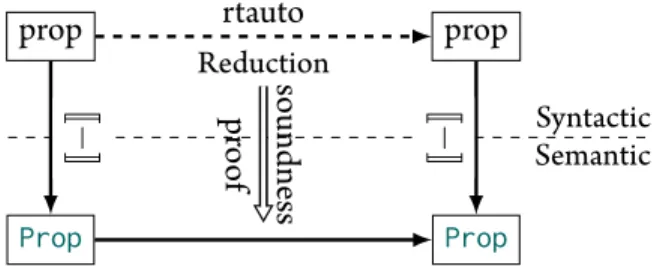
Prop Prop prop prop Semantic Syntactic J − K J−K rtauto Reduction soundne ss pr oof
Figure 2.1: The basic components of computational reflection. The dashed line separates the semantic world (bottom) from the syntactic universe (top).
J−K is the denotation function that connects the two. rtauto is the procedure that performs the reasoning, and soundness is the proof that translates the reduction into a proof object.
Intuitively, thertautofunction takes in a list of known factsH: list Propand a goalG: Propand returnstrue ifGis provable under the conjunction of the facts in H.
While the above definitions are straightforward, there are no interesting imple-mentations ofrtauto’ that satisfy the specification. This is because Gallina pro-vides no way to inspect values of typeProp. That is,rtauto’ cannot match onGor any of the values inHto see how they are built.
The standard technique to enable the function to inspect the goal is to intro-duce a level of indirection by defining a syntax that represents the structure of the propositions that we wish to inspect. Figure 2.1 shows the solution graphically. In the figure, the syntactic typeproprepresents a subset of all possibleProps. A deno-tation function—represented in the figure using Oxford brackets (J−K)—makes the meaning of the syntax precise by computing a proposition for each piece of syntax.
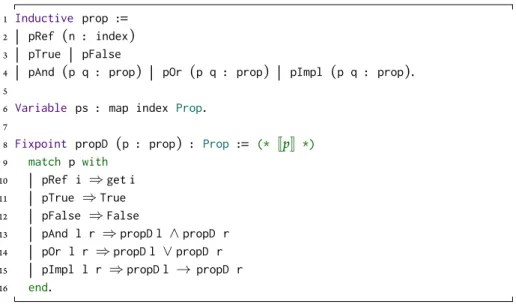
Figure 2.2 shows how this works using an inductive type and a denotation func-tion. Theprop inductive type provides constructors for each type of proposi-tional fact that the automation will reason about. The denotation function (propD) shows how these syntactic objects map directly to their semantic meanings (lines
1 Inductive prop := 2 | pRef (n : index) 3 | pTrue | pFalse
4 | pAnd (p q : prop) | pOr (p q : prop) | pImpl (p q : prop). 5
6 Variable ps : map index Prop. 7
8 Fixpoint propD (p : prop) : Prop := (* JpK *) 9 match p with
10 | pRef i ⇒get i 11 | pTrue ⇒True 12 | pFalse ⇒False
13 | pAnd l r ⇒propD l ∧propD r 14 | pOr l r ⇒propD l ∨propD r 15 | pImpl l r ⇒propD l → propD r 16 end.
Figure 2.2: Syntactic representation of propositional logic.
9-13). ThepRef constructor is used to represent uninterpreted symbols which rtautowill know nothing about. The denotation of these symbols is provided by thepsmap that is passed to thepropDfunction using the section variable mecha-nism.
Adaptingrtautoand its specification to use the syntactic propositions is simply a matter of replacingPropwithpropand using the denotation function to convert the syntactic values of typepropinto semantic values of typePropin the soundness theorem.
Definition rtauto (H: list prop) (G: prop) : bool :=
. . .
Theorem rtauto_sound : ∀ (H: list prop) (G: prop),
rtauto’ H P =true → ∀ (ps: map index Prop),
Forall (propD ps) H → (* propDps H1∧ · · · ∧propDps Hn *) propD ps G.
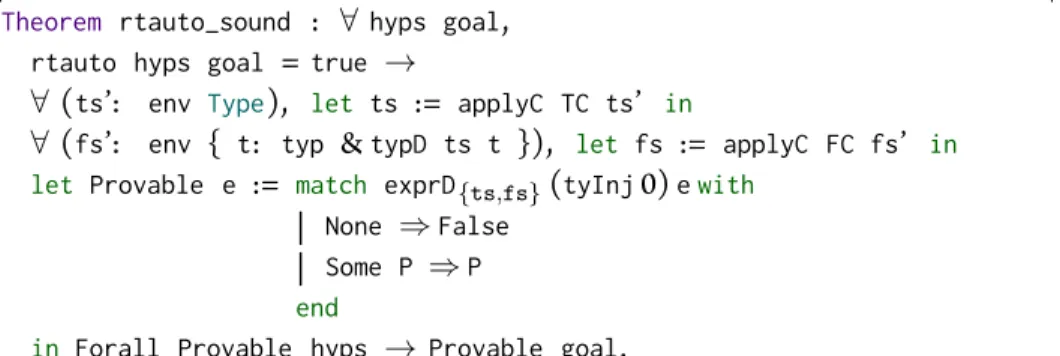
Since Gallina can match on values of typeprop, we can now write, and prove sound, useful implementations ofrtauto. Figure 2.3 shows a flavor of a simple
Fixpoint rtauto (hyps: list prop) (g: prop) : bool := match g with
| pTrue ⇒true
| pAnd g1g2⇒rtauto hyps g1&&rtauto hyps g2
| pImpl g1g2⇒rtauto(learn g1hyps) g2(* assuming g1, prove g2 *) | g ⇒findAssumption hyps g
end.
Figure 2.3: A partial, simplified implementation of a reflective tautology prover. The learn function breaks conjunctions in the term apart and adds the con-juncts to the list of hypotheses. ThefindAssumption function searches for the proposition in the list of hypotheses.
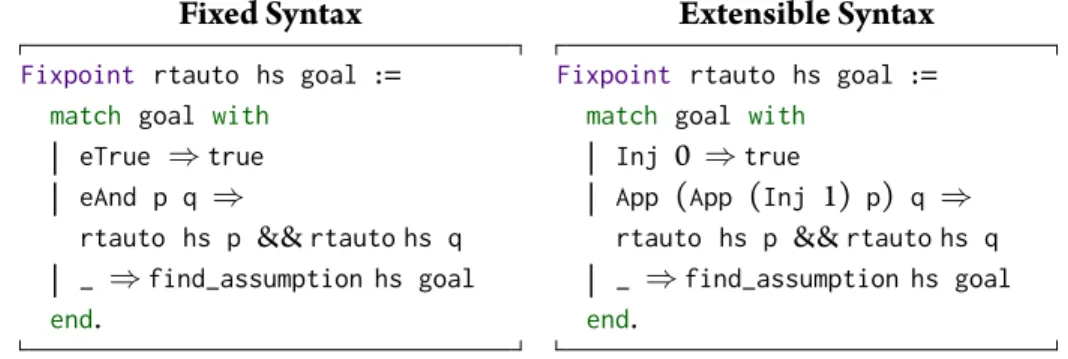
reflective procedure. Note that the code relies crucially on the ability to inspect the input through pattern matching. Achieving this in an extensible way will be the topic of Chapter 3.
2.3.1 Computational Reflection and Proofs
While we often think of proofs as being “extra” objects that do not affect com-putation, proofs are actually an integral part of the computation in Gallina. For example, when we perform a rewrite we are matching on a proof term, therefore, computationally, there must be a proof to match on. How does this idea reconcile with one of the core motivations of computational reflection, tonotgenerate proof terms?
To answer this question, consider the proof term for a simple tautology.
⊢P∧Q→Q∧P
In Gallina, a simple (manually constructed) proof term for this goal is the follow-ing⁴:
fun PQ: P ∧Q ⇒matchPQ with
| conj pfP pfQ ⇒conj pfQ pfP end
The proof is a function that takes the proof ofP ∧Q, matches on it to extract the independent proofs ofPandQ, and then reassembles them into a proof ofQ ∧P.
On the surface, the proof by computational reflection is quite a bit different, and longer.
rtauto_sound [] (* Hypotheses *) (pImpl (pConj (pRef 0) (pRef 1))
(pConj (pRef 1) (pRef 0))) (* Goal *) eq_refl (* Computation proof *)
{0 7→P; 17→Q}(* Environment *) Forall_nil (* Proof of hypotheses *)
The verbosity here is predominantly due to the need to repeat the problem in its syntactic form in order to callrtauto_sound. As the amount of reasoning increases relative to the size of the goal, the cost of repeating the goal becomes negligible compared to the size of the proof.
In the reflective proof, the call tortauto_soundhides the constructors that were apparent in the manual proof. But, leveraging the constructive nature of Gallina’s proofs, the reduction mechanism can cut through all of the abstraction and com-pute a proof that is not much different than from the hand-coded proof above.
fun (P Q : Prop) (x : P ∧Q) ⇒ conjP,Qmatchxwith
| conj _ x1 ⇒x1 end match x with
| conj x0 _ ⇒x0 end
The similarity to the manual proof is not surprising. Our soundness proof encodes exactly how to construct this proof for any particular problem instance. Further, since the soundness theorem is proved by structural induction on the reified syntax
it is not surprising that it is completely gone after reduction since the syntactic representation contains no opaque terms that would block reduction.
While the proof is simple, it requires some care to achieve the right computa-tional properties. In particular, it is important to keep in mind that some proofs are universally quantified, which will block pattern matches, while others are built by the proof of soundness and can be freely pattern-matched on. Writing the sound-ness theorem in a continuation-passing style makes it possible to generate exactly the hand-crafted proof that uses a singlematch on the proof ofP∧Q. While the proof terms do not match up exactly, they are provably equal.
2.3.2 The Drawbacks of Computational Reflection
While powerful and broadly applicable, computational reflection is not without some drawbacks. First, applying it requiresa prioriknowledge of all facts that could be used. This often results in building reflective procedures that require more facts than they actually need to prove any particular problem instance. While perfectly acceptable, this introduces false dependencies and might prevent generalization to situations where those false dependencies do not hold. For example, when proving P → Q → P, the proof ofPis not necessary and, in a manually constructed proof, it would be ignored. In the reflective proof, on the other hand, the proof ofQwould be passed to the reflective soundness theorem making it appear to be necessary to proveP. If the soundness proof of the reflective procedure is coded with care, these extraneous dependencies can be eliminated by completely reducing the proof as I showed in the previous section.
Second, computational reflection relies, in a fundamental way, on computation that can be reasoned about within the logic. In order to be efficient, this compu-tation must be fast; however, the engineering effort necessary to make reduction fast often compromises simplicity and thus increases the size of the trusted com-puting base. In Coq, this trade-off manifests itself in thevm_compute [84] mecha-nism which performs fast reduction by compiling Gallina to a virtual machine and running the code there. However, neither the virtual machine nor the
compila-tion process is formalized, but both lie in the trusted computing base. A simpler implementation of reduction exists and is easier to trust but orders of magnitude slower.
Third, proofs by computational reflection often, but not always, mix proof search with proof objects. In cases where reflective procedures explore a space of poten-tial proofs this exploration can make checking a proof as expensive as finding it. Techniques exist for easing this burden which I discuss in the related work of Chap-ter 6.
Finally, and related to the former point, the soundness proof (which might con-tain the heuristic search) is embedded directly in the proof. In cases where propri-etary heuristics and procedures must be kept secret, proofs produced using them cannot be distributed in their efficient form. In dependent type theories, it is al-ways possible to remove these generic lemmas from a development by inlining and reducing them. While this manifests the large proof object that we sought to elim-inate by using computational reflection, it can easily be done off-line.
The last two points are addressed by using computational reflection to imple-ment reflective proof checkers that fill in the boring details of high-level proofs. When designed this way, the high-level proof can be constructed by proprietary al-gorithms, and only their output needs to be included in the final, published proof. Since the high-level proof sketch exists explicitly in the proof it must be checked for well-typedness, which can be a burden if the sketch is long.
2.4
Related Work
In this chapter, I discussed the core underpinnings of the remainder of the disser-tation. The related work incorporates the entire rest of the design space for proof assistants and automation techniques. I delay a comprehensive discussion of work related to computational reflection until the end of Chapter 3.
Proof Assistants Coq is one of many proof assistants and represents a single point in an incredibly large design space. A thorough evaluation of all the