The Effects of a Six-Week Combined Exercise and Recreation Therapy Intervention on Stress Hormones and Heart Rhythms in Breast Cancer Survivors
Michael R. Anderson
A thesis submitted to the faculty of the University of North Carolina at Chapel Hill in partial fulfillment of the requirements for the degree of Master of Arts in the Department
of Exercise and Sport Science (Exercise Physiology).
Chapel Hill 2008
Approved by:
Advisor: Dr. Claudio Battaglini Reader: Dr. Diane Groff
ii ABSTRACT
MICHAEL R. ANDERSON: The effects of a six-week combined exercise and recreation therapy intervention on stress hormones and heart rhythms in breast cancer survivors
(Under the direction of Claudio Battaglini, Ph.D.)
TABLE OF CONTENTS
LIST OF TABLES………..…….v
LIST OF FIGURES……….…………...vi
Chapter I. INTRODUCTION………..………..1
Purpose……….6
Research Hypotheses………...6
Definition of Terms……….……….6
Assumptions……….………7
Delimitations………8
Limitations………...8
Significance of the Study……….9
II. REVIEW OF LITERATURE………10
III. METHODOLOGY………..19
Subjects………..………19
General Procedures………20
Exercise Intervention……….26
Recreation Therapy Intervention………...27
Instrumentation………..28
iv
IV. RESULTS………31
V. DISCUSSION………...38
Cortisol and DHEA………39
Heart Rate Coherence………42
Recommendations for Future Research……….46
Conclusion……….48
APPENDICES………...…50
Appendix 1: Biochemical Assay Procedures……….50
Appendix 2: Physiological Assessment Protocols……….53
LIST OF TABLES
Table
1. Descriptive data for cortisol:DHEA ratio...………...33 2. Percent changes in high HRC:low HRC……….………..37 3. Summary of comparisons made during hypothesis testing
vi
LIST OF FIGURES
Figure
Chapter I Introduction
2
cancer treatment related side-effects and symptoms. Therapies such as exercise, guided imagery, nutritional support, relaxation and cognitive behavioral support groups have been shown to reduce the amount of physiological and psychosocial distress experienced by women during and after cancer treatment, thus improving quality of life (Galvao and Newton, 2005; Hewitt et al., 2004).
Exercise as a complementary treatment
Exercise has been shown to be an effective adjunct therapy in helping patients combat many of the physiological and psychological side-effects commonly experienced during cancer treatment. A review performed by Galvao and Newton (2005) presented the summary of the results of 26 studies involving administration of exercise in the cancer population; these studies were performed in patients that were either undergoing or had completed major cancer treatment. Improvements in the cardiorespiratory, pulmonary, and endocrine systems as well as reduction in fatigue and improved quality of life were among numerous benefits reported in response to the administration of exercise in cancer populations (Galvao and Newton, 2005).
use of HeartMath, a biofeedback technique, has become another option to help cancer patients cope with many of the psychological distresses caused by the disease.
Recreation therapy as a complementary therapy
To aide patients in coping with the psychological side-effects associated with cancer treatment, recreation therapy involving interventions of psychosocial nature is often employed. Some recreation therapy techniques include group psychotherapy, leisure counseling, expressive arts, biofeedback and a variety of other techniques aiming to develop overall well-being.
4
Stress
From the time of diagnosis throughout the entire treatment process, feelings of despair, worry, anxiety, and fear of death as well as significant changes in physiology all contribute negatively to the overall well-being of the patient. These stressors can further compromise the functionality of the patient and his or her ability to tolerate cancer treatment which could potentially impact outcomes.
Stress is associated with increased levels of the glucocorticoid hormone cortisol (Spiegel et al., 2006; Brenner et al., 1998). Cortisol is often regarded as the principal catabolic hormone due to its central role in proteolysis (Loucks, 2005). Elevated cortisol levels can elicit a number of deleterious effects including diminished skin strength, easy bruising, wasting of muscle tissue, weakness, and osteoporosis (Neal, 2001) which can further compromise the functionality of the patient. Dehydroepiandrosterone (DHEA) is a hormone that has anti-glucocorticoid actions; DHEA has many effects that oppose those of cortisol. An anabolic hormone, DHEA can have positive effects on lean body mass, bone density, and quality of life (Copeland et al., 2002), but is decreased during periods of stress. The opposing roles of cortisol and DHEA make the ratio of cortisol:DHEA an attractive parameter to quantify in examining stress.
6 Purpose
The primary purpose of this study was to determine if a six-week combined intervention using exercise and HeartMath impacted the cortisol:DHEA ratio in women who have recently completed breast cancer treatment.
The secondary purpose of this study was to determine if a six-week combined intervention using exercise and HeartMath impacted heart rate coherence (specifically the ratio of high:low HRC) and heart rate variability.
Research Hypotheses
Hypothesis 1): It was hypothesized that there would be a decrease in the cortisol:DHEA ratio following the six-week combined exercise and HeartMath biofeedback intervention.
Hypothesis 2): It was hypothesized that there would not be a decrease in the cortisol:DHEA ratio in response to a single HeartMath biofeedback session.
Hypothesis 3): It was hypothesized that there would be an increase in the ratio of high HRC to low HRC following the six-week combined exercise and HeartMath biofeedback intervention.
Hypothesis 4): It was hypothesized that there would be an increase in the ratio of high HRC to low HRC following a single HeartMath biofeedback session.
Definition of Terms
Autocoherence: coherence within the rhythmic activity of the heart. Cross-coherence: coherence between different physiological systems.
Heart rate variability: a measure of the naturally occurring beat-to-beat changes within the rhythmic activity of the heart.
High heart rate coherence: the sum total of “high” and “medium” heart rate coherence scores, as defined in HeartMath software.
Cortisol: a glucocorticoid hormone released from the adrenal gland with catabolic properties.
Dehydroepiandrosterone (DHEA): a steroid hormone produced by the adrenal gland and the gonads with anabolic properties.
Combined Exercise and HeartMath Biofeedback Intervention: An intervention that utilizes both one hour of individualized prescribed exercise and thirty minutes of HeartMath per session, three times per week, for six weeks.
Just Be Condition: A 10 minute period during which a subject’s HRC and HRV are monitored while the subject is instructed to “just be”; the subject may think about or do whatever she pleases provided she remains seated.
Manage Stress Condition: A 5 minute period during which a subject’s HRC and HRV are monitored while the subject is instructed to do what she normally does to manage a stressful situation; the subject may think about or do whatever she pleases provided she remains seated.
Assumptions
8
2. The effects of the intervention were not affected by differences in previous treatment received for cancer as well as current adjuvant therapy (herceptin, tamoxifen, etc.).
3. All subjects were able to complete the majority (>90%), if not all exercise and recreation therapy sessions during the study.
Delimitations
1. The subjects in this study were women between the ages of 35 and 75.
2. All subjects had completed major breast cancer treatment within six months of voluntary enrollment in the study.
3. All subjects were re-tested six week post-baseline measures at the same time of day to control for variations in hormones release circadian rhythms.
Limitations
1. The results of the current study are only applicable to women between the ages of 35 and 75 who have recently completed breast cancer treatment. 2. With respect to hormonal analyses, the assay used in this study to analyze the
salivary samples reflect only the free portion of the hormones cortisol and DHEA rather than the total amount circulating in the body.
3. Subjects enrolled in the study may not have been able to complete all intervention sessions due to possible treatment or disease complications. 4. Subject disease staging (I-III) and different types of treatment administered
5. While all subjects in the study were within six months of cessation of treatment, the exact amount of time since cessation of treatment varied.
Significance of the Study
Breast cancer survivors face a number of difficult challenges even after successful treatment of their disease. Many of the deleterious symptoms faced by breast cancer survivors are related to the large amount of stress that this population faces. While exercise and HeartMath training have been shown to have positive effects on the stress response (i.e., the cortisol:DHEA ratio) independently in other populations such as cardiac patients, the combined effects of the two interventions remain unexamined. In this study, breast cancer survivors received a six-week combined exercise and HeartMath intervention. The effects of the combined intervention on stress hormones, heart rate coherence, and heart rate variability were examined.
Chapter II Review of Literature
Breast cancer is the third most common cancer in the world (Galvao and Newton, 2005) and is the second leading cause of cancer death in women (American Cancer Society, 2006). Over 200,000 new cases were documented in 2006 in the United States alone (American Cancer Society, 2006). It has been postulated that women have a 1 in 8 chance of developing breast cancer at some point during their lifetime (National Cancer Institute, 2007).
Current treatments of breast cancer include chemotherapy, radiation therapy, surgery and/or hormonal therapy. Although these treatments can be successful in ridding the body of cancer, each imposes a wide array of side effects. Chemotherapy is often associated with nausea, vomiting, low red and white blood cell counts, hair loss, mouth sores, menstrual cycle changes, cardiotoxicity, decreased memory and concentration, numbness, and shortness of breath (Zechariae et al, 2007; American Cancer Society, 2006; Turner-Gomes et al., 1996). Radiation therapy is often accompanied by nausea, vomiting, and changes in skin color (Nilsson et al., 2005). Surgery often compromises range of motion at the shoulder. Changes in breast shape, wound infection and a buildup of fluid in the wound are other common side effects of surgery (American Cancer Society, 2006). Hormonal therapy often causes hot flashes, vaginal discharge, headaches and blood clots (National Cancer Institute, 2007).
12
these side effects, but this treatment method offers only temporary relief and is often quite expensive (Crawford, 2002). Recently, more attention has been paid to complementary alternative treatments including exercise, guided imagery, nutritional support, relaxation and cognitive behavioral support groups (Galvao and Newton, 2005; Hewitt, Herdman, and Holland, 2004). These types of therapies may help to reduce both the physiological and psychological stress associated with cancer and its side effects.
Exercise as a complementary alternative treatment
It has been shown that exercise can help to alleviate many of the physiological side-effects associated with cancer treatment (Courneya, 2003; Dimeo et al., 2001; Galvao and Newton, 2005; Dimeo et al., 1997). Potential benefits of cardiovascular exercise for cancer patients include an increase in blood volume and improvement in the delivery of oxygen and nutrients to tissues. The increase in blood flow is fundamental for the proper functioning of cells (Dimeo et al., 1997). Increased blood flow to organs and organ systems also contributes to improvements in the body’s natural defense mechanisms. More efficient removal of cellular debris and toxins caused by cancer treatments are also benefits of the administration of cardiovascular exercise for cancer patients (Dimeo et al., 1999). Resistance training can help to promote lean mass and fight the wasting of skeletal muscle that occurs as a result of cancer and its treatment (Al-Majid and McCarthy, 2001). Flexibility exercises can help patients to maintain range of motion or at least partially offset the decrease in range of motion that can occur as a result of surgery and/or inactivity (Cheema and Gaul, 2006).
satisfaction with life (Peters et al., 1994; Peters et al., 1995). Dimeo and colleagues found an increase not only in exercise performance but also hemoglobin concentration along with a decrease in the severity of neutropenia, thrombopenia, diarrhea, pain and the duration of hospitalization (Dimeo et al., 1997).
Research has shown that a combination of cardiovascular, resistance and flexibility training after cancer treatment can not only be tolerated by patients but may improve many physiological parameters. Herrero and coworkers have shown that such a combined intervention elicited and increase in VO2peak, leg press strength and quality of life (Herrero et al., 2006) while Cheema and Gaul observed a decrease in the sum of skinfolds, waist girth and hip girth as well as an increase in upper and lower body strength, aerobic endurance, flexibility and quality of life (Cheema and Gaul, 2006). In a study conducted by Courneya and colleagues, the authors observed significant improvements in self-esteem, physical fitness and body composition in a group of breast cancer patients participating in a regular exercise routine (Courneya et al., 2007).
14
engage in leisure activities. In practice, this model supports the application of many interventions targeting improved psychosocial well-being
Recreation therapy as a complementary alternative treatment
Many different recreation therapy activities have been explored in clinical settings; however, very little data is available to confirm possible benefits. Bordeleau and colleagues found no significant improvement in quality of life in a cancer population in response to a group psychosocial intervention but the authors did find improvements in cognitive functioning and a decrease in fatigue (Bordeleau et al., 2003). Arving and coworkers found an increase in global quality of life in a group of cancer survivors in response to an individual psychosocial support intervention compared to a group receiving standard care (Arving et al., 2007).
rhythmic activity of the heart) and cross-coherence (coherence between different physiological systems) (McCraty et al., 2006).
16
cardiovascular system to adapt to circulatory demands (McCraty et al. 2003; McCraty et al. 2006).
Heart rate variability is a measure of the naturally occurring beat-to-beat changes within the heart (McCraty and Childre, 2003). Perhaps counter intuitively, high HRV is associated with ordered rhythms while low HRV is associated with erratic rhythms. Analysis of HRV, or heart rhythms, provides a measure of neurocardiac function reflecting heart-brain interactions and autonomic nervous system dynamics which are highly sensitive to changes in emotions. Specifically, it has been shown that heart rhythms become highly erratic and disordered during negative emotional states such as anger, frustration or anxiety; each of these emotions is likely high in a cancer population. On the contrary, heart rhythms become highly ordered during positive emotional states such as love, compassion or appreciation (McCraty and Childre, 2003). Research has shown that sustained states of positive emotions and thus sustained high HRV are associated with improved cognitive processing and perception, as well as improved hormonal balance, improved immunity and lower lipid levels (McCraty et al., 2006; Fredrickson, 2001; Davidson et al., 2003; McCraty et al., 1998; McCraty et al., 2003). McCraty and coworkers describe a state called “psychophysiological coherence” in which individuals are in a state of optimal functioning characterized by “increased synchronization, harmony, and efficiency in the interactions within and among the physiological, cognitive, and emotional systems.” This condition is marked by a distinct change in the rhythmic activity of the heart towards an increase in HRV and HRC.
correlations between positive emotions and improved health (Danner et al., 2001; Salovey et al., 2000).
Breast cancer and stress
Breast cancer patients are under a large amount of stress, both physiologically and psychologically (Cruess et al., 2000; Lebel et al., 2007); such chronic stress can influence the progression and recurrence of the disease (Cohen et al., 2007); Chronic stress can lead to a catabolic state, marked by high levels of circulating cortisol (Spiegel et al., 2006; Brenner et al., 1998) and low levels of circulating DHEA (Copeland et al., 2002); The ratio of cortisol:DHEA can be used as a catabolic-anabolic index due to cortisol’s role as a principal catabolic hormone, causing proteolysis, muscle wasting and osteoporosis (Loucks, 2005; Neal, 2001) and DHEA’s role as an anabolic hormone, promoting lean mass and bone density (Copeland et al., 2002). While decreases in the cortisol:DHEA ratio have been correlated with improved physiological functioning and homeostasis (McCraty et al., 1998), research has shown that the ratio is increased in breast cancer patients (van der Pompe et al., 1996).
18
reduce serum cortisol in early stage breast cancer patients (Cruess et al., 2000) while high HRC has been associated with a decreased cortisol:DHEA ratio (McCraty et al., 1998).
Chapter III Methodology
The primary purpose of this study was to determine if a six-week combined intervention using exercise and HeartMath impacted the cortisol:DHEA ratio in women who had recently completed breast cancer treatment. The secondary purpose of this study was to determine if a six-week combined intervention using exercise and HeartMath impacted heart rate coherence (specifically the ratio of high:low HRC) and heart rate variability.
The study followed a pre-test/post-test design. Patients received a combined exercise and recreation therapy (HeartMath) intervention for six weeks; the cortisol:DHEA ratio and the ratio of high heart rate coherence to low heart rate coherence were analyzed prior to the intervention and again after the intervention.
Subjects
20
Criteria for participation
All participants in the study fulfilled the following criteria: confirmed diagnosis of stage I, II or III invasive breast cancer; within six months of completion of all planned surgery, radiation therapy and chemotherapy; between 35 and 75 years of age.
Exclusion criteria
Any subjects who were determined by the supervising Get REAL & HEEL program physician to have any of the following conditions were excluded from the program: cardiovascular disease; acute or chronic respiratory disease; acute or chronic bone, joint or muscular abnormalities that would compromise the subject’s ability to participate in the exercise rehabilitation program; adequate renal function with a creatinine level less than 1.5 gm/dL; immune deficiency that would compromise the subject’s ability to participate in the exercise rehabilitation program; metastatic disease; a platelet count less than 90,000 per mm3 of blood; hematocrit less than 30; absolute neutrophil count less than 1500 per mm3 of blood.
General procedures
The timeline for the current study spanned six weeks. (Figures 1, 2) During the first visit to the Get REAL & HEEL center, two salivary samples were collected. (Figure 1) The first sample was collected upon arrival to the lab (Sample 1). The subjects then underwent approximately 20 minutes of HeartMath biofeedback exercises, as detailed below. A second sample was collected following this 20 minute session (Sample 2).
Following this six-week intervention, two more salivary samples were collected. The first sample was collected upon arrival to the Get REAL & HEEL center (Sample 3). The subject then underwent approximately 15 minutes of biofeedback exercises. A second sample was collected following this 15 minute session (Sample 4). (Figure 1) The initial and follow-up salivary collections were to occur at the same time of day to account for hormonal circadian rhythms.
Figure 1. Salivary sample collection timeline. Salivary sample collections are represented by the * symbols.
Salivary sample collection and treatment
On days involving salivary sample collections, all subjects were provided with the following pre-assessment guidelines prior to arriving at the Get REAL & HEEL center:
• Avoid brushing teeth within one hour of salivary collection
• Avoid using salivary stimulants such as chewing gum, lemon drops, granulated
sugar or drink crystals
• Avoid consuming a major meal within one hour of salivary collection
• Avoid alcohol within 12 hours of salivary collection
15 minutes of biofeedback Six weeks—Exercise
and HeartMath training
*1
*2
*3
*4
= salivary sample collection *
20 minutes of biofeedback
15 minutes of biofeedback Six weeks—Exercise
and HeartMath training
*1
*2
*3
*4
= salivary sample collection
* = salivary sample collection
*
22
• Avoid consuming acidic or high sugar foods within 20 minutes of salivary
collection
• Avoid exercise within 12 hours of salivary collection
Upon arrival at the Get REAL & HEEL center, subjects were instructed to rinse the mouth with water in an effort to remove any food particles; rinsing of the mouth occured ten minutes before the start of salivary collection. Each subject was provided with a drinking straw and a plastic cup. After being instructed to imagine eating their favorite food and allowing saliva to pool in the mouth, subjects tilted the head forward and guided saliva into the plastic cup through the drinking straw. This procedure was repeated as often as necessary until approximately two (2) milliliters of saliva had been collected. Samples were immediately put on ice until treated.
The samples were centrifuged for 10 minutes at 3000 RPM in a refrigerated centrifuge at a temperature of 4° Celsius. After centrifugation, the saliva was aliquotted and stored at -80° Celsius until assayed.
Assays for hormonal analyses
Fitness assessment
Once enrolled in the Get REAL & HEEL program, subjects underwent a battery of psychological and physiological assessments prior to participation in the current study. Of interest in the current study, resting vitals (blood pressure, heart rate, height, weight, hemoglobin saturation), cardiorespiratory endurance, muscular strength, muscular endurance, and flexibility were assessed.
Cardiorespiratory endurance was assessed using the modified Bruce protocol or the YMCA cycle ergometer protocol depending on the physical capabilities of each subject. The modified Bruce protocol is a submaximal treadmill protocol that is appropriate for high-risk populations because it imposes a relatively low amount of stress on the subject (Heyward, 2002); A value of 75% of the predicted maximal heart rate was calculated using the Karvonen Method; this value was used as the test termination point during the modified Bruce protocol. For the YMCA cycle ergometer protocol, a heart rate of 150 beats per minute was used as the termination point of the test. Either of these two cardiorespiratory endurance protocols was terminated earlier if the subject requested to stop.
24
Muscular endurance was assessed using the push-up and the partial curl-up tests. Flexibility was assessed using a modified sit-and-reach box. Detailed descriptions of all assessment procedures can be found in Appendix 2.
Assessment of HRC and HRV
To collect HRC and HRV data, subjects were instructed to perform three biofeedback exercises using HeartMath software prior to the six-week combined exercise and recreation therapy intervention (Baseline) and two biofeedback exercises using HeartMath software after the six-week combined exercise and recreation therapy intervention (Follow-up). (Figure 2) To use HeartMath software, each subject connected a small electrode to her ear lobe; heart rhythms were sensed via this electrode and were reflected via visual feedback on the screen of a laptop computer.
then shift focus to a feeling of love and appreciation. This condition was termed Baseline HeartMath. (Figure 2)
Following the six-week combined exercise and HeartMath intervention, subjects returned to the Get REAL & HEEL center for a follow-up biofeedback analysis session. Upon arrival, subjects were first instructed to “just be” for 10 minutes; this condition was termed Follow-up Just Be. Subjects were then instructed to do what they normally do to manage a stressful situation for 5 minutes; this condition was termed Follow-up Manage Stress. (Figure 2) Because subjects had been performing recreation therapy using HeartMath for six weeks, they did not undergo the 5 minute training session on Quick Coherence during the Follow-up assessment of HRC and HRV.
During the Baseline and Follow-up biofeedback sessions, HRC levels were monitored and classified using HeartMath software. Within HeartMath software, the overall HRC score is subdivided into high, medium and low categories. Because both medium and high HRC are above average, these two scores were added and considered “high” for the purpose of this experiment. Values for “high” and “low” HRC were determined, as well as the ratio of high HRC:low HRC.
Figure 2. HRC was measured during each of the five conditions illustrated above. Baseline Just Be Baseline Manage Stress Baseline HeartMath Follow-up Just Be Follow-up Manage Stress
10 min. 5 min. 5 min. 10 min. 5 min.
Six weeks—Exercise and HeartMath training Baseline Just Be Baseline Manage Stress Baseline HeartMath Follow-up Just Be Follow-up Manage Stress
10 min. 5 min. 5 min. 10 min. 5 min.
Six weeks—Exercise and HeartMath training Baseline Just Be Baseline Manage Stress Baseline HeartMath Follow-up Just Be Follow-up Manage Stress
10 min. 5 min. 5 min. 10 min. 5 min.
Six weeks—Exercise and HeartMath training Baseline Just Be Baseline Manage Stress Baseline HeartMath Follow-up Just Be Follow-up Manage Stress
10 min. 5 min. 5 min. 10 min. 5 min.
26
Exercise intervention
All subjects performed exercises at sub-maximal intensities that were determined according to the results of their initial physical assessments; exercises were performed with intensities varying between 20%-70% of predicted maximum capacity for each type of exercise. All subjects had a trained cancer exercise specialist from the Department of Exercise and Sport Science (graduate and undergraduate level) that monitored and conducted each exercise session. The design of the exercise intervention included cardiovascular training, resistance training, and flexibility exercises. The format for each exercise session involved an initial administration of a cardiovascular activity, followed by an entire body stretching session, resistance training, and a cool down period that included stretching activities. This format follows the ACSM (2006) guidelines for the components that should be included in a training session with the goal of promoting overall beneficial physiological responses.
followed the ACSM guidelines (2006) for resistance exercise training methods. The number of repetitions for each exercise ranged from 6-12 repetitions depending on the physical state of the subject during each exercise session. Subjects performed a maximum of three sets of each exercise per session. During the first weeks of the program, all subjects performed only one set of each exercise. During the following weeks, patients progressively advanced to performing two to three sets for each exercise which was administered until the end of the program. The movements for each exercise were performed at a moderate speed (three seconds of the concentric phase and three seconds of the eccentric phase of the movement during each repetition). The rest interval period between each set and between each exercise varied from thirty seconds to one minute according to each subject’s needs.
Regardless of the duration of exercise that was administered to the subjects each month, the structure of the exercise portion of each session included the following component percentages:
Cardiovascular workout: 20%
Resistance Training: 60%
Flexibility: 5%
Shoulder Rehabilitation: 15%
Recreation Therapy intervention
28
Healing Rhythms and emWave PC; these are three software packages that aim to instruct individuals to increase HRC and HRV. Each software package is a form of biofeedback and a personal stress relief technique that trains individuals to be aware of and regulate their HRC and HRV during various emotional states. Subjects placed a small sensor on their earlobe that monitored their heart rate and rhythms and provided visual and/or audible "feedback" about what was occurring in their body. Recreation therapy was administered three times a week with each session lasting thirty minutes. Recreation therapy was performed on the same day as exercise training.
Instrumentation
Heart rate was measured using a Polar heart rate monitor (Lake Success, NY); blood pressure was measured using a Diagnostix 700 aneroid sphygmomanometer (Hauppauge, NY) and Litmann stethoscope (St. Paul, MN); hemoglobin saturation was measured with a Sport Stat finger pulse oxymeter (Plymouth, MN); height and weight were measured using a balance beam physician scale equipped with a height rod (Health-o-meter 402KL Rye, NY).
Salivary cortisol concentrations were determined using an expanded range high sensitivity salivary cortisol EIA kit (Salimetrics LLC, State College, Pennsylvania); salivary DHEA concentrations were determined using an enzyme immunoassay kit (Salimetrics LLC, State College, Pennsylvania). A microplate washer (Sanofi Pasteur LP35, Marnes-LA-Coquette, France) and reader (Finstruments microplate reader, MXT Labs, Inc.) were used during the assay process.
Statistical Analyses
All data were gathered and entered into an electronic database for analysis. Descriptive statistics were presented in the form of means and standard deviations. All data were analyzed using SPSS version 15.0 for Windows, a statistical software program. The alpha level was set a priori at 0.05 for all analyses. Each hypothesis was analyzed as follows:
Hypothesis 1): There will be a decrease in the cortisol:DHEA ratio following the six-week intervention. The student’s t-test was used to compare the ratio of cortisol:DHEA between salivary samples 1 and 3.
30
Hypothesis 3): There will be an increase in the ratio of high HRC to low HRC following the six-week combined exercise and HeartMath biofeedback intervention and Hypothesis 4): There will be an increase in the ratio of high HRC to low HRC following a single HeartMath biofeedback session.
Chapter IV Results
The primary purpose of this study was to determine if a six-week combined intervention using exercise and HeartMath impacts the cortisol:DHEA ratio in women who have recently completed breast cancer treatment. It was hypothesized that the intervention would elicit a decreased cortisol:DHEA ratio. The secondary purpose of this study was to determine if a six-week combined intervention using exercise and HeartMath impacts heart rate coherence (specifically the ratio of high:low HRC) It was hypothesized that the intervention would elicit an increase in the ratio of high HRC:low HRC. Nine women fulfilled the criteria for participation and completed the study. The mean age of the participants was 56.8 ± 10.0 years.
32
Additionally, it was initially proposed that all subjects in the current study would receive a combined intervention including both exercise and recreation therapy. Data (salivary samples and HeartMath data) was initially collected for eight subjects, all of whom received a combined intervention including both exercise and recreation therapy. However, the industrial freezer which contained the salivary samples malfunctioned; each of the salivary samples remained thawed for several days and were purportedly non-viable for analysis of cortisol and DHEA. These eight subjects were excluded from the current study and data collection began on a new group of subjects. To avoid extreme delays in data collection, some subjects who were receiving exercise alone or recreation therapy alone were included in the study in addition to subjects who were receiving the combined exercise and recreation therapy intervention. Therefore, the results presented below are for a sample where four subjects received exercise and recreation therapy, four subjects received only exercise and one subject received only recreation therapy.
Following the presentation of data for hypotheses three and four (which involve the examination of heart rate coherence), the results of additional exploratory analyses are presented in which the data was analyzed for only the subjects who received the combined exercise and recreation therapy intervention. Exploratory analyses were performed for hypotheses three and four because heart rate coherence is affected by HeartMath training to a greater extent than exercise.
variance for cortisol and DHEA are as follows: 2.77 ± 2.21 and 2.49 ± 1.70, respectively. High and low control samples were included in the hormonal assays as a further measure of assay quality. For cortisol, the predicted value of the high control was 1.072 ± 2.68 µg/dl while the measured value was 1.384 µg/dl; the predicted value of the low control was 0.108 ± 0.027 µg/dl while the measured value was 0.069 µg/dl. For DHEA, the predicted value of the high control was 612.44 ± 153.11 pg/ml while the measured value was 618.97 pg/ml; the predicted value of the low control was 35.37 ± 14.15 pg/ml while the measured value was 28.83 pg/ml. The regression models used for prediction of hormone concentrations showed correlation coefficients of 0.987 for cortisol and 0.971 for DHEA.
Table 1. Descriptive data for the ratio of cortisol:DHEA. Data are presented for each of four salivary sample collections. Sample 1: Taken prior to the six-week intervention, prior to the Baseline HeartMath session. Sample 2: Taken prior to the six-week intervention, after Baseline HeartMath session. Sample 3: Taken after six-week intervention, prior to Follow-up HeartMath session. Sample 4: Taken after the six-week intervention, after the Follow-up HeartMath session. (n=9)
Pre-intervention Post-intervention
Sample 1 Sample 2 Sample 3 Sample 4
Mean 1.005 0.808 0.935 0.755
34
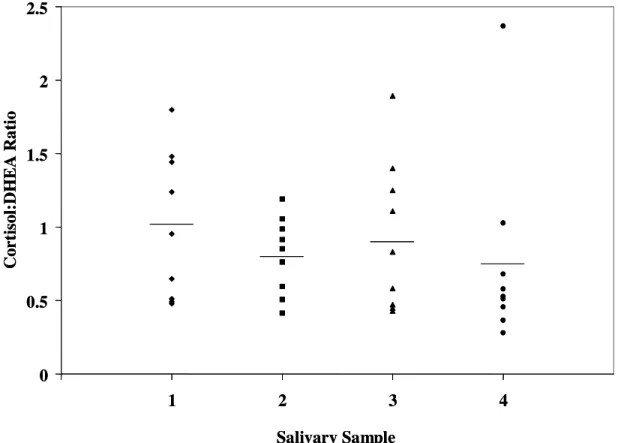
Figure 3. Cortisol:DHEA ratio values for salivary sample collections 1-4 for each of nine subjects. The horizontal lines represent the mean value for each salivary sample.
The results of a student’s t-test showed that no significant difference was observed between pre-intervention and post-intervention measurements (samples 1 and 3, respectively, p=0.747).
The second research hypothesis stated that there would be no change in the cortisol:DHEA ratio in response to a single HeartMath biofeedback session. Descriptive data for the analysis of the second research hypothesis is presented in table 1 above. The results of a student’s t-test showed that no significant difference was observed in the cortisol:DHEA ratio in response to a single HeartMath biofeedback session prior to the six-week intervention (samples 1 and 2, p=0.173) or following the intervention (samples 3 and 4, p=0.172).
0 0.5 1 1.5 2 2.5
1 2 3 4
C o r ti so l: D H E A R a ti o Salivary Sample 0 0.5 1 1.5 2 2.5
1 2 3 4
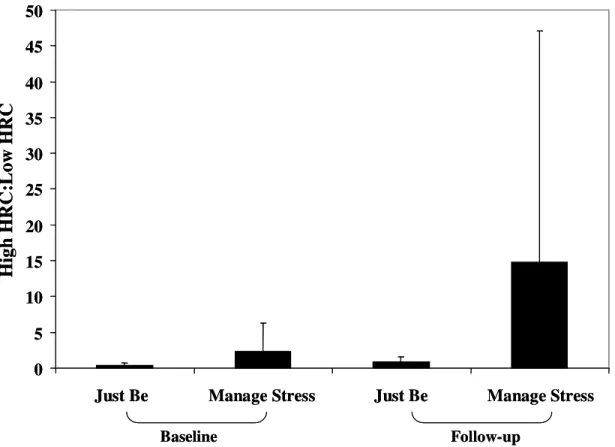
The third research hypothesis stated that there would be an increase in the ratio of high HRC:low HRC following the six-week combined exercise and HeartMath biofeedback intervention. Descriptive data for the analysis of the third hypothesis is presented graphically in figure 3. The results of a one-way within subjects ANOVA showed that no significant difference was observed in the ratio of high HRC:low HRC in response to the intervention (p=0.155 Baseline Just-Be vs. Follow-up Just Be; p=0.289 Baseline Manage Stress vs. Follow-up Manage Stress).
Further exploratory analysis involving only the four subjects who received the combined intervention showed that there was no significant difference in the ratio of high HRC:low HRC in response to the intervention (p=0.172 Baseline Just-Be vs. Follow-up Just Be; p=0.325 Baseline Manage Stress vs. Follow-up Manage Stress).
36
Further exploratory analysis involving only the four subjects who received the combined intervention showed that there was no significant difference in the ratio of high HRC:low HRC in response to a single HeartMath biofeedback session (p=0.300 Baseline Just-Be vs. Baseline Manage Stress; p=0.299 Follow-up Just Be vs. Follow-up Manage Stress).
Figure 4. Ratio of high HRC:low HRC for each of four conditions. Values are presented as mean ± standard deviation. (n=9)
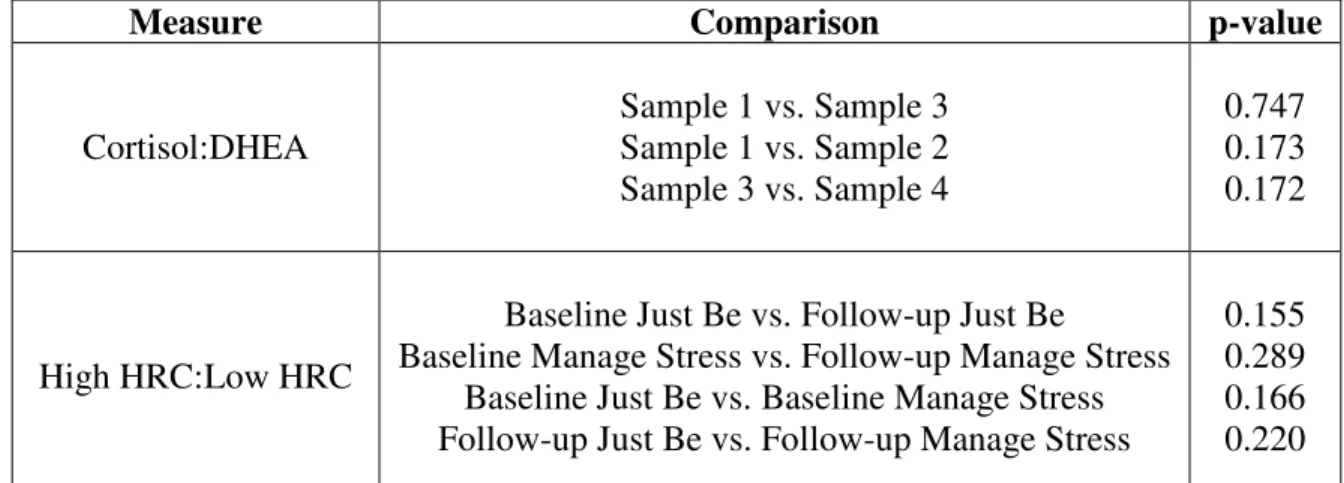
A summary of each comparison made is presented below in table 3. The results obtained during the study support the second research hypothesis and refute the first, third and fourth research hypotheses.
0 5 10 15 20 25 30 35 40 45 50
Just Be Manage Stress Just Be Manage Stress
H ig h H R C :L o w H R C Baseline Follow-up 0 5 10 15 20 25 30 35 40 45 50
Just Be Manage Stress Just Be Manage Stress
Table 2. Percent changes in high HRC:low HRC
Conditions compared Percent Change
Baseline Manage Stress vs. Baseline Just Be 473% Follow-up Mange Stress vs. Follow-up Just Be 1381%
Follow-up Just Be vs. Baseline Just Be 98% Follow-up Manage Stress vs. Baseline Manage Stress 534%
Table 3. Summary of all comparisons made during the testing of research hypotheses 1-4 and the associated probability values.
Measure Comparison p-value
Cortisol:DHEA
Sample 1 vs. Sample 3 Sample 1 vs. Sample 2 Sample 3 vs. Sample 4
0.747 0.173 0.172
High HRC:Low HRC
Baseline Just Be vs. Follow-up Just Be
Baseline Manage Stress vs. Follow-up Manage Stress Baseline Just Be vs. Baseline Manage Stress Follow-up Just Be vs. Follow-up Manage Stress
Chapter V Discussion
It has been shown in a number of research studies that exercise can be an effective tool in helping breast cancer patients combat the wide array of physiological side-effects that accompany the disease and its treatment. Reduced fatigue levels and improved cardiovascular, pulmonary and endocrine system functioning are but a few of the many physiological improvements that have been reported in breast cancer patients in response to exercise interventions. (Courneya 2003; Galvao and Newton, 2005) It is less clear, however, whether exercise is effective in helping patients cope with the majority of psychological side-effects associated with breast cancer and its treatment. In an effort to aid patients in management of the psychological side-effects associated with breast cancer and its treatment, recreation therapy is often employed. Improvements in quality of life and cognitive functioning are among the psychological improvements that have been noted in breast cancer patients in response to a recreation therapy intervention (Bordeleau et al., 2003; Arving et al., 2007).
side-effects of cancer and its treatment (Battaglini et al., 2006). By combining these therapies, patients might be able to more effectively manage both the physiological and psychological challenges involved with surviving breast cancer. In the current study, nine women who had recently completed treatment for breast cancer completed a six-week intervention consisting of three six-weekly sessions of exercise, recreation therapy or a combination of exercise and recreation therapy.
The primary purpose of this study was to determine if a six-week intervention using exercise and/or HeartMath impacts the cortisol:DHEA ratio in women who have recently completed breast cancer treatment. It was hypothesized that the intervention would elicit a decreased cortisol:DHEA ratio. The secondary purpose of this study was to determine if a six-week intervention using exercise and/or HeartMath impacts heart rate coherence (specifically the ratio of high HRC:low HRC). It was hypothesized that the intervention would elicit an increase in the ratio of high HRC:low HRC. Data regarding heart rate variability were not included in this study due to software complications at the Institute of HeartMath.
Cortisol and DHEA
40
Research has suggested that selective estrogen receptor modulators (SERMs), a class of drugs which includes Tamoxifen, can have a suppressive effect on adrenal corticosteroid release. Genezzani and coworkers performed a study examining hormone levels in response to long-term (12 months) SERM administration; the authors reported a 36% decrease in circulating DHEA and a 24% decrease in circulating cortisol (Genezzani et al., 2003). The authors suggest that the adrenal gland loses sensitivity to ACTH in response to long-term SERM use.
In addition to lower corticosteroid levels in the breast cancer population, Touitou and coworkers reported that breast cancer patients have significantly altered cortisol secretion patterns (Touitou et al., 1996). In fact, Speigel et al., suggesting disrupted HPA-axis feedback inhibition processes, reported that only approximately one-third of breast cancer patients showed normal circadian rhythms for cortisol release (Spiegel et al., 2006). Similar to the findings of Spiegel et al., there was a high degree of variability in the hormonal levels of the subjects in the current study.
cortisol:DHEA ratio; the adjunct therapy status of the subjects in this study made this scenario very difficult to achieve. Despite a trend towards lowered cortisol levels following the intervention, the fact that SERMs affect DHEA to a greater extent than cortisol likely prevented any decrease in the cortisol:DHEA ratio from being observed (Genazanni et al., 2003). Although DHEA has been suggested to have numerous positive effects (Copeland et al., 2002), its suppression via SERMs should not imply that this class of drugs is anything less than helpful; SERMs can lower estrogen levels (Genazzani et al., 2003), thus eliciting a protective effect against the recurrence of breast cancer.
The small sample size in the current study is another possible reason for the lack of observing a significant decrease in the cortisol:DHEA ratio. Because of the large variability often associated with endocrine measures, a larger sample size would have been desirable.
42
(Heyward). Only after the initial 8-12 weeks of regular exercise will physiological adaptations become evident. Despite the fact that previous research has shown that exercise interventions of a similar duration can decrease resting cortisol (Buono et al., 1987; Shepherd and Sidney, 1975) and increase resting DHEA (Copeland at al., 2002; Reichmann et al., 2004), it is possible that the relatively short duration of the intervention combined with the sedentary nature of the subjects and the aforementioned adrenocorticoid suppression due to SERM usage prevented any significant hormonal changes from being observed. If the combined exercise and recreation therapy intervention were carried out over the course of several months, perhaps more pronounced hormonal changes would have been observed.
The second research hypothesis stated that there would be no change in the cortisol:DHEA ratio in response to a single HeartMath biofeedback session. No significant change was found in the ratio of cortisol:DHEA in response to a single HeartMath biofeedback session prior to or following the intervention; the second research hypothesis was accepted. Both the pre- and post-intervention HeartMath biofeedback sessions lasted only approximately 25-30 minutes. Because the respective half-life values of cortisol and DHEA are both greater than this, the lack of a significant change in the ratio was unsurprising (Gusenoff et al. 2001).
Heart Rate Coherence
samples remained thawed for several days and were purportedly non-viable for analysis of cortisol and DHEA. These eight subjects were excluded from the current study and data collection began on a new group of subjects. To avoid extreme delays in data collection, some subjects who were receiving exercise alone or recreation therapy alone were included in the study in addition to subjects who were receiving the combined exercise and recreation therapy intervention. Therefore, the results presented below are for a sample where four subjects received exercise and recreation therapy, four subjects received only exercise and one subject received only recreation therapy. It is postulated that the results of the current study might have been different if all subjects had received the combined intervention as initially proposed.
The third research hypothesis stated that there would be an increase in the ratio of high HRC:low HRC following the six-week combined exercise and HeartMath biofeedback intervention. No significant difference was found in the ratio of high HRC:low HRC in response to the intervention. The lack of a significant finding could again be due to the small sample size and the large degree of variability associated with the measure. Additionally, one subject had undergone Mind-Body Awareness training at the Duke Center for Integrative Medicine. This subject was much more skilled at achieving high HRC and contributed greatly to the variability in the data.
44
therapy training over the course of the six-week intervention, the findings with respect to heart rate coherence could have been different.
Further exploratory analysis of the data revealed that when the with subjects split into three groups (Exercise and Recreation Therapy, Exercise only, and Recreation Therapy only), the subjects receiving both exercise and recreation therapy and the subjects receiving recreation therapy alone showed large improvements in the high HRC:low HRC ratio while the subjects receiving exercise only showed no improvement. The design of the current study does not allow for worthwhile comparisons to be made or for mechanisms to be postulated, but exercise did not appear to improve HRC; future research might benefit from this knowledge and be able to improve the design of similar studies. Clearly the small number of subjects in each of these subgroups does not allow for any conclusive statements to be made and the aforementioned observations have been made only to suggest future research.
While no significant differences were found in response to the intervention, numerically the ratio of high HRC:low HRC did increase (0.41 to 0.81 Baseline Just Be vs. Follow-up Just Be; 2.33 to 14.81 Baseline Manage Stress vs. Follow-up Manage Stress). Although not statistically significant, this data could be of clinical relevance as the harmony among the various systems of the body is associated with the degree of high heart rate coherence.
change in the ratio of high HRC:low HRC in response to a single HeartMath biofeedback session; the fourth research hypothesis was rejected. Similar to the third research hypothesis, the lack of a significant finding is likely due in part to the small sample size and the high degree of variability associated with the measure.
Although no significance was achieved, the ratio of high HRC:low HRC did increase numerically in the Manage Stress conditions compared to the Just Be conditions at both Baseline (0.41 to 2.33 Baseline Just Be vs. Baseline Manage Stress) and Follow-up (0.81 to 14.81 Follow-Follow-up Just Be vs. Follow-Follow-up Manage Stress). Although not statistically significant, this data could be of clinical relevance since the interaction among the various systems of the body is more harmonious and efficient with high levels of heart rate coherence.
46
all of the subjects had received recreation therapy training over the course of the six-week intervention.
Recommendations for Future Research
Future research should attempt to control for the circadian rhythms of the cortisol and DHEA much more strictly. Due to the nature of the Get REAL & HEEL Breast Cancer Rehabilitation Program and the busy schedules of the subjects, it was difficult to have all subjects provide salivary samples at the exact same time of day. In addition, as mentioned previously, research has also suggested that breast cancer patients show abnormal hormonal release patterns (Spiegel et al. 2006). In future studies, it might be helpful to collect multiple salivary samples at a variety of times throughout the day in an effort to gain insight into the release patterns of cortisol and DHEA. Alternatively, a 24-hour urine profile could be collected and analyzed for the ratio of cortisol:DHEA. From a 24-hour profile, the circadian rhythms of both cortisol and DHEA (and any associated disruptions) could be monitored.
In future research, it might prove interesting to examine and report the values of cortisol and DHEA alone rather than the ratio of cortisol:DHEA. Although ratio values can provide useful data, it might be beneficial to examine the absolute changes in each parameter rather than looking at ratio values.
heart rate coherence in the cancer population could prove comparisons between healthy individuals and individuals recovering from breast cancer interesting.
An effort should be made to increase the sample size in future research studies and randomized controlled trials. A larger randomized controlled trial including a non- treatment group plus the addition of age-matched healthy controls would allow for not only the examination of changes of the parameters included in the current experiment, but also a more precise understanding of the impact of the intervention used in the study. Additionally, valuable comparisons could be made between groups receiving exercise alone, groups receiving recreation therapy alone and groups receiving both exercise and recreation therapy with a larger number of subjects. While curiosities may arise and postulations may be made that (at least with respect to heart rate coherence) the combination of exercise and recreation therapy might serve as a better intervention than exercise alone, nothing can be concluded with any solidarity due to the small sample size and the design of the current study.
48
study by Maes et al. with patients suffering from severe depression, hyperactivity of the HPA-axis seems to be mediated in part by IL-1β (Maes et al., 1993). In Maes et al.’s study, a positive relationship between IL-1β and post-dexamethasone cortisol was observed. Due to the relationship between IL-1β and cortisol and the assumption made by the authors that IL-1β may in part mediate HPA-axis activity, IL-1β may warrant study as a potential marker of stress in cancer patients. Although drugs used to treat depression did not appear to affect IL-1β levels in Maes’ study, this may not be true for drugs used to treat breast cancer patients and therefore research should be conducted to address this possibility. A later study by Wichers and Maes (2002) suggests that, in addition to IL-1β, HPA-axis activity may also be mediated by the cytokines IL-6, IL-1 and TNF-α; although inflammation and stress are certainly different, it appears that the two may be related and the possibility of measuring one of the aforementioned immune parameters as an indirect indicator of stress merits study.
Aside from using different biomarkers as indicators stress, in future experiments it could be of value to study a sample of patients who were not being treated with SERMs. This may allow for confirmation of the current literature on the effect of certain anthracyclins on hormonal release. Additionally, supplementation of a physiological measure with some sort of a psychological or psychosocial questionnaire might aid in the interpretation of research findings. The results of the current study bring to light a wide array of future directions that warrant study.
Conclusion
future research were revealed. Increasing the statistical power with a larger sample size could allow for a much more accurate analysis of the effects of a combined exercise and recreation therapy intervention; future research could provide more conclusive evidence regarding the preliminary trends that were observed in the current study.
50 APPENDIX 1
Biochemical assay procedures Procedure for cortisol enzyme-linked immunosorbent assay
Adapted from Salimetrics Expanded Range High Sensitivity Salivary Cortisol EIA Kit 1. Determine plate layout
2. Place NSB (non-specific binding) wells in desired location on microplate 3. Pipette 24 mL of assay diluent into a disposable tube. Set aside for step 5.
4. Pipette 25 µL of standards, controls, and unknowns into appropriate wells. Standards, controls and unknowns should be assayed in duplicate. Pipette 25 µL of assay diluent into 2 wells to serve as the zero. Pipette 25 µL of assay diluent into each NSB well. 5. Make a 1:1600 dilution of the conjugate by adding 15 µL of the conjugate to the 24 mL of assay diluent prepared in step 3. Immediately mix the diluted conjugate solution and pipette 100 µL into each well using a multichannel pipette.
6. Mix plate on rotator for 5 minutes at 500 rpm (or tap to mix) and incubate at room temperature for an additional 55 minutes.
7. Wash the plate 4 times with 1X plate wash buffer.
8. Add 200 µL of TMB solution to each well with a multichannel pipette.
9. Mix on a plate rotator for 5 minutes at 500 rpm (or tap to mix) and incubate the plate in the dark at room temperature for an additional 25 minutes.
10. Add 50 µL of stop solution with a multichannel pipette.
11. Mix on a plate rotator for 3 minutes at 500 rpm (or tap to mix). Caution: do not mix at speeds over 600 rpm. Wipe off bottom of plate with a water-moistened, lint-free cloth and wipe dry. Read in a plate reader at 450 nm. Read plate within 10 minutes of adding stop solution.
Calculations
1. Compute the average optical density (OD) for all duplicate wells.
2. Subtract the average OD for the NSB wells from the average OD of the zero, standards, controls, and unknowns.
3. Calculate the percent bound (B/B0) for each standard, control and unknown by dividing the average OD (B) by the average OD for the zero (B0).
4. Determine the concentrations of the controls and unknowns by interpolation using software capable of logistics. We recommend using a 4-parameter sigmoid minus curve fit.
52
Procedure for DHEA enzyme-linked immunosorbent assay
Adapted from Salimetrics Salivary DHEA Enzyme Immunoassay Kit 1. Determine plate layout
2. Place NSB (non-specific binding) wells in desired location on microplate
3. Label five microcentrifuge tubes or other small tubes 2 through 6. Pipette 150 µL of assay diluent into tubes 2 through 6. Serially dilute the standard 2.5X by adding 100 µL of the 1000 pg/ml standard (tube 1) to tube 2. Mix well. After changing pipette tips, remove 100 µL from tube 2 to tube 3. Continue for tubes 4, 5 and 6. Pipette 18 ml of assay diluent into disposable tube and set aside for step 5.
4. Pipette 50 µL of standards, controls, and unknowns into appropriate wells. Standards, controls and unknowns should be assayed in duplicate. Pipette 50 µL of assay diluent into 2 wells to serve as the zero. Pipette 50 µL of assay diluent into each NSB well. 5. Make a 1:1500 dilution of the conjugate by adding 12 µL of the conjugate to the 18 mL of assay diluent prepared in step 3. Immediately mix the diluted conjugate solution and pipette 150 µL into each well using a multichannel pipette.
6. Cover plate with adhesive cover provided. Mix plate on rotator for 5 minutes at 500 rpm (or tap to mix) and incubate at room temperature for 3 hours.
7. Wash the plate 4 times with 1X plate wash buffer.
8. Add 200 µL of TMB solution to each well with a multichannel pipette.
9. Mix on a plate rotator for 5 minutes at 500 rpm (or tap to mix) and incubate the plate in the dark at room temperature for an additional 25 minutes.
10. Add 50 µL of stop solution with a multichannel pipette.
11. Mix on a plate rotator for 3 minutes at 500 rpm (or tap to mix). Caution: do not mix at speeds over 600 rpm. Wipe off bottom of plate with a water-moistened, lint-free cloth and wipe dry. Read in a plate reader at 450 nm. Read plate within 10 minutes of adding stop solution.
Calculations
1. Compute the average optical density (OD) for all duplicate wells.
2. Subtract the average OD for the NSB wells from the average OD of the zero, standards, controls, and unknowns.
3. Calculate the percent bound (B/B0) for each standard, control and unknown by dividing the average OD (B) by the average OD for the zero (B0).
APPENDIX 2
54
Physiological assessment protocols
Standardized push-up test: (Heyward, 2002)
1. Before administering the test, an exercise specialist will demonstrate the push-up procedure for the patient. For women, the modified push-up version includes: knees on the ground and legs bent with feet off of the ground.
2. A count of three seconds lowering down and three seconds pushing up will dictate the rhythm of the exercise. When the subject’s positioning or rhythm changes due to fatigue, the exercise will stopped and the number of push-ups performed will be recorded.
Standardized Partial Curl-up (crunch)test: (Heyward, 2002)
1. Before administering the test, an exercise specialist will demonstrate the curl-up procedure for the patient.
2. The appropriated position for the sit-up test includes having the subject lying in a supine position (on the back) on a mat, with knees flexed to 90 degrees and arms at the sides with fingers touching a piece of tape. A second piece of tape is placed 8 cm (for subjects 45 years or older) or 12 cm (for subjects less than 45 years) beyond the first piece of tape.
3. A metronome is then set at 40 bpm (20 curls- per minute).
4. The subject is then instructed to slowly lift her shoulder blades off the ground in time with the metronome. The subject should flex the trunk (curl up) until the fingertips touch the second tape mark or the trunk makes a 30 degree angle with the mat.
5. A count of three seconds curling up and three seconds lowering down will dictate the rhythm of the exercise. When the subject’s positioning or rhythm changes due to fatigue, the exercise will be stopped and the number of curl-ups performed will be recorded.
Standardized testing procedures for sit-and-reach test:
1. The subject will sit on the floor with buttocks, shoulders, and head in contact with the wall with the knees extended but not locked.
2. The subject will be instructed to place the soles of her feet against the box. 3. Keeping the head and shoulders in contact with the wall, the subject will
extend her arms forward with one hand on top of the other.
4. The exercise specialist will bring the sliding tab to the fingertips of the subject (not fingernails); this will serve as the “zero point”.
5. The subject will be instructed to bend forward slowly, pushing the silver tab along the measurement bar.
7. When reading the measurement bar, scale C will be used (in inches). If the subject reaches beyond 21 inches on scale C, scale B will be used to record the measurement.
8. The score (in inches) will be the most distant point on the measurement bar contacted by the fingertips.
The test will be administered three times with the highest measurement recorded as the patient’s score.
56
REFERENCES
ACSM’s Advanced Exercise Physiology, Chapter 22 (2005) Lippincott, Williams and Wilkins, New York.
Adamsen, L., Midtgaard, J., Rorth, M., Borregaard, N., Andersen, C., Quist, M., Moller, T., Zacho, M., Madsen, J.K., Knutsen, L. (2003) Feasibility, physical capacity, and health benefits of a multidimensional exercise program for cancer patients undergoing chemotherapy. Support Care Cancer 11(11):707-16
Ahmed, R.L., Thomas, W., Yee, D., Schmitz, K.H. (2006) Randomized controlled trial of weight training and lymphedema in breast cancer survivors. J Clin
Oncol.24(18): 2765-72
Aizawa, K., Akimoto, T., Inoue, H., Kimura, F., Joo, M., Murai, F., Mesaki, N. (2003) Resting serum dehydroepiandrosterone sulfate level increases after 8-week resistance training among young females. Eur J Appl Physiol 90(5-6):575-80
Al-Majid, S. and McCrathy, D.O. (2001) Cancer-induced fatigue and skeletal muscle wasting: The role of exercise. Biological Research for Nursing 2(3):186-97
Arving, C., Sjoden, P.O., Bergh, J., Hellbom, M., Johansson, B., Glimelius, B., Brandberg, Y. (2007) Individual psychosocial support for breast cancer patients: a randomized study of nurse versus psychologist interventions and standard care.
Cancer Nurs. 30(3):E10-19
Battaglini, C., Dennehy, C., Groff, D., Kirk, D., Anton, P. (2006) Complementary therapies in the management of cancer treatment-related symptoms: the
individualized prescriptive exercise intervention approach. Medicina Sportiva
10(2):49-57
Basen-Engquit, K., Taylor, C.L., Rosenblum, C., Smith, M.A., Shin, E.H., Greisinger, A., Gregg, X., Massey, P., Valero, V., Rivera, E. (2006) Randomized pilot test of a lifestyle physical activity intervention for breast cancer survivors. Patient Educ Couns. 64(1-3):225-24
Brenner, I., Shek, P.N., Zamecnik, J., Shepard, R.J., (1998) Stress hormones and the immunological responses to heat and exercise. Int. J. Sports Med. 19(2) 131-43 Buono, M., Yeager, J., Sucec, A. (1987) Effect of aerobic training on the plasma ACTH response to exercise. J Appl Physiol 63(3):2499-2501
Carlson, L.E., Speca, M., Patel, K.D., and Goodey, E. (2004) Mindfulness-based stress reduction in relation to quality of life, mood, symptoms of stress and levels of cortisol, dehydroepiandrosterone sulfate (DHEAS) and melatonin in breast and prostate cancer outpatients. Psychoneuroendocrinology 29(4):448-74
Cheema, B. and Gaul, C. (2006) Full body exercise training improves fitness and quality of life in survivors of breast cancer. J. Strength Cond. Res. 20(1):14-21 Cohen, S., Janicki-Deverts, D., Miller, G.E. (2007) Psychological stress and disease.
JAMA 298(14)1685-87
Copeland, J., Consitt, L., Tremblay, M. (2002) Hormonal responses to endurance and resistance exercise in females aged 19-69 years. J. Gerontology 57A(4): B158-B165 Courneya, K.S., and Friedenriech, C.M. (1999) Physical exercise and quality of life following cancer diagnosis: a literature review. Annals of Behavioral Medicine
21(2):171-9
Courneya, K.S., Mackey, J., Bell, G., Jones, L., Field, C., and Fairey, A. (2003) Randomized controlled trial of exercise training in postmenopausal breast cancer survivors: cardiopulmonary and quality of life outcomes. J. Clin. Oncol. 21(9): 1660-8
Courneya, K.S., Segal, R.J., Mackey, J.R., Gelmon, K., Reid, R.D., Friedenreich, C.M., Ladha, A.B., Proulx, C., Vallance, J.K., Lane, K., Yasui, Y., McKenzie, D.C. (2007) Effects of aerobic and resistance exercise in breast cancer patients receiving adjuvant chemotherapy: a multicenter randomized controlled trial. J.Clin Oncol.
Crawford, J. (2002) Clinical uses of pegylated pharmaceuticals in oncology. Cancer Treat. Rev. 28 Suppl A:7-11
Cruess, D., Antoni, M., McGregor, B., Kilbourn, K., Boyers, A., Alferi, S., Cerver, C., Kumar, M. (2000) Cognitive-behavioral stress management reduces serum cortisol by enhancing benefit finding among women being treated for early stage breast cancer. Psychosomatic Medicine 62(3): 304-308