VARIETY OF STRUCTURES OF BINUCLEAR CHIRAL SCHIFF
BASE Ce(III)/Pr(III)/Lu(III)-Ni(II)/Cu(II)/Zn(II) COMPLEXES
Tomoko Hayashi[a], Haruhiko Shibata[a], Shingo Orita[a] and Takashiro Akitsu[a]*
Keywords: Chirality, Schiff base, Ni(II) complex, Cu(II) complex, Zn(II) complex, Lanthanide complex
We have prepared and characterized several 3d-4f (Ni(II), Cu(II) and Zn(II) transition metal (3d) ions and Ce(III), Pr(III), and Lu(III) lanthanide metal (4f) ions) complexes incorporating chiral Schiff base ligands (abbreviated as CeNi, CeCu, CeZn, PrNi, PrCu, PrZn, LuNi, LuCu, and LuZn, respectively). Solid-state CD spectra and diffuse reflectance electronic spectra exhibited reasonable shift by combination of 3d and 4f ions at charge-transfer region. Magnetic features (antiferromagnetic interactions, if any) also exhibited substitution of 3d-4f ions of diamagnetic or paramagnetic spin numbers. Interestingly, determined crystal structures of some of them exhibited different structural characters about coordination numbers, crystalline solvents, and dimetic (or bridging) features nevertheless of 3d-4f metal substitution in identical organic ligands.
* Corresponding Authors
Tel: +81 3 5228 8271; Fax: +81 3 5261 4361 E-Mail: [email protected]
[a] Department of Chemistry, Faculty of Science, Tokyo University of Science, 1-3 Kagurazaka, Shinjuku-ku, Tokyo 162-8601, Japan
Introduction
In recent years, studies on 3d-4f binuclear metal complexes have gained importance with special interest on photophysical properties1-4 and magnetic properties5-12 arising from interactions between metal ions as well as sole metal ion having suitable electronic states or unpaired electrons. For example, some cyanide-bridges 3d-4f metal complexes13-15 have been studied to elucidate empirical estimation of magnetic interaction including paramagnetic ions for understanding multi-functions.16 In this context, we have been interested in chiral Schiff base 3d-4f dinuclear complexes incorporating so-called salen-type ligands and investigated structure-property correlation and its variety resulting from metal-substitution and their combination.16-17 By assembling 3d-4f ions, we are interested in characteristic chiroptical properties of the systems involving superexchange magnetic interactions. Generally, systematic comparison of electronic properties for a series of 3d-4f binuclear metal complexes should be carried out for isostructural ones. Indeed many types of 3d-4f binuclear metal complexes take identical crystal structure nevertheless of substitution of relatively small 3d metal ions and relatively large 4f metal ions showing lanthanide contraction typically. In this work, we prepared new chiral Schiff base Ln(III)-M(II) complexes (abbreviated as CeNi, CeCu, CeZn, PrNi, PrCu, PrZn, LuNi, LuCu, and LuZn; Scheme 1) and characterized with electronic spectra, CD spectra, magnetic properties, and X-ray crystallography. In contrast to common series of 3d-4f metal complexes, the present complexes showed drastic changes of crystal structures as well as molecular structures due to not only ionic radii of 4f ions (the smallest Lu(III), middle Pr(III), and the largest Ce(III))
but also coordination environment of 3d ions especially associated with axial ligands.
Scheme 1. Molecular structures of 3d-4f complexes representing different coordination modes of potentially bridging nitrate ligands and axial ligands (L).
Experimental
Materials and Instrumentation
4000-400 cm-1 at 298 K. Diffuse reflectance spectra were measured on a JASCO V-570 UV/VIS/NIR spectrophotometer equipped with polarizer in the range of 800-200 nm at 298 K and were converted from absorbance to reflectance by the Kubelka-Munk method. Circular dichroism(CD) spectra were measured as KBr pellets on a JASCO J-820 spectropolarimeter in a range of 800-300 nm at 298 K. Powder X-ray diffraction patterns were also measured by using synchrotron radiation beamtime at KEK PF BL-8B (2010G511) with 8 keV (λ = 1.54184 Å) with a RIGAKU imaging plate. The Cu2p3/2 and Cu2p1/2 peaks of XAS (soft X-ray absorption spectra) were measured at KEK PF BL-19B (2010G510) under variable temperature. The spectra were corrected by the standard Au sample. The magnetic properties were investigated with a Quantum Design MPMS-XL superconducting quantum interference device magnetometer (SQUID) at an applied field 1000 Oe in a temperature range 2-300 K. Powder samples were measured in a pharmaceutical cellulose capsule. The apparatus signals and the diamagnetic corrections were evaluated from the analogous diamagnetic LaZn complex.
X-ray Crystallography
Orange prismatic single crystals of CeNi, purple prismatic single crystals of CeZn, light-yellow prismatic single crystals of CeCu, red prismatic single crystals of PrNi, red prismatic single crystals of LuNi, brown prismatic single crystals of LuCu, and transparent prismatic single crystals of LuZn were glued on top of a glass fiber and coated with a thin layer of epoxy resin to measure the diffraction data. Intensity data were collected on a Bruker APEX2 CCD diffractometer with graphite monochromated Mo K radiation (λ = 0.71073 Å). Data analysis was carried out with a SAINT program package. The structures were solved by direct methods with a SHELXS-9719 and expanded by Fourier techniques and refined by full-matrix least-squares methods based on F2 using the program SHELXL-97.19 A multi-scan absorption correction was applied by a program SADABS. All non-hydrogen atoms were readily located and refined by anisotropic thermal parameters. All hydrogen atoms were located at geometrically calculated positions and refined using riding models.
Crystallographic data for CeNi.
C30H26CeNiN5O13.N3O9, crystal size 0.18 mm × 0.17 mm × 0.12 mm, Mw = 863.39, monoclinic, space group C2 (#5), a = 19.1533(18) Å, b = 15.6034(14)Å, c = 22.209(2) Å, β = 99.178(2) °, V = 6552.2(11) Å3, Z = 8, Dcalc = 1.750 Mg m-3, F(000) = 3448, R1 = 0.0542, wR2 = 0.1558 (20051 reflections), S = 0.847, Flack parameter = 0.00(2). (where R1 =||Fo|-|Fc||/|Fo|. Rw=(w(|Fo|-|Fc|)2/w|Fo|2)1/2, w=1/(σ2(Fo) + (0.1P)2), P = (Fo2 + 2Fc2)/3).
Crystallographic data for CeCu.
C30H26CeCuN2O4.CH3O10N3 crystal size 0.13 mm × 0.10 mm × 0.07 mm, Mw = 899.25, monoclinic, space group P21 (#4), a = 10.654(8) Å, b = 21.113(16) Å, c = 15.715(12) Å, β = 101.638(11) °, V = 3462(5) Å3, Z = 4, Dcalc = 1.725 Mg m-3, F(000) = 1796, R1 = 0.0538, wR2 = 0.1631 (18689 reflections), S = 0.821, Flack parameter = -0.02(2). (where R1 =||Fo|-|Fc||/|Fo|. Rw=(w(|Fo|-|Fc|)2/ Σw|Fo|2)1/2, w = 1/(σ2(Fo) + (0.1P)2), P = (Fo2 + 2Fc2)/3).
Crystallographic data for CeZn. C30H26CeZnN2O4. C2H7O11N3 crystal size 0.22 mm × 0.12 mm × 010 mm, Mw = 933.12, monoclinic, space group P21 (#4), a = 9.3562(9) Å, b = 16.1727(15) Å, c = 24.001(2) Å, β = 95.3730(10) °, V=3617.3(6) Å3, Z=4, Dcalc=1.713 Mg m-3, F(000) = 1872, R1 = 0.0251, wR2 = 0.0794 (20128 reflections), S = 0.677, Flack parameter = -10(10). (where R1 =||Fo|-|Fc||/|Fo|. Rw = (w(|Fo|-|Fc|)2/w|Fo|2)1/2, w=1/(σ2(Fo) + (0.1P)2), P = (Fo2 + 2Fc2)/3).
Crystallographic data for PrNi.
C30H26PrNiN2O4.O9N3, crystal size 0.27 mm × 0.18 mm × 0.17 mm, Mw = 864.18, monoclinic, space group C2 (#5), a = 19.173(2) Å, b = 15.6164(18)Å, c = 22.193(2) Å, β =99.155(2)°, V=6560.4(13) Å3, Z=8, Dcalc =1.750 Mg m-3, F(000) = 3456, R1 = 0.0434, wR2 = 0.0882 (20321 reflections), S = 1.012, Flack parameter = -0.001(13). (where R1 =||Fo|-|Fc||/|Fo|. Rw=(w(|Fo|-|Fc|)2/w|Fo|2)1/2, w = 1/(σ2(Fo) + (0.1P)2), P = (Fo2 + 2Fc2)/3).
Crystallographic data for LuNi.
C30H26LuNiN2O4.O9N3, crystal size 0.09 mm × 0.09 mm × 0.08 mm, Mw = 898.24, monoclinic, space group C2 (#5), a = 19.2462(14) Å, b = 15.4932(14)Å, c = 21.8129(18) Å, β = 98.9910(10) °, V = 6524.4(9) Å3, Z = 8, Dcalc = 1.857 Mg m-3, F(000) = 3552, R1 = 0.0315, wR2 = 0.0974 (17822 reflections), S = 0.679, Flack parameter = -0.015(8). (where R1 =||Fo|-|Fc||/|Fo|. Rw = (w(|F o|-|Fc|)2 /w|Fo|2)1/2, w=1/(σ2(Fo) + (0.1P)2), P = (Fo2 + 2Fc2)/3).
Crystallographic data for LuCu.
2(C30H28LuCuN2O4・CH3O10N3)CH4O crystal size 0.19 mm × 0.18 mm × 0.10 mm, Mw = 1900.25, triclinic, space group P1 (#1), a = 9.3607(7) Å, b = 14.0284(10) Å, c = 15.2948(11) Å, α= 107.9910(10) °, β = 104.5540(10) °, γ = 101.4330(10) °, V = 1764.0(2) Å3, Z =1, Dcalc = 1.789 mg/m3, F(000) = 942, R1 = 0.0193, wR2 = 0.0433 (9538 reflections), S = 0.948, Flack parameter = 0.001(5). (where R1 =||Fo|-|Fc||/|Fo|. Rw=(w(|F o|-|Fc|)2/w|Fo|2)1/2, w = 1/(σ2(Fo) + (0.1P)2), P = (Fo2 + 2Fc2)/3).
Crystallographic data for LuZn. C30H26LuZnN2O4・ O9N3 crystal size 0.19 mm × 0.16 mm × 015 mm, Mw = 904.90, monoclinic, space group P21 (#4), a = 10.2449(4) Å, b = 19.1856(8) Å, c = 17.2315(7) Å, β = 94.8660(10) °, V=3374.7(2) Å3, Z=4, Dcalc=1.781 Mg m-3, F(000) = 1784, R1 = 0.0410, wR2 = 0.0746 (20711 reflections), S = 1.013, Flack parameter = 0.006(8). (where R1 =||Fo|-|Fc||/|Fo|. Rw = (w(|F o|-|Fc|)2/w|Fo|2)1/2, w = 1/(σ2(Fo) + (0.1P)2), P = (Fo2 + 2Fc2)/3).
Preparations
(0.4375 g 1.00 mmol) was added to the resulting solution and the reaction was refluxed for 4 h at 373 K. After cooling the solution, this orange compound was filtered and recrystallized from methanol/diethyl ether to give orange prismatic single crystals for X-ray analysis.
Yield 0.1288 g (14.92 %). Anal. Found: C, 41.64; H, 2.82; N, 8.05 %. Calc. for C30H26CeNiN2O4.O9N3: C, 41.33; H, 3.24; N, 8.01 %. IR (KBr (cm-1)): 669 (s), 694 (s), 735 (s),774 (s), 846 (s), 945 (s), 1021 (s), 1075 (s), 1168 (s), 1071 (s), 1161 (s), 1231 (s), 1383 (w), 1229 (m), 1292 (m), 1368 (m), 1389 (m), 1458 (m), 1608 (m), 1621 (m) (C=N), 1652 (m), 1700 (m), 2339 (s), 3375 (sh). XRD(2q/degree): 7.714, 7.975, 8.700, 9.338, 10.295, 11.31, 11.977, 14.819, 14.848, 16.095, 18.763, 21.025, 21.576, 21.779, 22.765, 23.925, 24.157, 24.650, 26.680, 30.028.
Preparation of CeCu. To a solution of o-vanillin (0.305 g, 2.00 mmol) dissolved in methanol (60 mL), (1R,2R)-(+)-1,2-diphenylethylenediamine (0.212 g, 1.00 mmol) was added and stirred at 313 K for 2 h to give yellow solution of ligand. Copper(II) acetate hydrate (0.2045 g, 1.00 mmol) was added to the resulting solution to give muddy green solution of the complex. After stirring at 313 K for 3 h, cerium(III) nitrate hexahydrate (0.4375 g 1.00 mmol) was added to the resulting solution and the reaction was refluxed for 4 h at 373 K. After cooling the solution, this purple compound was filtered and recrystallized from methanol/diethyl ether to give crystals containing (nonstoichometric) CH4O solvent suitable for X-ray analysis.
Yield 0.5415 g (60.22 %). Anal. Found: C, 41.37; H, 2.83; N, 7.74 %. Calc. for C30H26CeCuN2O4.CH3O10N3: C, 41.40; H, 3.25; N, 7.79 %. IR (KBr (cm-1)): 604 (s), 640 (s), 668 (m), 701 (s), 741 (m), 754 (s), 778 (s), 813 (s), 852 (m), 951 (m), 993 (s), 1074 (s), 1097 (s), 1165 (s), 1201 (m), 1240 (s), 1288 (m), 1382 (w), 1448 (m), 1453 (m), 1467 (m), 1490 (m), 1555 (s), 1605 (m), 1626 (m) (C=N), 2353 (s), 2360 (s), 2365 (s), 2425 (s), 3352 (sh). XRD(2q /degree): 6.467, 7.743, 9.657, 10.382, 10.962, 11.542, 12.035, 12.644, 12.963, 14.210, 15.022, 15.544, 16.066, 16.385, 17.429, 18.386, 20.097, 20.967, 21.886, 21.982, 23.287, 23.896, 24.969, 25.259, 25.897, 27.144, 28.652, 29.406, 31.146, 32.074, 32.770. XAS: Cu2p3/2 933.3 eV, Cu2p1/2 954.1 eV.
Preparation of CeZn. To a solution of o-vanillin (0.305 g, 2.00 mmol) dissolved in methanol (60 mL), (1R,2R)-(+)-1,2-diphenylethylenediamine (0.212 g, 1.00 mmol) was added and stirred at 313 K for 2 h to give yellow solution of ligand. Zinc(II) acetate tetrahydrate (0.2217 g, 1.00 mmol) was added to the resulting solution to give light-yellow solution of the complex. After stirring at 313 K for 3 h, cerium(III) nitrate hexahydrate (0.4421 g 1.00 mmol) was added to the resulting solution and the reaction was refluxed for 4 h at 373 K. After cooling the solution, this light-yellow compound was filtered and recrystallized from methanol/diethyl ether to give light-yellow prismatic single crystals containing (nonstoichometric) CH4O solvent suitable for X-ray analysis.
Yield 0.3279 g (35.75 %). Anal. Found: C, 39.85; H, 2.90; N, 7.47 %. Calc. for C30H26CeN2O4Zn.CH3O10N3: C, 41.91; H, 3.63; N, 7.77 %. IR (KBr (cm-1)): 545 (s), 624 (s), 641 (s), 667 (m), 700 (s), 740 (m), 753 (s), 765 (s), 813 (s), 847 (m), 962 (m), 977 (m), 1025 (s), 1072 (m), 1094 (m), 1167 (s), 1219 (m), 1226 (m), 1275 (m), 1316 (m), 1382 (w), 1438 (m), 1449 (m), 1457 (m), 1479 (m), 1554 (m), 1605 (m), 1627 (m) (C=N), 1700 (m), 2357 (s), 2422 (s), 3359 (sh). XRD(2q /degree): 6.438, 7.772, 9.773, 10.237, 11.049, 12.876, 14.181, 15.689, 16.414, 18.270, 20.300, 24.070, 25.027, 25.230, 25.600, 32.016.
Preparation of PrNi. To a solution of o-vanillin (0.305 g, 2.00 mmol) dissolved in methanol (60 mL), (1R,2R)-(+)-1,2-diphenylethylenediamine (0.212 g, 1.00 mmol) was added and stirred at 313 K for 2 h to give yellow solution of ligand. Nickel(II) acetate tetrahydrate (0.2506 g, 1.00 mmol) was added to the resulting solution to give muddy brown solution of the complex. After stirring at 313 K for 3 h, praseodym(III) nitrate hexahydrate (0.4480 g 1.00 mmol) was added to the resulting solution and the reaction was refluxed for 4 h at 373 K. After cooling the solution, this orange compound was filtered and recrystallized from methanol/diethyl ether to give crystals for X-ray analysis.
Yield 0.3424 g (39.62 %). Anal. Found: C, 41.38; H, 3.20; N, 7.73 %. Calc. for C30H26PrNiN2O4.O9N3: C, 41.70; H, 3.03; N, 8.10 %. IR (KBr (cm-1)): 667 (m), 693 (s), 734 (s), 775 (s), 801 (s), 857 (s), 951 (s), 1021 (s), 1074 (s),1171 (s), 1233 (m), 1242 (m), 1290 (m), 1383 (m), 1456 (m), 1486 (m), 1557 (m), 1616 (m) (C=N), 1652 (m), 1700 (m), 2330 (s), 2352 (s), 3386 (sh). XRD(2q/degree): 7.337, 8.004, 8.729, 9.367, 10.324, 11.339, 12.035, 13.311, 13.291, 14.848, 15.138, 16.124, 16.153, 16.588, 170342, 17.516, 18.270, 18.821, 19.952, 22.765, 23.954, 24.186, 24.679, 26.738, 26.796, 27.985, 28.391, 28.971, 29.899, 30.305.
Preparation of PrCu. To a solution of o-vanillin (0.305 g, 2.00 mmol) dissolved in methanol (60 mL), (1R,2R)-(+)-1,2-diphenylethylenediamine (0.212 g, 1.00 mmol) was added and stirred at 313 K for 2 h to give yellow solution of ligand. Copper(II) acetate hydrate (0.1999 g, 1.00 mmol) was added to the resulting solution to give muddy green solution of the complex. After stirring at 313 K for 3 h, praseodym (III) nitrate hexahydrate (0.4505 g 1.00 mmol) was added to the resulting solution and the reaction was refluxed for 4 h at 373 K. After cooling the solution, this purple compound was filtered and recrystallized from methanol/diethyl ether to give purple prismatic single crystals containing (nonstoichometric) CH4O solvent suitable for X-ray analysis.
6.467, 7.859, 9.850, 10.295, 11.107, 12.963, 14.268, 15.747, 18.386, 20.445, 21.157, 23.084, 23.519, 23.925, 24.331, 25.201, 25.346, 26.216, 26.825, 27.318, 32.729. XAS: Cu2p3/2 930.9 eV, Cu2p1/2 952.7 eV.
Preparation of PrZn. To a solution of o-vanillin (0.305 g, 2.00 mmol) dissolved in methanol (60 mL), (1R,2R)-(+)-1,2-diphenylethylenediamine (0.212 g, 1.00 mmol) was added and stirred at 313 K for 2 h to give yellow solution of ligand. Zinc(II) acetate tetrahydrate (0.2211 g, 1.00 mmol) was added to the resulting solution to give light-yellow solution of the complex. After stirring at 313 K for 3 h, praseodym (III) nitrate hexahydrate (0.4492 g 1.00 mmol) was added to the resulting solution and the reaction was refluxed for 4 h at 373 K. After cooling the solution, this light-yellow compound was filtered and recrystallized from methanol/diethyl ether to give light-yellow prismatic single crystals containing (nonstoichometric) CH4O solvent suitable for X-ray analysis.
Yield 0.4836 g (53.61 %). Anal. Found: C, 41.26; H, 3.29; N, 7.81 %. Calc. for C30H26PrN2O4Zn.CH3O10N3: C, 41.37; H, 3.25; N, 7.78 %. IR (KBr (cm-1)): 641 (s), 667 (w), 699 (s), 739 (m), 756 (s), 781 (s), 809 (s), 848 (m), 960 (s), 976 (s), 1024 (s), 1071 (s), 1094 (s), 1168 (s), 1219 (m), 1226 (s), 1285 (m), 1309 (s), 1383 (w), 1419 (s), 1436 (m), 1456 (m), 1471 (m), 1506 (m), 1522 (s), 1567(s), 1623 (m) (C=N), 1652 (m), 1700 (s), 2328 (s), 2360 (s), 3392 (sh). XRD(2/degree): 6.409, 7.801, 9.744, 10.208, 10.991, 12.847, 14.123, 15.254, 15.602, 18.212, 19.343, 20.242, 21.025, 22.272, 22.881, 23.316, 23.722, 24.099, 24.477, 24.969, 25.114, 26.013, 26.564, 27.057, 27.521, 28.478, 21.319, 30.769, 31.320, 32.323, 32.509.
Preparation of LuNi.To a solution of o-vanillin (0.305 g, 2.00 mmol) dissolved in methanol (60 mL), (1R,2R)-(+)-1,2-diphenylethylenediamine (0.212 g, 1.00 mmol) was added and stirred at 313 K for 2 h to give yellow solution of ligand. Nickel(II) acetate tetrahydrate (0.2545 g, 1.00 mmol) was added to the resulting solution to give muddy brown solution of the complex. After stirring at 313 K for 3 h, lutetium(III) nitrate hexahydrate (0.3642 g 1.00 mmol) was added to the resulting solution and the reaction was refluxed for 4 h at 373 K. After cooling the solution, this orange compound was filtered and recrystallized from methanol/diethyl ether to give crystals.
Yield 0.4921 g (54.85 %). Anal. Found: C, 40.14; H, 2.92; N, 7.75 %. Calc. for C30H26LuNiN2O4.O9N3: C, 40.12; H, 3.02; N, 7.80 %. IR (KBr (cm-1)): 583 (s), 591 (s), 667 (m), 695 (m), 736 (m), 779 (s), 809 (s), 863 (s), 952 (s), 1025 (m), 1073 (m), 1171 (s), 1231 (m), 1275 (m), 1314 (m), 1383 (w), 1440 (m), 1474 (m), 1506 (m), 1559 (m), 1610 (m), 1619 (m) (C=N), 1700 (s), 2328 (s), 2922 (s), 3390 (sh). XRD(2/degree): 7.377, 8.062, 8.758, 9.388, 10.440, 11.426, 12.093, 13.340, 13.688, 14.065, 14.906, 15.109, 16.240, 16.385, 16.762, 17.574, 18.357, 18.734, 20.157, 21.199, 21.605, 21.808, 22.852, 23.896, 24.218, 24.302, 25.056, 26.709, 28.275, 30.044, 30.218, 30.450, 31.378.
Preparation of LuCu. To a solution of o-vanillin (0.305 g, 2.00 mmol) dissolved in methanol (60 mL),
(1R,2R)-(+)-1,2-diphenylethylenediamine (0.212 g, 1.00 mmol) was added and stirred at 313 K for 2 h to give yellow solution of ligand. Copper(II) acetate hydrate (0.2027 g, 1.00 mmol) was added to the resulting solution to give muddy green solution of the complex. After stirring at 313 K for 3 h, lutetium(III) nitrate hexahydrate (0.3610 g 1.00 mmol) was added to the resulting solution and the reaction was refluxed for 4 h at 373 K. The solution was evaporated under reduced pressure, and deep brown compound was yielded. This compound was filtered and recrystallized from methanol/diethyl ether to give crystals containing (nonstoichometric) CH4O solvent suitable for X-ray analysis.
Yield 0.2852 g (30.54 %). Anal. Found: C, 39.74; H, 3.22; N, 7.53 %. Calc. for C30H26LuCuN2O4.CH3O10N3: C, 39.86; H, 3.13; N, 7.74 %. IR (KBr (cm-1)): 649 (s), 667 (w), 698 (m), 742 (m), 854 (s), 955 (s), 1020 (s), 1071 (s), 1093 (s), 1167 (s), 1220 (m), 1239 (s), 1288 (m), 1383 (w), 1464 (m), 1495 (s), 1533 (s), 1557 (s), 1605 (m), 1623 (m) (C=N), 1652 (s), 1700 (m), 2345 (s), 3344 (sh). XRD(2θ/degree): 6.264, 6.641, 6.699, 7.192, 7.656, 8.236, 9.309, 9.628, 10.237, 10.759, 11.194, 11.803, 12.209, 12.644, 12.934, 13.253, 13.746, 14.355, 15.283, 16.414, 17.023, 18.647, 18.821, 20.184, 21.866, 22.678, 24.447, 24.940, 25.752, 26.245, 27.144, 27.666, 29.000, 30.305, 30.943, 32.074. XAS: Cu2p3/2 933.5 eV, Cu2p1/2 954.1 eV.
Preparation of LuZn. To a solution of o-vanillin (0.305 g, 2.00 mmol) dissolved in methanol (60 mL), (1R,2R)-(+)-1,2-diphenylethylenediamine (0.212 g, 1.00 mmol) was added and stirred at 313 K for 2 h to give a ligand. Zinc(II) acetate tetrahydrate (0.2243 g, 1.00 mmol) was added to the resulting solution to give light-yellow solution of the complex. After stirring at 313 K for 3 h, lutetium(III) nitrate hexahydrate (0.3526 g 1.00 mmol) was added to the resulting solution and the reaction was refluxed for 4 h at 373 K. The solution was evaporated under reduced pressure, and yellow compound was yielded. This compound was filtered and recrystallized from methanol/diethyl ether to give crystals containing (nonstoichometric) CH4O solvent suitable for X-ray analysis.
Yield 0.5046 g (53.91 %). Anal. Found: C, 39.74; H, 3.12; N, 7.57 %. Calc. for C30H26LuN2O4Zn.CH3O10N3: C, 39.78; H, 3.12; N, 7.48 %. IR (KBr (cm-1)): 507 (s), 525 (s), 543 (s), 592 (s), 640 (s), 667 (m), 700 (m), 740 (m), 771 (s), 809 (s), 851 (m), 959 (m), 974 (m), 1024 (s), 1071 (m), 1092 (m), 1165 (m), 1219 (m), 1285 (m), 1382 (w), 1452 (m), 1470 (m), 1557 (s), 1623 (m) (C=N), 1652 (m), 1700 (m), 2424 (s), 3340 (sh). XRD(2/degree): 6.206, 7.308, 9.309, 10.005, 11.165, 11.600, 13.195, 14.616, 18.937, 19.169, 21.895, 22.881, 29.58.
Results and Discussion
Solid-state CD and electronic spectra
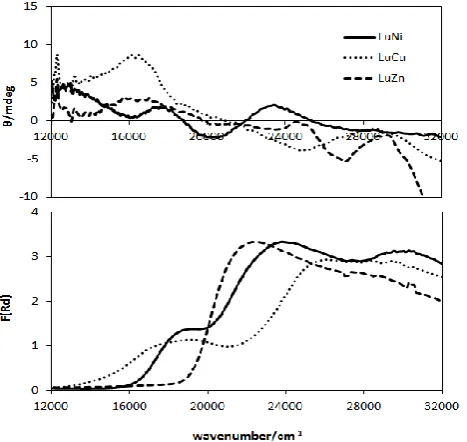
LuCu, and LuZn), respectively. For Ce-complexes, d-d bands (of Ni(II) or Cu(II) moieties) of electronic spectra appeared at about 18300-18600 cm-1, while the corresponding d-d and CT (charge transfer) bands of CD spectra appeared at about 16200-17400 cm-1 and 24100-25100 cm-1, respectively. For Pr-complexes, d-d bands (of Ni(II) or Cu(II) moieties) of electronic spectra appeared at about 18300-18400 cm-1, while the corresponding d-d and CT bands of CD spectra appeared at about 16200-17400 cm-1 and 24100-25100 cm-1, respectively. For Lu-complexes, d-d bands (of Ni(II) or Cu(II) moieties) of electronic spectra appeared at about 18700-19000 cm-1, while the corresponding d-d and CT bands of CD spectra appeared at about 16000-16300 cm-1 and 23300-27100 cm-1, respectively. Therefore, spectral changes, in particular charge transfer bands,17 are attributed to substitution and/or coordination environment of 3d metal ions.
Figure 1. Solid-state CD and diffuse reflectance electronic spectra of CeNi, CeCu, and CeZn.
Figure 2. Solid-state CD and diffuse reflectance electronic spectra of PrNi, PrCu, and PrZn.
Figure 3. Solid-state CD and diffuse reflectance electronic spectra of LuNi, LuCu, and LuZn.
Magnetic properties
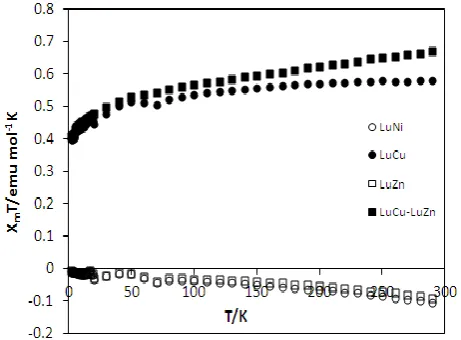
Figure 4. The MT vs T plots for CeNi, CeCu, and CeZn.
Figure 5. The MT vs T plots for PrNi, PrCu, and PrZn. Figure 6. The MT vs T plots for LuNi, LuCu, and LuZn.
By comparing with the corresponding paramagnetic 4f and diamagnetic 3d complexes, namely CeZn for CeCu and PrZn for PrCu, and evaluating the differences of MT values, these superexchange interactions via phenolate oxygen atoms are antiferromagnetic ones. It should be noted that discussion above is mentioned based on structural similarity (not isostructure completely) of 3d ion - phenolate oxygen atoms – 4f ion units for all complexes. Judgement for paramagnetic interactions may be impossible according to the way under this condition.18
Crystal structures
Crystal structures could be determined for CeNi, CeCu, CeZn, PrNi, LuNi, LuCu, and LuZn. According to powder XRD patterns, structural similarity between LuCu and LuZn and difference to LuNi are comparable to the corresponding Pr-complexes. Unfortunately, precise structures of PrCu and PrZn are not determined. However, one of the three nitrate ions of CeCu acts monodentate ligands though XRD patterns are almost
similar to CeZn. In this way, structural differences between arbitrary two complexes may be reliable, whereas reliable discussion of structural similarity and detailed structure-property correlation are restricted to comparison with only 7 complexes characterized structurally.
Figure 7 depicts structure of CeNi. Ni(II) ion affords a 4-coordinated distorted square planar geometry without methanol ligands and Ce(III) ion affords a 10-coordinated environment with distorted square pyramidal from the plane made by two nitrate ligands. Phenyl groups are located under a salen-plane with C40-C39-C54-C55 = 166.6(8) and C10-C9-C24-C25 = 156.3(9) °.
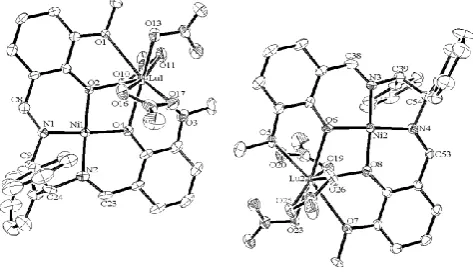
Figure 7. Molecular structures of CeNi showing selected atom labeling scheme. Hydrogen atoms are omitted clarity. Selected bond distance (Å) and bond or torsion angles (°): Ni1-N1 = 1.838(9), Ni1-N2 = 1.854(9), Ni1-O2 = 1.844(8), Ni1-O4 = 1.853(8), Ce1-O1 = 2.585(8), Ce1-O2 = 2.485(7), Ce1-O3 = 2.633(8), Ce1-O4 = 2.469(8), Ni2-N3 = 1.823(8), Ni2-N4 = 1.830(9), Ni2-O6 = 1.846(7), Ni2-O8 = 1.846(8), Ce2-O5 = 2.615(8), Ce2-O6 = 2.429(7), Ce2-O7 = 2.612(8), Ce2-O8 = 2.497(7), N1-Ni1-N2 = 86.4(4), N1 = 94.7(3), O2-Ni1-N2 = 175.8(3), O2-Ni1-O4 = 84.6(3), O4-Ni1-N1 = 175.2(4), O4-Ni1-N2 = 94.6(4), N3-Ni2-N4 = 85.9(4), O6-Ni2-N3 = 94.8(3), O6-Ni2-N4 = 177.5(3), O6-Ni2-O8 = 84.4(3), O8-Ni2-N3 = 176.9(3), O8- Ni2- N4 = 95.0(3), O1-Ce1-O2 = 60.8(3), O1-Ce1-O3 = 157.4(2), O1-Ce1-O4 = 120.0(3), O2-Ce1-O3 = 120.2(3), O2-Ce1-O4 = 60.3(3), O3-Ce1-O4 = 61.5(3), O5-Ce2-O6 = 61.4(2), O5-Ce2-O7 = 158.9(3), O5-Ce2-O8 = 118.2(3), O6-Ce2-O7 = 120.8(2), O6-Ce2-O8 = 60.4(3), O7-Ce2-O8 = 60.5(3).
Figure 8. Molecular structures of CeCu showing selected atom labeling scheme. Hydrogen atoms are omitted clarity. Selected bond distance (Å) and bond or torsion angles (°): Cu1-N1 = 1.910(10), Cu1-N2 = 1.932(9), Cu1-O2 = 1.897(7), Cu1-O4 = 1.909(8), Ce1-O1 = 2.677(10), Ce1-O2 = 2.453(9), Ce1-O3 = 2.705(9), Ce1-O4 = 2.508(7), Cu2-N3 = 1.928(9), Cu2-N4 = 1.908(11), Cu2-O6 = 1.898(10), Cu2-O8 = 1.908(8), Ce2-O5 = 2.718(9), Ce2-O6 = 2.497(9), Ce2-O7 = 2.693(11), Ce2-O8 = 2.478(9), N1-Cu1-N2 = 85.8(4), Cu1-N1 = 95.8(4), O2-Cu1-N2 = 170.2(4), O2-Cu1-O4 = 83.4(3), O4-Cu1-N1 = 178.9(4), O4-Cu1-O2 = 95.1(4), N3-Cu2-N4 = 86.5(4), O6-Cu2-N3 = 95.7(4), O6-Cu2-N4 = 171.3(4), O6-Cu2-O8 = 83.3(4), O8-Cu2-N3 = 178.1(4), O8-Cu2-N4 = 94.8(4), O1-Ce1-O2 = 59.5(3), O1-Ce1-O3 = 145.9(3), O1-Ce1-O4 = 117.0(3), O2-Ce1-O3 = 118.2(3), O2-Ce1-O4 = 61.4(2), O3-Ce1-O4 = 58.9(3), O5-Ce2-O6 = 59.1(3), O5-Ce2-O7 = 145.5(3), O5-Ce2-O8 = 117.8(3), Ce2-O7 = 117.5(4),
O6-Ce2-O8 = 61.1(3), O7-O6-Ce2-O8 = 60.0(3).
Figure 9. Molecular structures of CeZn showing selected atom labeling scheme. Hydrogen atoms are omitted clarity. Selected bond distance (Å) and bond or torsion angles (°): Zn1-N1 = 2.005(3), Zn1-N2 = 2.043(4), Zn1-O2 = 1.997(3), Zn1-O4 = 1.996(3), Ce1-O1 = 2.674(3), Ce1-O2 = 2.408(3), Ce1-O3 = 2.758(3), Ce1-O4 = 2.407(3), Zn2-N3 = 2.053(3), Zn2-N4 = 2.043(3), Zn2-O6 = 2.005(3), Zn2-O8 = 1.975(3), Ce2-O5 = 2.678(3), Ce2-O6 = 2.428(3), Ce2-O7 = 2.681(4), Ce2-O8 =2.432(3), N1-Zn1-N2 = 83.21(14), O2-Zn1-N1 = 92.21(13), O2-Zn1-N2 = 141.52(14), O2-Zn1-O4 = 80.89(11), O4-Zn1-N1 = 160.41(14), O4-Zn1-O2 = 90.81(12), N3-Zn2-N4 = 81.81(13), O6-Zn2-N3 = 90.29(13), O6-Zn2-N4 = 149.33(14), O6-Zn2-O8 = 80.67(11), O8-Zn2-N3 = 149.26(14), O8-Zn2-N4 = 91.11(12), O1-Ce1-O2 = 60.43(9), O1-Ce1-O3 = 152.3(1), O1-Ce1-O4 = 123.82(9), O2-Ce1-O3 = 121.0(1), O2-Ce1-O4 = 65.09(9), O3-Ce1-O4 = 58.4(1), O5-Ce2-O6 = 59.87(9), O5-Ce2-O7 = 154.33(12), O5-Ce2-O8 = 122.34(8), O6-Ce2-O7 = 121.76(10), O6-Ce2-O8 = 64.03(9), O7-Ce2-O8 = 59.74(10).
Figure 10 depicts structure of PrNi. Ni(II) ion affords a 4-coordinated distorted square planar geometry without methanol ligands and Pr(III) ion affords a 10-coordinated environment with distorted square pyramidal from the
plane made by two nitrate ligands. Phenyl groups are located under a salen-plane with C40-C39-C54-C55 = 154.1 (5) and C10-C9-C24-C25 = 165.6(5) °.
Figure 10. Molecular structures of PrNi showing selected atom labeling scheme. Hydrogen atoms are omitted clarity. Selected bond distance (Å) and bond or torsion angles (°): Ni1-N1 = 1.851(5), Ni1-N2 = 1.836(5), Ni1-O2 = 1.857(6), Ni1-O4 = 1.856(5), Pr1-O1 = 2.601(5), Pr1-O2 = 2.490(4), Pr1-O3 = 2.615(5), Pr1-O4 = 2.417(5), Ni2-N3 = 1.850(6), Ni2-N4 = 1.843(5), Ni2-O6 = 1.861(5), Ni2-O8 = 1.833(5), Pr2-O5 = 2.624(5), Pr2-O6 = 2.444(5), Pr2-O7 = 2.576(5), Pr2-O8 = 2.470(4), N1-Ni1-N2 = 86.5(2), N1 = 94.8(2), O2-Ni1-N2 = 176.7(2), O2-Ni1-O4 = 84.4(2), O4-Ni1-N1 = 177.6(2), O4-Ni1-N2 = 94.4(2), O1-Pr1-O2 = 60.33(17), O1-Pr1-O3 = 57.57(16), O1-Pr1-O4 = 121.34(16), O2-Pr1-O3 = 118.62(7), O2-Pr1-O4 = 61.11(17), O3-Pr1-O4 = 61.30(16), N3-Ni2-N4 = 86.9(2), N3 = 94.7 (3), N4 = 74.0(2), O6-Ni2-O8 = 83.9(2), O6-Ni2-O8-Ni2-N3 = 175.5(2), O6-Ni2-O8-Ni2-N4 = 95.00(2), O5-Pr2-O6 = 62.03(18), O5-Pr2-O7 = 156.34(16), O5-Pr2-O8 = 120.45(18), O6-Pr2-O7 = 120.50(17), O6-Pr2-O8 = 60.32(17), O7-Pr2-O8 = 61.15(17).
Figure 11 depicts structure of LuNi. Ni(II) ion affords a 4-coordinated distorted square planar geometry without methanol ligands and Lu(III) ion affords a 10-coordinated environment with distorted square pyramidal from the plane made by two nitrate ligands. Phenyl groups connected to the asymmetric carbon atoms are located under a salen-plane with C40-C39-C54-C55 = 166.2(5) and C10-C9-C24-C25 = 155.5(6) °.
O2-Ni1-N2 = 175.0(2), O2-Ni1-O4 = 81.5(2), O4-Ni1-N1 = 172.8(2), O4-Ni1-N2 = 96.1(2), O1-Lu1-O2 = 60.10(18), O1-Lu1-O3 = 150.47(16), O1-Lu1-O4 = 124.11(17), O2-Lu1-O3 = 125.41(19), O2-Lu1-O4 = 63.10(18), O3-Lu1-O4 = 64.96(19), N3-Ni2-N4 = 86.9(2), N3 = 94.6 (2), N4 = 178.2(2), O6-Ni2-O8 = 82.9(2), O6-Ni2-O8-Ni2-N3 = 176.8(2), O6-Ni2-O8-Ni2-N4 = 95.6 (2), O5-Lu2-O6 = 64.83(17), O5-Lu2-O7 = 151.07(16), O5-Lu2-O8 = 122.70(19), O6-Lu2-O7 = 125.10(17), O6-Lu2-O8 = 63.09(19), O7-Lu2-O8 = 62.33(18).
Figure 12 depicts structure of LuCu containing diffrent two types of molecules in an asymmetirc unit. Cu(II) ion affords a 4-coordinated compressed tetrahedral geometry, and Lu(III) ion affords 9- and 10-coordinated envitonments with distorted square pyramidal towards a coordinated methanol ligand or a bridging nitrate ligand.
Figure 12. Molecular structures of LuCu showing selected atom labeling scheme. Hydrogen atoms are omitted clarity. Selected bond distance (Å) and bond or torsion angles (°): Cu1-N1 = 1.835(6), Cu1-N2 = 1.834(6), Cu1-O2 = 1.833(5), Cu1-O4 = 1.846(5), Lu1-O1 = 2.522(5), Lu1-O2 = 2.313(4), Lu1-O3 = 2.508(5), Lu1-O4 = 2.275(5), Cu2-N3 = 1.837(6), Cu2-N4 = 1.829(6), Cu2-O6 = 1.835(5), Cu2-O8 = 1.828(6), Lu2-O5 = 2.484(5), Lu2-O6 = 2.271(5), Lu2-O7 = 2.530(5), Lu2-O8 = 2.363(4), N1-Cu1-N2 = 86.9(3), Cu1-N1 = 96.1(2), O2-Cu1-N2 = 175.0(2), O2-Cu1-O4 = 81.5(2), O4-Cu1-N1 = 172.8(2), O4-Cu1-N2 = 96.1(2), Lu1-O2 = 60.10(18), O1-Lu1-O3 = 150.47(16), O1-Lu1-O4 = 124.11(17), O2-O1-Lu1-O3 = 125.41(19), O2-Lu1-O4 = 63.10(18), O3-Lu1-O4 = 64.96(19), N3-Cu2-N4 = 86.9(2), O6-Cu2-N3 = 94.6 (2), O6-Cu2-N4 = 178.2(2), O6-Cu2-O8 = 82.9(2), Cu2-N3 = 176.8(2), O8-Cu2-N4 = 95.6 (2), O5-Lu2-O6 = 64.83(17), O5-Lu2-O7 = 151.07(16), O5-Lu2-O8 = 122.70(19), O6-Lu2-O7 = 125.10(17), O6-Lu2-O8 = 63.09(19), O7-Lu2-O8 = 62.33(18).
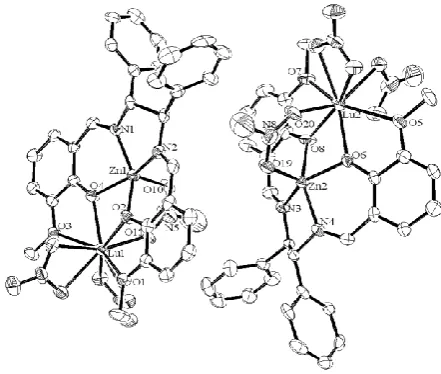
Figure 13 depicts structure of LuZn. Zn(II) ion affords a 5-coordinated square distorted pyramidal geometry lifted up towards axial methanol ligands and Lu(III) ion affords a 9-coordinated environment with distorted square pyramidal towards bridging nitrate ligands. Phenyl gruops connected to asymmetirc carbon atoms indicate slight distortion with C40-C39-C54-C55 = 56.0(8) and C25-C24-C9-C10 = 65.4(8) °.
Conclusion
In summary, we have prepared and structurally characterized seven 3d-4f binuclear complexes incorporating chiral salen-type Schiff base ligands. According to lanthanide contraction, the order of ion radii for the present 4f ions are Lu(III) (4f14) < Pr(III) (4f2) < Ce(III) (4f1). For 4f ions, Ce-complexes and Pr-complexes adopted coordination number 10, which are
Figure 13. Molecular structures of LuZn showing selected atom labeling scheme. Hydrogen atoms are omitted clarity. Selected bond distance (Å) and bond or torsion angles (°): Zn1-N1 = 2.004(6), Zn1-N2 = 2.021(6), Zn1-O2 = 1.999(5), Zn1-O4 = 2.014(5), Lu1-O1 = 2.562(5), Lu1-O2 = 2.282(5), Lu1-O3 = 2.603(5), Lu1-O4 = 2.229(6), Zn2-N3 = 2.041(6), Zn2-N4 = 2.016(6), Zn2-O6 = 2.019(5), Zn2-O8 = 2.011(5), Lu2-O5 = 2.627(6), Lu2-O6 = 2.232(5), Lu2-O7 = 2.568(5), Lu2-O8 = 2.238(5), N1-Zn1-N2 = 83.2(2), Zn1-N1 = 143.7(2), O2-Zn1-N2 = 91.5(2), O2-Zn1-O4 = 77.4(2), O4-Zn1-N1 = 91.0(2), O4-Zn1-N2 = 152.6(2), O1-Lu1-O2 = 61.9(2), O1-Lu1-O3 = 151.5(2), O1-Lu1-O4 = 127.8(2), Lu1-O3 = 127.7(2), O2-Lu1-O4 = 67.6(2), O3-O2-Lu1-O4 = 62.7(2), N3-Zn2-N4 = 82.2(2), O6-Zn2-N3 = 141.7(2), O6-Zn2-N4 = 90.6(2), O6-Zn2-O8 = 77.4(2), O8-Zn2-N3 = 89.9(2), O8-Zn2-N4 = 149.3 (2), O5-Lu2-O6 = 61.6(2), O5-Lu2-O7 = 149.9(2), O5-Lu2-O8 = 124.6(2), O6-Lu2-O7 = 130.1(2), O6-Lu2-O8 = 68.6(2), O7-Lu2-O8 = 62.0(2).
similar to analogous 3d-4f complexes previously reported.17-18,20-21 However, Lu-complexes are 10-coordinated for LuNi, 9- and 10-coordinated for LuCu, and 9-coordinated for LuZn. Moreover, bridging modes of nitrate ligands of CeCu and LuCu (and resulting dimeric structure) are different from other complexes. For 3d ions, axial coordination of methanol ligands and degree of distortion from planar basal plane exhibited variety among the complexes. Therefore, the present examples of appropriate combination of 3d-4f ions only by substituting three 3d ions and three 4f ions indicated drastic variety of crystal structures including crystalline solvents nevertheless of the identical chiral organic ligands.
Supplementary data
CCDC 864541‐864545 contain the supplementary crystallographic data. These data can be obtained free of
charge via
http://www.ccdc.cam.ac.uk/conts/retrieving.html, or from the Cambridge Crystallographic Data Centre, 12 Union Road, Cambridge CB2 1EZ, UK; fax: (+44) 1223-336-033; or e-mail: [email protected].
Acknowledgements
References
1Yang, X.-P., Jones, R. A., Wong, W.-K., Lynch, V., Oye, M., M., Holmes, A. L., Chem. Commun., 2006, 1836.
2Burrow, C. E., Burchell, T. J. Lin, P.-H. Habib, P., Wernsdorfer, W. Clerac, R., Murugesu, M.,Inorg. Chem., 2009, 48, 8051.
3Wong, W.-K. Yang, X., Jones, R. A., Rivers, J. H., Lynch, V., Lo, W.-K., Xiao, D., Oye, M. M., Holmes, A. L., Inorg. Chem., 2006, 45, 4340.
4Pasatoiu, T. D., Madalan, A. M., Kumke, M. U., Tiseanu, C., Andruh, M., Inorg. Chem., 2010, 49, 2310.
5Andruh, M., Costes, J.-P., Diaz, C., Gao, S., Inorg. Chem., 2009, 48, 3342.
6Colacio, E., Ruiz, J., Mota, A. J., Palacios, M. A., Cremades, E., Ruiz, E., White, F. J., Brechin, E. K., Inorg. Chem., 2012, 51, 5857.
7Yan, P.-F., Lin, P.-H. Habib, F. Aharen, T. Murugesu, M. Deng, Z.-P. Li, G.-M., Sun W.-B., Inorg. Chem., 2011, 50, 7059. 8Colacio, E., Ruiz-Sanchez, J., White, F. J., Brechin, E. K..,
Inorg. Chem., 2011, 50, 7268.
9Jana, A., Majumder, S., Carrella, L., Nayak, M., Weyhermueller, T., Dutta, S. Schollmeyer, D., Rentschler, E., Koner, R. Mohanta, S., Inorg. Chem., 2010, 49, 9012. 10Feltham, H. L. C., Clerac, R., Ungur, L. Vieru, V. Chibotaru,
L. F., Powell, A. K., Brooker, S., Inorg. Chem., 2012, 51, 10603.
11Margeat, O., Lacroix, P. G., Costes, J. P., Donnadieu, B., Lepetit, C., Inorg. Chem., 2004, 43, 4743.
Gomez, V., Vendier, L., Corbella, M., Costes, J.-P., Inorg. Chem., 2012, 51, 6396.
13Figuerola, A., Diaz, C., Ribas, J., Tangoulis, V., Granell, J., Lloret, F., Mahia, J., Maestro, M., Inorg. Chem., 2003, 42, 641.
14Li, G., Akitsu, T., Sato, O., Einaga, Y., J. Am. Chem. Soc., 2003, 125, 12396.
15Svendsen, H., Overgaard, J., Chevallier, M., Collet, E., Iversen, B.B., Angew. Chem. Int. Ed., 2009, 48, 2780.
16Akitsu, T., Asian Chem. Lett., 2010, 14, 53 and references therein.
17Akitsu, T., Hirarsuka, T., Shibata, H., Magnets: Types, Uses and Safety, Nova Science Publishers, 2012 and references therein.
18Hirarsuka, T., Shibata, T. Akitsu, H., Crystallography: Research, Technology and Applications, Nova Science Publishers, 2012 and references therein.
19Sheldrick, G. M., Acta Cryst., 2008, A64, 112.
20Bi, W.-Y., Lu, X.-Q., Chai, W.-L., Song, J.-R., Wong, W.-Y., Wong, W.-K., Jones, R. A., J. Mol. Struct., 2008,891, 450. 21Bi, W.-Y., Lu, X.-Q., Chai, W.-L., Jin, W.-J., Song, J.-R., Wong, W.-K., , Inorg. Chem. Commun., 2008, 11, 1316.