Research Article
July
2017
Computer Science and Software Engineering
ISSN: 2277-128X (Volume-7, Issue-7)
Cloud Computing : Security Issues And Resource
Allocation Policies
1
Gaurav Sharma (Research Scholar)
,
2Urvashi Garg, A.P
,
3Arun Jain, A.P., 4Loveleena Mukhija, A.P
1, 2
Department of Computer Science & Engineering, H.C.T.M. Kaithal, Haryana, India
3, 4
Department of Computer Science, P.M.N. College, Rajpura, Punjab, India
DOI: 10.23956/ijarcsse/V7I7/0116
Abstract: Cloud computing is the combination of distributed computing, grid computing and parallel technologies which define the shape of a new era. In this technology client data is stored and maintain in the data center of a cloud provider like Google, Amazon and Microsoft etc. It has inherited the legacy technology and including unique ideas. Industries, such as education, banking and healthcare are moving towards the cloud due to the efficiency of services such as transactions carried out, processing power used, bandwidth consumed, data transferred etc. There are various challenges for adopting cloud computing such as privacy ,interoperability, managed service level agreement (SLA) and reliability. In this paper we survey challenges in resources allocation and the security issues of the cloud environment.
Keywords: Cloud Computing, Allocation of resources, Architecture, IAAS, Cloud Platforms, Security.
I. INTRODUCTION
Cloud computing is the technology which is related to development of parallel computing, grid computing , distributed computing etc. It is evolution of Virtualization, Software-as-a-Service (SaaS), Infrastructure-as-a-Service (IaaS) and Platform-as-a-Service (PaaS) computing,. Cloud computing is a distributed computing paradigm offering on-demand admission to large-scale computing resources for data intensive computations [1]. Cloud computing has be come appealing because clients wage as they use resources on demand, as providers are able to present the illusion of infinite resources to such clients. Cloud computing is a practical approach of direct cost benefits. Cloud computing has the potential to transform a data center from a capital-intensive set up to a variable priced environment. We elucidate a cloud to mean a area datacenter presenting a expansive collection of hosting ser- vices established, e.g., virtualization, or multimedia services. This includes area cloud providers such as Amazon EC2 [2], Google AppEngine, Microsoft Azure, etc.
Cloud Providers offer services that can be grouped into three categories. These services are SaaS, PaaS and IaaS. In Software as a Service (SaaS), a complete application is offered to the customer, as a service on demand. A single instance of the service runs on the cloud & multiple end users are serviced. On the customer’s side, there is no need for upfront investment in servers or software licenses, while for the provider, the costs are lowered, since only a single application needs to be hosted & maintained. Today SaaS is offered by companies such as Google, Salesforce, Microsoft, Zoho etc. In Platform as a Service (PaaS), a layer of software, or development environment is encapsulated & offered as a service, upon which other higher levels of service can be built. The customer has the freedom to build his own applications, which run on the provider’s infrastructure. To meet manageability and scalability requirements of the applications, PaaS providers offer a predefined combination of OS and application servers, such as LAMP platform (Linux, Apache, MySql and PHP), restricted J2EE, Ruby etc. Google‟s App Engine, Force.com, etc are some of the popular PaaS examples. In third category, Infrastructure as a Service (Iaas) provides basic storage and computing capabilities as standardized services over the network. Servers, storage systems, networking equipment, data centre space etc. are pooled and made available to handle workloads. The customer would typically deploy his own software on the infrastructure. Some common examples are Amazon, GoGrid, 3 Tera, etc.
As shown in figure 1, the basic architecture of cloud computing includes three layers. First layer includes the service layer[17]. This layer is interfaced with the another layer known as cloud specific infrastructure with the help of network. The third layer supports the infrastructure and known as supporting (IT) infrastructure. In this paper we review different research papers related to cloud computing and emphasise to use methods from option pricing [3] to mitigate the chance of worth variation in spot markets. The objecticve is to find out the methods of least cost with good quality work. The main believed is to use a combination of spot and option instances to design the workload .The client can buy a number of options at a fixed worth beforehand the job starts. This is like an insurance policy. We say a spot instance fails after the worth goes above the user bid. Whenever such event occurs, the client exerts an option that protects the client againts worth variation[18,19]. At supplementary instances, the client can tolerate employing usual spot instances. As a consequence all the worth hikes are flattened out alongside a manipulated worth variation due to the options.
ISSN(E): 2277-128X, ISSN(P): 2277-6451, DOI: 10.23956/ijarcsse/V7I7/0116, pp. 176-181
it is a extra flexible form of pricing than demand. There can be periods after the demand is so elevated that the on-demand worth is low. As option benefits additionally fluctuate, it definitely retains the congestion manipulation property of spot benefits.
Figure 1: The basic architecture of Cloud Computing.
Using these thoughts, in the pricing models, there are generally two kinds of options that are extra popular. European options can merely be utilized at expiration, whereas American options can be utilized at each period beforehand expiration. As European options are extra amenable to mathematical research, we use them to statistically describe the finished worth for employing options for cloud resource allocation. On the supplementary hand, American options are extra useful, and we use them to develop an effectual on-line resource allocation strategy that we contrasted opposing base-line strategies that use merely spot instances[20,21]. Trace-driven simulation aftermath display that the option strategy can considerably cut finished worth variation for cloud users.
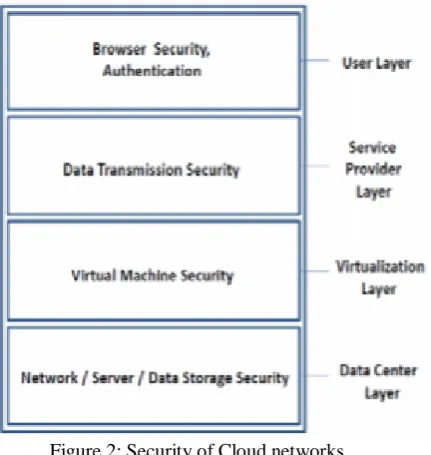
Figure 2: Security of Cloud networks.
We accept the spot instance ideal counseled in whereas every single spot instance for new amazon computing resources is believed as a distinct spot market. Every single physical contraption runs several kinds of adjacent contraption instances, a little of that are on-demand or kept instances, as others are spot instances. All the spot marketplaces allocate the alike new computational resource pool. In finish, Amazon’s spot instance mechanism works in a constant fashion. A spot instance can onset running as quickly as a appeal alongside presenting worth higher than the present spot worth is submitted. Hypothetically this can be requested by possessing the instance alongside higher proposal worth preempt the one alongside lower proposal worth, if there is merely plenty resources for one instance. As shown in figure 2, security is required at every level whether it is browser security or data transmission security or server’s security.
ISSN(E): 2277-128X, ISSN(P): 2277-6451, DOI: 10.23956/ijarcsse/V7I7/0116, pp. 176-181
II. POPULAR CLOUD COMPUTING PLATFORMS
Some popular cloud computing platforms are: a) Abicloud [5] platformt can be used to build, integrate and manage public as well as private cloud in the homogeneous environments. By using this platform, user can easily manage the server, storage system, network, virtual devices and applications and so on. The difference between Abicloud and other cloud computing platforms is its powerful web-based management function and its core encapsulation manner. User can finish deploying a new service by just dragging a virtual machine with mouse in this platform[23,24]. This is much easier and flexible than other cloud computing platforms that deploy new services through command lines. Abicloud can be used to deploy and implement private cloud as well as hybrid cloud according to the cloud providers’ request and configuration. It can also manage EC2 according to the rules of protocol. Besides, apply the Abicloud, a whole cloud platform based on Abicloud can be packed and redeployed at any other Abicloud platform. This is much helpful for the transformation of the working environment and will make the cloud deployment process much easier and flexible.
b) Eucalyptus (Elastic Utility Computing Architecture for Linking Your Programs to Useful Systems) [5] was used to build open-source private cloud platform. Eucalyptus is an elastic computing structure that can be used to connect the users' programs to the useful systems, it is an open-source infrastructure using clusters or workstation implementation of elastic, utility, cloud computing and a popular computing standard based on a service level protocol that permit users lease network for computing capability. Currently, Eucalyptus is compatible with EC2 from Amazon, and may support more other kinds of clients with minimum modification and extension.
c) Nimbus [5] is an open tool set and also a cloud computing solution providing IaaS. It permits users lease remote resources and build the required computing environment through the deployment of virtual machines. Generally, all these functional components can be classified as three kinds. One kind is client- supported modules which are used to support all kinds of cloud clients. Context client module, cloud client module, reference client module and EC2 client module are all belonging to this kind of component. The second kind of component is mainly service-supported modules of cloud platform, providing all kinds of cloud services. It includes a context agent module, web service resource framework module, EC2 WSDL module and a remote interface module. The third kind of component is the background resource management modules which are mainly used to manage all kinds of physical resources on the cloud computing platform, including work service management module, IaaS gateway module, EC2 and other cloud platform support module, workspace pilot module, workspace resource management module and workspace controller.
Table 1: Various Platforms.
d) OpenNebula [5] is also an open source cloud service framework. It allows user deploy and manage virtual machines on physical resources and it can set user’s data centers or clusters to flexible virtual infrastructure that can automatically adapt to the change of the service load.
The main difference of OpenNebula and nimbus is that nimbus implements remote interface based on EC2 or WSRF through which user can process all security related issues, while OpenNebula does not. OpenNebula is also an open and flexible virtual infrastructure management tool, which can use to synchronize the storage, network and virtual techniques and let users dynamically deploy services on the distributed infrastructure according to the allocation strategies for data center and remote cloud resources. Comparison of the various platforms are shown in Table 1.
III. RELATED WORK
ISSN(E): 2277-128X, ISSN(P): 2277-6451, DOI: 10.23956/ijarcsse/V7I7/0116, pp. 176-181
resource procurement: cloud-dominant strategy incentive compatible DSIC), cloud-Bayesian incentive compatible (C-BIC), and cloud optimal (C-OPT). C-DSIC is dominant strategy incentive compatible, based on the VCG mechanism, and is a low-bid Vickrey auction. C-BIC is Bayesian incentive compatible, which achieves budget balance. C-BIC does not satisfy individual rationality. In C-DSIC and C-BIC, the cloud vendor who charges the lowest cost per unit QoS is declared the winner. A cloud broker with such a procurement module enables users to automate the choice of a cloud vendor among many with diverse offerings, and is also an essential first step toward implementing dynamic pricing in the cloud.
Zuling Kang et al, in "A Novel Approach to Allocate Cloud Resource with Different Performance Traits" 2013 [7], the authors describe In a typical cloud computing environment, there will always be different kinds of cloud resources and a number of cloud services making use of cloud resources to run on. As they can see, these cloud services usually have different performance traits. Some may be IO-intensive, like those data querying services, while others might demand more CPU cycles, like 3D image processing services. Meanwhile, cloud resources also have different kinds of capabilities such as data processing, IO throughput, 3D image rendering, etc. A simple fact is that allocating a suitable resource will greatly improve the performance of the cloud service, and make the cloud resource itself more efficient as well. So it is important for the providers to allocate cloud resources based on the fitness of performance traits between resources and services. In this paper, they introduce a new cloud resource allocating algorithm, which creates a market for cloud resources and makes the resource agents and service agents bargain in that market.
Chunguang Wang et al, in "VCE-PSO: Virtual Cloud Embedding through a Meta-heuristic Approach" 2013 [8], the authors describe Resource allocation, an integral and continuously evolving part of cloud computing, has been attracting a lot of researchers in recent years. However, most of current cloud systems consider resource allocation only as placement of independent virtual machines, ignoring the performance of a virtual machine is also depending on other cooperating virtual machines and also the net links utilization, which result in a poor efficient resource utilization. In this paper, they propose a novel model Virtual Cloud Embedding (VCE) to formulate the cloud resource allocation problem. VCE regards each resource request as an integral unit rather than independent virtual machines including their link constraints. To address the VCE problem, they develop a meta-heuristic algorithm VCE-PSO, which is based on particle swarm optimization algorithm, to allocate multiple resources as a unit considering the heterogeneity of cloud infrastructure and variety of resource requirements.
Rong Yu et al, in "Toward cloud-based vehicular networks with efficient resource management" 2013 [9], the authors describe In the era of the Internet of Things, all components in intelligent transportation systems will be connected to improve transport safety, relieve traffic congestion, reduce air pollution, and enhance the comfort of driving. The vision of all vehicles connected poses a significant challenge to the collection and storage of large amounts of traffic-related data. In this article, they propose to integrate cloud computing into vehicular networks such that the vehicles can share computation resources, storage resources, and bandwidth resources. The proposed architecture includes a vehicular cloud, a roadside cloud, and a central cloud.
Parikh, S.M. in "A survey on cloud computing resource allocation techniques" 2013 [10], the authors describe Cloud Computing is a type of computing which can be considered as a new era of computing. Cloud can be considered as a rapidly emerging new paradigm for delivering computing as a utility. In cloud computing various cloud consumers demand variety of services as per their dynamically changing needs. So it is the job of cloud computing to avail all the demanded services to the cloud consumers[11]. But due to the availability of finite resources it is very difficult for cloud providers to provide all the demanded services. From the cloud providers' perspective cloud resources must be allocated in a fair manner.
Sheng Di et al, in "Adaptive Algorithm for Minimizing Cloud Task Length with Prediction Errors" 2014 [12], the authors describe Compared to traditional distributed computing like grid system, it is non-trivial to optimize cloud task's execution performance due to its more constraints like user payment budget and divisible resource demand. In this paper, they analyze in-depth their proposed optimal algorithm minimizing task execution length with divisible resources and payment budget: 1) They derive the upper bound of cloud task length, by taking into account both workload prediction errors and hostload prediction errors. With such state-of-the-art bounds, the worst-case task execution performance is predictable, which can improve the quality of service in turn. 2) They design a dynamic version for the algorithm to adapt to the load dynamics over task execution progress, further improving the resource utilization. 3) They rigorously build a cloud prototype over a real cluster environment with 56 virtual machines, and evaluate their algorithm with different levels of resource contention.
Kumar, A. et al, in "An efficient framework for resource allocation in cloud computing" 2013 [13], the authors describe Presently Cloud Computing is on high demand as it provides a way to reduce the cost of building infrastructure through virtualization of resources. Virtualization of resources requires a highly dynamic resource management mechanism. As cloud computing provides the facility to the cloud users to send multiple request simultaneously, there must be a self managing/provisioning scheme that all resources are made available to the requesting users in the efficient manner to satisfy their requirement and for improvement of resource utilization. In this paper they proposed an efficient framework named called EARA (Efficient Agent based Resource Allocation) for resource allocation based on agent computing on SaaS level in Cloud Computing. EARA Contain five different agents, each agent equipped with functionality to collect information regarding all resources available in actual cloud deployment based on signed SLA agreement, and then replies to the user with appropriate allocation or response code.
ISSN(E): 2277-128X, ISSN(P): 2277-6451, DOI: 10.23956/ijarcsse/V7I7/0116, pp. 176-181
resource allocation, in processing user requests with composite services. Our contribution is three-fold. (1) They devise a VM resource allocation scheme with a minimized processing overhead for task execution. (2) They comprehensively investigate the best-suited task scheduling policy with different design parameters. (3) They also explore the best-suited resource sharing scheme with adjusted divisible resource fractions on running tasks in terms of Proportional-Share Model (PSM)[25], which can be split into absolute mode (called AAPSM) and relative mode (RAPSM). They implement a prototype system over a cluster environment deployed with 56 real VM instances, and summarized valuable experience from their evaluation. As the system runs in short supply, Lightest Workload First (LWF) [15] is mostly recommended because it can minimize the overall response extension ratio (RER) for both sequential-mode tasks and parallel-mode tasks.
IV. CLOUD COMPUTING CHALLENGES
Despite its growing influence, concerns regarding cloud computing still remain. In our opinion, the benefits outweigh the drawbacks and the model is worth exploring. Some common challenges are:
1. Data Protection Data Security is a crucial element that warrants scrutiny. Enterprises are reluctant to buy an assurance of business data security from vendors. They fear losing data to competition and the data confidentiality of consumers. In many instances, the actual storage location is not disclosed, adding onto the security concerns of enterprises. In the existing models, firewalls across data centers (owned by enterprises) protect this sensitive information. In the cloud model, Service providers are responsible for maintaining data security and enterprises would have to rely on them.
2. Data Recovery and Availability All business applications have Service level agreements that are stringently followed. Operational teams play a key role in management of service level agreements and runtime governance of applications. In production environments, operational teams support Appropriate clustering and Fail over Data Replication System monitoring (Transactions monitoring, logs monitoring and others) Maintenance (Runtime Governance) Disaster recovery Capacity and performance management If, any of the above mentioned services is under-served by a cloud provider, the damage & impact could be severe.
3. Management Capabilities Despite there being multiple cloud providers, the management of platform and infrastructure is still in its infancy. Features like „Auto-scaling‟ for example, are a crucial requirement for many enterprises. There is huge potential to improve on the scalability and load balancing features provided today.
4. Regulatory and Compliance Restrictions In some of the European countries, Government regulations do not allow customer's personal information and other sensitive information to be physically located outside the state or country. In order to meet such requirements, cloud providers need to setup a data center or a storage site exclusively within the country to comply with regulations. Having such an infrastructure may not always be feasible and is a big challenge for cloud providers[25].
V. CONCLUSION AND FUTURE SCOPE
In spite of the several limitations and the need for better methodologies processes, cloud computing is becoming a hugely attractive paradigm, especially for large enterprises. In this paper, we survey frameworks that furnish such architectural principles for energy-efficient Cloud computing. As delineated in our discover the data centers hosting Cloud requests consume huge numbers of mechanical domination, adding to elevated operational prices and carbon impressions into the environment. Therefore, we honestly demand Cloud computing resolutions that cannot just minimize prices that are operational additionally cut the encounter that is environmental. This paper discussed the architecture and popular platforms of cloud computing. It also addressed challenges and issues of cloud computing in detail. Cloud computing has the potential to become a frontrunner in promoting a secure,virtual and economically viable IT solution in the future.
REFERENCES
[1] T. Dillon, C. Wu, and E. Chang, “Cloud Computing: Issues and Challenges,” 2010 24th IEEE International Conference on Advanced Information Networking and Applications(AINA), pp. 27-33, DOI= 20-23 April 2010. [2] Buyya, Rajkumar, Chee Shin Yeo, and Srikumar Venugopal. "Market-oriented cloud computing: Vision, hype, and reality for delivering it services as computing utilities." In High Performance Computing and Communications, 2008. HPCC'08. 10th IEEE International Conference on, pp. 5-13. Ieee, 2008.
[3] Marston, Sean, Zhi Li, Subhajyoti Bandyopadhyay, Juheng Zhang, and Anand Ghalsasi. "Cloud computing— The business perspective." Decision Support Systems 51, no. 1 (2011): 176-189.
[4] Wu, Linlin, Saurabh Kumar Garg, and Rajkumar Buyya. "Sla-based resource allocation for software as a service provider (saas) in cloud computing environments." In Cluster, Cloud and Grid Computing (CCGrid), 2011 11th IEEE/ACM International Symposium on, pp. 195-204. IEEE, 2011.
[5] S. Zhang, S. F. Zhang, X. B. Chen, and X. Z. Huo, “Cloud Computing Research and Development Trend,” In Proceedings of the 2010 Second International Conference on Future Networks (ICFN '10). IEEE Computer Society, Washington, DC, USA, pp. 93-97. DOI=10.1109/ICFN.2010.
[6] Prasad, A.S.; Rao, S.,"A Mechanism Design Approach to Resource Procurement in Cloud Computing",IEEE,Computers, IEEE Transactions on,2014
ISSN(E): 2277-128X, ISSN(P): 2277-6451, DOI: 10.23956/ijarcsse/V7I7/0116, pp. 176-181
[8] Chunguang Wang; Qingbo Wu; Yusong Tan; Deke Guo; Quanyuan Wu,"VCE-PSO: Virtual Cloud Embedding through a Meta-heuristic Approach",IEEE,High Performance Computing and Communications & 2013 IEEE International Conference on Embedded and Ubiquitous Computing (HPCC_EUC), 2013 IEEE 10th International Conference on,2013
[9] Rong Yu; Yan Zhang; Gjessing, S.; Wenlong Xia; Kun Yang,"Toward cloud-based vehicular networks with efficient resource management",IEEE,Network, IEEE,2013
[10] Parikh, S.M.,"A survey on cloud computing resource allocation techniques",IEEE,Engineering (NUiCONE), 2013 Nirma University International Conference on,2013
[11] P. Kalagiakos “Cloud Computing Learning,” 2011 5th International Conference on Application of Information and Communication Technologies (AICT), Baku pp. 1 - 4, DOI=12-14 Oct. 2011.
[12] Sheng Di; Cho-Li Wang; Cappello, F.,"Adaptive Algorithm for Minimizing Cloud Task Length with Prediction Errors",IEEE,Cloud Computing, IEEE Transactions on,2014
[13] Kumar, A.; Pilli, E.S.; Joshi, R.C.,"An efficient framework for resource allocation in cloud computing",IEEE,Computing, Communications and Networking Technologies (ICCCNT),2013 Fourth International Conference on,2013
[14] Di. S.; Kondo, D.; Wang, C.,"Optimization of Composite Cloud Service Processing with Virtual Machines",IEEE,Computers, IEEE Transactions on,2014
[15] Srinivasa, K.G.; Kumar, K.S.; Kaushik, U.S.; Srinidhi, S.; Shenvi, V.; Mishra, K.,"Game theoretic resource allocation in cloud computing",IEEE,Applications of Digital Information and Web Technologies (ICADIWT), 2014 Fifth International Conference on the,2014.
[16] A. K. Bhardwaj, R. Mahajan and Surinder, “Improved Load Management In Cloud Environment Using MHT Algorithm”, published in, “Int’l J. of Control Theory and Applications (2016) ” Vol. 9(22), pp. 301-305. [17] A.K Bhardwaj, R. Mahajan and Surender, “TTP based Vivid Protocol Design for Authentication and Security
for Cloud”, published in IEEE Xplore (2016); pp. 3275-3278.
[18] A. Kumar, Surender and R. Mahajan, “A Modified Heuristic-Block Protocol Model for Privacy and Concurrency in Cloud”, Published in International Journal of Advanced Computer Science and Applications (IJACSA) (2015), Vol. 6, No. 9, Pg. 179-184.
[19] Pawan Kumar, S. Singh and Surender Jangra, “Design and Implementation of Encryption based Data Security Algorithm for Cloud Environments ”, Published in, “Int’l J. of Control Theory and Applications (2017)”, Vol. 10, Issue No. 15, Pg. 163-171.
[20] Vishal, Bikrampal Kaur and Surender Jangra, “Protection and Security Models for Mobile Cloud Computing: A Review” ” published in “Int’l J. of Engineering and Management Research [IJEMR]”, Vol. 7, Issue 3, May-June 2017, Pg. 695-700, ISSN (Online): 2250-0758, ISSN (Print): 2394-6962.
[21] Naveen Garg, Sanjay Singla and Surender, “Challenges and Techniques for Testing of Big” published in the Journal, “Procedia Computer Science (Elsevier)”, 85 (2016), Pg. 940-948, DOI: 10.1016/j.procs.2016.05.285, ISSN: 1877-0509.
[22] Surender, Sachin Kumar and Shashi Bhushan, “Study of Attacks & Countermeasures on Layers of Wireless Sensor Networks”, Published in, “Int’l J. of Control Theory and Applications”, Vol. 10 (2017), Issue No. 15, Pg. 153-162, ISSN: 0974-5572.
[23] Sharma, P.K., Mahajan, R. & Surender, “A Security Architecture Attacks Detection and Authentication in Wireless Mess Network” Cluster Computing (2017). doi:10.1007/s10586-017-0970-9.
[24] Parveen Kumar Sharma, Rajiv Mahajan and Surender, “Authentication based Secure Protocol using TTP for Wireless Mobile Networks” published in IEEE Explore (2016), Pg. 3286-3290.