Thyroid Dysfunction and Choleduocholithiasis
ABSTRACT
BACKGROUND
Disturbances in lipid metabolism which occur during hypothyroidism lead to the formation of gallstones. This study aims to evaluate the thyroid function pattern in patients with common bile duct (CBD) stones.
METHODS
This case-control study recruited 151 patients with preliminary diagnoses of CBD stone who underwent ERCP (cases). The control group comprised healthy people who met the study criteria in the same hospital. The control group underwent ultrasonography to exclude any asymptomatic bile duct li-thiasis. A questionnaire that included demographic and anthropometrics data were completed by an assigned physician. Morning blood samples that fol-lowed 12 hours of fasting were taken from all participants for measurements of serum total thyroxin (T4), serum thyroid stimulating hormone (TSH), fasting blood sugar (FBS), triglycerides (TG), total cholesterol, low density lipopro-tein (LDL) and high density lipoprolipopro-tein (HDL).
RESULTS
The mean TSH in patients (2.59 ± 4.86mg/dl) was higher than the control group (2.53± 4.13 9mg/dl). In subclinical hypothyroidism, serum TSH levels higher than 5 MU/L were found in 30.6% of cases compared with 22.5% of controls [OR: 1.53; 95 % confidence interval (95% CI): 0.968-2.438). Hypo -thyroidism was detected in 10.8% of the control group and in 11.3% of cases (OR: 1.87; 95% CI: 0.578-2.043). The mean total cholesterol levels in cases was higher than the control group (p=0.61).The levels of TG (p=0.05), HDL (73.35 vs. 46.41; p<0.01) and LDL (64.81.88 vs. 111.04; p<0.01) was statisti-cally significant between both groups.
CONCLUSION
There is an association between thyroid disorders and the presence of bile duct stones. Thyroid testing in patients with gallstone and bile duct stones is recommended because hypothyroidism may be a predisposing factor for stone passage from the gallbladder.
KEYWORDS
Choledocholithiasis; Thyroid hormones; Obesity 1. Gastrointestinal and Liver Disease
Research Center (GILDRC), Firoozgar Hospital, Iran University of Medical Sciences, Tehran, Iran
Hossein Ajdarkosh1, Mohammad Reza Khansari1, Masoud Reza Sohrabi1, Gholam Reza Hemasi1,
Najmeh Shamspour1, Nafiseh Abdolahi1, Farhad Zamani1*
INTRODUCTION
Cholelithiasis is a prevalent abdominal disorder resulting in hospital admissions in Western countries. The prevalence of cholelithiasis has
* Corresponding Author: Farhad Zamani, MD
Associate Professor of Medicine, Gastroin-testinal and Liver Disease Research Center, Firoozgar Hospital, Tehran University of Medical Sciences, Tehran, Iran
Tel: + 98 21 88940489 Fax: +98 21 88941831
Email: [email protected] Received: 28 Apr. 2013
Accepted: 10 Jun. 2013
Please cite this paper as:
Ajdarkosh H, Khansari MR, Sohrabi MR, Hemasi GR, Shamspour N, Abdolahi N, Zamani F. Thyroid Dysfunction and Choleduocholithiasis. Middle East J Dig Dis 2013;5:141-5.
been reported as approximately 5%-26% in differ-ent countries.1 The prevalence of cholelithiasis in
Iran is approximately 5%, however one survey on the prevalence of cholelithiasis in Iranian cadavers has been reported it at 6.3%.2 The pathogenesis of
cholelithiasis is not unique, but appears to be mul-tifactorial.1,3 It has been shown that disturbances in
lipid metabolism that occur during hypothyroidism, particularly cholesterol pathway, changes the rate of bile excretion and lead to the formation of gall stones. Recently, the pro-relaxing effect of serum total thyroxin (T4) on both human and pig sphincter of Oddi (SO) has been proven.4,5 Possibly, the lack
of T4 may contribute to SO contractility which in
turn not only disturbs the normal bile flow but also
prohibits the passage of stones formed in the gall-bladder to the duodenum. Some researchers have reported a higher prevalence of both hypothyroid-ism and subclinical hypothyroidhypothyroid-ism in common bile duct (CBD) stones which supports a possible
relation between low T4 levels and CBD stones.5,6
To our knowledge there are only few published articles that have discussed the prevalence of un-diagnosed subclinical hypothyroidism among CBD patients. The current study investigates the preva-lence of clinical and subclinical hypothyroidism in patients with CBD stones.
MATERIALS AND METHODS
This case–control study conducted from Janu-ary 2008 to FebruJanu-ary 2012 enrolled 151 eligible patients with preliminary diagnoses of CBD stones who underwent ERCP at Firoozgar Hospital, Teh-ran, Iran.
Excluded were patients with a history of previ-ously diagnosed or treated thyroid function abnor-malities, history of thyroidectomy, pregnancy, se-rious underlying diseases, sepsis or cholanlangitis and those prescribed medications known to affect the thyroid function test such as phenytoin, carbam-azepin, metoclopramide, amiodarone, and lithium. The control group consisted of healthy individu-als with no history of liver diseases such as eleva-tions in liver enzymes. They were clinically euthy-roid and matched by sex and age. In order to ensure
that the control group did not have asymptomatic bile duct stones, all participants underwent abdomi-nal ultrasonography that was performed with a high resolution instrument (5 MHz transducer, Mylab50, The Netherlands). Excluded were subjects who had a history of cholecystectomy. Other exclusion crite-ria were as the same as for the case group.
A physician directly interviewed each individual and a questionnaire that included demographic and anthropometric data, past and present medical his-tories, drug history, and hypothyroidism symptoms was completed for each subject. A written informed consent was also signed. Morning blood samples were taken after 12 hours of fasting to measure se-rum total thyroxin (T4), sese-rum thyroid stimulating hormone (TSH), fasting blood sugar (FBS), triglyc-eride (TG), total cholesterol, low density lipoprotein (LDL) and high density lipoprotein (HDL) levels. Blood samples were taken at a central laboratory in Firoozgar Hospital. Serum T4 and TSH were
mea-sured by an immunofluorometric method. The nor -mal range for serum T4 was 6-12 Mu/l; for TSH, it was 0.25-5 Mu/ml. The colorimetery method (Bio-system, Spain) was used for the remainder of labo-ratory analyses. Body weight (kg) and height (m) were precisely measured and the body mass index (BMI) was calculated by dividing a participant’s weight to the square of their height. All laboratory results were analyzed by an expert endocrinologist who was blinded to the study groups.
Subclinical hypothyroidism is defined as periph -eral thyroid hormone levels that are within the nor-mal range in the presence of mildly elevated serum TSH (between 5 to 10 Mu/ml). Hypothyroidism is characterized by an elevated TSH of over 10 Mu/ ml.7 In case of borderline TSH levels, serum T4 and
patients’ symptoms were used to determine thyroid function. Subjects with FBS greater than 126 mg/dl
, confirmed by repeated measurement, were consid -ered as diabetic.8 Dyslipidemia was defined as LDL
levels greater than 130 mg/dl in diabetics and great-er than 100 mg/dl in non-diabetics, HDL levels less than 50 mg/dl in females and less than 40 mg/dl in males, and TG more than 150 mg/dl. Initially we included all patients who had preliminary diagnoses
of CBD stones; subsequently we excluded those
whose ERCP findings were compatible with dis -eases other than CBD stones.
Statistical analyses were done by SPSS version 16.0. Quantitative data were expressed as mean ± standard deviation (SD). P-values less than 0.05
were considered to be significant. We used the
Mann-Whitney u and independent t-tests for com-parison between groups. For qualitative variables, cross-tables and the chi-square test were performed. The association between the presence of gallstones and risk factors was evaluated by multilevel
logis-tic regression. The significance level for multivari -ate analyses was 0.05. The risk of developing CBD stone was estimated by using odds ratios and the
95% confidence interval (CI).
This study was approved by the Ethical Commit-tee of the Gastrointestinal and Liver Disease Re-search Center at Firoozgar hospital and the Ethical Committee of Tehran University of Medical Sci-ences.
RESULTS
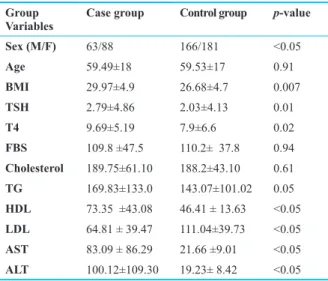
A total of 151 patients with mean age of 59.49±18.66 years comprised the case (CBD stone) group and 347 healthy individuals with a mean age of 59.53±17 years were in the control group. There were 58.6% females in the case group and 52.1.0% in the control group (Figure1). Mean BMI of cases was 29.97±4.90 kg/m² and mean BMI for control subjects was 26.68±4.75 kg/m².
The mean serum TSH levels among cases (2.79±4.86) was higher than controls (2.03±4.13;
p=0.01). Subclinical hypothyroidism was noted in
30.6% of cases and 22.5% of controls, whereas hy-pothyroidism was detected in 34 (10.8%) controls and 17 (11.3%) cases (Table 1). If those with serum TSH levels between 2.5 and 5.0 were considered at risk for subclinical hypothyroidism, then a dif-ference between case and control groups (p<0.05) was observed. The mean serum T4 levels between the case (9.69±5.19) and control (7.9±6.6) groups
was statistically significant (p<0.01). Subclinical hypothyroidism was found to be more prevalent in females in both groups (61.8 % for cases and 51.3% for controls).
This study evaluated a number of metabolic factors that included BMI, TG, HDL, LDL, and total cho-lesterol. There was a difference in BMI between cases (29.97±4.90) and controls (26.68±4.75;
p<0.01). The mean total cholesterol levels in cases was slightly higher than in controls, but was not
significant (p=0.61). There was a statistically
sig-nificant difference in HDL and LDL levels between
the two groups. According to bivariate analysis, cholesterol levels have an association with CBD
Fig. 1: Distribution of thyroid stimulating hormone (TSH) levels in case and control groups in relation to gender.
Table 1: Means of variables between case and control groups. Group
Variables Case group Control group p-value
Sex (M/F) 63/88 166/181 <0.05
Age 59.49±18 59.53±17 0.91
BMI 29.97±4.9 26.68±4.7 0.007
TSH 2.79±4.86 2.03±4.13 0.01
T4 9.69±5.19 7.9±6.6 0.02
FBS 109.8 ±47.5 110.2± 37.8 0.94
Cholesterol 189.75±61.10 188.2±43.10 0.61
TG 169.83±133.0 143.07±101.02 0.05
HDL 73.35 ±43.08 46.41 ± 13.63 <0.05
LDL 64.81 ± 39.47 111.04±39.73 <0.05
AST 83.09 ± 86.29 21.66 ±9.01 <0.05
ALT 100.12±109.30 19.23± 8.42 <0.05
BMI: Body mass index; TSH: Thyroid stimulating hormone; T4: Serum total thyroxin; FBS: Fasting blood sugar; TG: Triglycerides; HDL: High density lipoprotein; LDL: Low density lipoprotein
stones. The ratio of TG levels in the case and con-trol groups was 1.18 (p<0.05; Table1).
According to multivariate analysis, there was
no confirmed correlation between hypothyroidism
(95% CI: 0.968-2.438) and subclinical hypothy-roidism (95% CI: 0.578-2.043) with CBD stone.
However the TSH levels were significantly dif -ferent between both groups (OR: 3.07; 95% CI: 1.51-6.24), which could be a risk factor for the de-velopment of CBD stones. The potential risk for developing subclinical hypothyroidism showed no statistical association with CBD stone formation (OR:1.34; 95% CI: 0.790-2.279), although it might be considered a risk factor. There was no associa-tion between LDL and TG.
DISCUSSION
During last two decades the etiologies of choled-ocholithiasis have been evaluated more seriously. In addition to classic risk factors such as age, gen-der, obesity and genetics, the associations between CBD stones and delayed emptying of the biliary tract in hypothyroidism have been shown. This is related to lack of the prorelaxing effect of the thy-roid hormone on SO contractility.1-3 In this study we
have evaluated the prevalence of thyroid dysfunc-tion in patients with CBD stones.
Serum TSH is a hallmark of thyroid dysfunc-tion. The subclinical form of hypothyroidism is characterized by increased serum TSH levels along with normal serum FT4 levels and a lack of clini-cal symptoms. The mean TSH levels in the pres-ent study among the case group were higher than the control group. Although subclinical hypothy-roidism was more common in patients with CBD stones (OR: 1.53; 95% CI: 0.968-2.433), this
differ-ence was not significant. There were more females
with subclinical hypothyroidism in both groups in this study. This can possibly be attributed to the fact that females have usually been more considered to have thyroid dysfunction. A study by Laukkarinen has shown subclinical hypothyroidism to be a com-mon problem acom-mong patients with CBD stones. He concluded that hypothyroidism played a role in the formation of CBD stones secondary of its effects
on SO relaxation; which in turn might be influence
on emptying of the biliary system. The pro-relaxing effect of T4 on SO has been previously reported.4,6,9
In the present study, there was a close relation be-tween T4 levels according to binary analysis with choledolithiasis (p<0.01) which was similar to
ear-lier studies, however this was not confirmed in mul -tivariate analysis.5,9 Some studies have reported that
thyroxin replacement therapy has a positive effect on cholesterol level, cardiovascular, neuromuscular and choledolithiasis.10-14 We did not evaluate the
influence of thyroxin replacement therapy.
It is expected that increasing age increases sub-jects’ exposure to risk factors of CBD stones or thyroid dysfunctions. In our study there was no as-sociation between age and thyroid disorders which might be related to the number of patients. This cor-relation has been reported in different studies. In one study on cadavers there was a positive relation-ship between age and prevalence of cholelithiasis.2
According to different studies, among the elderly, the rate of hyperthyroidism was 2.1-6% and for hy-pothyroidism it was 2.0-2.9%. The prevalence of subclinical hypothyroidism in women older than 60 years of age was 11.4% in CBD-stone patients compared with 1.8 % in control patients.15-19
We have also evaluated metabolic factors in these two groups. Obesity is considered as a risk factor for gallstones. Supersaturated bile among obese subjects may be a mechanism for this phe-nomenon. In our study, there were more overweight cases compared to controls which supported results from previous studies.15,20
Patients with hypothyroidism are more prone to have high serum cholesterol levels. The mechanism of thyroid hormones on cholesterol metabolism is
multifactorial. Thyroid hormones influence the syn -thesis, absorption and usage of cholesterol. In the present study, although the mean cholesterol lev-els in the case group was not comparable with the control group, differences were observed in mean HDL, LDL, and TG levels. These results were al-most consistent with other studies.15,20 In regression
multivariate analysis, we concluded that serum-TSH level was an independent factor that could be
considered a risk factor for the formation of CBD stones (OR: 3.07; 95% CI: 1.51-6.2). HDL levels, however, had a negative correlation.
In conclusion, thyroid dysfunction is more com-mon acom-mong patients with CBD stones and it may be a risk factor for biliary stone formation. This may be attributed to the absence of the pro-relaxing ef-fects of thyroid hormones.
CONFLICT OF INTEREST
The authors declare no conflict of interest related to
this work.
REFERENCES
1. Lambou-Gianoukos S, Heller SJ. Lithogenesis and bile metabolism. Surg Clin North Am 2008;88:1175-94. 2. Farzaneh Sheikh Ahmad E, Zavvareh HT, Gharadaghi J,
Sheikhvatan M. Prevalence and characteristics of gallstone disease in an Iranian population: a study on cadavers. Hep-atobiliary Pancreat Dis Int 2007;6:509-12.
3. Laukkarinen J, Sand J, Autio V, Nordback I. Bile duct stone procedures are more frequent in patients with hypothyroidism.A large, registry-based, cohort study in Finland. Scand J Gastroenterol 2010;45:70-4.
4. Inkinen J, Sand J, Arvola P, Pörsti I, Nordback I. Direct ef-fect of thyroxin on pig sphincter of Oddi contractility. Dig Dis Sci 2001;46:182-6.
5. Laukkarinen J, Sand J, Aittomäki S, Pörsti I, Kööbi P, Kal-liovalkama J, et al. Mechanism of the prorelaxing effect of thyroxin on the sphincter of Oddi. Scand J Gastroenterol
2002;37:667-73.
6. Laukkarinen J, Koobi P, Kalliovalkama J, Sand J, Mattila J, Turjanmaa V, et al. Bile flow to the duodenum is reduced in hypothyroidism and enhanced in hyperthyroidism. Neu-rogastroenterol Motil 2002;14:183-8.
7. Fatourechi V. Subclinical Hypothyroidism: An Update for Primary Care Physicians. Mayo Clin Proc 2009;84:65–71. 8. American Diabetes Association. Diagnosis and
clas-sification of diabetes mellitus. Diabetes Care
2010;33Suppl1:S62-9.
9. Laukkarinen J, Kiudelis G, Lempinen M, Räty S, Pelli H, Sand J, et al. Increased prevalence of subclinical hypothy-roidism in common bile duct stone patients. J Clin Endo-crinol Metab 2007;92:4260-4.
10. Inkinen J, Sand J, Nordback I. Association between com-mon bile duct stones and treated hypothyroidism. Hepato-gastroenterology 2000;47:919-921.
11. Honoré LH. A significant association between symptom -atic cholesterol cholelithiasis and treated hypothyroidism in women. J Med 1981;12:199-203.
12. Volzke H, Robinson Dm, John U. Association between thy-roid function and gallstone disease. World J Gastroenterol 2005;11:5530-4.
13. Vassilakis JS, Nicolopoulos N. Dissolution of gallstones following thyroxin administration. A case report. Hepato-gastroenterology 1981;28:60-1.
14. Gärtner R. Subclinical hypothyroidism--does it have to be treated? MMW Fortschr Med 2004;146:37-9.
15. Chih-Cheng Lai, Sai-Hung Tang, Dee Pei , Cheng-Yi Wang, Yen-Lin Chen , Chung-Ze Wu , et al. The Preva-lence of Subclinical Thyroid Dysfunction and Its Associa-tion With Metabolic Syndrome in Taiwanese Elderly. Inter-national Journal of Gerontology 2011;5:25-9.
16. Wang JY, Wang CY, Pei D, Lai CC, Chen YL, Wu CZ, et al. Association between thyroid function and metabolic syn-drome in elderly subjects. J Am Geriatr Soc 2010;58:1613-4.
17. Dickey RA, Feld S. The thyroid-cholesterol connection: an association between varying degrees of hypothyroid-ism and hypercholesterolemia in women. J Womens Health Gend Based Med 2000;9:333-6.
18. Wilson S, Parle JV, Roberts LM, Roalfe AK, Hobbs FD, Clark P, et al. Prevalence of subclinical thyroid dysfunction and its relation to socioeconomic deprivation in the elderly: a community-based cross-sectional survey. J Clin Endocri-nol Metab 2006;91:4809-16.
19. Samuels MH. Subclinical thyroid disease in the elderly.
Thyroid 1998;8:803-13.
20. Duntas LH. Thyroid disease and lipids. Thyroid