Building Secure and Fast
Cryptographic Hash Functions Using
Programmable Cellular Automata
Alaa Eddine Belfedhal and Kamel Mohamed Faraoun
Computer Sciences Department, Djillali Liabes University of Sidi Bel Abbes, AlgeriaCryptographic hash functions have recently brought an exceptional research interest. With the increasing num-ber of attacks against the widely used functions as MD5, SHA-1 and RIPEMD, the need to consider new hash functions design and conception strategies becomes crucial. In this paper, we propose a fast and efficient hash function using programmable cellular automata that are very suitable for cryptographic applications due to their chaotic and complex behavior derived from simple rules interaction. The proposed function is evaluated using several statistical tests, while obtained results demon-strate very admissible cryptographic properties such as confusion/diffusion capability and high sensitivity to input changes. Furthermore, the hashing scheme can be easily implemented through software or hardware, so it provides very competitive running performances.
Keywords: cryptographic hash function, programmable cellular automata, cellular automata rule, pseudo-randomness, avalanche effect
1. Introduction
Cryptographic hash functions are considered as key components of almost all cryptographic protocols, and of many security applications. Their common usage scenarios range from the reduction of the amount of data to be signed, to timestamping or checking a file’s integrity and enabling user’s authentication across a network. Hash functions compute adigestof a given mes-sage which is a short and fixed-length bitstring. For a given message with an arbitrary length, the message digest, orhash value, is considered as its fingerprint(i.e., a unique and compact repre-sentation of a message). Unlike all other crypto-graphic algorithms, hash functions do not need a key to compute the message’s hash, except in some specific implementations named keyed
hash functions that are used for specific sig-nature scenarios. The use of hash functions in cryptography is manifold: hash functions are an essential part of digital signature schemes and message authentication codes (MACs). Hash functions are also widely used for other cryp-tographic applications, e.g., for storing of pass-word hashes or key derivation[1].
From a structural point of view, cryptographic hash functions may be categorized into three main classes, based on the nature of the op-erations performed in their internal compres-sion functions: the first class functions use a block cipher as compression functions [2] and [3], while the second class includes hash func-tions based on difficult mathematical problems, such as discrete logarithm problem[4], factor-ization problem[5]and the problem of finding cycles in expander graphs[6].
their logical operation attributes[7], their inher-ent parallelism and extreme sensitivity to initial conditions alterations. Hence, CA-based hash functions are able to achieve very high perfor-mance speeds[10]. The main approaches using CA to construct hash functions are discussed in detail in related works section.
In the present work, we propose a novel cryp-tographic hash function using programmable CA conjointly with the Davies-Mayer construc-tion [11] used to define compression function, when the Merkle-Damgard variant construc-tion is adopted as a domain extension algo-rithm. The proposed scheme is shown exper-imentally to be robust against the main hashing attacks, and evaluated with respect to the strict avalanche criterion and the pseudorandomness of the hashing output considered for large scale streams. Obtained results are compared to sev-eral existing hash functions. The rest of the paper is organized as follows: Section 2 intro-duces relevant background about cryptographic hash functions, CA preliminaries with related works. Section 3 details the proposed hash function construction, while Section 4 presents the performed experiments with corresponding obtained results. Finally, conclusions are drawn in Section 5.
2. Cryptographic Hash Functions and Cellular Automata
In the following, we introduce the basic nec-essary definitions related to cryptographic hash functions and to cellular automata preliminar-ies. We briefly describe the main works with relevance to the construction of CA-based hash functions.
2.1. Cryptographic Hash Functions
Formally speaking, a hash function H is a de-terministic and efficient algorithm that maps an arbitrary length binary message M to some fixed length(typically 128, 160, 256 or 512 bits) fin-gerprinth[1].
H:{0,1}∗→ {0,1}n
M →h=H(M) (1)
In order to be considered cryptographic, a hash function should resist the three main attacks: the
pre-image attack, the second pre-image attack and the collision attack. The pre-image attack consists for a given hash valuehto find the cor-responding message M such that H(M) = h. The second pre-image attack succeeds if for a given message M and a given hash value h = H(M) we can find a message M = M such thatH(M) = h. Finally, the collision at-tack aims to find two arbitrary distinct messages MandMsuch thatH(M) =H(M).
Using a brute-force attack, pre-images and 2nd
pre-images attacks succeed deterministically af-ter 2n call to the function H, when a collision
is very leaky to succeed using only 2n/2call to H according to the birthday paradox theorem. It is usually the goal in the design of a crypto-graphic hash functions that no attacks perform better than the brute-force attack.
In general, it is not always possible to get a for-mal proof of resistance to such attacks. But, in contrast, some statistical properties are eas-ily verifiable to show that a given hash func-tion has a good cryptographic level of security. A hash function that behaves like a pseudo-random function and satisfies the avalanche ef-fect is generally considered to be secure and can be used safely for cryptographic purposes. The avalanche effect reflects the sensitivity of the hash function to elementary changes in the hashed message: a little change in the input message (flipping one single bit) produces a significant change of the output(the final hash). Such statistical properties are easy to check, and then enable a fast and acceptable evaluation tool to validate the hash functions design.
Cryptographic hash functions have generally two main independent components: the mode of operation(a domain extender algorithm)and the compression function. Most popular hash functions are based on iterating a compression function that processes a fixed number of bits. The message to be hashed is split into blocks of a certain length where the last block is possibly padded with extra bits.
Let h : {0,1}nx{0,1}L → {0,1}n denote a
compression function, where n and L are pos-itive integers, and let M = m0|m1|. . .|mk be
the message to be hashed, where|mi| = L for
0≤i≤k. The hash value is then defined to be hk, wherehi=h(hi−1,mi)defines the chaining
A hash function can be either keyed or non-keyed, depending on the corresponding intended use. For non-keyed functions addressed in the present work, a fixed initialization vector IV is used to define the valueh0. If the messageMto be hashed cannot be split into blocks of equal length n,(if the last block consists of less than n bits), then a collision-free padding rule should be used[12].
It has been shown that attack on a given hash function implies similar attack on the corre-sponding, used compression function. So in order to show the hash function’s resistance to the collision, it suffices to show that the property is verified for the compression function. When iterating a compression function that provides collision resistance property, we can achieve a global collision resistance, and guarantee a perfect avalanche effect satisfaction by the con-structed hash function.
2.2. Cellular Automata Preliminaries
Cellular automata are dynamical systems in which space and time are discrete. They consist of collections of cells organized in a grid, when each cell has a corresponding current state. The states of the cells evolve over time, depending on their current states and the states of the neigh-boring cells, according to a local and identical interaction rule in the case of uniform CAs, or different interaction rules in the case of non-uniform CAs[13].
CA were originally used by von Neumann [14] while he was studying self-reproducing sys-tems and then popularized by Wolfram’s sub-stantial work in this area [15]. Wolfram ob-served that, based on simple rules, very com-plex behaviors can be obtained. He pioneered
the investigation of CA as mathematical models for self-organizing statistical systems and sug-gested the use of elementary CAs, which are simple 1-dimensional linearly connected array ofncells, usually referred to as 3-neighborhood CAs. Each cell in the array takes a discrete state s equal to 0 or 1. If a configuration of the CA at a time steptis defined by the binary vectorCt, and theithcell’s state is denoted by(Ct)i, then
the transition functionf is used to determine the next state of each cell from a neighborhood’s corresponding configuration. Cell’s states are updated in parallel with respect to each other, using the transition function in each time step. The next state of a cell at timet+1 is only in-fluenced by its own state and the states of its left and right neighbors at timet. The configuration Ct+1at timet+1 can be computed by:
(Ct+1)i=f((Ct)i−1,(Ct)i,(Ct)i+1), ∀i=0. . .n−1 (2) where(Ct)
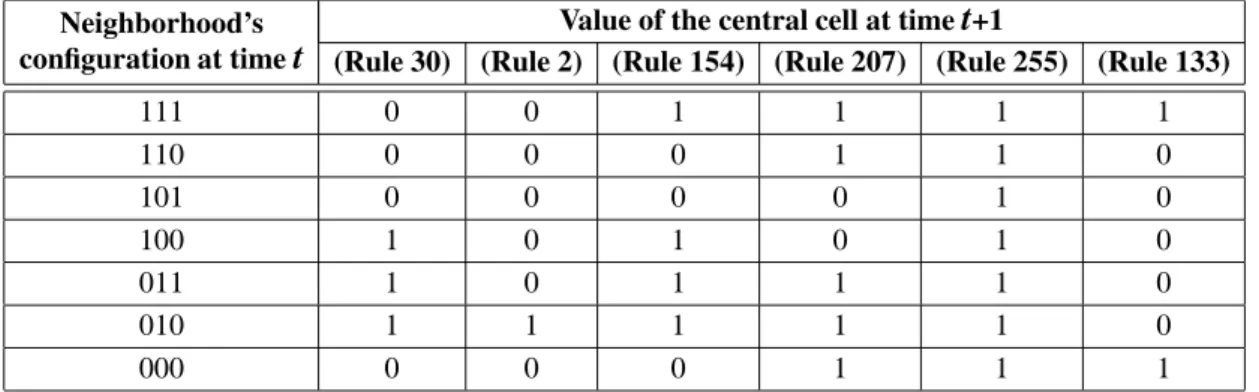
i−1, (Ct)i and(Ct)i+1 are the states of the left neighbor, self and right neighbor of theithcell at time t. A cellular automaton with 2 states and a neighborhood’s radius equal to 1 (3 cells) has 23 = 8 possible neighborhood’s configurations. If the set of all possible con-figurations is expressed using a truth table, the decimal equivalent of its sequence output is re-ferred to as a “Rule” [15], and by the way the transition rules length is equal to 8 and a total of 28 =256 CA local rules can be used. Table 1 illustrates an example of two elementary rules defined by the corresponding truth tables. If the same rule applies to all cells in a CA, the CA is named uniform or regular CA, whereas if different rules apply to different cells, it is
Neighborhood’s Value of the central cell at timet+1
configuration at timet (Rule 30) (Rule 2) (Rule 154) (Rule 207) (Rule 255) (Rule 133)
111 0 0 1 1 1 1
110 0 0 0 1 1 0
101 0 0 0 0 1 0
100 1 0 1 0 1 0
011 1 0 1 1 1 0
010 1 1 1 1 1 0
000 0 0 0 1 1 1
named a hybrid (or non-uniform) CA. A pro-grammable CA(PCA)is a hybrid CA controlled by a number of signals such that different rules can be generated.
Cellular automata have several properties that favor their use as basis for the design of hash functions. Their chaotic, complex and unpre-dictable behavior of some transition rules en-ables their effective use to design safe and reli-able hash functions. The simplicity of their im-plementations and their parallel nature makes them suitable as a basis for fast compression functions.
2.3. Cellular Automata for Hash Functions: Related Works
Cellular automata have been widely used re-cently to construct cryptographic primitives. They have been used for the construction of symmetric cryptosystems, public key cryptosys-tems, secret sharing schemas and hash func-tions. The first cryptographic application of CA initiated by Wolfram [16] describes a stream-based cipher using the elementary CA rule 30. The CA was used as a pseudorandom num-bers generator to produce statistically good se-quences used to cipher plain data by the Vernam ciphering model. CAs were also used for block-ciphers constructions using reversible and irre-versible rules[17], and also to build public-key cryptosystems by exploiting two-dimensional CAs reversibility problem[18].
In [19], Damgard was the first to propose a hash function based on CAs, he used Wolfram’s pseudorandom bit generation’s scheme to de-sign a compression function, but his proposal was cryptanalysed by Daemen et al. in [20] who, in turn, proposed a framework of colli-sion free hash functions based on CA, named CellHash. The same authors proposed later an improved version named SubHash in[21]. Both CellHash and SubHash are hardware-oriented so making extremely high speed possible, but unfortunately, the two schemas were cryptana-lysed later in[22].
Another CA-based hash function has been pro-posed by Mihaljevic, et al. in [23], where they describe a family of fast dedicated one-way hash functions using linear CA over GF(q). The proposal is an extension of the bit’s oriented hashing proposed earlier in [24], enhanced by
employing the approved model of iterative hash function with compression and output’s func-tions: the compression function is one of the Davies-Meyer types employing CA, when the output function was a key generator based on CA over GF(q). In [25] Dasgupta et al. pro-posed a CA based scheme for message authen-tication by investigating a particular class of non-group CA that can be employed to gener-ate an efficient message authentication function. Two-dimensional CA was also proposed as the base for construction of hash functions in[26]. More recently, Jun-Cheol proposed a one-way hash function using linear and nonlinear CAs [7]. Norziana et al. proposed an alternative hash function based on CA rules 30, 134 and Omega-Flip Network in[10], then proposed an-other hash function in[13]named STITCH-256 using balanced CA elementary rules like rules: 29, 39 and 27, and diffusion functions to imple-ment the compression function.
3. The Proposed Hashing Scheme
In the following, we present the proposed new CA-based cryptographic hash function. The function follows iterative hash model inspired by the Damgard’s one presented in [19], and uses two internal functions namely: a compres-sion function C and a transformation function T. The former employs programmable CA with 4 rules (30, 90, 105 and 150), while the latter T uses a hybrid cellular automaton with transi-tion rules 30 and 105. Both message blocks and hash value are 256 bit binary strings.
3.1. The Mode of Operation
In the proposed hashing scheme, we use a vari-ant of the Merkle-Damgard construction. The proposed algorithm requires a padding function (in such a way that the length of the message becomes a multiple of 256 bit)for which the last 64 bits encode the length of the message M to be hashed. The padded message is then divided into blocks Mi (i = 1. . .k) with |Mi| = 256
bits. The algorithm requires also a fixed initial-ization vector: IV∈ {0,1}256
and a chaining variable hi−1, to produce a 256 bit string as output. This output string is XORed with the output of a transformation function T applied to the block message Mi to form the
next chaining variablehi. Figure 1 illustrates a
pictorial representation of the proposed hashing scheme.
3.2. The Compression and Transformation Functions
To construct the compression function, we use an elementary programmable CA (PCA) with 4 rules, namely the rules: 30, 90, 105, 150 (As many works have studied the properties of different CA rules, we use only the rules that have been proven to have good pseudorandom properties).
We firstly define a functionF that takes as in-put a block messageMiand a chaining variable
hi−1, to produce an output stringf on 256 bits as follows:
F :{0,1}256× {0,1}256 → {0,1}256 (hi−1,Mi)→F(hi−1,Mi) =fi (3)
The functionF is defined like the following: a PCA of 256 bit length is initially loaded with
the message blockMi. Additional 256 bits from
chaining variable are doubled to form a 512 bit string S (i.e.S = hi−1|hi−1). The bits from S are used with the number of the current iteration to control the rule configuration of the individ-ual CA cells. Each 2 bits ofS control one cell rule(the bitsjandj+1 control the rule of the cell number j/2)conjointly with the remainder of the iteration number modulo 4. The con-trol logic of the proposed PCA is described in Table 2.
The CA is then iterated forntimes. The value of the parameterndefining the number of itera-tions may be fixed according to the desired ratio of speed/reliability performances. The output ofFis defined by the final PCA state.
The compression functionCis then defined us-ing the functionFas follows:
C :{0,1}256× {0,1}256 → {0,1}256 (fi,hi−1)→C(fi,hi−1) =ci =fi⊕hi−1
(4)
The transformationTtakes as input a block mes-sage of 265 bit length and produces an output
Figure 1.Pictorial representation of the proposed schema.
2 bits fromMi imod 4
0 1 2 3
00 Rule 30 Rule 90 Rule 105 Rule 150 01 Rule 90 Rule 30 Rule 150 Rule 105 10 Rule 105 Rule 150 Rule 30 Rule 90 11 Rule 150 Rule 105 Rule 90 Rule 30
stringtof 256 bit that is XORed with the com-pression function output.
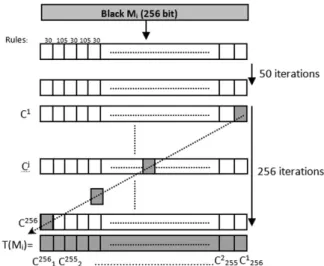
The transformation function is defined as fol-lows: A hybrid CA with rules 30 and 105(rules are applied in alternation i.e. 30, 105, 30. . ..) is initially loaded with the message block Mi.
The CA is iterated 50 times to obtain an in-termediate configuration, then iterated another 256 times to form a 256 by 256 bit square. The diagonal of this square is then taken as output ofT. Figure 2 illustrates pictorial specification of the transformationT operations mechanism.
Figure 2.Pictorial description of the transformation functionT.
The transformation function T is used to obtain the next chaining variablehiby:
hi=ci⊕T(Mi)
=fi⊕hi−1⊕T(Mi)
=F(hi−1,Mi)⊕hi−1⊕T(Mi) (5)
Using the described scheme, the proposed hash function can take any message M of arbitrary length as input, decompose it into consecu-tive blocks Mi, and produce the
correspond-ing hash value H(M). The proposed function is benchmarked with respect to several perfor-mance tests with several experiments illustrated in the following section.
4. Performances Evaluations and Obtained Results
As explained above, it is not always possi-ble to formally prove the resistance of a given
hash function to common attacks, but since a Merkle-Damgard construction is used as a do-main extension mechanism, the proof can be reduced to the resistance of the proposed com-pression function. In addition, several statisti-cal properties can be checked in order to show that the function provides good cryptographic level of security. Pseudorandom behavior and avalanche effect are generally considered as good security’s indicators of a hash function. In this section, we perform several statistical ex-periments on the proposed hashing scheme. We also show that best computational performances can be achieved by the proposed scheme with respect to existing models.
4.1. Security Analysis
The best assistance available about security of a particular hash function is the complexity of the most efficient applicable known attack, which gives an upper bound on its security. An at-tack of complexity 2n requires approximately 2noperations, each being an appropriate unit of
work. According to[35], it is possible to relate the security of H() to the security of h and g according to the following theorem:
Theorem 1 [35]: LetHbe an iterated hash func-tion with Merkle-Damgard construcfunc-tion, then preimage and collision attacks onH(where an attacker can choose IV freely)have roughly the same complexity as the corresponding attacks onhandg.
The function g is an optional transformation used in a final step to map the n-bit chaining variable to ann-bit resultg(Hm);gis often the identity mappingg(Hm) = Hm. In the present
work the functiongis trivially considered as the identity function, while the compression func-tion is handled by the funcfunc-tionFcomposed by the two transformationsCandT. Accordingly, the security of the proposed hash function is re-lied on the resistance of the compression func-tionh. The function h is applied on each sub-blockMiand transforms it using the two
func-tions C and T according to equation (4). The transformation steps consist of the following: – A non-linear mapping of Miusing the
– A non-linear compression of Mi using the
function C with a PCA evolution mecha-nism that maps the input vector into another vector of then-dimensional binary space.
– A bit-by-bit addition between the outputs of CandT to compute the final value ofF.
As a result, the following facts imply the secu-rity of the proposed compression function:
1. Cellular automata have chaotic characteris-tic that maps any nonzero state into a nonzero state which belongs to the sequence of all possible different 2n−1 nonzero
n-dimensio-nal vectors in such manner that the expected Hamming distance between the current state and the next one isn/2.
2. A high non linearity is performed on each sub-block Mi due to the dynamic character-istic of the nonlinear PCA with rules 30, 90, 105 and 150.
3. The computational infeasibility of recon-structing pervious configurations of a given nonlinear PCA.
The facts 1-3 imply that the proposed compres-sion function is a cryptographically secure one-way function. Hence, according to Theorem 1, and since the iterating mechanism is performed according to a Merkle-Damgard construction, the proposed hash function is cryptographically secure.
4.2. The Avalanche and Strict Avalanche Criteria
Avalanche effect is a desirable property for cryptographic hash functions that tries to re-flect the idea of high-nonlinearity[27]: a little change in the input (flipping one single bit) produces a significant change of the output( ap-proximately half of the bits are flipped). For-mally, if a functionF has the avalanche effect, then the Hamming distance between its output on a random input binary stringxand the output obtained when randomly changing one bit ofx should be, on average, half of the output size [28]. This effect tries to abstract the intuitive idea of high nonlinearity: very small difference in the input must produce high changes in the output, hence an avalanche of changes.
Mathematically,F :{0,1}m → {0,1}nhas the
avalanche effect if it holds the following:
∀x,y∈ {0,1}m:Hamming(x,y) =1 =⇒average(Hamming(F(x),F(y)))=n
2(6)
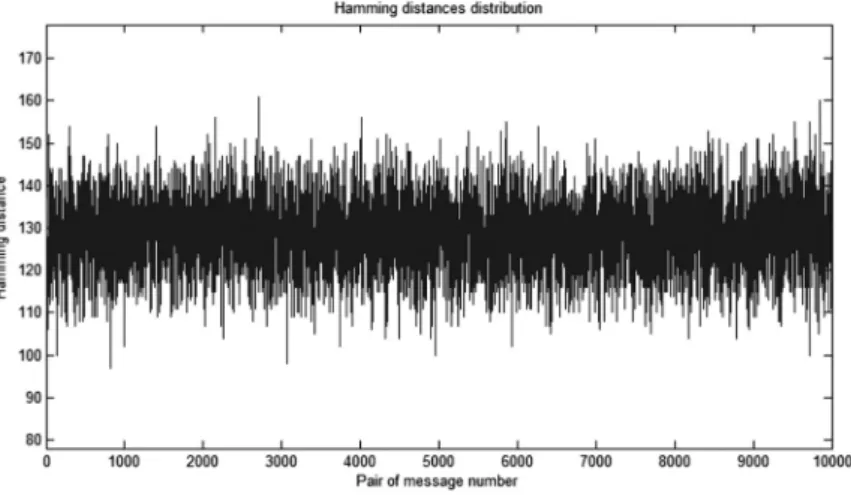
When Hamming (x,y) denotes the Hamming distance between the two n-bits blocks x and y. Figure 3 shows the results of the avalanche effect test performed on the proposed hash func-tion, using a set of 10 000 pairs of arbitrary mes-sagesMiandMisuch that Hamming(Mi,Mi) =
1. Obtained results show that the hamming dis-tances between the hash values(i.e. Hamming (H(Mi),H(Mi))) are concentrated around the
value 128, which indicates that the hash func-tion has a good avalanche effect.
Another, more accurate and demanding non-linearity measurement is the so called strict avalanche criterion[29]which, in particular, im-plies the avalanche effect. The strict avalanche criterion(SAC)is a more demanding property that was originally presented by as a general-ization of the avalanche effect to measure the quantity of confusion and diffusion in substitu-tion boxes (s-boxes). Formally, a function F is said to satisfy the SAC if, whenever a single input bit is flipped, each of the output bits must change with a probability of one half. This im-plies that the distribution of hamming distances between outputs that have similar inputs( differ-ing in one bit)should follow a binomial distri-bution. Mathematically, the SAC is described by[28]:
∀x,y∈ {0,1}m :Hamming(x,y) =1 ⇒Hamming(F(x),F(y))≈B
1 2,n
(7)
where B(1/2,n) denotes binomial distribution with parameters 1/2 andn. This definition also tries to abstract the more general concept of in-dependence of the output from the input. An ideal hash function F will resemble a perfect random function where inputs and outputs are statistically unrelated[30].
In order to evaluate the proposed hash function with respect to the SAC, the following experi-ment has been conducted: the 256 eleexperi-ments of an integer’s vector V (each one corresponding to a bit position of the hash function’s output) are initialized firstly to 0. A set of 1000 ran-dom messages with arbitrary length are then generated, and their corresponding hash values H(M)are computed. For each one of these mes-sages, only one bit is randomly flipped getting a new message M’, that is also hashed to obtain a new hash valueH(M). The Hamming distance Hamming(H(M),H(M))is calculated, and the result is used to determine the element of V to be incremented(i.e. V[Hamming(H(M),H(M))] ++). This operation is repeated 1000 times for each message.
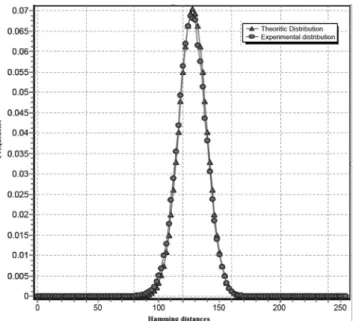
Finally, the values of the vector V elements are divided by the total number of performed ex-periments(equal to 1000∗1000= 106)in or-der to perform a normalization of the computed distribution. The obtained values represent the distribution of Hamming distances that is com-pared to the binomial distribution as plotted in Figure 4.
Figure 4.Experimental Hamming distances distribution vs. theoretical binomial distribution.
The distance between the observed distribution of the Hamming distances and their theoretical distribution under perfect Strict Avalanche Cri-terion hypothesisB(1/2,n), has also been mea-sured by means of a chi-square2 goodness-of-fit test [30]. The chi-square measurement is a statistical test that allows verifying the ade-quacy of a data set to a probability distribution by using the following formula[27]:
2=256
i=0
(Observed frequencyi−Expected frequency)2
Expected frequency
(8)
Using the distribution values obtained in the ex-periment described above, the value of the 2 measurement has been computed and found to be equal to 0,005465. Using the probability
=0.01 as our critical threshold, the hypothe-sis of equivalence between the two distributions is accepted if the2value is less than the quan-tile 255,0.01 = 310.45. It is clear that the ob-tained2is negligible with respect to the quan-tile value, and consequently, the null hypothesis is accepted and the Hamming distribution of the proposed hash function is then following a bi-nomial distributionB1
2,256
4.3. Randomness Statistical Tests
Cryptographic primitives and especially hash functions should act like pseudorandom func-tions to avoid statistical attacks; therefore the output of a secure hash function must be sta-tistically indistinguishable from the output of a random function. We performed several sta-tistical randomness tests on the output of the proposed hash function in order to show that it provides best randomness properties.
In the performed experiment, the hash function has been used as a pseudonumber generator to create a data stream of 10Mb. The stream is
generated using a counter mode scheme applied using the hash function on an initial random integer seed S and then calculating the values H(S),H(S+1), . . . ,H(S+327680)each one on 256bit. The resulting outputs are finally con-catenated to form a data stream.
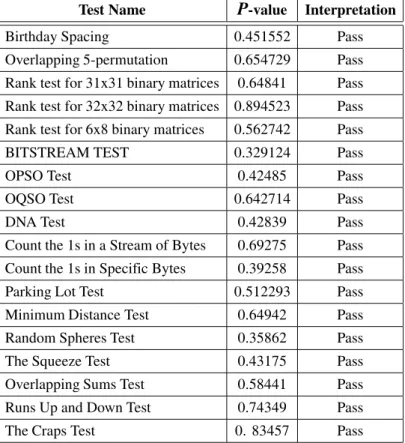
The produced stream is analyzed statistically using both Diehard [31]and ENT[32] statisti-cal tests batteries, and then obtained results are averaged and reported in Tables 3 and 4. It is clear from presented results that the binary stream generated by the hash function has suc-cessfully passed all DIEHARD and ENT tests. We can conclude that the function has a good
Test Name P-value Interpretation
Birthday Spacing 0.451552 Pass Overlapping 5-permutation 0.654729 Pass Rank test for 31x31 binary matrices 0.64841 Pass Rank test for 32x32 binary matrices 0.894523 Pass Rank test for 6x8 binary matrices 0.562742 Pass BITSTREAM TEST 0.329124 Pass
OPSO Test 0.42485 Pass
OQSO Test 0.642714 Pass
DNA Test 0.42839 Pass
Count the 1s in a Stream of Bytes 0.69275 Pass Count the 1s in Specific Bytes 0.39258 Pass Parking Lot Test 0.512293 Pass Minimum Distance Test 0.64942 Pass Random Spheres Test 0.35862 Pass The Squeeze Test 0.43175 Pass Overlapping Sums Test 0.58441 Pass Runs Up and Down Test 0.74349 Pass The Craps Test 0. 83457 Pass
Table 3.Results of the DIEHARD tests battery applied on designed hash function’s output.
Test Name Value Norm
Entropy 7.997982 8.0
Optimum compression 0.000003 0.0 Arithmetic mean value of data bytes 127.5586 127.5=random Monte Carlo value for 3.140865524
Serial correlation coefficient 0.000347 totally uncorrelated=0.0
pseudorandom behavior and can as a result be considered statistically indistinguishable from random function, which is a principal charac-teristic of a secure hashing scheme.
4.4. Comparison With Existing CA-based Hash Functions
In order to illustrate the advantages of the pro-posed hash function with respect to existing CA-based ones, a comparative study has been per-formed with respect to several criteria includ-ing sensitivity to elementary alterations, strict avalanche criterion, and randomness. The pro-posed function has been compared to CellHash [20], SubHash [21], STITCH-256 [13] and the function proposed initially by Damgard in[19]. Performances and speed comparison are pro-vided in the next section.
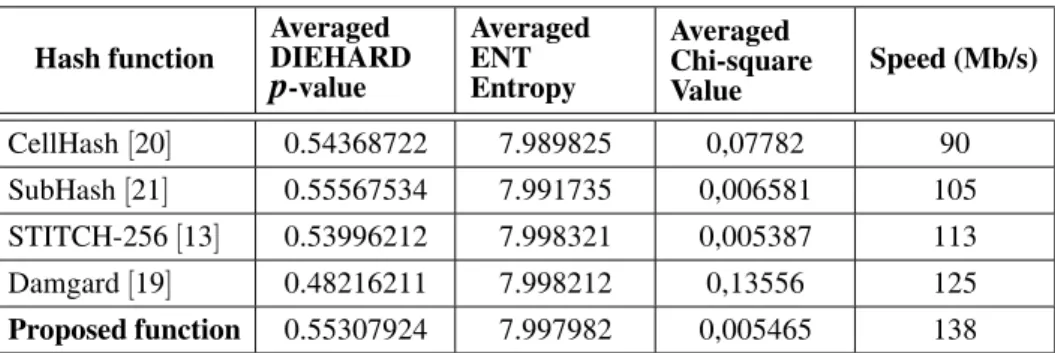
Table 5 illustrates several comparison result using the chi-square measurement to evaluate the strict avalanche criterion, the averaged p-value of the DIEHARD test, the averaged en-tropy from the ENT test and the average run-time performances. The functions were imple-mented in software while performance’s exper-iments were performed using an Intel Core i5 (2.5 GHz)microprocessor platform. It is clear from the obtained results that the proposed func-tion achieves very competitive runtime perfor-mances with equivalent randomness and sensi-tivity results. Figure 5 illustrates a comparison of the experimental Hamming distributions be-tween the proposed function and the mentioned CA-based ones.
Figure 5.Experimental Hamming’s distribution compared with respect to some known CA-based hash
functions.
4.5. Performance Analysis of the Designed Function
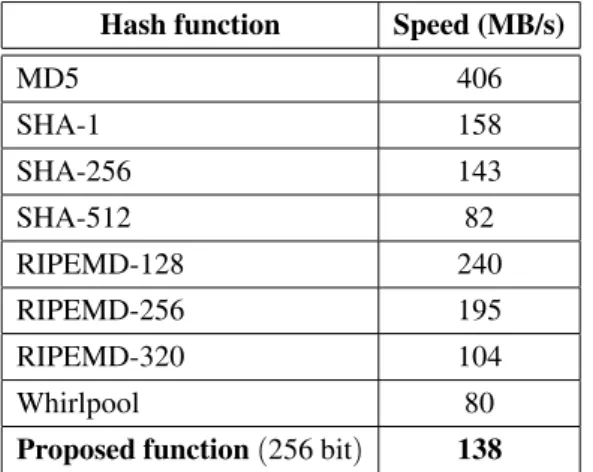
Cellular automata uses simple binary opera-tions. Therefore CA-based primitives can achi-eve very high speed in both hardware and soft-ware implementations. In the present work, the proposed hash function has been imple-mented using Microsoft Visual C++, while performance’s experiments were performed us-ing an Intel Core i5 (2.5 GHz) microproces-sor platform. Table 6 shows a comparison be-tween the hash function and the widely used ones implemented by the Crypto++library us-ing Microsoft Visual C++ [33]. It is clear that the designed function achieves very competitive speeds with respect to other standards, and we assume that it can achieve much better rates if hardware implementation is used.
Hash function AveragedDIEHARD p-value
Averaged ENT Entropy
Averaged Chi-square
Value Speed (Mb/s)
CellHash[20] 0.54368722 7.989825 0,07782 90 SubHash[21] 0.55567534 7.991735 0,006581 105 STITCH-256[13] 0.53996212 7.998321 0,005387 113 Damgard[19] 0.48216211 7.998212 0,13556 125
Proposed function 0.55307924 7.997982 0,005465 138
Hash function Speed (MB/s)
MD5 406
SHA-1 158
SHA-256 143
SHA-512 82
RIPEMD-128 240
RIPEMD-256 195
RIPEMD-320 104
Whirlpool 80
Proposed function(256 bit) 138
Table 6.Speed performances compared with respect to some known hash functions.
5. Conclusions
In this paper, we propose a cryptographic hash function based on cellular automata. The pro-posed function uses two internals, namely: a compression function based on programmable cellular automata controlled by the chaining variable bits, and a transformation function con-struct from a hybrid cellular automaton with rules 30 and 105. The proposed scheme has been experimentally analyzed with respect to several statistical tests, and the obtained re-sults show that the proposed function provides good cryptographic properties such as pseudo-random behavior and sensitivity to the input changes. In addition, the function is simple, fast, and can be easily implemented through software or hardware. Performance evaluations show that extremely optimal performances are achieved by the function with respect to existing standards, and we presume that better perfor-mances can be obtained if hardware implemen-tation is adopted due to the inherent parallelism of cellular automata.
References
[1] M. NAOR, M. YUNG, Universal one-way hash func-tions and their cryptographic applicafunc-tions. In Pro-ceedings of the twenty-first Annual ACM Symposium on the Theory of Computing,(1989, February)pp. 33–43. ACM.
[2] B. PRENEEL, R. GOVAERTS, J. VANDEWALLE, Hash Functions Based on Block Ciphers: A Synthetic Approach. InCrypto ’93,773of LNCS,(1993)pp. 368–378. Springer-Verlag.
[3] J. BLACK, P. ROGAWAY, T. SHRIMPTON, Black-Box Analysis of the Block-Cipher-Based Hash-Function Constructions from PGV. In Crypto’02, 2442 of LNCS,(2002)pp. 320–335. Springer-Verlag.
[4] J. BUCHMANN, S. PAULUS, A One Way Function Based on Ideal Arithmetic in Number Fields. In Crypto ’97, 1294of LNCS, (1997)pp. 385–394. Springer-Verlag.
[5] S. CONTINI, A. LENSTRA, R. STEINFELD, VSH, an Effcient and Provable Collision – Resistant Hash Function. InEurocrypt ’06,4004of LNCS,(2006)
pp. 165–182. Springer-Verlag.
[6] D. CHARLES, K. LAUTER, E. GOREN, Cryptographic Hash Functions from Expander Graphs.Journal of Cryptology,22(1),(2007)93–113.
[7] J-C. JEON, Analysis of Hash Functions and Cellular Automata Based Schemes.International Journal of Security and Its Applications,7(3),(May, 2013).
[8] M. MAQABLEH, A. SAMSUDIN, M. ALIA, New Hash Function Based on Chaos Theory(CHA-1). Inter-national Journal of Computer Science and Network Security,8(2),(2008)20–27.
[9] X. YI, Hash Function Based on Chaotic Tent Maps. IEEE Transactions on Express Briefs,52(6),(2005)
354–357.
[10] J. NORZIANA, M. RAMLAN, R. Z. MUHAMMAD, I. U. NUR, A. Z. ZURIATI, A New Cryptographic Hash Function Based on Cellular Automata Rules 30, 134 and Omega-Flip Network. International Proceed-ings of Computer Science & Information Tech.,27,
(2012)163.
[11] A. MENEZES, P. OORSCHOT, S. VANSTONE, Hand-book of Applied Cryptography, chapter Hash Func-tions and Data Integrity. CRC Press, 1996, pp. 321–384.
[12] NIST., Federal Information Processing Standard
(FIPS) Publication 180-2, Secure Hash Standard
(SHS), U.S. Doc/NIST, 2002. Available from
http://csrc.nist.gov/publications/fips/ fips180-2/fips180-2.pdf
[13] N. JAMIL, R. MAHMOOD, M. R. Z’ABA, N. I. UDZIR, Z. A. ZUKARNAEN, A New Cryptographic Hash Function Based on Cellular Automata Rules 30. 134 and Omega-Flip Network International Con-ference on Information and Computer Networks (ICICN 2012) IPCSIT,27 (2012). IACSIT Press, Singapore.
[14] J. V. NEUMANN, The World of Physics: A Small Library of the Literature of Physics from Antiquity to the Present, chapter The General and Logical Theory of Automata. Simon and Schuster, New York, 1987, 606–607.
[15] S. WOLFRAM, A New Kind of Science. Wolfram Media, 2002.
[17] Z. CHAI, Z. CAO, Y. ZHOU, Encryption Based on Reversible Second-Order Cellular Automata.ISPA Workshops, LNCS 3759,(2005)pp. 350–358.
[18] A. CLARRIDGE, K. SALOMAA, A Cryptosystem Based on the Composition of Reversible Cellu-lar Automata.LATA 2009, LNCS 5457,(2009)pp. 314–325.
[19] I. DAMGARD, A Design Principle for Hash Func-tions. InCrypto ’89, volume 435 of LNCS,(1989)
pp. 416–427. Springer-Verlag.
[20] J. DAEMEN, R. GOVAERTS, J. VANDEWALLE, A Framework for the Design of One-Way Hash Func-tions Including Cryptanalysis of Damgard’s One-Way Function Based on a Cellular Automaton. In Asiacrypt ’91, volume 739 of LNCS, (1991) pp. 82–96. Springer-Verlag.
[21] J. DAEMEN, R. GOVAERTS, J. VANDEWALLE, A hard-ware design model for cryptographic algorithms, Computer Security – ESORICS 92. Proc. Second European Symposium on Research in Computer Security, LNCS 648,(1992)pp. 419–434. Springer-Verlag.
[22] D. CHANG, Preimage Attacks on CellHash, SubHash and Strengthened Versions of CellHash and Sub-Hash.Cryptology ePrint Archive, Report 2006/412.,
(2006).(eprint.iacr.org/2006/412)
[23] M. MIHALJEVIC, Y. ZHENG, H. IMAI, A Fast Cryp-tographic Hash Function Based on Linear Cellular Automata over GF(q). Special Section on Cryp-tography and Information Security. IEICE TRANS. FUNDAMENTALS,E82(1), January 1999.
[24] M. MIHALJEVIC, Y. ZHENG, H. IMAI, A Cellular Automaton Based Fast One-Way Hash Function Suitable for Hardware Implementation. Proceed-ings of PKC’98, LNCS 1431,(1998)pp. 217–233.
[25] P. DASGUPTA, S. CHATTOPADHYAY, I. SENGUPTA, Theory and Application of Non-group Cellular Automata for Message Authentication.Journal of Systems Architecture,47(55),(2001)pp. 383–404.
[26] S. HIROSE, S. YOSHIDA, A one-way hash function based on a two-dimensional cellular automaton. The 20th Symposium on Information Theory and Its Applications (SITA97). Proc.1,(Dec. 1997)pp. 213–216. Matsuyama, Japan.
[27] A. F. WEBSTER, S. E. TAVARES On the design of s-boxes, Lecture notes in computer sciences.218 on Advances in cryptology – CRYPTO 85,(1985)pp. 523–534. Springer-Verlag, New York, USA.
[28] J. C. H. CASTROA, J. M. SIERRAB, A. SEZNECA, A. IZQUIERDOA, A. RIBAGORDAA, The strict avalanche criterion randomness test.Mathematics and Com-puters in Simulation,68,(2005)pp. 1–7.
[29] R. FORRE, The strict avalanche criterion: spec-tral properties of booleans functions and an ex-tended definition. Advances in cryptology, in: Crypto’88, Lecture Notes in Computer Science,
403,(S. GOLDWASSER, Ed.),(1990)pp. 450–468. Springer-Verlag.
[30] A. DOGANAKSOY, B. EGE, O. KOCAK¸ , F. SULAK, Cryptographic Randomness Testing of Block Ci-phers and Hash Functions.IACR Cryptology ePrint Archive 2010,564(2010).
[31] G. MARSAGLIA, Diehard Battery of Tests of Ran-domness, 1995.
http://www.stat.fsu.edu/pub/diehard/
[32] J. WALKER, ENT A Pseudorandom Number Se-quence Test Program, 2008.
http://www.fourmilab.ch/random/ [33] W. DAI,Crypto++, 2013.
http://www.cryptopp.com/
[34] R. MERKLE, One way hash functions and DES. Ad-vances in cryptology – CRYPTO 89, Lecture Notes in Computer Science,435,(1990)pp. 428–446.
[35] L. KNUDSEN, B. PRENEEL, Fast and secure hashing based on codes.Advances in cryptology – CRYPTO 97, Lecture Notes in Computer Science, 1294,
(1997)pp. 485–498.
Received:February, 2015
Revised:July, 2015
Accepted: August, 2015
Contact addresses:
Alaa Eddine Belfedhal Computer Sciences Department Djillali Liabes University of Sidi Bel Abbes Algeria e-mail:[email protected] Kamel Mohamed Faraoun Computer Sciences Department Djillali Liabes University of Sidi Bel Abbes Algeria e-mail:kamel [email protected]
ALAAEDDINEBELFEDHALis currently a PhD student at the Com-puter Science Department of Djillali Liabes University, Algeria, and an assistant teacher at Mascara University, Algeria. He received his Engi-neering and Master’s degrees in computer science from Djillali Liabes University in 2008 and 2011 respectively. His research interests include cryptographic primitives and information security.