Full Report
Korea
Life Persistency Study
008728-1110 (562-44-0-J34)
Kyong Hee Yang Korea Insurance Development Institute
[email protected] Ingrid R. Goodenow, FLMI
International Research 860.285.7835 [email protected]
A 2010 Report
L
IFE
P
ERSISTENCY
S
TUDY
KOREA
©2010, LL Global, Inc.SM
This publication is a benefit of LIMRA membership. No part may be shared with other organizations or reproduced in any form without LL Global’s written permission.
C
ONTENTS
Page
GETTING ANY BETTER? ... 5
Introduction ... 5
KEY RESULTS ... 6
OUTLOOK FOR THE KOREAN MARKET ... 7
PERSISTENCY TRENDS ... 8
Lapse Experience... 8
13th-Month Persistency Experience ... 11
25th-Month Persistency Experience ... 11
PERSISTENCY AND SALES FORCE ... 13
Total Solicitor Trends ... 13
Average Solicitor Trends ... 14
Solicitor Trends and Lapse Experience ... 15
Persistency and Retention ... 16
BENCHMARKING MATURE MARKETS ... 17
U.S. Lapse Experience ... 17
U.S. Lapse Experience by Products ... 19
U.S. Lapse Experience by Characteristics ... 21
Lapse-Supported Product Lapse Experience ... 27
F
IGURES AND
T
ABLES
Page
Figure 1 Premium Income Trend ... 7
Figure 2 Trend in Lapse Experience ... 8
Figure 3 Trends in Lapse Experience by Account ... 9
Figure 4 Trends in Lapse Experience by Company Group ... 10
Figure 5 13th-Month/25th-Month Persistency Rates ... 12
Figure 6 Solicitor Number Trend ... 13
Figure 7 Average Solicitor Number by Company Group ... 14
Figure 8 Solicitor Trend and Lapse Experience ... 15
Figure 9 U.S Individual Life Insurance Policy Lapse Rates ... 17
Figure 10 U.S Individual Life Insurance Face Amount Lapse Rates ... 18
Figure 11 U.S Individual Life Insurance Lapse Rates ... 18
Figure 12 Trends in Whole Life and Term Life Insurance Lapse Rate ... 19
Figure 13 Trends in VUL and UL Insurance Lapse Rate ... 20
Figure 14 Whole Life Lapse Rates by Gender ... 21
Figure 15 Universal Life Lapse Rates by Gender... 22
Figure 16 Whole Life Lapse Rates by Issue Age Group ... 22
Figure 17 Universal Life Lapse Rates by Issue Age Group ... 23
Figure 18 Whole Life Lapse Rates by Smoking Status ... 24
Figure 19 Universal Life Lapse Rates by Smoking Status ... 24
Figure 20 Whole Life Lapse Rates by Risk Class ... 25
Figure 21 Universal Life Lapse Rates by Risk Class ... 26
G
ETTING
A
NY
B
ETTER
?
INTRODUCTION
What is the trend of persistency for life insurers in Korea? Why is persistency important? The Korean life insurance industry experienced a slowdown in revenue growth during the recent economic downturn. Life insurers are now focused on improving profitability and preparing for upcoming uncertainty more than ever.
One of the key factors of profitability in life insurance is persistency of the existing policyholders.
This report examines lapse experience of Korean life insurance companies. This study can be used for industry benchmarking as well as for background information on product development and in the planning process.
Theoretically, the revenue of a company suffers a setback if policies lapse. This becomes more of a concern if there is a rise in the number of lapsed policies in the first year, since the
administrative costs during the first year are high. In this report, we will look at not only basic lapse trends, but also 13th-month and 25th-month persistency trends to better understand lapse experience.
This report also compares Korean and U.S. life insurance lapses to give a perspective about the future of the life insurance market in Korea.
The data contained in this report can help companies identify factors that impact life insurance persistency. This report uses not only survey results from member companies, but also the entire industry data.
The industry data includes all product information sold by life insurance companies from term-life products to annuities. Although annuity data is relatively small compared to term-life data, companies should carefully consider the underlying differences in product design, product development, and market strategy between life products and annuity products.
About the Survey
This report presents the results of a study of life insurance lapse experience in Korea conducted by LIMRA International and the Korea Insurance Development Institute.
The following report provides the results and analysis of issues covered in industry data from Financial Supervisory Service (FSS) and Korea Life Insurance Association (KLIA).1
_____
1
K
EY
R
ESULTS
Lapse rates have improved remarkably since the Asian economic crisis in the late 1990s. The overall lapse rate was 29.4 percent in 1998 and decreased to 10.3 percent 10 years later.
Due to recent global economic turmoil, the lapse rates show ups and downs. The lapse rate went up to 12.4 percent in 2008 and went down slightly to 11.3 percent in 2009.
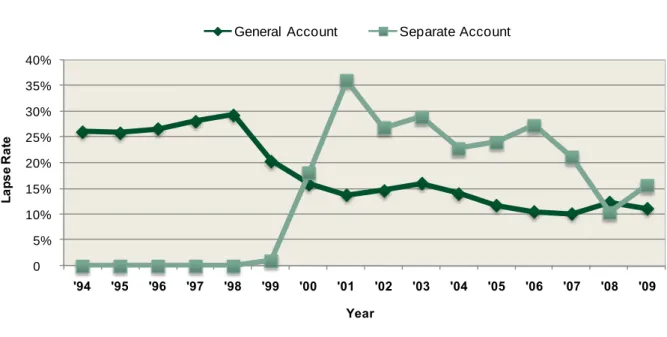
The lapse rates for separate accounts, mostly equity-linked products including variable life and variable annuity, show unstable lapse rate patterns from a high of 36.1 percent in 2001 to a low of 10.5 percent in 2008. Separate accounts fluctuate depending on the economic environment and stock market performance.
Foreign insurers used to show lower lapse rates than domestic insurers in general. That trend has changed since 2005. Apparently domestic insurers made an effort to lower their lapse rates.
The first anniversary is a crucial revenue measure for insurers. Thirteenth-month persistency rate improved from 50.9 percent in 1997 to 81.7 percent in 2007.
However, the recent trends since 2008 show some concerns about persistency. In 2009, the 13th-month persistency rate has dropped 6.8 percentage points from 78.3 percent to
71.5 percent — the lowest number in the past couple of years. The good news for insurers is that the gap between 13th- and 25th-month persistency is closing.
The 13th-month persistency rate trend has a similar pattern to the 13th-month solicitor retention trend.
Even with wide range of sophisticated products, Korea is considered a less mature market compared with the United States and Canada, as it has a relatively short insurance product history. Benchmarking to mature markets will give Korean insurers a perspective on the future market.
O
UTLOOK FOR THE
K
OREAN
M
ARKET
Korea was the world’s eighth largest life insurance market in 2008, with a gross premium of $66.4 billion. It is now the third largest in Asia after Japan and China. Life income in 2008 was Korean Won (KRW) 73,561bn (USD 66.75bn). Life insurance penetration was 7.18 percent, ranking the country sixth globally. In 2009, 84.5 percent of households had one or more life policies, 13.1 percent had a postal life policy,2 and 9.0 percent had a policy from NongHyup (NH), the agricultural co-operative. 3Life insurance premium income and profit have been affected by the global economic crisis. Net profit figures for Korean life companies for fiscal 2008 (ended March 31, 2009) show a 70.7 percent fall compared with fiscal year 2007. Market net profit was KRW 570.2bn (USD 560.1mn), down from KRW 2.11trn (USD 2.27bn) in 2007. Investment gains in 2008 were also down by KRW 1.3trn (USD 1.12bn). Seven of the 22 life companies reported losses. Total life insurance premiums were down 2.04 percent at KRW 73.56trn (USD 66.75bn).4
In 2009, life insurers recovered shortly after the 2008 setback. Life insurance premium for 2009 went up compared with 2007.
Figure 1
Premium Income Trend
Source: KLIA
_____
2
Life policy sold by Korea Post.
3
AXCO research, INSURANCE MARKET REPORT REPUBLIC OF KOREA: LIFE & BENEFITS, 2010
4
Ibid
48,956 46,390 46,755 51,654 47,364 49,067 50,392 53,751
61,472 66,455
75,096 73,561 76,957
-10,000 20,000 30,000 40,000 50,000 60,000 70,000 80,000 90,000
97 98 99 00 01 02 03 04 05 06 07 08 09
K R W b n Year
P
ERSISTENCY
T
RENDS
LAPSE EXPERIENCE
When the Asian economic crisis hit Korea, the lapse rate for all products combined went up to 29.4 percent in 1998. Companies struggled to keep their policies. Revenue went down. However, this also provided opportunities for restructuring the Korean life insurance industry. In 1995, there were 33 Korean life insurance companies with heavy competition and high lapse rates. During the economic crisis in the late 1990s, Korean life companies were forced to go through painful restructuring. After a major restructuring process, only the relatively solid companies survived.
Today, 22 Korean life insurance companies are in the market. And the lapse rate dropped
dramatically to 20.4 percent in 1999, nine percentage points down from 29.4 percent in 1998, and 11.3 percent in 2009. From a long-term perspective, the lapse rates have been decreasing steadily over the past 10 years. However, lapse rates are fluctuating since the recent economic decline.
Figure 2
Trend in Lapse Experience
Source: KLIA
0% 5% 10% 15% 20% 25% 30% 35%
'94 '95 '96 '97 '98 '99 '00 '01 '02 '03 '04 '05 '06 '07 '08 '09
La
ps
e
R
at
e
Figure 3 shows the lapse rates for general and separate accounts. Separate accounts are mostly equity-linked products including variable life and variable annuities. As a result, they are greatly affected by the economic situation.
In 2001, separate accounts had the highest lapse rate of 36.09 percent. During that time variable products, such as variable whole life, were introduced to consumers. Due to the complexity of variable products and a lack of understanding, consumers tend to lapse variable products more quickly in early policy years. In addition, consumer behavior is more closely tied to the economic environment and stock market performance causing lapse rates for separate accounts to fluctuate from a low of 10.47 percent to a high of 36.09 percent.
Figure 3
Trends in Lapse Experience by Account
Source: KLIA
0% 5% 10% 15% 20% 25% 30% 35% 40%
'94 '95 '96 '97 '98 '99 '00 '01 '02 '03 '04 '05 '06 '07 '08 '09
La
ps
e
R
ate
Year
Over the past 10 years, the overall lapse rates have improved for both domestic and foreign insurers. Foreign insurers used to show lower lapse rates than domestic insurers. That trend has changed since 2005. Apparently domestic insurers have made an effort to lower their lapse experience.
Since the late 1990s, foreign insurers have become heavily involved in the life market through rescues, takeovers, and joint ventures.5 As a whole, foreign insurers are considered a more profit-focused group compared with domestic insurers. That perception is changing as today’s domestic insurers focus more on profitability.
Figure 4
Trends in Lapse Experience by Company Group
Source: FSS
0% 5% 10% 15% 20% 25%
'99 '00 '01 '02 '03 '04 '05 '06 '07 '08 '09
La
ps
e
R
ate
Year
13
TH-MONTH PERSISTENCY EXPERIENCE
The first anniversary is a critical revenue measure for life insurance, which is why we focus on early or 13th-month persistency rates. In 1997, when the Asian economic crisis hit Korea, the 13th-month persistency rate was 50.9 percent. Half of all new policies were surrendered or lapsed within the first year. Ten years after that mega shock, the 13th-month persistency rate improved dramatically from 50.9 percent to 81.7 percent.
Recent trends show some concerns about persistency. In 2009, the 13th-month persistency rate dropped 6.8 percentage points from 2008 of 78.3 percent to 71.5 percent — the lowest number since 2005.
Table 1
13th-Month Persistency Rates
1997 2005 2006 2007 2008 2009
13th-month persistency rate (A) 50.9% 79.4% 81.0% 81.7% 78.3% 71.5%
Source: FSS newsletter 2010.6.25, www.fss.or.kr
25
TH-MONTH PERSISTENCY EXPERIENCE
As 13th-month persistency improved, 25th-month persistency numbers also went up. It improved significantly to 68.9 percent in 2007 from 39.0 percent in 1997, the year when Asian crisis hit Korea. However, insurers should pay attention to the fact that 13th-month and 25th-month persistency rates over the past three years have declined. Due to the recent economic turmoil, insurers are having a hard time retaining policies.
Poor persistency increases the loading of expense in the premium per policy. Insufficient funds leave the extra burden not only on the insurance company but also makes insurance more costly for new policyholders.
Table 2
25th-Month Persistency Rates
1997 2005 2006 2007 2008 2009
25th-month persistency rate (B) 39.0% 65.8% 67.8% 68.9% 66.9% 61.3%
Figure 5 shows persistency trends by year, and the gap between 13th-month and 25th-month persistency rates. The good news for insurers is that not only have the 13th-month and 25th month persistency rates significantly improved compared to year 1997, but also the gap is closing between 13th- and 25th-month persistency rates.
Figure 5
13th-Month/25th-Month Persistency Rates
Source: FSS
0% 10% 20% 30% 40% 50% 60% 70% 80% 90%
'97 '05 '06 '07 '08 '09
La
ps
e
R
ate
Year
P
ERSISTENCY AND
S
ALES
F
ORCE
In Korea, sales through solicitors still play the main role in distribution.6 In this section, we will look at solicitor trends to get a better idea about persistency and productivity.
TOTAL SOLICITOR TRENDS
Figure 6 shows the number of solicitors since 1998. The total number of solicitors dropped steadily until 2005, and has been growing ever since. Since the Asian economic crisis of 1997, many insurers were forced to restructure sometimes through merger and acquisition. From the late 1990s to the early 2000s, productivity and alternative channel expansion became major issues, while recruiting solicitors to expand business took a back seat. However, in recent years, the numbers of recruits has grown.
Figure 6
Solicitor Number Trend
Source: FSS
_____
6
Soliciting agent: insurance salesperson that contacts potential customers and handles clerical responsibilities but has no authority to make insurance contracts.
0 50,000 100,000 150,000 200,000 250,000 300,000
'98 '99 '00 '01 '02 '03 '04 '05 '06 '07 '08 '09
Pe
rs
on
AVERAGE SOLICITOR TRENDS
Even though the total number of solicitors has decreased (Figure 6), the average number of solicitors per company had increased in the late 1990s due to major merger and acquisitions among domestic insurers (Figure 7). In 1998, the number of total domestic life insurers was 21. In 2000, only 13 domestic insurers survived.
The ―Big Three‖ — Samsung Life, Kyobo Life, and Korea Life — are all domestic insurers and may impact the average number of solicitors per domestic company.7 Even so, domestic insurers clearly have more solicitors than foreign insurers (Figure 7). However, the gap in number of solicitors between domestic and foreign insurers has been decreasing.
Figure 7
Average Solicitor Number by Company Group
Source: FSS
0 2,000 4,000 6,000 8,000 10,000 12,000 14,000 16,000
'98 '99 '00 '01 '02 '03 '04 '05 '06 '07 '08 '09
N
um
be
r
Year
SOLICITOR TRENDS AND LAPSE EXPERIENCE
From the late 1990s to the early 2000s, lapse rates improved dramatically and the number of solicitors declined along with lapse rates. During this period, insurers were forced to restructure their entire system just to survive the Asian crisis. Improved productivity, retention of business and profitability might be considered more important than new policies and gaining market share. Recently lapse rates have been fluctuating because of the global economic turbulence. However, it should be noted that total number of solicitors has been growing again. Increased recruiting of solicitors could be a warning sign of market share competition among insurers. This is the time to think about improved productivity again. Recruiting on its own will not provide sustainable growth. There is a need for improved productivity and retention of more seasoned solicitors.
Figure 8
Solicitor Trend and Lapse Experience
Source: FSS
0% 5% 10% 15% 20% 25% 30% 35%
0 50,000 100,000 150,000 200,000 250,000 300,000
'98 '99 '00 '01 '02 '03 '04 '05 '06 '07 '08 '09 Year
PERSISTENCY AND RETENTION
Ten years after the mega shock in 1997, the 13th-month persistency rate improved dramatically from 50.9 percent to 81.7 percent. During the same period, the monthly income of solicitors tripled — up from 1.06 million KRW to 3.63 million KRW — and retention rates improved significantly.
Although it is not clear that 13th-month solicitor retention directly impacted the 13th-month persistency rate or vice versa, it should be noted that the 13th-month persistency rate has a similar pattern to the 13th-month solicitor retention rate trend.
Table 3
Persistency Rate and Retention Rate
1997 2005 2006 2007 2008 2009
13th-month persistency rate 50.9% 79.4% 81.0% 81.7% 78.3% 71.5% 13th-month solicitor retention rate 18.4% 36.1% 39.7% 41.5% 37.5% 33.3% Solicitor monthly income
(average, in 10,000 Won) 106 330 354 368 329 302
B
ENCHMARKING
M
ATURE
M
ARKETS
8Korea has a very high market penetration of life insurance policies — 89.2 percent of households — (including postal life and the NH co-operative) in Korea.9
Even with wide range of sophisticated products, Korea is considered a less mature market compared with the United States and Canada, as it has a relatively short insurance product history.
This section is based on LIMRA/SOA joint report U.S. Individual Life Insurance Persistency
(2009). For more information about U.S. life persistency, please access the full report on LIMRA.com.
U.S. LAPSE EXPERIENCE
In the most recent study, early-policy-year lapse rates have increased slightly from the prior study but remain at a near-10-year low. This continues to be driven in part by lower earlier-year lapse rates on level premium term plans.
Figure 9
U.S Individual Life Insurance Policy Lapse Rates
Source: U.S. Individual Life Insurance Persistency (LIMRA/SOA, 2009).
_____
8
U.S. individual life insurance persistency data: 2004–2005 of observation year, policy lapse base (without referring to the text).
9
AXCO research, INSURANCE MARKET REPORT REPUBLIC OF KOREA: LIFE & BENEFITS, 2010
0% 2% 4% 6% 8% 10% 12%
1 2 3 4 5 6-10 11-20 21+
La
ps
e
R
ate
Policy Year
On a face amount basis, lapse rates improved across most policy years. Total individual life lapse rates by face amount were fairly level during 2004 and 2005, averaging around 5.2 percent overall versus 5.7 percent in 2003 and 2004.
Figure 10
U.S Individual Life Insurance Face Amount Lapse Rates
Source: U.S. Individual Life Insurance Persistency, LIMRA/SOA, 2009.
During the earlier policy years, policies with smaller face amounts lapse more frequently while large policies tend to lapse in later policy years. Lapses during the early policy years are more likely to result from buyer’s remorse or additional price comparison shopping. On the other hand, lapses during later policy years are more likely due to replacement or full surrender.
Figure 11
U.S Individual Life Insurance Lapse Rates
0% 2% 4% 6% 8% 10% 12% 14% 16%
1 2 3 4 5 6-10 11-20 21+
La
ps
e
R
ate
Policy Year
2004-2005 2003-2004 2001-2002 1994-1996
6% 8% 10%
U.S. LAPSE EXPERIENCE BY PRODUCTS
Even though Korean insurers have introduced highly sophisticated insurance products to the market, Korea has a relatively short history compared to more mature markets. Studying mature markets will give Korean insurers a chance to have a better perspective on their future market. Based on policy characteristics, products were grouped into traditional life — such as whole life and term life — and more adjustable life such as universal life (UL) and variable universal life (VUL).
Whole Life and Term Life
The lapse rates of whole life show a constant decreasing pattern as policy years go by. On the other hand, term life shows an increase in lapse rates after the first 10 years. For policy Years 11 and later, lapse rates increase significantly, reflecting the impact of level-premium term plans that have periodic jumps in premium payment such as at the 10-year mark.
Figure 12
Trends in Whole Life and Term Life Insurance Lapse Rate
Source: U.S. Individual Life Insurance Persistency, LIMRA/SOA, 2009.
0% 2% 4% 6% 8% 10% 12% 14%
1 2 3 4 5 6-10 11-20 21+
La
ps
e
R
ate
Policy Year
Universal Life and Variable Universal Life
As life products become more and more diverse in Korea, insurers will need to pay greater attention to the lapse experience of so-called non-traditional life products such as VUL or UL in the United States.
The lapse trends for UL are similar to whole life. They decline gradually as policy years go by. However, VUL shows a different lapse trend altogether. In the first policy year, the lapse rate of VUL is significantly lower than that of UL. After a year, the VUL lapse rate goes up to about the same level as UL.
It is hard to predict the lapse trend of VUL since the variable products are greatly affected by the trend of the equities market. However, dump-ins may postpone the early lapsation of VUL. It may be that lapses due to buyer’s remorse are more severe with VUL. If a buyer lapses a VUL policy, it means that the buyer has already lost a significant portion of premium. Instead, a buyer may hold onto the policy in hopes that the market will go up.
Figure 13
Trends in VUL and UL Insurance Lapse Rate
Source: U.S. Individual Life Insurance Persistency, LIMRA/SOA, 2009.
0% 2% 4% 6% 8% 10% 12% 14%
1 2 3 4 5 6 7 8 9 10 11 12 13 14 15
La
ps
e
R
at
e
Policy Year
U.S. LAPSE EXPERIENCE BY CHARACTERISTICS
According to LIMRA research, economic factors do impact insurance sales and lapses.10 However, historical data points to other factors including demographics, legislation, new products, and pricing that have had a greater impact on the industry, essentially overshadowing economic factors.
This section examines U.S. lapse experience for two major life products — whole life and universal life — by key demographic characteristics such as gender, age, smoking status, and risk class.
Gender
Overall whole life lapse rates for males and females are about the same, with lapse rates for females slightly higher in the first few years and a bit lower in later years (Figure 14).
Like whole life, UL lapse rates for female policyholders are higher than males during the first couple of policy years. However, after Year 8, the lapses for females are consistently lower than lapse rates for males.
Figure 14
Whole Life Lapse Rates by Gender
Source: U.S. Individual Life Insurance Persistency, LIMRA/SOA, 2009.
_____
10
Will History Repeat Itself? Looking at the impact of recessions on insurance sales and persistency, LIMRA, October 2008.
0% 2% 4% 6% 8% 10% 12% 14%
1 2 3 4 5 6 7 8 9 10 11 12 13 14 15 16 17 18 19 20 21 22 23 24 25 26-29 30+ La ps e R at e Policy Year Males Females
Figure 15
Universal Life Lapse Rates by Gender
Source: U.S. Individual Life Insurance Persistency, LIMRA/SOA, 2009.
Issue Age
Policies issued under age 30 have the highest lapse rates in the first three years. However, after the first five years most of the lapse rates settle between 2 and 6 percent.
Figure 16
Whole Life Lapse Rates by Issue Age Group
0% 1% 2% 3% 4% 5% 6% 7% 8% 9%
1 2 3 4 5 6 7 8 9 10 11 12 13 14 15 16 17 18 19 20 21 22
La ps e R ate Policy Year Male Female 2% 4% 6% 8% 10% 12% 14% 16% La ps e R at e
Like whole life products, UL lapse rates generally decrease with increasing issue age, particularly during the first 10 years (Figure 15). The exception to this is for policyholders under age 20 at issue, whose policies are generally purchased by older relatives — that lapse experience trends more closely to issue age groups 30–39 and 40–49.
Figure 17
Universal Life Lapse Rates by Issue Age Group
Source: U.S. Individual Life Insurance Persistency, LIMRA/SOA, 2009.
Smoking Status
Whole life lapse rates for smokers are much higher than for non-smokers during the first few years; but after Year 6 there is little variance between smoker and non-smoker experience (Figure 18).
Although the gap between smokers and non-smokers gradually decreases through the policy years, smokers exhibit higher rates of lapse than non-smokers at all durations (Figure 19).
0% 2% 4% 6% 8% 10% 12% 14%
1 2 3 4 5 6 7 8 9 10 11 12 13 14 15 16 17 18 19 20 21 22
La
ps
e
R
ate
Policy Year
Figure 18
Whole Life Lapse Rates by Smoking Status
Source: U.S. Individual Life Insurance Persistency, LIMRA/SOA, 2009.
Figure 19
Universal Life Lapse Rates by Smoking Status
Source: U.S. Individual Life Insurance Persistency, LIMRA/SOA, 2009.
0% 5% 10% 15% 20%
1 2 3 4 5 6 7 8 9 10 11 12 13 14 15 16 17 18 19 20 21 22 23 24 25 26-2930+
La
ps
e
R
at
e
Policy Year
Non Smokers Smokers
0% 2% 4% 6% 8% 10% 12%
1 2 3 4 5 6 7 8 9 10 11 12 13 14 15 16 17 18 19 20 21 22
La
ps
e
R
ate
Policy Year
Risk Class
With the exception of the first four policy years, the three risk classes exhibit similar lapse rates, with standard and substandard lapse rates remaining close in later years. While the preferred class displays lower lapse rates in the first four years, lapse rates drift higher after Year 7. This could be due to the tendency of policies with higher face amounts to lapse in later policy years.11
Figure 20
Whole Life Lapse Rates by Risk Class
Source: U.S. Individual Life Insurance Persistency, LIMRA/SOA, 2009.
_____
11
In this study, the preferred risk class carries a significantly higher average face amount compared to standard and substandard risk class policies.
0% 2% 4% 6% 8% 10% 12%
1 2 3 4 5 6 7 8 9 10 11 12 13 14 15 16 17 18 19 20 21 22 23 24
La
ps
e
R
ate
Policy Year
In the first few years, standard risk class shows the highest lapse rates. However, after policy Year 5, preferred policies begin to exhibit higher lapse rates than standard and substandard policies.
Figure 21
Universal Life Lapse Rates by Risk Class
Source: U.S. Individual Life Insurance Persistency, LIMRA/SOA, 2009.
0% 2% 4% 6% 8% 10% 12%
1 2 3 4 5 6 7 8 9 10 11 12 13 14 15 16 17 18
La
ps
e
R
ate
Policy Year
LAPSE-SUPPORTED PRODUCT LAPSE EXPERIENCE
Since Korean insurers are allowed to develop lapse-supported products, this is a perfect time to look into the lapse trends of various lapse-supported products. Figure 22 shows Term-to-100 and UL level cost of insurance (COI) for Canada and long-term care insurance for U.S. lapse
experience from the joint LIMRA/SOA persistency studies combined with the results of the Canadian studies.12
Although LTCI gives surprisingly low lapse during the early policy years, it tends to sustain certain levels of lapse rates as later policy durations like UL Level COI. However, Term-to-100 shows both steady and sharp declining lapse trends though all policy durations.
Figure 22
Trends in Lapse-Supported Product Lapse Rates
Source: The Future of Flexible Premium Products, LIMRA, 2010.
_____
12
The Future of Flexible Premium Products, LIMRA, 2010.
0% 1% 2% 3% 4% 5% 6% 7% 8% 9%
1 2 3 4 5 6 7 8 9 10 11 12 13 14 15
La
ps
e
R
at
e
Policy Year
R
ELATED
L
INKS
The following links are valid as of 11/01/10.
LIMRA
U.S. Individual Life Insurance Persistency (2009)
This study examines individual life insurance persistency experience for 38 participating U.S. companies. The report provides lapse rates separately for traditional whole life, term, universal life, and variable life products. Lapse results are reviewed for a variety of policy and product features, which explains some of the variations in experience from one study period to the next. http://www.limra.com/members/abstracts/reports/10127.pdf
The Future of Flexible Premium Products (2010)
This report presents an overview of the market for universal life and variable universal life products.
http://www.limra.com/members/abstracts/reports/10551.pdf
Non-LIMRA
Korea Insurance Development Institute (KIDI)
KIDI has been providing various services to the insurance industry in Korea, including collecting industry data, making reference tables, and developing insurance products since 1983.
http://www.kidi.or.kr/eng/MA/index.asp
Financial Supervisory Service (FSS)
The primary function of the FSS is to examine and supervise financial institutions, but can extend to other oversight and enforcement functions as charged by the Financial Services Commission and the Securities and Futures Commission.
http://english.fss.or.kr/fsseng/index.jsp
Full Report
Korea
Life Persistency Study
Kyong Hee Yang Korean Insurance Development Institute
[email protected] Ingrid R. Goodenow, FLMI
International Research 860.285.7835 [email protected]