ISSN(Online): 2320-9801
ISSN (Print): 2320-9798
I
nternational
J
ournal of
I
nnovative
R
esearch in
C
omputer
and
C
ommunication
E
ngineering
(An ISO 3297: 2007 Certified Organization)
Vol. 3, Issue 7, July 2015
Protected and Capable Facts Broadcast For
Cluster-Based Wireless Sensor Networks
K.Durgadevi
1,
H. Lookman Sithic 2Research Scholar, Dept. of CS, Muthayammal College of Arts & Science, Rasipuram, Namakkal, India1
Associate Professor, Department of BCA, Muthayammal College of Arts & Science, Rasipuram, Namakkal, India2
ABSTRACT: Wireless Sensor Networks (WSNs) are used in many applications in military, ecological, and
health-related areas. These applications often include the monitoring of sensitive information such as enemy movement on the battlefield or the location of personnel in a building. Security is therefore important in WSNs. To study a Secure Data Transmission for Cluster-Based WSNs (CWSNs), where the clusters are formed dynamically and periodically. The propose two Secure and Efficient Data Transmission (SET) protocols for CWSNs, called SET-IBS and SET-IBOOS, by using the Identity-Based Digital Signature (IBS) scheme and the Identity-Based Online/Offline Digital Signature (IBOOS) scheme, respectively. In SET-IBS, security relies on the hardness of the Diffie-Hellman problem in the pairing domain. SET-IBOOS further reduces the computational overhead for protocol security, which is crucial for WSNs, while its security relies on the hardness of the discrete logarithm problem. It show the feasibility of the SET-IBS and SET-IBOOS protocols with respect to the security requirements and security analysis against various attacks. The calculations and simulations are provided to illustrate the efficiency of the proposed protocols. The results show that the proposed protocols have better performance than the existing secure protocols for CWSNs, in terms of security overhead and energy consumption.
KEYWORDS: Personal health records; cloud computing; data privacy; fine-grained access control; attribute- based
encryption.
I. INTRODUCTION
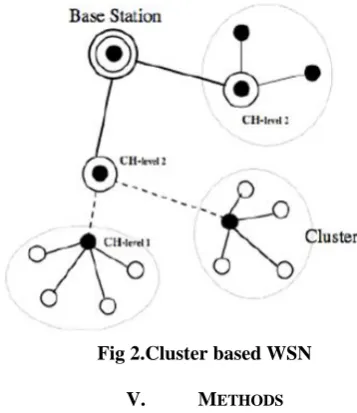
A Wireless Sensor Network (WSN) is a network system comprised of spatially distributed devices using wireless sensor nodes to monitor physical or environmental conditions, such as sound, temperature, and motion. The individual nodes are capable of sensing their environments, processing the information data locally, and sending data to one or more collection points in a WSN . Efficient Data Transmission is one of the most important issues for WSNs. Meanwhile, many WSNs are deployed in harsh, neglected, and often adversarial physical environments for certain applications, such as military domains and sensing tasks with trustless surroundings . Secure and Efficient Data Transmission (SET) is, thus, especially necessary and is demanded in many such practical WSNs. Cluster-based data transmission in WSNs has been investigated by researchers to achieve the network scalability and management, which maximizes node lifetime and reduce bandwidth consumption by using local collaboration among sensor nodes . In a Cluster-Based WSN (CWSN), every cluster has a leader sensor node, regarded as Cluster Head (CH). A CH aggregates the data collected by the leaf nodes (non-CH sensor nodes) in its cluster, and sends the aggregation to the Base Station (BS). The Low-Energy Adaptive Clustering Hierarchy (LEACH) protocol presented by Heinzelman et al. is a widely known and effective one to reduce and balance the total energy consumption for CWSNs. To prevent quick energy consumption of the set of CHs, LEACH randomly rotates CHs among all sensor nodes in the network, in rounds. LEACH achieves improvements in terms of network lifetime.
ISSN(Online): 2320-9801
ISSN (Print): 2320-9798
I
nternational
J
ournal of
I
nnovative
R
esearch in
C
omputer
and
C
ommunication
E
ngineering
(An ISO 3297: 2007 Certified Organization)
Vol. 3, Issue 7, July 2015
cluster, and sends the aggregation to the Base Station (BS). The Low-Energy Adaptive Clustering Hierarchy (LEACH) protocol presented by Heinzelman et al. is a widely known and effective one to reduce and balance the total energy consumption for CWSNs. To prevent quick energy consumption of the set of CHs, LEACH randomly rotates CHs among all sensor nodes in the network, in rounds. LEACH achieves improvements in terms of network lifetime. Following the idea of LEACH, a number of protocols have been presented such as APTEEN and PEACH , which use similar concepts of LEACH. To convenience, we call this sort of Cluster-Based Protocols as LEACH-like protocols. Researchers have been widely studying CWSNs in the last decade in the literature.
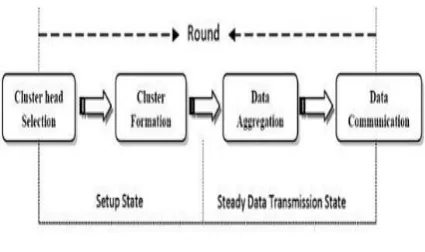
Fig 1.Operation in the Proposed Secure Data Transmission
III. EXISTINGSYSTEM
The Existing System of wireless Sensor Network comprised of spatially distributed devices using wireless sensor nodes to monitor physical or environmental conditions, such as sound, temperature, and motion. The individual nodes are capable of sensing their environments, processing the information data locally, and sending data to one or more collection points in a WSN. Efficient data transmission is one of the most important issues for WSNs. Meanwhile, many WSNs are deployed in harsh, neglected and often adversarial physical environments for certain applications, such as military domains and sensing tasks with trustless surroundings.
Disadvantages of existing system:
The clusters are formed dynamically and periodically.
Existing solutions are provided for distributed WSNs, but not for CWSNs. It reduces the possibility of a node joining with a CH.
Problem occurs when a node does not share a pairwise key with others in its preloaded key ring.
IV. PROPOSED SYSTEM
ISSN(Online): 2320-9801
ISSN (Print): 2320-9798
I
nternational
J
ournal of
I
nnovative
R
esearch in
C
omputer
and
C
ommunication
E
ngineering
(An ISO 3297: 2007 Certified Organization)
Vol. 3, Issue 7, July 2015
ADVANTAGES OF PROPOSED SYSTEM:
Secure communication in SET-IBS relies on the ID based cryptography, in which, user public keys are their ID information. Thus, users can obtain the corresponding private keys without auxiliary data transmission, which is efficient in communication and saves energy.
Fig 2.Cluster based WSN
V. METHODS
SECURITY VULNERABILITIES AND PROTOCOL OBJECTIVES:
The data transmission protocols for WSNs, including Cluster-Based Protocols (LEACH-like protocols), are vulnerable to a number of security attacks. Especially, attacks to CHs in CWSNs could result in serious damage to the network because data transmission and data aggregation depend on the CHs fundamentally. If an attacker manages to compromise or pretend to be a CH, it can provoke attacks such as sinkhole and selective forwarding attacks, hence disrupting the network. On the other hand, an attacker may intend to inject bogus sensing data into the WSN, for example, pretend as a leaf node sending bogus information toward the CHs. Nevertheless, LEACH-like protocols are more robust against insider attacks than other types of protocols in WSNs [23]. It is because CHs are rotating from nodes to nodes in the network by rounds, which makes it harder for intruders to identify the routing elements as the intermediary nodes and attack them. The characteristics of LEACH-like protocols reduce the risks of being attacked on intermediary nodes, and make it harder for an adversary to identify and compromise important nodes (i.e., CH nodes).
The goal of the proposed secure data transmission for CWSNs is to guarantee the secure and efficient data transmissions between leaf nodes and CHs, as well as transmission between CHs and the BS. Meanwhile, most of existing secure transmission protocols for CWSNs in the literature however, apply the symmetric key management for security, which suffers from the orphan node problem. To aim to solve this orphan node problem by using the ID Based Cryptosystem that guarantees security requirements, and propose SET-IBS by using the IBS scheme. Furthermore, SET-IBOOS is proposed to reduce the computational overhead in SET-IBS with the IBOOS scheme.
IBS AND IBOOS FOR CWSNS
ISSN(Online): 2320-9801
ISSN (Print): 2320-9798
I
nternational
J
ournal of
I
nnovative
R
esearch in
C
omputer
and
C
ommunication
E
ngineering
(An ISO 3297: 2007 Certified Organization)
Vol. 3, Issue 7, July 2015
SET-IBS PROTOCOL
The propose two novel SET protocols for CWSNs, called SET-IBS and SET-IBOOS, by using the IBS scheme and the IBOOS scheme, respectively. The proposed SET-IBS has a protocol initialization prior to the network deployment and operates in rounds during communication, which consists of a setup phase and a steady-state phase in each round.To introduce the protocol initialization, describe the key management of the protocol by using the IBS scheme, and the protocol operations afterwards.
SET-IBOOS PROTOCOL
The SET protocol for CWSNs by using IBOOS (SET-IBOOS) in this section. The SET-IBOOS protocol is designed with the same purpose and scenarios for CWSNs with higher efficiency. The proposed SET-IBOOS operates similarly to the previous SET-IBS, which has a protocol initialization prior to the network deployment and operates in rounds during communication. The first introduce the protocol initialization, then describe the key management of the protocol by using the IBOOS scheme, and the protocol operations afterwards.
VI. ALGORITHM
The idea of Diffie and Hellman is that it's easy to compute powers modulo a prime but hard to reverse the process: If someone asks which power of 2 modulo 11 is 7, you'd have to experiment a bit to answer, even though 11 is a small prime. If you use a huge prime instead, then this becomes a very difficult problem even on a computer. Steps:
1. Alice and Bob, using insecure communication, agree on a huge prime p and a generator g. They don't care if someone listens in.
2. Alice chooses some large random integer xA < p and keeps it secret. Likewise Bob chooses xB < p and keeps it secret. These are their "private keys".
3. Alice computes her "public key" yA gxA(mod p) and sends it to Bob using insecure communication. Bob computes his public key yB gxBand sends it to Alice. Here 0 < yA < p, 0 < yB < p.As already mentioned, sending these public keys with insecure communication is safe because it would be too hard for someone to compute xA from yA or xB from yB, just like the powers of 2 above.
4. Alice computes zA yBxA(mod p) and Bob computes zB yAx B(mod p). Here zA < p, zB < p.But zA = zB, since zA yBx A (gxB)xA= g(x A xB) (mod p) and similarly zB (gx A)xB= g(xA xB) (mod p). So this value is their shared secret key. They can use it to encrypt and decrypt the rest of their communication by some faster method.In this calculation, notice that the step yBxA (gxB)xAinvolved replacing g xBby its remainder yB, (in the reverse direction) so we were really using the "as often as you want" principle
VII. RESULT ANALYSIS
ISSN(Online): 2320-9801
ISSN (Print): 2320-9798
I
nternational
J
ournal of
I
nnovative
R
esearch in
C
omputer
and
C
ommunication
E
ngineering
(An ISO 3297: 2007 Certified Organization)
Vol. 3, Issue 7, July 2015
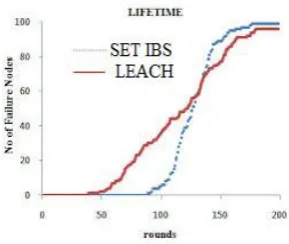
Fig 3.Result Analysis Graph
VIII. CONCLUSION AND FUTURE WORK
The first reviewed the data transmission issues and the security issues in CWSNs. The deficiency of the Symmetric Key Management for Secure Data Transmission has been discussed. It presents two secure and efficient data transmission protocols, respectively, for CWSNs, SET-IBS, and SET-IBOOS. It provided feasibility of the proposed SET-IBS and SET-IBOOS with respect to the security requirements and analysis against routing attacks. SET-IBS and SET-IBOOS are efficient in communication and applying the ID Based Cryptosystem, which achieves security requirements in CWSNs, as well as solved the orphan node problem in the Secure Transmission Protocols with the symmetric key management. Lastly, the comparison in the calculation and simulation results show that the proposed SET-IBS and SET-IBOOS protocols have better performance than existing secure protocols for CWSNs. With respect to both computation and communication costs, to pointed out the merits that using SET-IBOOS with less auxiliary security overhead is preferred for Secure Data Transmission in CWSNs.
REFERENCES
1. T. Hara, V.I. Zadorozhny, and E. Buchmann, Wireless Sensor Network Technologies for the Information Explosion Era, Studies in Computational Intelligence, vol. 278. Springer-Verlag, 2010.
2. Y. Wang, G. Attebury, and B. Ramamurthy, “A Survey of Security Issues in Wireless Sensor Networks,” IEEE Comm. Surveys & Tutorials, vol. 8, no. 2, pp. 2-23, Second Quarter 2006.
3. A.A. Abbasi and M. Younis, “A Survey on Clustering Algorithms for Wireless Sensor Networks,” Computer Comm., vol. 30, nos. 14/ 15, pp. 2826-2841, 2007.
4. W. Heinzelman, A. Chandrakasan, and H. Balakrishnan, “An Application-Specific Protocol Architecture for Wireless Microsensor Networks,” IEEE Trans. Wireless Comm., vol. 1, no. 4, pp. 660- 670, Oct. 2002.
5. A. Manjeshwar, Q.-A. Zeng, and D.P. Agrawal, “An Analytical Model for Information Retrieval in Wireless Sensor Networks Using Enhanced APTEEN Protocol,” IEEE Trans. Parallel & Distributed Systems, vol. 13, no. 12, pp. 1290-1302, Dec. 2002.
6. S. Yi et al., “PEACH: Power-Efficient and Adaptive Clustering Hierarchy Protocol for Wireless Sensor Networks,” Computer Comm., vol. 30, nos. 14/15, pp. 2842-2852, 2007.
7. K. Pradeepa, W.R. Anne, and S. Duraisamy, “Design and Implementation Issues of Clustering in Wireless Sensor Networks,” Int’l J. Computer Applications, vol. 47, no. 11, pp. 23-28, 2012.
8. L.B. Oliveira et al., “SecLEACH-On the Security of Clustered Sensor Networks,” Signal Processing, vol. 87, pp. 2882-2895, 2007.
BIOGRAPHY
ISSN(Online): 2320-9801
ISSN (Print): 2320-9798
I
nternational
J
ournal of
I
nnovative
R
esearch in
C
omputer
and
C
ommunication
E
ngineering
(An ISO 3297: 2007 Certified Organization)
Vol. 3, Issue 7, July 2015