Partial Key Exposure in Ring-LWE-Based Cryptosystems:
Attacks and Resilience
Dana Dachman-Soled∗, Huijing Gong, Mukul Kulkarni, and Aria Shahverdi University of Maryland, College Park, USA
[email protected], [email protected], {mukul@terpmail, ariash@terpmail}.umd.edu
Abstract. We initiate the study of partial key exposure in ring-LWE-based cryptosystems. Specifically, we
– Introduce the search and decision Leaky-RLWE assumptions (Leaky-SRLWE, Leaky-DRLWE), to formalize the hardness of search/decision RLWE under leakage of some fraction of coordinates of the NTT transform of the RLWE secret and/or error.
– Present and implement an efficient key exposure attack that, given certain 1/4-fraction of the coordinates of the NTT transform of the RLWE secret, along with RLWE instances, recovers the full RLWE secret for standard parameter settings.
– Present a search-to-decision reduction for Leaky-RLWE for certain types of key exposure.
– Analyze the security of NewHope key exchange under partial key exposure of 1/8-fraction of the secrets and error. We show that, assuming that Leaky-DRLWE is hard for these parameters, the shared key v (which is then hashed using a random oracle) is computationally indistinguishable from a random variable with average min-entropy 238, conditioned on transcript and leakage, whereas without leakage the min-entropy is 256.
1
Introduction
Partial key exposure attacks. Many of the cryptanalytic attacks on RSA are based on the seminal “Cop-persmith’s method,” [17,16] which provides an efficient lattice-based algorithm to solve for small roots of a polynomial over a modulus. One of the most beautiful applications of Coppersmith’s method is to so-called “partial key exposure attacks” on RSA, introduced by Boneh, Durfee, and Frankel [9]. This class of attacks shows that given 1/2 of the bits of the secret key—either the most or least significant—it is possible to efficiently recover the entire key. The original attack worked for only certain choices of parameters, but a long line of follow-up works have greatly improved the applicability of these results [8,26,41,42]. Partial key exposure attacks are not meant to model realistic leakage attacks (since the attacks only work when the leakage is highly structured), although vulnerability of RSA to key exposure has been exploited in practice, due to flaws in certain prime generation algorithms [7,36]. The main motivation to study these attacks is that they provide a setting in which the algebraic structure of a cryptosystem can be exploited to obtain improvements far beyond what is naively expected. Say, after exposing 1024 bits of a 2048-bit RSA key, one could still hope to maintain the security level of 1024-bit RSA. These attacks show that, in fact, no security at all is maintained after exposing 1024 bits in specific positions. This helps to further our understanding of the algebraic structure of the cryptosystem and how that structure can be leveraged in cryptanalytic attacks.
Enter post-quantum. Recently there has been a huge effort in the cryptographic community to develop “post-quantum” cryptosystems that remain secure even in the presence of quantum adversary. One of the foremost avenues for viable post-quantum public key cryptography is to construct schemes from Ring-LWE (RLWE) assumptions—currently 12 out of 69 submissions for the first round of NIST submissions are based on assumptions in the ring setting. RLWE is often preferred in practice over standard LWE due to its algebraic structure, which allows for smaller public keys and more efficient implementations. In the RLWE
∗
setting, we typically consider rings of the formRq :=Zq[x]/(xn+ 1), wherenis a power of two and q≡1
mod 2n. The (decisional) RLWE problem is then to distinguish (a, b=a·s+e)∈Rq×Rq from uniformly
random pairs, wheres∈Rqis a random secret, thea∈Rqis uniformly random and the error terme∈Rhas
small norm. A critical question is whether the additional algebraic structure of the RLWE problem renders it less secure than the standard LWE problem. Interestingly, to the best of our knowledge—for the rings used in practice and for practical parameter settings—the best attacks on RLWE are generic and can equally well be applied to standard LWE [38].
The NTT transform. One key method for speeding up computations in the RLWE setting is usage of the NTT transform (similar to the discrete Fourier transform (DFT), but over finite fields) to allow for faster polynomial multiplication over the ring Rq. Specifically, applying the NTT transform to two polynomials
p,p0 ∈ Rq—resulting in two n-dimensional vectors, bp,bp
0
∈ Znq—allows for component-wise multiplication
and addition, which is highly efficient . Typically, the RLWE secret will then be stored in NTT form, and so leakage of coordinates of the NTT transform is a natural model for key exposure attacks.
NewHope key exchange protocol. Some of our results focus on analysis of the NewHope key exchange protocol of [4] in the presence of partial key exposure. Briefly, NewHope key exchange is a post-quantum key exchange protocol that has been considered as a good candidate for practical implementation, due to its computational efficiency and low communication. Specifically, Google has experimented with large-scale implementation of NewHope in their Chrome browser [13] to determine the feasibility of switching over to post-quantum key exchange in the near-term.
This work. The goal of this work is to initiate a study of partial key exposure in RLWE based cryptosystems and explore both positive and negative results in this setting. Specifically, we (1) define search and decision versions of Leaky RLWE assumptions, where the structured leakage occurs on the coordinates of the NTT transform of the LWE secret (and/or error); (2) present partial key exposure attacks on RLWE, given 1/ 4-fraction of structured leakage on the secret key; (3) present a search to decision reduction for the Leaky RLWE assumptions; and (4) analyze the security of the NewHope key exchange protocol under the decision version of the assumption.
1.1 Leaky RLWE Assumptions–Search and Decision Versions
We next briefly introduce the search and decision versions of the Leaky RLWE assumptions. Forp∈Rq:=Zq/(xn+1) we denotepb:=NTT(p) := (p(ω
1),p(ω3), . . . ,p(ω2n−1)), whereωis a primitive 2n-th root of unity moduloq, and is guaranteed to exist by choice of primeq, s.t.q≡1 mod 2n. Note that
b
pis indexed by the setZ∗2n.
The search version of the ring-LWE problem with leakage, denoted R-SLWE, is parameterized by (n0 ∈ {1,2,4,8, . . . n},S ⊆ Z2∗n0). The goal is to recover the R-LWE secret s = NTT−1(bs), given samples from the distribution Dreal,n0,S which outputs
b
a,ab·bs+be,[sbi]i≡αmod 2n0|∀α∈S
, wherea,s, and eare as in the standard RLWE assumption.
The decision version of the ring-LWE problem with leakage, denoted R-SLWEis parameterized by (n0 ∈ {1,2,4,8, . . . n},S ⊆ Z∗2n0). The goal is to distinguish the distributions Dreal,n0,S and Dsim,n0,S, where Dreal,n0,S is as above and Dsim,n0,S outputs
b
a,u,b [sbi]i≡αmod 2n0|∀α∈S
, where ubi = abi·sbi+ebi for i ≡α
mod 2n0,α∈ S andubi is chosen uniformly at random fromZq, otherwise.
When S ={α} consists of a single element, we abuse notation and write the Leaky-RLWE parameters as (n0, α). Due to automorphisms on the NTT transform, Leaky-RLWE with parameters (n0,S) where
S ={α1, α2, . . . , αt}, is equivalent to Leaky-RLWE with parameters (n0,S0), whereS0 =α−11 ·S (multiply every element ofS byα−11 ), See the Technical Overview for additional discussion.
1.2 Our Results
settings ofn= 1024,q= 12289, andχ=Ψ16(centered binomial distribution of parameter 16). We present and implement efficient algorithms to fully recover the RLWE secret, given specific 1/4-fraction of the positions in the NTT transform of the RLWE secret. We emphasize that the algebraic structure of the ring setting is intrinsic to our results on partial key exposure. In addition, we were also able to successfully recover the entire RLWE secret forn= 1024, q= 12289 and χ=ψ16 for leakage patterns (1,7) mod 16 in roughly 15 hours and forn= 1024,q= 12289 and χ=ψ16 and leakage pattern (1,15) mod 16 in about 1 hour 17 minutes. The experiments were run using a MacBook Pro with 2.6 GHz Intel Core i5 processor, 16 GB 1600 MHz DDR3 memory, with a python script running 4 parallel processes and using Sage version 8.1. See Section3.4. Indeed, the NTT notion itself is only applicable to certain specific rings, based on cyclotomic polynomialsΦmand modulus q≡1 modm. We note that this stands in contrast to the non-leaky setting,
where it is not clear how to leverage the algebraic structure of the ring to design improved attacks on RLWE. In addition, our experiments indicate that leaky search-RLWE remains hard for leakage parameter settings (n0= 8, α= 1) .
A search-to-decision reduction. Assuming 2O(n)sub-exponential hardness of search-RLWE, fix some desired
hardness level 2Ω(n 0
), where0≤. Let n∗ be the minimum value in{4,8,16,32, . . . , n} such that it takes Tn∗∈2Ω(n
0)
time to solve the search version of leaky-RLWE, given positions [ˆs1
i]i≡α mod 2n∗. Theorem 1.1 (Informal). Assume n∗>4, then one of the following must hold:
(1) Dreal,n∗,{α}≈Dsim,n∗,{α} OR
(2) Dreal,n∗,{α,(n∗−1)·α}≈Dsim,n∗,{α,(n∗−1)·α} OR (3) Dreal,n∗,{α,(2n∗−1)α}≈Dsim,n∗,{α,(2n∗−1)α}.
While at first glance it may seem that the conclusions (1), (2), (3) are redundant, in fact they are incomparable; Indeed, conclusion (1) does not imply (2) (resp. (3)), since the adversary in (2) (resp. (3)) is given additional leakage. Conversely, conclusion (2) (resp. (3)) does not imply (1), since the set of NTT coordinates that are indistinguishable from random is smaller in (2).
Furthermore, note that the assumption that n∗ > 4 is validated by our experimental results, which show that leaky search-RLWE is easy for (the NewHope setting of parameters),n= 1024,q= 12289, error distributionχ=Ψ16, andn0= 4.
We note that the search-to-decision reduction we present crucially relies on the fact that the leakage pattern is highly structured and our techniques do not seem to carry through to cases where arbitrary or random coordinates are leaked.
Resilience of NewHope to partial key exposure.
Theorem 1.2 (Informal). Assuming that Leaky-DRLWE with leakage parameters(8, α= 1) and RLWE parametersn= 1024, q= 12289and error distributionζ1is hard, the shared keyv(which is then hashed using a random oracle) of the NewHope key exchange protocol is computationally indistinguishable from a random variable with average min-entropy238, conditioned on the transcript and leakage of[ˆs,e,ˆ sˆ0,eˆ0,ˆe00]i≡α mod 16.
Moreover, using known relationships between average min-entropy and min-entropy, we have that with all but 2−80probability,vis indistinguishable from a random variable that has min-entropy 158, conditioned on the transcript and leakage. Note that without leakage, the min-entropy is 256.
As mentioned above, settingα= 1 is WLOG, andαcan be any value inZ∗16. While the above may seem straightforward, given that we are already assuming hardness of Leaky-DRLWE, the challenge comes not in the computational part of the analysis (which indeed essentially substitutes instances of Leaky-DRLWE for instances of DRLWE), but in the information-theoretic part of the analysis. Specifically, we must show that given the adversary’s additional knowledge aboutv, as well as the transcript, which includes the reconciliation information (corresponding to the output of a randomized function ofv), the inputv to the random oracle still has sufficiently high min-entropy. For a discussion of our proof techniques, see Section1.3.
1
The above theorem could be made more general, and stated in asymptotic form for broader settings of leakage parameters (n0,S). However, there is one step in the proof that is not fully generic (although we believe it should hold for wide ranges of parameters) and so for simplicity we choose to state the theorem in terms of the concrete parameters above. Very informally, for the proof to go through, we need to argue existence of a vector of a certain form, where existence depends on the parameter settings of n, q, n0 and
S. For this step of the proof we can apply a heuristic argument and we confirm existence experimentally for the concrete parameter settings. We discuss the details of the heuristic argument in Section6.4.
Choice of n0 = 8 in Theorem 1.2. Our experimental results show that the search version of Leaky RLWE seems hard for parameters (n0, α = 1), where n0 = 8 and α∈ Z∗16, and is easy for parameters (n0, α = 1), wheren0 = 4 (recall that settingα= 1 is WLOG). Therefore, 8 is a good candidate for the value ofn∗above. Moreover, our search to decision reduction tells us that if indeedn∗= 8, then either (1)Dreal,8,1≈Dsim,8,1 OR (2)Dreal,8,{1,7}≈Dsim,8,{1,7}OR (3)Dreal,8,{1,15}≈Dsim,8,{1,15}. However, experimental results show (as discussed above) that we can break the search version of Leaky RLWE for distributions Dreal,8,{1,7} and Dreal,8,{1,15}, which precludes (2) and (3). Thus, our experimental results support the conjecture that Dreal,8,1≈Dsim,8,1, for the NewHope parameter settings ofn= 1024,q= 12289, andχ=Ψ16.
1.3 Technical Overview
Partial Key Exposure Attack on NTT Transform.Recall that the secret key is stored in NTT format, i.e.bs:= (s(ω1),s(ω3), . . . ,s(ω2n−1)). Note that coordinates of secret key in NTT format are indexed in by the set Z∗2n. We consider partial key exposure attacks in which we leak from bs (1) all indices i such that
i ≡1 mod 8 (2) all indices i such that i ≡1 mod 16 and for i ≡7 mod 16 (resp. i ≡1 mod 16 and for i≡15 mod 16).
Given the above coordinates we reconstruct a polynomial s0 of lower degree whose evaluation at the indices i matches with the leaked coordinates i.e. for all i in the set of leaked coordinatess0(ωi) =s(ωi).
This means thats0is then equal to the original secret key modulo another polynomial of degree smaller than n. In (1) leaking indicesisuch thati≡1 mod 8,s0=smod (xn/4−ωn/4) and in (2) leaking indicesisuch thati≡1 mod 16 ( and indices such thati≡7 mod 16) we obtains0 =smod (xn/8−ωn/8) ( and another polynomials00=s(x) mod (xn/8−ω7·n/8) ).
This means, in settings (1) (resp. (2)), each coordinate of the reconstructed polynomial provides a linear constraint on adisjointset of coordinates ofs. In (1) (resp. (2)) there aren/4 (resp.n/8) independent systems of equations such that solving each system of equation will give us 4 (resp. 8) coordinates of the original RLWE secrets. Since these systems are small and disjoint, they allow for attacks that are super-polynomial in the dimension. Specifically, for each system, we can find the most likely corresponding coordinates of the RLWE secret (under distributionχ=Ψ16), Unfortunately, simply choosing the most likely solution for each system as the final guessed key will not work, since the probability that the most likely solution is the correct one forall n/4 orn/8 systems is miniscule.
To solve this problem, we leverage the additional information provided by the RLWE instances. First, we extend the above attack to the error vector, e. Note that in NTT transform notation the equation
b
a·bs+be=ub holds component-wise and so given leakage on certain coordinates ofbs, we can solve for the corresponding coordinates of be. We also get to see multiple RLWE instances (which we write in matrix notation) as (A1, A1s+e1=u1), . . . ,(At, Ats+et=ut), where each RLWE instance will yieldn/4 (orn/8)
linear constraints on the coordinates ofei. Out of all the systems, we take only the likely solutions for which
we have very high confidence that they are indeed correct. (E.g. for n= 1024, we choose confidence 0.98 for n/4 and 0.98 for n/8). For these systems, we fix the corresponding coordinates of the error and derive a noiseless system ofnvariables and 4 (resp. 8) equations. Once we haven/4 (resp.n/8) such systems, we end up with a final linear system ofnvariables andnequations, which we can then solve to recovers. The attack works if all our guesses are correct, which will occur with probability 0.98256 (resp. 0.98128). We also show that in some cases the number RLWE instances are needed in order to obtain a sufficient number of noiselesssystems is not too high. See Section3 for more details on the attack and results.
of the secret key. Let the RLWE secret be denoted by ˆs:= ˆs1. Assume WLOG that there exists an adversary obtains leakage [ˆs1i]i≡1 mod 2n0 and distinguishes ˆu = ˆa·sˆ+ ˆe from ˆu0, where ˆui = ˆai·sˆi+ ˆei for i ≡ 1 mod 2n0 and otherwise is uniform random2. It is not hard to see, using techniques of [32], that this implies an attacker that learns a single index j ∈ Z∗2n, j 6≡1 mod 2n0, j ≡ b mod 2n0 of the RLWE secret. We
present an attack Attack 1that uses the above to learn all the values [ˆs1
i]i≡br mod 2n0 forr∈[n0/2]. The main idea of attack is to learn all [ˆs1
i]i≡b mod 2n0 in the first round, then apply an automorphism to shift the positionsi ≡b2 modn0 into the positions i≡b mod 2n0, resulting in a permuted RLWE secret, denoted ˆ
s2. Note that applying the automorphism causes the positions ˆs1
i such thati ≡b modn0 to shift into the
positions i ≡ 1 mod 2n0. This means that we are now back where we started, and the reduction is now able to provide the required leakage (on [ˆs2
i]i≡1 mod 2n0) to the adversary and thus can learn the values of [ˆs2
i]i≡b mod 2n0 = [ˆsi1]i≡b2 modn0 in the second iteration, [ˆs3i]i≡b mod 2n0 = [ˆs1i]i≡b3 modn0 in the third iteration, etc.
Assuming 2O(n)sub-exponential hardness of RLWE, fix some desired hardness level 2Ω(n0), where0≤. Letn∗ be the minimum value in{4,8,16,32, . . . , n} such that it takesT
n∗ ∈2Ω(n
0)
time to solve the search version of leaky-RLWE, given positions [ˆs1
i]i≡1 mod 2n∗ (i.e. given 1/n∗-fraction of leakage) and takes time Tn∗/2 ∈/ 2Ω(n
0)
time to solve the search version of leaky-RLWE given positions [ˆs1
i]i≡1 modn∗ (i.e. given 2/n∗-fraction of leakage). In particular (for sufficiently large n), Tn∗/2 < Tn∗/2. Note that assuming that RLWE is at least 2Ω(n)-hard, such ann∗must exist. Our theorem shows that for suchn∗, a form of DRLWE with leakage holds.
Specifically, given [ˆs1
i]i≡1 mod 2n∗, we show that if there exists a distinguishing adversary, then Attack 1, runs in time at most Tn∗/4 (and a modified version of the attack takes time Tn∗/2), can be launched. Moreover, if b ∈ Z∗
2n∗ is such that for some r ∈ [n∗/2], br ≡ n∗ + 1 mod 2n∗, then we can combine with our knowledge of [ˆs1
i]i≡1 mod 2n∗ to obtain all values [ˆs1i]i≡1 modn∗. This means that we can then run the search attack for 2/n∗-fraction of leakage to recover all of ˆs in time Tn∗/2. But by assumption Tn∗/4( resp.Tn∗/2) +Tn∗/2< Tn∗, thus leading to contradiction.
The problem with the above approach is that given the structure of the group Z∗2n0, there will be some elementsb∈Z∗2n∗such thatb2= 1. This means that the above algorithm can only learn [ˆs1i]i≡b mod 2n∗ and will not learn [ˆs1
i]i≡n∗+1 mod 2n∗. In this case, we do not know how to rule out the possibility that given [ˆs1
i]i≡1 mod 2n∗, the positions i ≡ b mod 2n∗ do not look random. But we show that if this is the case, then given leakage on [ˆs1
i]i≡1 modn0, [ˆsi1]i≡b modn0, all the other positions must be indistinguishable from random, since otherwise a variant of Attack 1 can be run.
Overview of NewHope Algorithm. We start with an overview of the NewHope key-exchange protocol of [3] and then provide the necessary details relevant to this work. The protocol starts by serverP1choosing a uniform random polynomial from ringRq as public keya (note that the elements ofRq are polynomials)
and sharing it with clientP2. BothP1 andP2 sample the RLWE secrets (resp. errors)sands0 locally. The parties then exchange the RLWE samplesb,u.
At this point both the parties share an approximate of shared secret a·s·s0. P2 then generates some additional informationr usingP1’s RLWE instanceb, and shares it withP1. Both the parties then apply a reconciliation functionRecon their approximate inputs locally. The protocol ensures that after runningRec, the parties agree on the exact same valuev.
Finally, the parties apply hash function onv(as instantiation of random oracle) to agree on the key. Thus, the security proof can now rely on the unpredictability of random oracle on input v, rather than arguing thatv is indistinguishable from a uniform random value.
Resilience of NewHope to Partial Key Exposure. Recall that P2 generates additional information r for P1, which is generated by applying a function HelpRec locally on inputv derived using P1’s RLWE instancebandP2’s secrets0. The ring elementv∈Znq that is input to theHelpRecfunction in the NewHope
2
protocol is split into vectorsxi ∈Z4q,i∈ {0, . . . n/4−1} and then theHelpRec function is run individually
on eachxi. It is not hard to show that, under the Leaky-DRLWE assumption, the distribution over thexi
(given the transcript and the leakage), fori∈ {n/8, . . . , n/4−1} is indistinguishable from uniform random inZ4
q and fori∈ {0, . . . , n/8−1}, is indistinguishable from uniform random, given a single linear constraint.
Specifically, for i∈ {0, . . . , n/8−1}, the xi is uniform random, conditioned oncω,α·xi =γi, for a known
cω,αandγi. The technically difficult part of the proof is showing that, with high probability overγi, the
min-entropy ofRec(xi,ri) is close to 1, conditioned onboththe output ofHelpRec(xi;b) =ri (for a bitb∈ {0,1})
and the linear constraintcω,α·xi =γi. This indicates that the probability of guessing the corresponding bit
is close to 1/2, even with respect to an adversary who seesboth the transcript and the leakage.
We handle this by showing the existence of a bijective map: (x, b0)→(x0i, b0⊕1) such that,HelpRec(xi, b) =
(xi, b) (= r) with high probability 1−p, and it guarantees Rec(xi,r) = 1⊕Rec(x0i,r). Specifically, we
set x0 = x+w as the bijective relation. Unlike the original proof from NewHope protocol where wi =
(b−b0+q)(1/2,1/2,1/2,1/2), we needwi to be close to (q/2, q/2, q/2, q/2) and also satisfy an additional
linear constraintcω,α·wi= 0 to ensurecω,α·x0i=γi, which is the information that can be derived aboutxifor
i∈ {0, . . . , n/8−1}from the leakage. In this setting, we can easily prove that ifHelpRec(xi, b) = (xi, b) (=r)
thenRec(xi,r) = 1⊕Rec(x0i,r) following similar argument as in NewHope paper. Then it remains to show
that HelpRec(xi, b) = (xi, b) (=r) with high probability 1−p. SinceHelpRec(x;b) =CVPD˜ 4
2r
q (x+bg)
mod 2r as defined, it is equivalent to prove CVP
˜
D4(z) =CVPD˜4(z+β) with high probability 1−p, where z,β are variables that depend on x,w which are defined explicitly in later section. We then analyze the case-by-case probability that algorithmCVPD˜4 on inputzand on inputz+βdisagree in the first three steps and eventually bound the probability thatCVPD˜4(z)=6 CVPD˜4(z+β).
1.4 Related Work
Partial key exposure. There is a large body of work on partial key exposure attacks on RSA, beginning with the seminal work of Boneh et al. [9]. Partial key exposure attacks on RSA are based on a cryptanalytic method known as Coppersmith’s method [17,16]. There has been a long sequence of improved partial key exposure attacks on RSA, see for example [8,26,41,42].
Leakage-resilient cryptography. The study of provably secure, leakage-resilient cryptography was introduced by the work of Dziembowski and Pietrzak in [25]. Pietrzak [39] also constructed a leakage-resilient stream-cipher. Brakerski et al. [14] showed how to construct a schemes secure against an attacker who leaks at each time period. There are other works as well considering continual leakage [22,29]. There are also work on leakage-resilient signature scheme [28,12,34].
Robustness of Lattice-based scheme. One of the first and important work is by Goldwasser et al. [27] which shows that LWE is secure even in the cases where secret key is taken from an arbitrary distribution with sufficient entropy and even in the presence of hard-to-invert auxiliary inputs. Additionally they constructed a symmetric-key encryption scheme based on standard LWE assumption, that is robust to secret key leakage. Authors of [1] showed that the public-key scheme of [40] is robust against an attacker which can measure large fraction of secret key without increasing the size of secret key. Dodis et al. [23] presented construction in the case where the leakage is a one way function of the secret (exponentially hard to invert). Their construction are related to LWE assumptions. Dodis et al. [21] presented a construction of public-key cryptosystems based on LWE in the case where the adversary is given any computationally uninvertible function of the secret key. Albrecht et al. [2] consider the ring-LWE and investigate cold boot attacks on schemes based on these problem. They specifically looked into two representation of secret key, namely, polynomial coefficients and encoding of the secret key using a number theoretic transform (NTT). Dachman-Soled et al. [18] considered the leakage resilience of a RLWE-based public key encryption scheme.
leak-age patterns considered in this paper 3 called k-wise independent distributions, they notice that if k-wise independent set isfixed then the scheme may not be secure. This supports the attack methodology used in our work.
Lattice-based key exchange. An important research direction is the design of practical, lattice-based key exchange protocols, which are post-quantum secure. Some of the most influential proposed key exchange protocols include those introduced by Ding [20], Peikert [37], the NewHope protocol of Alkim et al. [4], the Frodo protocol of Bos et al. [10], and the Kyber protocol of Bos et al. [11]
2
Preliminaries
For a positive integern, we denote by [n] the set{0, . . . , n−1}. We denote vectors in boldfacexand matrices using capital lettersA. For vector xover Rn or Cn, define the `2 norm askxk2 = (
P i|xi|
2
)1/2. We write as kxk for simplicity. We use the notation ≈t(n),p(n) to indicate that adversaries running in time t(n) can distinguish two distributions with probability at mostp(n).
2.1 Lattices and background
Let T =R/Z denote the cycle, i.e. the additive group of reals modulo 1. We also denote by Tq its cyclic
subgroup of orderq, i.e., the subgroup given by{0,1/q, . . . ,(q−1)/q}. LetH be a subspace, defined asH ⊆ CZ
∗
m, (for some integerm≥2),
H = {x∈CZ
∗
m : x
i =xm−i,∀i∈Z∗m}.
A lattice is a discrete additive subgroup ofH. We exclusively consider the full-rank lattices, which are generated as the set of all linear integer combinations of some set of n linearly independent basis vectors B={bj} ⊂ H:
Λ = L(B) =
X
j
zjbj :zj∈Z
.
Thedeterminant of a latticeL(B) is defined as|det(B)|, which is independent of the choice of basisB. The minimum distance λ1(Λ) of a lattice Λ (in the Euclidean norm) is the length of a shortest nonzero lattice vector.
Thedual lattice of Λ⊂H is defined as following, whereh·,·idenotes the inner product.
Λ∨ = {y∈H :∀x∈Λ,hx,yi=X
i
xiyi∈Z}.
Note that, (Λ∨)∨ = Λ, and det(Λ∨) = 1/det(Λ).
Theorem 2.1. Let L ⊆ Rn be a full dimensional lattice, and let B denote a basis of L. Let K ⊆Rn be a
convex body. Let ε >0denote a scaling such that P(B)∪ −P(B)⊆εK. For allr > ε, we have that
(r−ε)nVoln(K)
det(L) ≤ |rK∩ L| ≤(r+ε)
nVoln(K) det(L) .
Proof. Details can be found in [19].
2.2 Volume of Hypercube Clipped by One Hyperplane
In this subsection, we consider a unit hypercube and a half hyperspace overn-dimension and want to know volume of their intersection, which can be handled by the following theorem.
Let [n] be an ordered set{0,1, . . . , n−1}. Let|·|denote the cardinality of a set. Forv= (v0, v1, . . . , vn−1)∈
Rn,we define v0 as v0:={i∈[n] |vi= 0}. LetF0be a set of all vertices that each coordinate is either 0
or 1, written asF0={(v0, v1, . . . , vn−1)| vi= 0 or 1 for alli.}.
Theorem 2.2. ([6], revisited by [35, Theorem 1])
vol([0,1]n∩H+) = X
v∈F0∩H+
(−1)|v0|g(v)n
n!Qnt=1at
,
where the half space H1+ is defined by
{t|g(t) :=a·t+r1=a0x0+a1x1+· · ·+an−1xn−1+r1≥0} withQnt=1at6= 0.
We now present some background on Algebraic Number Theory.
2.3 Algebraic Number Theory
For a positive integer m, the mth cyclotomic number field is a field extension K =
Q(ζm) obtained by
adjoining an element ζm of order m (i.e. a primitive mth root of unity) to the rationals. The minimal
polynomial ofζmis themthcyclotomic polynomial
Φm(X) = Y
i∈Z∗m
(X−ωim) ∈Z[X],
whereωm∈Cis any primitivemthroot of unity inC.
For everyi∈Z∗m, there is an embeddingσi:K→C, defined asσi(ζm) =ωmi .Letn=ϕ(m), the totient
ofm. The trace Tr :K →Qandnorm N :K→Qcan be defined as the sum and product, respectively, of
the embeddings:
Tr(x) = X
i∈[n]
σi(x) and N(x) = Y
i∈[n] σi(x).
For any x ∈ K, the lp norm of x is defined as kxkp = kσ(x)kp = (Pi∈[n]|σi(x)|p)1/p. We omit p when
p= 2. Note that the appropriate notion of normk·k is used throughout this paper depending on whether the argument is a vector over Cn, or whether the argument is an element from K; whenever the context is
clear.
2.4 Ring of Integers and Its Ideals
Let R ⊂K denote the set of all algebraic integers in a number field K. This set forms a ring (under the usual addition and multiplication operations in K), called the ring of integers of K. Ring of integers in K is written asR=Z[ζm].
The (absolute) discriminant ∆K of K measures the geometric sparsity of its ring of integers. The
dis-criminant of themthcyclotomic number fieldK is
∆K=
m
Q
primep|m
p1/(p−1)
n
≤nn,
An (integral) ideal I ⊆ R is a non-trivial (i.e. I 6= ∅ and I 6= {0}) additive subgroup that is closed
under multiplication by R, i,e., r·a ∈ I for any r ∈ R and a ∈ I. The norm of an ideal I ⊆ R is the number of cosets ofI as an addictive subgroup in R, defined as index of I, i.e., N(I) =|R/I|. Note that N(IJ) = N(I)N(J).
A fractional ideal I in K is defined as a subset such that I ⊆R is an integral ideal for some nonzero d ∈ R. Its norm is defined as N(I) = N(dI)/N(d). An ideal lattice is a lattice σ(I) embedded from a fractional ideal I by σ in H. The determinant of an ideal lattice σ(I) is det(σ(I)) = N(I)·√∆K. For
simplicity, however, most often when discussing about ideal lattice, we omit mention ofσsince no confusion is likely to arise.
Lemma 2.3 ([33]). For any fractional idealI in a number field K of degreen,
√
n·N1/n(I)≤λ1(I)≤√n·N1/n(I)·
q
∆1K/n.
For anyfractional idealI inK, itsdual ideal is defined as
I∨={a∈K: Tr(aI)⊂Z}.
Definition 2.4. ForR = Z[ζm], defineg=Qp(1−ζp) ∈R, wherepruns over alloddprimes dividingm.
Also, define t = mˆ
g ∈R, wheremˆ = m
2 ifm is even, otherwisemˆ = m.
The dual idealR∨ofRis defined asR∨=ht−1i, satisfyingR⊆R∨⊆mˆ−1R. For any fractional idealI, its dual isI∨=I−1·R∨. The quotientR∨
q is defined asR∨q =R∨/qR∨.
Fact 2.5 ([33]). Assume that q is a prime satisfying q = 1 modm, so that hqi splits completely into n distinct ideals of normq. The prime ideal factors ofhqiare qi =hqi+hζm−ωmi i,fori∈Z∗m. By Chinese
Reminder Theorem, the natural ring homomorphism R/hqi →Q
i∈Z∗m(R/qi)
∼
= (Znq)is an isomorphism.
2.5 Ring-LWE
We next present the formal definition of the ring-LWE problem as given in [33].
Definition 2.6(Ring-LWE Distribution). For a “secret”s∈R∨q (or justR∨) and a distributionχover KR, a sample from the ring-LWE distributionAs,χ over Rq ×(KR/qR
∨) is generated by choosing a ←R
q
uniformly at random, choosinge←χ, and outputting(a, b = a·s+emodqR∨).
Definition 2.7 (Ring-LWE, Average-Case Decision). The average-case decision version of the ring-LWEproblem, denoted R-DLWEq,χ, is to distinguish with non-negligible advantage between independent
sam-ples from As,χ, where s ← χ is sampled from the error distribution, and the same number of uniformly
random and independent samples fromRq×(KR/qR∨).
Theorem 2.8. [33, Theorem 2.22] LetK be the mth cyclotomic number field having dimension n=ϕ(m) and R = OK be its ring of integers. Let α = α(n) > 0, and q = q(n) ≥ 2, q = 1 modm be a poly(n)
-bounded prime such thatαq≥ω(√logn). Then there is a polynomial-time quantum reduction fromO˜(√n/α) -approximateSIVP(orSVP) on ideal lattices inK to the problem of solving R-DLWEq,χgiven only lsamples,
whereχ is the Gaussian distributionDξ forξ=α·q·(nl/log (nl))1/4.
2.6 Number Theoretic Transform (NTT)
LetRq :=Zq[x]/xn+ 1 be the ring of polynomials, withn= 2d for any positive integerd. Also, letm= 2n
andq= 1 modm. For, ωa mth root of unity in
Zq the NTT of polynomialp=Pni=0−1xi∈Rq is define as,
b
p=NTT(p) :=
n−1
X
i=0
b
where the NTT coefficientspbi are defined as:pbi= Pn−1
j=0 pjωj(2i+1).
The function NTT−1 is the inverse of functionNTT, defined as
p=NTT−1(bp) :=
n−1
X
i=0 pixi
where the NTT inverse coefficientspi are defined as:pi=n−1Pnj=0−1pbjωi(2j+1).
We next present the definitions of min-entropy and average min-entropy.
2.7 Min-Entropy and Average Min-Entropy
Definition 2.9 (Min-Entropy). A random variable X has min-entropyk, denotedH∞(X) =k, if max
x Pr[X =x] = 2
−k.
Definition 2.10(Average Min-Entropy). Let(X, Z)be a pair of random variables. Theaverage min entropy of X conditioned on Z is
˜
H∞(X|Z) def
= −logEz←Zmax
x Pr[X=x|Z =z].
Lemma 2.11 ([24]). For anyδ >0,H∞(X |Z =z) is at leastH˜∞(X |Z)−log(1/δ) with probability at least1−δover the choice of z.
3
Partial Key Exposure Attack on NTT
3.1 Reconstructing the secret given (α mod 8) leakage.
Recall that the secret keysis represented as a degreen−1 polynomials(x) =s0+s1·x+. . .+sn−1·xn−1, where s(x) ∈ Zq[x]/xn + 1, n is power of two and q ≡ 1 mod 2n. Let ω be a 2n-th primitive root in Zq, i.e. ω2n ≡ 1 mod q. Then the NTT transform is obtained by evaluating s(x) mod q at the powers
ω1, ω3, . . . , ω2n−1. Specifically,bs(x) =NTT(s(x)) = hs(ω1) modq,s(ω3) modq, . . . ,s(ω2n−1) modqi. For n0 ∈ {1,2,4,8, . . . , n} and α ∈
Z∗2n0, let suα(x) be the degree u = n/n0 polynomial that is obtained by taking s(x) moduloxn/n0−(ωα)n/n0. As discussed earlier, we may assume WLOG that α= 1. Therefore,
we abbreviate notation and writesu, instead ofs1u.
We consider attacks in which the adversary obtains as leakage all coordinates i of bs(x) such that i ≡
1 mod 2n0 such thatn0∈ {1,2,4,8, . . . , n}.
Fori∈[n0], thei-th coefficient ofsu(x), i.e.su,i is equal to
si+ωu·si+u+ω2·u·si+2·u+. . .+ω(n
0 −1)·u
·si+(n0−1)·u
Note that the coefficients ofscan be partitioned intougroups ofn0, forming independent linear systems, each withn0variables and one equation. Specifically, given only the leakage, the set of feasible secret keys is a cartesian productS1×· · ·×Su, where fori∈[u], the setSiis the set of vectors{si, si+u, si+2u, . . . , si+(n0−1)u} that satisfy thei-th linear system:
1ωuω2·u· · ·ω(n0−1)·u·
si
si+u
si+2·u
.. . si+(n0−1)·u
=
su,i
of variables, there are at most qn0 candidate solutions. For n0 = 4, we can enumerate over allq4 = 122894 possible vectors to find those that satisfy the constraint and then find the “most likely” solution (in fact, we use a meet-in-the-middle approach to reduce the number of candidate solutions, and speed up the attack). When the distribution over secret keys is Gaussian, the “most likely” solution is the one with the smallest norm. Since we are using a binomial distribution, we calculate the exact probability of each solution (using a table of values) under the binomial distribution and pick the one with highest probability.
Unfortunately, simply choosing the candidate secretsto be the one composed of the most likely solution of each system will almost never give the correct answer. Consider that the most likely solution is correct with probability 0.7 even in this case the success probability of recovering the full secret by correctly guessing 128 systems is 0.7128= 1.48−18%. . Moreover, the above attack has not leveraged the fact that, in addition to leakage ons, we are also provided with RLWE instances! In the following, we describe an improved approach for guessing the secret key, that leverages the fact that we get to see multiple RLWE instances of the form (a,a·s+e=u).
First, we note that in NTT transform notation the equationba·bs+be=ubholds component-wise. Therefore, given leakage on certain coordinates ofbs, we can solve for the corresponding coordinates ofbe, assuming that the corresponding coordinates of ba are invertible in Zq (which occurs with high probability for random
b
a). We also get to see multiple RLWE instances (which we write in matrix notation) as (A1, A1s+e1 = u1), . . . ,(At, Ats+et = ut). Thus, given leakage on coordinates of
b
s, we can learn all the corresponding coordinates ofbei, fori∈[t]. Note that the previous method for finding most likely solutions for the systems of equations (which was described in terms of the RLWE secrets), can work equally well for eachet, since it is sampled from the same distribution ass.
Now, our goal will be to carefully choose which sets of variables (from all possible sets of variables in e1, . . . ,et) to make a guess on so that the following are satisfied: (1) In total, we guess at leastunumber of
n0-variable sets of coordinates frome1, . . . ,et; (2) With high probabilityall our guesses are correct. To see
why (1) and (2) allow us to recover the secret, observe that if our guess for thei-th variable set of someej is
correct (denotedej,i), we learn the following linear system ofn0 equations andnvariables (Aij·s=ui−ej,i), whereAij is the submatrix ofAj consisting ofn0 rows corresponding to thei-th variable set ofej andui is
the vector of corresponding positions ofu. So assuming (1) and (2) hold, we can learnunoiseless systems ofn0 linear equations, each withn=u·n0 number of variables. Ultimately, we now have a linear system of n variables andnequations, which we can then solve to obtain the candidate s. We must now argue that (1) and (2) hold with high probability.
In order to ensure (2), we only guess the value ofeji when we have “high confidence” in the “most likely” solution. Specifically, for each (i, j), we want to know when the “most likely” solution to the system
1ωuω2·u· · ·ω(n0−1)·u
·
eji eji+u eji+2·u
.. . eji+(n0−1)·u
=heju,ii
has probability at least, say 0.98, of being the correct solution. To do this, we enumerate over all solutions and calculate the probability of the “most likely” solutionse∗i,j := (e∗i,j, ei∗+,ju, . . . , e∗i+(,jn0−1)u) as the ratio of the probability ofe∗,j over the sum of the probabilities of all solutions. If the ratio is larger than, say 0.98,
then we choose to guess this value ofe∗i,j. Otherwise, we discard it. Thus, our probability ofall guesses being correct is 0.98u= 0.98n/n0. Forn= 1024 and n0= 4, this means that we expect the attack to succeed with probability approx. 0.57%.
the solution is above the threshold we keep it, if not we discard it. Experimentally, we show that by setting the threshold correctly, we can still achieve confidence of approximately 0.98.
Our experiments also show that a fairly small number of LWE instances allows for (1) to hold as well. Specifically, for n = 1024, q = 12289, χ = Ψ16, n0 = 4, we show that the “most likely” solutions for approx. 3% of the linear systems will have “high confidence” of at least 0.98. Thus, we expect around 33 RLWE instances to be sufficient in order to obtain 256 number of systems of 4 equations, for which each is correct with confidence at least 0.98.
Thus far we focused only on guessing sets of variables from the error terms of the RLWE instances; we extend our attack to guess sets of variables from the RLWE secret as well. Specifically, if a candidate solution for thei-th system, corresponding to thei-th set ofucoordinates of the RLWE secret has “high confidence” we can fix those variables to the candidate solution and thus reduce the total number of variables in the final system as described in the following: Lets∗i := (s∗i, s∗i+u, . . . , s∗i+(n0−1)u) denote a candidate solution to the i-th system that has high confidence. Now, consider each RLWE sample (Aj, Ajs+ej =uj. We denote by A∗,j the submatrix obtained by deleting the columns{i, i+u, . . . , i+ (n0−1)u}fromAj. LetAj,` denote the `-th column of matrixAj then we update the solutionuj to beu∗,j :=uj−(Aj,i·s∗i +Aj,i+u·s∗i+u+. . .+ Aj,i+(n0−1)u·s∗
i+(n0−1)u). If we obtain multiple high confidence candidate for sets of variables ofs, assume kof them, the above procedure can be done for each of them, reducing the total number of variables in the final system fromnton−n0·k.
Confidence Expected Number of RLWE Instance Expected Success Probability
0.98 22 0.5
0.95 7 1.96×10⁻⁴
0.90 4 1.9×10⁻¹⁰
3.2 Reconstructing the secret given (α, α·7 mod 16) leakage
As noted in the previous section, let sαu(x) be the degreeu=n/n0 polynomial that is obtained by taking
s(x) modulo xn/n0 −(ωα)n/n0. We consider two polynomial sα
u(x) and sαu·7(x). We may assume WLOG,
α= 1. Thei-th coefficient ofsu(x) ands7u(x) are as follows, respectively
si+ωu·si+u+ω2·u·si+2·u+. . .+ω(n
0−1)·u
·si+(n0−1)·u si+ω7·u·si+u+ω7·2·u·si+2·u+. . .+ω7·(n
0 −1)·u·s
i+(n0−1)·u Similar to previous subsection we form the equation to solve the secret key as follows,
1 ωu ω2·u · · · ω(n0−1)·u 1ω7·uω7·2·u· · ·ω7·(n0−1)·u
·
si
si+u
si+2·u
.. . si+(n0−1)·u
=
s u,i
s7
u,i
Forn0= 8, we should enumerate overq8= 122898possible vectors to find the “most likely” (in order to solve the above equation we use meet-in-the-middle approach). The “most likely” key candidate is the one with smallest norm.
Similar to previous section our goal is to carefully choose the answers with “high confidence” such that (1) In total, we guess at least u number of n0-variable sets from e1,e2, . . . ,etl (2) With high probability
As was mentioned in the previous subsection, we transform the computation of solutions with high confidence to a CVP problem over an n0-dimensional lattice. Experimentally, for n = 1024, q = 12289, χ =Ψ16, n0 = 8, we show that approx. 0.56% of the solutions have “high confidence” of at least 0.95. We expect to need 178 RLWE instance to be sufficient in order to obtain 128 number of systems of 8 equations, for which the confidence is at least 0.95.
The following table summarizes the estimates obtained by solving the CVP problem for 128000 systems of size 8.
Confidence Expected Number of RLWE Instance Expected Success Probability
0.98 1778 7.5324%
0.95 178 0.1408%
0.9 18 1.3×10⁻⁶%
3.3 Difficulty of Reconstructing the secret given (α mod 16) leakage
Unfortunately, our techniques do not seem to extend to 1/8-fraction of leakage, leading us to conjecture that search-RLWE with leakage is hard for these parameters. Similar to previous section, letsα
u(x) be the degree
u=n/n0 polynomial that is obtained by taking s(x) moduloxn/n0−(ωα)n/n0. We assume WLOG,α= 1. Thei−thcoefficient ofsαu(x) is equal to
si+ωu·si+u+ω2·u·si+2·u+. . .+ω(n
0−1)·u
·si+(n0−1)·u
Similar to the case (α mod 8), to find key candidates the following equation should be solved
1ωuω2·u· · ·ω(n0−1)·u
·
si
si+u
si+2·u
.. . si+(n0−1)·u
=
su,i
For n0 = 8, we can enumerate over all q8 = 122898 possible vectors to find those that satisfy the constraint. In order to perform this enumeration efficiently, a meet-in-the-middle approach is used. Similar to the previous section we would like to guess the solution in cases in which we have “high confidence”. For the case of n0 = 8, however, we experimentally found that the probability of the most probable solution was always less than 0.12. This means that we cannot hope to obtain a sufficient number of noiseless linear constraints on the secrets. In particular, with at most 0.12 confidence, we expect the probability of success of our attack to be at most 0.12n/n0 = 1.36×10−116, which is clearly negligible.
3.4 Experimental Results
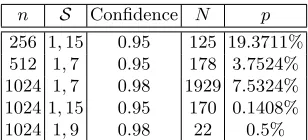
We wish to highlight that in agreement to our estimates we were able to successfully recover the entire RLWE secret for various dimensions as listed in Table1. Specifically we were able to recover an entire secret key for n= 1024, q= 12289 andχ=ψ16 for leakage patterns (1,7) mod 16 in roughly 15 hours and forn= 1024, q= 12289 and χ=ψ16and leakage pattern (1,15) mod 16 in about 1 hour 17 minutes.
The experiments were run using a MacBook Pro with 2.6 GHz Intel Core i5 processor, 16 GB 1600 MHz DDR3 memory, with a python script running 4 parallel processes and using Sage version 8.1
n S Confidence N p 256 1,15 0.95 125 19.3711% 512 1,7 0.95 178 3.7524% 1024 1,7 0.98 1929 7.5324% 1024 1,15 0.95 170 0.1408% 1024 1,9 0.98 22 0.5%
Table 1: Expected Success Probability of our Attack
4
Search and Decisional RLWE with Leakage
In this section we define the search and decisional ring-LWE problem with structured leakage on the secret key (i.e. partial key exposure). The definition is similar to the definition2.7.
Ring elements (polynomials) pare stored as a vector of their coefficients (p0, . . . , pn−1). Forp∈Rq we
denotepb:=NTT(p) := (p(ω1),p(ω3), . . . ,p(ω2n−1)), whereωis a 2n-th primitive root of unity in
Zq(which
exists sinceqis prime andq≡1 mod 2n), andp(ωi) fori∈
Z∗2n denotes evaluation of the polynomialpat
ωi. Note that b
pis indexed by the setZ∗2n.
Definition 4.1 (Ring-LWE, Search with Leakage). The search version of the ring-LWE problem with leakage, denoted R-SLWEq,ψ,n0,S, is parameterized by (n0 ∈ {1,2,4,8, . . . n},S ⊆ Z∗2n0). The experiment chooses s←χ, where s=NTT−1(bs). The goal of the adversary is to recovers, given independent samples from the distribution Dreal,n0,S, which outputs
b
a,ba·bs+be,[sbi]i≡αmod 2n0|∀α∈S
where a,e are obtained
fromAs,ψ as described in definition 2.6.
Definition 4.2 (Ring-LWE, Decision with Leakage). The decision version of the ring-LWE prob-lem with leakage, denoted R-DLWEq,ψ,n0,S, is parameterized by (n0 ∈ {1,2,4,8, . . . n},S ⊆ Z∗
2n0). The experiment chooses s ← χ, where s = NTT−1(bs). The goal of the adversary is to distinguish be-tween independent samples from the distributions Dreal,n0,S and Dsim,n0,S, where Dreal,n0,S outputs
b
a,ab·bs+be,[sbi]i≡αmod 2n0|∀α∈S
where a,e are obtained from As,ψ as described in definition 2.6. And
the Dsim,n0,S outputs
b
a,u,b [sbi]i≡αmod 2n0|∀α∈S
wherea,e are obtained fromAs,ψ as described in
Defini-tion2.6,and
b
ui=abi·sbi+ebi |i≡αmod 2n0∀α∈S
and
b
ui←Zq
chosen uniformly random, otherwise.
Note that in the above definitions, the adversary can receive the leakage [ebi]i≡αmod 2n0|∀α∈S for each error vector as well, since givenab and [sbi]i≡αmod 2n0|∀α∈S, the adversary can derive [ebi]i≡αmod 2n0|∀α∈S.
Also note that if decisional RLWE with leakage parameterized by (n0,S) as above is hard for randomly distributed ba, then it is also hard for ba that is arbitrarily distributed in positions i such that i ≡α mod 2n0,α∈ S and randomly distributed elsewhere. This is because given an RLWE instance with leakage
b
a,u,b [sbi]i≡αmod 2n0|∀α∈S
, fori≡α mod 2n0,α∈ S one can change the instance frombai toba0i by adding
(ba0
i−bai)·sbi from thei-th coordinate ofub.
When S ={α} consists of a single element, we abuse notation and write the Leaky-RLWE parameters as (n0, α).
We present a search to decision reduction in Section5.
5
Search to Decision Reduction With Leakage
For a polynomialv∈Rq, recall that ˆv denotes the NTT representation ofv, where ˆv is indexed by the set Z∗2n, so ˆv= ˆv1,v3, . . . ,ˆ v2ˆ n−1, wherevbi:=v(ω
i) fori∈
new definitions and theorems sometimes in terms ofa,b bs,beinstead ofa,s,e since the leakage we consider is on the NTT transform which is used for efficient computations. Note that this is equivalent to considering a,s,eas NTT is efficiently invertible.
Letφi→j be the automorphism that maps ˆv to ˆv0 such thatv(ωi) =v0(ωj).φi→j induces a permutation
on the elements of ˆv, denotedρi→j. Specifically,φi→j(ˆv) maps ˆv` to ˆvρi→j(`)fori, j, `∈Z
∗ 2n.
Fact 5.1. If i≡α mod 2n0,j≡β mod 2n0, and`≡γ mod 2n0 thenρi→j(`)≡α−1γβ mod 2n0.
The following theorem follows straightforwardly from [31,30].
Theorem 5.2 (Existence of Basic Attack). If, for any (n0,S ⊆Z∗
2n0)adversary A running in time T distinguishes Dreal,S,n0 from Dsim,S,n0 with probability1/T, then is some index j such that j 6=α0 modn for alla0∈ S and an attack “Basic Attack” that learns NTT coordinateˆsj with probability1−1/poly(n)and
takes time poly(n)·T2.
Attack 1: On input RLWE instance (ˆa,uˆ), index j ∈ Z2∗n, where j ≡ b mod 2n0, leakage
[ˆsi]i≡1 mod 2n0, and adversary A running in time T that distinguishes on index j with probability 1/T:
1. Set ˆa1:= ˆa,uˆ1:= ˆu, [ˆsr
i := ˆsi]i≡1 mod 2n0.
2. Loop invariant: at the beginning of the outer loop, adversary always knows [ˆsr
i]i≡1 mod 2n0.
3. Forr∈[n0/2], For each j0 such thatj0≡j mod 2n0:
(a) Run the Basic Attack with RLWE instance (ˆa := φj0→j(ˆar),uˆ := φj0→j( ˆur)), leakage set [ˆsi := ˆsrρ
j0 →j(i)]i≡1 mod 2n
0 to recover ˆsrj0. Note that all these values of ˆsrρ
j0 →j(i) are known: If
i≡1 mod 2n0 thenρj0→j(i)≡1 mod 2n0, sincej≡j0 mod 2n0.
4. Note that at the end of the inner loop, (w.h.p.) all ˆsrj0 such that j0≡b mod 2n0 are known. 5. Choose an`∈Z∗2n such that`≡b
2 mod 2n0. Set ˆar+1
:=φ`→j(ˆar) and ˆur+1:=φ`→j( ˆur). Note
that the adversary now knows [ˆsri+1]i≡1 mod 2n0, since all elements ˆsri0 such that i0 ≡b mod 2n0 are now in position ˆsri+1such that i≡1 mod 2n0.
At the end of the execution, the adversary learns all valuessisuch thati≡br mod 2n0andr∈[n0/2].
For parametern0, let Tn0 denote the time it takes to solve search-RLWE, under leakage attack parame-terized by (n0, α= 1).
Assuming 2O(n) sub-exponential hardness of LWE, fix some0. Letn∗be the minimum element in the setS, where S:={n0∈ {2,4,8, . . . , n} |Tn0 ∈2O(n
0)
}. Note that it must be the case thatTn∗ >2·Tn∗/2. Recall that, we use the notation≈t(n),p(n)to indicate that adversaries running in timet(n) can distinguish two distributions with probability at mostp(n).
Theorem 5.3. Assume n∗>4, then one of the following must hold: – Dreal,n∗,{α}≈t(n),p(n)Dsim,n∗,{α} OR
– Dreal,n∗,{α,(n∗−1)·α}≈t(n),p(n)Dsim,n∗,{α,(n∗−1)·α} OR – Dreal,n∗,{α,(2n∗−1)α}≈t(n),p(n)Dsim,n∗,{α,(2n∗−1)α}. where, t(n) =√Tn∗/poly(n) =p(n)
Proof. As discussed above, due to the automorphisms, we can assume WLOG that α = 1. Assume Dreal,n∗,{1} 6≈√T
n∗/poly(n),poly(n)/√Tn∗ Dsim,n∗,{1}. Then there must be an adversary A running in time
√
Case 1: b is such that br≡n∗+ 1 mod 2n∗ for some r∈[n∗/2].In this case, we can use Attack 1 to recover the positionsisuch thati≡n∗+ 1 mod 2n∗ (w.h.p.) in timepoly(n)·Tn∗/4poly(n). Now we can run the attack that takes as input [ˆsi]i≡1 modn∗ and recovers all of ˆs. By assumption, this attack runs in timeTn∗/2< Tn∗/2. Thus, we can to recover the whole ˆsin timepoly(n)·Tn∗/4poly(n) +Tn∗/2< Tn∗, which is a contradiction.
By properties of the groupZ∗2n∗, wheren∗ is a power of two, for allb∈Z∗
2n∗\ {n∗−1,2n∗−1}, it is the case thatbr≡n∗+ 1 mod 2n∗for somer∈[n∗/2]. Thus, Case 1 holds for allb∈
Z∗2n∗\ {n∗−1,2n∗−1}. Case 2: b = n∗−1. In this case, we can use Attack 1 to recover the positions i such that i ≡ n∗−1
mod 2n∗ (w.h.p.) in time poly(n)·Tn∗/4poly(n). Assume Dreal,n∗,{1,(n∗−1)} 6≈√T
n∗/poly(n),
√
Tn∗/poly(n)
Dsim,n∗,{1,(n∗−1)}, then there must be some adversary A0 that distinguishes on index j0 ∈ Z∗2n, where j0 ≡b0∈Z∗2n∗\ {1, n∗−1}. We can combine this with the previous attack as follows:
Case 2(a): b0 ∈Z∗2n∗\ {1, n∗−1,2n∗−1}.Due to essentially the same argument as before, we can (w.h.p.) learn all [ˆsi]i≡(b0)r mod 2n∗ forr∈[n∗/2] in timepoly(n)·Tn∗/2poly(n) and then apply the same argument as above.
Specifically, given the initial leakage [ˆs1
i]i≡1 mod 2n∗, the attack will first learn [ˆsi1]i≡n∗−1 mod 2n∗, then learn [ˆs1
i]i≡b0 mod 2n∗, then, for some (j, j0) such thatj ≡ b0 mod 2n∗ and j0 ≡1 mod 2n∗, apply automorphismφj→j0 to get ˆs2, learn [ˆs2i]i≡n∗−1 mod 2n∗, then learn [ˆs2i]i≡b0 mod 2n∗, etc. thus ultimately learning [ˆsi]i≡(b0)r mod 2n∗ forr ∈[n∗/2]. At this point, we will have [ˆsi]i≡1 modn∗ and thus can learn all of ˆs in additional time Tn∗/2 < Tn∗/2. Thus, in total the attack takes time poly(n)·Tn∗/2poly(n) +Tn∗/2< Tn∗, leading to contradiction.
Case 2(b): b0 = 2n∗−1.Due to essentially the same argument as before, we can (w.h.p.) recover the positionsisuch thati≡2n∗−1 mod 2n∗ in timepoly(n)·Tn∗/4poly(n). The adversary now knows [ˆsi]i≡n∗−1 modn∗. We can thus can learn all of ˆsin additional time Tn∗/2 < Tn∗/2. Thus, in total the attack takes timepoly(n)·Tn∗/4poly(n) +Tn∗/2< Tn∗, leading to contradiction.
Case 3: b= 2n∗−1.This essentially follows identically to Case 2.
6
Leakage Analysis of New Hope Key Exchange
6.1 New Hope Key Exchange scheme
It contains New Hope key exchange scheme and subroutines ofHelpRec andRec. In this section we revise some important results and algorithms from [3]. Let ˜D4be a lattice as defined below:
˜
D4=Z4∪g+Z4wheregt=
1 2,
1 2,
1 2,
1 2
Let, B = (u0,u1,u2,g) be the basis of ˜D4, where ui are the canonical basis vectors of Z4. Note that
u3=B·(−1,−1,−1,2)
t
. Also, letV be the Voronoi cell of ˜D4.4
Note that,u0,u1,u2, and 2g are inZ4. Therefore, a vector in ˜D4/Z4can be checked by simply checking
the parity of its last coordinate when represented with basis B. We can now use a simple encoding and decoding scheme to represent a bit. The encoding algorithm is as follows: Encode(k ∈ {0,1}) = kg. For decoding to ˜D4/Z4, the correctness requires that the error vectore∈V. As noted in [3], this is equivalent to checking ifkek1≤1. We can now present the decoding algorithm as follows in figure6.1:
4 For more details and background on reconciliation mechanism of NewHope, please refer to [3] (section 5 and
Algorithm 6.1 (Algorithm 1). Decode (x∈R4/Z4)
Ensure:A bit ksuch thatkgis a closest vector tox+Z4:x−kg∈V +
Z4
1 v=x− bxe
2 return0ifkvk1≤1and1otherwise
Lemma 6.2. (Lemma C.1 [3]) For anyk∈ {0,1}and anye∈R4 such thatkek
1<1, we haveDecode(kg+ e) =k.
Let us now present the algorithmCVP, which will be used as subroutine in reconciliation algorithms, as follows:
Algorithm 6.3 (Algorithm 2). CVPD˜
4 (x∈R 4)
Ensure:An integer vectorzsuch thatBzis a closest vector tox:x−Bz∈V
1 v0← bxe
2 v1← bx−ge
3 k←(kx−v0k<1)?0 : 1 4 (v0, v1, v2, v3)t←vk
5 return(v0, v1, v2, k)
t
+v3·(−1,−1,−1,2)
t
Next, we define ther-bit reconciliation as,
HelpRec(x;b) =CVPD˜4
2r
q(x+bg)
mod 2r,
whereb∈ {0,1}is a uniformly chosen random bit.
Lemma 6.4. (Lemma C.2 [3]) Assume r ≥ 1 and q ≥ 9. For any x ∈ Z4q, set r := HelpRec(x) ∈ Z42r.
Then, 1qx− 1
2rBrmod 1is close to a point ofD4/˜ Z
4, precisely, for α= 1 2r +
2
q:
1
qx−
1
2rBr∈αV +Z
4 or
1
qx−
1
2rBr∈g+αV +Z4.
Additionally, forxuniformly chosen in Z4q we haveDecode
1
qx−
1 2rBr
is uniform in{0,1}and indepen-dent of r.
Let,Rec(x,r) =Decode1
qx−
1 2rBr
.
We can now define the following reconciliation protocol:
Algorithm 6.5 (Protocol 1). Reconciliation protocol in qD˜4/qZ4
Alice Bob
x0∈Z4q x0≈x x0 ∈Z4q
r
←− r←HelpRec(x)∈Z4 2r
k0 ←Rec(x0,r) k←Rec(x,r)
Lemma 6.6. (Lemma C.3 [3]) If kx−x0k1 < 1− 1 2r
·q−2, then by the above protocol 6.5 k = k0. Additionally, if xis uniform, thenkis uniform independently of r.
Algorithm 6.7 (Protocol 2). Parameters: q= 12289,n= 1024Error Distribution: Ψ16n
Alice (server) Bob (client)
Sample: a←Rq
s,e←−Ψn
16 s0,e0,e00←−Ψ16n
bs:=NTT(s),be:=NTT(e) bs
0
:=NTT(s0),be0:=NTT(e0)
b
e00:=NTT(e0)
bb:=ab·bs+be b
a,bb
−−→
b
u:=ba·bs0+be0
b
v:=bb·bs
0 +be00 v:=NTT−1(bv) (bu,r)
←−−− r←HelpRec(v) w:=NTT−1(ub·sb) v←Rec(v,r) v←Rec(w,r) µ←SHA3−256(v) µ←SHA3−256(v)
6.2 Security with Auxiliary Inputs
In this section we consider a modification to Protocol6.7in which all binomial random variables are instead drawn from discrete Gaussians with corresponding standard deviation σ. We prove in Corollary 6.15 that the distribution overv, given the transcript of the modified protocol, is (with all but negligible probability) indistinguishable from a distribution with high min-entropy. By the analysis of [3] leveraging Renyi divergence and the random oracle model, this is sufficient to obtain our main result.
The proof of Corollary6.15has two components. In the first (computational) component (proof of The-orem6.8), we analyze the distribution ofv, conditioned on the transcript thatdoes not include the reconcil-iation informationr and show that it is close to another distribution overv00. In the second (information-theoretic) component (proof of Theorem 6.9), we analyze the expected min-entropy of v ← Rec(v00,r), conditioned on the adversary’s view which now includes the reconciliation information r←HelpRec(v00, b). These are then combined to obtain Corollary6.15.
The view of the adversary in the modified protocol consists of the tuple
ViewA:= (ba,bb,u,b [bsi,bei,bs0i,be
0
i,eb
00
i]i≡α mod 2n0). Moreover, note thatvbi=bbi·bs0i+be
00
i, so [bvi]i≡α mod 2n0 is deducible from the view.
Theorem 6.8. If ring-LWE decision problem with leakage is hard as defined in Section4with parameters (n0= 8, α∈
Z∗2n0), then
(1) The marginal distribution over [vbi]i≡α mod 2n0, is computationally indistinguishable from uniform ran-dom overZn/n
0
q .
(2) Given the adversary’s view, ViewA,
[bvi]i6≡α mod 2n0
is computationally indistinguishable from uniform random over Znq−n/n0.
Proof. (Proof of theorem6.8):
We prove the above theorem by considering the adversary’s view in a sequence of hybrid distributions.
Hybrid H0:This is the real world distribution
(ba,bb,u,b [sbi,ebi,bs0,eb0i,be
00
i]i≡α mod 2n0,
b