© 2014, IJCSMC All Rights Reserved
1136
International Journal of Computer Science and Mobile Computing
A Monthly Journal of Computer Science and Information Technology
ISSN 2320–088X
IJCSMC, Vol. 3, Issue. 5, May 2014, pg.1136 – 1142
RESEARCH ARTICLE
Optimization Of Capacity Of MIMO Antenna
Based Wireless System Using Genetic Algorithm
R.Sharma
1, A.S.Buttar
21
Student, Dept. of Electronics & Communication Engineering,
PITK
,
Kapurthala
2
Associate Professor, Dept. of Electronics& Communication Engineering,
PITK, Kapurthala
[email protected]
,
[email protected]
Abstract— In this work, at the earlier stage, the signal formation and the initial antenna array setup is considered as the input population set to the Genetic process. The genetic process is defined for N number of iterations. With each iteration, the two parent configurations are selected under the fitness rule specification. The fitness rule is defined to analyze the channel capacity under antenna configuration. To perform the selection, Rank selection approach is defined in this work. After the selection of parent configuration, the child configuration is generated by performing the crossover operation. To generate the child one point crossover is defined in this work. At the final stage, the mutation function is implemented over it. The genetic process is defined to identify the identical antenna configuration will be achieved and the effective channel throughput will be drawn. The presented work is implemented in Matlab environment.
Keywords: MIMO, Antenna, Genetic Optimization
I. INTRODUCTION
© 2014, IJCSMC All Rights Reserved
1137
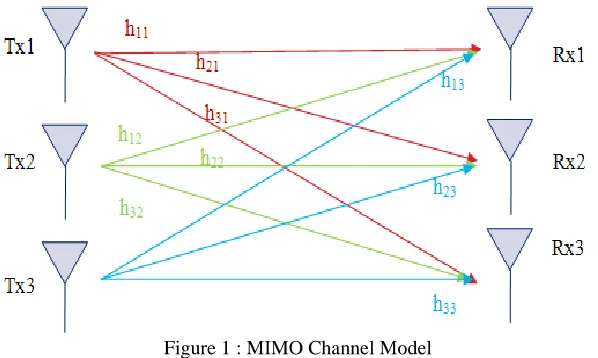
MIMO system is defined under the signal quality and communication quality analysis under the antenna. These kinds of systems are having multiple transmitter/receiver antennas as shown in figure 1.
Figure 1 : MIMO Channel Model
Here figure 1 is showing the MIMO system under channel model specification under multiple transmitter and receiver specification. Figure is showing the interconnection between these antennas to perform reliable communication [11][13].
MIMO system is defined to improve the communication throughput and to reduce the BER. This system is defined under the signal processing algorithms to improve the channel capacity, bandwidth improvement, channel equalization and effective communication channel estimation. In this growing communication scenario, MIMO systems are improved under the integrated circuits so that the physical level communication analysis and improved will be attained. MIMO system is defined with multiple antenna system where each antenna is having the specific range capability to control the communication and to provide the effective communication throughput. These kind of communication systems are having the following capabilities
MIMO system enables the significant communication throughput with effective range enhancement without including additional channel and transmission power over the channel.
Higher spectral analysis is defined to improve the channel communication. The reliability over the system is defined under diversity analysis.
MIMO systems are defined as the effective path communication network with signal specification under various communication parameter analysis. Author defined the MIMO system with multiple parallel signals so that the signal transformation and signal generation will be obtained effectively. The MIMO system includes the distance communication under different fading channels and irregular communication channels. These kind of system requires the effective channel formation, utilization and estimation. One of important aspect of such communication system is the antenna capacity estimation and improvement so that the overall communication over the channel will be improved. These kind of communication systems are defined with signal modeling and channel effective communication so that the system reliability will be improved[6][7][14].
MIMO system is defined as the transmitter and signal generation so that the multi-path communication will be performed. The transmission stream with channel matrix estimation is defined under the transmitter and multiple antenna specification. The signal vector under antenna capacity evolution and decoding is defined under signal vector. The MIMO system model is defined as
Y=HX+G (1)
Where Y and X are receive and transmit vectors, H and G are the channel matrix and noise vector, respectively.
© 2014, IJCSMC All Rights Reserved
1138
effective system model is defined to optimize the MIMO system based antenna system placement. In section IV, the results obtained from the work are discussed. In section V, the conclusion obtained from the work is discussed and presented.
II. Review of Literature
In this section, the work defined by earlier researchers is defined and presented. Some of the work defined by earlier researchers is presented in this section.
Manuel O. Binelo[1] has defined a work on antenna array based capacity optimization using genetic approach. Author defined a MIMO based antenna system under the array antenna specification and capacity optimization under propagation modeling. Author defined the constraint analysis approach using antenna modeling and array optimization over the system. Author defined the work to optimize the channel and to gain the high throughput over the network. U. Olgun [2] has defined a work on antenna array optimization for capacity evaluation and optimization in MIMO system. Author defined the work to analyze the MIMO system capacity estimation so that the multiple component based integration will be obtained. Author defined communication analysis along with system volume analysis. Author defined PSO based approach for optimization of integrated tool as the effective linear and circular array based system. Rui Xu[3] has defined a range based optimization system using channel optimization and LoS parameters for MIMO system. Author defined the communication system for indoor communication. Author presented the study for 2x2 and 3x2 MIMO system to obtain the effective communication over the network. Author defined the measurement analysis over the system to gain the high capacity communication in optimization environment.
M.-H. Ho[4] has defined a channel capacity estimation and optimization approach using PSO. Author defined work for indoor communication under radiation pattern analysis. Author defined the optimized antenna array formation to maximize the channel capacity in indoor communication. Author defined the frequency response analysis under antenna pattern analysis and capacity estimation. Jianxin Dai[5] has defined uplink capacity estimation based approach for MIMO system analysis for SIMO. Author defined the work with smart antenna system and investigate the direction of arrival under transmission analysis. Author defined the antenna array formation under capacity estimation and evaluation for antenna array specification. Rick S. Blum[6] has presented an optimal antenna selection criteria for MIMO system. Author defined the antenna array specification under receiver and transmitter based analysis so that the signal estimation and optimization will be achieved. Author defined the antenna selection analysis under capacity formation and generation. Author presented the signal level estimation over the system so that the system error probability will be reduced. Ralf R. Muller[7] has defined a probabilistic estimation and analysis approach channel capacity evaluation for multiple antenna array. Author defined the detection channel capacity generation so that the signal analysis with dual antenna capacity estimation will be obtained. Author defined the work under fading channel and perform the error probability estimation.
Ben Lu[8] has defined the performance analysis based optimization approach MIMO coded system. Author defined the design system optimization under density parity check so that the MIMO system improvement will be gained. Author performed the frequency level estimation and evolution under optimized irregular codes to compute the signal to noise ratio. Author perform the optimization of various channel model with demodulation scheme to optimize the system performance. Yuuta Nakaya[9] has defined an array antenna analysis for MIMO system under the interference analysis for MIMO system. Author define dthe SINR ratio analysis along with MIMO system formation and capacity analysis to improve the system. Shahab Sanayei [10] has defined the capacity improvement method using transmitter receiver antenna analysis so that the MIMO system improvement will be gained. The system optimization is here done under th antenna receiver specification. Author defined the suboptimal algorithm for the system improvement in such environment and system. Jiansong Chen [11] presented a work antenna selection for MIMO system under complexity and cost estimation.
III. PROPOSED WORK
© 2014, IJCSMC All Rights Reserved
1139
configuration so that the optimal antenna configuration obtained. This antenna configuration improved system capacity and reduced the communication error.
A) MIMO Channel Model
In this present work MIMO system channel modeling is defined by NR x NT. Here NR represents the number of receiving
antennas and NT represents the number of transmitter antennas. As the MIMO system is defined, some antennas are set
activated and deactivated so that the effective particular antenna position in H matrix will be identified. The presentation of the antennas is done in the form of H-Matrix. It has assumed that receiver is perfectly synchronized with transmitter means one sample per symbol and optimum sampling rate and synchronization is achieved by symbol time estimator. The perfect synchronization ith received block Yi is given as:
Here
H
is the complex version of channel matrix HB) Antenna Configuration
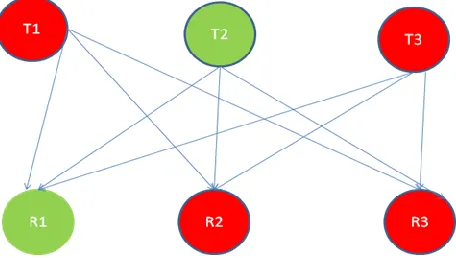
As the H Matrix of antenna is representation, the matrix formation is done so that the activation and deactivation of antennas will be performed. This configuration is considered as the specific formation values shown with an example for 3*3 MIMO system
Means we have three transmitter antennas and one receiver antenna Example [010010]
represents tx0=1,tx2=1,tx3=0,rx1=0,rx2=1,rx3=0 Suppose we have a 00001100 where
0-represents antenna is OFF 1-represents antenna is ON And in a matrix consisting of 3*3
Means we have three transmitter antennas and three receiver antenna
Figure 2 : Antenna Array Configuration
C) Algorithm
In this work an antenna array system is defined using genetic approach. The algorithmic representation is given by
AntennaArrayOptimization(AntennaArray)
/*AntennaArray is the initial specification of antenna configuration*/ {
( )
Y
i
HC s
G
i
Re(
)
Im (
)
Im (
)
Re(
)
H
g H
H
g H
H
© 2014, IJCSMC All Rights Reserved
1140
1 Setup the MIMO system configuration with the specification of channel length and relative parameters. 2 Setup the antenna array configuration with on and off the particular antenna position
3 Generate the signal under the specification of channel parameters and the antenna configuration.
4 Define the setup with the combination of channel specification and the antenna parameters and consider it as initial population for genetic process.
5 For i=1 to MAX_Iteration
[Process the genetic for fixed number of iterations] {
6 Perform the selection under defined rank based selection approach.
7 Define the fitness rule under the acceptance constraints for antenna and signal specification. 8 Perform cross
9 Perform the image enhancement using preprocessing Tools to Normalize the Image 10 Initialize the population respective to the Genetic algorithm
11 Perform the Selection of Selection on this Training Dataset
12 Perform the Crossover on selected parents and generate the next level child 13 Perform the Mutation to neglect the values that does not support fitness function 14 Recombine the generated child with existing population to Generate new Population Set 15 Obtain the channel capacity estimation for the configuration.
16 } }
IV. RESULTS
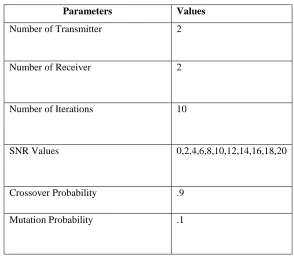
The presented work is implemented in matlab environment. The obtained results from the system are analyzed respective to the BER. In this present work, MIMO system is defined along with antenna system configuration. The MIMO system settings are defined in table 1
Table 1 : Simulation Parameters
Parameters Values
Number of Transmitter 2
Number of Receiver 2
Number of Iterations 10
SNR Values 0,2,4,6,8,10,12,14,16,18,20
Crossover Probability .9
Mutation Probability .1
© 2014, IJCSMC All Rights Reserved
1141
1 2 3 4 5 6 7 8 9 10
18.5 19 19.5 20 20.5 21 21.5
Iterations
C
ap
ac
ity
Capacity
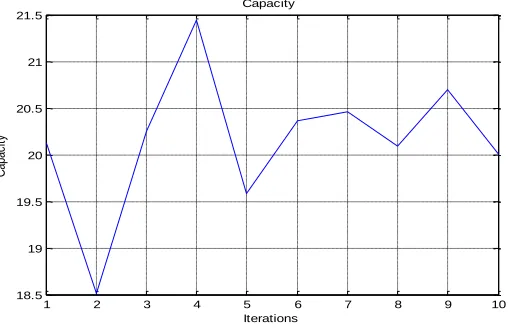
Figure 3 : Channel Capacity Estimation
Figure 3 is showing the optimized identification of channel capacity using genetic approach in case of MIMO 2x2 system. As we can see, here x axis represents the genetic interations and y axis is showing the channel capacity. During the channel capacity identification, each iteration performs the positional changes over the antenna to gain the maximum channel capacity. Here we can see, different capacity degrees respective to different iterations. These results are obtained under the effect of SNR. The results show at iteration 2, the optimized channel capacity is achieved.
The work is testing on different MIMO antenna configuration.
V. CONCLUSION
In this present work an optimization to MIMO channel capacity is defined by MIMO antenna array configuration. The work has defined the effective array configuration so that the channel capacity will be improved. The work is tested on different MIMO system configuration. The work is optimized using genetic approach and effective channel optimization is obtained. The results show the effective estimation of this configuration under different configuration vectors.
REFERENCES
[1] Manuel O. Binelo," MIMO Array Capacity Optimization Using a Genetic Algorithm", IEEE Transactions On
Vehicular Technology 0018-9545© 2011 IEEE
[2] U. Olgun, "Optimization Of Linear wire Antenna Arrays To Increase MIMO Capacity Using Swarm Intelligence", IEEE Conference On Antennas and Propagation pp1-6, 2007.
[3] Rui Xu," Capacity Optimization for Short-Range LoS 3X2 MIMO Channels", APCC 2012 978-1-4673-4728-0/12
©2012 IEEE
[4] M.-H. Ho," Optimization of channel capacity for multiple-input multiple-output smart antenna using a particle
swarm optimizer", The Institution of Engineering and Technology 2012
[5] Jianxin Dai," The Uplink Capacity of SA-MIMO System under Single-User Scenario", 978-1-4577-1010-0/11
©2011 IEEE
[6] Rick S. Blum," On Optimum MIMO With Antenna Selection", IEEE Communication Letters 1089-7798/02 © 2002
IEEE
[7] Ralf R. Muller," Minimum Probability of Error and Channel Capacity in Large Dual Antenna Array Systems",
© 2014, IJCSMC All Rights Reserved
1142
[8] Ben Lu, "Performance Analysis And Design Optimization Of Ldpc Coded MIMO OFDM Systems", GLOBECOM
2003 0-7803-7974-8/03 © 2003 IEEE
[9] Yuuta Nakaya, "An RF-adaptive Array Antenna Incorporated in a MIMO Receiver under Interference",
0-7803-8255-2/04@2004 IEEE
[10] Shahab Sanayei, "Capacity Maximizing Algorithms for Joint Transmit-Receive Antenna Selection",
0-7803-8622-1/04 ©2004 IEEE
[11] Jiansong Chen, "Fast Receive Antenna Selection for MIMO Systems", 0-7803-8622-1/04 ©2004 IEEE
[12] Frode Bohagen," Construction and Capacity Analysis of High-Rank Line-of-Sight MIMO Channels", IEEE
Communications Society / WCNC 2005 0-7803-8966-2/05© 2005 IEEE
[13] Federico Boccardi, "Zero-Forcing Precoding For The MIMO Broadcast Channel Under Per-Antenna Power
Constraints".
[14] Athanasios G. Kanatas," A Receive Antenna Subarray Formation Algorithm for MIMO Systems", IEEE