ISSN(Online): 2320-9801
ISSN (Print): 2320-9798
I
nternational
J
ournal of
I
nnovative
R
esearch in
C
omputer
and
C
ommunication
E
ngineering
(An ISO 3297: 2007 Certified Organization)
Vol. 4, Issue 11, November 2016
Content Based Image Retrieval using GLCM
Anupam Mukherjee1, Kumar Gaurav2, Abhishek Verma3, Harishankar Kumar4, Rahul Thakur5
Assistant Professor, Dept. of C.S.E, Siliguri Institute of Technology, Siliguri, India1
B.Tech Student, Dept. of C.S.E, Siliguri Institute of Technology, Siliguri, India2,3,4,5
ABSTRACT: This paper mainly focuses on a non-conventional image retrieval technique called content Based image retrieval (CBIR).CBIR will possess a new dimension in the field of digital image processing. In CBIR images are retrieved not only based on the manual annotation or tags of the image, rather it focuses on the content of the image (color, shape, texture).This paper construct and proposed a system that retrieve the relevant image based on five major features like GLCM (Gray level co-relation matrix), mean, standard deviation, skewness of R, G, B components. After extracting the features, these systems construct image dataset for each image. Then the user generated query is compared with the system dataset. Those image generate the highest throughput are displayed .The accuracy of our system is measured by using precision & recall strategies.
KEYWORDS: Content Based Image Retrieval, GLCM, Precession & Recall, Standard Deviation, Skewness, Threshold value.
I. INTRODUCTION
Content-based image retrieval, a technique which uses visual contents to search images from large scale image databases according to users' interests, has been an active and fast advancing research area since the 1990s. During the past decade, remarkable progress has been made in both theoretical research and system development.
A. ARCHITECTURE OF CONTENT BASED IMAGE RETRIEVAL
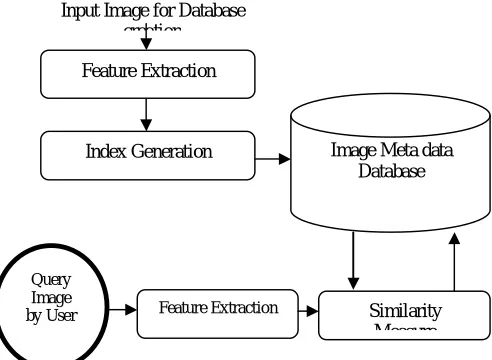
The architecture of content based image retrieval system having online and off line processing part. The images which are stored in database are processed offline. Features are extracted from stored images and extracted features are kept in image Meta data database. These extracted features are used to index the image. In Other part, user generated query image is analyzed and necessary features are extracted then these extracted features are used to retrieve the similar images from the image database. Rather than directly comparing two images, similarity of the visual features of the query image is measured. (Mitra, S., & Acharya, T., 2005).
Fig 1: Architecture of Content Based Image Retrieval
Feature Extraction
Index Generation Image Meta data Database Input Image for Database
creation
Query Image
by User Feature Extraction Similarity
ISSN(Online): 2320-9801
ISSN (Print): 2320-9798
I
nternational
J
ournal of
I
nnovative
R
esearch in
C
omputer
and
C
ommunication
E
ngineering
(An ISO 3297: 2007 Certified Organization)
Vol. 4, Issue 11, November 2016
B. IMAGE CONTENT DESCRIPTORS
Image content may be described in terms of visual and semantic contents. General Visual content focus on color, texture, shape, spatial relationship, etc, whereas domain specific visual content may emphasis on domain specific content like human face. Semantic content is obtained either by textual annotation or by complex inference procedures based on visual content. Color is the most important features, while we can identify only a limited number of gray levels, but our eyes are able to differentiate thousands of colors and a computer can represent even millions of distinguishable colours in practice.
COLOR MOMENTS: Color moments are used to distinguish images based on their features of color. They provide a measurement for color similarity between images. Similarity value can then be compared to the values of images indexed in a database for tasks like image retrieval.
In Digital Image processing two color models are frequently used – RGB(Red, Green, Blue) and HSV(Hue, Saturation, Value), as color can be defined by 3 channels (e.g. RGB or HSV), therefore color moments are calculated for each of these channels. An image is characterized by 9 moments that is 3 moments for each of the 3 color channels. Let is the Color channel at the image pixel. Then three Color moments can be defined as:
Mean: It provides average Color value in the image. It is calculated using following statics:
( ) =∑ Where, N is the total number of pixels in the image.
Standard deviation: The standard deviation is the square root of the variance of the distribution. It is calculated using following statics:
. ( ) = 1/ −
Skewness: It gives measure of the degree of asymmetry in the distribution. It is calculated using following statics:
( ) = 1 −
GREY-LEVEL CO-OCCURRENCE MATRIX:
In a statistical texture analysis, texture features were computed on the basis of statistical distribution of pixel intensity. Depending on the number of pixels or dots in each combination present in an image matrix, we have the first-order statistics, second-order statistics or higher-order statistics. Feature extraction based on grey-level co-occurrence matrix. (GLCM) is the second-order statistics that can be use to analyzing image as a texture. GLCM is also called gray tone spatial dependency matrix.
The figure below represents the formation of the GLCM of the grey-level (4 levels) image at the distance d = 1 and the direction of 0°.
ISSN(Online): 2320-9801
ISSN (Print): 2320-9798
I
nternational
J
ournal of
I
nnovative
R
esearch in
C
omputer
and
C
ommunication
E
ngineering
(An ISO 3297: 2007 Certified Organization)
Vol. 4, Issue 11, November 2016
Now the question comes in our mind how we can calculate the direction.
Fig3. Direction of GLCM generation.
From the centre ( ) to the pixel 1 representing direction = 0° with distance d =1, to the pixel 2 direction = 45° with distance d = 1, to the pixel 3 direction = 90° with distance d = 1, and to the pixel 4 direction = 135° with distance d = 1. In addition to the horizontal direction (0 º), GLCM can also be formed for the direction of 45 º, 90 º and 135 º as shown in Figure.
II. RELATED WORK
In 2008 Chun, Y. D., Kim, N. C., & Jang, I. H. proposed a CBIR method based on an efficient combination of multiresolution color and texture features. This paper focus on color features, color auto-correlograms of the hue and saturation component images in HSV color space. In addition, the proposed method almost always shows performance gain in precision versus recall and in ANMRR over the other methods. Dr. H.B.Kekre, Sudeep D. Thepade, Tanuj a K. Sarode and Vashali Suryawanshi proposed a image retrival techniques using GLCM, LBG (Linde-Buzo-Gray) and KPE(Kekre’s Proportionate Error) algorithm for texture feature extraction. They prepare a system that computes 89.10% less computations compare to GLCM method. Zhang,J. et. al. proposed a method that gives encouraging results when comparing its retrieval performance to that of the traditional co-occurrence matrices and Yao’s approach.
III.PROPOSED METHODOLOGY & ALGORITHM
The proposed method shows some relevant images to the user based on the query image the user selects. This paper proposed a new approach for Content based image retrieval system in efficient manner. In this proposed method a database is constructed which having number of images. The user has to input test image (query image) and selected object images. Low level Features like color, histogram, skewness and standard deviation and texture are then extracted for test (query) image and object images.
ISSN(Online): 2320-9801
ISSN (Print): 2320-9798
I
nternational
J
ournal of
I
nnovative
R
esearch in
C
omputer
and
C
ommunication
E
ngineering
(An ISO 3297: 2007 Certified Organization)
Vol. 4, Issue 11, November 2016
Fig 4: Worked flow and methodology which can be adopted
IV.PSEUDO CODE
Algorithm for Creation of Image Dataset
Step 1: Read input image and create image Matrix Step 2: Resize that input image to 128×128 image Matrix Step 3: Apply noise reduction technique to remove noise.
Step 4: Extracting the histogram value from R,G,B components of resized image(R_hist, G_hist,B_hist). Step 5: Extracting the Mean value from R,G,B components of resized image (R_mean, G_ mean,B_ mean).
Query Image
Histogram, Mean, Std. Deviation, Skewness
Values extraction
Formation of GLCM Matrix
Combining All Results
Prepare R,G,B Sub matrix
Image Resize
Noise Reduction
Start
Read Input Image
Image Resize
Prepare R,G,B Sub matrix
Combining All Results
Formation of GLCM Matrix
Database
Compare
Desired Image
Continue
Finish
Noise Reduction
Histogram, Mean, Std. Deviation, Skewness
Values extraction
N
ISSN(Online): 2320-9801
ISSN (Print): 2320-9798
I
nternational
J
ournal of
I
nnovative
R
esearch in
C
omputer
and
C
ommunication
E
ngineering
(An ISO 3297: 2007 Certified Organization)
Vol. 4, Issue 11, November 2016
Step 7: Extracting the Skew value from R,G,B components of resized image(R_skew, G_skew,B_ skew). Step 8: Result1:= combine (R_hist,R_mean,R_sd,R_skew)
Step 9: Result 2:=combine (G_hist,G_mean,G_sd,G_skew) Step 10: Result 3:= combine (B_hist,B_mean,B_sd,B_skew) Step 11: Result := combine (Result1,Result2,Result3) Step 12: Apply GLCM technique in Result Matrix Step 13: Store 8×8 GLCM feature vector in Image Dataset
Algorithm for comparing of Image Dataset
Step 1: Read Image Step 2: xx=1 Step 3: t=Zero(1,n) Step 4: for i=1:n
J := num2str(i); K=Xlsread(j)
P1=sum(sum(abs(n-k))) if p1<=10
t(xx)=i xx=xx+1 end if
if p1<= - 0.0
not=('not valid') end if
V. PERFORMANCEEVALUATION
To assess the retrieval efficiency can be measured in terms of its recall and precision. Precision, P, is defined as the ratio of the number of retrieved relevant images to the total number of retrieved images. Precision P measures the accuracy of the retrieval.
Number of relevant images retrieved X Precision
Total number of images retrieved X Y
Recall, R, is defined as the ratio of the number of retrieved relevant images to the total number of relevant images in the whole database.
Number of relevant images retrieved X
Recall
Total number of relevant images X Z
Where X represent the number of relevant images that are retrieved, Y, the number of irrelevant items and the Z, number of relevant items those were not retrieved. The number of relevant items retrieved is the number of the returned images that are similar to the query image in this case. The total number of items retrieved is the number of images that are returned by the search engine.
The efficiency of the retrieval, namely recall precision and accuracy were calculated for color images from image database. Standard formulas have been used to compute accuracy rate.
2
Precision Recall
ISSN(Online): 2320-9801
ISSN (Print): 2320-9798
I
nternational
J
ournal of
I
nnovative
R
esearch in
C
omputer
and
C
ommunication
E
ngineering
(An ISO 3297: 2007 Certified Organization)
Vol. 4, Issue 11, November 2016
To figure axis labels, use words rather than symbols. Do not label axes only with units. Do not label axes with a ratio of quantities and units. Figure labels should be legible, about 9-point type.
Color figures will be appearing only in online publication. All figures will be black and white graphs in print publication.
VI.SIMULATION RESULTS
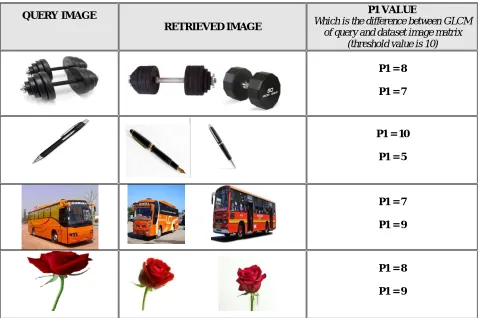
The simulation study involves some basic operations. In First stage of this research work a random collection of more than hundred images are stored. Different categories of images include dumbbell, pen, bus, flower etc. These images are stored and feature extract techniques are applied, extracted features are kept in image database. When the user generate a query image in the user terminal, the features of the query image is checked with the corresponding features of the previously stored database images, if the difference between these result is below the threshold value (in that case it is 10) the set of final retrieved images are displayed. Simulation report is shown in table 1.
QUERY IMAGE
RETRIEVED IMAGE
P1 VALUE
Which is the difference between GLCM of query and dataset image matrix
(threshold value is 10)
P1 = 8
P1 = 7
P1 = 10
P1 = 5
P1 = 7
P1 = 9
P1 = 8
P1 = 9
Table 1: result analysis of query and retrieved images based on threshold value.
TEST CASE ANALYSIS
ISSN(Online): 2320-9801
ISSN (Print): 2320-9798
I
nternational
J
ournal of
I
nnovative
R
esearch in
C
omputer
and
C
ommunication
E
ngineering
(An ISO 3297: 2007 Certified Organization)
Vol. 4, Issue 11, November 2016
Test Cases Query Images Desired Output Actual Output Result
Case 1 Figure 5 Figure 2, Figure 5, Figure 10 Figure 2, Figure 5,
Figure 10
Successful
Case 2 Figure 15 Figure 20, Figure 25, Figure
15
Figure 22, Figure 25,
Figure 15
Partially Successful
Case 3 Figure 46 Figure 42, Figure 46, Figure
49
Figure 42, Figure 46,
Figure 49
Successful
Case 4 Figure 65 Figure 62, Figure 65, Figure
70
Figure 65, Figure 77,
Figure 40
Unsuccessful
Case 5 Figure 75 Figure 72, Figure 75, Figure
80
Figure 72, Figure 75,
Figure 77
Partially Successful
Table 2: Test Case Analysis
VII. CONCLUSION AND FUTURE WORK
Content Based Image Retrieval is an exciting field in Digital Image Processing domain. In this paper a system is proposed and implemented which accepts any color image from the user end and corresponding relevant output images are displayed. This paper mainly focus on five major features like GLCM (Gray level co-relation matrix), mean, standard deviation, skewness of R, G, B components. In this proposed method a database is constructed which having number of images. The user has to input test image (query image) and selected object images. Low level Features like color, histogram, skewness and standard deviation and texture are then extracted for test (query) image and object images.
ACKNOLEDGEMENT
The authors express their deep sense of gratitude to the Department of Computer Science & Engineering, Siliguri Institute of technology, West Bengal University of Technology. The experiment has been performed under the academic curriculum of Bachelor of Technology degree in Computer Science and Engineering of West Bengal University of Technology.
REFERENCES
1. Kato, T. (1992). Database architecture for content-based image retrieval. In A. A. Jambardino and W. R. Niblack, editors, Proceedings of SPIE Image Storage and Retrieval Systems, 1662, 112 – 123.
2. Sathiya, D., Parameshwari, V., Jeeva, G., & Tamilselvi, C. Content Based Image Retrieval System using Colour Model Histogram. Int. J. Novel. Res. Eng & Pharm. Sci, 1(04), 29-35.
3. Mukherjee, A. (2017). Retrieval of Multimedia Information Using Content-Based Image Retrieval (CBIR) Techniques. In Intelligent Analysis of Multimedia Information (pp. 143-180). IGI Global.
4. Arthi, K., & Vijayaraghavan, M. J. (2013). Content based image retrieval algorithm using colour models. International Journal of Advanced Research in Computer and Communication Engineering, 2(3), 1343-47.
5. Eakins, J. P., & Graham, M. E. (1999). Content-based image retrieval, a report to the JISC Technology Applications programme. 6. Mitra, S., & Acharya, T. (2005). Data mining: multimedia, soft computing, and bioinformatics. John Wiley & Sons.
7. Long, F., Zhang, H., & Feng, D. D. (2003). Fundamentals of content-based image retrieval. In Multimedia Information Retrieval and Management (pp. 1-26). Springer Berlin Heidelberg.
8. Gonzalez, R. C., Woods, R. E., & Eddins, S. L. (2004). Digital image processing using MATLAB. Pearson Education India. 9. Chanda, B., Majumder, D.D., Digital Image Processing and Analysis. PHI publication. 56-57.
ISSN(Online): 2320-9801
ISSN (Print): 2320-9798
I
nternational
J
ournal of
I
nnovative
R
esearch in
C
omputer
and
C
ommunication
E
ngineering
(An ISO 3297: 2007 Certified Organization)
Vol. 4, Issue 11, November 2016
11. Haridas, K., & Thanamani, A. S. Well-Organized Content based Image Retrieval System in RGB Color Histogram, Tamura Texture and Gabor Feature.
12. Chun, Y. D., Kim, N. C., & Jang, I. H. (2008). Content-based image retrieval using multiresolution color and texture features. IEEE Transactions on Multimedia, 10(6), 1073-1084.
13. Kekre, H B; Thepade, Sudeep D; Sarode, Tanuja K; Suryawanshi, Vashali. International Journal of Computer Theory and Engineering 2.5 (Oct 2010): 695.
14. Zhang, J., Li, G. L., & He, S. W. (2008, September). Texture-based image retrieval by edge detection matching GLCM. In High Performance Computing and Communications, 2008. HPCC'08. 10th IEEE International Conference on (pp. 782-786). IEEE.
BIOGRAPHY