Optimization of Hybrid Renewable Energy
System using BPSO-PID based Load sensitive
EMS
Dr.S B Shivakumar1, Sampathkumar.V.Patil2
Principal, Department of Electrical Engineering, PDIT, Hosapete, India1 Research Scholar, Department of Electrical Engineering, VTU, Belagavi, India 2
ABSTRACT: This paper represents the optimization of Hybrid Renewable Energy(Wind-Turbine/PV) system using Evolutionary Algorithm like Binary Particle Swarm Optimization(BPSO) based PID .Due to Unreliablity of Renewable Energy sources nowadays Hybrid Renewable Energy system is preferred ,especially wind and PV system is gaining more popularity due to its several advantage like cost, efficiency and reliability. Use of Batteries become manadatory for the supply of Reliable energy system.But the charging and discharging of Batteries based on Load sensitivity or during power outages or poor quality power generation became one of challenging aspect. This paper represents the Control of Batteries through Evolutionary algorithm approach like BPSO(Binary particle swarm optimization ) which is used for the tuning of PID parameters, through which charging and discharging of battery is controlled.
KEYWORDS: Hybrid RenewableEnergy System, Energy Management system, Binary Particle Swarm Optimization, PID, Evolutionary Algorithms.
I.INTRODUCTION
II. RELATED WORK
This section discusses some of the key literatures pertaining to EMS systems. Undeniably, a number of efforts have been made to develop better EMS control systems; however rising complexity of operating environment often opens up demands for further optimization.
Authors in [18] developed a two-level optimization model for coordinated energy management between distribution systems and clustered WT-PV-battery MGs. In their model, the higher level of the system functions as distribution network, while lower level focused on incorporating synchronized operation of multiple MGs (Micro Grids). To enable coordination of the power swap among multiple MGs and distribution network, authors derived an Interactive Game Matrix (IGM). In [19] an optimization model was developed for energy management in hybrid RES system encompassing RES and diesel generators. To enable efficient EMS, authors focused on charging and discharge control for which they developed Dynamic Programming (DP) algorithm. Similarly, a control technique for hybrid energy system employing RES was proposed in [20], where authors used individual storage designed using Super Capacitor (SC) module. Though their approach could be cost efficient and augmented life time, could not address mitigating fluctuations caused due to generation side non-linearity and load variations. In [21] authors developed EMS control model to be used in hybrid RES system. Additionally, a control model to deal with system nonlinear was developed in [21]. Authors in [22] derived a controller model for energy management of a stand-alone RE hybrid scheme. Their proposed model encompassed five major components, namely, PV arrays, WT, electrolyzer, hydrogen storage tanks, and fuel cell. Authors in [23] developed a DC connected hybrid RES for stand-alone applications where RESs were used as main energy sources and battery units were considered as storage to meet load demand. However, their classical EMS system could not address the non-linearity in load demands that requires efficient EMS provision. Authors [24] developed a DC connected hybrid solar wind energy scheme for stand-alone applications. Authors applied Adaptive Neuro Fuzzy inference scheme (ANFIS) to estimate the panel voltage based on which the highest power could be obtained. A classical EMS model was developed in [25], where authors considered MG parameters to control EMS. One of the key issues in hybrid RES system is its instability under non-linear generation scenario. To assess system stability authors [26] developed control model that considers micro-grid parameters to derive control decision. In [27], authors developed a grid-connected hybrid RES system that comprised WT generation system, PV, Battery Storage System (BSC) and loads. To enable better EMS control authors applied a Programmable Logic Controller (PLC). Utilizing power converters and control algorithms with RES was developed in [28] to enable efficient EMS. A meta-model plan for hybrid RES based power system was developed in [29] where authors applied two types of storage i.e. electric and hydraulic tools. Demand Response (DR) strategy based energy management model was developed in [30]. Their proposed model exploited energy demands from load side and MGs voltage profile to control EMS for enabling secure power delivery.
.
III. SYSTEM MODELING
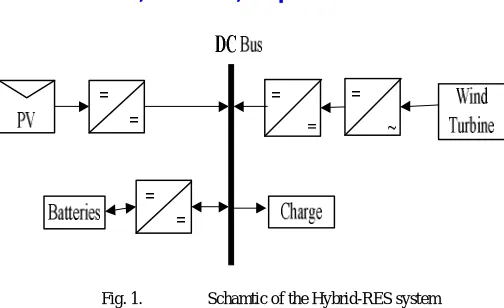
Fig. 1. Schamtic of the Hybrid-RES system
The following sub-sections brief about different components used in our proposed Hybrid RES systems and their functional characteristics.
A.Photovoltaic System
The PV generator converts the solar energy into electrical energy. This is realized through series connection and parallel modules. Literatures [43][44][45] state that the PV cell may also be represented as a current generator whose electrical behavior is similar to a current source shunted by a diode. The simplicity and accuracy make the single diode model as the simplest PV model that comprises five components; a current source, one diode and two resistors including series resistance and shunt resistance. The current generated by PV cell on the basis of the output voltage
can be obtained using following equation (1).
= 1−
∆
−1 +∆
(1)
where and signify the constants. Mathematically, these constants are obtained using (2) and (3).
= 1−
(2)
=
−1
ln 1−
(3)
Similarly, the other variables ∆ and ∆ are obtained using following equations:
⎩ ⎪ ⎨ ⎪
⎧ ∆ = −
∆ = ∆ + −1
∆ =− ∆ − ∆
(4)
B. Wind Turbine
In the proposed WECS system, WT with the power generation capacity of 3kW is considered. The overall WECS design encompasses a wind turbine, Permanent Magnet Synchronous Generation (PMSG) unit, an AC/DC converter and a DC/DC (Buck) converter. The structure of this design is on the basis of three-phase Diode Bridge and consists of Buck converter to transform the rectified voltage. The mechanical power generated from the wind is calculated using (7).
= Ω (7)
where R states the radius of the wind turbine [ ] and Ω refers the rotational speed [ / ]. An schematic of the WECS system is presented in Fig. 3.
MSAP
AC
DC
DC
DC
Fig. 2. Wind Turbine Energy Conversion System
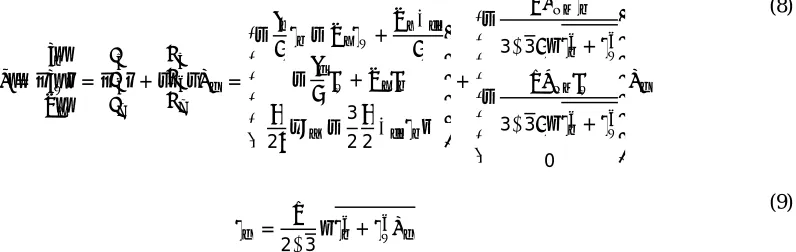
The power coefficient characteristic is based on the specific speed . To design WECS model a reference work in [46] is considered. Mathematically (9),
̇= ̇ ̇ ̇ = + = ⎣ ⎢ ⎢ ⎢ ⎢ ⎡− − + ∅ − + 2 − 3
2 2∅ ⎦
⎥ ⎥ ⎥ ⎥ ⎤ + ⎣ ⎢ ⎢ ⎢ ⎢ ⎢ ⎢ ⎡−
3√3 +
−
3√3 +
0 ⎦ ⎥ ⎥ ⎥ ⎥ ⎥ ⎥ ⎤ (8) =
2√3 +
(9)
and represent the components homopolar, which is the direct and the quadrature three-phase currents from the Park transformation. is the electric angular velocity, and signify the resistance and inductance of winding per phase the stator, respectively. The other variable refers the numbers of poles of the PMSG, while signifies the moment of inertia of the rotor. In addition, the other variable ∅ represents the flux generated because of the stator currents, is the DC bus voltage, is a simple function of the duty cycle of the converter used (for this configuration: = 1/ ), is the current from the turbine and injected into the DC bus and is the mechanical torque produced by the turbine. Mathematically,
=
(10)
C. Electrical Storage System
presented in Fig 4. Here, the source voltage is considered as the battery that varies with their state of charge. Noticeably, the state variation takes place as per the battery current. The state will be decreases when it is positive (battery discharge) and discharges. The charge will be increases when it is negative (battery charging) [47] [48].
Fig. 3. Equivalent circuit diagram of a cell of the Nickel-Cadmium Battery
D. Proportional-integral-derivative (PID) controller
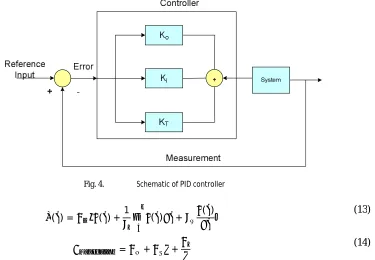
In present day industrial applications, PID controllers are the most commonly applied controllers, particularly for electrical or electronic system control. A simple schematic of the PID controller is given in Fig. 4. PID controller employs the continuous time and the transfer function to perform control functions [49]. In our proposed EMS control model PI controller with EC based parameter tuning is applied.
Fig. 4. Schematic of PID controller
( ) = ( ) +1 ( ) + ( ) (13)
= + + (14)
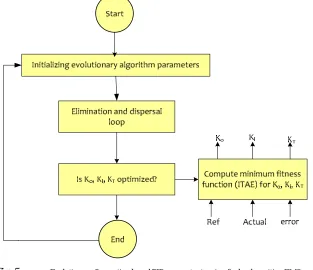
those conditions like exceedingly dynamic non-linear generation and load variation. To deal with these limitations, optimal PID parameter selection and tuning can be of paramount significance. With this motivation, in this research work we have applied t enhanced EC algorithms BPSO to perform PID parameter running in real-time environment. A symbolic function of EC based PID tuning is illustrated in Fig. 7.
Fig. 5. Evolutionary Computing based PID parameter tunning for load sensitive EMS control
Being evolutionary computing algorithm, BPSO requires an objective function to perform PID parameter tuning. Evolutionary algorithms intend to maximize objective function iteratively to achieve optimal or near-optimal solution. In our proposed model, Integral Time Absolute Error (ITAE) is applied as objective function to optimize the PID tuning parameters. A brief of the ITAE objective function is given as follows:
IV. Objective function (OF)
Generally, there are numerous indices applied to assess PID controller performance. Some of these indices are; Integral Square Error (ISE), Integral Absolute Error (IAE), ITAE, and Mean Square Error (MSE). In this paper, we have applied ITAE reduction as the objective function to perform PID parameter tuning, where BPSO tries to reduce ITAE iteratively to achieve optimal PID parameters so as to enable swift and efficient EMS control. The efficiency or capability of ITAE to avoid long duration transient makes ITAE suitable for our study. Mathematically, ITAE is given in equation (15), which is obtained as the difference between the load power and the generated power.
ITAE = t|e(t)| . dt
(15)
objective function e(t) as the error between the reference speed and the actual speed of the PMSG WECS. Now, applying above mentioned objective functions, we have performed PID (tuning) parameter optimization using BPSO algorithms. A brief of the EC schemes applied in this research work is given in the following sub-sections. In this paper, the emphasis is made on applying EC schemes mainly for EMS control optimization to avoid any outage probability and to facilitate quality power to the customers.
V. BPSO (BINARY PARTICLE SWARM OPTIMIZATION)
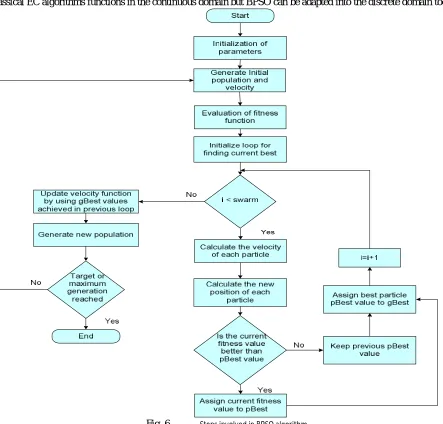
Typically, BPSO algorithm represents a type of stochastic heuristic optimization approach that performs removal of the features from the correlation investigation. It applies swarm intelligence technique to identify optimum PID tuning parameter or gain parameters by means of obtaining global minima. In this algorithm, the particles inform the inner
velocity in PSO and dissimilar to the classical GA, BPSO avoid iterative crossover and mutation process that significantly reduces computational overheads and time. In addition, through GA chromosome distributes key information to one another, which is usually avoided in BPSO which executes information swap via finest area. Classical EC algorithms functions in the continuous domain but BPSO can be adapted into the discrete domain too.
As depicted in Fig. 8, BPSO primarily contains four parameters; initialization, generate initial population and velocity, particle own finest position and global finest position amongst every particles.
In BPSO based PID parameter tuning, a population containing chromosomes of PID gain parameters is initialized randomly and sprinkled in the search space. The parameter x = x + x +, … , +x and V = V + V +, … , +V are signified as initial positions and velocities of the particles, respectively. the particles inform their velocities in all iteration [50]. Mathematically,
= ( ) + ,( ) − ( ) + ,( )− ( ) (16)
where refers the velocity of particle in impending time slot, states the inertia factor, presents the current velocity, and are arbitrary numerals, and are local and global pulls respectively, signifies the particles present place, X represents local finest place and X stand for global finest place. Here, the particle’s velocity is mapped in between 0 and 1 by using sigmoid function (16),
( ( )) = 1
1 + (− ( ))
(17)
The random values given to each particle (signifying PID gain parameters) in the population are contrasted by exploiting the sigmoid function to produce a binary coded population.
= 1 ( ( )) < ,
0 ℎ
(18)
Particles record their places relation to neighbors in all iteration. The local best places are formed through the particles are signified asX = X + X + ___ + X . The local best values are obtained which is then followed by the retrieval of the other global best location. The gth particle among the particles is said to be the global best place if it gratify the objective function, along with the global finest places are signified asX = X + X +
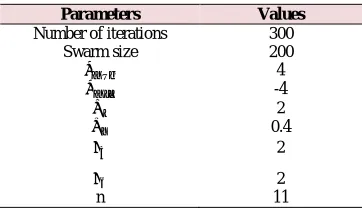
___ + X . The swift convergence to achieve optimum solution is the predominant cause behind the use of global best value other than local best value. The global best value is signified as the optimum ON/OFF condition of the application and it is a binary coded string. By exploiting the matching cost of global finest value, the fitness function of every particle is estimated. The simulation environment of BPSO implementation for PID parameter optimization is presented in Table 2.
Table 2 BPSO Parameters and its values
Parameters Values
Number of iterations 300 Swarm size 200 4 -4 2 0.4
2
2
n 11
VI. RESULTSANDDISCUSSION
Considering the significance of a robust EMS control model for Hybrid-RES system, in this work the emphasis was made on exploiting both load variations and non-uniform generation pattern to perform optimal charging and discharging control. Here, unlike traditional PID based control, EC based PID control was developed, where EC algorithm such as BPSO were applied to enhance PID gain parameters so as to perform swift or transient decision for EMS control. At first, to derive a Hybrid-RES power system, we modeled Wind-Turbine Energy Conversion system (WECS) and Photovoltaic (PV) cells, where WECS was developed for the specification of 3kW generation power, 50 Hz frequency and 440 V supply. Noticeably, here we used PMSG wind turbine of 3kW power. Similarly, PV cell of 1 kV was used to derive PV power system, with traditional Perturb and Observe (PO) Maximum Power Point Tracking (MPPT) facility. In addition to the power generation units other key components, such as DC/DC Buck converter, DC-DC Bidirectional converter, and Nickel-Cadmium Battery Storage System (BSS), two circuit breakers (for charging and discharging control), PID controller (for EMS control as well as speed control of WECS), and BPSO algorithm. The overall models were developed using MATLAB 2015a/SIMULINK tool. As depicted we used DC/DC converter to connect PV cells with DC bus, while bidirectional converters were used in wind-turbine interface to the DC bus. To examine the efficacy of the proposed EC based EMS control, we simulated proposed Hybrid-RES system in three distinct simulation cases; first EMS control using classical PID control with predefined gains (P=1, I=1), second, using BPSO tuned PID control for EMS control under dynamic load and generation patterns.
Fig. 7. Developed Hybrid-RES system comprising Wind-Turbine and Photovoltaic Cells
Considering rotor side controllability to assist reliable power generation, initially PID was used. The simulation with different control mechanisms and respective outcomes are discussed as follows:
A. Classical PID Based EMS Control
Watts.. Here, the continuous 440 Volt power is generated Similarly, the generation pattern of the PV cells also depicts power generation in the range of 460 Watts to 680 Watts, while the maximum generation capacity is 1kW.
Fig. 8. WECS generated power (W) with classical PID
control Fig. 9. PV cell generated (above) and current (below) (W) with PID
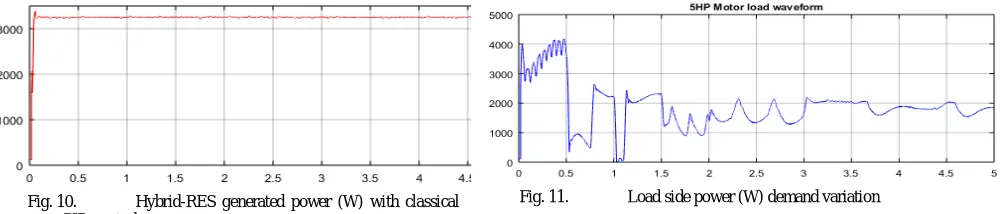
The overall generated power under varying or dynamic load condition is given in Fig. 10. The overall load sensitive power generation by Hybrid PV/WT RES system could be visualized in Fig. 11. Here, it can be found that as combined RES solution, it generates approximate 3.6kW of power at almost stable generation rate The efficiency of charging and discharging could be easily visualized through these results. The speed control performance by PID controller can be observed in Fig. 12.
Fig. 10. Hybrid-RES generated power (W) with classical PID control
Fig. 11. Load side power (W) demand variation
To achieve stable power generation while fulfilling load demands, controlling wind turbine speed is vital and hence we applied PID controller to control WT speed while considering load demands. Here, PID controller controls WT speed by considering reference speed (1750 r/s) and the actual speed. The speed control output using classical PID is given in Fig. 12.
Fig. 12. Speed control (r/s) with reference to PID Fig. 13. Chargind and discharging control with reference to PID based EMS control
B. BPSO-PID based EMS Control
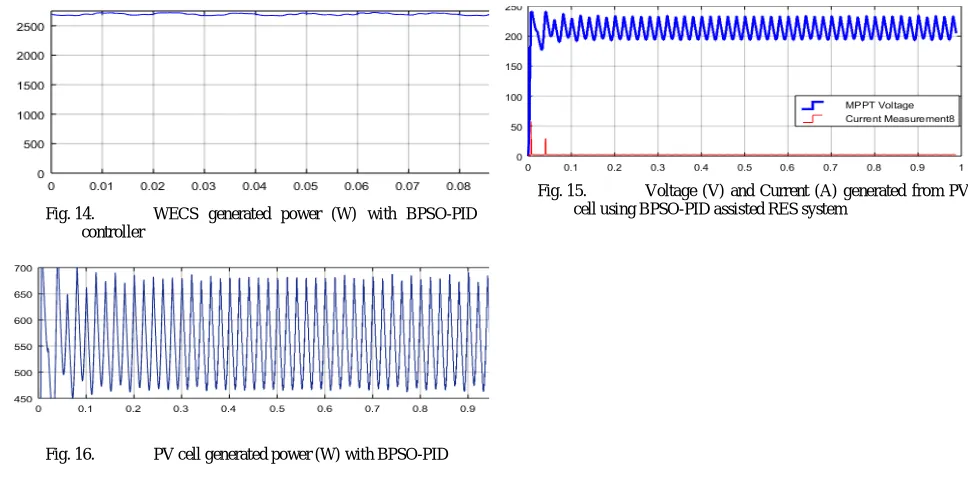
Fig. 14. WECS generated power (W) with BPSO-PID controller
Fig. 15. Voltage (V) and Current (A) generated from PV cell using BPSO-PID assisted RES system
Fig. 16. PV cell generated power (W) with BPSO-PID
The results obtained for HRES power generation (Fig.17), Respective load variations (Fig. 18), and load sensitive WT speed control (Fig. 19), and battery charging and discharging control (Fig. 20) are presented as follows:
Fig. 17. Total power generated from the HRES system Fig. 18. Dynamic load variation in HRES system
VI. CONCLUSION
In this research work a robust load-sensitive EMS control model was developed for PV-Wind Turbine RES system. Here both generation side and Load side has been controlled through charging and Discharging of EMS,which in turn is controlled by Evolutionary algorithm based PID.However, to alleviate the issue of online PID parameter tuning for efficient charging and discharging control of the EMS, evolutionary computing algorithms named Binary Particle Swarm Optimization (BPSO) have been applied. The PID parameter tuning (or optimization) makes overall control decision swift and efficient that eventually alleviates the probability of the power outage and faults.. In future, more efficient evolutionary computing approaches could be explored for their efficacy to perform EMS control along with generator side control to assist reliable and quality power supply.
REFERENCES
[1] G. Shafiullah, M. Amanullah, A. ShawkatAli, P. Wolfs P. (February 2013), Smart Grid for a Sustainable Future, Smart Grid and Renewable Energy, Scientfic Research, pp. 23-34.
[2] S. Collier, “Ten steps to a smarter grid,” IEEE Ind. Appl. Mag., vol. 16, no. 2, pp. 62–68, 2010. [3] J. A. Turner, “A realizable renewable energy future,” Sci., vol. 285, no. 5428, pp. 687–689, 1999. [4] T.Wiedmann and J. Minx, A Definition of ‘Carbon Footprint’. Hauppauge, NY, USA: Nova Science, 2008.
[5] J. Carrasco, L. Franquelo, J. Bialasiewicz, E. Galvan, R. Guisado, M. Prats, J. Leon, and N. Moreno-Alfonso, “Power-electronic systems for the grid integration of renewable energy sources: A survey,” IEEE Trans. Ind. Electron., vol. 53, no. 4, pp. 1002–1016, 2006.
[6] H. Ibrahim, A. Ilinca, and J. Perron, “Energy storage systems – characteristics and comparisons,” Renewable Sustainable Energy Rev., vol. 12, no. 5, pp. 1221–1250, 2008.
[7] J. Garcia-Gonzalez, R. de la Muela, L. Santos, and A. Gonzalez, “Stochastic joint optimization of wind generation and pumped-storage units in an electricity market,” IEEE Trans. Power Syst., vol. 23, no. 2, pp. 460–468, 2008.
[8] T. D. Nguyen,K.-J. Tseng, S. Zhang, and T. D. Nguyen, “On the modeling and control of a novel flywheel energy storage system,” in Proc. IEEE ISIE, 2010, pp. 1395–1401.
[9] H. Zhou, T. Bhattacharya, D. Tran, T. Siew, and A. Khambadkone, “Composite energy storage system involving battery and ultracapacitor with dynamic energy management in microgrid applications,” IEEE Trans. Power Electron., vol. 26, no. 3, pp. 923–930, 2011.
[10] S. G. Chalk and J. F. Miller, “Key challenges and recent progress in batteries, fuel cells, and hydrogen storage for clean energy systems,” J. Power Sources, vol. 159, no. 1, pp. 73–80, 2006.
[11] J. Barton and D. Infield, “Energy storage and its use with intermittent renewable energy,” IEEE Trans. Energy Conversion, vol. 19, no. 2, pp. 441–448, 2004.
[12] K. G. Vosburgh, “Compressed air energy storage,” J. Energy, vol. 2, no. 2, pp. 106–112, 1978.
[13] C. Abbey and G. Joos, “Supercapacitor energy storage for wind energy applications,” IEEE Trans. Ind. Appl., vol. 43, no. 3, pp. 769–776, 2007. [14] P. Brown, J. P. Lopes, andM.Matos, “Optimization of pumped storage capacity in an isolated power system with large renewable penetration,”
IEEE Trans. Power Syst., vol. 23, no. 2, pp. 523–531, 2008.
[15] C. Abbey and G. Joos, “A stochastic optimization approach to rating of energy storage systems in wind-diesel isolated grids,” IEEE Trans. Power Syst., vol. 24, no. 1, pp. 418–426, 2009.
[16] Y. Zhang, N. Gatsis, and G. Giannakis, “Robust energy management for microgrids with high-penetration renewables,” IEEE Trans. Sustainable Energy, vol. PP, no. 99, pp. 1–10, 2013.
[17] OnurOzdal MENGI, Ismail Hakkı ALTAS,“Fuzzy logic control for a wind/battery renewable energy production system” Turk J ElecEng& Comp Sci, Vol.20, No.2, 2012.
[18] T. Lu, Z. Wang, Q. Ai and W. J. Lee, "Interactive Model for Energy Management of Clustered Microgrids," in IEEE Transactions on Industry Applications, vol. 53, no. 3, pp. 1739-1750, May-June 2017.
[19] T. A. Nguyen and M. L. Crow, "Optimization in energy and power management for renewable-diesel microgrids using Dynamic Programming algorithm," 2012 IEEE International Conference on Cyber Technology in Automation, Control, and Intelligent Systems (CYBER), Bangkok, 2012, pp. 11-16.
[20] S. Sikkabut et al., "Control strategy of solar/wind energy power plant with supercapacitor energy storage for smart DC microgrid," 2013 IEEE 10th International Conference on Power Electronics and Drive Systems (PEDS), Kitakyushu, 2013, pp. 1213-1218.
[21] Bouharchouche, E. M. Berkouk and T. Ghennam, "Control and energy management of a grid connected hybrid energy system PV-wind with battery energy storage for residential applications," 2013 Eighth International Conference and Exhibition on Ecological Vehicles and
Renewable Energies (EVER), Monte Carlo, 2013, pp. 1-11.
[22] M. Trifkovic, M. Sheikhzadeh, K. Nigim and P. Daoutidis, "Hierarchical control of a renewable hybrid energy system," 2012 IEEE 51st IEEE Conference on Decision and Control (CDC), Maui, HI, 2012, pp. 6376-6381.
[23] S. Kumaravel and S. Ashok, "Adapted multilayer feedforward ANN based power management control of solar photovoltaic and wind integrated power system," ISGT2011-India, Kollam, Kerala, 2011, pp. 223-228.
[24] N. Varghese and Reji P., "Battery charge controller for hybrid stand alone system using adaptive neuro fuzzy inference system," 2016 International Conference on Energy Efficient Technologies for Sustainability (ICEETS), Nagercoil, 2016, pp. 171-175.
[25] Küçüker, T. Kamal, S. Z. Hassan, H. Li, G. MaazMufti and M. Waseem, "Design and control of photovoltaic/wind/battery based microgrid system," 2017 International Conference on Electrical Engineering (ICEE), Lahore, 2017, pp. 1-6.
[27] Yuanrui Chen and Jie Wu, "Agent-based energy management and control of a grid-connected wind/solar hybrid power system," 2008 International Conference on Electrical Machines and Systems, Wuhan, 2008, pp. 2362-2365.
[28] Merabet, K. Tawfique Ahmed, H. Ibrahim, R. Beguenane and A. M. Y. M. Ghias, "Energy Management and Control System for Laboratory Scale Microgrid Based Wind-PV-Battery," in IEEE Transactions on Sustainable Energy, vol. 8, no. 1, pp. 145-154, Jan. 2017.
[29] M. Zaibi, T. M. Layadi, G. Champenois, X. Roboam, B. Sareni and J. Belhadj, "A hybrid spline metamodel for Photovoltaic/Wind/Battery Energy Systems," IREC2015 The Sixth International Renewable Energy Congress, Sousse, 2015, pp. 1-6.
[30] J. O. Petinrin and M. Shaaban, "A hybrid solar PV/wind energy system for voltage regulation in a microgrid," 2013 IEEE Student Conference on Research and Developement, Putrajaya, 2013, pp. 545-549.
[31] X. Li, D. Hui, M. Xu, L. Wang, G. Guo and L. Zhang, "Integration and energy management of large-scale lithium-ion battery energy storage station," 2012 15th International Conference on Electrical Machines and Systems (ICEMS), Sapporo, 2012, pp. 1-6.
[32] L. Pan, J. Gu, J. Zhu and T. Qiu, "Integrated Control of Smoothing Power Fluctuations and Peak Shaving in Wind/PV/Energy Storage System," 2016 8th International Conference on Intelligent Human-Machine Systems and Cybernetics (IHMSC), Hangzhou, 2016, pp. 586-591. [33] M. Dahmane, J. Bosche and A. El-Hajjaji, "Power management strategy for renewable hybrid stand-alone power system," 2015 4th
International Conference on Systems and Control (ICSC), Sousse, 2015, pp. 247-254.
[34] Sheikh, "Hybrid energy management system for microgrid applications," 2016 International Conference on Energy Efficient Technologies for Sustainability (ICEETS), Nagercoil, 2016, pp. 361-365.
[35] R. Wang, F. Zhang and T. Zhang, "Multi-objective optimal design of hybrid renewable energy systems using evolutionary algorithms," 2015 11th International Conference on Natural Computation (ICNC), Zhangjiajie, 2015, pp. 1196-1200.
[36] M. Khalid, A. V. Savkin and V. G. Agelidis, "Optimization of a power system consisting of wind and solar power plants and battery energy storage for optimal matching of supply and demand," 2015 IEEE Conference on Control Applications (CCA), Sydney, NSW, 2015, pp. 739-743.
[37] M. F. M. Yusof and A. Z. Ahmad, "Power energy management strategy of micro-grid system," 2016 IEEE International Conference on Automatic Control and Intelligent Systems (I2CACIS), Selangor, 2016, pp. 107-112.
[38] R. Carli and M. Dotoli, "A decentralized resource allocation approach for sharing renewable energy among interconnected smart homes," 2015 54th IEEE Conference on Decision and Control (CDC), Osaka, 2015, pp. 5903-5908.
[39] S. F. Phiri and K. Kusakana, "Demand Side Management of a grid connected PV-WT-Battery hybrid system," 2016 International Conference on the Industrial and Commercial Use of Energy (ICUE), Cape Town, 2016, pp. 45-51.
[40] P. Gopi and I. P. Reddy, "Modelling and optimization of renewable energy integration in buildings," International Conference on Sustainable Energy and Intelligent Systems (SEISCON 2011), Chennai, 2011, pp. 116-120.
[41] M. H. Nehrir et al., "A Review of Hybrid Renewable/Alternative Energy Systems for Electric Power Generation: Configurations, Control, and Applications," in IEEE Transactions on Sustainable Energy, vol. 2, no. 4, pp. 392-403, Oct. 2011.
[42] Ben Ammar M. “Contribution loptimisation de la gestion des systmes multi-sources dnergiesrenouvelables” Thse de LcoleNationaledIngnieurs de Sfax 2011
[43] A. Bellini and Bifaretti S. and Iacovone V. and Cornaro,”Simplified Model of a Photovoltaic Module”, Applied Electronics, 2009. [44] Chedid R. and Rahman S. “Unit sizing and control for hybrid wind-solar power systems”, IEEE Transactions on Eenrgy Conversion, 1997. [45] Belfkira R. and Hajji O. and Nichita C. and Barakat G. “Optimal sizing of stand-alone hybrid wind/PV systems with battery storage”, Phd