Bacteria Foraging Optimization against Worm Hole
Attack In AODV Based MANET
Kanika aroraP 1
P
, Sonia JindalP 2
P
1
P
M.tech (Student), ECE
Chandigarh Engineering College, Landran, Mohali, Punjab, India
P
2
P
Assistant Professor, ECE
Chandigarh Engineering College, Landran, Mohali, Punjab,India
Abstract
Mobile ad hoc network (MANET) is a self-coordinated system which is intended through a group of mobile nodes with wireless links deprived of using any consolidated infrastructure. Communication between nodes occurs with the help of different routing protocol. The absence of centralised administration makes it vulnerable to various attacks. Worm hole attack is considered to be serious and lethal attack. In this attack, an attacker records one packet and tunnels them to other location lastly retransmit it into the network . In this paper we have explored the outcome of wormhole attack in AODV routing protocol established on Mobile Ad-hoc Network as well as at that moment optimize it utilizing Bacteria Foraging Optimization algorithm in MATLAB simulator utilizing parameter corresponding routing overhead and packet delivery ratio. BFO is bio inspired algorithm which simulates bacteria’s behaviour and can be effectively applied in various fields. In the end comparison of network nodes with attack and after compensation of attack with BFO has been made. From the results it has been deduce that BFO works well for the prevention of worm hole attack.
Keywords: MANET, BFO, Routing, Worm hole attack, AODV, Security
1. Introduction
An ad-hoc network is group of infrastructure less mobile nodes which designs a temporary network without the support of any decentralized administration[5]. Mobile ad hoc networks (MANETs) constitutes elaborate distributed systems in which mobile nodes are directly and dynamically self-organized into an erratic network topology. These networks are attached and installed without having pre-existing administrative base station. Mobile ad hoc network is distinguished by highly effective network topology and with few system resources. In building a MANET [6][7] big challenge is that each device should be properly equipped so as to continuously maintain the information required to route traffic in better way.
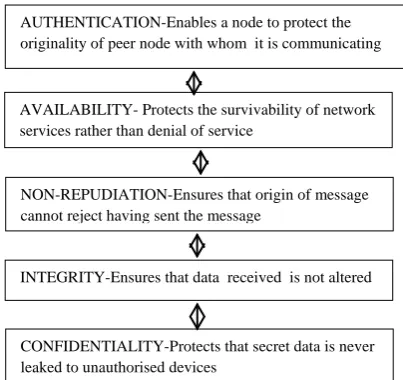
There are five security goals that need to be known for preventing from attacks, so as to maintain reliable and efficient ad-hoc network
2. Literature Survey
Comparison of various detection techniques in tabular form
Table 1: Summarizes various detection techniques
Author & year
Technique Pros Cons
H. S.Chiu and K.Lui [1] 2006
DELPHI Wormhole Detection Mechanism for Ad Hoc Wireless Networks
It can identify both exposed and hidden threats
It Can’t identify the position of false alarm and worm hole attack. C. Sun
K,DooYo ung, L .Do-
WAP Wormhole attack
Synchronizing of node required at only source
It can’t identify false positive
AUTHENTICATION-Enables a node to protect the originality of peer node with whom it is communicating
AVAILABILITY- Protects the survivability of network services rather than denial of service
NON-REPUDIATION-Ensures that origin of message cannot reject having sent the message
INTEGRITY-Ensures that data received is not altered
CONFIDENTIALITY-Protects that secret data is never leaked to unauthorised devices
Author & year
Technique Pros Cons
hyeon, and J. Jae-il [2] 2008
prevention Node .Detects both hidden and exposed threats
alarm
C. P. Vandana and A. F. S. Devaraj [3] 2013
MLDW Multi layer detection mechanisim for worm hole attack
Permit early identification of wormhole attack during the route discovery phase. Doesn’t need special hardware
Overhead is maximum
J. Biswas, A. Gupta and D.Singh [4] 2014
WADP Wormhole Attack Detection and Prevention Technique in MANET
Identify false positive alarm
Can’t detect hidden attacks
3. Worm Hole Attack
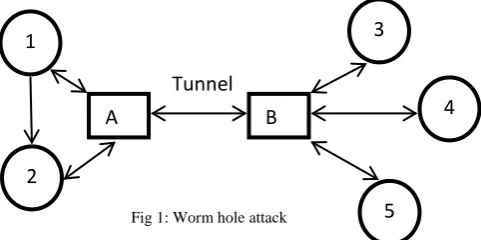
In an actual wormhole attack an impostor constructs a tunnel in the course of the transfer of the information from one end-point of the linkage to the further end-point, making leading distant network nodes intended to rely on that they are direct neighbors’ as well as communicate over the wormhole link. Wormhole refers to an attack on various routing protocols in which colluding nodes generate an illusion that two distant regions of a MANET are directly linked through nodes that appear to be neighbours but are actually remote from one another as shown in fig 1. These are unsafe as they can threaten the whole network even without knowing the route or path[14].
Here A and B are two malicious nodes which are connected through a private connection. Every packet that A receives from the network is forwarded through “wormhole” or tunnel to node B and vice versa. This attack disrupts routing protocols and is difficult to identify because route to deliver information is usually not actual route [8].
4. Worm hole attack in AODV
AODV used in ad-hoc networks is an on-demand routing protocol. AODV describes three messages: Route Requests (RREQs), Route Errors (RERRs) and Route Replies (RREPs). In AODV[9], Worm hole threat prevents route discovery and may create a worm hole link for the packets which are not addressed to itself. This is done because of broadcasting. It is one of the lethal attacks of MANET .Worm hole attack begin in AODV during route discovery phase making illusion of one hop neighbour with the help of worm hole peers. Worm hole link is constructed and route request packets are transmitted to arrive destination with lower hop count or at faster rate as compared with normal path. As per AODV protocol, the destination node neglect all route request packet that arrives later and accepts malicious worm hole tunnel to send route reply
5. Bacteria Foraging Optimisation
Bacteria Foraging Optimization Algorithm (BFOA), which is related to nature generated algorithm for optimisation and is presented by Kevin M. Passino (2002) .The Bacterial Foraging Optimization Algorithm is important for the group foraging behaviour of bacteria like E.coli and M.xanthus[9]. The BFO follows the chemo taxis behavior of bacteria that will perceive movement of node or nutrient in the environment and move towards or away from specific signals.
6. Proposed Work
When the behaviour of node changes from its basic nature, it is supposed to be an attack on the network. AODV is one of the finest protocols in MANET which already has a basic prevention scheme against any attack. But when the attack is more random and précised in nature then it becomes quite difficult for any protocol to deal with it. Worm hole attack is one of the most lethal attack in terms of its random nature and the ability to bluff the transmiting node.
This paper presents Bacteria foraging optimisation algorithm which is based on AODV protocol to detect worm hole attack in efficient manner in the
A 1
2
3
5 4 Tunnel
B
Fig 1: Worm hole attack
whole network. By applying BFO we tried to eliminate worm hole nodes from network through which intermediate network nodes are getting disturbed and that deals with lower energy consumption and higher packet delivery ratio which increase life span.
6.1 Steps Of Bacterial Foraging Algorithm
Three steps in Bacterial Foraging optimisation Algorithm are illustrated as follows :
1. Chemo taxis. 2. Reproduction.
3. Elimination and dispersal.
Chemotaxis: Bacteria generates movement pattern in the knowledge of chemical repellants and attractants are define as chemotaxis. This technique through swimming and tumbling simulates the movement of an E.coli cell via flagella. Biologically an E.coli bacterium can run in two different ways. It can swim or tumble for a period of time in the same direction or alternate for the entire lifetime between these two modes [11,13].
Reproduction: The population size will remain constant for this process as the healthier bacteria will sexually split up into two bacteria and less healthy bacteria will eventually die which are then situated at same position.
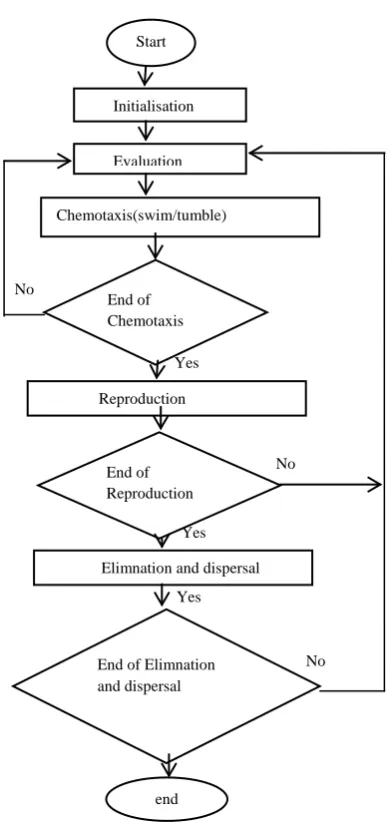
Elimination and dispersal : Events can occur in such a way that all the bacterium can either eradicate or scatter in a region into a new type of the environment. They have both the effect of assisting and destroying chemotactic progress, since dispersal may place bacteria near good food sources (Passino, 2002). In BFO after reproduction processes, the dispersion event happens in which some bacteria are considered to be killed and moved to another position within the environment [10,12].Figure 2 explains flowchart of BFO.
This technique consists of three phase to detect and prevent from worm hole attack in MANET
.
Phase 1: Construction Of Network1. Create network consisting 50 nodes.
2. Select source and the destination node.
3. The transmission will start from source to destination by multi hop.
4. Get network length and width as input 5. Initialise BFO parameters respective to the network
No
Yes
No
Yes
Yes
No
Phase 2: Identification of attack
1. Read each node of population set respective for chemotactic step and so worm hole attack is detected by the chemotactic movement of data in the network and find cost of location in the network.
2. Perform the next movement respective to swimming and tumbling.
3. Implement the swarming process so node patterns can be distinguished and calculated .It will perform similar routes for transmission. It can be achieved by transmitting attractant signal to other node for finding relative distance between two nodes by using cost function.
4. The node that is not transmitting the data forward is the worm hole node.
Start
Initialisation
Evaluation
Chemotaxis(swim/tumble)
End of Chemotaxis
Reproduction
End of Reproduction
Elimnation and dispersal
End of Elimnation and dispersal
end
Fig 2: Flowchart of BFO
Phase 3: Recovery
1.Implement the reproduction process by performing splitting of node and implement them in same location with same route
2. In the elimination mode of BFOA, eliminate the worm hole node.
3. In the dispersion mode, a node is generated that is the replacement of worm hole node.
4. Analyze the P.D.R and the routing overhead.
7. Results and Implementation
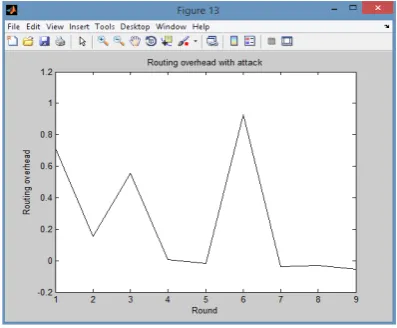
7.1 Routing overhead with attack
Above figure shows the routing overhead compensation with attack. Routing overhead is the parameter in which packets during sending get the problem in routing from source to destination. It has been seen that value of routing overhead is on high level. In this scenario a malicious node is inserted into the network and attacks the network and routing overhead occurs
7.2 Routing overhead using BFO
Above figure shows routing overhead
compensation with BFO. Routing overhead is the parameter in which packets during sending get the problem in routing from source to destination. Routing overhead must be low in order to have efficient results. So with the usage of optimisation algorithm BFO, routing overhead has been decreased to great value .So BFO works well in optimisation of routing over head in network.
7.3 Packet delivery ratio with attack
Above figure shows the packet delivery ratio with wormhole nodes. It is defined as the ratio of data packets received by the destination to those generated by the source.
PDR = (packets sent – packet dropped) / total packets sent.
It has been seen that packet delivery ratio has been decreased by wormhole attack in network. As packets are sent constantly, they will reach after some time delay to destination and some number of packets is drop between nodes. As round of node increase the packet dropping is also increase. Fig 3: Routing overhead with attack
Fig 4:.Routing overhead using BFO
Fig 5: Packet delivery ratio with attack
7.4 Packet delivery using BFO
Above figure shows packet delivery ratio compensation with BFO. It is defined as the ratio of data packets received by the destinations to those generated by the sources. Packet delivery ratio must be high in the network. From simulation graph it has been seen that Packet delivery ratio has been enhanced to greater rate in comparision to presence of attack. So after compensation with BFO packet delivery ratio increases or it has been enhanced.
8. Conclusion
This paper analysis the performance of BFO technique in MANETs .The nodes movements are same as bacteria movement. This technique is applied for detection and prevention from worm hole attack, which can be easily applied in mobile ad hoc network. In a wormhole attack an intruder creates a tunnel during the communication of the data from one point to the another point of the network , making leading distant network nodes to realise that they are direct neighbors’ and communicate through the wormhole link. By applying BFO technique on MANETs we get better results than Existing techniques. This improves the performance in terms of packet delivery ratio and
routing overhead. Routing overhead after
compensation with BFO decreases and packet delivery ratio after compensation with BFO increases. For future scope, we can do a hybridization of BFO with GA algorithm and then compare it with this outcome
References
[1] H. S. Chiu and K. Lui, “DelPHI: Wormhole Detection Mechanism for Ad Hoc Wireless Networks”, In Proceedings of International Symposium on Wireless Pervasive Computing, (2006), pp. 6-11.
[2] C. Sun K, Doo-Young, L .Do-hyeon, and J. Jae-il, “WAP: Wormhole Attack Prevention Algorithm in Mobile Ad Hoc Networks,” in proceedings of 2008 IEEE
International Conference on Sensor Networks, Ubiquitous, and Trustworthy Computing (SUTC 2008). [3] C. P. Vandana and A. F. S. Devaraj, “MLDW- A MultiLayered Detection mechanism for Wormhole attacks in AODV based MANET”, in International Journal of Security, Privacy and Trust Management (IJSPTM) vol. 2, no. 3, (2013) June.
[4] J. Biswas, A. Gupta and D. Singh, “WADP: A Wormhole Attack Detection and Prevention Technique in MANET using Modified AODV routing Protocol”, 9th International Conference on Industrial and Information Systems (ICIIS), (2014).
[5] Y hu and A. Perrig, “a survey of secure wireless Ad Hoc routing”, IEEE security & privacy, May/June 2004,pp.28-39.
[6] Y Zhang and W. Lee, "Intrusion Detection in Wireless Ad-Hoc Networks,": MobiCom'2000, Boston, Massachusetts, Aug. 6-11, 2000,
pp. 275 - 283.
[7]S. Corson and J. Macker, "Mobile Ad Hoc Networking (MANET):Routing protocol performance issues and Evaluation
[8]Nigam, N., Saraf, A., Nagar, C.2011. A Review New Thread Based Wormhole Attack Prevention Mechanism in MANET. International Journal of Electrical, Electronics & Computer Engineering, Vol.1 (1), pp. 84-87
[9] C. E. Perkins and E. M. Royer, “The ad hoc on-demand distance vector protocol,” in Ad hoc
Networking, Addison-Wesley, pp. 173–219, 2000 Considerations January 1999," RFC2501
[10]Samaneh Zareh, Hamid Haj Seyedjavadi, Hossein Erfani, Grid Scheduling using Cooperative BFO Algorithm, American Journal of Scientific Research ISSN 1450-223X Issue 62(2012), pp.78-87.
[11]R. Vijay, Intelligent Bacterial Foraging Optimization Technique to Economic Load Dispatch Problem, International Journal of Soft Computing and Engineering (IJSCE) ISSN: 2231-2307, Volume-2, Issue-2, May 2012 [12]K. Sathish Kumar, T. Jayabarathi,”Power system reconfiguration and loss minimization for an distribution systems”, Elsevier, Electrical Power and Energy Systems T. Jayabarathi, Electrical Power and Energy Systems 36 (2012) 13–17
[13] Mezura-Montes, E., & Hernández-Ocana, B. 2008, October). Bacterial Foraging for Engineering Design Problems: Preliminary Results
[14] F. Nait-Abdesselam, B. Bensaou, T. Taleb. “Detecting and Avoiding Wormhole Attacks in Wireless Ad hoc Networks”, IEEE Communications Magazine, 46 (4), pp. 127 - 133, 2008
Fig 6. Packet delivery ratio using BFO