DOI: http://dx.doi.org/10.26483/ijarcs.v8i9.5184
Volume 8, No. 9, November-December 2017
International Journal of Advanced Research in Computer Science
RESEARCH PAPER
Available Online at www.ijarcs.info
LOCAL BINARY PATTERN WITH SUPPORT VECTOR MACHINE TO
ENHANCE IMAGE RETRIEVAL
Nitika Seth
Research Scholar, Department of CSE SBSSTC, Ferozepur,India
Sonika Jindal
Assistant Professor, Department of CSE SBSSTC, Ferozepur,India
Abstract: Image search techniques were not generally based on visual features but on the textual annotation of images. Images were firstly annotated with text and then searched using a text-based approach from traditional database management systems which is time consuming and difficult to manage. To overcome this problem, content based image retrieval is introduced which is becoming the hottest research area these days due to vast range of real time applications such as crime prevention, photograph archives, medical diagnosis, geographical information and remote sensing system etc. The CBIR system consist of various phases to extract and match the features and search the images from the large scale image databases on the basis of visual contents such as color, shape and texture according to the user's interest. During retrieval, features and descriptors of the query image are compared to those of the images in the database in order to rank each image according to its distance to the query. In our research work, a hybrid combination of SVM (support vector machine) and LBP (Local Binary Pattern) is applied to retrieve the images from the database. A Support Vector Machine (SVM) is a discriminative classifier formally defined by a separating hyper plane. Local Binary Pattern (LBP) is one of the techniques used in image classification based on texture. This operator is simple and very effective, which labels the image pixels based on their neighboring and consider the result being a binary number.
Keywords: Content based image retrieval (CBIR), color histogram, color, shape, texture features.
I. INTRODUCTION
Image searching is a standout amongst the most essential administrations that should be bolstered by such frameworks. When all is said in done, two distinctive methodologies have been connected to permit searching on image accumulations: one based on image printed Meta information and another based on image data. The main retrieval approach is based on connecting printed metadata to each image and uses conventional database inquiry strategies to recover them by keywords. However these frameworks require past footnotes of the database images, which is an exceptionally difficult and tedious assignment. Besides, the explanation procedure is normally wasteful on the grounds that clients, for the most part, don't make the comment efficiently. The distinctive clients tend to utilize diverse words to depict a same image trademark. The absence of systematization in the comment procedure diminishes the execution of the watchword based image look. These inadequacies have been tended to by the purported Content-Based Image Retrieval (CBIR) frameworks. Content based image retrieval, is an important tool which is having a set of interested images which are retrieved from the large database, which is used to narrow the problem [1]. In these frameworks, image preparing algorithms (normally programmed) are utilized to remove include vectors that speak to image properties, for example, color, texture, and shape [2]. In this approach, it is conceivable to recover images like one picked by the client (inquiry by-case). One of the primary points of interest of this approach is the likelihood of a programmed retrieval process, differentiating to the exertion expected to clarify images. With the current outburst of multimedia-enabled systems, the need for multimedia retrieval has increased by using leaps and bounds.
Due to the complexity of multimedia contents, photograph information is a hard-albeit-exciting topic of studies, inside the domain of multimedia retrieval. Extracting treasured expertise from a huge-scale multimedia repository, commonly called “multimedia mining”, has currently stuck up as a domain of hobby amongst researchers. Typically, within the improvement
of an image requisition system, semantic photo retrieval is predicated closely at the associated captions, e.g., filenames, categories, annotated key-words, and other guide descriptions [3]. Searching of images is predominantly primarily based upon associated metadata consisting of keywords, text, and so forth.
The term CBIR describes the method of retrieving preferred photographs from the large collection of database on the idea of capabilities that may be robotically extracted from the photographs. The closing purpose of a CBIR machine is to avoid the usage of textual descriptions within the hunt for a photo by using the person. Unfortunately, this kind of a textual-based photograph retrieval device continually suffers from issues: high priced manual annotation and misguided and inconsistent automatic annotation. On one hand, the value related to manual annotation is prohibitive almost about huge-scale information set. On the alternative hand, irrelevant computerized annotation yields distorted outcomes for semantic photo retrieval. As an end result, a number of effective image retrieval algorithms have been proposed to deal with such problems over the past few years. CBIR is the mainstay of contemporary picture retrieval systems. In CBIR, retrieval of photo is based totally on similarities of their contents, i.e., textures, colors, shapes etc., which are taken into consideration the decrease degree capabilities of a photo. These traditional techniques for picture retrieval are based on the computation of the similarity between the users query and pictures. In CBIR each image saved within the database, has its capabilities extracted and as compared to the capabilities of the question photograph [3]. Thus, extensively, it includes two approaches i.e. Function extraction and characteristic matching. Feature extraction includes the photograph functions to a distinguishable quantity. Average RGB, shade Moments, co-occurrence, Local Color Histogram, Global Color Histogram and Geometric Moments are used to extract features from the check image. Feature matching, then again, entails matching the extracted functions to yield consequences that show off visible similarities.
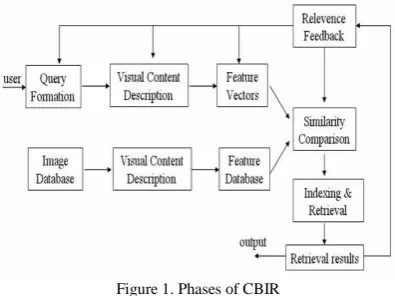
audio, video and images has been used in many fields like medical remedy, satellite statistics, video and nevertheless pix repositories, virtual forensics and surveillance gadget. This has created an ongoing call for of structures that can keep and retrieve multimedia data in an effective way. Many multimedia records garage and retrieval systems had been advanced till now for catering these demands. The most common retrieval structures are Text Based Image Retrieval (TBIR) systems, wherein the hunt is based totally on automated or manual annotation of pix [4]. A conventional TBIR searches the database for the same text surrounding the image as given within the question string. The generally used TBIR device is Google Images [5]. The text based totally systems are speedy because the string matching is computationally less time ingesting system. However, it's far now and again difficult to express the complete visible content material of images in words and TBIR might also become in generating beside the point results. In addition annotation of images isn't always correct and consumes a variety of time. For finding the alternative way of searching and overcoming the constraints imposed by means of TBIR structures more intuitive and user friendly content based totally photo retrieval structures (CBIR) have been developed. A CBIR device uses visible contents of the photos described in the form of low level features like color, texture, shape and spatial locations to symbolize the images inside the databases. The machine retrieves similar photos whilst an instance photo or query image/sketch is presented as input to the CBIR system [6]. Querying in this manner eliminates the want of describing the visible content material of image in words and is near human belief of visible information. Some of the representative CBIR systems are Query by using Image Content (QBIC). The various phases of CBIR in which various types of operations can be performed on the images such as extraction of images, similarity matching etc. which is explained in the given figure 1.
Figure 1. Phases of CBIR
CBIR (Content Based Image Retrieval) consist of various phases and operation performed on images on the basis of visual contents of the images. The visual contents may be color, texture and shape. On the basis of the features all the phases of CBIR will perform their actions to retrieve the desired output as per the user’s interest [7]. In a standard CBIR based machine (Figure 1), image based features like color, texture, shape of an image and spatial locations are shown and represented in the form of a multidimensional feature vector. The characteristic vectors of images inside the database form a feature database. The retrieval process in CBIR system is started whenever a consumer question the system using query image or provides the sketch of the image [8]. The question photograph or the query image is converted into the internal illustration of feature vector using the equal characteristic extraction process that was used for constructing the feature
database. The similarity measure or the degree is hired to calculate the distance among the feature vectors of query image and those of the target images inside the characteristic database of images. Finally, the retrieval is achieved by using an indexing scheme which facilitates the efficient searching of the image database. Recently, consumer’s relevance remarks or we can say the feedback is likewise included to further enhance the retrieval method so one can produce perceptually and semantically greater meaningful retrieval effects using CBIR system [9].
II. FIELDSOFAPPLICATION
Image retrieval is primarily based on content of the material and is extraordinarily useful in many applications or the spheres of our lives together with publishing and marketing, ancient studies, fashion and photo layout, architectural and engineering design, crime prevention, medical diagnosis, geographical information and remote sensing structures, etc. [10]. A usual image retrieval software system is a design engineer who wishes to go looking his company database for layout initiatives similar to that required by way of his clients, or the police in search of to confirm the face of a suspected crook among faces within the database of renowned criminals. In the trade department, earlier than trademark is ultimately authorized to be used, there may be need to find out if such or similar ones ever existed. In healing centers, a few diseases require the restorative expert to hunt and audit comparable X-rays or filtered photos of a patient before proffering an answer. The maximum vital utility, however, is the Web, as large fraction of it is committed to pix, and attempting to find a specific photograph is certainly a daunting assignment. Numerous commercial and experimental CBIR structures are now available, and many net search engines at the moment are geared up with CBIR centers, as for example Alta Vista, Yahoo and Google [11].
III. IMAGECONTENTDESCRIPTOR
Image contents descriptors include both visual as well as semantic contents in which visual content include only the color, shape and texture features of an image whereas semantic include the features of the human face which also may include the domain knowledge. In this section we will explain the brief introduction of visual contents of an image.
recorder. This part is only important in the retrieval of visually similar images [7].
Figure 2. Color Moment
2. Texture: Texture of an image is characterized by the arrangement of measurements which is figured in the image handling configuration to recognize the texture of an image. This gives the data about plan of hues in an image and the power of the image at specific chose locale of an image. Texture of an image can be captures through natural scenes or it may be artificially created in an image and this is just like a data that explains the description of an image.
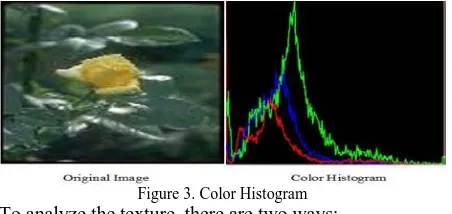
Figure 3. Color Histogram
To analyze the texture, there are two ways:
• Structured Approach: A structured approach sees an image texture as a set of primitive pixels in some regular or repeated pattern. For analyzing artificial textures this approach is best.
• Statistical Approach: A statistical approach sees an image surface as a quantitative measure of the game plan of forces in a district. When all is said in done this approach is less demanding to register and is all the more broadly utilized, since characteristic surfaces are made of examples of sporadic sub components.
Texture is a one of the most important feature of natural images. The various techniques have been developed to measure the texture similarity. Mostly techniques are depend on the comparing values that are also known as statistics which can be measured from the query image and the images which are stored in the database [14]. Image texture can be calculated by using the coaseness, degree of contrast, directionality, regularity, periodicity and randomness. Furthermore, gabor filters and fractals would be used for the analysis of texture for the retrieval of images. For the extraction of features gabor filter is widely used from the various images for the retrieval of images and has been very efficient.
3. Shape: Shape of an image is characterized as the trademark surface of image, shape and framework of an image. This is an important visual feature and one the basic features used to describe the image content. The shape highlights of items or areas for the most part utilized as a part of different based image retrieval frameworks. After comparing with the color and texture features, basically shape features are explained just after the segmentation of image into regions or objects [15]. Shape based image retrieval consisting of the measurement of similarity between shapes which represented in the form of features. Geometric features are able to explain the
[image:3.595.54.272.85.193.2]shapes and usually, simple features can only discriminate shapes with large differences.
Figure 4. Texture
IV. PROBLEMFORMULATION
The inspiration of our examination is to enhance numerous aspects of content-based image retrieval in which the latent association is being searched between low-level visual features and high-level semantics and then integrate it into a unified vector space model. To be more particular, the hugeness of this approach is to plan and execute a powerful and effective structure of image retrieval methods, utilizing an assortment of visual highlights, for example, shading, texture, shape and spatial connections. Steerable Pyramid, a data retrieval system, is joined with content-based image retrieval. By utilizing this strategy, we mean to remove the hidden semantic structure of image content and consequently to conquer any hindrance between low-level highlights and abnormal state ideas. Enhanced retrieval execution and more productive ordering structure can likewise be accomplished.
• As number of images present in the database may be in large quantity, it takes a lot of time to feature each and every image from the database and compare our image with the database images.
• Every image has to be compared with images present in the database, so it increases the complexity of the system.
• If there are more number of comparisons, more hardware is required and thereby increasing the cost.
• The semantic gap between the user's needs and the capability of CBIR algorithms remains significant. Significant effort has been put into using low-level image properties such as color.
In this proposed work we will identify the semantic gaps in the existing mechanisms and will try to improve the number of positive images in the result set by optimizing the processing time of the algorithm, thereby improving the overall efficiency of the system.
V. LBP
[image:3.595.51.277.303.410.2]Figure 5. Basic LBP Operator
The LBP operator was originally designed for texture description. The operator assigns a label to every pixel of an image by thresholding the 3x3-neighborhood of each pixel with the center pixel value and considering the result as a binary number. For each PIXEL of an image, a BINARY CODE is produced to make a new matrix with the new value (binary to decimal value).
𝐿𝐿𝐿𝐿𝐿𝐿𝑝𝑝,𝑟𝑟(𝑁𝑁𝑐𝑐) =� 𝑔𝑔 𝐿𝐿−1
𝑝𝑝=0
�𝑁𝑁𝑝𝑝− 𝑁𝑁𝑐𝑐�2𝑝𝑝
where, neighborhood pixels (Np ) in each block is thresholded by its center pixel value (Nc )
VI. SVM
Learning techniques are the techniques which are basically for the classification purpose. Only due this techniques can be easily classified in the form of labelled and unlabeled data. For this purpose we use different types of classifiers which train the system as per the user’s interest and attain the desired relevant output [18][19]. The problem of classification mostly arises in computer vision tasks: being of supervised, unsupervised and semi-supervised, even there is no availability of class labels. Still a user is in favoring of certain grouping solutions over others. Supervised learning includes the Relevance feedback, SVM, KNN, Neural Network, Decision tree etc. Unsupervised learning includes the K-mean clustering, Bayes Classifier, Flynn’s Classification etc. Semi supervised techniques includes the combination of both supervised and unsupervised learning techniques. Supervised Technique: In supervised learning technique, training is given by the teacher to attain the goal and to learn a general rule which maps the input to the output. Support vector machine is a classifier which used to arrange the images and this formally characterized by an isolating hyper plane. SVM is a computer algorithm which is used to assign he labels that learn by examples. Classification of SVM is the best example of supervised learning in which labels helps us to get the knowledge about whether the system is performing the right operation or not. This detail point out the desired or user’s interested information and also validate the system’s accuracy. SVM classification involves the known classes of the database. This is also known as the feature extraction [20]. Moreover, this an also be used to identify the key sets which consist the processes which differentiate the various classes. In another way, marked preparing information is given (administered taking in), the calculation yields an ideal hyper plane which arrange into new illustrations.
Figure 6. SVM Hyperplane
VII. PROPOSEDWORK
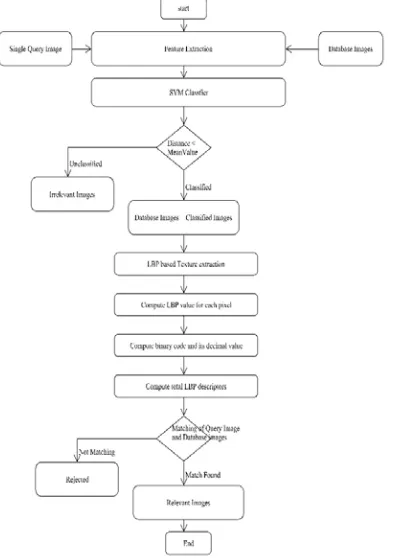
[image:4.595.50.273.72.139.2]In our research work, a hybrid combination of SVM (support vector machine) and LBP (Local Binary Pattern) is applied to retrieve the images from the database. A Support Vector Machine (SVM) is a discriminative classifier formally defined by a separating hyper plane. Local Binary Pattern (LBP) is one of the techniques used in image classification based on texture. This operator is simple and very effective, which labels the image pixels based on their neighboring and consider the result being a binary number. The most important property of LBP operator in real world is the in variation of the differences of the image brightness. The administrator appoints a mark to each pixel of an image by thresholding the 3x3-neighborhood of every pixel with the inside pixel esteem and thinking about the outcome as a paired number. First of all the database images are classified using SVM classifier by fetching the features of database images and query image and classifying the database images into relevant and irrelevant. The irrelevant images are then dropped from the database.
[image:4.595.312.509.465.744.2]VIII.EXPERIMENTALRESULTS
[image:5.595.306.560.82.356.2]Multiple numbers of experiments have been conducted on different categories of images. The different categories like animals, mountains, flowers, cars etc. have been used for testing and analysis. A retrieved image is considered to be correct if and only if it is in the same category as the query. For each inquiry, a preselected number of images are recovered which are delineated and recorded in the rising request of the separation between the question and the recovered images. The experiments are carried out in a personal computer with Intel Core i5 processor with 8 GB RAM. The program is developed using OpenCV libraries and Visual Studio IDE. Each category image from the database was used in turn as a query with the scope set as 10, 20, 40, 60, 80, 100 and 200. After performing all the retrievals, the results are evaluated.
Figure 8. Different Categories of Images
Figure 9. Similarity Matching of Query Image with Database Images
IX. PERFORMANCEEVALUATION
The retrieval System’s performance is evaluated on the basis of numerous criterions. Some of the commonly used performance measures are average precision, average recall, average retrieval rate. All these parameters are computed using precision and recall values computed for each query image. The precision of the retrieval is defined as the fraction of the retrieved images that are indeed relevant for the query. The recall is the fraction of relevant images that is returned by the query. A good retrieval system should have high values for precision and recall. Different set of images are taken in each experiment. As shown in the table 1, out of 39 total images in the first experiment, 17 images are positive in the final result.
Table 1. SVM Classification in proposed work
Category Name
Total Training descriptors
count (SVM)
Precision Recall
Forest 22504 0.9 0.5
Freeway 25242 0.6 0.4
GolfCourse 24234 0.5 0.4
Intersection 22396 0.8 0.6
Medium
Residential 33742 0.9 0.8 Mobile Home
Park 19955 0.9 0.7
Overpass 14698 0.8 0.7
Parking Lot 23544 0.8 0.7
River 29326 0.7 0.6
[image:5.595.42.283.267.591.2]Runway 12622 0.7 0.6
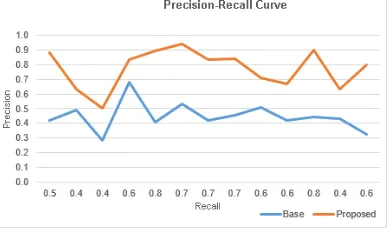
[image:5.595.336.531.494.608.2]Figure 10. illustrates the improvement in precision when SVM classification is applied along with LBP in CBIR mechanism. After applying the classification using SVM, the precision of the proposed work has been increased and thereby increasing the overall efficiency of the system. A good CBIR system should have higher value of precision. We have illustrated the precision-recall graph of the proposed work. For a given experiment, as the size increases, both the Recall and precision increased. This is expected as the number of positive and negative images can only remain constant or increase. The trade-off between the two values is governed by the size used.
Figure 10. Precision comparison of Current and Proposed Work
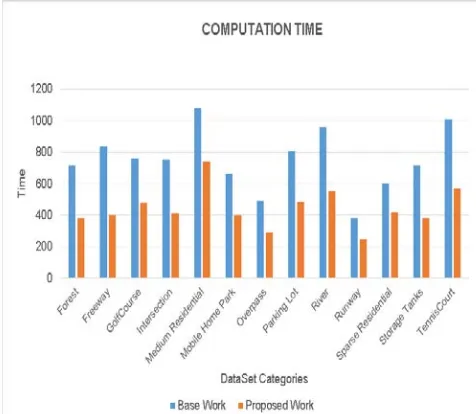
Figure 11. Computation time Comparison
Figure 12. shows the significance improvement in the matching time for the proposed work. The matching time has been reduced because we have reduced the database images after applying the SVM classification mechanism. There is an improvement of approximately 17-28% in overall matching time.
Figure 12. Matching Time bar Graph
X. CONCLUSIONS
Content based image retrieval is a challenging method of capturing relevant images from a large storage space. Although this area has been explored for decades, no technique has achieved the accuracy of human visual perception in distinguishing images. Whatever the size and content of the image database is, a human being can easily recognize images of same category. From the very beginning of CBIR research, similarity computation between images used either region based or global based features. Global features extracted from an image are useful in presenting textured images that have no certain specific region of interest with respect to the user. Region based features are more effective to describe images that have distinct regions. Retrieval systems based on region features are computationally expensive because of the need of segmentation process in the beginning of a querying process and the need to consider every image region in similarity computation. In this paper, we presented an architecture of content based image retrieval with its various applications. The proposed method is implemented in OpenCv environment using Visual studio IDE and multiple experiments are conducted on the different categories of images like animals, birds, cars, flowers, fruits, medical images etc. Multiple attacks are also conducted like (i) Crop the images, (ii) Rotate the
image, (iii) Add noise in the images etc. After attempting the experiments on various images, various parameters are evaluated like precision, recall, computation time and matching time. The graphs demonstrate the effectiveness of the proposed system with the existing system.
XI. REFERENCES
[1] M. Fakheri, T. Sedghi, M. G. Shayesteh1 and M. C. Amirani, "Framework for image retrieval using machine learning and statistical similarity matching techniques," IET Image Process, pp. 1-11, 2013.
[2] P. MANIPOONCHELVI and K. MUNEESWARAN, "Multi region based image retrieval system," Indian Academy of Sciences, pp. 333-344, 2014.
[3] H. J´egou, M. Douze, C. Schmid and P. P´erez, "Aggregating local descriptors into a compact image representation," IEEE, pp. 3304-3311, 2010.
[4] Y. Chen, J. Z. Wang and R. Krovetz, "CLUE: Cluster-Based Retrieval of Images by Unsupervised Learning," IEEE, pp. 1187-1201, 2005.
[5] R. Fergus, L. Fei-Fei, P. Perona and A. Zisserman, "Learning Object Categories from Google’s Image Search," IEEE, 2005.
[6] Y. Chen, X. Li, A. Dick and A. v. d. Hengel, "Boosting Object Retrieval with Group Queries," IEEE, pp. 765-768, 2012.
[7] R. Arandjelovi´c and A. Zisserman, "Three things everyone should know to improve object retrieval," IEEE, pp. 2911-2918, 2012.
[8] M. Perd'och, Chum and J. Matas, IEEE, pp. 9-16, 2009. [9] S. A. Chatzichristofis and Y. S. Boutalis, "CEDD: Color and
Edge Directivity Descriptor: A Compact Descriptor for Image Indexing and Retrieval," Springer-Verlag Berlin Heidelberg, pp. 313-322, 2008.
[10] Y. Chen and J. Z. Wang, "A Region-Based Fuzzy Feature Matching Approach to Content-Based Image Retrieval," IEEE, pp. 1252-1267, 2002.
[11] C.-H. Lin, R.-T. Chen and Y.-K. Chan, "A smart content-based image retrieval system content-based on color and texture feature," ELSEVIER, p. 658–665, 2009.
[12] Z. Wang, J. Li and G. Wiederhold, "SIMPLIcity: Semantics-Sensitive Integrated Matching for Picture LIbraries," IEEE, pp. 947-963, 2001.
[13] S. Gandhani, R. Bhujade and A. Sinhal, "AN IMPROVED AND EFFICIENT IMPLEMENTATION OF CBIR SYSTEM BASED ON COMBINED FEATURES," IET, pp. 353-359.
[14] S. M. H. Khan, A. Hussain and I. F. T. Alshaikhl, "Comparative study on Content Based Image Retrieval (CBIR)," IEEE, pp. 61-66, 2013.
[15] Sreedevi S. and Shinto Sebastian, "Fast Image Retrieval with Feature Levels," IEEE, 2013.
[16] S. Ezekiel, Mark G. Alford, David Ferris and Eric Jones,, "Multi-Scale Decomposition Tool for Content Based Image Retrieval," IEEE, 2013.
[17] K. Juneja, A. Verma , S. Goel and S. Goel , "A Survey on Recent Image Indexing and Retrieval Techniques for Low-level Feature Extraction in CBIR systems," IEEE, pp. 67-72, 2015.
[18] K. BELATTAR and S. MOSTEFAI, "CBIR using Relevance Feedback: Comparative Analysis and Major Challenges," IEEE, pp. 317-325, 2013.
[19] D. Jeyabharathi and A. Suruliandi, "Performance Analysis of Feature Extraction and Classification Techniques in CBIR," IEEE, pp. 1211-1214, 2013.
[image:6.595.49.289.357.492.2]