Hardaware Realization of Parameter Sensing
Unit with Data Aggregation
Prasad Thube1, Sachin Takale2, Umashankar More3
M. E Student, Dept. of E & TC, SCOE, Pune, India1
Asst. Professor. E & TC, SCOE, Pune, India2
Asst. Professor, E&TC, Dnyanshree Institute of Engg.& Tech, Satara, India3
ABSTRACT: Wireless sensor nodes are rapidly used in many application, such as fire monitoring, forest monitoring and military surveillance. Sensor node which send sensed data. As sensor nodes are battery driven, an efficient use of power is essential in node for long time hence it is needed to reduce data traffic inside sensor node. For WSN, a data aggregation function reduces communication and power consumption required for the transmission. Sensor node is resource constrained, so it is very important to collect data precisely. Sensor node requires less power for processing as compared to transmission of data. It is preferable process inside node and reduce packet transmission. One such approach is data aggregation. Data aggregation is used to reduce the number of transmissions and save energy by aggregation of multiple data packets into an aggregated data packet in wireless sensor node. Data Aggregation algorithm is based on event or time.
KEYWORDS:Wireless sensor node, data aggregation, in-node aggregation, count aggregation, aggregation protocol.
I. INTRODUCTION
Sensor node is composed of small and cost effective sensing device with wireless radio transmitter for environment
monitoring have more feasible. Wireless sensor node is widely used in many applications like forest fire monitoring,
temperature monitoring and military surveillance [1]. The sensor node can monitor the environment parameter by collecting information from near area and send data to destination. Data aggregation protocol aims for eliminating redundant data transmission and thus improves the lifetime of energy constrained sensor node. Sensor node deployed on the field, a sensor node is limited source constrained in storage, computation power. The information collected from the node is sent through wireless media required power. A function used for data acquisition systems for sensor node performs in-node aggregation protocol. Mostly data aggregation functions are the time based. Data aggregation is function of process of aggregating the sensor information by aggregation approaches. The function uses sensor data and then aggregates the data by using aggregation function such as average, RMS, Min, Max. In this paper, we designed the system hardware implementation parameter of sensing unit and an algorithm for aggregation. The algorithm used to aggregation is count.
II.RELATED WORK
The increased use of the energy resources and active distribution network require new model for operation of power system. Monitoring the power transfer network is mainly in power quality (PQ) framework. The RMS values are applied to values taken from the successive aggregation of data available for long term observation. The end-user needs for information and data resulting from averaging over one period of the observed quantities (i.e. rms value) has be done by data aggregation over the time axis. The aggregation process in time and space using data obtained from non-aggregated value. [3]
III.DESIGN METHODOLOGY
The system is divided into two parts. The first unit consists of sensing unit and in second part aggregation unit. Block diagram of the system as shown in the fig. 1
Fig 1.Block diagram of sensor node system
Fig 2: Flowchart for aggregation algorithm
The algorithm checks event in periodic manner. The user can set and offset is set to 2. The sample is between this ranges then it takes next attempts. IF sample it outside this range then change occurs. If change happen (sample outside the range) sample store in the memory and change not occurs (sample is in the range) then second attempts takes. Up to seven attempts sample fall in the range then sample store in the memory.
IV.RESULT AND DISCUSSION
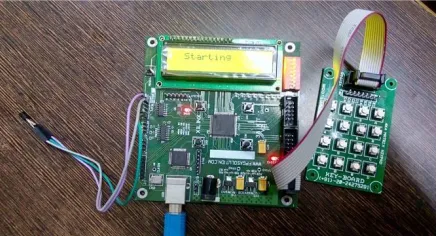
The system output shown on the LDC display, the current temperature, set point, the number of memory location required to stored data sample. The interfacing of system shown in the fig 3.The system needs LCD to show the result of the system, ADC needs to convert analog senor data to digital to display the result of the sensing parameter. Here temperature sensor signals to ADC to monitor the temperature of surrounding. The LM 35 sensed the environment temperature and gives the data toanalog ADC which converts this sample into the digital data.
The Fig.4 show the LCD display giving the temperature reading. The user set the set point of the temperature. The number of memory location shown on the LCD display required for stored data sample. The data shows the data sample stored on the memory.
Fig 4: LCD module shows parameter of the system
In without aggregation sample takes at 1s interval then data generate rate is very high it requires huge amount of memory to store this sample. In aggregation takes data into memory if event occurs and if event not generate it takes seven attempts to check event generate and upto7 attempts event not occurs then sample is save into the memory. The memory requirement in data aggregation is reduces. The data aggregation is based on both event and time.
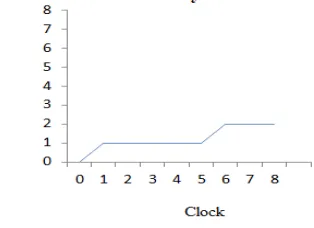
Fig 5: Memory requirement for without aggregation
The fig 5 shows the graph of memory requirement for without aggregation for without aggregation memory requirement increase linear with time. In with aggregation graph shown at fig 6 that in with aggregation memory increase if event occurs and up to 7 attempts event not occurs then sample store into the memory.
Fig 6: Memory requirement for with aggregation
The fig 6 graph shows difference between memory requirement in with and without aggregation. In with aggregation successful reduce in memory requirement.
= ∗ ∗
Where current is in Amperes, Voltage in Volts and Time is in seconds.
= 20∗10 ∗3 ∗1 ∗ 1
8 =
7.5
Table 1: Number of packet store in memory
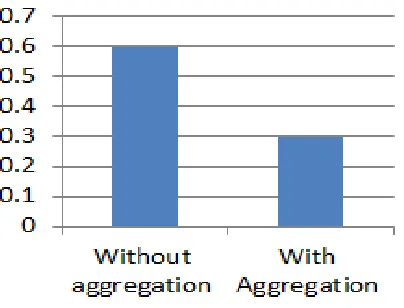
The fig 7 shows the comparison of energy consumption between without aggregation and with aggregation technique. The graph shows energy consumption between without aggregation and with aggregation technique.
Fig 7: Energy consumption
V.CONCLUSION AND FUTURE WORK
The sensor node generate huge amount of the sample. To store this sample needed huge amount of memory. Due to these memory wasted to store these samples. The aggregation leads to low data availability. The flexibly achieve in the algorithm for the balance between memory, timeliness and data availability. The data aggregation methodreduces storage requirement to store data sample. The algorithm is based on event driven and periodic driven. The future work is node security and accuracy.
REFERENCES
[1] Sankardas Roy, Mauro Conti, Sanjeev Setia , sushil Jajodia, “Secure data Aggregation in wireless Sensor Network ”, IEEE transaction on Information forensic and security, 2013.
[2] S. Madden, M. J. Franklin, J. M. Hellerstein, and W. Hong, “TAG: A tiny aggregation service for ad hoc sensor networks,” in Proc.5th USENIX Symp. Operating Systems Design and Implementation(OSDI), 2002.
[3] J. Zhao, R. Govindan, and D. Estrin, “Computing aggregates for monitoring sensor networks,” in Proc. 2nd Int. Workshop Sensor NetworkProtocols Applications, 2003.
[4] J. Considine, F. Li, G. Kollios, and J. Byers, “Approximate aggregation techniques for sensor databases,” in Proc. IEEE Int. Conf. DataEngineering (ICDE), 2004.
[6] M. Albu, “dual data aggregation for power quality assessment”, instrumentation and measurement technology conference (I2MTC) proceedings, 2014 IEEE international, MAY 2014.
[7] Ana Maria Dumitrescu, Mihai Calin, Mihaela M. Albu, “Measurement Data Aggregation in Power Systems – Challenges and Opportunities”, Proc. of the 2nd Conference on the Power Options for the Eastern Mediterraneanregion, POEM, Nicosia., 6-8 October 2013.
[8] L. Zhong, R. Shah, C. Guo, and J. Rabaey, “An ultra –low power and distributed access protocol for broadband wireless sensor networks,” presented at the Net world + Interop: IEEE Broadband Wireless Summit, Las Vegas, NV, May 2001.
[9] IEC 61000-4-30 ed2.0, Electromagnetic compatibility (EMC) Part 4-30: Testing and measurement techniques - Power quality measurement methods,2008