ISSN 2348 – 7968
Investigation and Application of Improved Text mining based on
Bayes Algorithm
Tang Zhi-hang
School of Computer and Communication, Hunan Institute of Engineering Xiangtan 411104, China
Abstract—Finding features in semi-structured or non-structured document data was not an easily thing in the past. With the
development of text mining technique, it has become a widely used analysis tools to find out patterns or rules in hugely text data. The
purpose of this study tries to discern some common patterns in the lyrics of music chart singles, which make these singles popular. We
provide a walk-through of language identification fundamentals by first introducing the theoretical background, followed by a
step-by-step guide on model building, according to the standard practice of data mining. We will put emphasis on understanding the
problem, and solving it in an effective and costless manner within the open source environment RapidMiner. We will become familiar
with RapidMiner’s “Text Mining Extension”, and learn how to create several simple and fast workflows for language identification.
The methods we will use are generic, and applicable to any dataset, with the appropriate pre-processing. In addition, we will learn how
to use the implemented models in custom projects, by exporting them as web services using Rapid Analytics, and deploying them in
custom applications. We will go through a case study of a web application for language identification of web pages, using
RapidMiner’s “Web Mining Extension”. Special emphasis will be given to the optimization of the exported workflow, to enable faster
execution, and harmonious integration in other applications.
Keywords—Bayes Algorithm, text mining, web mining
1. Introduction
In the past, finding features in semi-structured or non-structured document data was not an easily thing. With the
development of text mining technique, it has become a widely used analysis tools to find out patterns or rules in hugely text
data. For example, Weng and Liu [1] proposed a mechanism based on text mining technology to reduce the load of replying
customer service e-mails. de Oliveira et al[2] Used text mining technology to analyze and acquire the enterprise’s competitive
strategies. Aurora [3] proposed a topic discovery system to reveal the implicit knowledge with text mining technology.
Although the topics are somewhat different, all of them showed that text mining is suitable for finding the information needed
in the semi-structured or non-structured document data.
The purpose of this study is to find out the common features of famous singles using text mining technology. Base on the
results of text mining, several analysis methods has been used to quantify the features in the lyrics and then proposed a
quantitative measurement mechanism which can be used to predict whether a single might become attractive to audience.
2. Related work
2.1 Text Mining
Feldman and Dagan [4] was one of the pioneers to give much attention to KDT (Knowledge discovery from text) or text
mining. They describe KDT as a process to find out the profitable and usable information in texts. Thus, text mining can be
broadly defined as a knowledge discovery process in which an individual extracts the useful information from a text-based
data by using analysis tools [5]. As compare with the data mining which is an automatically process to discover useful
information from structured data stored in the database [6], the main objective of text mining is to discover valuable
knowledge embedded in semi-structured or non-structured document data [7].
Feldman and Sanger [5] indicate that the results of text mining usually represent the features of documents rather than
the underlying documents themselves. Although the potential features of documents can be represented in various ways, the
commonly types of feature used are: characters, words, terms, and concepts.
Nasukawa and Nagano [8] suggests that the entire text mining procedure can be divided into three components:
Concepts extraction. Since the same words or terms may sometimes express different meaning in the different document.
As a result, the first part of text mining is concentrate on how to extract the meaningful concepts from the document.
Rules and patterns discovery. After extract the concepts from the documents, some quantitative analysis methods may be
used to find out the hidden rules and patterns.
Display and interactive analysis. The final part of text mining is to visualization the results in a multi-dimension view
and provide an interactive interface for user to interact with.
2.2 Application of Text Mining
The primary objectives of text mining are classification and prediction. Several methods were used to work for text
mining in recent years. Among these methods, most of them are the widely studied and applied method of data mining. Weiss
et al [9] pointed out that text mining technology can be used in five major areas:
Document classification. This area is about assigning documents to one of several predefined categories.
Information retrieval. Information retrieval is a common topic especially in web-based text mining. It allows researchers
to gathering the documents on Internet as the clues to retrieve the specific document.
Clustering and organizing documents. Distinct from classification which assigning documents to the predefined
categories, clustering technology is useful to group semi-structured or non-structured document data as clusters and assigning
the labels needed for each cluster.
Information extraction. Information extraction is to extract useful information from a text-based data. As mentioned, it is
more difficult to extract the useful information from semi-structured or non-structured document data as compare with the
traditional data mining. Thus, finding useful information from semi-structured or non-structured document is more valuable
and interesting to the researchers.
Prediction and evaluation. The ultimate goal of text mining is prediction. Based on the finding patterns in the input
document data, researchers can use these patterns to form of some generalized rules that can be used to predict and evaluate
something they care about.
3. Improved Text mining based on Bayes Algorithm
3.1 The Problem of Language Identification
The task of language identification can be simply described as discerning the language of a given text segment. For
example, given a set of six sentences in different languages, the goal is to identify the language of each sentence. This task
may be somewhat trivial for humans. We might be able to easily discern the language and possibly identify some of them,
even though we might not speak any of those languages. The first sentence is easy, since we are reading this book written in
English. We may say that the second sentence “feels” German, or that the third one “sounds” French. The alphabet of the
fourth sentence looks completely different from the others, so we might guess it “looks like” Greek, while the fifth sentence
might “lead to” Spanish. We might find the sixth sentence somewhat tricky since it looks different from the previous ones. If
we are vaguely familiar with the Slavic family of languages we might say it “relates to” that family, since the sentence is
ISSN 2348 – 7968 When identifying languages, we use our knowledge of languages, acquired either actively or passively. To design
algorithms for achieving the same task, we first need to systematize the knowledge needed for language identification. There
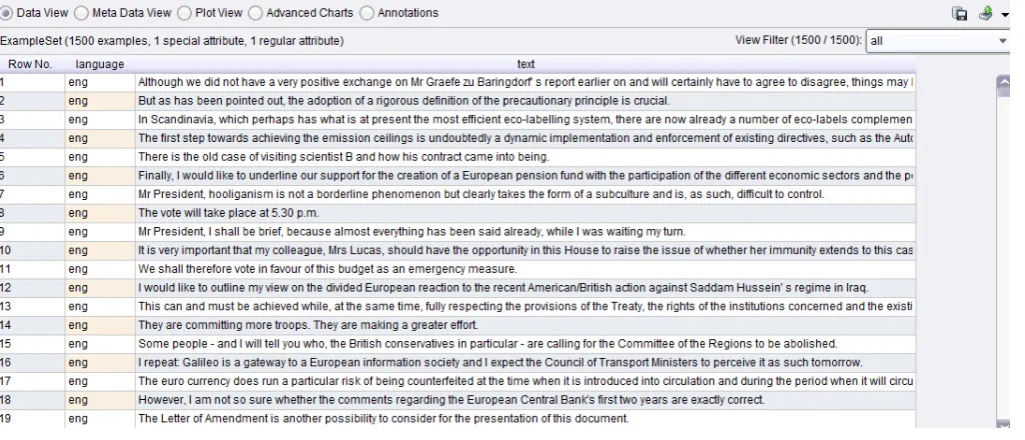
are several indicators we can rely on when identifying languages, without knowing those languages at all; Examples of
several different alphabets are given in Figure 1.
Figure 1 example set of English
3.2 Token-based Representation
The token-based representation is built on top of basic meaningful elements of text, called tokens. Tokens can be words
separated by delimiters; logograms—signs and characters representing words or phrases, such as Chinese letters; idioms, or
fixed expressions, such as named entities—names of places, people, companies, organisms, etc.
The process of token extraction is called tokenization. For most of the languages and uses, tokenization is done by
splitting sentences over whitespaces and punctuation characters, sometimes ignoring numbers, or allowing specific
punctuation in a word, e.g., wasn’t, off-line. The frequent words approach identifies the most frequent words in the text, and
uses them for the language identification. The most used words across different languages have similar meanings, and
regarding the type of words, they are usually articles, prepositions, pronouns, and some frequently used verbs, and adjectives.
Due to their high frequency of occurrence, they are suitable even for shorter texts. Figure 2 depicts main process of model
frequent words
Figure 2 main processes of model frequent words
3.3 Examining the Word Vector
A word vector is just a fancy name for a table, where each row is a document (SMS message in this case), and each
column is a unique word in the corpus (all of the words in all of your documents). The values inside the table depend on the
type of word vector you are creating. In this case we are using Term Occurrences, meaning that a value in a cell represents the
number of times that word appeared in that document. You could also use the Binary Term Occurrences, meaning the value in
the cell will be zero if the word did not appear in that document, and one if the word appeared one or more times in that
document. It is always a good idea to examine your data, in order to “get a feel” for it, and to look for strange anomalies.
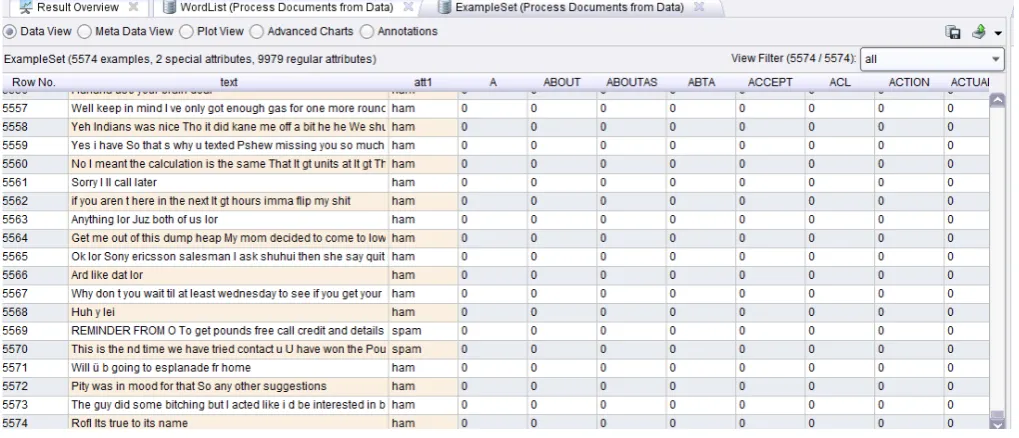
1. Click the Example Set tab to view the word vector. You will see that the word vector has 9755 attributes, meaning that
there are 9755 unique words in the corpus. Equivalently, there are 9755 columns in the word vector.
2. Look at the Range column for the “text” role attribute. You will note that:
• “Sorry I’ll call later” is the most common message.
• Below that, you can see that there are 4827 “ham” messages, and 747 “spam” messages.
3. Click the Data View button. You will see that document 13 has a “1” under the word “A”, meaning that the word “A”
appears one time in that document. Actually, “a” and “A” appear in that document, but we are considering the letter case of
the words in this process, so they are counted as distinct words, Figure 3 depicts table of wordlist frequencies and Figure 4
depicts table of example set..
Figure 3 A table of wordlist frequencies
ISSN 2348 – 7968
Figure 4 A table of example set
3.4 Validating the Model
To build the Support Vector Machine model, add the Support Vector Machine operator after the Process Documents
from Data operator. To find the model’s predictive accuracy, we must apply the model to data, and then count how often its
predictions are correct. The accuracy of a model is the number of correct predictions out of the total number of predictions.
Add the Apply Model operator after the Support Vector Machine operator and connect their two nodes together. Add a
Performance operator after the Apply Model operator and connect it to a res node.
To be able to predict a model’s accuracy on unseen data, we must hide some of the data from the model, and then test the
model on that unseen data. One way to do this is to use K-fold Cross-Validation.
When using, say, 10-fold Cross-Validation, we would hide 1/10th of the data from the model, build the model on the
remaining 9/10ths of the data, and then test the model on the whole dataset, calculating its accuracy. We would do this again,
hiding a different 1/10P th
P
of the data from the model, and test again. We would do this 10 times in total, and take the average of
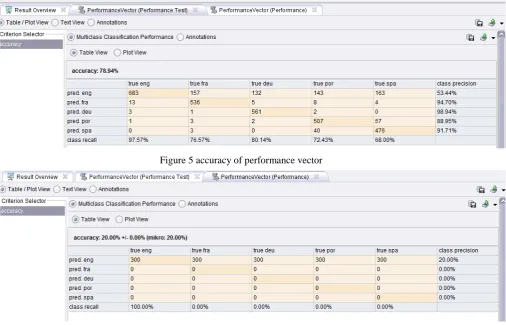
the accuracies. This provided a better idea of how the model will perform on data that it has not seen before, Figure 5 depicts
accuracy of performance vector and Figure 6 depicts classification error of performance vector.
1. Remove the Support Vector Machine, Apply Model, and Performance operators from the Main Process window.
2. Connect an X-Validation operator to the Process Documents from Data operator, and connect its ave (for average
performance) node to a res node.
3. Double-click the X-Validation operator. Put a Support Vector Machine operator in the left side of this inner process,
and an Apply Model operator and a Performance operator in the right side of the process. Connect all required nodes.
Figure 5 accuracy of performance vector
Figure 6 classification error of performance vector
4. Conclusions
Language identification is an important pre-processing step in many text mining applications, and is in its basic form
easy to implement in RapidMiner. In this chapter, we demonstrated three different basic approaches to the problem. The
frequent words method identified languages over the most frequent words in the corpus, per language. We saw that this
method yields relatively high accuracy, but is unable to correctly classify sentences which do not contain frequent words,
since the number of words in a language is practically unlimited. The character n-gram method, on the other hand, uses
character n-grams instead of whole words in order to do the language identification. This method yields higher accuracy than
the frequent words method, and possibly results in a smaller and faster model. The similarity-based method presented in the
end, simplifies the resulting model and the computation, though at a cost of a lower accuracy. We implemented and tested
these methods using RapidMiner, on an easily obtainable dataset. In the end, we showed how to use the similarity-based
workflow in order to create a workflow for web page language identification, and export it as a web service using Rapid
Analytics. Having a language identification workflow as a web service enabled us to apply it in various custom applications
by simply issuing an HTTP call.
By getting familiar with the problem, its possible solutions, and using the solution in a real-world problem, we hope you
mastered language identification and are ready for further challenges. Further challenges might include experimentation with
method improvement, optimization of accuracy, and computational performance. Though it might seem that language
identification is a solved problem, there is still room for further research and improvement, especially in
the application areas like tweet, multilingual document, or language-variant language differentiation. We hope that
we successfully gave you the ground knowledge, and inspired you to tackle such challenges and venture deeper into the new
horizons of language identification.
ACKNOWLEDGEMENTS:
ISSN 2348 – 7968 A Project Supported by Scientific Research Fund of Hunan Provincial Education Department(15A043)
REFRENCES:
[1]. Weng, S.S. & Liu, C.K. 2004. Using Text Classification and Multiple Concepts to Answer E-mails. Expert Systems with Applications, 26(4), 529–543.
[2]. de Oliveira, J. P. M., Loh, S., Wives, L. K., Scarinci, R. G., Musa, D. L., Silva, L., & Zambenedetti, C. 2004. Applying Text Mining on Electronic Messages for Competitive Intelligence, In Proceeding of the 5th International Conference on Electronic Commerce and Web Technologies, Spain: Zaragoza.
[3]. Aurora, P. P., Rafael, B. L., & José, R. S. 2006. Topic Discovery Based on Text Mining Techniques. Information Processing and Management, 43(3), 752–768.
[4]. Feldman, R. & Dagan, I. 1995. KDT- Knowledge Discovery in Texts, In Proceeding of the First International Conference on Knowledge Discovery and Data Mining (KDD), Canada: Montreal.
[5]. Feldman, R. & Sanger, J. 2007. The Text Mining Handbook-Advanced Approaches in Analyzing Unstructured Data, USA: New York.
[6]. Tan, A. H. 1999. Text Mining: The State of the Art and the Challenges. In Proceedings of the 3rd Pacific-Asia Conference on Knowledge Discovery and Data Mining, China: Beijing.
[7]. Losiewicz, P. B., Oard, D. W., & Kostoff, R. N. 2000. Textual Data Mining to Support Science and Technology Management. Journal of Intelligent Information System, 15(2), 99–119.
[8]. Nasukawa, T. & Nagano, T. 2001. Text Analysis and Knowledge Mining System. IBM Systems Journal, 40(4), 967–984.
[9]. Weiss, S. M., Indurkhya N., Zhang T., & Damerau F. J. 2005. Text Mining-Predictive Methods for Analyzing Unstructured Information, USA: New York.
< Zhi-hang Tang >, <1974-08-08>, <hunan, China>
Current position, Doctor of Hunan Institute of Engineering
University studies: control theory and control engineering in donghua University Scientific interest: intelligent decision and knowledge management
Publications <number or main>: 40 Papers
Experience: Zhihang TANG was born in Shaoyang, China, in 1974. He earned the M.S. degrees in control
theory and control engineering from zhejiang University of techonlogy, in 2003 and Ph.D. from donghua
University China in 2009. At the same time ,he is a teacher in department of computer and communication,
Hunan Institute of Engineering(Xiangtan, China) from 2003.Chaired the 49th China Postdoctoral Science
Foundation grant, presided over science and technology projects in Hunan Province in 2010, presided over the
Education Department of Hunan Province in 2010 Outstanding Youth Project, as the first author more than 30
papers were published.His current research interests include intelligent decision and knowledge management.