R E S E A R C H
Open Access
Throughput and delay analysis of network
coded ALOHA in wireless networks
Hyun-kwan Lee
1, June Hwang
2, Seong-Lyun Kim
1*and Riku J
a
¨
ntti
3Abstract
The purpose of this article is to analyze the impact of network coding in wireless networks. We consider a network coded ALOHA that performs bi-directional network coding over the ALOHA MAC protocol in a star topology network. The transmission probabilities of each outer node and the center node, and the target signal-to-interference-plus-noise ratio (SINR) are jointly optimized to achieve the maximum throughput of coded ALOHA. We analyze and compare the optimal performance of slotted and coded ALOHA. Under the unsaturated traffic condition at the center node, we derive practical throughput and delay, considering the network coding opportunity and the maximum queue length of the center node. Under the saturated traffic condition, we obtain a throughput upper bound of coded ALOHA to judge the ideal gain of network coding. The impact of asymmetric topology is evaluated with simulations.
Keywords: Network coding, ALOHA, Throughput, Delay, Cross-layer optimization, Wireless networks
Introduction
The demand for high-quality mobile services has stim-ulated the development of new wireless network tech-nologies. In contrast to wired networks, in which the quality of service (QoS) can be improved by increas-ing infrastructure density (server, communication line, router, and switch, etc.), a wireless (access) network is not easy to improve by means of infrastructure deploy-ment. One reason is that the radio frequency is restricted and is a finite resource, and the same frequency chan-nel cannot be used at the same time and in the same space. Due to this scarcity of radio resources, many researchers have tried to improve the performance of wireless links.
Medium access control (MAC) has been studied in order to allocate radio resources by resolving the con-flicts from multiple users’ access to the common medium and improve the channel access efficiency in wireless networks. ALOHA [1], a classic MAC, was created in 1970, and has been widely used and highlighted for its simplicity. Many variations to ALOHA have also been proposed. Currently, this protocol is used in RFID [2]. The
*Correspondence: [email protected]
1Department of Electrical and Electronic Engineering, Yonsei University, 50 Yonsei-Ro, Seodaemun-Gu, Seoul 120-749, Korea
Full list of author information is available at the end of the article
most importantly, ALOHA formed the basis for the ran-dom access MAC in wireless sensor networks and wireless LAN. However, despite its simplicity of operation, the original ALOHA has low throughput, while the slotted ALOHA, an improvement over the original, has more or less double the capacity.
The relatively low performance of ALOHA originates from its random access nature. The node having a packet accesses the medium through a Bernoulli trial with a given probability. High access probability makes for high colli-sions, while a low probability results in under-utilization of the radio medium. The resulting optimal access prob-ability still shows low throughput, even in a slotted ALOHA. The variations of ALOHA mostly focus on improving time-synchronization [3,4], channel reserva-tion [5-7], and cross-layer optimizareserva-tion [8-10]. Physical layer technologies such as MIMO [11,12] and cognitive radio [13,14] are combined with ALOHA, and their per-formances are analyzed. Most of these efforts, with the exception of the adoption of new physical layer character-istics, aim to reduce idle or collision time in the overall time scale.
In the previous studies, the complex operation is required to increase the throughput of ALOHA. How-ever, it may reduce the merit of ALOHA that is simple and easy to implement. In this article, we analyze a net-work coded ALOHA, which is a different type of remedy
for the low throughput of ALOHA. Network coding [15] is a promising technique in improving network through-put in multi-hop networks. Intermediate nodes in the network combine code packets, and intermediate or destination receivers decode these coded packets using known packets. From the medium usage point of view, network coding gives better performance by using the medium less when compared to the traditional commu-nication method, in which each packet uses the medium exclusively [16,17].
To verify the effect of network coding, we investi-gate and analyze embedding the network coding into the ALOHA protocola in the star topology, where the cen-ter node communicates with source/destination nodes one hop away. The network throughput can be improved when the network coding opportunity in the center node increases. Outer nodes put more packets into the center node in order to increase the network coding opportu-nity. Therefore, the optimal access probability for each node should be calculated in the network coded situa-tion. Besides, the impact of network coding on the delay performance should be considered. With the simulation, we also evaluate the impact of asymmetric distance in the star topology, and find the tendency of the optimal transmission probability.
There has been research into combination of ALOHA and network coding. A similar model was considered in previous studies [18,19]. In [19], routing, MAC, and net-work coding are jointly optimized, but both [18,19] did not consider the queuing effects for network coding at the intermediate node. Other than this, the most rele-vant article [20] analyzed the throughput and delay of network coded ALOHA. However, they considered a pro-tocol (collision) channel model and restricted the topology to two-way relay networks. The protocol channel model is not sufficient to represent the wireless channel (e.g., transmission errors due to the channel gain and cap-ture effect). These assumptions are relaxed in our article. Network coding gain has been analyzed [17] within the CSMA/CA MAC layer, and we determined the set of the target signal-to-interference ratio (SIR) value and the carrier-sensing range that jointly maximize the through-put. Our results in this article are summarized as follows: (1) The maximum throughput of coded ALOHA is greater than that of the conventional ALOHA (coding gain is about 1.3). (2) Under the same parameters (transmis-sion probability and target SINR), coded ALOHA shows less delay. (3) With the optimal parameters that max-imize the throughput, coded ALOHA has a tendency to increase delay. (4) A throughput upper bound on coded ALOHA is obtained to judge the gain of network coding.
The remainder of the article is organized as follows: In Section ‘System model’, we explain our system model.
In Section ‘Network throughput analysis’, the through-put of ALOHA and coded ALOHA is analyzed under the finite and infinite buffers in the center node. In Section ‘Packet delay analysis’, we derive the packet delay. Our numerical results are described in Section ‘Numerical results’. Finally in Section ‘Conclusions’, we conclude the article.
System model Network model
Consider the star topology wireless network ofk+1 nodes in Figure 1 [18]. Nodes are divided intokouter nodes and one relay node in the center. This network constitutes a block in ad hoc or mesh networks, in which the multi-ple routes go through the center node. Letkbe an even number. Thekouter nodes are equally spaced on a circle (radius=r). Every outer node(n1,n2,. . .,nk)establishes
a bi-directional communication pair with the node in the opposite direction, and communicate with it through the center node. In Figure 1, for example, noden1andn5are the pair. The role of the center node is to relay packets to the appropriate outer nodes using the decode-and-forward mode. The center node does not generate its own packets. There is only two-hop communication through the center node.
We consider the capture effect so that, even if more than two nodes transmit at the same time, the data or infor-mation from source node can be decoded successfully
at receiver when the signal-to-interference-plus-noise ratio (SINR) is greater than the target threshold. The source nodes can acknowledge success or failure of the transmitted packet (ACK). We assume that such ACK feedback is through the out-of-band transmission.
Medium access control and bi-directional network coding The time is divided into equal-sized slots, each of which corresponds to one packet. Every node is synchronized with these time slots. At the beginning of each time slot, every outer node transmits a packet with trans-mission probability p, and the center node transmits with pc. Each outer node always has packets to
trans-mit to its destination on the opposite side. The cen-ter node relays received packets from oucen-ter nodes with the transmission probability pc to appropriate
destina-tion nodes. The center node has the finite queue length, M in the real situation. The infinite queue length case is investigated for the asymptotic analysis. If trans-mission fails, the node retransmits the same packet with the same transmission probability until success is achieved.
We use bi-directional network coding at the cen-ter node, where network coding is applied for two bi-directional packets—a header packet in the queue of the center node and an opposite packet. The opposite packet is sent by the opposite node of the header packet’s transmitter. For example, when node n1 and n5 are bi-directional pair, node n1 sends packet X1 to the center node in time slot 1, noden5sends packetX5to the cen-ter node in time slot 2, and the cencen-ter node broadcasts coded packet (X1XORX5) in time slot 3. In this exam-ple,X1is the header packet, andX5is the opposite packet. The destination node performs the XOR operation on the coded packet with its own transmitted packet. The ACK packet from the destination node implicitly means that the coded packet is successfully delivered and decoded at the destination node.
However, when there is no opposite packet in the queue, the center node transmits the header packet as a native packet without network coding. This opportunistic scheduling is optimal in terms of the sum rate maximiza-tion for the bi-direcmaximiza-tional traffic [21].
Transmission success probability
In Figure 1, there are three types of transmissions. First, outer nodes inject packets to the center node. Second, the center node relays the received packets to one of the outer nodes without any network coding. Finally, the cen-ter node (network) codes two bi-directional packets and transmits the coded packet to the two outer nodes. Let us denote the probability that each transmission succeeds by Pin,Pout, andPnc, respectively.
In a previous study [22], the transmission success prob-ability of ALOHA was derived under the Rayleigh fading channel:
wherenis the number of interfering nodes,d0is the dis-tance between a source and its destination node,diis the
distance from the interfering node i to the destination node,piis the transmission probability of the interfering
nodei, P0 is the transmission power of all transmitting nodes,N0 is the noise power, and is the target SINR threshold. In this article, we assume that every outer node has the same transmission probability pi = pand the
center node has pc. This probability is conditioned that
the source node transmits and the receiver node does not participate the transmission.
From (1), we can find the success probability of the outer node when the center node does not transmit and the source outer node transmits,Pin, by replacingdi=d0=r
Similarly, we can derive the success probability of the center node without the network coding,Pout, by
replac-ingd0 = rand the other distancesdi = 2rsin(πki),i =
1,. . .,k − 1, when the center node transmits and the destination outer node does not transmit:
Pout=exp
The transmission success probability for the coded packet,Pnc, consists of three probabilities{Pn(1c),Pn(2c),Pn(3c)}
with the condition that the center node transmits. One of three events occurs when the coded packet is successfully transmitted: (i) Two destination nodes successfully receive the coded packet with probabilityP(n1c). (ii) One destination
node receives the coded packet, while another destination node fails due to a collision with itself with probability Pn(2c)(i.e., one of two destination nodes transmits). (iii) One
nodes does not transmit). These probabilities are derived in Appendix 1 as:
Pn(1c)=exp
In this article, the throughput is defined as the average amount of received data by the outer nodes in a unit time slot. It is the result of multiplying the average num-ber of received packets at the outer nodes by the amount of information in a single packet. We can increase the amount of information in a single packet using a high target SINR.
However, at the same time, the high target SINR reduces the transmission success probability and the average num-ber of received packets at the destination nodes. In this section, we obtain the maximum throughput under the both of saturated and unsaturated traffic conditions. The saturated traffic condition means that the center node always has enough packets for the network coding. This condition makes the maximum coding opportunity in the infinite queue length of the center node(M= ∞). From this, we can obtain a throughput upper bound. On the other hand, the unsaturated traffic condition reflects the actual dynamics of the center node’s queue, and gives us a precise throughput with the finite queue length and actual coding opportunity.
Unsaturated traffic
The center node may have a queue state such that it can-not operate the network coding process and transmits the header packet as a native packet. The state of the cen-ter node should be described as a sequence of packets in the queue. Unfortunately, because the state dimen-sion increases with the number of flows, it is difficult to derive the steady state probability. Thus, we approximate the queue state by considering only the number of pack-ets in the queue (the accuracy of our approximation is verified by the numerical evaluation in Section ‘Numer-ical results’). Let us define Xt as the number of packets
in the queue at timet, whereMis the maximum queue length (Xt ≤M). Letπmdenotes the stationary
probabil-ityπm=limt→∞Pr[Xt=m] of ALOHA andπmncdenotes
that of coded ALOHA.
The state transition probability of Xt can be derived
from transmission success probabilities, Pin and
Pout, in Section ‘Transmission success probability’.
The probabilities λ0 = Pr[Xt+1 = 1|Xt = 0] and
where pi = p is the transmission probability of outer
nodei, andpcis that of the center node. For the ALOHA
(non-network coding) case, the transition probabilityμ= Pr[Xk+1 = m−1|Xk = m] form≥ 1, is represented as
follows:
μ=pc(1−p)Pout. (9)
With these probabilities,λ0,λandμ, the queue of the cen-ter node is modeled as a birth-death process in Figure 2. By solving this Markov chain, we can obtain the steady state probabilityπm.
In the steady state, the throughput of the center node is represented as successfully delivered through unit bandwidth.
In coded ALOHA, the state diagram of the center node is complicated. With the successful transmission of a coded packet, the queue state moves to the state with two fewer packets. The number of packets in the queue does not provide sufficient information to deter-mine whether network coding is possible. There may be no opposite packet, even if there are many packets in the queue. To quantify this, we introduceq(m), the net-work coding probability when there arempackets in the queue.
To derive q(m), let us define the injection rate, ri,
Figure 2State diagram of the center node for ALOHA.
Therefore, the network coding probability can be obtained as follows:
q(m)=
k
i=1 ri
1−(1−rj)m−1
=1−
1− 1 k
m−1
, (1≤m≤M). (11)
With probabilityq(m), we can calculate the state tran-sition probability. First, let us consider the transmis-sion success probabilityPn(1c). In Figure 3, the state
tran-sition probability with the network coding μC(m) =
Pr[Xt+1=m−2|Xt=m] is expressed as
μC(m)=q(m)pc(1−p)2P(n1c), (2≤m≤M). (12)
When network coding is not possible, with 1 − q(m), the center node transmits a header packet as a native packet. In this case, the state transition is sim-ilar to ALOHA. Additionally, the coded packet trans-mission can be partially successful, with a probability of P(n2c) or Pn(3c). The single-state transition μN(m) =
Pr[Xt+1=m−1|Xt=m] is the sum of a successful
header packet transmission and the partial success of the coded packet. UsingPn(2c)orPn(3c),μN(m)is summarized as
μN(m)=(1−q(m))pc(1−p)Pout
+q(m)2pcp(1−p)Pn(2c)+2pc(1−p)2P(n3c)
,
(1≤m≤M).
(13)
When there is only one packet in the center node (m= 1), the transition probability simplifies toμN(1) =
pc(1−p)Pout.
In the steady state, the throughput of coded ALOHA is represented as
Sqnc=L M
m=1
πmnc(2μC(m)+μN(m)). (14)
The detailed derivation of state probabilitiesπmncand the throughput are included in Appendix 2.
Saturated traffic
In the case of the saturated traffic, the center node has the infinite queue length (M= ∞), and always make a coded packet due to sufficient packets in the queue. When the coding probabilityq(m)is equal to 1, we have an upper bound on the throughput. The condition is achieved when the queue length of the center node tends to infinity. To proceed further, we borrow results from our previous arti-cle [18]. There are three types of flows: an input flow to the center node, an output flow from the center node, with and without network coding, denoted asSfin,SfncandSfout, respectivelyb. With the transmission success probabilities in Section ‘Transmission success probability’, we calculate Sinf ,Soutf , andSfncas follows:
Sfin=
k
i=1
L×p(1−pc)Pin=k L p(1−pc)Pin, (15)
Sfout= L×pc(1−p)Pout, (16)
Sfnc=(2L)pc(1−p)2P(nc1)
+(L)
2pcp(1−p)Pnc(2)+2pc(1−p)2Pnc(3)
=2Sfout.
(17)
Intuitively, (17) represents that the maximum coding gain is two because two packets are coded. However, the
actual coding gain is lower than two due to thepacket con-servation lawconstraint. The packet conservation law at the center node (Sifn=Sfout) is needed to maintain the sat-urated condition at the center node [23,24]. Consequently, the transmission probability of the center node is given by:
pc=
By substituting (18) into (16), we can obtain the through-put of ALOHA as a function of the transmission probabil-ity of outer nodep, which satisfies the packet conservation law at the center node:
Sfout= k L p(1−p)PinPout (1−p)Pout+k p Pin
. (19)
In coded ALOHA, the packet conservation law isSfin = Sfnc, from which we have
where (21) is obtained by substituting (20) into (17). By solving ∂∂pSofut = 0 and∂∂pSfnc= 0, we find the
max-imal throughput and the optmax-imal transmission probabili-tiesp∗and p∗c, respectively. Unfortunately, the differential equations do not have solutions as a closed-form. Instead, we provide an approximation forp∗andp∗cas follows:
Proposition 1.In the saturated traffic case, if the target SINR increases, then the optimal transmission proba-bility of the outer node p∗ maximizing the throughput in ALOHA and coded ALOHA converges to:
p∗→
Proof. See Appendix 3.
Once we have an approximate value for p∗, we can derive the optimal value forp∗c (18) or (20). Our simula-tions in Section ‘Numerical results’ verify that the formula matches the numerical results, even in low target SINR cases.
Packet delay analysis
We define packet delay as the average time taken from the first transmission of a packet at a source node to
the successful receipt of the packet at the destination node. The packet delay consists of the first transmission time, retransmission delay at the outer node, and the queuing delay at the center node [20]. We disregard the queueing delay in the outer source since our focus is on the delay portion incurred from the wireless access part and the effect of network coding. The number of packet retransmissions at the outer node NR follows the
geo-metric random distribution, with success probabilityPR.
The average number of retransmissions isE[NR]= (1−
PR)/PR where PR = (1− pc)Pin(1−π0nc) +Pinπ0nc = (λ(1−π0nc)+λ0π0nc)/(kp). On average, the outer nodes waits 1/ptimes to retransmit the packet. Thus the retrans-mission delay isE[NR]/p. With Little’s law, the queueing
delay is derived asEnc[m]/λ¯ where λ¯ = λ(1− π0nc) +
λ0π0ncis the average packet arrival rate at the center node, andEncis the expected number of packets in the center
node of coded ALOHA. In conclusion, the packet delay of coded ALOHA is derived as follows:
Dnc=1+
The packet delay of ALOHA, D, is identical to (22), after replacingπmncbyπm. Bothπmncandπmare derived in
Appendix 2.
In the previous section, we found the optimal parame-ters that maximize the throughput of ALOHA and coded ALOHA. As shown in the numerical example section that follows, the optimalp∗of coded ALOHA is higher than that of ALOHA while the optimal p∗c of coded ALOHA is lower than that of ALOHA. This can be also identi-fied by Proposition 1 under the saturated traffic condition. With a higherpand lowerpc, coded ALOHA has a higher
packet injection rate from outer nodes to the center node than dose ALOHA. This rate results in more queued packetsEnc[m] at the center node, a higher network
cod-ing opportunity, and increases the throughput of coded ALOHA accordingly. However, the packet delay is dom-inated by the queueing delay, and becomes larger than that of ALOHA. This is the trade-off between throughput and delay in coded ALOHA for the optimal throughput point. In the following section, we show that this trade-off property is not valid for non-optimal solution cases.
Proposition 2. Under the same parameters of trans-mission probabilities p, pc, and the target SINR, coded
Proof.ALOHA and coded ALOHA have the same access delay and arrival rate. However, due to the dif-ferent service rates, ALOHA and coded ALOHA have a different number of queued packets in the center node (i.e.,Enc[m]= E[m]). From the throughput of ALOHA,
Sqout (10), we can define the service rate of ALOHA asμ (9). Similarly, the service rate of coded ALOHA can be defined asμnc=2μC(m)+μN(m), from the throughput
of coded ALOHA,Snqc (14). When the coding
opportu-nityq(m) =0, the service rate of coded ALOHA is equal to that of ALOHA,μnc = μ. However, when the coding opportunityq(m) =1, the service rate of coded ALOHA isμnc = 2μ. Because 0 ≤ q(m) ≤ 1, the service rate of
coded ALOHA exists in the interval ofμ≤μnc≤2μ. The
higher service rate of coded ALOHA can result in fewer queued packets in the center node,Enc[m]≤ E[m], and
less delay,Dnc≤D.
Numerical results
We plotted the analytical results to get insight into the gain of network coding and compared them with the results of the simulation. In the simulation, we generate a Bernoulli random variable and an exponential random variable, which represent the packet transmission event of each node and Rayleigh fading channel, respectively. Then we check the queue of the center node and measure the throughput. We set some of dimensionless parameters such that transmission powerP0=1, radius of the topol-ogyr = 1, and path loss attenuation factorα = 4. We obtain the maximum throughput by jointly optimizing the
transmission probabilities (pandpc) and the target SINR
(). Figures 4, 5 and 6 depict the relationships between the throughput and the three parametersp,pcand,
respec-tively, with the number of outer nodes (k = 4) and the maximum queue length (M = 100) in the unsaturated case.
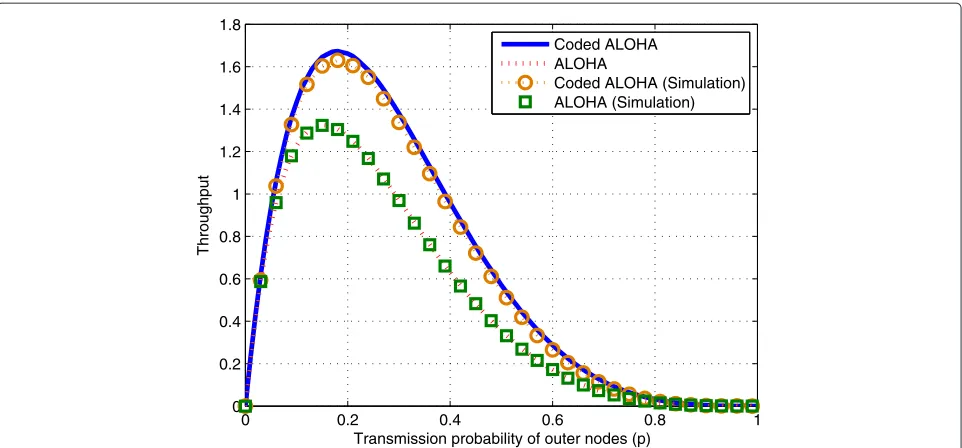
As shown in Figure 4, there is a unique optimal trans-mission probability, p∗, which achieves the maximum throughput. With the optimal p∗c, the throughput of coded ALOHASqnc(14) is maximized atp∗ = 0.18 and
that of ALOHA Sqout (10) at p∗ = 0.15. Similarly, in Figure 5, there is a unique optimal point in coded ALOHA (p∗c = 0.30) while the throughput of ALOHA mono-tonically increases and converges to a certain value with the optimalp∗. The maximum throughput of ALOHA is achieved in the interval of 0.43 ≤ pc ≤ 1. These
opti-mal parametersp∗ andp∗c are obtained from numerical enumeration. In both figures, the maximum through-put values of ALOHA and coded ALOHA are Soqut = 1.3256 and Sqnc = 1.6733, respectively. Using the
net-work coding, a higher throughput is achieved with a smaller transmission probability of the center node. It allows outer nodes to transmit for more packets to the center node, and this makes more coding opportunity in the center node. Although increasing p might cause more collision events with other outer nodes or the cen-ter node, the network coding gain is much higher than the cost of higher collision. However, for high p, both throughput curves converge to zero due to overmany collisions.
0 0.2 0.4 0.6 0.8 1
0 0.2 0.4 0.6 0.8 1 1.2 1.4 1.6 1.8
Transmission probability of outer nodes (p)
Throughput
Coded ALOHA ALOHA
Coded ALOHA (Simulation) ALOHA (Simulation)
0 0.2 0.4 0.6 0.8 1 0
0.2 0.4 0.6 0.8 1 1.2 1.4 1.6 1.8
Transmission probability of the center node (p c)
Throughput
Coded ALOHA ALOHA
Coded ALOHA (Simulation) ALOAH (Simulation)
Figure 5The throughput of ALOHA and coded ALOHA as a function ofpc.The throughput of ALOHA (Sqout) and coded ALOHA (Sqnc) as a function of the center node transmission probability (pc). The number of outer nodesk=4, the target SINR=20 dB, and transmit power to noise
ratioP0/N0=30 dB.
In Figure 5, both throughput curves of ALOHA and coded ALOHA converge to 1.3, not to zero whenpcgoes
to 1. It is becausepcis a conditional transmission
prob-ability when the center node has packets in its queue. If there is no packet in the center node queue, the center node cannot participate the transmission even if pc =
1. Increasing pc makes higher service rate of the center
node queue, which results in higher throughput. How-ever, for highpc, throughput curve of ALOHA converges
to 1.3 due to the limit of injection rate to the center node. For lowpc, coded ALOHA can achieve higher
through-put than ALOHA because coded ALOHA can send two packets at once using network coding. However, highpc
reduces the number of packets in the center node and
0 5 10 15 20 25 30
0 0.2 0.4 0.6 0.8 1 1.2 1.4 1.6 1.8
Target SINR (Θ) dB
Throughput
Coded ALOHA (P0/N0=30dB)
ALOHA (P0/N0=30dB)
Coded ALOHA (P0/N0=20dB)
ALOHA (P0/N0=20dB)
the coding opportunity. Thus, aspc increases, the
cod-ing gain converges to zero, and the throughput of coded ALOHA converges to that of ALOHA. The simulation results are averages of 100 independent samples over 10000 time slots. It can be seen that our analysis matches the simulation results well.
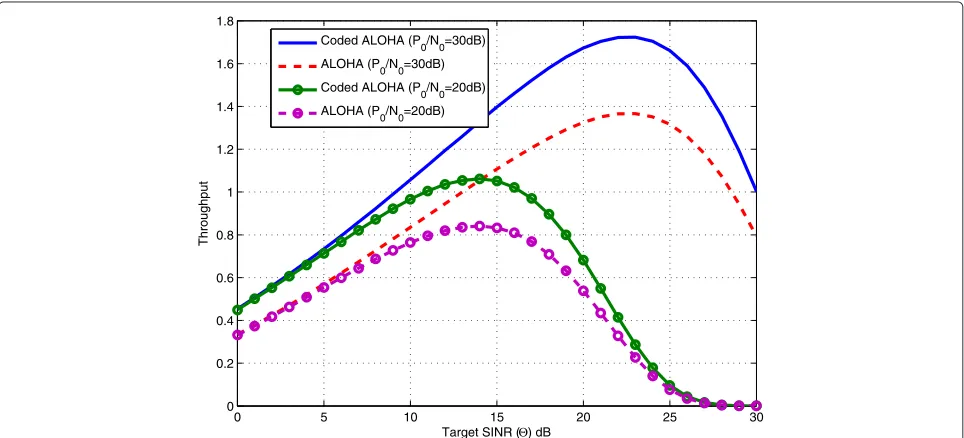
We can increase the throughput by selecting an optimal target SINRof the PHY layer. The effect of selecting the target SINRis shown in Figure 6. Throughput curves are concave and there is an optimal point in each curve. With a high target SINR, we can send the packet with high spectral efficiency, however, the transmission success probability of that packet is low. In contrast, with a low target SINR, we can send many packets that include lit-tle information. As a result of the numerical evaluation, the optimal target SINR that maximizes the throughput is 22.55 dB when transmit power to noise ratioP0/N0 = 30 dB, and is 14.77 dB when transmit power to noise ratio P0/N0= 20 dB. When the noise level increases, the opti-mal target SINR should decrease to reduce the channel error.
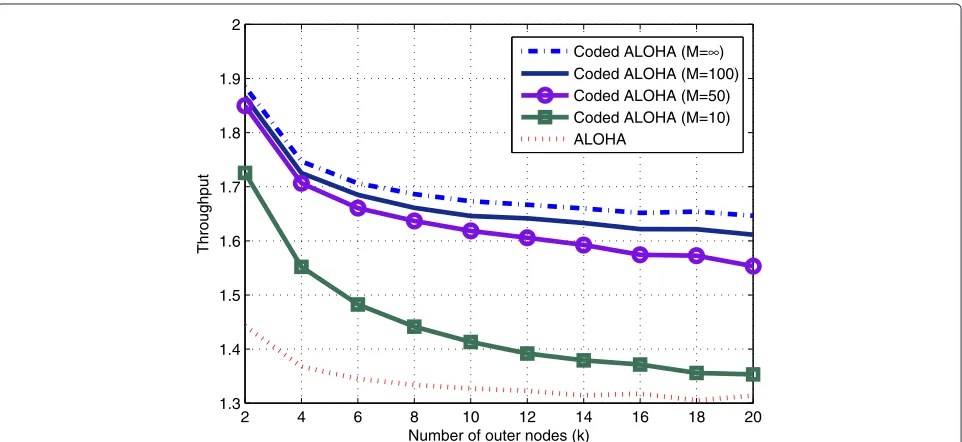
The number of outer nodes, k, and the maximum queue length,M, affect the network performance. Figure 7 depicts the throughput as a function ofk. Due to the inter-ference and increase in collisions, the throughput of both ALOHA and coded ALOHA decrease askincreases. This is the cost of the random access scheme. The dash-dot line (M = ∞) is a throughput upper boundSnfc(21) that is
obtained from the saturated traffic condition of the cen-ter node. For convenience, we use the notationM = ∞ for the saturated condition. Three solid lines represent the
throughputSqnc (14) with the finite queue lengths which
are obtained from queueing analysis. The throughputSnqc
converges to the throughput upper boundSfnc when the
queue length (M) increases. With the small queue size and many outer nodes, the coding opportunityq(m)goes to zero, and the throughput of coded ALOHA diminishes and approaches that of ALOHA. Note that the through-put of ALOHA,Sqout (10), is equal toSfout (19), regardless of the queue length(M). The reason is that the optimal solution of ALOHA makes the center node push out the packet received from the outer nodes immediately.
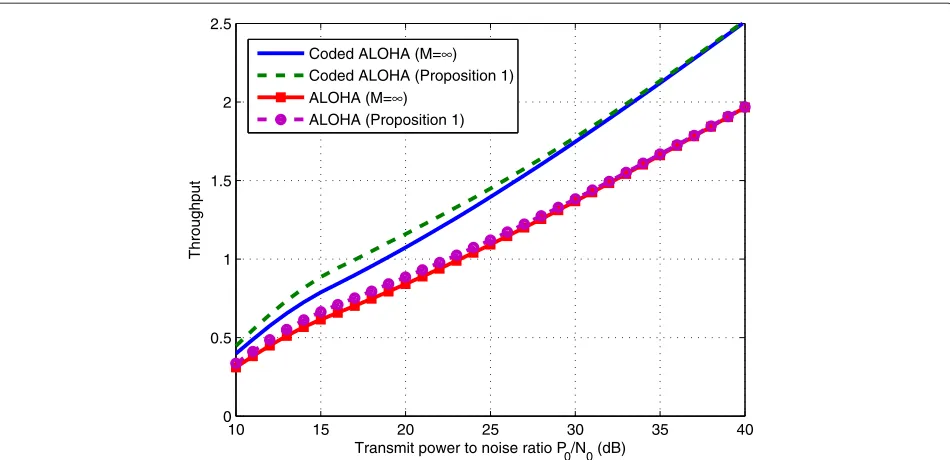
In addition, Figure 8 verifies the result of Proposition 1 which is based on the saturated traffic condition. We compare the throughput from the numerically obtained optimal parameters (solid line) and the throughput from Proposition 1 (dotted line). For the solid line, the opti-mal parameters are obtained by searching the entire p anddomain. We see the approximation error is suffi-ciently small, even with a small transmit power to noise ratio P0/N0 = 10 dB. Thus, we can easily use the closed-form solution of transmission probabilities,p∗and p∗c, instead of those from searching the entire pand domain.
Figure 9 shows the delay of ALOHA and coded ALOHA, which use the optimal parameters that maximize the throughput. Both delay curves are obtained through the numerical evaluations ofDnc andDare verified by
sim-ulations. The coded ALOHA has a unique throughput-optimal parameter set (p∗, p∗c, ∗), while ALOHA has multiple optima due to multiple p∗c. The packet delay of ALOHA is set to the minimum value that can be
2 4 6 8 10 12 14 16 18 20
1.3 1.4 1.5 1.6 1.7 1.8 1.9 2
Number of outer nodes (k)
Throughput
Coded ALOHA (M=∞)
Coded ALOHA (M=100) Coded ALOHA (M=50) Coded ALOHA (M=10) ALOHA
10 15 20 25 30 35 40 0
0.5 1 1.5 2 2.5
Transmit power to noise ratio P
0/N0 (dB)
Throughput
Coded ALOHA (M=∞)
Coded ALOHA (Proposition 1)
ALOHA (M=∞)
ALOHA (Proposition 1)
Figure 8Verification of Proposition 1.The solid lines denote the throughput from real optimal parameters. The dotted lines are results from the approximation of Proposition 1. The number of outer nodes isk=4. The optimal parameters(p∗,p∗c, and∗) are used at each point.
achieved in multiple optimal parameter sets. As a result, the optimal transmission probability of ALOHA,p∗c con-verges to 1. While D is independent of the queue size, coded ALOHA stores packets to increase the coding opportunity, and it has a longer delay as the queue sizeM increases.
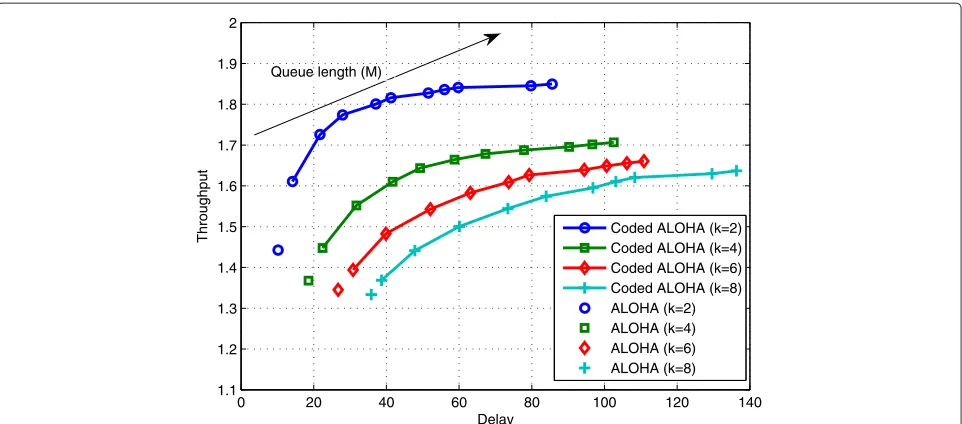
We can verify the throughput-delay trade-off in coded ALOHA in Figure 10. As the queue size M increases, coded ALOHA achieves a higher throughput and a
longer delay than those of ALOHA. To increase the throughput with network coding, the coded ALOHA needs some stored packets to generate network coded packets. Thus, the expected number of queued packets increases with the queue size of M, causing the queue-ing delay at the center node. With the large number of outer nodes, k, both throughput and delay perfor-mance of coded ALOHA degrade due to low coding opportunity.
5 10 15 20 25 30 35 40 45 50
10 20 30 40 50 60 70 80 90 100 110
Queue Length (M)
Delay
Coded ALOHA ALOHA
Simulation (Coded ALOHA) Simulation (ALOHA)
Figure 9The packet delay of ALOHA and coded ALOHA as a function ofM.The packet delay of ALOHA and coded ALOHA as a function of queue lengthM. Transmit power to noise ratio isP0/N0=30 dB, the number of outer nodes isk=4, and optimal parameters (p∗,p∗c, and∗) are
0 20 40 60 80 100 120 140 1.1
1.2 1.3 1.4 1.5 1.6 1.7 1.8 1.9 2
Delay
Throughput Coded ALOHA (k=2)
Coded ALOHA (k=4) Coded ALOHA (k=6) Coded ALOHA (k=8) ALOHA (k=2) ALOHA (k=4) ALOHA (k=6) ALOHA (k=8) Queue length (M)
Figure 10The throughput-delay trade-off in coded ALOHA.The throughput-delay trade-off in coded ALOHA as a function of queue lengthM and the number of outer nodes,k. Solid lines are the results of coded ALOHA, and markers with no line are that of ALOHA. The optimal parameters (p∗,p∗c, and∗) are used at each point.
When delay constraints are critical, coded ALOHA should change the operation point. To find a proper oper-ation point, we propose and compare four sub-optimal strategies. (a) Increase pc without changing the other
parameters. With a higher service rate at the center node, the actual queue size is reduced and the coding opportu-nity is decreased. Because the delay is very sensitive to the value ofpc, it can significantly reduce the delay with the
least throughput loss, as shown in Figure 11. Moreover it can be used simply at the center node. (b) Decreasep with-out changing the other parameters. With a lower injection
rate of outer nodes, the center node has a small number of packets in its queue, and so the coding opportunity is decreased. It sustains a larger throughput loss than does the pc control case. However, it has a strong point in
energy consumption because many outer nodes reduce the transmission trials and save that transmission energy. (c) DecreaseMwithout changing the other parameters. This uses a small queue for a low coding opportunity. It can also be easily adopted at the center node, but it has a high blocking problem at the center node. (d) Schedul-ing of ALOHA and coded ALOHA. This switches the
10 20 30 40 50 60 70 80 90 100 110 1.35
1.4 1.45 1.5 1.55 1.6 1.65 1.7 1.75
Delay
Throughput
Coded ALOHA (p
c)
Coded ALOHA (p) Coded ALOHA (M) Scheduling Optimal ALOHA
transmission mode between ALOHA and coded ALOHA. For certain time duration, the center node performs the network coding with optimal parameters, and changes the operation to general ALOHA, afterwards. The perfor-mance of scheduling lies on a certain point on the dotted line in Figure 11. From Figure 11, we can notice that delay is much sensitive than throughput to small change of parameters that maximize the throughput. This can be utilized to effectively reduce the delay of coded ALOHA. As a result, increasing pcis the best in order to reduce
the significant delay with the least throughput loss, and decreasing p may be suitable for sensor networks that need to save transmission energy.
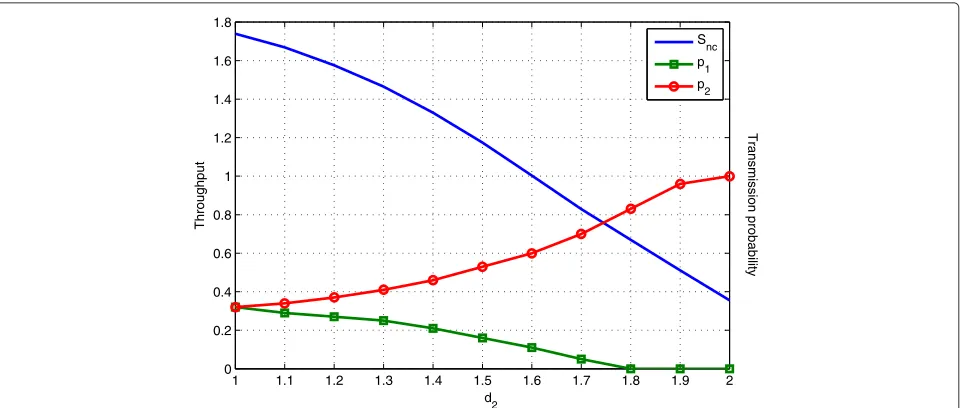
Figure 12 depicts the impact of asymmetric star topol-ogy, where the number of outer nodes k is 2 and the distance between the center node and node 2,d2, changes from 1 to 2. With the simulation, the maximum through-put and the optimal transmission probabilities of outer nodes,p1andp2, are obtained where the target SINR and the transmission probability of the center nodepcare
fixed to the optimal value for d2 = 1 case. It is obvi-ous that longer distanced2makes worse wireless channel condition and reduces the throughput of the network. As distance d2increases, the transmission probability ofn2 (p2) increases and that of n1 (p1) decreases in order to balance the injection rates (r1andr2) to the center node. The balanced injection rates are helpful to maintain the high coding opportunity at the center node. Whend2 = 2, eventually, the optimal transmission probabilities con-verse to one directional ALOHA. In the one directional ALOHA, the network can achieve the higher throughput by turning off the close noden1. It is because the wireless
link from the center node ton2has the lowest capacity due to the long distanced2and the interference fromn1.
Conclusions
In this article, we presented a coded ALOHA that per-forms the bi-directional network coding over ALOHA. We mathematically analyzed the performance of coded ALOHA in terms of throughput and delay. To maximize the throughput of coded ALOHA, the transmission prob-abilities (p and pc) and the target SINR were jointly
optimized. The throughput of coded ALOHA was derived under the both unsaturated and saturated traffic condi-tions at the center node. Under the saturated condition, we obtained a throughput upper bound with the per-fect network coding opportunity, and presented a closed form formula for the optimal transmission probability. The result of the unsaturated condition showed that the throughput of coded ALOHA converges to that of the saturated condition with a sufficiently large queue size. Additionally, as the topology becomes asymmetric, the optimal transmission probabilities of outer nodes try to balance the injection rates for higher coding opportunity. In slotted ALOHA, it can bring higher throughput by turning off the close node’s transmission.
With the same parameters, throughput of coded ALOHA is higher than that of ALOHA, and the delay of coded ALOHA is shorter than that of ALOHA. More-over, with same throughput condition, coded ALOHA can have shorter delay than ALOHA. However, with their own optimal parameters, coded ALOHA has higher through-put and higher packet delay than those of ALOHA. For the optimal parameters, coded ALOHA has higherpand
1 1.1 1.2 1.3 1.4 1.5 1.6 1.7 1.8 1.9 2 0
0.2 0.4 0.6 0.8 1 1.2 1.4 1.6 1.8
Transmission probability
Throughput
Snc
p 1 p2
d 2
Figure 12The throughput and optimal transmission probabilities of outer nodes in coded ALOHA.The throughput and optimal transmission probabilities of outer nodes in coded ALOHA as a function of distanced2, where target SINR andpcare fixed to the optimal value of
lowerpcthan those of ALOHA. This solution reflects the
increased coding opportunity, since network coding has the benefit only when the system gets the opportunity to do it and this opportunity can be raised by stacking more candidate packets in the coding node repository. How-ever, the packet delay is increasing by this solution since the average queueing delay of packets increases. The exis-tence of significant queueing delay is the main reason of this throughput-delay tradeoff which looks weird at the first glance. In an engineering perspective, coded ALOHA is better to be used in the situation where the traffic is highly generated as of optimalp∗and the time bound of application is relatively loose such as sensor network mea-suring a temperature or humidity of some region (delay tolerant network). Furthermore we compared four ways to consider the delay QoS, and found that increasingpc
has the best performance in term of throughput loss and decreasing p can be a good solution in term of energy consumption.
Endnotes
aFor convenience, we shall refer to slotted ALOHA as
ALOHA.
bWe use the superscript “f” to denote the saturated case
and “q” to denote the unsaturated case in (14).
Appendix 1
Derivation of the transmission success probability
Pn(1c) is the conditional success probability given that the
center node transmits and two destination nodes are idle. Thus, nodes other than the two destination nodes can interfere. The maximum number of interfering nodes is n=k−2 and the interfering distance isdi=2rsin(πki)for
ered when both destinations have higher SINR than the target SINR.
Pn(2c)is the conditional success probability given that the
center node transmits; one of two destination nodes,j, is busy; and the other,i, is idle. In this case, the node on the opposite side,j, interferes with probability 1. Therefore, it can be derived withn = k−1 and interfering distance dl=2rsin(πkl),l=1,. . .,k−1 as:
Pn(3c) is the conditional success probability given that
the center node transmits, and two destinations are idle. One of destination nodes, j, fails to receive the coded packet, while the other destination node, i, successfully receives the coded packet. This success probability can be derived as:
Queueing analysis of network coding
In Figure 3, the local balance equations between the states are given as follows:
Then,
where z in (32) is a normalization factor. Combining (32)-(35) and the normalization equation, we can obtain the normalization factorzand the steady state probability πmnc.
For a given stateXm, the system throughput, the
aver-age spectral efficiency of successful packet transmission can be 2LμC(m)orLμN(m)depending on the success of network coding. With the successful coded packet trans-mission, the throughput is doubled since two packets are delivered to their destinations at once. Using πmnc, the throughput of network codingSqnccan be represented as:
Sqnc=L
Proof of proposition 1
Take a log(·)function toSfinof (15):
log(Sfin)=log(kL)+log(p)+log(1−pc)+log(Pin). (37)
Differentiating (37) withp, we have:
∂log(Sfin)
where pc andPin are functions of the outer node
trans-mission probability p as (20) and (2), respectively. In (20),Pout/Pin can be simplified when the target SINR
Thus,pccan be rewritten as follows:
pc≈
With (40), the second term of (38) is reduced to: −1
the third term of (38) can be rewritten as:
1
Using (41) and (42), (38) can be simplified as:
lim of which the solution forpis given as:
p∗→ −k−1+ √
3k2−2k+1
k(k−2) , for coded ALOHA. (44)
Similarly, the approximation of the optimal solutions of ALOHA can be obtained by replacingpcin (40) as follows:
p∗→ −k−1+ √
5k2−2k+1
2k(k−1) , for ALOHA. (45)
Competing interest
The authors declare that they have no competing interests.
Acknowledgements
This research was supported by the MKE (The Ministry of Knowledge Economy), Korea, under the ITRC (Information Technology Research Center) support program supervised by the NIPA (National IT Industry Promotion Agency), (NIPA-2012-(H0301-12-1003)).
Author details
1Department of Electrical and Electronic Engineering, Yonsei University, 50
Yonsei-Ro, Seodaemun-Gu, Seoul 120-749, Korea.2School of Integrated
Technology, Yonsei University, 162-1 Songdo-Dong, Yeonsu-Gu, Incheon 406-840, Korea.3Department of Communications and Networking, Aalto
University of Technology, P.O. Box 3000, 02015 Aalto, Finland.
Received: 9 December 2011 Accepted: 9 August 2012 Published: 30 August 2012
References
1. N Abramson. The ALOHA system - another alternative for computer communication, inProceedings of the 1970 Fall Joint computer Conference, vol. 37 (AFIPS Press, 1970), pp. 281–285
2. EPCglobal, Epc radio-requency identify protocols class-1 generation-2 UHF RFID protocol for communications at 860MHz-960MHz version 1. 2. 0 (2008)
3. L Kleinrock, SS Lam. Packet-switching in a slotted satellite channel, in
Proceedings of National Computer Conference, AFIPS Press, 1973. pp. 703–710
4. LG Roberts, ALOHA packet system with and without slots and capture, ACM SIGCOMM Comp. Commun. R.5(2), 28–42 (1975)
5. LG Roberts. Dynamic allocation of satellite capacity through packet reservation, inProceedings of National Computer Conference, AFIPS Press, 1973, pp. 711–716
6. W Growther, R Rettberg, D Walden, S Ornstein, F Heart. A system for broadcast communication: reservation ALOHA, inProceedings of 6th Hawaii International Conference on System Sciences, (Honolulu, 1973). pp. 711–716
8. G Dimic, ND Sidiropoulos, R Zhang, Medium access control-physical cross-layer design, IEEE Signal Proc. Mag.21(5), 40–50 (2004) 9. X Wang, K Kar, Cross-layer rate control for end-to-end proportional
fairness in wireless networks with random access, IEEE J. Sel. Areas Commun.24(8), 1548–1559 (2006)
10. X Lin, NB Shroff, R Srikant, A tutorial on cross-layer optimization in wireless networks, IEEE J. Sel. Areas Commun.24(8), 1452–1463 (2006)
11. R Lin, AP Petropulu, A new wireless network medium access protocol based on cooperation, IEEE T. Signal Process.53(12), 4675–4684 (2005) 12. Y Lin, VWS Wong, Cross-layer design of MIMO-enabled WLANs with
network utility maximization, IEEE T. Veh. Technol.58(5), 2443–2456 (2009) 13. S Choe. Performance analysis of slotted ALOHA based multi-channel
cognitive packet radio network, inProceedings of IEEE CCNC, (Las Vegas, 2009. pp. 1–5
14. Z Yang, YD Yao, D Zheng. Random access in a cognitive radio network with slotted ALOHA for primary users and CSMA for secondary users, in
Proceedings of IEEE Sarnoff Symposium, (Princeton, 2010). pp. 1–5 15. R Ahlswede, N Cai, S-YR Li, RW Yeung, Network information flow, IEEE T.
Inf. Theory.46(4), 1204–1216 (2000)
16. S Katti, H Rahul, W Hu, D Katabi, M M´edard, J Crowcroft, XORs in the air: practical wireless network coding, IEEE ACM T. Network.16(3), 497–510 (2008)
17. J Hwang, S-L Kim, Cross-layer optimization and network coding in CSMA/CA based wireless multihop networks, IEEE ACM T. Network.19(4), 1028–1042 (2011)
18. H-K Lee, S-L Kim. Network coded ALOHA for wireless multihop networks, inProceedings of IEEE WCNC, Budapest, Hungary, 2009. pp. 1866–1870 19. MF Uddin, Throughput optimization in multi-hop wireless networks with
random access: Ph.D dissertation. University of Waterloo, 2011
20. D Umehara, T Hirano, S Denno, M Morikura, T Sugiyama, Wireless network coding in slotted ALOHA with two-hop unbalanced traffic, IEEE J. Sel. Areas Commun.27(5), 647–661 (2009)
21. CH Liu, F Xue. Network coding for two-way relaying: rate region, sum rate and opportunistic scheduling, inProceedings of IEEE ICC, Beijing, China, 2008. pp. 1044–1049
22. X Liu, M Haenggi, Throughput analysis of fading sensor networks with regular and random topologies, EURASIP J. Wirel. Commun.2005(4), 554–564 (2005)
23. YE Sagduyu, A Ephremides, On joint MAC and network coding in wireless ad hoc networks, IEEE T. Inf. Theory.53(10), 3697–3713 (2007)
24. I Gitman, On the capacity of slotted ALOHA networks and some design problems, IEEE T. Commun.23(3), 305–317 (1975)
doi:10.1186/1687-1499-2012-277
Cite this article as:Leeet al.:Throughput and delay analysis of network coded ALOHA in wireless networks.EURASIP Journal on Wireless Communica-tions and Networking20122012:277.
Submit your manuscript to a
journal and benefi t from:
7Convenient online submission
7Rigorous peer review
7Immediate publication on acceptance
7Open access: articles freely available online
7High visibility within the fi eld
7Retaining the copyright to your article