LogisticLDA: Regularizing Latent Dirichlet Allocation
by Logistic Regression
?Jia-Cheng Guoa, Bao-Liang Lua,b, Zhiwei Lic, and Lei Zhangc
a
Center for Brain-Like Computing and Machine Intelligence Department of Computer Science and Engineering b
MOE-Microsoft Key Laboratory for Intelligent Computing and Intelligent Systems Shanghai Jiao Tong University
800 Dong Chuan Road, Shanghai 200040, China [email protected]
c
Microsoft Research Asia
49 Zhichun Road, Haidian District, Beijing 100080, China
{zli, leizhang}@microsoft.com
Abstract. We present in this paper a supervised topic model for multi-class classification problems. To incorporate supervisory information, we jointly model documents and their labels in a graphical model called LogisticLDA, which mathematically integrates a genera-tive model and a discriminagenera-tive model in a principled way. By maximizing the posterior of document labels using logistic normal distributions, the model effectively incorporates the supervisory information to maximize inter-class distance in the topic space, while documents still enjoy the interchangeability characteristic for ease of inference. Experimental results on three benchmark datasets demonstrate that the model outperforms state-of-the-art supervised topic models. Compared with support vector machine, the model also achieves compara-ble performance, but meanwhile it discovers a topic space, which is valuacompara-ble for dimension reduction, topic mining and document retrieval.
Keywords: supervised topic model, text categorization, graph model, statistical learning
1 Introduction
As an unsupervised method, Latent Dirichlet Allocation (LDA) (Blei et al., 2003) seeks to si-multaneously find a set of basis (i.e. topics) and embed documents to the latent space spanned by this basis. Due to its inherent capability of producing interpretable and semantically coherent topics, LDA has been widely used in text analysis and shown promising performance in tasks like topic mining, browsing, and accessing document similarity. In contrast, when LDA is applied to text classification tasks, it is often used as only a dimension reduction step to extract features for consecutive discriminative models (e.g. SVM). Because the objective of LDA (as well as other unsupervised topic models) is to infer the best set of latent topics that can explain the document collection rather than separate different classes, the training of LDA is actually independent to supervisory information. This paradigm greatly limits its applications in classification tasks.
To address this issue, some topic models which integrate supervisory information have been proposed in recent years. Mimno and McCallum categorized these models to two types: upstream and downstream models. In “upstream” models, hidden topics are generated by conditioning on supervisory information(i.e. p(z|y), wherez means a hidden topic andy means the category of
?J.C. Guo and B.L. Lu are supported by the National Natural Science Foundation of China (Grant No. 60773090 and Grant No. 90820018), the National Basic Research Program of China (Grant No. 2009CB320901), and the National High-Tech Research Program of China (Grant No. 2008AA02Z315).
a document). Examples of upstream models include the Dirichlet Multinomial Regression model (DMR) (Mimno and McCallum, 2008), and the Theme Model (Li and Perona, 2005). Although upstream models explicitly model the class distribution p(z|y) (i.e. reducing intra class vari-ance) in the topic space, they disregard the inter class information (without maximizing inter-class distance), which is very crucial for classification problems. Though Discriminative LDA model (DiscLDA) (Lacoste-Julien et al., 2008) has similar modelling, its unique training scheme make it more like a hybrid of “upstream” and “downstream” models.
In “downstream” models, the supervisory information and words are simultaneously generated from hidden topics (i.e. p(w, y|z), wherewmeans a word), like the supervised LDA (sLDA) pro-posed by Blei and McAuliffe (2007), and Topic over Time Model (Wang and McCallum, 2006). Although supervisory information in upstream models looks to be more deeply involved in the likelihood function than in downstream models, downstream models are more like discriminative models because the posterior of supervisory information explicitly appears in models. As a regres-sion model, the discriminative information captured in the model can help find a topic space in which class labels can be generated with minimal errors. However, it’s unclear that how to adapt sLDA to multi-class classification problem.
In this paper, we develop a new downstream topic model for multi-class classification prob-lems. Following the work of Blei and McAuliffe, we also employ LDA to project documents into a topic space (topic simplex). In the topic space, for each class we place a corresponding class prototype, and for each document, we calculate the memberships that this document embedding belongs to each class. Here the membership function is defined as a normal distribution centered at each class prototype. The membership scores of this document are then combined together as the parameter of a multinomial distribution to generate the corresponding label. Because labels are observed, to best explain the observed data, the multinomial parameters (i.e. membership scores) for each multinomial distribution, have to be as sparse as possible. This sparse attribute in turn imposes an implicit constraint to the model that the class prototypes should be apart from each other. In this way, the model effectively incorporates the supervisory information to maximize inter-class distance in the topic space, while documents still enjoy the interchangeability charac-teristic for ease of inference. The proposed LogisticLDA model can be regarded as an extension of sLDA to multi-class classification. As we will show in Section 2, the objective function (log-likelihood) of this model logically consists of two terms. One is the log-likelihood of documents in LDA model, and the other one is the posterior of document labels given the embeddings of the documents. The posterior in the second term is just the probability used in logistic regression. By choosing a logistic normal distribution as the distribution to generate categories of documents, a logistic regression loss can be plugged in LDA model in a principled way. This is the reason why the model is named as LogisticLDA.
2 LogisticLDA Model
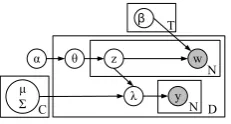
Figure 1:A graphical model representation of LogisticLDA
learnt latent topic space. Usually, it is used as low-dimensional features in discriminative models to classify documents (Blei et al., 2003) and LDA is only used as a dimension reduction step.
The basic idea of LogisticLDA is to regularize the embeddings of documents (θ) by incorpo-rating supervisory information, and consequently propagating its influence to topic distributions (β1:T). To support a good classification, embeddings of documents should have some good prop-erties. For example, the embedding of each document should be close to its category center but far from centers of other categories. Adding this requirement to the objective function of a topic model will constrain the embeddings of documents, and consequently the change of document embeddings will further influence the distributions of topics.
To incorporate supervisory information in a more principled way rather than using a heuris-tic regularization approach, we add to the model a set of label variables y associated with each document, and jointly model the documents and their labels. We assume each category follows a Gaussian distributionN(µi,Σ−1), in whichµi is a category prototype in the topic simplex. For each document, we calculate the likelihoods that the document embeddingθis generated by these categories in the topic simplexp(y =k|θ, µi,Σ−1). By normalizing these probabilities, we get a
C-dimensional Multinomial distributionp(y =k|λ), whose parameterλreflects the probabilities that the document belongs to each category. That is, λi ∝ N(θ, µi,Σ−1). Such a distribution
p(y = k|θ, µi,Σ−1)is actually the logistic normal distribution taken in Correlated Topic Model (Blei and Lafferty, 2005). This multinomial distributionp(y=k|λ)is used to generate the docu-ment labely.
As document labels are observed variables, to best generate the data, the multinomial param-eterλneeds to be as sparse as possible. That is, the parameter component corresponding to the document’s category should be large while other components should be small. Asλis calculated from Gaussian distributions,λi ∝N(θ|µi,Σ−1), the sparse property of the multinomial parame-ter in turn imposes an implicit constraint to the model that the category prototypes should be apart from each other and inter-class distance is thus maximized. This explains why maximizing the posterior of document labels will adjust the category distributions and reduce the classification error.
Finally, due to the fact that the scale of a single label’s multinomial distribution probability is far smaller than the the scale of document’s word generative probability, we proportionally augment document’s labels to the number of words in the document. So that, during the training process, the regularization from label won’t be simply omitted for the gain of document’s word generative probability.
In summary, each document and its supervisory side information arise from the following gen-erative process under the LogisticLDA model:
1. Draw topic proportionθ∼Dir(α) 2. For each of theN wordswn:
(a) Draw topic assignmentzn∼M ult(θ) (b) Draw wordwn|zn, β1:K ∼M ult(βzn)
3. Computeλ∼sof tmax(¯z;µ1:C,Σ−1), which isλi = exp(−(¯z−µi)
TΣ−1(¯z−µ i)/2) PC
j=1exp(−(¯z−µj)TΣ−1(¯z−µj)/2)
4. For each of theN labelsyn, draw topic assignmentyn∼M ult(λ) Here we definez¯= N1 PNi=1zi. Note that the expectation ofz¯isθ.
2.1 Discussions
¯
zisθ, the two formulations actually have almost equivalent functionalities. Blei et al. has another argument to this problem(Blei and McAuliffe, 2007).
Modeling of categories. In previous research on supervised embedding of documents, there are
some common criteria, e.g. distances among documents in the same category (intra-class variance) should be small while distances among documents in different categories (inter-class distance) should be large, and large-margin rules. However, these criteria are difficult to be introduced to topic models because they will also introduce extra dependencies among documents while we wish to keep the document exchangeability property to make the model inferable. In LogisticLDA, by introducing the multinomial distribution p(y = k|λ)to generate observed labels, we convert dependencies between documents to dependencies between documents and categories. In this way, we effectively incorporate the supervisory information to maximize inter-class distance in the topic space, while documents still enjoy the interchangeability characteristic for easy inference.
A concern about the single Gaussian per category assumption is that single Gaussian cannot deal with complex decision boundary as the embeddings of documents may not be linearly separa-ble. However, if the number of topics is not too small (e.g. 100 topics), the possible forms of topic space are huge, as well as embeddings of documents in it. Thus, by regulating the topic space with label information, we should be able to find a topic space under which documents are linearly classifiable. Our experiments on various datasets indicated the reasonableness of this assumption.
Reason of the name. Logically, the log-likelihood of this model consists of two terms1:
L(w,y;α, µ,Σ−1) =LLDA+ N
X
n=1
E[log(p(yn|z, µ,¯ Σ−1))]
wherewdenotes a document. The first term is the log-likelihood of the document in LDA model, and the second term is the posterior of the document label given the embedding of this document. Thus, LogisticLDA could be treated as a combination of a generative model and a discriminative model. The generative model seeks to simultaneously find a set of basis (i.e. topics) and embed documents to the latent space spanned by this basis, while the discriminative model regulates the embedding of documents by forcing category prototypes apart from each other. If we assume the variance of each category distribution is I, by removing the quadratic term exp(−12z¯Tz¯),
p(y=k|z, µ¯ 1:C, I)can be rewritten as
p(y =k|z, µ¯ 1:C, I) =
exp(µTkz¯−1 2µTkµk)
PC
j=1exp(µTjz¯−12µTjµj)
It is the probability of logistic regression. Thus, this model is named as logisticLDA. 3 Approximate Inference
Given parametersα,β,µandΣ−1, the joint probability of a document and its label is given by:
p(w,y|α, β1:T, µ1:C,Σ−1) =
Z
dθp(θ|α)X Z1:n
N
Y
n=1
p(zn|θ)p(wn|zn) N
Y
n=1
p(yn|z, µ¯ 1:C,Σ−1) (1)
However, due to the coupling between hidden variables,θandz, in the integration, the computa-tion is intractable. So we adopt a variacomputa-tional method to approximate it (Bishop, 2006).
We use the same approximate distribution as in LDA,
q(θ, z1:n|γ, φ1:N) =q(θ|γ) N
Y
n=1
q(zn|φn) (2)
1
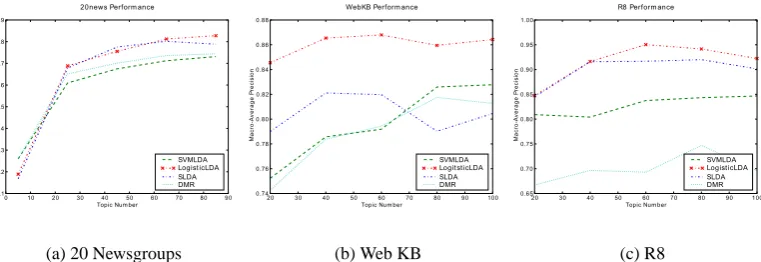
(a) 20 Newsgroups (b) Web KB (c) R8
Figure 2:Macro average precision(MAP) changes with the number of topics on three datasets 4.2 Experimental Setup
To evaluate the performance of LogisticLDA models, we chose five baseline approaches: Naive Bayes(NB) (Yang, 1999), SVM with linear kernel(SVM) (Joachims, 1998), performing dimension reduction by LDA and then classifying documents by SVM with Gaussian kernels(SVMLDA) (Blei et al., 2003), supervised LDA model(sLDA) (Blei and McAuliffe, 2007), Dirichlet-Multinomial Regression(DMR) (Mimno and McCallum, 2008). Although it was proposed a decade ago, SVM with linear kernel is still one of the state-of-the-art algorithms for text cat-egorization. And we use TF-idf normalized feature for it. For other models we used bag of word representation. Because the implementation of sLDA which can directly support multi-class categorization is unclear, we decomposed the classification problem as C binary classification problems (i.e. one vs. rest). We use the 0-1 regression implementation proposed in (Blei and McAuliffe, 2007). It took more than two weeks to train sLDA classifiers. In contrast, it usually takes a day or two to train our model. For single label multi-class classification, micro-average
precision(mip) and macro-average precision(map) are the two most popular performance
mea-sures (Yang, 1999), and we use them as benchmark.
Table 1:Details of datasets
#Docs #Words #Train #Categories
20NG 18821 34989 11293 20
WebKB 4199 7287 2803 4
R8 7674 7394 5485 8
R52 9100 8396 6532 52
4.3 Experimental Results
We conducted three experiments to evaluate the performance of LogisticLDA.
Table 2:Overall performance comparison
20NG WebKB R8 R52
mip map mip map mip map mip map
NB 0.8021 0.7764 0.8459 0.8286 0.9357 0.9149 0.8744 0.5366 SVM 0.8302 0.8278 0.8793 0.8625 0.9612 0.9329 0.8895 0.6033 SVMLDA 0.7404 0.7333 0.8286 0.827 0.9465 0.8462 0.8801 0.4318 sLDA 0.8048 0.8011 0.8358 0.8211 0.9222 0.919 0.8752 0.5907 DMR 0.7454 0.7444 0.8336 0.8176 0.9177 0.7469 0.7733 0.4043 LogisticLDA 0.8262 0.8245 0.8671 0.8724 0.9534 0.9513 0.9127 0.6164
4.3.2 Performance Comparison Table 2 lists performances of all approaches on the four datasets. We mark the best performances under each measure in pink color. Overall, the per-formances of SVM and LogisticLDA outperform other methods on all the datasets under both the two measures. SVM and LogisticLDA both get 4 best scores. The two measures, mip and map, can show different aspects of algorithms. mip is good at showing the overall performance of an algorithm, while map is a more balanced score with equal weight for every class. From Table 2, we can see SVM often get best results under mip measure, while LogisticLDA often get best results on map measure. This is a characteristic of LogisticLDA as a topic model. As for topic models, the classification task is carried out in the topic space, which is jointly generated by all the documents in the corpus, and small classes may leverage samples from large classes by filtering out noise through topic space. So the result of small classes may be improved.
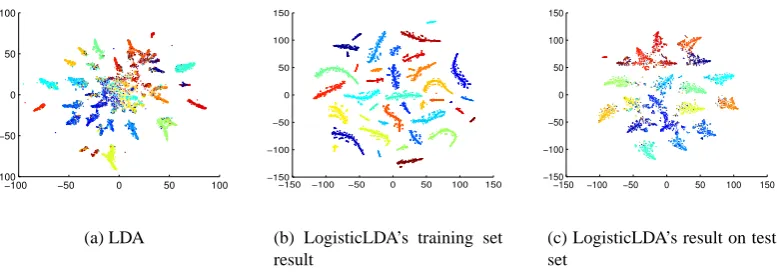
4.3.3 Topic Space Regulation As the main goal of LogisticLDA is to regulate the topic space by label information of documents, it is important for us to examine the document’s distribution in the topic space. For this purpose, we adopted the tSNE tool developed by van der Maaten and Hinton (2008). Fig.3 shows the scatter plot of 2D-embedding of topic distributions provided by tSNE on the 20 newsgroup dataset under topic numberT = 85, in which each colored dot denotes a document and different colors denote different classes. Compared with standard LDA in Fig. 3(a), there are the noticeable margins between data points of different classes for LogisticLDA on training set in Fig.3(b). This is because when guided with class label, large margin between classes are the natural result of minimizing the exponential loss of logistic regression as in Eq.10. It is noted that the shape of each class is more like a strip instead of a cluster which is demanded by Gaussian distribution in Fig.3(b). This is because by incorporating label information in a discriminative way, the resulting model only requires that the data lie in the inverse direction of
µi −µy to increase inter-class distances, as the explanation to Eq.10, rather than close to the corresponding class center in all dimensions. In this way, the task of simultaneously seeking semantic topic space and discriminative embedding can be achieved. In Fig.3(c), we show the embedding results of LogisticLDA on test set, and we can see that most classes are still separated by large margins. This result demonstrates that via the regulating of φn, the label information has been propagated into topic distributionsβ1:T and make them being aligned in a way that are suitable for classification, and the generalization ability of LogisticLDA is satisfied.
5 Conclusion and Discussion
−100 −50 0 50 100 −100
−50 0 50 100
(a) LDA
−150 −100 −50 0 50 100 150 −150
−100 −50 0 50 100 150
(b) LogisticLDA’s training set result
−150 −100 −50 0 50 100 150
−150 −100 −50 0 50 100 150
(c) LogisticLDA’s result on test set
Figure 3: tSNE’s 2D embeding of estimated topic distribution on 20NG dataset. Each color represents a class in the dataset with each dot corresponding to one document in the dataset
topic space, which is valuable for dimension reduction, topic mining and information retrieval. Good mathematical properties of logistic regression will definitely aspire extensions to Logisti-cLDA, e.g. multi-Gaussian formulation.
References
Bishop, Christopher M. 2006. Pattern Recognition and Machine Learning. Springer.
Blei, David and Jon McAuliffe. 2007. Supervised topic models. In J.C. Platt, D. Koller, Y. Singer and S. Roweis, editors, Advances in Neural Information Processing Systems 20.
Blei, David M. and John D. Lafferty. 2005. Correlated topic models. In NIPS.
Blei, David M., Andrew Y. Ng and Michael I. Jordan. 2003. Latent dirichlet allocation. Journal
of Machine Learning Research, 3.
Burges, Christopher J. C. 1998. A tutorial on support vector machines for pattern recognition.
Data Min. Knowl. Discov., 2(2):121–167.
Cardoso-Cachopo, Ana and Arlindo L. Oliveira. 2007. Semi-supervised single-label text catego-rization using centroid-based classifiers. In SAC.
Joachims, Thorsten. 1998. Text categorization with suport vector machines: Learning with many relevant features. In ECML.
Lacoste-Julien, Simon, Fei Sha and Michael Jordan. 2008. Disclda: Discriminative learning for dimensionality reduction and classification. In NIPS.
Lewis, David D., Yiming Yang, Tony G. Rose and Fan Li. 2004. Rcv1: A new benchmark collection for text categorization research. Journal of Machine Learning Research, 5.
Li, Fei-Fei and Pietro Perona. 2005. A bayesian hierarchical model for learning natural scene categories. In CVPR (2).
Mimno, David M. and Andrew McCallum. 2008. Topic models conditioned on arbitrary features with dirichlet-multinomial regression. In UAI.
Minka, Thomas P. 2000. Estimating a dirichlet distribution. Technical report, Microsoft.
Van der Maaten, Laurens and Geoffrey Hinton. 2008. Visualizing data using t-sne. Journal of
Machine Learning Research, 9.
Wang, Xuerui and Andrew McCallum. 2006. Topics over time: a non-markov continuous-time model of topical trends. In Tina Eliassi-Rad, Lyle H. Ungar, Mark Craven and Dimitrios Gunop-ulos, editors, KDD, pages 424–433. ACM. ISBN 1-59593-339-5.