International Journal of Scientific Research in Computer Science, Engineering and Information Technology © 2018 IJSRCSEIT | Volume 4 | Issue 3| ISSN : 2456-3307
To Augment Protection of data in Cloud Computing using Digital
Signature
Ms. B. Kauser Banu1, Mr. V. Sakthivel2
1Research Scholar, Dept. of Computer Science, Shanmuga Industries Arts and Science College, Thiruvannamalai,
Tamil Nadu, India
2Research Supervisor, HOD, Dept. of Computer Application, Shanmuga Industries Arts and Science College,
Thiruvannamalai, Tamil Nadu, India
ABSTRACT
Cloud computing is an information technology for thedecade. It allows user to store large amount of data in cloud storage and use as and when required, from any part of the world, via any terminal equipment. Since cloud computing is rest on internet, security issues like privacy, protection of data, confidentiality, and authentication is encountered. In order to get rid of the same, a variety of encryption algorithms and mechanisms are used. Many researchers choose the best they found and use it in different combination to provide security to the data in cloud. On the similar terms, we have chosen to make use of a combination of authentication technique and key exchange algorithm blended with an encryption algorithm. This combination is referred to as “Three way mechanism” because it ensures all the three-protection scheme of authentication, protection of data and verification, at the same time. In this paper, we have proposed to make use of digital signature and Diffie Hellman key exchange blended with (AES) Advanced Encryption Standard encryption algorithm to protect confidentiality of data stored in cloud. Even if the key in transmission is hacked, the facility of Diffie Hellman key exchange render it useless, since key in transit is of no use without user’s private key, which is confined only to the legitimate user. This proposed architecture of three-way mechanism makes it tough for hackers to crack the security system, thereby protecting data stored in cloud.
Keywords:Cloud Computing, AES Algorithm, Data Confidentiality
I.
INTRODUCTIONCloud computing simply means Internet computing generally the internet is seen as collection of clouds; thus the word cloud computing can be defined as utilizing the internet to provide technology enabled services to the people and organizations[5]. Cloud computing is new utility of the century, which many enterprises wants to incorporates in order to improve their way of working. It implies sharing of computing resources to handle applications. Cloud computing offers reduced capital expenditure,
Since cloud computing is a utility available on net, so various issues like user privacy, data theft and leakage, eaves dropping, unauthenticated access and various hackers’ attacks are raised. These unsolved security issues of authentication, privacy, data protection and data verification are main hindrance for widespread adoption of cloud computing. Hence to get a overwhelmed acceptance to cloud computing in finance, market and industry as well, we have proposed a secure architecture for it. Under the above mentioned title, I am incorporating three security control mechanisms viz authentication, Encryption and data verification technique in to a single stand-alone system. Hence it is a three ways protection scheme wherein digital signature provides authentication, encryption algorithm provides session encryption key and is used to encrypt user data file as well, which is to be saved in cloud and lastly trusted computing to verify integrity of user data.
II.
PROBLEM STATEMENTWith cloud computing, organizations can use services and data is stored at any physical location outside their own control. This facility raised the various security questions like privacy, confidentiality, integrity etc. and demanded a trusted computing environment wherein data confidentiality can be maintained. To induce trust in the computing, there is need of a system, which performs authentication, verification and encrypted data transfer, hence maintaining data confidentiality.
Name of
Attack Description
Tampering
An attacker may alter information either stored in local files, database or is sent over refute the validity of a statement or contract which is sent by to monitor the communication and modify the messages for malicious purposes
Replay Attack
A replay attack is defined as when an attacker or originator sends a valid data with intention to use it maliciously or fraudulently.
Identity Spoofing
Identity spoofing occurs when an attacker impersonates the users as the originator of the message
When new versions are released, a differential analysis of the new and old version would indicate that decrease the performance of hardware and application even these malicious codes corrupts files on local file system.
III.
RELATED WORKSAs per Uma Somani, Kanika Lakhani and Manish Mundra [1]: In Cloud computing, we have problem like security of data, files system, backups, network traffic, host security .They have proposed a concept of digital signature with RSA algorithm, to encrypt the data while transferring it over the network. This technique solves the dual problem of authentication and security. The strength of their work is the framework proposed to address security and privacy issue.
Volker Fusenig and Ayush Sharma [2]: states a new approach called cloud networking which adds networking functionalities to cloud computing and enables dynamic and flexible placement of virtual resources crossing provider borders. This allows various kinds of optimization, e.g., reducing latency or network load. This paper presents a security architecture that enables a user of cloud networking to define security requirements and enforce them in the cloud networking infrastructure.
As per Deyan Chen and Hong Zhao [3] from the consumers’ perspective, cloud computing security concerns are specially protection of data and privacy protection issues which remain the primary inhibitor for adoption of cloud computing services. They provided a concise but all-round analysis on protection of data and privacy protection issues associated with cloud computing across all stages of data life cycle. Then they proposed to protect data using various scheme and policies like airavat etc. This system can prevent privacy leakage without authorization in Map-Reduce computing process. The weakness is that it just a theory which depends on other scheme and policies for its implementation.
As per EmanM.Mohamed and Hatem S. Abdelkader [8] Cloud computing moves the application software and databases to the large data centers, where the management of the data and services may not be
fully trustworthy. This unique feature, however, raises many new securitychallenges. Every cloud provider solves this problem by encrypting the data by using encryption algorithms. Thus their paper investigates the basic problem of cloud computing protection of data. They presented the protection of data model of cloud computing based on the study of the cloud architecture. They implemented software to augment work in a protection of data model for cloud computing. Finally they applied this software in the Amazon EC2 Micro instance for evaluation process.
G. Jai Arul Jose, C. Sajeev, and Dr. C. Suyambulingom [9]: proposed to generate RSA Public keys and Private Keys for public and private access to overcome the problem of protection of data. Certificate Binary file is used inside control node configuration file to make sure cloud data flow securely. The control node sends data through Secure Socket Layer after certificate activation. Finally AES algorithm is used for encryption .This unique combination makes this solution best to prevent different types of attacks. The strength of their work is strong protection of data against various attacks. If a user is attempt to login falsely for many times, the system automatically slowing the service and temporarily stop the account service for the particular user.
IV.
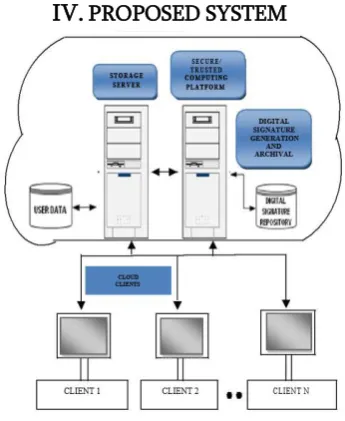
PROPOSED SYSTEMIn our proposed architecture, we are using three ways protection scheme. Firstly Diffie Hellman algorithm is used to generate keys for key exchange step. Then digital signature is used for authentication, thereafter AES encryption algorithm is used to encrypt or decrypt user’s data file. All this is implemented to provide trusted computing environment in order to avoid data modification at the server end. For the same reason two separate servers are maintained, one for encryption process known as (trusted) computing platform and another known as storage server for storing user data file.
When a user wants to upload a file to the cloud server, first key are exchanged using Diffie Hellman key exchange at the time of login, then the client is authenticated using digital signature. Finally user’s data file is encrypted using AES and only then it is uploaded to another (cloud) Storage server. Now when client is in need of same file, it is to be downloaded from cloud server. For that purpose, when user login, first encryption keys are exchanged, file to be downloaded is selected, authentication takes place using digital signature then, AES is used to decrypt the saved file and client can access the file.
A. Execution Steps 1. Sign up
2. Login from TCP
2.1 Key Exchange – Diffie Hellman 2.2 Digital Signature –SHA-I
3. Uploading / Downloading Data Encryption- AES 4. Data is stored / retrieved from Storage server 5. Logout.
B. Hardware specification
The system running the application should have following minimum requirements:
1. Pentium Core. 2. RAM Size 128mb. 3. Processor 1.2GHz.
C. Software Specification
The system running the application must have the following:
1. Supporting OS: Windows XP, VISTA, LINUX: Red Hat, Ubuntu, Fedora.
2. Java Development Kit - jdk1.6.0_02. 3. Java Runtime Environment - jre1.6.0_06.
4. Web Browser like Google chrome with Java Plug-in installed.
5. Wireless connectivity driver.
D. Technology Specific Tools used
In this work we use following technology tools: 1. Java Development Kit - jdk1.6.0_02/ Java Runtime Environment - jre1.6.0_06.
2.Java.awt package for layout of the applet.
3.Java.net package for connection settings and message passing.
4.Netbeans 5.Java Web Start. 6.SOAP.
7.Glassfish Server.
Socket Options interface of methods to get/set socket options.
V.
REFERENCES[1] Yoichiro Ueno, NoriharuMiyaho, Shuichi Suzuki,MuzaiGakuendai, Inzai-shi, Chiba,Kazuo Ichihara, 2010, “Performance Evaluation of a Disaster Recovery System and Practical Network System Applications,” Fifth International Conference on Systems and Networks Communications,pp 256-259.
[2] Chi-won Song, Sungmin Park, Dong-wook Kim, Sooyong Kang, 2011, “Parity Cloud Service: A Privacy-Protected Personal Data Recovery Service,” International Joint Conference of IEEE TrustCom-11/IEEE ICESS-11/FCST-11.
Distributed Networking and Secure Metadata Handling Technology”, Proceedings of the 4th edition of the UPGRADE-CN workshop, pp. 45-48.
[4] Giuseppe Pirr´o, Paolo Trunfio, Domenico Talia, Paolo Missier and Carole Goble, 2010, “ERGOT: A Semantic-based System for Service Discovery in Distributed Infrastructures,” 10th IEEE/ACM International Conference on Cluster, Cloud and Grid Computing.
[5] VijaykumarJavaraiah Brocade Advanced Networks and Telecommunication Systems (ANTS), 2011, “Backup for Cloud and Disaster Recovery for Consumers and SMBs,” IEEE 5th International Conference, 2011.
[6] Lili Sun, Jianwei An, Yang Yang, Ming Zeng, 2011, “Recovery Strategies for Service Composition in Dynamic Network,” International Conference on Cloud and Service Computing
[7] Xi Zhou, Junshuai Shi, YingxiaoXu, Yinsheng Li and Weiwei Sun, 2008, "A backup restoration algorithm of service composition in MANETs," Communication Technology ICCT 11th IEEE International Conference, pp. 588-591.
[8] M. Armbrust et al, “Above the clouds: A berkeley view of cloud computing,”http://www.eecs.berkeley.edu/Pub s/TechRpts/2009//EEC S-2009-28.pdf.
[9] F.BKashani, C.Chen,C.Shahabi.WSPDS, 2004, “Web Services Peerto Peer Discovery Service ,” ICOMP.
![Table 1.Types of Attacks [8]](https://thumb-us.123doks.com/thumbv2/123dok_us/1045185.1130401/2.595.300.546.50.702/table-types-of-attacks.webp)