Coreference Resolution for Latvian
Artūrs Znotiņš, Pēteris Paikens
University of Latvia, Faculty of Computing and Institute of Mathematics and Computer Science Raina bulvaris 29, Riga, LV-1459, Latvia
E-mail: [email protected], [email protected]
Abstract
Coreference resolution (CR) is a current problem in natural language processing (NLP) research and it is a key task in applications such as question answering, text summarization and information extraction for which text understanding is of crucial importance. We describe an implementation of coreference resolution tools for Latvian language, developed as a part of a tool chain for newswire text analysis but usable also as a separate, publicly available module. LVCoref is a rule based CR system that uses entity centric model that encourages the sharing of information across all mentions that point to the same real-world entity.
The system is developed to provide starting ground for further experiments and generate a reference baseline to be compared with more advanced rule-based and machine learning based future coreference resolvers. It now reaches 66.6 F-score using predicted mentions and 78.1% F-score using gold mentions.
This paper describes current efforts to create a CR system and to improve NER performance for Latvian. Task also includes creation of the corpus of manually annotated coreference relations.
Keywords: coreference resolution, rule based, entity centric model
1.
Introduction
Coreference resolution is the task of grouping all the mentions of entities in a document into coreference chains so that all the mentions in a given chain refer to the same discourse entity (van Deemter & Kibble, 1999). For example, given the following text (mention borders are marked with square brackets)
[Latvietis1] [Jānis Bērziņš1] ir [jauns zinātnieks1] un [universitātes profesors1]. [Profesors1] ir veicis nozīmīgus pētījumus datorlingvistikā kopā ar [profesoru2] [Pēteri Kalniņu2]. [Viņš1] kopā ar [savu1] [līdzgaitnieku2] [Kalniņu2] uzstāsies konferencē Itālijā.
[Latvian1] [Jānis Bērziņš1] is a [new scientist1] and [professor at university1]. The [professor1], together with [professor2] [Pēteris Kalniņš2], have carried out important research in computer linguistics. [He1], together with [his1] [associate2] [Kalniņš2], will speak in the conference in Italy.
the task is to group the mentions so that those referring to the same entity are placed together into a coreference chain (represented with same subscripted index). Latvian is an under-resourced language, with a limited range of language processing tools and resources, and very limited earlier research on coreference resolution (Bārzdiņš et al., 2008). We believe that the described system is the first available implementation of coreference resolution for Latvian language.
Nowadays most coreference systems use knowledge rich features that require extra preprocessing. Typically coreference resolution requires following steps:
identification of tokens and sentences; part of speech tagging;
parsing;
named entity recognition; mention identification; coreference resolution.
While today most state-of-the-art coreference resolvers use machine learning (Witten, Hall & Frank, 2011), many coreference relations can be resolved using relatively simple rules and recent work has shown that rule based approach can outperform machine learning models for coreference resolution (Haghighi & Klein, 2009; Lee et al., 2011). In this paper we have investigated these approaches and describe our implementation as adapted to Latvian language. In addition, we describe the changes to existing named entity recognition solutions aimed at better coreference resolution accuracy.
2.
Proposed Solution
2.1. Entity Centric Model
LVCoref uses an entity centric model which allows each coreference decision to be globally informed by previously created coreference chains. It allows to use global constraints, e.g., linking two mentions is not allowed if it creates attribute disagreement (“Jānis Bērziņš” and “Pēteris Bērziņš” linked together by a common surname). It also diminishes distance between potential coreferent mentions if the closest same entity mention cannot be correctly linked with current mention based on local features.
2.2. System Description
LVCoref base module integrates other modules described here, and handles input/output formatting and used rules according to a configuration file. An evaluation module uses MMAX (Müller & Strube, 2006) format gold coreference links.
The rule module contains available rule sets. These rules are created by combining features from the feature module.
2.3. Pre-processing
The coreference resolution system relies on morphosyntactic information produced by the following tools:
1. The initial step is a statistical morphology tagger which achieves 97.9% accuracy for part of speech recognition and 93.6% for the full morphological feature tag set (Paikens, Rituma & Pretkalniņa, 2013). 2. Syntactic parsing is done by a parser (Pretkalniņa & Rituma, 2013) based on MaltParser toolkit (Lavelli et al., 2009) and the hybrid dependency-based annotation model used in the Latvian Treebank (Bārzdiņš et al., 2007). The parser is based on dependency grammar approach achieving 72% precision.
3. In addition, we identify mentions of named entities with a CRF-based NER tool trained for Latvian that provides annotation of person names, geographic locations and organizations, media types, product names. NER currently reaches 84.6% F-score.
2.4. Annotated Corpus
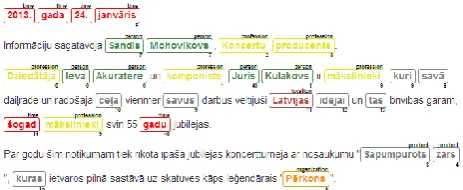
For evaluation purposes we manually annotated 6 interviews (see section 3.1 for used data set statistics) with coreference information. The evaluation data was encoded in MMAX format and featured 3 layers: the word layer, the sentence layer and the coreference layer. 5 mention categories were annotated in this corpus – person, location, media, organization and other (mentions that did not fit in other categories).
2.5. Named Entity Recognition
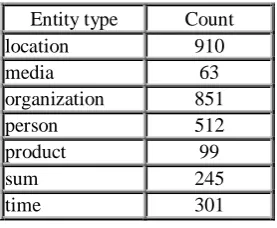
Before this project, there were two available NER systems for Latvian: TildeNER (Pinnis, 2012) and LVTagger (Paikens et al., 2012) both based upon the Stanford NER condition random field (CRF) classifier (Finkel, Grenager & Manning, 2005). For the purposes of this research we chose to adapt LVTagger, extending it with additional training data for modern news language. Our chosen taxonomy consists of 7 types of NE (person, location, organization, product, media, sum and time). Nested expressions are not tagged as separate NEs, taking in account the longest NE. E.g., whole phrase “Latvijas Republikas Finanšu un Veselības ministrijas” (organization) is marked as one entity without marking “Latvijas Republikas” (organization) as another entity. The named entity annotated corpus (45 000 words, 2 500 sentences) consists of manually annotated news articles (see Table 1). The corpus can be considered rather small when compared to CoNLL corpora which have over 300 000 tokens (Tjong Kim Sang & Meulder, 2003). While CoNLL corpora uses 4 NE types, LVTagger introduces 7 types, which makes the data sparser and
therefore the NER task harder.
The standard CoNLL metric is used, where the output NE is considered correct only if its span and type is exactly the same as the span and type in the gold data.
We have improved gazetteer features for multiword expressions. We have increased F-score by about 4% by introducing distributional similarity features. For this we used unlabelled 83 million token corpus to create 200 similar world clusters as suggested by Faruqui and Pado (2010). Experiments with syntactic features (phrase head information) introduced only slight improvement. To atomically extract high quality gazetteers we use semantic database of NE’s and frames which is constantly augmented with data from processed news articles. Table 2 lists current results for NER accuracy.
Entity type Count location 910
media 63
organization 851
person 512
product 99
sum 245
time 301
Table 1: Named entity corpus statistics.
Entity type F1 P R
location 86.9 84.2 89.9
media 77.2 95.1 65.0
organization 74.0 77.5 70.9
person 86.8 89.1 84.6
product 14.0 39.3 8.5
sum 94.1 97.3 91.2
time 88.3 92.7 84.4
totals 84.6 91.0 79.1
Table 2: NER evaluation results.
2.6. Identification of entity mentions
To resolve coreferences, one must first detect the mentions that are going to be linked in coreference chains. Mention identification finds pronouns, common nouns, and named entity mentions. In general, we choose the largest possible noun phrase for the particular head word, based on the sentence syntactic analysis. For example, in phrase “Kultūras ministrija” (“the Ministry of Culture”) only the whole phrase “Kultūras ministrija” is marked as a mention and not “ministrija”. Mentions can be nested, e.g., “[[Latvijas Nacionālā teātra] direktors]” (“the [director of the [Latvian National Theatre]]”).
We also use a whitelist of known entity head words and acronyms, and a blacklist of idiomatic phrases to filter out certain non-mentions, e.g., pleonastic “tas” (“it”) in phrases like “tas nozīmē” (“it means”).
2.7. Coreference Module
two mentions refer to the same real entity. In this way, system can also consider information about the related mentions joined together in previous steps.
2.7.1. Exact string match
This rule links two named entity mentions only if they contain exactly the same text by comparing lemmatized phrases.
2.7.2. Precise constructions
This rule set links two mentions if any of the conditions below is satisfied:
Appositive. Standard Haghighi and Klein (2009) definition to detect appositives is used: one mention is dependent on another, e.g., “[profesors1] [Jānis Bērziņš1]” (“[professor1] [Jānis Bērziņš1]”). Predicative nominative are in a subject-object
relation being dependent on same verb “būt” (“to be”), e.g., “[Jānis Bērziņš1] ir [pasniedzējs1]” (“[Jānis Bērziņš1] is a [professor1]”).
Acronym – mentions are linked if one of them equals the sequence of upper case characters in the other mention, e.g., “Ekonomikas ministrija” and “EM”.
2.7.3. Strict head match
Two mentions are linked based on naive matching of their head words, if the second mention does not introduce new entity attributes, e.g., “Latvijas Republikas Augstākā tiesa” (“the Supreme Court of the Republic of Latvia”) and “Latvijas Augstākā tiesa” (“the Supreme Court of Latvia”) are considered coreferent but “Latvijas Augstākā tiesa” and “Krievijas Augstākā tiesa” (“the Supreme Court of Russia”) are not because the latter one introduces new attribute “Russia”.
2.7.4. Pronoun anaphora
Pronoun antecedents are searched in three previous sentences using Hobbs’ algorithm (1976).
Mention compatibility is based on the information about their represented coreference chain. Two mentions are acknowledged as coreferent based on their morphological features (gender, number and case), syntactic constraints (one does not dominate another, i-within-i (Haghighi & Klein, 2009)), semantic category and their represented mention chains shared attributes.
3.
Results and Evaluation
3.1. Data Set
Evaluation data came from created coreference corpus using all 6 annotated interviews. Data statistics are listed in Table 4.
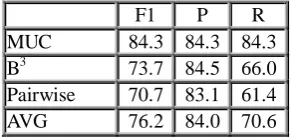
Two of six interviews (~30% of whole data set) were annotated twice by different annotators in order to measure inter-annotator agreement. We measured it in the same way as LVCoref was evaluated against gold standard (see Table 3).
Analysis of inter-annotator disagreements showed that majority of errors resulted from accidental annotation mistakes and completely missed coreference chains and mentions. Although inter-annotator agreement results (76.2 % averaged F-score) are comparable to other research (Vilain et al., 1995), there is room for
improvement by optimizing annotation guidelines.
F1 P R
MUC 84.3 84.3 84.3
B3 73.7 84.5 66.0
Pairwise 70.7 83.1 61.4
AVG 76.2 84.0 70.6
Table 3: Coreference data set inter-annotator agreement
Number of documents 6
Number of sentences 778
Number of words 13 768
Number of mentions 1 088
Number of coreference chains 333
Number of singleton mentions 180
The average length of the coreference chain 3.27
Table 4: Coreference data set statistics.
3.2. Baseline
As a baseline for evaluation we use the naive head match method, linking only mentions with the exact same head. More sophisticated resolution models have been suggested, but they are rarely compared with this baseline, admitting that it performs better than expected. For the MUC-7 test data Soon’s system (Soon, Ng & Lim, 2001) outperforms head match only by 5%, while Uryupina’s system (2007) outperforms baseline by 15%.
3.3. Evaluation
Gold mentions Predicted mentions
F1 P R F1 P R
Baseline
MUC 62.6 65.1 60.3 56.6 56.5 56.7 B3 74.2 80.3 69.0 71.2 74.9 67.7 Pairwise 59.3 79.5 47.3 53.6 63.8 46.2 AVG 65.4 75.0 54.5 60.5 65.1 53.4 LVCoref
MUC 84.1 88.2 80.3 68.2 69.7 66.7 B3 82.9 90.6 76.4 76.0 79.4 72.8 Pairwise 67.3 87.8 54.5 55.8 62.8 50.2 AVG 78.1 88.9 61.8 66.6 70.7 57.7
Table 5: Coreference resolution evaluation results.
System was evaluated against three coreference resolution metrics: pairwise, MUC (Vilain et al., 1995) and B3 (Bagga & Baldwin, 1998) in two settings (using gold mentions or predicted mentions).
MUC is a link based metric which measures how many predicted and gold mention chains need to be merged to cover gold and predicted clusters respectively.
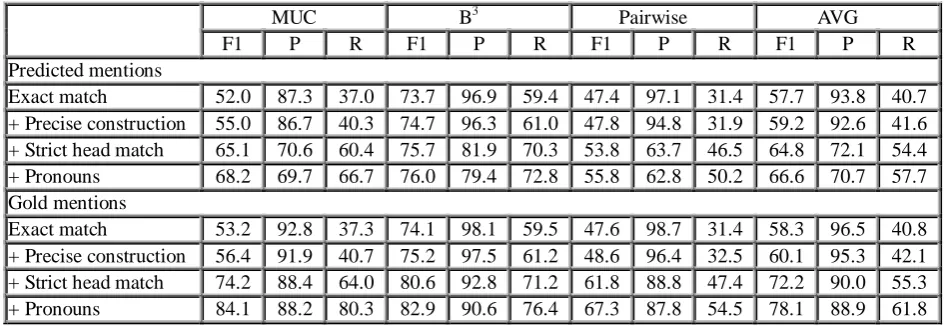
MUC B3 Pairwise AVG
F1 P R F1 P R F1 P R F1 P R
Predicted mentions
Exact match 52.0 87.3 37.0 73.7 96.9 59.4 47.4 97.1 31.4 57.7 93.8 40.7 + Precise construction 55.0 86.7 40.3 74.7 96.3 61.0 47.8 94.8 31.9 59.2 92.6 41.6 + Strict head match 65.1 70.6 60.4 75.7 81.9 70.3 53.8 63.7 46.5 64.8 72.1 54.4 + Pronouns 68.2 69.7 66.7 76.0 79.4 72.8 55.8 62.8 50.2 66.6 70.7 57.7 Gold mentions
Exact match 53.2 92.8 37.3 74.1 98.1 59.5 47.6 98.7 31.4 58.3 96.5 40.8 + Precise construction 56.4 91.9 40.7 75.2 97.5 61.2 48.6 96.4 32.5 60.1 95.3 42.1 + Strict head match 74.2 88.4 64.0 80.6 92.8 71.2 61.8 88.8 47.4 72.2 90.0 55.3 + Pronouns 84.1 88.2 80.3 82.9 90.6 76.4 67.3 87.8 54.5 78.1 88.9 61.8
Table 6: Cumulative performance as rule sets are added.
The output has the results for each of the three metrics mentioned earlier, both in terms of precision and recall, as well as F-score.
Table 5 lists the performance of the system. Given gold mentions LVCoref outperforms baseline by 12.7%, but using predicted mentions by 6.2%.
Table 6 illustrates the performance of the system as the 4 rule sets are incrementally added. Each successive rule set increases system performance by increasing recall and slightly decreasing precision. With respect to individual contributions, this analysis highlights two significant performance increases: exact string match and strict head match. It illustrates that a large percentage of mentions in text are repetitions of previously mentioned entities based on string similarity. Precise constructions give only a slight performance increase because they are relatively infrequent.
3.4. Error Analysis
To understand the errors in the system, we analyzed two documents from evaluation set and categorized them into the following distinct groups:
1. Non-anaphoric constructions. Identifying whether noun phrase is nested mention or part of the stable construction is not a trivial task, e.g., “Aktieru zāle” is stable construction and “Aktieru” is a non-anaphoric construction.
2. Indefinite noun phrases. Latvian does not explicitly distinguish definite and indefinite nouns, so it is unclear if mention with same head introduces a new entity or refers to a previous mention, e.g., “Privatizācijas aģentūra” and “aģentūra”.
3. Morphological tagging/disambiguation errors. E.g., singular mentions “šuvēja” and “šuvējas” (“tailor”) are not linked together because of incorrect grammatical number identification (equal singular genitive and plural nominative forms).
4. Syntactic errors make it difficult to find appositive and predicative nominative constructions.
5. Pronoun anaphora resolution. Demonstrative pronoun “tas” (“it”) often refers to event mention, e.g., “plānot” (“to plan”). This system currently does not mark event mentions, thus missing all mentions that are verbal phrases.
Another considerable source of errors is caused by insufficient semantic information, e.g., when the plural personal pronoun “mēs” (“we”) is used to refer to an
organization in an interview.
4.
Conclusion
The presented approach offers a useful yet easy to implement baseline for further work and is currently the only available coreference resolution system for Latvian. The implementation is currently used as a part of a larger system for newswire text analysis and fact extraction. We also plan to make an evaluation of the impact of coreference resolution precision on the precision of final fact extraction by the end of this year.
The currently achieved F-score – 66.6% using predicted mentions and 78.1% using gold mentions – was satisfactory for use in our text analysis problem and is comparable with results recently achieved for linguistically similar languages (Goenaga et al., 2012; Kopeć & Ogrodniczuk, 2012; Novák & Žabokrtský, 2011) and other languages (Recasens et al., 2010), although their research shows options for future work in improving accuracy. Morphological, syntactic, semantic information and the entity centric model all provide noticeable contribution to coreference resolution performance. Precision of mention identification is one the most important factors that affects the performance of the end-to-end coreference system. Error analysis revealed that the main problems of coreference resolution are related to non-anaphoric constructions, indefinite noun phrases and pronoun coreference resolution.
Currently planned future work includes machine learning experiments for coreference resolution and incorporating available semantic database knowledge (facts about popular entities) to support high quality gazetteer maintenance for named entity recognition and to help resolve coreferences using global semantic information. LVCoref along with annotated data is publicly available at github.com/chaosfoal/LVCoref.
5.
Acknowledgements
This work has been supported by the European Social Fund with the project “Support for Doctoral Studies at University of Latvia” and University of Latvia Faculty of Computing.
We are grateful to the reviewers of this paper for comments which helped us to improve the paper.
6.
References
Bagga, A., Baldwin, B. (1998). Algorithms for scoring coreference chains. In The First International Conference on Language Resources and Evaluation Workshop on Linguistics Coreference, pp. 563--566. Bārzdiņš, G., Grūzītis, N., Nešpore, G., Saulīte, B. (2007).
Dependency-Based Hybrid Model of Syntactic Analysis for the Languages with a Rather Free Word Order. In Proceedings of the 16th Nordic Conference of Computational Linguistics, pp. 13--20.
Bārzdiņš G., Grūzītis N., Nešpore G., Saulīte B., Auziņa I., Levāne–Petrova K. (2008). Multidimensional Ontologies: Integration of Frame Semantics and Ontological Semantics. In Proceedings of the XIII Euralex Internacional Congress.
Faruqui, M., Pado, S. (2010). Training and Evaluating a German Named Entity Recognizer with Semantic Generalization. In Proceedings of Konvens 2010, Saarbrucken, Germany.
Finkel, J. R., Grenager, T., and Manning, C. (2005). Incorporating Non-local Information into Information Extraction Systems by Gibbs Sampling. Proceedings of the 43nd Annual Meeting of the Association for Computational Linguistics (ACL-05), Stroudsburg, PA, USA: Association for Computational Linguistics pp. 363--370.
Goenaga, I., Arregi, O., Ceberio, K., de Ilarraza, A. D., Jimeno, A. (2012). Automatic Coreference Annotation in Basque. In 11th International Workshop on Treebanks and Linguistic Theories, pp. 115--126. Haghighi, A., Klein, D. (2009). Simple coreference
resolution with rich syntactic and semantic features. In Proceedings of the 2009 Conference on Empirical Methods in Natural Language Processing, pp. 1152--1161.
Hobbs, J. R. (1976). Resolving Pronoun References. In Readings in Natural Language. Los Altos, California: Morgan Kaufman Publishers, pp. 339--352.
Kopeć, M., Ogrodniczuk, M. (2012). Creating a Coreference Resolution System for Polish. In Proceedings of the Eight International Conference on Language Resources and Evaluation (LREC'12), pp. 192--195.
Lavelli, A., Hall, J., Nillson, J., Nivre, J. (2009). MaltParser at the EVALITA 2009 Dependency Parsing Task. In Proceedings of EVALITA 2009.
Lee, H., Peirsman, Y., Chang, A., Chambers, N., Surdeanu, M., Jurafsky, D. (2011). Stanford's Multi-Pass Sieve Coreference Resolution System at the CoNLL-2011 Shared Task. In Proceedings of the Fifteenth Conference on Computational Natural Language Learning: Shared Task, pp. 73--79.
Müller, C., Strube, M. (2006). Multi-level annotation of linguistic data with MMAX2. Corpus Technology and Language Pedagogy: New Resources, New Tools, New Methods. Frankfurt a. M., Germany: Peter Lang, pp. 197--214.
Novák, M., Žabokrtský, Z. (2011), Resolving Noun Phrase Coreference in Czech. In I. Hendrickx, S. L. Devi, A. H. Branco & R. Mitkov (Eds.), 8th Discourse Anaphora and Anaphor Resolution Colloquium, pp 24--34.
Paikens, P., Auziņa, I., Garkāje, G., Paegle, M. (2012). Towards named entity annotation of Latvian National Library corpus. In Human Language Technologies - The Baltic Perspective: Proceedings of the Fifth International Conference Baltic HLT 2012, pp. 169--175.
Paikens, P., Rituma, L., Pretkalniņa, L. (2013). Morphological analysis with limited resources: Latvian example. In Proceedings of the 19th Nordic Conference of Computational Linguistics (NODALIDA 2013), pp. 267--277.
Pinnis, M. (2012). Latvian and Lithuanian Named Entiy Recognition with TildeNER. In Proceedings of the Eight International Conference on Language Resources and Evaluation (LREC'12), pp. 1258--1265. Pretkalniņa, L., Rituma, L. (2013). Statistical syntactic parsing for Latvian. In Proceedings of the 19th Nordic Conference of Computational Linguistics (NODALIDA 2013), pp. 279--289.
Recasens, M., Màrquez, L., Sapena, E., Martí, M. A., Taulé, M., Hoste, V., Poesio, M., Versley, Y. (2010). SemEval-2010 Task 1: Coreference Resolution in Multiple Languages. In Proceedings of the 5th International Workshop on Semantic Evaluation, pp. 1--8.
Soon, W. M., Ng, H. T., Lim, D. C. Y. (2001). A machine learning approach to coreference resolution of noun phrases. In Computional Linguistics, 27, pp. 521--544. Tjong Kim Sang, E. F., De Meulder, F. (2003). Introduction to the CoNLL-2003 shared task: language-independent named entity recognition. In Proceedings of CoNLL-2003, pp. 142--147.
Urypina, O. (2007). Knowledge Acquisition for Coreference Resolution. PhD thesis. Saarland University, Saarbrücken, Germany.
van Deemter, K., Kibble, R. (1999). What is coreference, and what should coreference annotation be? In Proceedings of ACL workshop on Coreference and Its Applications, pp. 90--96.
Vilain, M. Burger, J., Aberdeen, J., Connolly, D., Hirschman, L. (1995). A model-theoretic coreference scoring scheme. In MUC, pp. 45--52.