Blind Adaptive Decorrelating RAKE (DRAKE) Downlink
Receiver for Space-Time Block Coded Multipath CDMA
Sudharman K. Jayaweera
Department of Electrical Engineering, Princeton University, Princeton, NJ 08544, USA Email: [email protected]
H. Vincent Poor
Department of Electrical Engineering, Princeton University, Princeton, NJ 08544, USA Email: [email protected]
Received 31 January 2002 and in revised form 17 September 2002
A downlink receiver is proposed for space-time block coded CDMA systems operating in multipath channels. By combining the powerful RAKE receiver concept for a frequency selective channel with space-time decoding, it is shown that the performance of mobile receivers operating in the presence of channel fading can be improved significantly. The proposed receiver consists of a bank of decorrelating filters designed to suppress the multiple access interference embedded in the received signal before the space-time decoding. The new receiver performs the space-time decoding along each resolvable multipath component and then the outputs are diversity combined to obtain the final decision statistic. The proposed receiver relies on a key constraint imposed on the output of each filter in the bank of decorrelating filters in order to maintain the space-time block code structure embedded in the signal. The proposed receiver can easily be adapted blindly, requiring only the desired user’s signature sequence, which is also attractive in the context of wireless mobile communications. Simulation results are provided to confirm the effectiveness of the proposed receiver in multipath CDMA systems.
Keywords and phrases:multiuser detection, space-time coding, blind adaptive receivers, code division multiple access.
1. INTRODUCTION
Space-time coding [1, 2, 3], multiuser detection [4], and RAKE combining [5, 6, 7, 8] are powerful techniques that can offer significant performance gains in mobile commu-nications environments and many emerging wireless sys-tems adopt some combination of these techniques. For ex-ample, the application of RAKE receivers to multiuser sys-tems has been studied extensively, prompted by the fact that 3G technology is based on the wideband code division mul-tiple access (CDMA) concept and thus it must contend with frequency-selective channels.
Of course, RAKE combining allows the receiver to ex-tract the useful signal energy embedded in the signals that arrive via different paths in such channels. Thus, the RAKE receiver provides one way of providing frequency diversity at the receiver [5] in CDMA systems. On the other hand, recent advances in space-time coding exploit the spatial diversity inherent in fading channels [1, 2, 3]. Most space-time cod-ing schemes are based on the assumption of a frequency flat fading channel. Under these conditions, the introduction of space-time coding into multiuser systems seems to provide
significant performance gains just as they do in single-user channels [9, 10, 11, 12, 13, 14].
However, as mentioned above, most next generation wireless systems will be wideband communications systems, and thus they must contend with frequency selective chan-nel fading. Transmit diversity schemes for wideband CDMA systems have recently been proposed in [15, 16, 17, 18], for instance. In future wireless systems, the downlink is expected to present a performance bottleneck due to the asymmetric nature of the system traffic, and thus it is specifically impor-tant to consider transmit diversity schemes at the base station [12, 19]. It is also conceivably easier to implement multiple antennas at a base station than at a mobile station due to space, power, and other considerations.
downlink performance in the presence of multipath. In this paper, we propose a blind adaptive downlink scheme for a space-time block coded multipath CDMA system. Similar blind adaptive downlink receivers for flat fading channels have also been considered in [12]. Space-time multiuser de-tection for space-time block coded CDMA has been consid-ered in [20] with a blind adaptive implementation. The blind adaptive space-time multiuser detector proposed in [20] as-sumes multiple receiver antennas whereas we limit our atten-tion to only single receiver antenna systems. Analytical ex-pressions for BER performance of linear multiuser detection based receivers in space-time block coded CDMA can also be found in [20].
In this paper, we assume that the base station employs space-time block coding. The proposed receiver operates by first applying a decorrelating RAKE (DRAKE) filter [6] to the received signal and then performing space-time decoding along each path component separately, thus exploiting space-time coding gains along each path. The DRAKE filter zero forces the interpath interference and mitigates the multiple access interference (MAI) according to a minimum mean square error (MMSE)-like criterion. Multipath combining is then performed after space-time decoding. The proposed scheme can easily be adapted blindly, meaning that the only information required for its successful operation at the re-ceiver is the desired user’s signature sequence. This makes the new receiver an attractive candidate for downlink mobile re-ceivers in future wideband wireless communication systems. This presentation is organized as follows. In Section 2, we present our signal model and the system description. Next, in Sections 3 and 4, we derive the batch-mode receiver for a frequency selective CDMA channel and the blind adaptive receiver implementation, respectively. Finally, in Section 5, we give performance results of the proposed receiver archi-tecture for a representative space-time block code and some typical system environments.
2. SIGNAL MODEL
Consider a system with K simultaneous users. We assume that the base station consists ofNTtransmitter antennas and
the mobile is equipped withNR receiver antennas. For the
sake of simplicity, we will assume thatNT =2 andNR =1
although generalization to larger numbers of transmit and receive antennas is straightforward. The BPSK information symbol sequence {dk(i)}∞i=0 of userk, for k = 1, . . . , K, is
first encoded by a space-time block encoder. For thisNT =2
case, the space-time block code that achieves full transmit diversity is given by the well-known Alamouti scheme [1]. If two consecutive input symbols of user kto the space-time encoder are denoted bydk(i) anddk(i+ 1), then according
to the Alamouti scheme, during the first symbol period the symbolsdk(i) anddk(i+ 1) are transmitted simultaneously
from the first and second antennas, respectively. During the second symbol period, the symbols−d∗k(i+ 1) anddk∗(i) are
transmitted from the first and second antennas, respectively, where ∗ denotes complex conjugation. If we denote the space-time block encoder function byF:Ꮿ1×NT →ᏯNT×NT,
we may write this coding scheme in matrix form as below, where the columns and rows correspond to space (transmit antennas) and time dimensions, respectively,
Fdk(i)dk(i+ 1)
=
dk(i) dk(i+ 1)
−d∗k(i+ 1) dk∗(i)
. (1)
The space-time encoder output of each user is next modu-lated by the user’s spreading sequence and transmitted from the two transmit antennas at the base station. Note that the two symbols transmitted from the two antennas, cor-responding to a particular user, are modulated by the same spreading sequence, that is, each user is assigned only one spreading code. The spreading waveformsk(t) of userkis
as-sumed to be of the form
sk(t)= N−1
j=0
ck(j)ϕ
t−jTc
, (2)
where N denotes the processing gain of the CDMA sys-tem andck =[ck(0), . . . , ck(N−1)]T denotes thekth user’s
spreading code sequence. In (2),Tcdenotes the chip period,
ck(j)∈ {+1/
√
N,−1/√N}, andϕ(t) is the normalized chip waveform.
We may assume that we are interested in detecting the signals for userk. The continuous time received signal at the mobilekcan be written as
rk(t)= K
k=1
NT
nT=1
xk,nT(t)fk,nT(t) +n(t), (3)
where denotes the convolution operation and n(t) is a complex white Gaussian noise process with zero mean and variance 1/2 per dimension. The function fk,nT(t) in (3) denotes the composite channel response corresponding to transmitter antenna nT at the base station and receiver k,
which can be written as
fk,nT(t)=
L
l=1
hk,nT,lδ
t−(l−1)Tc
. (4)
In the above,Lis the number of paths present in the channel between transmitter antennanT of the base station and the
receiver antenna of userk,hk,nT,l is the fading coefficient of the pathl, forl=1, . . . , L,andδ(t) is the Dirac delta func-tion. Also,xk,nT(t) in (3) is given as
xk,nT(t)=
B−1
i=0
bk,nT(i)sk(t−iT), (5)
whereBis the received frame size andbk,nT(i) denotes the
transmitted symbol of userkon antennanT, fornT =1,2,
during the transmission interval [iT,(i+ 1)T].
Note that, in order to minimize the notational complex-ity in (4), we have assumed that the number of multipaths in the channels between the receiverkand different transmit
order to let the number of multipaths depend on the trans-mit antenna index. Also, in a practical implementation, it is not difficult to include different values for the multipath de-lays at the expense of some extra notational complexity. In fact, we may get rid of the constraint of multipath delays be-ing an integral multiple of the chip interval and include the effect of fractional correlation of the chip waveforms in the fading coefficienthk,nT,l. Thus, our model is general enough to absorb these generalizations and yet is simple enough to avoid unnecessary notational complexity in the current discussion.
Next, we make the following assumption for the sake of simplicity. We assume that the maximum delay spread is (L−1)Tcand the symbol period is defined asT=(N+L−1)Tc.
In that case, if we assume synchronous transmission at the base station, then all the delayed replicas of the transmit-ted signals will be received at the receiver of user kduring the same symbol period, resulting in no intersymbol inter-ference. This is equivalent to the assumption that the actual spreading waveform is obtained by appending L−1 zeros to the tail of the spreading codeck. This is a reasonable
ap-proximation for channels with delay spreads on the order of a few chip intervals. LetNbe the modified signature sequence length, that is,
N=N+L−1. (6)
The signalrk(t) is first chip matched filtered and then
sampled at the receiver for userk. The output of the chip matched filter corresponding to the ith symbol period is given as, forj=0,1, . . . , N−1,
rk(i, j)=
∞
0 rk(t)ϕ(t−iT−jTc)dt. (7)
The resulting chip-rate-sampled output can be collected to form a vector of lengthNas
where n(i) is a complex Gaussian noise vector such that
n(i)∼ᏺ(0,IN), theN×LmatrixCk, fork=1,2, . . . , K,
and theL-vector of fading coefficients of the different mul-tipaths between transmit antenna nT, for nT = 1,2, and
mobile k is defined as hk,nT = [hk,nT,1, hk,nT,2, . . . , hk,nT,L]T,
wherehk,nT,lis the path gain of thelth path between transmit antennanTand the receiver for userk. Defining theL×NT
matrixHkof fading coefficients as
Hk=
and theNT length transmit symbol vector of userkat time
instantiasbk(i)=[bk,1(i), bk,2(i)]T, we may write the
chip-rate sampled output (8) corresponding to the symbol timei
as
Suppose that the receiver processes received chip matched signals in blocks of size NT, corresponding to the
space-time code word length. Then, the two consecutive received signals during the mth received space-time code block correspond to the two consecutive information sym-bolsdk(mNT) anddk(mNT+ 1) of the desired userk, form=
have the property that the lth row ofHk is orthogonal to
thelth row ofH˜k, that is,αHk,lα˜k,l = 0 forl = 1, . . . , Land
k=1, . . . , K, whereαHk,land ˜αHk,ldenote thelth row ofHkand
˜
Hk, respectively.
3. DECORRELATING RAKE-BASED RECEIVER
FOR SPACE-TIME CODED CDMA
In this section, we develop the structure of the proposed two-stage receiver for multipath CDMA systems. The proposed system is an extension of the DRAKE receiver to space-time coded frequency selective channels [6].
In the presence of multipath, in order to take advan-tage of the diversity offered by the multipath channel, the receiver needs to be able to coherently combine the useful signal energy present in each of the paths in an optimal way. The RAKE receiver operates by resolving the paths at the re-ceiver and combining them in order to improve the signal-to-interference-plus-noise ratio (SINR). We may employ the same strategy of resolving the paths at the space-time re-ceiver. However, it is important to ensure that the application of the RAKE receiver to the received signal does not destroy the structure of the space-time code embedded in the signal. The first stage of the proposed receiver consists of a bank of
Lfilters with weight vectorswk,l, forl=1, . . . , L, so that the
output of thelth branch filter is given by
zk,l(i)=wHk,lyk(i). (16)
In order to preserve the space-time code structure at the output of each branch, we impose the constraint that
CHkwk,l=el, (17)
whereelis a vector of lengthLhaving all zeros except a single
one at thelth position. Then, combining (13), (16), and (17), we can write the outputs of thelth branch filter
z1
k,l(i)=wHk,lyk1(i)
=eHl Hkbk(i) + K
k=k
wHk,lCkHkbk(i) +wHk,ln1
=αH
k,lbk(i) +η1k,l(i),
z2
k,l(i)=wHk,lyk2(i)
=eH
l H˜kbk(i) + K
k=k wH
k,lCkH˜kbk(i) +wHk,ln2
=α˜H
k,lbk(i) +η2k,l(i),
(18)
where, as before, αHk,l denotes thelth row ofHk, andη1k,l(i)
andη2k,l(i) denote the residual MAI plus noise terms at the output of thelth branch filter. Hence, the output SINR of the
lth branch is then given by
SINRl= E
αH k,lbk(i)2
Eη1
k,l(i)
Hη1
k,l(i)
= αk,l
2
Eη1
k,l(i)
Hη1
k,l(i)
. (19)
Thus, maximizing the SINR at the output of the branch filter l is the same as minimizing the output variance
E{(η1k,l(i))Hη1k,l(i)}. However, since the output signal power
is fixed at |αk,l|2 due to the constraint (17), this in turn
is achieved by minimizing the output energy E{|zk,l(i)|2}
given by
Ezk,l(i)2
=wH
k,lRy ywk,l, (20)
where the autocorrelation matrixRy yis given by
Ry y=E
yk(i)ykH(i)
. (21)
In effect, this means that we are employing a minimum mean output energy (MMOE) multiuser detector to suppress the MAI while the constraint (17) nulls the interpath interfer-ence caused by the frequency selective fading process. Note that, in order to keep the notation simple in (21), we have dropped the superscripts fromynT
k (i) fornT = 1,2, . . . , NT.
Thus, maximizing the output SINR at each branch reduces to the minimization of the cost functionwHk,lRy ywk,land the
filter design problem for thelth branch reduces to the follow-ing constrained optimization problem. Forl=1, . . . , L,
wk,l=arg min
w
wHk,lRy ywk,l subject toCHkwk,l=el. (22)
It is a straightforward exercise to show that the solution of this problem is
wk,l=R−y y1Ck
CH kR−y y1Ck
−1
el (23)
and the output of the filter bank, fornT =1,2, is simply given
as
znT
k (i)=WHkyknT(i)=
CHkR−y y1Ck
−1
CHkR−y y1ynT
k (i), (24)
where wk,l is the lth column of theN×LmatrixWk, for
l=1, . . . , L.
At the next stage of the receiver, the space-time decoding is performed along each branch in two symbol blocks. Ob-serving from (18) that the space-time code property is pre-served at the output of each branch, we may form the vector
zk,l(i)=
z1
k,l(i)
z2
k,l(i)
= αHk,l
˜ αH
k,l
bk(i) +
η1k,l(i)
η2k,l(i)
=Hk,lbk(i) +ηk,l(i),
(25)
where we have defined the 2×2 matrix (NT×NT, in general)
Hk,l =[αHk,l; ˜αHk,l] and the 2-vector (NT-vector, in general) of
noise term ηk,l(i)=ηk,l1 (i) ηk,l2 (i)
T
. Note that, the matrix
Hk,lsatisfies the property
HHk,lHk,l=αk,l2I2=
hk,1,l2+hk,2,l2
Thus, we still have the advantage of simple linear decoding of the space-time block code along each branch filter as
˜zk,l(i)=HHk,lzk,l(i)=
hk,1,l2+hk,2,l2
bk(i)+˜ηk,l(i), (27)
where we have defined
˜
ηk,l(i)=HHk,lηk,l(i). (28)
Note that η1
k,l(i) and ηk,l2 (i) are no longer independent due
to the MAI component included in them. This also re-sults in correlated components in the noise vector ˜ηk,l(i). Thus, it is no longer optimal to decode the components of
˜zk,l(i) separately. However, in order to keep the receiver
com-plexity to a minimum, we will ignore these correlations in the noise components and decode˜zk,l(i) componentwise, as
in a single-user channel; that is, we will assume that the space-time decoder output decouples the effect ofdk(i) and
dk(i+ 1).
Finally, the receiver combines the space-time decoder outputs from all the branches in order to form the final de-cision variable. Due to the above assumption of decoupled space-time decoder output, the decision variable fordk(i) has
to take into account only theL-vector of branch outputs de-fined as 1,2,are vectors of correlated noise components.
In the final stage of the receiver, the space-time decoded outputs are multipath combined to form the final decision variable. The optimal combining scheme is given as ˆzk =
R−˜zk1,˜zk˜zk[6]. However, we may instead employ maximal ratio combining (MRC) given as
ˆ
zk(i)=gHk˜z1k(i), zˆk(i+ 1)=gkH˜z2k(i). (31)
The multipath combined outputs ˆzk(i) and ˆzk(i+ 1), for
i = 0,1, . . ., are used either to make a final decision on the information symbols by passing through a quantizer, or to feed into a channel decoder as the soft inputs if the trans-mitter also performs any additional channel coding. We will not consider any channel coding in our system, however, and will thus base our performance analysis on raw bit error rates (BER).
4. BLIND ADAPTIVE IMPLEMENTATION
The first stage of the above proposed scheme requires knowl-edge of the signature sequences of all the interfering users. However, similarly to the scheme proposed in [6] for the DRAKE receiver, we may also easily adapt this receiver blindly, requiring only knowledge of the signature sequence of the desired user, namely ck. In this section, we outline
a blind adaptive process based on the least mean squares (LMS) [21, 22] algorithm.
The LMS algorithm adapts the filter coefficients for each branch of the first stage of DRAKE receiver as
wk,l(i+ 1)=wk,l(i)−µ∇wk,l
and approximating the covariance matrix by its instanta-neous valueyyH, we have
In order to make sure that the constraintCH
kwk,l = el
is satisfied at each iteration, we may initialize the LMS algo-rithm with
wk,l(0)=
CHk†el, (35)
whereA†denotes the Moore-Penrose generalized inverse of the matrixA, and then perform the weight adaptation in the subspace orthogonal to the range ofCk. Since the projection
matrix on to the column space ofCkisPC=Ck(CHkCk)−1CHk,
the component of the gradient vector along the subspace or-thogonal to the constraint subspace is simply given asP⊥C =
becomes, forl=1, . . . , L,
wk,l(i+ 1)=
I−µCk
CHkCk
−1
CHkyyHwk,l(i) (36)
with the initialization
wk,l(0)=
CHk†el. (37)
Thus, the proposed receiver provides a simple and effec-tive way to exploit the frequency diversity offered by the mul-tipath channel and at the same time to take full advantage of the space-time coding diversity. With knowledge of only the desired user’s spreading code, we may implement the blind adaptive algorithm to mitigate the MAI. It should be noted that still the knowledge of channel fading coefficients of the desired user are required for the successful decoding of the space-time block code, and thus the proposed scheme isblind
only in the sense that it does not require the knowledge of the signature sequences of the interfering users.
As we will see in the next section, the performance of the blind algorithm is still much better than that of a con-ventional system in which either only a single branch space-time decoder or a RAKE receiver without space-space-time coding is used.
The complexity of the LMS algorithm is of orderᏻ(N+
L−1) per update, which will usually be dominated by the processing gainN. The filtering operation in each branch re-quires anotherN+L−1 multiplications and a single addition. The space-time decoding requires onlyNT =2
multiplica-tions andNT additions per branch. The implementation of
MRC requires onlyLmultiplications and additions. Hence, the total complexity per bit of the proposed receiver using MRC isᏻ(N+L−1+L(N+L−1+NT))∼ᏻ(LN+LNT+L2).
5. SIMULATION RESULTS
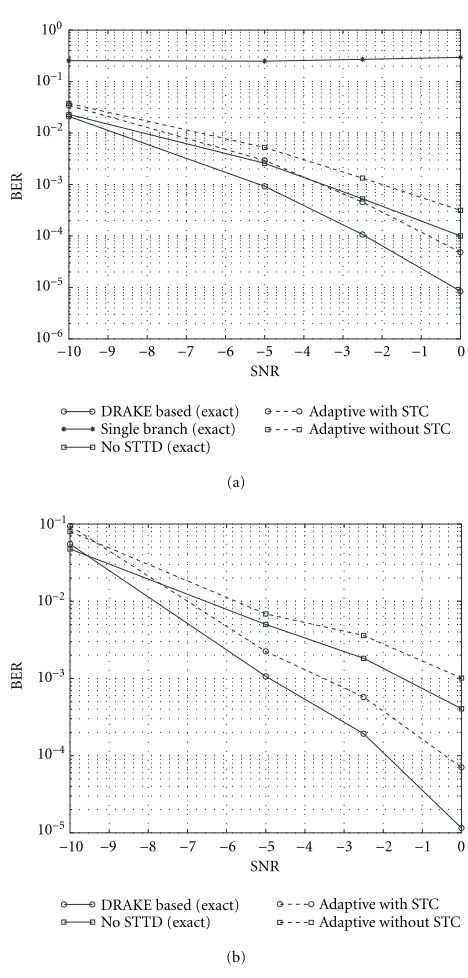
Plots (a) and (b) in Figure 1 show the BER performance of the proposed receiver for a BPSK system withK =4 users andL=3 paths per user. The processing gain of the CDMA system is N = 16 (random spreading codes were used in these simulations). Figure 1a corresponds to the BER aver-aged over 10 random code simulations. Figure 1b shows the performance of the best code set out of those 10 random spreading code sets. The fading is assumed to be quasi-static Rayleigh fading where the fading coefficients are constant for a block of 100 symbols and then change independently to new values. The space-time code used is the Alamouti code [1] withNT =2.
In both figures, we have also included the performance of a similar system without space-time coding but with the same multipath combining receiver. From Figure 1, it is clear that, when the SNR is sufficiently high, the proposed re-ceiver with space-time coding can offer improved perfor-mance in multipath channels. Figure 1 also shows the BER performance obtained with the adaptive implementation of the receiver. It should be noted that in the simulations we did not attempt to optimize the step-size parameter of the LMS algorithm.
−10 −9 −8 −7 −6 −5 −4 −3 −2 −1 0
SNR 10−6
10−5 10−4 10−3 10−2 10−1 100
BER
DRAKE based (exact) Single branch (exact) No STTD (exact)
Adaptive with STC Adaptive without STC (a)
−10 −9 −8 −7 −6 −5 −4 −3 −2 −1 0
SNR 10−5
10−4 10−3 10−2 10−1
BER
DRAKE based (exact) No STTD (exact)
Adaptive with STC Adaptive without STC (b)
Figure1: BER performance versusEb/N0(in dB) of the
DRAKE-based space-time detector.NT=2,K=4,L=3, andN =16 in all
cases. (a) Average. (b) Best.
−10 −8 −6 −4 −2 0 2 SNR
10−5 10−4 10−3 10−2 10−1 100
BER
DRAKE based (exact) Single branch (exact) No STTD (exact)
Adaptive with STC Adaptive without STC
(a)
−10 −8 −6 −4 −2 0 2
SNR 10−5
10−4 10−3 10−2 10−1 100
BER
DRAKE based (exact) Single branch (exact) No STTD (exact)
Adaptive with STC Adaptive without STC
(b)
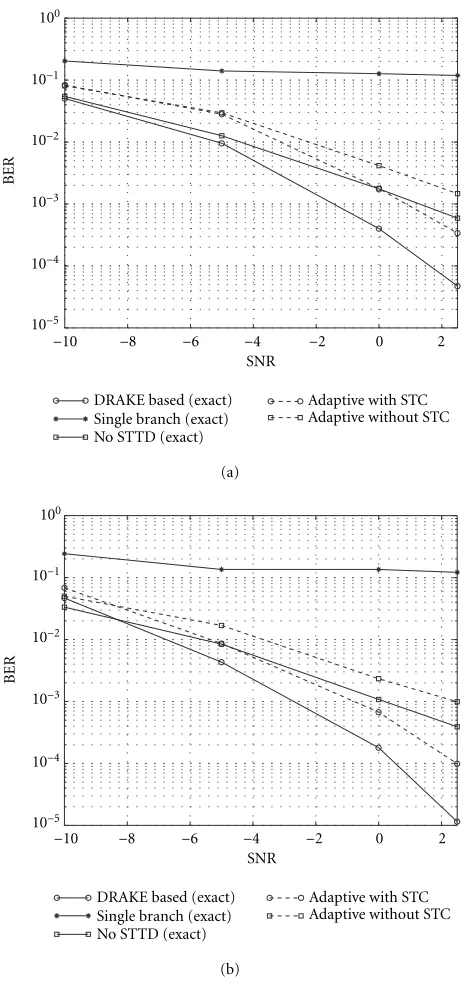
Figure2: BER performance versusEb/N0(in dB) of the
DRAKE-based space-time detector.NT=2,K=8,L=2, andN =16 in all
cases. (a) Average. (b) Best.
transmit powers does not help in this case and thus the per-formance of the single branch filter is insensitive to the SNR. Figure 2 gives similar performance results for a system withK=8 users andL=2 paths per user. Again, we observe that the proposed receiver maintains improved performance over a system without space-time coding as before.
It is clear from these simulation results that the pro-posed scheme offers significant performance improvement
with only linear complexity at the downlink receiver as long as the number of paths in the channel is not too large and the SNR is sufficiently high.
6. CONCLUSIONS
We have proposed a downlink receiver for space-time block coded CDMA systems in multipath channels. The new re-ceiver exploits both the useful signal energy contained in the multipath replicas of the received signal and the diversity offered by the space-time coding process. We have shown that this type of receiver can offer significant performance improvement on the downlink in the presence of fading. An LMS-based adaptive implementation has also been pro-posed, which requires the knowledge of only the desired user’s spreading code. Our simulation results show that the new receiver can offer significant performance gain over sys-tems without space-time coding, without significant increase in the computational complexity, as long as the number of paths in the channel is not too large and the SNR is suffi -ciently high.
ACKNOWLEDGMENTS
The authors would like to thank the anonymous review-ers for their helpful comments. This research was supported by the National Science Foundation (NSF) under grant 99-80590 and by the New Jersey Center for Wireless Telecom-munications.
REFERENCES
[1] S. M. Alamouti, “A simple transmit diversity technique for wireless communications,” IEEE Journal on Selected Areas in Communications, vol. 16, no. 8, pp. 1451–1458, 1998. [2] V. Tarokh, H. Jafarkhani, and A. R. Calderbank, “Space-time
block codes from orthogonal designs,” IEEE Transactions on Information Theory, vol. 45, no. 5, pp. 1456–1467, 1999. [3] V. Tarokh, N. Seshadri, and A. R. Calderbank, “Space-time
codes for high data rate wireless communications: Perfor-mance criterion and code construction,” IEEE Transactions on Information Theory, vol. 44, no. 2, pp. 744–765, 1998. [4] S. Verd ´u, Multiuser Detection, Cambridge University Press,
Cambridge, UK, 1998.
[5] J. C. Liberti Jr. and T. S. Rappaport,Smart Antennas for Wire-less Communications, Prentice-Hall, Upper Saddle River, NJ, USA, 1999.
[6] H. Liu, Signal Processing Applications in CDMA Communica-tions, Artech House Publishers, Boston, Mass, USA, 2000. [7] A. J. Paulraj and C. B. Papadias, “Space-time processing for
wireless communications,” IEEE Signal Processing Magazine, vol. 14, no. 6, pp. 49–83, 1997.
[8] R. Price and P. E. Green Jr., “A communication technique for multipath channels,”Proceedings of the IRE, vol. 46, pp. 555– 570, March 1958.
[10] S. K. Jayaweera and H. V. Poor, “Iterative multiuser detec-tion for space-time coded synchronous CDMA,” inProc. IEEE International Conference on Vehicular Technology, vol. 4, pp. 2736–2739, Atlantic City, NJ, USA, October 2001.
[11] S. K. Jayaweera and H. V. Poor, “Low complexity re-ceiver structures for space-time coded multiple-access sys-tems,” EURASIP Journal on Applied Signal Processing, vol. 2002, no. 3, pp. 275–288, 2002, Special Issue on Space-Time Coding and Its Applications—Part I.
[12] H. Li, X. Lu, and G. B. Giannakis, “Capon multiuser receiver for CDMA systems with space-time coding,”IEEE Trans. Sig-nal Processing, vol. 50, no. 5, pp. 1193–1204, 2002.
[13] B. Lu and X. Wang, “Iterative receivers for multiuser space-time coding systems,”IEEE Journal on Selected Areas in Com-munications, vol. 18, no. 11, pp. 2322–2335, 2000.
[14] Y. Zhang and R. S. Blum, “Multistage multiuser detection for CDMA with space-time coding,” inProc. 10th IEEE Workshop on Statistical Signal and Array Processing, pp. 1–5, Poconos, Pa, USA, August 2000.
[15] B. Hochwald, T. L. Marzetta, and C. B. Papadias, “A novel space-time spreading scheme for wireless CDMA systems,” in
37th Annual Allerton Conference on Communications, Control, and Computing, pp. 1284–1293, Monticello, Ill, USA, Septem-ber 1999.
[16] B. Hochwald, T. L. Marzetta, and C. B. Papadias, “A trans-mitter diversity scheme for wideband CDMA systems based on space-time spreading,” IEEE Journal on Selected Areas in Communications, vol. 19, no. 1, pp. 48–60, 2001.
[17] S. K. Jayaweera and H. V. Poor, “A turbo RAKE receiver for space-time block coded frequency selective CDMA systems,” inProc. 2nd IEEE Sensor Array and Multichannel Signal Pro-cessing Workshop, Rosslyn, Va, USA, August 2002.
[18] Z. Liu and G. B. Giannakis, “Space-time block-coded multi-ple access through frequency-selective fading channels,”IEEE Trans. Communications, vol. 49, no. 6, pp. 1033–1044, 2001. [19] P. Bender, P. Black, M. Grob, R. Padovani, N. Sindhushayana,
and A. Viterbi, “CDMA/HDR: A bandwidth-efficient high-speed wireless data service for nomadic users,”IEEE Commu-nications Magazine, vol. 38, no. 7, pp. 70–77, 2000.
[20] D. Reynolds, X. Wang, and H. V. Poor, “Blind adaptive space-time multiuser detection with multiple transmitter and re-ceiver antennas,” IEEE Trans. Signal Processing, vol. 50, no. 6, pp. 1261–1276, 2002.
[21] M. H. Hayes, Statistical Digital Signal Processing and Mod-elling, John Wiley & Sons, New York, NY, USA, 1996. [22] B. Widrow and S. Stearns, Adaptive Signal Processing,
Prentice-Hall, Englewood Cliffs, NJ, USA, 1985.
Sudharman K. Jayaweerareceived the B.E. degree in electrical and electronic engineer-ing with first class honors from the Univer-sity of Melbourne, Australia, in 1997 and M.A. degree from Princeton University in 2001. Since 1999, he has been a graduate student at Princeton University, USA where he is working toward the Ph.D. degree in electrical engineering. During the years of 1998 and 1999, he worked at the US
Wire-less Corporation in San Ramon, Calif, USA, as a member of the Wireless Signal Processing Algorithm Development Group, where he was involved in the development of wireless geo-location al-gorithms for the company’s proprietary RadioCamera technol-ogy. He has held summer research internships at Envoy Networks, Inc. in Boston, Mass, USA, Magnify, Inc. in Chicago, Ill, USA,
Australian Telecommunications Research Institute in Perth, Aus-tralia, and the Department of Mathematics, University of Mel-bourne, Australia. His current research interests include space-time coding, multiple antenna wireless systems, adaptive and array sig-nal processing, information theoretic aspects of fading channels and multiuser detection.
H. Vincent Poorreceived the Ph.D. degree in EECS in 1977 from Princeton University, where he is currently a Professor of electri-cal engineering. From 1977 until he joined the Princeton faculty in 1990, he was a fac-ulty member at the University of Illinois at Urbana-Champaign. He has also held vis-iting and summer appointments at several universities and research organizations in the United States, Britain, and Australia. His
research interests are primarily in the area of statistical signal pro-cessing, with applications in wireless communications and related areas. Among his publications in this area is the forthcoming book,