Fine-Grained Sentiment Analysis with Structural Features
C¨acilia Zirn† Mathias Niepert†
†KR & KM Research Group University of Mannheim
Mannheim, Germany
Heiner Stuckenschmidt† Michael Strube‡
‡Heidelberg Institute for Theoretical Studies Heidelberg, Germany [email protected]
Abstract
Sentiment analysis is the problem of de-termining the polarity of a text with re-spect to a particular topic. For most ap-plications, however, it is not only nec-essary to derive the polarity of a text as a whole but also to extract negative and positive utterances on a more fine-grained level. Sentiment analysis systems working on the (sub-)sentence level, how-ever, are difficult to develop since shorter textual segments rarely carry enough in-formation to determine their polarity out of context. In this paper, therefore, we present a fully automatic framework for fine-grained sentiment analysis on the sub-sentence level combining multiple senti-ment lexicons and neighborhood as well as discourse relations to overcome this prob-lem. We use Markov logic to integrate po-larity scores from different sentiment lex-icons with information about relations be-tween neighboring segments, and evaluate the approach on product reviews. The ex-periments show that the use of structural features improves the accuracy of polar-ity predictions achieving accuracy scores of up to 69%.
1 Introduction
Sentiment analysis systems have continuously im-proved the quality of polarity classifications of en-tire product reviews. For numerous real-world ap-plications, however, classification on such a coarse level is not suitable. Even in their most enthu-siastic reviews, users still tend to mention nega-tive aspects of a particular product. Conversely, in very negative reviews there might still be men-tions of several positive aspects of the product. Moreover, different opinions can even be uttered
in the same sentence. Consider, for instance, the sentence “Despite the pretty design I would never recommend it, because the sound quality is unac-ceptable” which expresses both positive and nega-tive opinions about a product. Thus, to determine both negative and positive utterances in product reviews, classification on the subsentence level is needed.
Sentiment Analysis on Subsentence Level. As basic classification unit for our fine-grained sen-timent analysis system we choose discourse seg-ments. There are various theories describing dis-course, discourse segmentation and discourse re-lations. The most well-known theory aiming to describe some aspects of text coherence is the Rhetorical Structure Theory (RST) introduced by Mann and Thompson (1988). According to this theory, every text consists of elementary segments that are connected by relations. Segments joined by a relation form a unit, which is itself connected to other segments. This leads to a hierarchical tree structure that spans over the whole text. The ex-ample sentence given above could be divided into the three segmentss1 =Despite the pretty design,
s2 = I would never recommend it and s3 = be-cause the sound quality is unacceptable, with a CONCESSIONrelation1holding betweens1ands2 and a CAUSE-EXPLANATION-EVIDENCErelation holding betweens2ands3. As the segments form logical units, and parts of sentences bearing differ-ent polarities are contrastive and thus do not con-stitute a logical unit, we claim that the discourse segment level is appropriate for fine-grained senti-ment analysis.
Integrating Neighborhood Relations. As dis-course segments consist of only a few tokens, they
1Please note that in this work we do not distinguish be-tween CONCESSIONand CONTRASTrelations and consider
both as CONTRASTrelations. In the following, we will refer
to all other kind of relations as NO CONTRASTrelations.
rarely carry enough information to determine their polarity out of context. While it occurs that neigh-boring segments bear opposite polarities, like in the example given above, two segments following each other are mostly of the same polarity. There-fore, when determining the polarity of a discourse segment, we consider the polarity of the neighbor-ing segments for the classification.
Leveraging Contrast Relations. Although mentioning positive and negative opinions next to each other constitutes a contrast, we cannot conclude that every contrast indicates a polarity change. We conducted a simple corpus study, focusing on the cue word but which is a strong indicator for contrast relations. Of all consecutive discourse segments connected by the word but, 40% express opposite and 60% express the same opinion. Of all the other discourse segment pairs, only 10% express differing opinions. From this experimental observation, we conclude that two neighboring segments not related by a contrast relation have a much higher probability of bearing opinions of the same polarity than segments con-nected by a contrast relation. In our experiments, we will investigate whether the distinction be-tween CONTRAST and NO CONTRAST relations will improve fine-grained sentiment analysis.
Collective classification. The challenge of fine-grained sentiment analysis is that shorter text seg-ments pose a more difficult classification prob-lem. There are various approaches to determin-ing the polarity of text. One common approach is the look-up of terms in a sentiment lexicon with polarity scores. As discussed in the previ-ous paragraphs, we claim that incorporating infor-mation about a segment’s neighbors, the classifi-cation of small text segments can be improved on. Therefore, we simultaneously determine the most probable classification of all segments in a review. We use Markov logic to combine polarity scores from different sentiment lexicons with informa-tion about discourse relainforma-tions between neighbor-ing segments, and evaluate the method on product reviews.
2 Related Work
Methods for fine-grained sentiment analysis are developed by Hu and Liu (2004), Ding et al. (2008) and Popescu and Etzioni (2005). While the approaches of the former two operate on the
sentence level, the system of the latter - Popescu and Etzioni (2005) - extracts opinion phrases on the subsentence level for product features. Their approaches have in common that they first extract features of a product, like the size of a camera or its weight. Then, they look for opinion words describing these features. Finally, the polarity of these terms and, thus, of the feature is deter-mined. An even finer-grained system is presented in Kessler and Nicolov (2009). The approach aims at classifying both sentiment expressions as well as their targets using a rich set of linguistic fea-tures. However, they have not implemented the component that detects and analyses sentiment ex-pressions, but focus on target detection.
T¨ackstr¨om and McDonald (2011) combine fully and partially supervised structured conditional models for a joint classification of the polarity of whole reviews and the review’s sentences.
An approach based on assumptions similar to our intuition to integrate discourse relations is de-scribed in Kim and Hovy (2006) where the au-thors label sentences as reasons for or against pur-chasing a product. The system makes use of con-junctions like “and” to infer polarities and applies a specific rule to sentences including the word “but”: if no polarity can be identified for the clause containing “but”, the polarity of the previ-ous phrase is taken and negated. In our system, we incorporate this information using discourse rela-tions.
3 Statistical-Relational Representation The basic idea of our approach is the integration of heterogeneous features such as polarity scores from sentiment lexicons and neighborhood rela-tions between segments. We use concepts and al-gorithms from statistical relational learning and, in particular, Markov logic networks (Richardson and Domingos, 2006).
We briefly introduce Markov logic as a frame-work for combining numerical and structural fea-tures and describe how the problem of fine-grained sentiment analysis based on multiple lexicons and discourse relations can be represented in the lan-guage. Most probable polarity classifications are then derived by computing maximum a-posteriori (MAP) states in the ground Markov logic network.
3.1 Markov Logic Networks
Markov logic (Richardson and Domingos, 2006) can be as a first-order template language for log-linear models with binary variables. Log-log-linear models are parameterizations of undirected graph-ical models (Markov networks) which play an im-portant role in the areas of reasoning under un-certainty (Koller and Friedman, 2009) and statisti-cal relational learning (Getoor and Taskar, 2007). Please note that log-linear models are also known as maximum-entropy models in the NLP commu-nity (Manning and Sch¨utze, 1999). The features of a log-linear model can be complex and allow the user to incorporate prior knowledge about what types of data are expected to be important for clas-sification.
A Markov network M is an undirected graph whose nodes represent a set of random variables X={X1, ..., Xn}and whose edges model direct probabilistic interactions between adjacent nodes. More formally, a distribution P is a log-linear
model over a Markov network Mif it is
associ-ated with:
• a set of features{f1(D1), ..., fk(Dk)}, where each Di is a clique in M and each fi is a function fromDitoR,
• a set of real-valued weightsw1, ..., wk, such that
P(X=x) = 1
Zexp
k
X
i=1
wifi(Di)
! ,
whereZis a normalization constant.
A Markov logic network is a set of pairs (Fi, wi)where eachFiis a first-order formula and each wi a real-valued weight associated with Fi. With a finite set of constantsC it defines a log-linear model over possible worlds{x}where each variableXjcorresponds to a ground atom and fea-turefiis the number of true groundings (instantia-tions) ofFiwith respect toCin possible worldx. Possible worlds are truth assignments to all ground atoms with respect to the set of constantsC. We
explicitly distinguish between weighted formulas anddeterministic formulas, that is, formulas that always have to hold.
Inference
There are two common types of inference tasks for a Markov logic network: Maximum a-posteriori inference and (conditional) probability inference. The latter computes the posterior probability dis-tribution over a subset of the variables given an stantiation of a set of evidence variables. MAP in-ference, however, is concerned with finding a joint assignment to a subset of variables with maximal probability. Assume we are given a setX0⊆Xof instantiated variables and letY =X\X0. Then, a most probable state of the ground Markov logic network is given by
argmax y
k
X
i=1
wifi(Di).
Parameter Learning
Given a set of first-order formulas and a set of ground atoms, we wish to find the formulas’ max-imum a posteriori (MAP) weights, that is, the weights that maximize the log-likelihood of the hidden variables given the evidence. There exist several learning algorithms for Markov logic such as voted perceptron, contrastive divergence, and scaled conjugate gradient (Lowd and Domingos, 2007).
We employed the voted perceptron learner for the experiments (Richardson and Domingos, 2006; Lowd and Domingos, 2007; Riedel, 2008) which performs gradient descent steps to approx-imately optimize the conditional log-likelihood. In a MLN, the derivative of the conditional log-likelihood with respect to a weightwi is the dif-ference between the number of true groundings
model with weightsw
gi =
∂ ∂wi
logP(Y=y|X0 =x0) =fi−Ew[fi].
The expected number of true groundingsEw[fi]is determined by (approximately) computing a MAP state with the current weightsw. The perceptron update rule for the set of weightswfor epocht+1 is then
wt+1 =wt+ηg,
where η is the learning rate. Online learners
re-peat these steps updating the weight vector for a predetermined number ofnepochs.
3.2 Markov Logic Formulation
Each discourse segmentsis modeled with a
con-stant symbol c ∈ C. The setC, therefore,
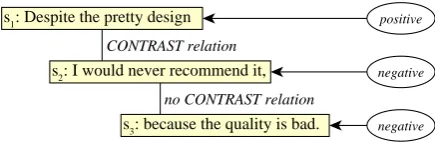
mod-els the discourse segments in the text under con-sideration and comprises the set of constants of the Markov logic network. The segments s1, s2, ands3depicted in Figure 1, for instance, would be modeled using the constant symbolsc1, c2andc3. We represent the polarity of a segment using two non-observable predicatespositiveandnegative.
Note that the state of variables modeling non-observable ground predicates is only known dur-ing weight learndur-ing. We first formulate the fact that a segment is positive or negative but cannot bepositiveandnegativeat the same time using
the following deterministic formulas:
∀x:¬positive(x) ⇒ negative(x)
∀x:negative(x) ⇒ ¬positive(x)
Furthermore, the model incorporates several numerical a-priori features such as the polarity scores of individual segments provided by external lexical resources. We introduce these features in the experimental section in more detail. For each of these features`we wish to include in the model,
we first add the following deterministic equiva-lence formulas
∀x:positive source`(x) ⇔ positive(x)
∀x:negative source`(x) ⇔ negative(x)
Now, in order to include a-priori polar-ity scores, we add the weighted formula
positive source`(x) and scale the contribu-tion of a true ground atom positive source`(s) with the a-priori polarity score of the particular
s1: Despite the pretty design
s2: I would never recommend it,
s3: because the quality is bad.
positive
negative
negative
CONTRAST relation
no CONTRAST relation
Figure 1: Sentiment polarities of and discourse re-lations between the segments of a sentence.
segments. This way, the parameter learning
algo-rithm balances the contributions of the different sources according to their accuracy on the training data. The framework ”Markov theBeast”2 which we used for our experiments allows to add such real-valued features (Riedel, 2008).
The novel contribution of the present paper, however, is the addition ofstructural features, that is, features that model specific dependencies hold-ing between the segments of a review. We distin-guish two different types of such features, namely, neighborhood relationsanddiscourse relations.
3.2.1 Neighborhood Relations
The intuition behind neighborhood relations is that neighboring segments are more likely to have the same polarity. We model the fact that a seg-ment precedesanother segment with the observ-able predicatepre. Each sentence is represented
as a set of ground predicates instantiated by con-stants modeling consecutive sentence segments. The sentence depicted in Figure 1, for instance, would be represented with the two ground atoms
pre(c1, c2)andpre(c2, c3). The following formu-las are included in the Markov logic formulation to model the dependency of preceding segments.
∀x, y:pre(x, y)∧positive(x)⇒positive(y)
∀x, y:pre(x, y)∧negative(x)⇒negative(y)
The weights of the above formulas (a subset of the parameters of the model) are learned during training.
3.2.2 Discourse Relations
While there are numerous types of possible dis-course relations we decided to only distinguish be-tween contrast relations (contrast) and all other
types of relations (nconstrast) due to their
poten-tial impact on polarity changes between discourse segments. In principle, however, it is possible to
Topic p n total Cell Phones & Service 1392 1785 3177
Gourmet Food 990 616 1606
Kitchen & Housewares 1188 1405 2593
Sum 3570 3806 7376
Table 1: Amount of positive (p) and negative (n) segments.
extend the model to also incorporate additional re-lations. The sentence shown in Figure 1, for in-stance, would be represented with the two ground atomscontrast(c1, c2)andncontrast(c2, c3).
In order to leverage contrast relations, we in-cluded the following formulas in the Markov logic formulation, modeling how the absence of contrast relations between segments influences their poten-tial polarity changes.
∀x, y:contrast(x, y) ∧ positive(x) ⇒negative(y)
∀x, y:contrast(x, y) ∧ negative(x) ⇒ positive(y)
∀x, y:ncontrast(x, y)∧positive(x) ⇒ positive(y)
∀x, y:ncontrast(x, y)∧negative(x) ⇒negative(y)
Again, the weights of the above formulas are learned in the training phase.
The classification of a given set of segments is now equivalent to computing a maximum a-posteriori (MAP) state of the respective ground Markov logic network.
4 Experiments
In what follows, we describe the individual com-ponents of our sentiment analysis system and the data we used to experimentally evaluate it. For the evaluation, we first combine real-valued polar-ity scores derived from sentiment lexicons using Markov logic networks and classify all segments of a product review. We then investigate whether the addition of certain structural features improves the performance of the system.
4.1 Data
We chose a subset of the the Multi-Domain Senti-ment Dataset arranged by Blitzer et al. (2007) and annotated it for our purpose. The Multi-Domain Sentiment Dataset consists of user-written prod-uct reviews downloaded from the web page
http://amazon.com. The reviews are
sub-divided according to their topics. We included the three categories ”Cell Phones & Service”, ”Gourmet Food” and ”Kitchen & Housewares”.
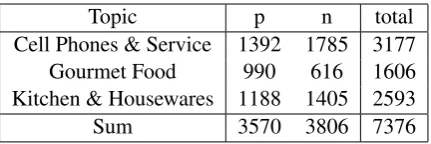
Each category consists of up to 100 reviews. A review is already classified as positive or neg-ative according to the amount of stars the user has chosen for the product along with their re-view. To achieve a balanced corpus, we picked the 20 longest positive and the 20 longest nega-tive reviews for each of the two topics, resulting in a complete amount of 120 reviews. Table 1 lists the three categories and their respective numbers of segments.
4.1.1 Gold Standard
Three independent annotators were instructed to label all passages of a review as positive,
negativeorneutral. Here, a passage is
de-fined as a sequence of words sharing the same opinion. Each word of a review belongs to exactly one passage. The annotators were instructed to choose arbitrary passage boundaries independent of sentence or clause limits. The inter-annotator agreement among the three annotators varies from
κ= 0.40 toκ= 0.45 for negative reviews, which is
considered only fair agreement, and fromκ= 0.60
toκ = 0.84 for positive reviews which is
consid-ered strong agreement according to Fleiss kappa (Fleiss, 1971). In our experiments, we only use the two classespositiveandnegative. Because of the individual segmentations, we processed the corpus word by word to determine the final polar-ity labels. For each word, we considered the three polarity labels the annotators had chosen for the respective passages containing the word. If one of the labelspositiveornegativewas used in the majority, we chose this as the final label. Whenever the majority of the annotators picked
neutralor each of the annotators chose a
dif-ferent label the general polarity of the entire re-view as given by the data set was taken as final label. This is because we estimate the user chose the star-rating according to his overall opinion on the product he is reviewing. This general opinion is expressed by the review text and, therefore, the “standard” label for the review represents the over-all opinion. The numbers of positive and negative segments according to the gold standard are shown in Table 1.
the same amount of positive and negative labels, we take the overall polarity of the whole review as label.
4.2 Polarity Features
For each segment, we estimate prior positivity and negativity scores using state-of-the-art sentiment classification methods. There are two basic ways to classify polarity. One of the most common ap-proaches is to train a classifier on labeled data that works with a bag-of-words model or uses similar features. However, named approach will have dif-ficulties with the short text segments our system is focused on.
Another method for polarity classification is to look up terms in a pre-compiled sentiment lexicon that lists terms and their polarities. We chose the latter method for several reasons. First, lexicon-based methods do not rely on large amounts of training data. Second, lexicons can easily be ex-changed or added which makes the approach more flexible. Third, the use of Markov logic allows us to combine several lexicons without additional effort. To compute the positivity and negativity score for a segment according to a lexicon, we first look up the positivity as well as the negativity of each term of the segment in this lexicon. Then, we average the positivity as well as the negativity scores. This leads to one positivity score and one negativity score per lexicon for each segment. We use a simple heuristic to consider negated polarity terms such as innot good. To this end, we manu-ally compiled a list of negation terms3. Every time we detect such a negation indicator within a seg-ment, we switch the positivity and the negativity scores of all terms occurring after said negation. We employ the following lexicons:
• SentiWordNet(SWN)
SWN (Esuli and Sebastiani, 2006) is a lex-ical resource that contains positivity-scores, negativity-scores and objectivity-scores for WordNet (Fellbaum, 1998) synsets. The scores are between 0.0 and 1.0 and all three scores for a synset sum up to 1.0. For our system, we only regard positivity scores and negativity scores. We use a part-of-speech tagger and take the first word sense.
3We used the negation indicatorsno, cannot, not, none, nothing, nowhere, neither, nor, nobody, hardly, scarcely, barelyand all negations of auxiliaries modals ending onn’t, likedon’torwon’t.
• Taboada and Grieve’s Turney Adjective
List(TGL)
Taboada and Grieve (2004) created a list con-taining adjectives and their polarities based on a method described by Turney (2002). They first query a search engine for the ad-jective together with some manually chosen clearly positive adjectives, using the near -operator, then they do the same with a list of negative adjectives. Finally, they calculate the point-wise mutual information (Church and Hanks, 1990) between the queries.
• Unigram Lexicon(UL)
There are terms whose polarity depends on the context they are used in. Consider for instance the word large: a large screen is good while alarge cell phoneis likely bad. To take domain-dependence into account, we compile a list of common positive and neg-ative unigrams as well as punctuation marks for each of the three topics separately. Since we need 40 reviews per topic for the evalu-ation only the remaining reviews are used to compile the unigram lexicon. From this data, we calculate the ratio of all occurrences of a unigram in positive reviews to its occurrences in negative reviews and use this ratio as the positivity and negativity scores, respectively.
4.2.1 Discourse Parsing
We employ the discourse parser HILDA devel-oped by duVerle and Prendinger (2009). It per-forms two tasks: First, it splits the review text into discourse segments which constitute the ba-sic entities our system classifies. Second, it deter-mines the discourse relations between segments. The actual output of HILDA is the discourse tree of a text. We convert the tree structure to a linear sequence of relations between neighboring seg-ments. HILDA uses the set of relation labels de-scribed by Soricut and Marcu (2003) which is coarser-grained than RST and consists of 18 la-bels. For the experiments, we distinguished two types of relations: relations labeled as contrast
and all other relations. We refer to this class as ncontrast. We model these two relations in
the Markov logic framework as described in Sec-tion 3.2.
positive negative
P R F P R F A
majority baseline 0.00 0.00 0.00 51.60 100.00 68.07 51.60
SVM 57.05 43.06 49.08 56.44 69.47 62.28 56.66
MLN polarity 53.21 69.58 60.31 59.90 42.62 49.80 55.67 MLN neighborhood 66.38 72.94 69.50 72.02 65.34 68.52 69.02
MLN contrast 61.39 73.47 66.89 69.48 56.65 62.41 64.79
Table 2: Results (%) for the different systems. P = precision, R = recall, F = F-measure, A = accuracy
the discourse parser constitute the basic units for our sentiment classification system. Evaluating the correctness of discourse parsing is a hard task. However, it is not of prime importance for our task that the segments are correct according to any dis-course theory but that they do not include passages containing differing labels according to the gold standard. An analysis of the data shows that only 3.2% of the segments contain contradictory labels. We therefore concluded that it is appropriate to use the discourse segments as basic units for the eval-uation of our system.
4.3 Experimental Setting
The goal of our system is to label discourse seg-ments of a review as positiveornegative. We employed the Markov logic network imple-mentation ”Markov theBeast”(Riedel, 2008).
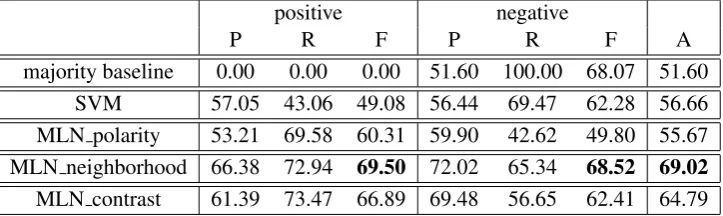
We compare three different Markov logic net-works. First, we only take into account the real-valued polarity features. We consider this ML formulation (“MLN polarity”) a baseline to eval-uate the quality of the evidence collected from the sentiment lexicons. To compare the perfor-mance of this system to the state of the art in classification algorithms, we train a Support Vec-tor Machine (SVM) (Platt, 1998; Keerthi et al., 2001; Hastie and Tibshirani, 1998) on the polar-ity features. In a second Markov logic formula-tion (MLN neighborhood), we incorporate struc-tural information about neighboring segments us-ing the formulas described in section 3.2.1. In or-der to assess the impact of explicitly distinguish-ing between contrast and ncontrast rela-tions, we use the Markov logic formulation de-scribed in Section 3.2.2 (MLN contrast).
We learn the weight parameters of the Markov logic networks by running the voted perceptron online learner for 20 epochs (Riedel, 2008). We then evaluate each of the classification algorithms
with 10-fold cross validation.
4.4 Results
Table 2 lists the evaluation results for the dif-ferent classifiers. To determine statistical signif-icance of the relative effectiveness of two clas-sifiers we applied a paired t-test at a signifi-cance level of p < 0.01. The classifiers ex-clusively using polarity features have compara-ble accuracy values. While the SVM is show-ing a bias towards classifyshow-ing segments as nega-tive ML polarity shows the opposite trend. Al-though the accuracy of SVM is slightly higher the relative difference of the accuracy values is not statistically significant. Including neighbor-hood relations increases the effectiveness rela-tive to both non-structure based classifiers signifi-cantly. MLN neigborhood achieves an F-measure of 69.50% for positive segments and 68.52% for negative segments with an overall accuracy of 69.02%. It also significantly outperforms the majority baseline which achieves an accuracy of 51.60%. Contrary to our hypothesis, distinguish-ing between contrast and ncontrast rela-tions did not improve the effectiveness relative to MLN neigborhood. MLN contrast achieves a slightly lower accuracy than MLN neighborhood although the difference is not statistically signif-icant. These results suggest that the correlation
of contrast relations and polarity changes is
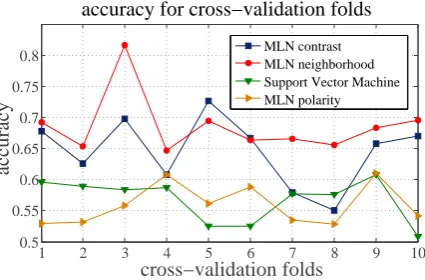
not significant. Furthermore, the number of con-trast relations in product reviews is too small to have a significant impact. Finally, employing a discourse parser as a component of a sentiment analysis poses the problem that misclassifications might as well be caused by erroneous decisions of the component. Figure 2 depicts the accuracy val-ues for the different classifiers on each of the ten cross-validation folds.
sen-1 2 3 4 5 6 7 8 9 10 0.5
0.55 0.6 0.65 0.7 0.75 0.8
cross−validation folds
accuracy
accuracy for cross−validation folds
MLN contrast MLN neighborhood Support Vector Machine MLN polarity
Figure 2: Accuracy values of the various algo-rithms for the 10 different cross-validation folds.
timent analysis system operating on the discourse segment level to which we could compare our re-sults. However, the task is similar to that ap-proached by Kim and Hovy (2006) whose system achieves an accuracy of 57% classifying whole sentences of reviews as positive or negative. In T¨ackstr¨om and McDonald (2011), the authors present a semi-supervised approach classifying sentences as positive, negative or neutral. Their approach achieves an accuracy of up to 59.1%. Considering the fact that our system is working on subsentence level we find our results promising.
5 Conclusion and Future Work
In this work, we addressed the problem of fine-grained sentiment analysis on subsentence level, achieving an accuracy of 69%. We proposed a sentiment classification method that uses Markov logic as a means to integrate polarity information from different sources and to explicitly use infor-mation about the structure of text to determine the polarity of text segments. The approach has a number of advantages. It is flexible enough to incorporate polarity scores from various sources. We used two pre-existing sentiment lexicons. To capture domain-dependent knowledge, we com-piled an individual lexicon for each domain from training data. The presented approach, however, is not restricted to these sources and can include any source of polarity features. It allows for an easy combination of various existing methods into a single polarity judgement. Moreover, its major advantage is the inclusion of structural informa-tion. Again, this ability is more or less indepen-dent from a concrete method. In our work we used an existing discourse parser, however, other
meth-ods for determining the discourse structure could be used as well. Finally, the Markov logic repre-sentation can be used in a supervised and in an un-supervised setting. The experiments described in the paper are based on the supervised setting: we used a manually annotated corpus to learn weights for the formulas in the Markov logic model. In cases, where no annotated corpus is available, we could still set the weights by hand and experiment with different settings until a good setting is found. Concerning fine-grained sentiment analysis the main result of our work is that the use of gen-eral structures found in the text systematically im-proves the results. As described in the paper, it turned out, however that the relation between the contrast relation and the change of polarity is not as close as we had expected. This means that the classical discourse relations are not necessarily the best choice concerning text structures to be taken into account. However, we think that focusing on cue words for discourse connectives is worth be-ing investigated to determine features that allow us to more accurately predict such polarity changes. Further, in the work reported here, we only con-sidered positive and negative polarity. This raises some questions concerning the treatment of seg-ments that do not have a clear polarity. In future work, we will therefore extend our experiments to the case where segments can be classified as
positive,negativeorneutral.
Acknowledgments
We would like to thank Anette Frank for useful comments in the early phase of this work, and the annotators for annotating the product reviews.
References
Nicholas Asher, Farah Benamara, and Yannick Math-ieu. 2009. Appraisal of opinion expressions in dis-course.Lingvisticae Investigations, 31(2):279–292.
John Blitzer, Mark Dredze, and Fernando Pereira. 2007. Biographies, Bollywood, boom-boxes and blenders: Domain adaptation for sentiment classi-fication. InProc. of ACL-07, pages 440–447.
Kenneth Ward Church and Patrick Hanks. 1990. Word association norms, mutual information, and lexicog-raphy.Computational Linguistics, 16(1):22–29.
David duVerle and Helmut Prendinger. 2009. A novel discourse parser based on support vector classifica-tion. InProc. of ACL-IJCNLP-09, pages 665–673.
Andrea Esuli and Fabrizio Sebastiani. 2006. Senti-WordNet: A publicly available lexical resource for opinion mining. InProc. of LREC ’06, pages 417– 422.
Christiane Fellbaum, editor. 1998. WordNet: An Elec-tronic Lexical Database. MIT Press, Cambridge, Mass.
Joseph L. Fleiss. 1971. Measuring nominal scale agreement among many raters. Psychological Bul-letin, 76(5):378–382.
Lise Getoor and Ben Taskar. 2007. Introduction to Statistical Relational Learning. MIT Press.
Trevor Hastie and Robert Tibshirani. 1998. Classifi-cation by pairwise coupling. In Michael I. Jordan, Michael J. Kearns, and Sara A. Solla, editors, Ad-vances in Neural Information Processing Systems, volume 10, pages 451–471. MIT Press.
Minqing Hu and Bing Liu. 2004. Mining and summa-rizing customer reviews. InProc. of ACM SIGKDD ’04, pages 168–177.
S.S. Keerthi, S.K. Shevade, C. Bhattacharyya, and K.R.K. Murthy. 2001. Improvements to Platt’s SMO algorithm for SVM classifier design. Neural Computation, 13(3):637–649.
Jason S. Kessler and Nicolas Nicolov. 2009. Target-ing sentiment expressions through supervised rank-ing of lrank-inguistic configurations. InProc. of ICWSM-09, pages 90–97.
Soo-Min Kim and Eduard Hovy. 2006. Automatic identification of pro and con reasons in online re-views. InProc. of COLING-ACL-06 Poster Session, pages 483–490.
Daphne Koller and Nir Friedman. 2009. Probabilistic Graphical Models: Principles and Techniques. MIT Press.
Daniel Lowd and Pedro Domingos. 2007. Efficient weight learning for Markov logic networks. InProc. of ECML/PKDD-07, pages 200–211.
William C. Mann and Sandra A. Thompson. 1988. Rhetorical structure theory. Toward a functional the-ory of text organization. Text, 8(3):243–281.
Christopher D. Manning and Hinrich Sch¨utze. 1999. Foundations of statistical natural language process-ing. MIT Press.
J. Platt. 1998. Fast training of support vector ma-chines using sequential minimal optimization. In B. Schoelkopf, C. Burges, and A. Smola, edi-tors, Advances in Kernel Methods - Support Vector Learning, pages 185–208. MIT Press.
Ana-Maria Popescu and Oren Etzioni. 2005. Extract-ing product features and opinions from reviews. In Proc. HLT-EMNLP ’05, pages 339–346.
Matthew Richardson and Pedro Domingos. 2006. Markov logic networks. Machine Learning, 62(1-2):107–136.
Sebastian Riedel. 2008. Improving the accuracy and efficiency of MAP inference for Markov logic. In Proc. of UAI-08, pages 468–475.
Swapna Somasundaran and Janyce Wiebe. 2009. Rec-ognizing stances in online debates. InProc. of ACL-IJCNLP-09, pages 226–234.
Swapna Somasundaran, Galileo Namata, Janyce Wiebe, and Lise Getoor. 2009. Supervised and unsupervised methods in employing discourse rela-tions for improving opinion polarity classification. InProc. EMNLP-09, pages 170–179.
Radu Soricut and Daniel Marcu. 2003. Sentence level discourse parsing using syntactic and lexical infor-mation. In Proc. of HLT-NAACL-03, pages 149– 156.
Maite Taboada and Jack Grieve. 2004. Analyzing ap-praisal automatically. In Proceedings of the AAAI Spring Symposium on Exploring Attitude and Affect in Text: Theories and Applications,Palo Alto, Cal., 22–24 March 2004, pages 158–161.
Oscar T¨ackstr¨om and Ryan McDonald. 2011. Semi-supervised latent variable models for sentence-level sentiment analysis. InProc. of ACL-11, pages 569– 574.