Interaction between Structural Changes in Machine Translation
S a t o s h i K I N O S H I T A R e s e a r c h a n d D e v e l o p m e n t C e n t e r
T o s h i b a C o r p o r a t i o n K o m u k a i - T o s h i b a - c h o 1, S a i w a i - k u ,
K a w a s a k i , 2 1 0 J a p a n
J o h n I ' H I L L I P S J u n - i c h i T S U J I I C e n t r e h ) r C o m t ) u t a t i o n a l L i n g u i s t i c s
U M I S T P . O . B o x 88, M a n c h e s t e r ,
M 6 0 1 Q D , U . K .
A b s t r a c t
This paper discusses coml)lex s t r u c t u r a l changes dur- ing transfer within a non-destructive transfer frame- work. T h o u g h the description of each individual s t r u c t u r a l change is not difficult, special provision must be made when they are combined, because in- teraction between t h e m sometimes causes unexpected problems. Transfer of coordinate structures is also discussed a.q this sometimes necessitates a s t r u c t u r a l change and interacts with other s t r u c t u r a l changes in a problematic way.
1
Introduction
Several focal issues have emerged in machine trans lation (MT) research as the result of recent intensive studies in the field. T h a t is,
• Declarative Frameworks for expressing Bi-lingual Knowledge
• Integration of Knowledge-based Processing and Contextual Processing with the Translation p r o cess
• Effective Exploitation of D o m a i n / ' l ~ x t Type- Specificity (or Sublauguageness) in MT and Dis- covery Processes for such Specifieities
T h o u g h new frameworks of MT such as Statistics- based M T (SBMT), F, xample-bascd MT (F, BMT), Analogy-based MT (ABMT), Knowledge-based MT ( K B M T ) etc. look radically difihrent from con- ventional liuguisties-based MT (LIIMT) anch as Transfer-based MT, they address role or two of the above focal issues and ignore the rest[7][10]. In par- ticular, the new p a r a d i g m s of MT tend to ignore t.he first issue ie. declarative representation of bi-lingual knowledge and the complexities involved in the pro- cess of combining units of bi-liagual knowledge.
It is our contention t h a t any MT system, whichever p a r a d i g m it belongs to, has to store a set of translation-equivalent units for a pair of languages and combine these to produce larger units of trans- lation. In EBMT, for example, a set of translation examples has to be stored and several of them have
to be combined properly to produce translation. Be- cause of the declarative n a t u r e of translation exam- pies, E B M T inevitably encounters the same complex- itics of combining translation units in declarative rep- resentation o.~ I,BMT does.
tLescarch in LBMT[1][2][3][ll][12][13] has revealed t h a t dittieulties in tim declarative representation of bi-lingual knowledge stem mainly from the t r e a t m e n t of idiosyncratic s t r u c t u r a l changes caused by lexieal items, and interactions of such idiosyncratic struc- tural changes when they co-exist in single sentences. These type of structural changes also cause problems when they are combined with general or ordinary lin- guistic phenomena soeh as coordination. A formal framework to cope with these m a t t e r s is essential in other aPl)roaches, such as E B M T , as in LBMT, if the translation is produced in a compositional way.
In this paper, we discuss problems caused by such interaction, and give solutions in our logic-based transfer framework[8]. O u r transfer model views the transfer process as deduction; it produces the t a r g e t linguistic description without changing the source de- scription. This giw:s a clear c o n t r a s t to the conven- tional tree-traasducer model, which gradually tranS- forms the source description, a n d is therefore hard to control.
Because of the logic oriented n a t u r e of our frame- work, it can also be extended easily to cope with the other local issue of MT such as the integration of knowledge-based processing with translation[4].
2
Formalism
We use a simple formalism, representing a sentence as a network of semantic dependencies. The basic units of the formMism are indices, properlies, and re- Istwna. A logical form consists of an unordered net of Ierms; each term is either a p r o p e r t y predicated of an it~dex, or ~t relation between two indices. The written notation depicts properties and relations as unary and binary functors, respectively, and indices as theiL" arguments, i.e. within brackets. A logical form representing ' J o h n saw M a r y ' might be e : john(j) & see(el & m a r y ( n 0 & tense(e,past) & subj(e,j) & obj(e,m)
This representation in simplified particularly in t h a t
the man who Mary saw: x : man(x) & mary(m) & see(el & t . . . (e,past) & subj(e,m) & obj(e,x) the man who saw Mary: x : man(x) & nrary(m) & see(el & tense(e,past) & subj(e,x) & obj(e,m) I managed to painl my house quickly: m : me(me) & manage(m) & tense(m,past) & subj(m,me) &
obj(m,p) & paint(p) & obj(p,h) & of(h,me) & house(h) & qniek(q) & subj(q,p) Mary looked at the brightly painted house: l : mary(m) & look(l) & tense(l,past) & subj(l,m) & at(l,h) &
bright(b) & subj(b,p) & paint(p) & obj(p,h) & house(h)
Mary's house was painted: p : m a r y ( m ) & of(h,rn) & house(h) & paint(p) & tense(p,past) & obj(p,h)
Figure 1: Examples of Logical Forms
the relation tense here stands for w h a t should be a complex representation of tense, aspect, and aktion- sart, related anaphorieally to the preceding discourse. It can be seen t h a t the representation includes the names of the concepts, both objects and events, which are mentioned in the sentence, aud the semantic re- lationships between them. Each of the three indices, j, m and e, is a unique label given to a node in the dependency network. The indices also serve as dis- course referents when the logical form is incorporated into a discourse representation. The root node of the network is specified at the beginning of the represen- tation, in tiffs ease e, the node representing the seeing event. In terms of discourse representation theory, e is tim discourse referent of which the logical form is a description. As long as the root node of the network i s specified, it is possible to convert a logical form mechanistically into a s t r u c t u r e d representation such as a dependency graph or a feature structure such as
tense : past
subject : [predicate : john] object : [predicate : mary]
Some other examples of logical forms are shown in figure 1. T h e particular characteristics of the formalism - - the types of relations and predicates used and the m a n n e r of their use - - are justified elsewhere[9]. We only state here t h a t tbe forrualism can t r e a t the p h e n o m e n a which are treated by tradi- tional formalisms, along with additional phenomena relating to discourse structure and lexical semantics.
3
T r a n s f e r
We follow the s t a n d a r d division of a machine trans- lation system into stages of analysis, transfer, and generation. The parts of the system include algo- rithms for analysis, transfer, a n d generation, descrip- tions of the strneture of individual languages (used by the analysis and generation algorithm.s), and de- scriptions of equivalence relationships between pairs of languages (used by the transfer algorithm). It is a requirement for the transfer description t h a t it should state all and only the equivalence relation- ships between expressions of a pair of languages. It
should contain no general linguistic information, el- tiler universal or specific to a n y single language: these types of information belong ill the formalism and con- tent, respectively, of the descriptions of individual languages. In fact most of our transfer descriptions consist of direct equivalences between predicates or groups of predicates of the language pair.
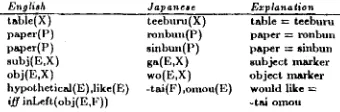
A transfer rule shows a particular translation equivalence between two languages. It consists of three parts: a pair of logical forms, one for each language, representing tile equivalence, and a third logical form giving the conditions under which the equivalence is applicable. We call these the equiva~ lenee pair and the condition respectively. T w o logical forms form an equivalence pair if the n a t u r a l language expressions they represent have overlapping denota- tions (using ' d e n o t a t i o n ' in a very broad sense to en- compass not only the referential possibilities of nouns but the possibility in general of applying a predicate to a particular index). The rule can therefore be used for translating in either direction: the two logical forcers of the eqnivalenee pair are always translation- ally equivalent if the condition is satisfied. The logical forms of the equivalence pair will be indistinguishable from logical forms of the respective languages, using the same predicates a n d relations. T h e logical forms of the condition use meta-predieates which allow ref- erence to to the logical form of the current local trans- lation unit (sentence or clause) and to the linguistic context. In practice, most transfer rules have no con- dition; they consist just of an eqnivalenee pair. Some examples of rules follow:
English J a p a n e s e Explanation table(X) teeburu(X) table = teeburu
paper(P) ronb,m(p) paper = ronbun
paper(P) sinbmt(P) paper = sinbun
subj(E,X) ga(E,X ) subject marker
obj(E,X) wo(E,X) object marker
hypothetical(El,like(El -tai(F),omou(E) would like
iff inLeft(obj(E,F)) ~tal omou
The following is the basic definition of transfer be- tween two texts (sentences, clauses, or whatever):
A source logical form and a target logical form are correctly transferred if tile terms of each can be divided into non-overlapping sub- sets such that the source subsets can be placed into one-to-one correspondence with the target subsets by each corresponding pair being 'uni- fied' with the two halves of the equivalence pair
[image:2.432.234.404.399.455.2]of a transfer rule, and if the accumulated con- ditions of the transfer rules used are satisfied. 'Unification' in this definition is rattmr similar to graph unilication.
q~ansfer rules specifying larger sets of terms can be used to state trauslational equivalences for idioms and fixed expressions. Simple idioms present no par- ticular problem. One translation of the English idiom
to kick the bucket
into Japanese issinu
'die', and this can be represented by the transfer rulekick(K) $z. obj(K,n) & the-bucket(B) ~ sinu(K) Fixed expressions, appropriate only to a specific con- text, may require conditions which refer to the dis- course representation.
4
' C o m p l e x ' t r a n s f e r
4 . 1 T y p e s o f c o m p l e x t r a n s f e r
Lindop & Tsujii (1991) list and discuss a variety of examples that are alwaYs problematic for machine translation systems. We suggest that what makes these examples difficult is that different dependency structures are associated with otherwise synonymous lexical items. We break the problem down into four subparts.
i)
Argument-switching
as i n t h e t r a n s l a t i o n o f t h e G e r m a nDer Wagen gef'~llt mir - - I like the car The car pleasen me
gefallen(E) & nora(O) & dat(S) like(E) & subj(S) & obj(O)
In argument-switching, the relations between the lex- ical item and its dependents are not translated stan- dardly. Although the German nominative normally corresponds to an English subjcct, it must in this ex- ample be translated as a dative.
it)
IIead-switching
as h i t h e t r a n s l a t l o l t o f G e r - n l a ntlaas sehwimmt gem - - John likes swinmfing John swinm ~ladly
like(L) & obj(L,S)
geru(L) & subj(L,S) iyshift(L,S) The Germau sentence is a description of a situation to do with swimming; the English is a description of a situation to do with liking. The
shift
predicate is explained below.iii)
Decomposition
as i n t h e t r a n s l a t i o n o f t h e J a p a n e s eJohn-ga jisatusita -.- John committed suicide jisatu_suru(E)
commit(E) & suicide(S) & obj(E,S)
llere the single Japanese word
jisatusnrn
is tra~l~- lated as the English phraseto commit suicide.
Some types of decomposition can give rise to special prob- lems when there arc modifiers or dependents involved. These are discussed in detail by Tsujii et al. (1992), Shortage of space aml tile variety and complexity of examples prevents their discussion here.iv)
ttaistng
as i n t h e t r a n s l a t i o n o f t h e W e l s h Fe ddigwydd rod Si6n ymahappells be ~l o|ln here John happens to he here
digwydd(E1) ~ subj(E1,E2) & subj(E2,X) . -+ happen(E1) ,~ subj(E1,X) & obj(E1,E2) In the English, the subject of
happen
is John, but in the Welsh, the subject ofdigwydd
('happen') is the situation of John's being here.The predicate
shift
is introduced to define a trans- lation equivalence where certain dependencies are dif- ferently arranged in the target language, as compared to the source language. It can be understood in terms of semantic type-shifting - - the types are differently distributed in the source- and target-language logi- cal forms.Shifl(H,E)
means that in any instance ofsubj(H,X)
orl'(X, tt)
(where V stands tbr auy rela~ tion) in the logical form representing the English text, the H corresponds to an E in the logical form repre- senting the other language. The following example shows how the example under (it) above would work in practice.lch welt] Hans schwimmt gern - i know John likes swmuning
ieh(i) me(i)
--~en(wi
know(w)
sut,j(w,i) subj(w,i) ohj(w,s) obj(w,s)' Hans(j) John(j) sehwimmen(s) swim(s)
s.bj(sj)
suhj(iQ)
gern(g) like(g) subj(g,s) obj(g,s)
{shift(s,g)} me(i) know(w) subj(w,i) obj(w,g)
John(j)
swim(s)' subj(gd) like(g) obj(g,s)
The columns of the table show tile German source logical form, the English logical form as it would be without
shift,
and tile actual English target logical form. The horizontal divisions of the table represent the fields of operation of separate transfer rules.4 . 2 I n t e r a c t i o n b e t w e e n t y p e s o f
c o m -
p l e x
t r a n s f e rWhen several of these syntactic changes are combined in one example, the logical form resulting from trans- fer is incoherent. The following examples are types on which most, if not all, existing machine translation
systems will fail, as will the mechanism proposed here so far.
English - Welsh; raising with argument-switching: John happens to like swimming
fe ddigwydd fod yn dda gan John nofio
happens be nice by John swim
(swimraing-bein~-nice-in-dohn's-opinion occurs)
Dutch - English; verb - head-switching twice: Jan zwemt grnag toevallig
John Bwims g l a d l y happeningly John happens to like swimming (also 'John likes happening to swim~
There are two separate causes of difficulty in these examples. Firstly, the long-distance movement caused by raising canses problems in the transfer of structures which have been the target of raising. The simplest way to get rmmd the problem is to require syntactically-deleted arguments to be marked explic- itly on all the verbs of wbich they are logical ar- guments, treating the phenomenon syntactically as an example of lexieally-triggered extraction, on a par with the extractions of syntactic objects in a man I knowand an easy man to please. Transfer rules which introduce raising predicates will then have to bring in the new subject explicitly. For instance, the rule for happen and digwydd, (iv) in §4.1, will be re-written as
digwydd(E1) & subj(E1,E2)
happen(E1) & subj(E1,X) & obj(E1,E2) iff subj(E2,X)
The second point is that the shift predicate must be defined in such a way t h a t it can cope with re- cursive changes in the dependency structure brought about by the occurrence of several interdependent head-switching translations. It seems that shift can be made to do this simply by having e.g. shifl(H,E) affect all instances of snbj(tl, X) or P(X,H) (including shifl(X,H)) not transferred by the transfer rule which introduced the shift(ll, E).
Together, these two stipulations enable the trans- fer of examples involving head-switching, argument- switching, raising, and most types of decomposition.
5
T r a n s f e r
o f
C o o r d i n a t e
S t r u c t u r e s
5.1
Problems in transfer of coordi-
nate
s t r u c t u r e sCoordination often reqnires exceptional treatment in parsing and generation of natural language. Transfer is no exception. Transferring a coordinated structure
sometimes produces a miserable result due to the ac- companying combination of structural changes or the fact that coordinated linguistic objects require differ- ent target words for a shared source word. However, few attempts have been reported to formalize this problem.
We here divide the problem into two categories: t
• Divergence in semantic constraints
• Combination of complex transfers
The first type of problem occurs when semantic fea- tures of the coordinated source words require a source word to be translated into two different target words. A typical example can be seen in translation of the following English sentence into Japanese.
( l a ) Site wears a bat and shoes.
(lb) kanojo-ga boushi-wo kaburi, kutsu-wo she-suhj lmt-ohj wear shoe-obj haku.
wear
As is understood from its translation, "wear" is trans- lated "kaburu" or "haku" in Japanese, depending on whether its object is something worn on the head or on the foot(or leg). This means that, in this example, coordination of objects in English should be altered to that of verb phrases in Japanese.
This type of knowledge for lexical choice is very common in a transfer or bi-lingual dictionary, and plays an essential role in lexical transfer of most cur- rent transfer-based MT systems. The problem is that ueither a transfer program or a transfer-rule writer expects such an awkward problem caused by coor- dination. To translate "wear" iuto "kaburu" in the above example, n rule writer may usually write the following rule in our notationS:
wear(X) ~ kaburu(X) iff obj(X,Y)&HAT(Y)
But the condition part of this rule is implicitly ex- pected to be interpreted as follows.
wear(X) ~ kaburn(X) iff V Y obj(X,Y)&;HAT(Y)
The precise definition may change depending on how the coordinate structure is represented. But the 1 There is eamther type of problem wlfich is baaed on the syn- tactic differences between coordination constructlom in source arid target languages. For example, "2 or 3 potuld~" in En- glish should be trmmlated "2 pondo ka 3 pondo'(2 poundJ or 3 pounds} in JaF.mlese and "dwybunt ncn clair" (2 pounds or 3) in Welsh. (The Welsh expression is used only for a sum of money. Another exists for weight.) This type of problem tlaould alto be solved in transfer, but we do n o t mention it here.
2In this section, we coltsider translation whose source and target logical forms are on the left and right sides of a trantfer rule. For the sake of simplicity, trmasfer rules hereafter are described as uni-directional ones.
point is t h a t "wear" m a y be trmmlated "kaburn" only if all the objects have a feature of being a "HAT".
A simple transfer algoritlnn, for example, may choose the t a r g e t word when it finds the first ap- plicable transfer rule for a source word: this algo- rithm m a y produce "boushi-to kutsu-wo kaburu" for the sentence (la), which memm t h a t tile semantic re- lation between "wear" a n d "shoes" is ignored. There may be another type of transfer algorithm which sim- ply fails beeanse it cannot provide two dilfcrent t a r g e t words to one identical source word.
The second type of the problem occurs when one of the coordinated objects triggers a complex transfer which is described in §3. This type of problem can bc seen in the following translation.
lie connnitted n m r d e r then suicide.
kare-ga satsujin-wo okaslfi, jisatsu-shita. he~subj murder-obj conmlit commit-ed suicide
This problem is more complicated t h a n the previous one because complex ti'ansfer, in this example "many- to-one transfer", causes a s t r u c t u r a l change. Our sim- ple transfer algorithm mentione<l in tile previous sec- tion m a y produce a disastrous result for this type of translation.
There are several possible solntions to this problem. The simple.st one is t h a t a transfer:rule writer writes all the transfer rules which explicitly describe every possible sub-structure with coordination. This is of course unrealistic.
A n o t h e r solution is to make a transfer p r o g r a m which modifies the transfer result dyuanfically when, tbr example, a source word is given two differeut tar: get words. B u t such a d y n a m i c modilication of tile result during transfer is against our policy of logic: based transfer, because this means gradual transfor- mation of the source s t r u e t u r c and therefore transfer cannot be formalized as logical inference.
5.2
'lYansfer with C o o r d i n a t e Expan-
s i o l l5.2.1 C ~ x w d l n a t e E x p a n s i o n
tiereafter we concentrate on a case where coordinated objects of a verb cause the problem, t h o u g h there is a p p a r e n t l y an example where other eases such a.~ "snbj" cause the same problem.
The basic reqnirement in logic-based transfer is t h a t coordination of objects should he reorganized to t h a t of verb phrases or sentences, which is not supposed to cause problems in transfer. We call this reorganization "coordinate expansion".
The following is a p a r t of logical form for (ta), which involves a coordinate structure.
wear(w)&obj(w,o)&coord(o,ol)&hat(ol)& coord(o,o2)&shoe(o2)
Input Logical Form
U
Expansi . . . [ E x p a n d r u l e u ]
, ' r u n s l e r +- [ Transfer rules ]
g Reduction
O u t p u t Logical Form
t,'igure 2: Transfer with Coordinate Expansion
In this form, o is a linguistic object, and a predi- cate coord represents a relation between the linguistic object and its coustituents. The following is a r ~ u l t of expansion.
coord(w,w 1)&we;tr(w 1 )&obj(w l,n l)$zhat(ol)& coord(w,w2)&wear(w2)&obj(w2,o2)&shoe(o2)
The most naive and simplest s t r a t e g y usiug this expansion is to expand cvery coordination within a sentence and rel)reseut it in sentcnce coordination be- fore transfer. This transfer result will be reorganized again into an a p p r o p r i a t e representation of coordina- tion in tim t a r g e t language. But this solution seems inefficient from the c o m p u t a t i o u a l point of view beo ettase caseswhere expansion is uecessary are rare . Unnecessary expansion a n d reorganization of coordi- nate structures should be avoided.
The strategy wc propose executes coordination ex- pansion only if it is necessary[5]. Figure 2 shows a general view of our modified a p p r o a c h to transfer.
Transfer is divided into three phases; in the first phase, logical forms are expanded if e x p a n d rnles (ex- plained below) find tim necessity of coordinate expan- sion. This process continues as long as the necessity remains. In tile second phase, transfer described in previous sections is executed. Fiually, in the third phase, coordilmtion is reorganized if the t a r g e t lan- guage has a more a p p r o p r i a t e s t r u c t u r e for coordi- nation than tile second phase result. (Consider the translation of (lb). W i t h o u t reorganizing eoordina~ ti(m, the transfer result will contain two "wear"s .)
Tile following is all expand rule which detects the necessity of expansion concerned with translation of "wearing a b a t " .
wear(X)&obj(X,Y)&coord(Y,Y1)&llAT(Y1)& c o o r d ( Y , Y 2 ) & Y l e Y 2 & ~ H A T ( Y 2 )
- - - expand(Y,X)
ht tile rule, e~:pand(Y,X) means t h a t coordination of the level Y should be expanded to that of X. This rule suggests t h a t coordinate expansion is necessary
if the object of "wear" is a coordinate structure, and one constituent is a H A T while another isn't.
We assume t h a t expand rules are produced auto- matically from transfer rules before the a c t u a l trans- fer operation. The simplest way of e x t r a c t i n g such a rule refers only one transfer rule at one time. This means t h a t the necessity of expansion can be detected not b y creating expand rules but b y referring trans- fer rules in actual transfer phase. But the former a p p r o a c h seems essential if we wish to optimize ex- pansion detection.
5.2.3 D i s c u s s i o n
Our coordinate expansion detection works even if a coordinate s t r u c t u r e has more t h a n two constituents. W h a t wc have to consider is an appropriate expan- sion algorithm. For example, in translating (4a), an appropriate expansion should keep coordination of "shoes" and "stockings", as shown in (4b), he- cause both satisfy a semantic constraint on which the system chooses "haku" as the translation of "wear". Otherwise reorganizing a coordination in the genera- tion phase is inevitable.
5 . 2 . 2 O t h e r e x a m p l e s
E x p a n d rules from a transfer rule which involves a s t r u c t u r a l change are little different in forms to the previous ease. The following are a transfer rule for translating "commit suicide" into Japanese and its expand rule.
commit(X)&obj(X,Y)&suicide(Y) - - ~ jisatsu..suru(X)
commit(X)&obj(X,Y)&coord(Y,Y1)&suicide(Y1)& coord(Y,Y2)&Y l#Y2&--,suicide(Y2)
expand(Y,X)
Another example is the translation of the En- glish "HUMAN have A D J NOUN" construction into Japanese. The sentence (2E) is translated (2J) using the rule (3).
(2E) She has beautiful eyes.
(2J) kanojo-no me-ga utsukushii. aho-poas eye-aubj beautiful (3) h a v e ( H ) & s u b j ( H , S ) a o b j ( H , X ) & m o d ( X , U )
poss(X,S)&subj(M,X)
iff ItUMAN(S)&PART_OF.BODY(X)
(4a) She wears a hat, stockings and shoes. (4b) She wears a hat and wears stockings and shoes.
Reorganization of a coordination in the t a r g e t lan- guage does not only occur as outlined in the above case. Since the coordinate expansion is completely separate from the actual transfer process, transfer rules which do not cause problems might be used.
There is still a problem to be solved with regard to tile transfer of coordination with "expansion"; ex- pansion is not always straightforward. There is of- ten a ease where coordinate expansion is impossible without deep u n d e r s t a n d i n g of the sentences, or it is impossible in t h a t it may change their semantic struc- tures. For example, the sentence (5b) cannot be the expansion of (5a) t h o u g h it seems so a t first glance.
(5a) I saw a group of men and women.
(5b) I saw a group of men and I saw a group of women.
The a p p a r e n t disadvantage of our a p p r o a c h with "expand rules" is t h a t a large n u m b e r of expansion rules might be created. T h o u g h it provides an effi- cient way of detecting the necessity of expansion, it consumes a lot of memory, which will raise an imple- mentation problem.
This case is more complicated t h a n the previous ones because the transfer rule refers to two semantic features. Therefore we will get two expand rules, one of which is the following rule.
have(X)&subj(X,Y)&coord(Y,Y1)&HUMAN(Y1) & coord(Y,Y2)&Y I # Y 2 & - , H UMAN(Y2) & obj(X,Z) & rood(Z,_) & P A R T - O F - B O D Y ( Z )
expand(Y,X)
In addition, we need another expand rule which checks another type of coordinate construction. This rule will apply when the s y s t e m translates "she has long hair and beautiful eyes".
have(X) & suhj(X,S) & HUMAN(S) & obj(X,Y) 8* -,mod(Y,_) g~ coord(Y,Yl) & rood(Y1,_) & PART_OF_BODY(Y1)
---+ expand(Y,X)
6
C o n c l u s i o n and f u t u r e w o r k
In this paper, we showed how complex structural changes in transfer are treated within our logic-based transfer mode[, in which the t a r g e t linguistic descrip- tion is obtained from tile source description in a non- destructive manner. These type of s t r u c t u r a l changes cause a problem when they co-occur and their trans- fer rules are interacted. We also discussed a problem in transferring coordinate structures and presented an extended transfer model with coordinate expansion.
Some of our solutions to these problems are r a t h e r simple and need further investigation when we apply our framework to a practical system. We also have to evaluate our framework by examining a wider range of translation problems.
One of our c u r r e n t concerns is to implement our transfer model in a parallel processing framework. O u r current algorithm for transfer a n d its implemen- tation have a procedural aspect of operation. T h a t
is, the sense of "logic" in the name of our model llas not been fully achieved. We think that the search for parallel implementation will lead to "logic-based transfer" in the true sense.
R e f e r e n c e s
[1] H.AIshawi, D.Carter and M.Rayner: 'qYansla- tion by Qua.st Logical Form Transfer', in Proc. of 29th A CL Conference, Berkeley, 1991.
[2] C.Copeland, J.Durand, S.Krauwer and B.Maegaard: 'The Eurotra Linguistic Spec- ification', in Studies in Machine Translation and Natural Language Processing Vol. 1, Office for Official Publication of the European Commmli- ties, 1991
[3] l{.Kaplan,K.Netter,.l.Wedekind and A.Zaenan: 'Translations by Structural Correspondences', in Proc. of 4th European ACL Conference, Manch- ester, 1989.
[4] S.Kinoshita and J.Tsujii: 'l~amework for Incor- porating Knowledge into Machine Translation', in Proc. of International Workshop on Funda- mental Research for the Future Generation of Natural Language Processing, Kyoto, 1991.
[5] S.Kinoshita: Transfer of Coordinate Structures, CCL/UMIST Report 91/13, 1991.
[6] J.Lindop and J.Tsujii: Complez 7~'aasfer in MT: A Survey of Examples, CCL/UMIST Report 91/5, 1991.
[7] S.Nirenburg: Machine Translation, Cambridge University Press, 1987.
[8] J.D.Phillips, K.Yoshimura, K.Dohsaka and J. Tsujii: 'Linguistic Context for Machine Trans- lation', in Proc. of SICONLP '90, Seoul, 1990.
[9] J.D.Phillips: An Architecture for Machine 7~nslation, CCL/UMIST i~port 92/7, 1992.
[10] S.Sato and M.Nagao: 'Memory-based Transla- tion', in Proe. of COLING 90, llelsinki, 1990.
[11] J.Tsujii and K.Fujita: 'Lexical Transfer based on Bilingual Signs: Towards interaction during transfer', in Proc. of 5th European ACL Confer- ence, Berlin, 1991.
[12] G.van Noord, J.Dorrepaal et al: 'The MiMo2 Research System', in Proc. of the 3rd Interna- tional Conference on Theoretical and Method- ological lssues in Machine Translation, Austin, 1990.
[13] If. Watanabe: 'A Model of a Transfer Process Using Combinations of Transfer Rules', in Proc. of PRICAI '90, 1990.