Correction of OCR Word Segmentation Errors
in Articles from the ACL Collection
through Neural Machine Translation Methods
Vivi Nastase and Julian Hitschler
University of HeidelbergHeidelberg, Germany
{nastase, hitschler}@cl.uni-heidelberg.de
Abstract
Depending on the quality of the original document, Optical Character Recognition (OCR) can produce a range of errors – from erroneous letters to additional and spurious blank spaces. We applied a sequence-to-sequence machine translation system to correct word-segmentation OCR errors in scientific texts from the ACL collection with an estimated precision and recall above 0.95 on test data. We present the correction process and results.
Keywords:character-level sequence-to-sequence model, word segmentation, ACL collection
1.
Introduction
The ACL anthology provides a valuable collection of scien-tific articles, and organizing it into a structured format could provide us with additional insight into research in this do-main, help with finding related work and help with keeping up with new developments and ideas. The analysis of the ACL collection was stimulated by the shared task at ACL 2012 (Sch¨afer et al., 2012), the workshop onRediscovering 50 years of Discoveries, and the series of SemEval tasks on
ScienceIE – Extracting Keyphrases and Relations from Sci-entific Publications. Analysis has tackled various aspects of this collection: the citation network (Sim et al., 2012), citation references (Radev and Abu-Jbara, 2012; Gordon et al., 2016), keywords and relation extraction (G´abor et al., 2016), topics and community studies (Bordea et al., 2014), among others.
Considering the status of our NLP toolbox, the success on processing such a corpus increases when the texts are clean. The ACL collection contains numerous articles pub-lished before electronic submission became standard for our conferences. These older papers have been scanned and processed through OCR, resulting in texts that con-tain errors. A brief inspection of this portion of the col-lection has shown that a very common error introduced by the OCR process consists of spurious blank spaces, which split words randomly in a varying number of smaller frag-ments (Figure 1). This problem is so pervasive, that it influ-ences subsequent processing, for example keyword extrac-tion – in the list of keywords produced with the SAFFRON system, we found the following keywords in papers from Coling 1996: Non-l inear, Context fi,Segmentat ion, Ion theory.
Inspired by previous work on error correction using ma-chine translation models (e.g. (Yannakoudakis et al., 2017)), we apply a character-level sequence-to-sequence model to learn how to segment English words in the ACL collection. Written modern languages of European origin usually segment words explicitly, so English texts generally do not require word segmentation, but as we have seen, this problem has popped up in documents processed with OCR. This means that we can very easily obtain large volumes
of data for training. We use a portion of the ACL collec-tion (the articles published after electronic submission had become the norm in our community, a date which we con-servatively set at 2005) to generate training, development and test data. The high results – above 96% precision – ob-tained on the test data indicate that processing the part of the collection published before 2005 would solve the vast majority of the word fragmentation issues, and would pro-vide the community with a corpus of increased quality. In this paper, we present the processing tool and experiments done on the post-2005 portion of the collection, and the cor-rected ACL collection will be offered to the ACL anthology editor to be made available to the community.1
2.
Related Work
Depending on their source, errors in unedited texts can fall into various categories: typos, deliberate misspellings in-cluding shortened/phonetically written words (particuarly on social media), word segmentation errors, erroneous characters, non-canonical spellings (historical texts), gram-matical errors, and probably more.
For many of the above mentioned problems, neural-based approaches originally developed for machine translation have proved to be very successful. Yannakoudakis et al. (2017) use a machine translation inpired approach – N-best list ranking using neural sequence labelling models – for grammatical error correction. Word and character-based sequence-to-sequence models (Yuan and Briscoe, 2016; Xie et al., 2016; Yang et al., 2017) have achieved good per-formance on the CoNLL-2014 shared task (Ng et al., 2014) on text correction (which covers a variety of errors made in written essays by second language learners). Schmaltz et al. (2017) show that character-level sequence-to-sequence models perform better than word-level models even with less training data than previous sequence-to-sequence
ap-1
INTRODUCTION
Although the l i terature dealing with formal and natural languages abounds with theoretical arguments of worst-case performance by various parsing strategies \[e.g., Griffiths & Petrick, 1965; Aho & Ullman, 1972; Graham,
Harrison & Ruzzo, Ig80\], there is l i t t le discussion of comparative performance based on actual practice in
understanding natural language. Yet important practical considerations do arise when writing programs to under-stand one aspect or another of natural language utteran-ces. Where, for example, a theorist wi l l characterize a parsing strategy according to its space and/or time
requirements in attempting to analyze the worst possible input acc3rding to ˜n arbitrary grammar st r ic t ly limited in expressive power, the researcher studying Natural
Language Processing can be just i f ied in concerning himself more with issues of practical performance in parsing sentences encountered in language as humans Actually use i t using a grammar expressed in a form corve˜ie: to the human linguist who is writing i t .
Figure 1: Excerpt from paper P81-1001,A Practical Comparison of Parsing Strategiesby Jonathan Slocum
proaches, and outperform statistical phrase-based machine translation models on the CoNLL data.
Chen et al. (2015a; Chen et al. (2015b) explore the use of GRUs and LSTMs for Chinese word segmentation, and Zhang et al. (2016) approach the task using word and character context in a globally optimized beam-search framework for neural structured prediction. Yang et al. (2017) build on this previous work to produce a modular neural-based segmentation model for Chinese, using five-character window, pre-trained based on a variety of external resources.
Based on these previous analyses into the kind of archi-tectures that perform well for different types of error cor-rection, we adopt a character-level sequence-to-sequence model for the word segmentation of English texts.
3.
The ACL collection
The ACL collection we work with consists of 18,849 scien-tific articles published between 1965 and 2012. Papers pub-lished before electronic submission became the norm in the 2000s have been scanned and processed with OCR, and as such suffer from the type of errors common in such material – most notably spurious spaces and erroneous characters. The most common OCR error we noticed was incorrect word segmentation – there are numerous spurious blank characters at random locations in the texts, as can be seen in the text fragment from paper P81-1001 displayed in Fig-ure 1 (which we reproduce as is in the file, including new lines). The problem is so pervasive that it influences tasks such as keyword extraction, the basis for further process-ing of the collection. This is evidenced by an inspection of the keywords produced with the SAFFRON system (Bor-dea et al., 2014), wherein we find keywords among the top 15 ranked for each articles that were affected by this OCR error. While wrongly split keywords may not seem so problematic as long as all parts are present (e.g.Segmentat
ion), incomplete words may lead to erroneous or mislead-ing keyphrases (e.g. Context fiandIon theory). We set to address this problem, considering that training and test data can be automatically obtained from the portion of the ACL collection that consist of electronic submissions (conserva-tively, we choose 2005 as our lower time limit).
4.
Machine translation-based correction
model
We use the nematus system2 (Sennrich et al., 2017), a state-of-the-art sequence-to-sequence machine translation model. It is a highly configurable system that implements an attentional encoder-decoder architecture. For the experi-ments presented here we use the default cross-entropy mini-mization as the training objective, via (accelerated) stochas-tic gradient descent. We use this system to process se-quences at the character level. The training data consists of parallel input-output sequences, with a default limit of sequence length 100. Below we describe what kind of train-ing data was provided to the system.
As noted from the fragment in Figure 1, the scanned text preserves the line breaks from the original paper, which in-clude hyphenated words. The first processing step we ap-ply to the entire collection is to remove the new lines if the line does not finish with a dot, question mark or colon. Hyphenated words are replaced with their non-hyphenated version if such a variant was encountered anywhere in the texts. This processing step produces texts with one para-graph per line. After this step, we separated the collection – pre-2005 (B2005) (to be conservative about the begin-ning of widespread use of OCR) and post-/ including 2005 (A2005). The texts from A2005 were considered correct from the point of view of word segmentation, and the train-ing data was produced from these texts, taktrain-ing into account
input output
t o - i n f i n i t i v e s t o - i n f i n i t i v e s
a n d g e r u n d s a n d ## g e r u n d s
B o t h t h e b a s e l i n e a n d S p a d e o p e r a t e o n p a r s e
B o t h ## t h e ## b a s e l i n e ## a n d ## S p a d e ## o p e r a t e ## o n ## p a r s e
t r e e s w h i c h w e r e o b t a i n e d f r o m C h a r n i a k ? s
t r e e s ## w h i c h ## w e r e ## o b t a i n e d ## f r o m ## C h a r n i a k ? s
p a r s e r p a r s e r
O u r s e t o f e x p e r i m e n t a l m a t e r i a l s c o n t a i n e d
O u r ## s e t ## o f ## e x p e r i m e n t a l ## m a t e r i a l s ## c o n t a i n e d
c o m p r e s s i o n s c o m p r e s s i o n s P r o c e d u r e a n d S u b j e c t s W e o b t a i n
e d c o m p r e s s i o n
P r o c e d u r e ## a n d ## S u b j e c t s ## W e ## o b t a i n e d ## c o m p r e s s i o n
r a t i n g s d u r i n g a n e l i c i t a t i o n s t u d y c o m p l e t e d
r a t i n g s ## d u r i n g ## a n ## e l i c i t a t i o n ## s t u d y ## c o m p l e t e d
Table 1: Example of input-output parallel training data for correcting word segmentation problems in the ACL collection. The ## sequence indicates a blank space.
predicted
001) and by items ( F2(3; 117) = 40 \/\/ 0 0 1 )
gold standard
001) and by items ( F2(3;117) = 40 \/\/ 0 0 1 )
where ”F2(3;117)” is considered one word in the gold standard, and is split in two in the predicted version.
Table 2: Errors caused by erroneous spacing in formulas.
the chosen sequence limit, as follows:
1. the texts with one paragraph per line are split into smaller fragments, avoiding as much as possible split-ting on ”ambiguous” breaking points (i.e. spaces be-tween text fragments which may actually be erro-neous):
(a) split on end of sentence characters or phrase de-limiting characters (.?!;: - parentheses)
(b) if the fragment is longer than 50 characters, split at numbers
(c) if the fragment is still longer than 50 characters, split into 50 character long sequences
2. produce nematus input training data by removing blank spaces from the string, and (conform nematus’ input formatting) inserting a blank space after each character
3. produce nematus output training data by replacing blank spaces with a special sequence (##) and then in-serting a blank space after each character (except the ones in the special sequence).
The parallel input-output training data is exemplified in Ta-ble 1.
The data prepared in this manner consists of 9,310,664 input-output parallel sequences. We selected 2,000,000 se-quences for training, and 500,000 sese-quences for testing.
Training was done using the system’s default settings – training is done with cross-entropy minimization with adam optimizer, encoder and decoder implement GRUs, learning rate 0.0001, embedding layer size 512, hidden layer size 1000, dropout for input embeddings and hidden layers 0.2. The model built during training is used to ”translate” the input test data, which are then compared token-by-token to the expected output test sequences.
5.
Results and discussion
We have performed two evaluations: one with respect to the test data described in Section 3., and one on the actu-ally corrected data, the B2005 portion. The results of these evaluations are described in Sections 5.1. and 5.2. respec-tively.
5.1.
Evaluation on test data
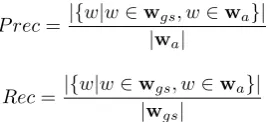
For the ACL correction, evaluation was performed on 500,000 fragments obtained as explained in Section 3.. We evaluate in terms of word-level precision and recall, com-puting the number of correctly predicted words. Formally, for an automatically produced sequencewa, we compute precision and recall by comparison with a gold standard se-quencewgs3:
3We consider these sequences as ordered lists of words, and
Although the literature dealing with formal and natural languages abounds with theoretical arguments of worst-case performance by various parsing strategies \[ e . g . , Griffiths & Petrick , 1965; Aho & Ullman , 1972;
Graham , Harrison & Ruzzo , Ig 80\] , there is little discussion of comparative performance based on actual practice in understanding natural language . Yet important practical considerations do arise when writing programs to understand one aspect or another of natural language utteran-ces . Where , for example , a theorist will characterize a parsing strategy according to its space and/or time requirements in attempting to analyze the worst possible input acc3rding to ˜ n arbitrary grammar strictly limited in expressive power , the researcher studying Natural Language Processing can be justified in concerning himself more with issues of practical performance in parsing sentences encountered in language as humans Actually use it using a grammar expressed in a form corve ˜ ie : to the human linguist who is writing it .
Figure 2: Corrected version of the excerpt from paper P81-1001,A Practical Comparison of Parsing Strategiesby Jonathan Slocum from Figure 1
P rec=|{w|w∈wgs, w∈wa}|
|wa|
Rec= |{w|w∈wgs, w∈wa}|
|wgs|
Precision and recall on the entire test data is a micro-average of the scores for the 500,000 sequences in the test data. We obtained a precision of 0.955 and recall of 0.950 on re-segmenting into words. Most of the errors we ob-served are caused by spaces in formulas, as in the exam-ples in Table 2. Partially discounting this type of error (which impacts very little, if at all the text processing of the ACL collection), the precision and recall become 0.979 and 0.974 respectively.
Because we want to apply the trained model to the B2005 portion of the collection for which we have no test data, we would like to have a better idea of what the results are likely to be. The fact that the papers in the B2005 portion of the collection come from the same domain as the A2005 portion which was used for training makes it highly likely that most of the vocabulary in B2005 is shared with A2005, but there will also be tokens unknown to the model. For this reason we performed an additional evaluation on the A2005 test data, for tokens that do not appear in the training or development data. The recall on these unknown tokens is 0.821, and the precision 0.876. Many of these unknown tokens are part of formulas, which, as mentioned before, we think is highly unlikely to impact information/keyword extraction, and other such tasks that focus on ”proper” text.
5.2.
Evaluation on corrected data (B2005)
The high performance on the test data and on unknown to-kens indicates that applying the model to the B2005 col-lection will likely solve many of the existing segmentation problems. In Figure 2 we include the version obtained after the word re-segmentation process of the fragment in Figure 1.The motivation that lead us to attempt correcting word seg-mentation errors was that they were so prevalent that even
tag N in the raw text in the corrected text incorrect 38 35 (92.1%) 3 (7.9%) correct 535 455 (85.05%) 453 (84.67%)
Table 3: Results on the keywords from a sample of 40 doc-uments
keywords presented such problems. Within the used ACL anthology was a file of keywords obtained with the SAF-FRON system (Bordea et al., 2014). This version of the system is no longer available to obtain keywords on the corrected version of the files. Because of this we decided to perform an evaluation with respect to the keywords ob-tained on the raw files: we selected randomly 40 papers from the collection published before 2005, and annotated each of their keywords ascorrectorincorrectwith respect to word segmentation4. This provided a total of 573 key-words, 38 of which were incorrect, and 535 correct. We tested each of these keywords against the raw and corrected versions of the corresponding files, and present the sum-mary of results in Table 3.
Of the 38 incorrect keywords, 35 actually appear in the raw files. Those that do not appear in the raw files seem to be caused by some preprocessing done by the keyword extrac-tor – e.g. for the paper A94-1014, the keyword that does not appear in the raw (or corrected) file is ”Computer Science Univ”, which seems to have been caused by collapsing the lines that contain the authors’ affiliations (”Dept . of Com-puter Science [new line] Univ . of Central Florida”). Only 3 of the 38 badly segmented keywords appear in the cor-rected files.
For the correct keywords, the reason why some do not ap-pear in the raw or the corrected files is mainly the prepro-cessing done by the keyword extractor (e.g. lemmatiza-tion). There are two correct keywords that appear in the raw files but not in the corrected files. One of these is lan-guage process(from paper P84-1101), which seems correct
4
0.6 0.65 0.7 0.75 0.8 0.85 0.9 0.95 1
1965 1970 1975 1980 1985 1990 1995 2000 2005
Occurrence rate
Year
Keyword relative occurrence (corrected/raw)
macro average micro average
0.6 0.65 0.7 0.75 0.8 0.85 0.9
1965 1970 1975 1980 1985 1990 1995 2000 2005
Occurrence rate
Year
Keyword occurrence
raw corrected
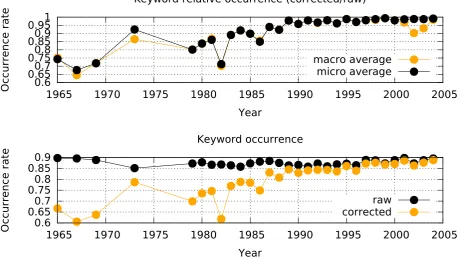
Figure 3: Proportion of keywords from the original (raw) files in the raw files and the corrected versions.
but in fact was extracted because of the erroneous segmen-tationlanguage process ing. The second error is a proper processing error: the keyphraserigid system-directed dia-logue structure(from paper E93-1061) appears in the cor-rected version asarigid system-directed dialogue structure, ”rigid” having been merged with the preceding indefinite article.
The results of the manual analysis show that the sequence to sequence model does indeed perform well on correcting the B2005. We performed an additional analysis to obtain an-other estimation of the impact of the word re-segmentation. A visual inspection of the ACL data shows that older papers appear more difficult for OCR processing as they seem to have been first scanned from prints of various quality. More recent papers were more often processed from directly pro-duced pdf files. This would indicate that older papers have more OCR (and thus, word segmentation) errors compared to more recent ones. This would mean that more recent papers have more of the extracted keywords (because they would be more likely to be correct) than older papers. We plot the rates of occurrence of the keywords in the raw and corrected versions on the files, by year, for the B2005 ar-ticles that have keywords. The top of Figure 3 shows the macro and micro average of the number of keywords that appear in the corrected vs. the raw articles (number of key-words that appear in the corrected files divided by the num-ber of keywords in the raw files). The bottom figure plots separately the rate of occurrence of the keywords in the raw and corrected files respectively, relative to the total number of keywords for each paper. The upward trend of the ratio of old keywords in the corrected files confirms the above observation, as in older papers fewer keywords appear in the corrected versions of the papers than in more recent
ones, correlating with the increase in OCR quality. The B2005 portion of the ACL collection was processed, and the re-segmented texts will be offered to the ACL anthology editors. Information about availability will be posted on the website of the University of Heidelberg’s Computational Linguistics Institute5.
6.
Conclusion
We have presented the character-level sequence-to-sequence model used to correct one of the very pervasive errors in the part of the ACL collection processed through OCR – spurious blank spaces that fragment words. The high results on the test portion of the data indicate that a large part of this type of errors could be corrected in the ACL collection. We have applied this process and produced a cleaner version of the ACL collection, which we will of-fer to the ACL anthology editors to make it available with the raw collection to the community.
7.
Acknowledgements
We thank our reviewers for their comments. This research was funded by the Leibniz Science Campus Empirical Lin-guistics & Computational Language Modeling, supported by Leibniz Association grant no. SAS-2015-IDS-LWC and by the Ministry of Science, Research, and Art of Baden-W¨urttemberg.
8.
Bibliographical References
Bordea, G., Buitelaar, P., and Coughlan, B. (2014). Hot topics and schisms in NLP: Community and trend
ysis with Saffron on ACL and LREC proceedings. In
Proceedings of the Ninth International Conference on Language Resources and Evaluation (LREC-2014). Eu-ropean Language Resources Association (ELRA). Chen, X., Qiu, X., Zhu, C., and Huang, X. (2015a). Gated
recursive neural network for chinese word segmentation. InProceedings of the 53rd Annual Meeting of the Asso-ciation for Computational Linguistics and the 7th Inter-national Joint Conference on Natural Language Process-ing (Volume 1: Long Papers), pages 1744–1753, Beijing, China, July. Association for Computational Linguistics. Chen, X., Qiu, X., Zhu, C., Liu, P., and Huang, X. (2015b).
Long short-term memory neural networks for chinese word segmentation. InProceedings of the 2015 Confer-ence on Empirical Methods in Natural Language Pro-cessing, pages 1197–1206, Lisbon, Portugal, September. Association for Computational Linguistics.
G´abor, K., Zargayouna, H., Buscaldi, D., Tellier, I., and Charnois, T. (2016). Semantic annotation of the acl an-thology corpus for the automatic analysis of scientific lit-erature. InLREC 2016.
Gordon, J., Zhu, L., Galstyan, A., Natarajan, P., and Burns, G. (2016). Modeling concept dependencies in a scien-tific corpus. InProceedings of the 54th Annual Meeting of the Association for Computational Linguistics (Vol-ume 1: Long Papers), pages 866–875. Association for Computational Linguistics.
Ng, H. T., Wu, S. M., Briscoe, T., Hadiwinoto, C., Susanto, R. H., and Bryant, C. (2014). The conll-2014 shared task on grammatical error correction. In Proceedings of the Eighteenth Conference on Computational Natu-ral Language Learning: Shared Task, pages 1–14, Bal-timore, Maryland, June. Association for Computational Linguistics.
Radev, D. and Abu-Jbara, A. (2012). Rediscovering acl discoveries through the lens of acl anthology network citing sentences. InProceedings of the ACL-2012 Spe-cial Workshop on Rediscovering 50 Years of Discoveries, pages 1–12. Association for Computational Linguistics. Sch¨afer, U., Read, J., and Oepen, S. (2012). Towards an
acl anthology corpus with logical document structure: an overview of the acl 2012 contributed task. In Proceed-ings of the ACL-2012 Special Workshop on Rediscover-ing 50 Years of Discoveries, pages 88–97. Association for Computational Linguistics.
Schmaltz, A., Kim, Y., Rush, A., and Shieber, S. (2017).
Adapting sequence models for sentence correction. In
Proceedings of the 2017 Conference on Empirical Meth-ods in Natural Language Processing, pages 2797– 2803, Copenhagen, Denmark, September. Association for Computational Linguistics.
Sennrich, R., Firat, O., Cho, K., Birch, A., Haddow, B., Hitschler, J., Junczys-Dowmunt, M., L¨aubli, S., Miceli Barone, A. V., Mokry, J., and Nadejde, M. (2017). Nematus: a toolkit for neural machine transla-tion. InProceedings of the Software Demonstrations of the 15th Conference of the European Chapter of the As-sociation for Computational Linguistics, pages 65–68, Valencia, Spain, April. Association for Computational Linguistics.
Sim, Y., Smith, N. A., and Smith, D. A. (2012). Discov-ering factions in the computational linguistics commu-nity. InProceedings of the ACL-2012 Special Workshop on Rediscovering 50 Years of Discoveries, pages 22–32. Association for Computational Linguistics.
Xie, Z., Avati, A., Arivazhagan, N., Jurafsky, D., and Ng, A. Y. (2016). Neural language correction with character-based attention.CoRR, abs/1603.09727.
Yang, J., Zhang, Y., and Dong, F. (2017). Neural word seg-mentation with rich pretraining. InProceedings of the 55th Annual Meeting of the Association for Computa-tional Linguistics (Volume 1: Long Papers), pages 839– 849, Vancouver, Canada, July. Association for Computa-tional Linguistics.
Yannakoudakis, H., Rei, M., Andersen, Ø. E., and Yuan, Z. (2017). Neural sequence-labelling models for gram-matical error correction. In Proceedings of the 2017 Conference on Empirical Methods in Natural Language Processing, pages 2785–2796, Copenhagen, Denmark, September. Association for Computational Linguistics. Yuan, Z. and Briscoe, T. (2016). Grammatical error