Efficient Tate Pairing Computation for Supersingular Elliptic Curves over Binary Fields
Soonhak Kwon
Department of Mathematics, Sungkyunkwan University, Korea [email protected]
Abstract: After Miller’s original algorithm for the Tate pairing computation, many improved algorithms have been suggested, to name just a few, by Galbraith et al. and Barreto et al., especially for the fields with characteristicthree. Also Duursma and Lee found a closed formula of the Tate pairing computation for the fields with characteristicthree. In this paper, we show that a similar argument is also possible for the finite fields with characteristictwo. That is, we present a closed formula for the Tate pairing computation for supersingular elliptic curves defined over the binary field F2m of odd dimension. There are exactly three isomorphism
classes of supersingular elliptic curves over F2m for odd m and our result is applicable to
all these curves. Moreover we show that our algorithm and also the Duursma-Lee algorithm can be modified to another algorithm which does not need any inverse Frobenius operation (square root or cube root extractions) without sacrificing any of the computational merits of the original algorithm. Since the computation of the inverse Frobenius map is not at all trivial in a polynomial basis and since a polynomial basis is still a preferred choice for the Tate pairing computation in many situations, this new algorithm avoiding the inverse Frobenius operation has some advantage over the existing algorithms.
Keywords: supersingular elliptic curve, Tate pairing, divisor, automorphism, roots of unity.
1. Introduction
With increasing use of the Tate pairing in cryptographic areas, a study of efficient computation of the Tate pairing becomes the subject of active research these days. Many cryptographic schemes are based on the bilinear pairings arising from the rank two abelian group structure of the points of prescribed order of the given elliptic curve. Examples of such cryptographic protocols are, to name just a few, identity based encryption scheme by Boneh and Franklin [10], short signature scheme by Boneh et al. [11], tripartite Diffie-Hellman key agreement protocol by Joux [12], identity based authenticated key agreement protocol by Smart [25], and identity based signature schemes by Hess [7], Sakai et al. [24]. In most of these applications, the Weil pairing or Tate pairing of supersingular elliptic curves (or curves of small embedding degrees) are essential tools. Therefore efficient computation of the Weil or Tate pairings is a crucial factor for practical applications of the above mentioned cryptographic protocols. The Weil pairing for a given elliptic curve is a symmetric bilinear pairing which can be thought of two applications of the Tate pairing. Thus the Weil pairing is more slow to compute than the Tate pairing, and consequently, it is desirable to replace the Weil pairing as the Tate pairing whenever it is possible in many cryptographic schemes.
of the Tate pairing. Eisentr¨ager et al. [13] introduced the notion of the squared Tate pairing. Scott and Barreto [2] and Granger et al. [9] discussed properties of compressed pairings. Bar-reto et al. [1] showed that the standard algorithm of Miller [19] can be modified to so called the BKLS algorithm where division in a finite field can be omitted since the denominator be-comes one after final powering. Also Duursma and Lee [3] presented a closed formula for the computation of the Tate pairing for a finite field with characteristicthree, which significantly reduces the cost of computing and is flexible for both of software and hardware applications. In this paper we show that an efficient closed formula can also be obtained for the com-putation of the Tate pairing for supersingular elliptic curves over a binary fieldF2m with odd
dimensionm. There are exactly three isomorphism classes of supersingular elliptic curves over F2m with m odd [15] and our method is applicable to all these curves, of which two are the
most commonly used curves with embedding degree 4. Also we present a method of avoiding inverse Frobenius operations in our and Duursma-Lee’s algorithms. When one wants to use a polynomial basis, inverse Frobenius operation is not at all trivial unlike the case of a normal basis and this inverse operation deteriorates the performance of the algorithms of Duursma-Lee and ours, which need two inverse Frobenius operations in each step of the algorithms. We propose new modified algorithms which avoid the inverse Frobenius map without affecting the computational merits of the original algorithms.
2. Elliptic curves and Miller’s algorithm
LetE be an elliptic curve over a finite fieldFqwhereq is a power of a prime. We may express
E as the following standard Weierstrass form
E :Y2+a1XY +a3Y =X3+a2X2+a4X+a6,
where the coefficients a1, a2, a3, a4, a6 are in Fq. Let E(Fq) be the set of all points P =
(x, y), x, y ∈ Fq, on the curve with the point at infinity O (which is (0,1,0) on the
corre-sponding homogeneous equation of degree 3 over a projective plane). E(Fq) has a structure
of an abelian group and the order |E(Fq)| is bounded by the following well known relation
due to Hasse [14],
|E(Fq)|=q+ 1−T r(ϕ), |T r(ϕ)| ≤2√q, (1)
whereT r(ϕ)∈Zis the trace of the Frobenius mapϕ:E−→E, withϕ(x, y) = (xq, yq),and ϕ is a zero of the characteristic polynomial h(X) = X2 −T r(ϕ)X+q. Let l be a positive integer and let E[l] (resp. E[l](Fq)) be the set of points P ∈ E(Fq) (resp. P ∈ E(Fq))
satisfyinglP =O, whereFq is an algebraic closure of Fq. Letkbe the minimal degree of the
extension satisfying E[l] ⊂ E(Fqk). Such k is called the embedding degree (or the security
multiplier) ofE[l] [1,15] and is dependent onE andl. Iflis prime toq, then it is well known [14,15] thatE[l]∼=Z/l⊕Z/l.
A divisorDon E is a formal (finite) sum of the pointsP on the curve
D=Xnp(P), np ∈Z. (2)
We callDa zero divisor ifPnp = 0. A principal divisor is a divisor of the form (f) =Pnp(P),
wheref is a rational function on E and P is a point of E with nP the order of multiplicity
of f at P, i.e. nP > 0 if f has a zero at P and nP < 0 if f has a pole at P. We say two
divisorsDandD0
are equivalent ifD−D0
a principal divisor (f) is a zero divisor, and a divisor D= Pnp(P) is a principal divisor if
D is a zero divisor and PnpP =O in the abelian group E(Fq). More precisely, there is an
isomorphism [15]
Div0/Divprin −→E, with D= X
np(P)7−→ X
npP, (3)
where the summation in the right side is the addition of points on the elliptic curveEandDiv0
(resp. Divprin) is a free abelian group generated by the zero divisors (resp. principal divisors).
Now suppose thatP ∈E[l]. Then the divisorl(P)−l(O) is a principal divisor so that there is a rational functionfP such that (fP) =l(P)−l(O). For any rational function f and any
divisorD =Pnp(P) having disjoint supports, one naturally define f(D) = Qf(P)np. The
Tate pairingτl on the set E[l] is defined as follows.
Definition 1. Let P ∈E[l](Fq) and Q∈E[l](Fqk). The Tate pairing is a map
τl:E[l](Fq)×E[l](Fqk)−→ {ζl}, with τl(P, Q) =fP(DQ) qk−1
l ,
wherefP is a rational function satisfying(fP) =l(P)−l(O)andDQis a zero divisor equivalent
to(Q)−(O)such that DQ and(fP)have disjoint supports. Also{ζl}is the group ofl-th roots
of unity inF×
qk.
It is well known thatτlis a non-degenerate bilinear pairing. That is, for anyP 6=O ∈E[l](Fq),
there exists a point Q ∈ E[l](Fqk) such that τl(P, Q) 6= 1. Also we have τl(P1 +P2, Q) =
τl(P1, Q)τl(P2, Q) and τl(P, Q1+Q2) = τl(P, Q1)τl(P, Q2). Non-degeneracy is not a trivial
result and a proof can be found in [6,17]. It is also easy to verify τld(P, Q) = τl(P, Q) for
P, Q∈E[l] andd >0 withld dividing|E(Fq)|.
An effective algorithm for finding a rational functionfP satisfying (fP) =l(P)−l(O) with
P ∈ E[l] is found by Miller [15,19]. Let us briefly explain the idea of Miller. For any zero divisorDand D0
, the isomorphism in (3) implies that there exist points P and P0
such that
D= (P)−(O) + (f), D0
= (P0
)−(O) + (f0
),
for some rational functionsf and f0
. Then one easily checks that
D+D0
= (P +P0
)−(O) + (f f0 `P,P0
`P+P0
), (4)
where`P,P0 is an equation of a line intersecting P and P0, and `P is an equation of a vertical
line intersectingP and −P. This can be verified using the relation
( `P,P0 `P+P0
) = (`P,P0)−(`P+P0)
= (P) + (P0
) + (−P −P0
)−3(O)− {(P +P0
) + (−P −P0
)−2(O)} = (P) + (P0
)−(P +P0
)−(O).
(5)
Thus the right side of (4) is
(P +P0
)−(O) + (f f0 `P,P0
`P+P0
) = (P +P0
)−(O) + (f f0
) + (P) + (P0
)−(P +P0
)−(O)
= (P) + (P0
)−2(O) + (f f0
) =D+D0
An elliptic curve E over Fq is called supersingular if T r(ϕ) ≡ 0 (mod p) where ϕ is the
Frobenius map andpis the characteristic ofFq. If an elliptic curveE overFqis supersingular,
then it is well known [15] that for anyldividing|E(Fq)|, the embedding degreekis bounded
by 6. More precisely, we have E[l] ⊂ E(Fqk) with k = 2,3,4,6. It is also well known [15]
that the embedding degree k = 6 is attained when the characteristic of Fq is three and the
embedding degreek= 4 is attained when the characteristic ofFq is two.
3. BKLS algorithm and the algorithm of Duursma and Lee
Barreto, Kim, Lynn, and Scott [1] showed that, for some supersingular curves with embedding degree k = 2,4,6, one can speed up the computation of the Tate pairing by observing that the denominators`Qappearing in the Miller’s algorithm can be omitted using the idea of the
distortion mapφintroduced in [18], whereφis a suitably chosen nontrivial automorphism of the given supersingular elliptic curve. That is, since the lineX−αintersectingQ= (α, β)∈Fq
and −Q has only X-coordinate and since this X-coordinate has the value in Fqk/2 after
applying φto Q, it becomes one after taking the final power by qk−1
l because l|qk/2+ 1 and
qk−1 = (qk/2−1)(qk/2+ 1). Therefore omitting `Q does not affect the final pairing value
and this greatly simplifies the Miller’s algorithm since the costly operation of division is not necessary. By the similar reasoning, Barreto et al. [1] also showed that it is not necessary to evaluate the Tate pairing at O, the point at infinity, since the image of O is already in the field Fq before taking the final power by q
k−1
l . To summarize, the BKLS algorithm can be
explained as follows.
Theorem 2.(Barreto et al. [1])LetE be a supersingular elliptic curve overFqwith embedding
degreek= 2,4,6and suppose that there is a suitable distortion mapφforE. Letlbe a positive integer dividing |E(Fq)| with gcd(l, q) = 1 and let {ζl} be the group of l-th roots of unity in
F×qk. Then the modified Tate pairing
τl:E[l](Fq)×E[l](Fq)−→ {ζl}, with τl(P, Q) =fP(φ(Q)) qk−1
l ,
is a non-degenerate bilinear pairing, where fP is a rational function with denominator one,
i.e. a polynomial, satisfying (fP) =l(P)−l(O).
The crucial difference between the above pairing with a distortion mapφand the conventional Tate pairing is that this new pairing is symmetric as long asE[l](Fq) is a cyclic group, while
the original Tate pairing is not. The reason is that, in this new pairing, both of the pointsP and Q are in the same cyclic group E[l](Fq) generated by a point R of orderl. Thus there
are integersaand b satisfying P =aR and Q=bR so that we have
τl(P, Q) =τl(aR, bR) =τl(R, R)ab=τl(bR, aR) =τl(Q, P). (6)
Efficient computation of the Tate pairing is closely related with efficient computation of the scalar multiplicationlP of a given pointP since one has to find a rational functionfP satisfying
(fP) =l(P)−l(O). Usually a binary representation of l is used for the field F2m or the field
Fp withp a prime. A (balanced) ternary representation ofl is an optimal choice forF3m and
both of the algorithms of BKLS [1] and Duursma-Lee [3] made careful studies for this case. For a field with characteristic three, Fq with q = 3m, Duursma and Lee [3] noticed that
ldividingq3+ 1, since the ternary expansion ofq3+ 1 is trivial. That is, if one writegQ as a
rational function satisfying
3(Q)−3(O) = (3Q)−(O) + (gQ),
then, by repeated applications of the above equation, one has
33m(P)−33m(O) = (33mP)−(O) + (g3P3m−1g333Pm−2· · ·g333m−2Pg33m−1P).
It is shown [3] that the rational function
f =
3m Y
i=1
g33i3−m1−Pi =g3 3m−1
P g3
3m−2
3P · · ·g333m−2Pg33m−1P (7)
can be used for a computation of the Tate pairing as
τl(P, Q) =f(φ(Q))3
3m−1
. (8)
Duursma and Lee showed that the value f(φ(Q)) = Q3i=1{m g3i−1P(φ(Q))}3 3m−i
has certain cyclic property with regard to the polynomialsg33i3−m1−Pi so that they found a nice closed formula
[3] forf as a product ofm (not 3m) polynomials.
4. Tate pairing computation for binary fields with closed formulas
4.1. Supersingular elliptic curves over binary fields
For cryptographic purposes, it is natural to think of elliptic curves defined over F2m withm
odd or more strongly a prime. There are exactly three isomorphism classes of supersingular elliptic curves overF2m whenm is odd [15]. Namely they are
Y2+Y =X3, Y2+Y =X3+X, Y2+Y =X3+X+ 1. (9)
Among them, the curves
Eb:Y2+Y =X3+X+b, b= 0,1 (10)
have the embedding degree (or security multiplier) k= 4 while the curve Y2+Y =X3 has k= 2. Thus we are mainly interested in the curves Eb though our method is also applicable
to the curveY2+Y =X3. The Frobenius mapϕ:E
b−→Eb withϕ(x, y) = (x2, y2) is a root
of the characteristic polynomial
h(X) =X2±2X+ 2 = (X−ϕ)(X−ϕ).¯
We also have the order|Eb(F2m)| of the group of rational pointsEb(F2m) as
|Eb(F2m)|= 2m+ 1−T r(ϕm),
where T r(ϕm) = ϕm + ¯ϕm and ϕm(x, y) = (x2m
, y2m
). Letting cj = T r(ϕj), one can find
the values of cj using the following second order liner recurrence relations (or Lucas type
sequences) arising from the characteristic polynomialh(X),
with c0 = 2 and c1 = ∓2. From the above relations, it is straightforward to see [15] that
Eb(F2m) is a cyclic group of order
|Eb(F2m)|= 2m+ 1 + (−1)b√2·2m, if m≡1,7 (mod 8)
= 2m+ 1−(−1)b√2·2m, if m≡3,5 (mod 8). (12)
4.2. Closed formula of the Tate pairing for F2m
As in the characteristic three case of Duursma and Lee [3], we want to derive a closed formula for the Tate pairing computation using the simple equality for our binary case,
22m+ 1 = (2m+ 1 + 2m+12 )(2m+ 1−2
m+1 2 ).
LetP = (α, β) be a point on the curveEb :Y2+Y =X3+X+b, b= 0,1. Then one has
−P = (α, β+ 1) and 2P = (α4+ 1, α4+β4). Thus we get
22P = (α24, β24 + 1) =−ϕ4(P), 23P = (α26 + 1, α26+β26 + 1), 24P = (α28, β28),
whereϕ4+ 4 = 0, i.e. h(X) = X2±2X+ 2 divides X4+ 4. Using this cyclic property, one finds easily
2i−1
P = (α22i−2 +i−1, β22i−2 + (i−1)α22i−2 +²i)
= (α(2i−2)
+i−1, β(2i−2)
+ (i−1)α(2i−2)
+²i),
(13)
whereα(j) (resp. β(j)) is defined as α(j) =α2j
(resp. β(j)=β2j
) and²i is defined as
²i= 0 if i≡1,2 (mod 4) and ²i = 1 if i≡3,4 (mod 4). (14)
For an effective Tate pairing computation, the following distortion map (nontrivial automor-phism) is chosen [1] forEb,
φ:Eb −→Eb, with φ(x, y) = (x+s2, y+sx+t), (15)
wheres2+s+ 1 = 0 and t2+t+s= 0. That is,
F2(s) =F22, F2(t) =F24, s=t5, t4+t+ 1 = 0, (16)
andtis a generator of the cyclic groupF×24 of order 15. Therefore if P is a point of orderl in
F2m withm odd, thenφ(P)∈E(F24m) butφ(P)6∈E(F22m), and the two pointsP andφ(P)
generate all points of orderl as a Z/l module.
For any point Qon the curve Eb, let us write gQ as a rational function satisfying
2(Q)−2(O) = (2Q)−(O) + (gQ).
By the Miller’s formula in (4), we have gQ = `Q,Q/`2Q and the denominator `2Q can be
omitted by the result of Barreto et al. [1]. Now for a given pointP ∈Eb(F2m), one repeatedly
has
2(P)−2(O) = (2P)−(O) + (gP),
22(P)−22(O) = 2{(2P)−(O)}+ (g2P) = (22P)−(O) + (gP2g2P),
23(P)−23(O) = 2{(22P)−(O)}+ (g2P2g22P) = (23P)−(O) + (gP22g22Pg22P), · · ·
Letting
fP =
2m Y
i=1
g22i2−m1−Pi =g2 2m−1
P g2
2m−2
2P · · ·g222m−2Pg22m−1P, (17)
we have
22m(P)−22m(O) = (22mP)−(O) + (fP) and (P)−(O) = (P)−(O) + (1).
Thus the equation (4) of the Miller’s formula again says
(22m+ 1){(P)−(O)}= (fP`P), (18)
because 22mP = −P. Note that the line `
P can also be omitted in the actual computation
by the BKLS algorithm. Therefore after adjusting the irrelevant factors, we can say that
(fP) = (22m+ 1){(P)−(O)}= 2
2m+1
l · {l(P)−l(O)}= 2
2m+1
l (f
0
P), (19)
wheref0
P is a rational function satisfyingl(P)−l(O) = (f
0
P). Thus we have the Tate pairing
τl(P, Q) =fP0 (φ(Q))
24m−1
l =f0
P(φ(Q))
22m+1
l (2
2m−1)
=fP(φ(Q))2
2m−1
. (20)
From the equation (17), the rational functionfP is just a product of the functions of the form
g2i−1P and, in view of the BKLS algorithm, the rational function g2i−1P can be regarded as
the tangent line at the point 2i−1
P. Thus all we have to do is to find an explicit expression offP =Q2i=1m g2
2m−i
2i−1P.
Lemma 3. Let P = (α, β), Q = (x, y) be points in Eb(F2m). Then one has the value of
{g2i−1P(φ(Q))}2 2m−i
={g2i−1P(x+s2, y+sx+t)}2 2m−i
as
{g2i−1P(φ(Q))}2 2m−i
=α(i−1)
x(−i)
+β(i−1)
+y(−i)
+s(α(i−1)
+x(−i)
) +t+b,
where gR(X, Y) =`R,R is an equation of the tangent line at R.
Proof. The tangent line at P = (α, β) on the curve Eb : Y2 +Y = X3 +X+b is Y =
(α2+ 1)X+β2+b. Thus we have 2(P)−2(O) = (2P)−(O) + (`gP
2P) where
gP(x, y) = (α2+ 1)x+β2+b−y, (21)
and`2P is the vertical line intersecting 2P and −2P. Since`2P can be removed in view of the
BKLS algorithm [1], we are mainly interested in the computations of the linesg2i−1P. Using
the equation (13), one has
g2i−1P(x, y) = (α(2i −1)
+i)x+β(2i−1)
+ (i−1)α(2i−1)
+²i+b−y.
Therefore, by applying the distortion mapφto the point Q= (x, y), we get
Taking 22m−i
-th power of both sides of the above equality,
{g2i−1P(φ(Q))}2 2m−i
= (α(i−1)
+i)(x(2m−i)
+s(2m−i+1)
) +β(i−1)
+ (i−1)α(i−1)
+²i+b
−(y(2m−i)
+s(2m−i)
x(2m−i)
+t(2m−i)
)
=α(i−1)
x(2m−i)
+{i−s(2m−i)
}x(2m−i)
+{s(2m−i+1)
+i−1}α(i−1)
+β(i−1)
+b−y(2m−i)
+{is(2m−i+1)
+²i−t(2m−i)}.
(23)
Froms2+s+ 1 = 0, we haves(2)=s4 =s, s(3)=s2 =s+ 1, s(4)=s,· · ·. That is,
s(j)=s+ 1 if j=odd and s(j)=s if j=even. (24)
The coefficientsi−s(2m−i)
(resp. i−1 +s(2m−i+1)
) ofx(2m−i)
(resp. α(i−1)
) in the equation (23) have a unique value equal tosindependent of the choices ofibecauseiand 2m−ialways have the same parity. For example, wheniis odd,i−s(2m−i)
= 1 +s+ 1 =sand also when iis even,i−s(2m−i)
= 0 +s=s. That is, for anyi, we get
i−s(2m−i)
=s=i−1 +s(2m−i+1)
. (25)
Fromt2 =t+s, we havet(2)=t22 =t+s+s2=t+1, t(3)=t23 =t+s+1, t(4) =t+s+s2+1 = t, t(5)=t2 =t+s,· · ·. Therefore, for anyj≥0, we have
t(4j) =t, t(4j+1) =t+s, t(4j+2) =t+ 1, t(4j+3)=t+s+ 1. (26)
Now using the equations (14),(24),(26), it is trivial to show that the last term of the equation (23) has the value
is(2m−i+1)
+²i−t(2m−i)=t (27)
independent of the choices ofi. This can be proved as follows. Since the extension degreem is odd, we havem≡1 (mod 4) or m≡3 (mod 4). In any case, we get 2m≡2 (mod 4) and letting 2m= 4j+ 2 for some j,
is(2m−i+1)
+²i−t(2m−i)=is(4j+3−i)+²i−t(4j+2−i). (28)
By taking i (mod 4) and noticing that our field has characteristic two, we easily get the equation (27). Sincex, y, α, β are all inF2m, the values x(j), y(j), α(j), β(j) are determined up
to the residue classes ofj (mod m) andx(j)withj∈Z(resp. y(j), α(j), β(j)) is understood as x(j)=x2j0 wherej0
, 0≤j0
≤m−1,is a unique integer satisfyingj0
≡j (mod m). Therefore we get
{g2i−1P(φ(Q))}2 2m−i
=α(i−1)
x(−i)
+sx(−i)
+sα(i−1)
+β(i−1)
+y(−i)
+t+b
=α(i−1)
x(−i)
+β(i−1)
+y(−i)
+s(α(i−1)
+x(−i)
) +t+b.
Theorem 4. One has the Tate pairingτl(P, Q) =fP(φ(Q))2
2m−1 where
fP(φ(Q)) = m Y
i=1
{α(i)x(−i+1)
+β(i)+y(−i+1)
+s2(α(i)+x(−i+1)
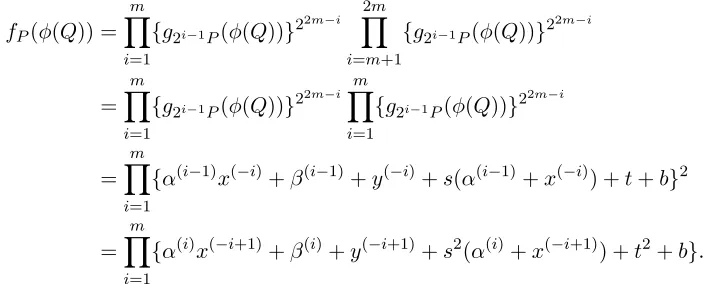
Proof. By the equation (17) and (20), we have fP(φ(Q)) = Qi2=1{m g2i−1P(φ(Q))}2 2m−i
and since allx(j), y(j), α(j), β(j) are determined up to the residue classes of j (modm),
fP(φ(Q)) = m Y
i=1
{g2i−1P(φ(Q))}2
2m−i Y2m
i=m+1
{g2i−1P(φ(Q))}2 2m−i
=
m Y
i=1
{g2i−1P(φ(Q))}2
2m−iYm
i=1
{g2i−1P(φ(Q))}2 2m−i
=
m Y
i=1 {α(i−1)
x(−i)
+β(i−1)
+y(−i)
+s(α(i−1)
+x(−i)
) +t+b}2
=
m Y
i=1
{α(i)x(−i+1)
+β(i)+y(−i+1)
+s2(α(i)+x(−i+1)
) +t2+b}.
5. Efficient field arithmetic for the computation of fP(φ(Q))
The computation of fP(φ(Q)) involves multiplications in F24m. A natural way to do this
is to use a basis for F24m over F2m and transforms a multiplication in F24m into several
multiplications inF2m. Since the extension degree is 4, we may use an optimal normal basis
of type I but we will stick to the polynomial basis {1, t, t2, t3} for F
24m with the minimal
polynomial oft asX4+X+ 1 overF2m. Usings2 =t2+t+ 1, we may express the element
α(i)x(−i+1)
+β(i)+y(−i+1)
+s2(α(i)+x(−i+1)
) +t2+bas
α(i)x(−i+1)
+β(i)+y(−i+1)
+s2(α(i)+x(−i+1)
) +t2+b=w+zt+ (z+ 1)t2,
where
z=α(i)+x(−i+1)
, w=z+α(i)x(−i+1)
+β(i)+y(−i+1)
+b. (29)
Letting C = c0+c1t+c2t2+c3t3, ci ∈ F2m, be the partial product in the computation of
fP(φ(Q)), we have
C·(w+zt+ (z+ 1)t2) = (c0+c1t+c2t2+c3t3)(w+zt+ (z+ 1)t2)
=c0 0+c
0 1t+c
0 2t2+c
0 3t3,
(30)
where
c0
0 =c0w+ (c2+c3)(z+ 1) +c3
c0
1 =c0w+ (c1+c2+c3)w+ (c0+c2+c3)(w+z+ 1) +c3(z+ 1) +c0+c3
c0
2 =c0w+ (c1+c2+c3)w+ (c0+c2+c3)(w+z+ 1) + (c1+c2)(w+z+ 1) +c1
c0
3 = (c1+c2+c3)w+ (c1+c2)(w+z+ 1) +c2.
(31)
Therefore one needs only 6 multiplications for the computation ofC·(w+zt+ (z+ 1)t2).
Table 1. An algorithm for computingfP(φ(Q))
————————————————————————— Input: P = (α, β), Q= (x, y)
C←1
for (i= 1 to m ;i+ +) α←α2, β←β2
z←α+x, w←z+αx+β+y+b C←C·(w+zt+ (z+ 1)t2)
x←x2m−1, y←y2m−1 end for
————————————————————————–
Assuming that we are using a normal basis for F2m overF2, the Frobenius maps in Table 1
contribute a negligible cost. Moreover the mapx←x2m−1 is just a left cyclic shifting by one position of the vectorxwith respect to a normal basis whilex←x2is a right cyclic shifting by
one position. All these Frobenius maps are especially useful if one wants an efficient hardware implementation. If we ignore the costs of Frobenius maps and F2m-additions, we find that
exactly 7F2m-multiplications are needed in each round of the for-loop, where the computation
of w needs one multiplication in F2m and the computation of C needs 6 multiplications in
F2m by the equation (31). Compare our result with the similar result inF3m case of Duursma
and Lee where each step of the algorithm in [3] requires 17 F3m-multiplications with trace
computation technique [2] and can be reduced to 14F3m-multiplications [8] with loop unfolding
technique.
It should be mentioned that one can also use a normal basis for F24m over F2m instead
of using {1, t, t2, t3} with t4+t+ 1 = 0. Letting t3 = γ, one has γ5 = 1 and the minimal
polynomial of γ over F2m is X4 +X3 +X2 +X + 1. Therefore we have a normal basis
{γ, γ2, γ22, γ23}={γ, γ2, γ3, γ4}of type I overF2m. Using the relationt= 1
t3+1 = γ+11 =γ3+
γ, one may reformulate the equations (30) and (31) with respect to the basis{γ, γ2, γ3, γ4}. In
this case, the number of necessary additions inF2m slightly increases, however the expressions
of the coefficients ofC in (31) have more regular patterns which are particularly useful for a hardware implementation.
Computing the final powering by 22m−1 is a formidable task. However in some situations
like a signature verification, one only needs to determine whetherτl(P, Q) =τl(P0, Q0) without
having to know the exact value ofτl(P, Q) =fP(φ(Q))2
2m−1
. In this case, it suffices to check whether fP(φ(Q))2
2m
fP0(φ(Q0)) = fP(φ(Q))fP0(φ(Q0))2 2m
and the cost of this operation is much cheaper than the cost of the exponentiation by 22m −1. Replacing 22m by 33m, the same technique is also applicable to the Duursma-Lee algorithm [3].
6. Algorithms without inverse Frobenius operations for polynomial basis arith-metic in F2m and F3m
polynomial basis outperforms a method with a normal basis since one needs many operations of multiplication while only two cube root operations are needed in each step of the Duursma-Lee algorithm [3,8] and since the cost of a multiplication with a normal basis is quite expensive than that of a polynomial basis in general situations. With a small amount of precomputa-tion, Granger et al. [8] showed that a cube root operation inF3m has roughly the same cost
as 2/3 multiplication inF3m. The same method in [8] can be applied to our characteristictwo
case so that we can show that the cost of one square root operation is roughly equal to the cost of 1/2 multiplication with a precomputation. It should be mentioned that a general case without a precomputation is not so simple and one needs at leastO(m2log2m) additions in F2 to find a square root in F2m as is observed by Barreto et al. [2], though the complexity
can be reduced to O(m2) additions in F
2 if we use a low weight polynomial like a trinomial
or a pentanomial.
6.1. Avoiding square root extraction
In this section, we briefly remark that a close examination of the algorithm in Table 1 reveals that one may derive a new algorithm for the Tate pairing computation which does not need any inverse Frobenius operation (like square root or cube root extractions). Our method is also applicable to the characteristic three case of Duursma an Lee [3] and will be explained later. Let us first study the binary case here. From Theorem 4, we know that
fP(φ(Q)) = m Y
i=1
{α(i)x(−i+1)
+β(i)+y(−i+1)
+s2(α(i)+x(−i+1)
) +t2+b}. (32)
We defineAi as the conjugates of the terms in the product of the above formula by
Ai(m−i) =Ai2m−i =α(i)x(−i+1)
+β(i)+y(−i+1)
+s2(α(i)+x(−i+1)
) +t2+b
so that
fP(φ(Q)) = m Y
i=1
Ai2m−i =A12m−1A22m−2· · ·Am = (· · ·(((A1)2A2)2A3)2· · ·)2Am. (33)
SinceAi is in F24m, we getAi(4m)=Ai. Therefore, using the factα, β, x, y∈F2m, we have
Ai = (A(m
−i)
i )2
3m+i
=α(2i)x(1)+β(2i)+y(1)+s(3m+1+i)(α(2i)+x(1)) +t(3m+1+i)+b
=α(2i)x2+β(2i)+y2+s(i)(α(2i)+x2) +t(m−1+i)
+b, (34)
becauses(j) is determined up to j (mod 2) with 3m+ 1≡0 (mod 2) andt(j) is determined up toj (mod 4) with 3m+ 1≡m−1 (mod 4) as is clear from the equations (24) and (26). Using the cyclic property of t(j) in the equation (26), it is not difficult to see that, for all indices 1≤i≤m,Ai can be written as Ai =Ai(t) =w+zt+ (z+ 1)t2 for somez andw in
F2m. Thus, similarly as in the equations (30) and (31), one needs 6 F2m-multiplications for
computingC·Ai(t) with respect to the basis{1, t, t2, t3}for anyC ∈F24m. We now have the
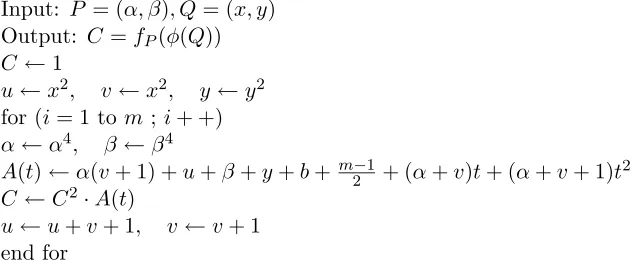
following algorithm for computingfP(φ(Q)) which avoids inverse Frobenius operations.
Table 2. An algorithm for computingfP(φ(Q)) avoiding inverse Frobenius operation
Input: P = (α, β), Q= (x, y) Output: C =fP(φ(Q))
C←1
u←x2, v←x2, y←y2 for (i= 1 to m ;i+ +) α←α4, β←β4
A(t)←α(v+ 1) +u+β+y+b+ m−1
2 + (α+v)t+ (α+v+ 1)t2
C←C2·A(t)
u←u+v+ 1, v←v+ 1 end for
————————————————————————–
Note that the coefficients of Ai(t) depend on the values of s(i) and t(m−1+i) and they are
recursively computed by the relation (24) and (26). We have the initial values s(1) = s2 = t2+t+ 1 and t(m)=t2+m−1
2 and thus we get
A1(t) =αx+β+y+ (t2+t+ 1)(α+x) +t2+ m2−1+b
=α(x+ 1) +x+β+y+b+m−1
2 + (α+x)t+ (α+x+ 1)t2,
A2(t) =αx+β+y+ (t2+t)(α+x) +t+ 1 +m2−1+b
=αx+ 1 +β+y+b+m−1
2 + (α+x+ 1)t+ (α+x)t2,
A3(t) =α(x+ 1) + (x+ 1) +β+y+b+m2−1 + (α+x)t+ (α+x+ 1)t2,
A4(t) =αx+β+y+b+m2−1 + (α+x+ 1)t+ (α+x)t2.
Using the intermediate valuesu, vwith the relationsu←u+v+ 1, v←v+ 1, the pair covers all the possible values (u, v) = (x, x),(1, x+ 1),(x+ 1, x),(0, x+ 1) and the algorithm in Table 2 is justified. In each step of the above algorithm, one needs 7 F2m-multiplications which is
same to the algorithm in Table 1. Since the operationC←C2 needs 4 squaring operations in
F2m and since the operationsα ←α4, β ←β4 need the same 4 squaring operations, the total
number of necessary squaring is 8 in this new algorithm. On the other hand, the algorithm in Table 1 needs 2 squaring and 2 square root operations. Therefore our new algorithm in Table 2 is a more optimal choice if one is interested in the implementation with a polynomial basis since this new algorithm uses 6 Frobenius operations instead of using 2 inverse Frobenius operations.
6.2. Avoiding cube root extraction from the algorithm of Duursma and Lee
Duursma and Lee [3] found a close formula for the following supersingular elliptic curves defined overF3m withm prime to 6,
Eb :Y2 =X3−X+b, b=±1. (35)
For the above mentioned curves, the following distortion map (nontrivial automorphism) is used,
φ:Eb −→Eb, with φ(x, y) = (ρ−x, σy), (36)
whereσ2+ 1 = 0 andρ3−ρ−b= 0. That is,F
3(σ) =F32 andF3(ρ) =F33. A closed formula
can be written asτl(P, Q) =fP(φ(Q))3
3m−1
where
fP(φ(Q)) = m Y
i=1
{−σβ(i)y(−i+1)
−(α(i)+x(−i+1)
−ρ+b)2}, (37)
and fP is a rational function satisfying (fP) = (33m+ 1){(P)−(O)}. Now define the
inter-mediate valuesµand λas
µ=α(i)+x(−i+1)
+b∈F3m and λ=−σβ(i)y(−i+1)−µ2∈F32m.
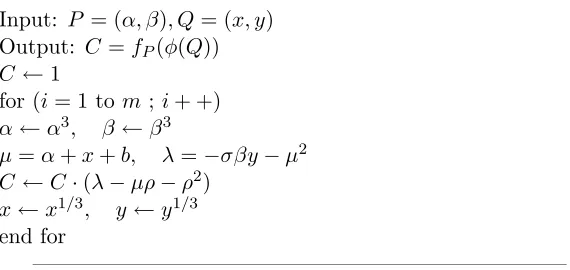
Then the formula (37) to computefP(φ(Q)) is realized by the following algorithm [2,3,8].
Table 3. Duursma-Lee algorithm for computingfP(φ(Q))
————————————————————————— Input: P = (α, β), Q= (x, y)
Output: C =fP(φ(Q))
C←1
for (i= 1 to m ;i+ +) α←α3, β←β3
µ=α+x+b, λ=−σβy−µ2 C←C·(λ−µρ−ρ2)
x←x1/3, y←y1/3 end for
————————————————————————–
One needs 2 cube root operations in each step of the above algorithm. However it is not so difficult, by using the same technique of the previous section, to show that one can have a new algorithm where 2 cube root operations (inverse Frobenius) are replaced by 8 cube operations (Frobenius) without affecting the number of multiplications inF3m, which are quite useful in
polynomial basis arithmetic. Let us define Ai ∈ F36m as the conjugates of the terms in the
product formula (37) by
Ai(m−i)=Ai3m−i =−σβ(i)y(−i+1)
−(α(i)+x(−i+1)
−ρ+b)2 (38)
so that
fP(φ(Q)) = m Y
i=1
Ai3m−i =A13m−1A32m−2· · ·Am = (· · ·(((A1)3A2)3A3)3· · ·)3Am. (39)
SinceAi is inF36m, we getAi(6m)=Ai. From the equation (38), using the factα, β, x, y∈F3m,
we have
Ai = (A(m
−i)
i )3
5m+i
=−σ(5m+i)β(2i)y(1)−(α(2i)+x(1)−ρ(5m+i)+b)2
= (−1)i+1σβ(2i)y(1)−(α(2i)+x(1)−ρ+ (m+ 1−i)b)2, (40)
because the relationsσ2+ 1 = 0, ρ3−ρ−b= 0 imply
Lettingµ=α(2i)+x(1)+ (m+ 1−i)b∈F3m andλ= (−1)i+1σβ(2i)y(1)−µ2 ∈F32m from the
equation (40), one finds that
Ai=λ−µρ−ρ2. (42)
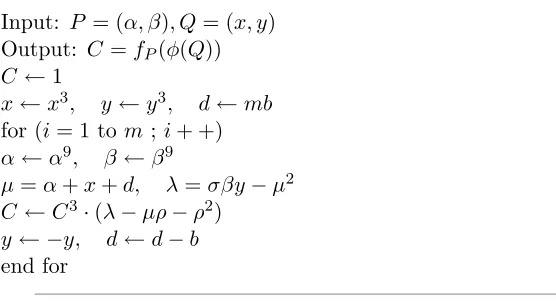
Therefore the modified algorithm is given as follows.
Table 4. A modified Duursma-Lee algorithm without cube root operations —————————————————————————
Input: P = (α, β), Q= (x, y) Output: C =fP(φ(Q))
C←1
x←x3, y ←y3, d←mb
for (i= 1 to m ;i+ +) α←α9, β←β9
µ=α+x+d, λ=σβy−µ2
C←C3·(λ−µρ−ρ2) y← −y, d←d−b end for
————————————————————————-In each step of the above algorithm, the number of necessary multiplications inF3m is same to
that of the algorithm in Table 3. Since the cube operationC←C3 with respect to the basis
{1, ρ, ρ2}overF
32m costs 6 cube operations inF3m and since the operations α←α9, β ←β9
cost 4 cube operations in F3m, the total number of necessary Frobenius operations in each
step of the above algorithm is 10. Note that the Duursma-Lee algorithm in Table 3 needs 2 Frobenius operations plus 2 inverse Frobenius operations. Therefore our modified algorithm uses 8 Frobenius operations instead of using 2 inverse Frobenius operations. In a polynomial basis, it is safe to believe [8] that the cost of 4 cube operations is cheaper than the cost of one cube root operation.
It should be mentioned that our technique of avoiding inverse Frobenius operations can also be applied to the refined algorithm of Granger et al. [9], where the for-loop in Table 3 is unrolled so that it has m−1
2 steps and a multiplication of twoλ−µρ−ρ2 is executed before
being multiplied to the partial product C. The only thing we have to do is to redefine Ai in
the equation (39) appropriately so that the multiplication AiAi+1 is performed before being
multiplied toC.
7. Tate pairing computation for Y2+Y =X3
Among the three isomorphism classes of supersingular elliptic curves over a binary field F2m
with m = odd, Eb : Y2 +Y = X3 +X+b, b = 0,1 and E : Y2 +Y = X3, the curve
Y2 +Y = X3 has the embedding degree k = 2. Though the curve Y2 +Y = X3 is not so interesting in terms of the bandwidth, i.e. the imbedding degree k = 2, we will discuss a method of efficient Tate pairing computation with a closed formula. Note that a similar formula (like the cases of characteristictwoandthree) is not available for a prime fieldFp with
p 6= 2,3 and one has the same embedding degree k = 2 for this prime field case. Although the curve E : Y2 +Y = X3 is not discussed by Barreto et al. in the BKLS algorithm [1],
LetP = (α, β) be a point on the curveE :Y2+Y =X3. Then one has−P = (α, β+ 1) and 2P = (α4, β4+ 1) =−ϕ2(P). Thus we get
22P = (α24, β24) =ϕ4(P),
whereϕ4−4 = 0, i.e. h(X) =X2+ 2 divides X4−4. Using this property, it is easy to show inductively
2i−1
P = (α22i−2, β22i−2+i−1) = (α(2i−2)
, β(2i−2)
+i−1). (43)
For an effective Tate pairing computation, we will use the following distortion map (nontrivial automorphism) forE,
φ:E −→E, with φ(x, y) = (x+ 1, y+x+t), (44)
wheret ∈F22 with t2 +t+ 1 = 0. It is clear that the proposed map φ is an automorphism
since the following equality can be easily checked,
(y+x+t)2+ (y+x+t) = (x+ 1)3. (45)
Lemma 5. With the above distortion map, the lineX−u intersecting R= (u, v) and −R= (u, v+ 1)with R∈E(F2m) can be omitted without altering the pairing value.
Proof. The lineX−u evaluated at the pointφ(Q) withQ= (x, y)∈E(F2m) is x+ 1−u. By
applying the final powering by 22m−1
l = (2m−1)
(2m+1)
l , one has (x+ 1−u)
22m−1
l = 1 because
x, u∈F2m andl divides|E(F2m)|= 2m+ 1.
Lemma 6. Let P = (α, β), Q= (x, y) be points in E(F2m) withE :Y2+Y =X3. Then one
has the value of{g2i−1P(φ(Q))}2
m−i
={g2i−1P(x+ 1, y+x+t)}2
m−i
as {g2i−1P(x+ 1, y+x+t)}2
m−i
=α(i−1)
x(−i)
+ (α+β)(i−1)
+ (x+y)(−i)
+t.
Proof. The tangent line atP = (α, β) on the curveE:Y2+Y =X3 isY =α2X+β2. Thus we havegP(x, y) =α2x+β2−y and using the equation (43), we get
g2i−1P(x+ 1, y+x+t) =α(2i −1)
(x+ 1) +β(2i−1)
+i−1−(y+x+t). (46)
Taking 2m−i
-th power of the both sides of the above equality,
{g2i−1P(x+ 1, y+x+t)}2
m−i
=α(i−1)
(x(−i)
+ 1) +β(i−1)
+i−1−(y(−i)
+x(−i)
+t(m−i)
). (47)
Sincet(1) =t2 =t+ 1, one has t(2) =t4=t, t(3)=t+ 1, t(4)=t,· · ·.That is,
t(j)=t+j, (48)
for anyj because we are in the field with characteristictwo. Thus we havet(m−i)
=t+m−i in the equation (47) and therefore
{g2i−1P(φ(Q))}2
m−i
=α(i−1)
(x(−i)
+ 1) +β(i−1)
+i−1−(y(−i)
+x(−i)
+t+m−i)
=α(i−1)
x(−i)
+ (α+β)(i−1)
+ (x+y)(−i)
Theorem 7. One has the Tate pairingτl(P, Q) =fP(φ(Q))2 m−1
where
fP(φ(Q)) = m Y
i=1
{g2i−1P(φ(Q))}2
m−i
=
m Y
i=1 {α(i−1)
x(−i)
+ (α+β)(i−1)
+ (x+y)(−i)
+t},
andfP is a rational function satisfying(2m+ 1){(P)−(O)}.
One may derive the same algorithms as in Table 1 and 2 for this case also but we omit them here since the method is pretty straightforward.
8. Conclusions
In this paper we showed that an efficient closed formula can be derived for the Tate pairing computation for supersingular elliptic curves over a binary fieldF2m of odd dimension. There
are exactly three isomorphism classes of supersingular elliptic curves overF2m withmodd and
our method is applicable to all these curves. Each step of our algorithm requires two inverse Frobenius operations like the characteristic three case of Duursma and Lee. To overcome the computational complexity of the inverse Frobenius operation in a polynomial basis, we modified our algorithm and the algorithm of Duursma and Lee, and presented another closed formula which does not need any inverse Frobenius operation, which is especially useful for polynomial basis arithmetic.
References
[1] P. Barreto, H. Kim, B. Lynn, and M. Scott, “Efficient algorithms for pairing based cryp-tosystems,” Crypto 2002, Lecture Notes in Computer Science, vol. 2442, pp. 354–368, 2002. [2] M. Scott and P. Barreto, “Compressed pairings,”Crypto 2004, Lecture Notes in Computer Science, to appear, 2004.
[3] I. Duursma and H. Lee, “Tate pairing implementation for hyperelliptic curvesy2 =xp− x+d,” Asiacrypt 2003, Lecture Notes in Computer Science, vol. 2894, pp. 111–123, 2003. [4] S. Galbraith, “Supersingular curves in cryptography,” Asiacrypt 2001, Lecture Notes in Computer Science, vol. 2248, pp. 495–513, 2001.
[5] S. Galbraith, K. Harrison, and D. Soldera, “Implementing the Tate pairing,”ANTS 2002, Lecture Notes in Computer Science, vol. 2369, pp. 324–337, 2002.
[6] F. Hess, “A Note on the Tate pairing of curves over finite fields,” Arch. Math. vol. 82, pp. 28–32, 2004.
[7] F. Hess, “Efficient identity based signature schemes based on pairings,”SAC 2002, Lecture Notes in Computer Science, vol. 2595, 310-324, 2003.
[8] R. Granger, D. Page, and M. Stam, “Hardware and software normal basis arithmetic for pairing based cryptography in characteristic three,” preprint, available at http://eprint.iacr. org/2004/157.pdf, 2004.
[9] R. Granger, D. Page, and M. Stam, “On small characteristic algebraic tori in pairing based cryptography,” preprintavailable athttp://eprint.iacr.org/2004/132.pdf, 2004.
[10] D. Boneh and M. Franklin, “Identity based encryption from the Weil pairing,” Crypto 2001, Lecture Notes in Computer Science, vol. 2139, pp. 213–229, 2001.
[11] D. Boneh, B. Lynn, and H. Shacham, “Short signatures from the Weil pairing,”Asiacrypt 2001, Lecture Notes in Computer Science, vol. 2248, pp. 514–532, 2002.
[13] K. Eisentr¨ager, K. Lauter, and P.L. Montgomery, “Improved Weil and Tate pairing for elliptic and hyperelliptic curves,” preprint, 2004.
[14] J.H. Silverman,The Arithmetic of Elliptic Curves, Springer-Verlag, 1985.
[15] A.J. Menezes, Elliptic Curve Public Key Cryptosystems, Kluwer Academic Publisher, 1993.
[16] A.J. Menezes, T. Okamoto, and S.A. Vanstone, “Reducing elliptic curve logarithms to logarithms in a finite field,”IEEE Trans. Information Theory, vol. 39, pp. 1639–1646, 1993. [17] G. Frey and H. R¨uck, “A remark concerning m-divisibility and the discrete logarithm in the divisor class groups of curves,”Math. Comp., vol. 62, pp. 865–874, 1994.
[18] E.R. Verheul, “Evidence that XTR is more secure than supersingular elliptic curve cryp-tosystems,” Eurocrypt 2001, Lecture Notes in Computer Science, vol. 2045, pp. 195–210, 2001.
[19] V. Miller, “Short programs for functions on curves,”unpublished manuscript, 1986. [20] D. Hankerson, J.L. Hernandez, and A.J. Menezes, “Software implementation of elliptic curve cryptography over binary fields,”CHES 2000, Lecture Notes in Computer Science, vol. 1965, pp. 1–24 , 2000.
[21] N. Koblitz, A. Menezes, and S. Vanstone, “The state of elliptic curve cryptography,”
Design, Codes and Cryptography, vol. 19, pp. 173–193, 2000.
[22] P. Gaudry, F. Hess, and N.P. Smart, “Constructive and destructive facets of Weil descent on elliptic curves,”J. of Cryptology, vol. 15, pp. 19–46, 2002.
[23] A. Miyaji, M. Nakabayashi, and S. Takano, “New explicit conditions of elliptic curve trace for FR-reduction,”IEICE Trans. Fundamentals, vol. E84 A, pp. 1–10, 2001.
[24] R. Sakai, K. Ohgishi, and M. Kasahara, “Cryptosystems based on pairing,”SICS 2000, Symposium on Cryptography and Information Security, pp. 26–28, 2000.
[25] N.P. Smart, “An identity based authentication key agreement protocol based on pairing,”
Electronics Letters, vol. 38, pp. 630–632, 2002.