ISSN 2286-4822 www.euacademic.org
Impact Factor: 3.1 (UIF)
DRJI Value: 5.9 (B+)
The Effects of Parenting Style on Students’ Identity
Status
NILOOFAR ESMAEILI
MA Educational Psychology Shahid Beheshti University Iran
FARZANE FARROKHI
MA Educational Psychology Shahid Beheshti University Iran
MAHNAZ NIKAKHLAGH
MA Educational Technology Islamic Azad University, Tehran South Branch Iran
ZAHRA YOUSEFI
Assistant Professor of Counseling Department of Psychology, Isfahan Science Research Branch Islamic Azad University, Isfahan Iran
Abstract:
identity crisis in boys and girls and the boys realized that there is a significant relationship. Conclusion: The results suggest that in addition to parenting styles and religious adherence, other factors may also shape - the effective identity of the peer, mental health training received socioeconomic status, personality and mutual influence of parent teenager on each other.
Key words: parenting styles, religious adherence, identity
Introduction
To have an identity is important for all human beings because proper identity will lead to good performance. Psychologists believe that people should be, before the age of eighteen, achieving a sense of identity. Some psychologists believe that even before finishing high school youth are to gain a healthy identity (Yunus , Kamal , Jusoff & Zakaria,2010).
styles that affect teens’ development; Authoritarian, Permissive & Authoritative.
Authoritarian parents have rigorous and punitive style that exact borders and controls to children; permissive parents are warm but lacked focus on discipline and control. Democratic parents are parents who are interested in law and yet warm and friendly (Baumrind, 1989). Indeed, these groups of parents are supportive and responsible breeder and from their children have appropriate expectations (Maccoby and Martin, 1983).
Since it seems to be the most important task teens is to achieve identity, so present study examined predictive role of parenting style and identity of religious adherence in students.
Method
This research is descriptive, correlation and multiple applications. The population of this study is girls and boys in all grades of Esfahan City. The statistical sample included 250 girls and 250 were boys.
After collecting questionnaires sample size for boys 241 and 244 and random cluster sampling were used. First from Education District 5 three areas randomly selected from each of District 12 classes (8 boys and 8 girls) were selected at the end of each school was selected as a single class.
Measures
Parenting style and family functioning scale test of religious adherence (FFS). Bloom (1995) prepared his test during series of studies that these four subscales are considered for scale. Reliability and validity of study has been approved (Islam, 2002, quoted Khalili, 2004).
achievement, Identity moratorium, Identity Foreclosure & Identity diffusion, each subscale has 16questions (Farzanejo, 2010).
Results
To verify collected data from questionnaires were analyzed by using descriptive statistics and stepwise regression analysis. Table 1 shows Mean and standard deviation of the predictor variables and the criterion test.
Table 1 Mean and standard deviation scores of the subjects in the study variables by sex
gender variables Mean Standard Deviation
boy
Identity diffusion 67.17 8.36 Identity achievement 68.67 8.29 Identity moratorium 45.62 7.51 Identity Foreclosure 52.57 10.62
Authoritarian 12.35 2.9
Authoritative 12.57 2.96
Permissive 12.4 2.24
religious coherence 16.35 2.6 girl Identity diffusion 66.75 9.5 Identity achievement 67.26 8.4 Identity moratorium 45.6 6.7 Identity Foreclosure 54.51 9.8
Authoritarian 11.84 2.5
Authoritative 12.13 1.96
Permissive 12.02 2.11
religious coherence 16.55 2.4
A table 2 shows Stepwise regression analysis to assess predictive role of parenting styles on confused identity.
Table 2. Stepwise regression analysis to assess the predictive role of parenting style on moratorium identity by gender differentiation
gender model variable R R2 B t sig F
boy 1 democratic parenting style
0.269 0.073 1.23 2.69 3.42 0.001 11.74 0.001 2 democratic
parenting
style religious adherence girl
1 religious adherence
0.239 0.057 1.19 0.239 3.94 0.000 15.56 0.000 2 democratic
parenting style religious adherence
0.290 0.84 1.01 0.165 2.75 0.006 11.78 1.14 0.228 3.8 0.000
As shown in Table (2) can be observed among boys authoritarian parenting style has a significant positive relationship with boy's moratorium identity and %6.3 of the variance identity crisis is characterized by an authoritarian parenting style is.
Table (3) shows Regression step analysis to evaluate the predictive role of parenting style and religious on adherence identity.
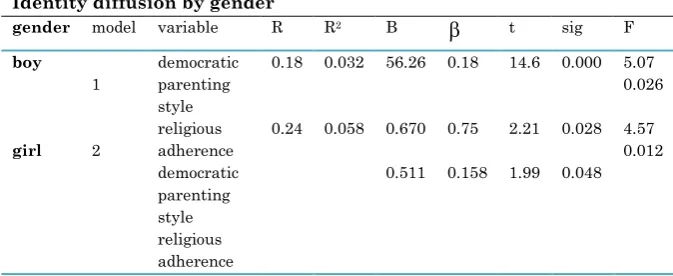
Table (3) shows stepwise regression analysis to examine the predictive role of parenting styles and religious adherence and Identity diffusion by gender
gender model variable R R2 B t sig F
boy 1
democratic parenting style
0.18 0.032 56.26 0.18 14.6 0.000 5.07 0.026
girl 2
religious adherence
0.24 0.058 0.670 0.75 2.21 0.028 4.57 0.012 democratic
parenting style religious adherence
0.511 0.158 1.99 0.048
In the second step to model bye arrival of religious adherence, 0.06 has been added to R. In the first step, liberalism alone predict %2.3 of variance in Identity diffusion.
By entering religious adherence, %5.8 of the variance in Identity diffusion is explained by these two variables together. F-statistic shows that developmental ANOVA is significant stepwise again.
Table 4 shows stepwise regression analysis to examine predictive role of parenting style and religious adherence on identity.
Table 4 stepwise regression analysis to examine the predictive role of parenting style and religious adherence to the achieved identity
gender model variable R R2 B t sig F
boy 1
religious adherence
0.274 0.075 0.926 0.274 49.3 0.001 12.2 0.001 girl 2 religious
adherence
0.129 0.017 0.439 0.129 0.02 0.046 4.096 0.046
As Table 4 shows from variables entered into the regression analysis only religious adherence with achieved identity among boys and girls were significant and positive. As can be seen in Table %2.74 of variance in boys’ achieved identity and %1.29of variance in girls' identity achieved is determined by religious adherence. F-statistic indicates that presence of these variables in model is significant.
Conclusions
Results indicate Stepwise regression analysis of the variables in predicting the variability in the proportion of variance detected significant identity variable is not significant. And other role of variables in variability of identity should be considered as general family functioning, peer influence, received training in mental health, social and economic impact of personality variables and parent-child mutually on each other.
REFERENCES
Ahmadi, Sedighe. 2008. Barresi rabete jave khanevade va bohrane hoviat dar beyne nojavanan kanoone eslah va tarbiyat: Tehran payanname karshenasee arshad. Ahmadi, S. 2004. “Relationship between families’ emotionally
atmosphere and adolescent identity crisis of juvenile institution in Tehran.” Review of the master's thesis
from University of Tarbiat Moalem.
http://idochpz.irandoc.
Arnett, J.J. 2009. Adolescence and Emerging Adulthood .3rd
Edition . New Jersey, USA :Pearson Education.
Banahue, M. & Benson, P. 1995. “Religion and wellbeing of adolescents.” Journal of Social Issue 51:145-160.
Baumrind, D. 1989. “Rearing competent children.” In Child
Development Today and Tomorrow, edited by Damon,
346-378. San Francisco: Josey-Bods.
Baurnrind, D. 1996. “The discipline controversy revisited.”
Family Relations 45: 405-414.
Bergh, S. & Erling, A. 2005. “Adolescent Identity formation: A Swedish study of Identity status.” Using the EOMEIS-II.
ProQuest Education Journals: Adolescence 40 (158):
377-391.
Donahue, M., & Benson, P. 1995. “Religion and the well-being of adolescents.” Journal of Social Issues 51: 145-160. Erickson. J.A. 1992. “Adolescent religious development and
commitment: Astructural equation model of the role of family, peer group, and educational influence.” Journal
for scientific religion 31(2): B4-152.
Erikson, E. 1968. Identity: Youth and crisis. New York: Norton. Everall, R .D., Bostik, K .E .& Paulson, B .L.) 2005)" .I’m Sick of
Being Me :Developmental Themes in a Suicidal Adolescent .ProQuest Education Journals :Adolescence,
40 (160): 693-708.
Farzanehjo, M., Yarmohamdian, A., and Molavi, H. 2006. “The effect of family size on the identity of the students.”
Journal of Behavioral Sciences 3(2): 142 1135.
Graf, S.C., Mullis, R.L. & Mullis. A. K. 2008. “Identity formation of united states American and Asian – Indian Adolescents.” ProQuest Education Journals: Adolescence
43(169): 57-69.
Khajepour, M. A. H. 2008. “Comparison of methods for identification and evaluation of parenting styles between male and female students in their pre-university education in four areas of the city.” Educational and
Psychological Studies 8 (1): 197-178.
Krettenauer, T . 2005(. The Role of Epistemic Cognition in Adolescent Identity Formation :Further Evidence .
Journal of Youth and Adolescence .34 (3): 185-198.
Luyckx, K., Goossens, L., Soenens, B., Beyers, W .&
Vansteenkiste, M . 2005." Identity Statuses Based on 4 Rather Than 2 Identity Dimensions :Extending and Refining Marcia’s Paradigm" .Journal of Youth and Adolescence .34 (6): 605-618.
Maccoby. E.E. M. & Martin, J. 1983. “Socialization in the context of the family: parent child integration.” In
Handbook of Child Psychology: Socialization,
Mussen (series ed.), & E. M. Heheringto (vol. editor), 1-104. 4th ed. New York: Wiley.
Mandara, J. 2006. “African American male’s academic achievement: A Review and clarification of the empirical literature.” Teachers College Record 108(2): 206-228. Mandara, J. and Murrany, C.B. 2000. “Effects of parental
marital status, Income, and family functioning in African American adolescent self – esteem.” Journal of
Family Psychology 14(3): 475-490.
Njus, D .& Johnson, D .R( .(2008) .)Need for Cognition as a
Predictor of Psychosocial Identity Development .The
Journal of Psychology .142(6):645 – 655.
Omidian, M. 2010. Reviews of Modes of identity and religious dimensions of interpersonal differences in dependent variables among student Shahid Chamran University.
PhD’s thesis. Shahid Chamran University. Faculty of Education and Psychology.
Phillips, T.M. & Pittman, J. F. 2001. “Adolescent psychological well being by Identity style.” Journal of Adolescent.
30(6): 1024 -1034.
Romano, J.J. 2004. “Dimensions of parenting and Identity Development in late Adolescence.” Retrieved July 2010,
from http://scholar.lib.ut.edu/
thoses/arailable/etd06302004121004/ unrestricted/ JJeomano thesis. pdf.
Santrock, J .W . 2008( .Adolescence .12th Edition. New York,
USA :McGraw Hill.
Santrock, J .W .)2007) .Child Development .11th Edition, McGraw Hill, New York, USA.
Schwart, S. J., Mason, C.A, pantin, H., Szapocznik. 2009. “Longitudinal relationships between family functioning and identity Development in his panic adolescents: continuity and change.” Journal of Early Adolescents
Sharifi, K. 2003. The relationship between family functioning and psychological hardiness of high school students in
academic year 2003-2004. M.Sc’s Thesis. University of
Esfahan. Faculty of Education and Psychology.
Schwartz, S., Mason, J., Pantin, C.A., and Szapoznik, H. 2008. “Effects of family functioning and identity confusion on substance use and sexual behavior in Hispanic immigrant early adolescents.” Journal of Early
Adolescents 18(2): 107-124.
Steinberg, L. Darnbusch, S.M, & Brown, B. B. 1992. “Ethnic differences in adolescent achievement: An ecological perspective.” American psychologist 47: 723-729.