Performance Evaluation of Space Time Trellis Code by
Simulation in MATLAB
A
Vinod Kumar &
BDr. Rajeev Ratan
A
Research Scholar, MVN University, Palwal, Haryana, India
B
Associate Professor, MVN University, Palwal, Haryana, India EMAIL: [email protected]
Abstract—
In this paper, to evaluate the performance of space-time trellis code we calculate pairwise error probability (PEP) expressions. We then use these PEP expressions to calculate union bounds on the performance of space-time trellis codes. A MATLAB based approach is proposed and implemented to evaluate and compare performance of 4-psk with different transmitting and receiving antennas. The performance of STTC codes is evaluated by giving the performance as a function of SNR against frame error rate (FER).
Keywords: Space-time trellis coding; pairwise
error probability; diversity; multiple transmit antenna; frame-error rate; outage capacity
Introduction
A major problem in the wireless channel is that out-of-phase reception of multi-path causes deep attenuation in the received signal, known as fading. The distortion induced by the time varying fading is caused by the superposition of delayed, reflected, scattered and diffracted signal components. Another problem of the wireless channel is variation over time, due to the movements of the mobile unit and objects in the environment. This results into severe attenuation of the signal, referred to as deep fade. This instantaneous decrease of the signal-to-noise ratio (SNR) results in error bursts which degrades the performance significantly.
In fading environments, reliable
communication is possible through the use of diversity techniques in which the receiver is afforded multiple replicas of the transmitted signal under varying fading conditions. These techniques reduce the probability that all the replicas are simultaneously affected by a severe attenuation. Information theoretic investigations in the past few years have shown that very high capacity can be obtained by employing multiple antenna elements at both the transmitter and the receiver of a wireless system. These investigations have led to the development of a novel multiple transmit-receive architecture called Bell Labs Layered Space-Time Architecture (BLAST), which provides transmission rates that are unattainable by traditional techniques. Another approach that uses multiple transmit antennas and (optionally) multiple receive antennas is Space-Time Coding (STC), introduced to provide high data rates and reliable communications over fading channels, this concept combines coding, modulation and spatial diversity into a two-dimensional coded modulation technique. Examples of space-time coding include time trellis codes, space-time block codes, super-orthogonal space-space-time codes and linear-dispersion (LD) codes. Space-time trellis codes provide full diversity and coding gain at the cost of a complex receiver. Space-time block codes provide full diversity and simple decoding, but no coding gain.
particular antenna element is different from the effect at all other antenna elements. This implies independent or spatially uncorrelated fading. This holds true only if spacing between transmit antennas or receive antennas is of the order of several wavelengths. However, if antenna spacing is not enough, the fading channel from multiple antennas might be correlated, and the performance will be degraded. In this paper, a MATLAB based approach is proposed and implemented to evaluate and compare performance-using 4-psk with different transmitting and receiving antennas. The performance of STTC codes is evaluated by giving the performance as a function of SNR against frame error rate (FER).
II LITERATURE SURVEY
The study of wireless communications with multiple transmit and receive antennas has been conducted expansively in the literature on information theory and communications. It has been known from the information-theoretic results that the application of multiple antennas in wireless systems can significantly improve the channel capacity over the single-antenna systems with the same requirements of power and bandwidth. Receive diversity existed as far back as 1960 [1]. However, receive diversity is not suitable for downlink in mobile communications, hence transmit diversity has attracted attention. Alamouti presented basic two transmit diversity scheme [2] which has remarkably low decoding complexity. Tarokh et al. [3] extended it to generalized the Alamouti scheme for more than two transmit antennas, called orthogonal space-time block codes (OSTBC). OSTBC have full diversity (nT - nR), but have little or no coding gain. To provide both diversity and coding gain, one can choose a space-time code that has an in-built channel coding mechanism, for example space-time trellis codes, or one can choose a space-time block code concatenated with an outer channel code. Borran et al. [4] discuss design issues of concatenating channel codes with OSTBC. They show that design issues in maximizing diversity gain, and maximizing coding gain can be decoupled. Due to this
simplicity, this structure has been accepted, e.g. in WCDMA standard. Gong and Ben Letaief [5] discuss design of concatenated trellis coded modulation (TCM) and OSTBC, and also show that this scheme outperforms space-time trellis codes with the same spectral efficiency, trellis complexity and signal constellation. Bauch and Hagenauer [6] give a new view of OSTBC over fading channel as an equivalent SISO channel. Using this equivalent channel model, they give analytical evaluation of error probability, without considering the effect of block fading (which is typically assumed for linear decoding of STBC). Uysal and Georghiades [7] give error bounds for MTCM-STBC under Rician Fading. However, interleaving does not appear in their analysis. Schulze [8] gives union bounds for channel codes and Alamouti signaling for temporally correlated and i.i.d. channel. But again, the block fading assumption is absent in his analysis. None of the above mentioned works discuss spatially correlated fading. Lai and Mandyam [9] simulate concatenated convolutional/turbo codes with two temporally and spatially correlated antennas in the framework of WCDMA, but do not provide any analysis.
Another class of space-time codes is trellis based space-time codes (e.g. space-time trellis codes [10], super-orthogonal space-time trellis codes [11] etc.). These codes incorporate coding and diversity into a single design. Much of the analysis of these systems concentrates on uncorrelated antennas, e.g., the analysis of space-time codes in i.i.d. fading in [12] and the analysis of super-orthogonal codes in [13]. In a few isolated cases, attempts have been made to explore the performance of
III SPACE-TIME TRELLIS CODES (STTC)
Fig. 1 Trellis Diagram
A trellis gives possible code sequences and coding gain is achieved. These codes have shown considerable performance gains for wireless communication at the expense of a rising decoding effort with increasing numbers of transmitting antennas or trellis states. The trellis diagram often describes space-time trellis codes. In the given fig. 1, the state bits are shown at the right of the trellis; each line represents a possible transition with the input bits shown besides the line; the outputs for the current state and input are shown in the matrix at the left of the trellis. Outputs for different transmit antennas are grouped together.
Code construction and performance criteria Assume that a codeword c = (c1 c2 . cl) was transmitted, where l is the codeword length and ct is a space-time symbol at time t, and the maximum likelihood receiver might decide erroneously in favor of another codeword e = (e1e2 . el). The different N ×l matrix B was constructed with elements (eji-cji), i=1, ., N, j=1,.,l, and r denotes the rank of the matrix B, and ëi is the eigenvaluesof the distance matrix A = B B*. We will now describe the performance criteria of space-time codes over Rayleigh fading channels, assuming perfect CSI is available to the receiver.
Rank and determinant criteria
When diversity gain rM is small, the rank and determinant criteria will determine the
performance [10] [31] [32]. The pair-wise error bound is given by
(1)
Euclidean distance criteria
When the diversity gain is large (with two or more receive antennas), the Euclidean distance criterion will determine the performance [11] [12]
(2)
In general, when the number of transmit antennas is very large, the channel approximate a Gaussian channel, thus the Euclidean distance criterion is more appropriate.
Code search with the performance criteria The rank/determinant and Euclidean distance criteria are usually used as the guidance for computer search of good space-time trellis codes. Several search results are given in [33]-[37], some of which are programmed in this project (See Appendix). Because of the computation complexity of the pair-wise error probability bound equations given above; computer simulation is usually carried out to more accurately evaluate the code performance. No comparison results between the upper bound and the simulation results are given in the literature so far.
Performance criteria in the presence of channel estimation error and multi-path effects are discussed in [32]. It was shown that the design criteria also apply to the Nakagami fading channels [38]. The performance criteria and simulation results of space-time trellis codes over frequency selective fading channels are given in [39].
The design criteria for code construction of space-time trellis codes assume that perfect channel state information (CSI) is available at the receiver, i.e., the receiver know the exactly what the channel path gains. However, in reality, it is impossible for the receiver to get perfect channel information. The receiver usually estimates the CSI; hence the error in channel estimation leads to performance degradation of the space-time trellis codes.
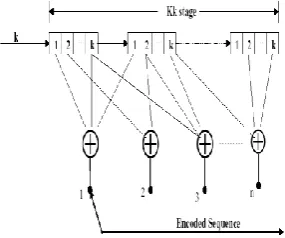
stages and linear algebraic function generators as shown below. The input binary data to the encoder is shifted into and along the shift registers k-bits at a time.
Fig. 2 Convolution Encoder
Pair wise error probability
It is assumed that each element of the signal constellation is contracted by a scale factor, chosen so that the average energy of the constellation elements is square root of Es . The
pair wise error probability is the probability that a maximum-likelihood receiver decides erroneously in favor of a signal.
(3) assuming that
(4) was transmitted. Assuming ideal channel state information (CSI), the probability of transmitting and deciding in favor of at the decoder is well approximated by
(5) Where N0 /2 is the noise variance per dimension and
(6)
Putting Ωj =(g1j,……gnj) and rewriting the above equation
(7)
after simple manipulation, it may be observed that
(8)
for 1 ≤ p, q ≤ n.
Since A(c,e) is Hermitian, there exists a unitary matrix V and a real diagonal matrix D such that VA(c,e) V=D*. The rows {v1,v2,….vn} of V are a
complete orthonormal basis of Cn given by eigen vectors of A. Further, the diagonal elements of D are the eigen values λi i=1,2,……..n of A counting multiplicities, the matrix
(9)
(10
Where
Next recalling that aij are samples of a complex
Gaussian random variable with mean Eai,j. Let
Kj Ea1,j , Ea2,j ,…, Ean,j
Since V is unitary, {v1,v2,v3,…,vn} is an
orthonormal basis of Cn and are independent complex Gaussian random variables with variance 0.5 per dimension and mean Kj.vi.
Thus |βi,j| are independent Rician distributions
with pdf
(11)
For |βi,j|≥0, where I0(.)is the zero order modified
(12)
With respect to independent Rician distributions of |βi,j| to arrive at
(13)
For Rayleigh fading channel Eai,j=0 and Ki,j for
all i and j. Then the inequality obtained above can be written as
(14)
Let r denote the rank of matrix A, then the kernel of A has dimension n-r and exactly n-r eigen values of A are zero. Say the non-zero eigen values of A are λ1, λ2…. λr, then it
follows from inequality above that is the Frame Error Rate(FER)
II PROPOSED SIMULATIONMODEL
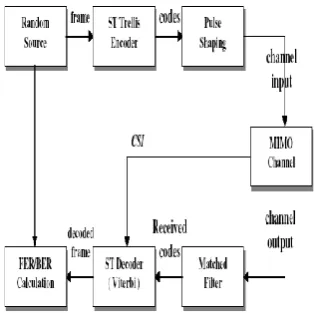
The proposed simulation model is illustrated in figure shown below and may be carried out in MATLAB.
Fig. 3 Proposed Simulation Model
Random M-PSK symbols are grouped into
frames, which must consists a fixed number of symbols each. The space-time trellis encoder takes the frame as input and generates codeword pairs for each input symbol simultaneously for all the transmit antennas. Pulse shaping changes the waveform of transmitted pulses. Its purpose is to make the transmitted signal suit better to the communication channel by limiting the effective bandwidth of the transmission. These complex signals are transmitted through the MIMO channel. The most commonly used MIMO channel is quasi-static at Rayleigh fading. Various channels flat Rayleigh/ Nakagami fading channels and two-ray model frequency selective fading channel may be considered. If the signals and channels are modeled in base-band, thus modulation/demodulation operations are not required.
The matched filter is the optimal linear filter for maximizing the signal to noise ratio (SNR) in the presence of noise. In the above model it must be assumed that perfect channel state information (CSI) is available at the receiver. At the receiver, a maximum likelihood sequence detector has to be used to decode the received signal. The Viterbi decoder uses the Viterbi algorithm for decoding a bitstream that has been encoded using a convolutional code. Frame error and bit error rate is calculated after decoding each frame.
III PERFORMANCE COMPARISON FOR 4-PSK STTC
Fig. 4 Performance comparison of FER v/s SNR for 4-PSK taking different transmitting and two receiving antennas.
Fig. 4 compares the performance of 4-psk STTC by varying the number of transmitting and receiving antennas. The simulation results show performance improves as the number of transmits antennas are increased. At FER of 100 there is a gain of approximate 1db when the number of transmit antennas increases from 2 to 5 and number of receiving antennas are 2.
Fig.5 shows that keeping the number transmitting antennas 2 and varying the receiving antennas from 2 to 5, there is an improvement of approximate 2.2 db at FER of 100
Fig.5 Performance comparison of FER v/s SNR for 4-PSK taking 2 transmitting antennas and different receiving antennas.
IV CONCLUSION AND FUTURE WORK
In this project, the encoder and decoder for space-time trellis codes are not implemented, and performance of ST codes are evaluated by MATLAB programming and under different number of transmit/receive antennas. The proposed simulation model in this paper is capable for evaluating space-time trellis codes with ideal channel estimation. Some future work will be needed to enhance the simulation model and obtain more specific results specifically simulation of the proposed model given in this paper, simulation of other types of space-time codes, e.g. space-time block codes and layered space-time codes, enhanced channel simulation model for frequency selective fading channel for both Rayleigh and Nakagami fading envelops. Implementation with C-MEX functions is required for efficiency.
REFERENCES
[1] M. K. Simon and M.-S. Alouini, Digital Communication over Fading Channels: A Unified Approach to Performance Analysis. New York: John Wiley and Sons, 2000.
[2] S. M. Alamouti, “A simple transmit diversity technique for wireless communications," IEEE J. Select. Areas Commun., vol. 16, no. 8, pp. 1451-1458, October 1998.
[3] V. Tarokh, H. Jafarkhani, and A. Calderbank, “Space-time block codes from orthogonal designs," IEEE Trans. Inform. Theory, vol. 45, no. 5, pp. 1456-1467, July 1999.
[4] M. Borran, M. Memarzadeh, and B. Aazhang, “Design of coded modulation schemes for orthogonal transmit diversity," submitted for publication in IEEE transaction on Communications, May 2001.
Transactions on Wireless Communications, vol. 1, no. 4, pp. 580-590, Oct 2002.
[6] G. Bauch, J. Hagenauer, and N. Seshadri, “Turbo processing in transmit antenna diversity systems," Ann. Telecommun., vol. 56, no. 7-8, pp. 455-471, 2001.
[7] M. Uysal, C. N. Georghiades “Upper bounds on the BER performance of MTCM-STBC schemes over shadowed Rician fading channels," in Proc. IEEE Vehicular Technology Confer- ence, 2002, pp. 62-66.
[8] H. Schulze, “Performance analysis of concatenated spacetime coding with two transmit antennas," IEEE Transactions on Wireless Communications, vol. 2, no. 4, pp. 669-679, July 2003.
[9] J. Lai and N. B. Mandayam, “Performance of turbo coded WCDMA with downlink space-time block coding in correlated fading channels," accepted for publication in IEEE transaction on wireless communications,2002.
[10] V. Tarokh, N. Seshardi, and A. Calderbank, “Space-time codes for high data rate wireless communication: Performance criteria and code construction," IEEE Trans. Inform. Theory, vol. 44, no. 2, pp. 744-765, March 1998.
[11] H. Jafarkhani and N. Seshadri, “Super-orthogonal space-time trellis codes," IEEE Transactions on Information Theory, vol. 49, no. 4, pp. 937-950, April 2003.
[12] M. K. Simon, “Evaluation of average bit error probabilitie for space-time coding based on a simpler exact evaluation of pairwise error probability," Journal of Communications and Networks, vol. 3, no. 3, pp. 257-264, September 2001.
[13] M. K. Simon and H. Jafarkhani, “Performance evaluation of super-orthogonal space-time trellis codes using a moment