1
THE APPLICATION OF EARNED VALUE MANAGEMENT (EVM)
IN CONSTRUCTION PROJECT MANAGEMENT
Tan Chin-Keng, Najihah Shahdan
Department of Quantity Surveying
Kulliyyah of Architecture & Environmental Design International Islamic University Malaysia
Kuala Lumpur Malaysia
*Corresponding E-mail: [email protected], [email protected]
Abstract
Earned Value Management (EVM) is a methodology that combines scope, schedule, and resource measurements to assess project performance and progress, it involves the integration of the three key elements of project which are schedule, work scope, and cost. Based on the literatures, various benefits have been associated with the use of EVM in project management. However, there is only a few of researches that have discussed EVM practices in Malaysia construction industry. Therefore, it is found to be insufficiency of documented EVM implementation in Malaysia construction projects. The lack of researches may discourage EVM awareness and its utilization by the construction professionals and practitioners. The objectives of this study are to determine the level of awareness on EVM among construction practitioners in Malaysia and to investigate whether EVM is been applied in Malaysia construction projects. For the purpose of data collection, this research applied questionnaire survey technique with 33 samples. This findings of this study reveal that key players in construction industry have very low level of awareness on EVM. The study identified that the key players in Malaysia construction industry have applied some parts of EVM concepts during construction projects but the application is not found to be intensive. It is recommended that much efforts to be made in order to enhance the awareness and increase the level of application on EVM among the key players in the construction industry.
Keywords: Earned value management, construction, project management, Malaysia.
1.0 Introduction
PMI (2013) defined Earned Value Management (EVM) as “a methodology that combines scope, schedule, and resource measurements to assess project performance and progress”. Garrett (2006) and Vanhoucke (2012) defined EVM similarly when they described EVM as a Project Performance Measurement (PPM) method that involves the integration of the three key elements of project which are schedule, work scope, and cost. Cleland and Ireland (2007) stated in the same way but left out work of scope in the integration. The author claimed that the work of scope is indirectly related to EVM as the adequately completed work packages means that the work scope has been performed successfully.
2
The author claimed that EVM is a powerful technique in monitoring the physical project progress as it monitors the progress objectively instead of subjectively.
EVM is one of the PPM tools that compares the total work planned with the total work done and the actual cost incurred in a project (Dissanayake, 2010). Cleland and Ireland (2007) stated that it is also known as earned value analysis even though the analysis emphasized is only constitutes one part of the whole EVM process. EVM is recognized as a powerful tool by Chen (2008) as it boosts the confidence of the project team in executing the project. Cost and schedule variance analysis (described in sub-heading 2.6.2) in EVM enable the project manager to get a more precise status on the project performance (Kim, Wells Jr., & Duffey, 2003).
According to Vanhoucke (2012), there are three key parameters of EVM required in order to measure project performance namely planned value (PV), actual cost (AC) and earned value (EV). Chen (2008) stated that the key parameters of EVM need to be in the same unit. It can be measured in either dollar ($) or work hour (time) (Pratt, 2006 & Chen, 2008).
It can be concluded that many researchers has defined EVM in the same way through different terms and expression that meant the same. This is because the significant dimensions of EVM are cost, schedule, and work scope that have been brought together to assist the project team in managing the performance of project successfully.
2.0 Objectives
The objectives of this study are to determine the level of awareness on EVM among construction practitioners in Malaysia and investigate whether EVM is been applied in Malaysia construction projects.
3.0 Literature Review
A project is considered to be successful when it meets the goals set and the objectives identified during project initiation (Frimpong, Oluwoye, & Crawford, 2003). It means that the completed project has achieved its technical performance, according to the planned schedule and within the initial agreed cost (Frimpong, Oluwoye, & Crawford, 2003; Memon, Abdul Rahman, & Abdul Azis, 2012; Meng & Gallagher, 2012). Time and cost have been considered as the basis of project management (Memon, Abdul Rahman, & Abdul Azis, 2012) and its importance is widely acknowledged by construction practitioners (Olawale & Sun, 2010) despite the opposite finding found by Ali and Rahmat (2010). The authors found that functionality is regarded as the most important project performance instead of time and cost. Different clients have different needs and requirements for their projects. Hence, project objective is prioritized differently in according to the needs and requirements.
However, as construction projects are always unique and heterogeneous, it will always encounter many unforeseen events that will affect the construction process negatively. Frimpong, Oluwoye, and Crawford (2003) as well as Le-Hoai, Lee, and Lee (2008) both indicated that construction process is a phase that has always encountered with major problems especially time and cost overruns. Delayed projects will either been prolonged or speeded up and as a result, the cost will be escalated (Sambasivan & Soon, 2007). This effect will then cause dissatisfaction among all construction parties involved in the project as it may affect the end product of the construction project.
3
due to the fact that infrastructure projects are much more complex and completed. Hence, it requires additional monitoring and controlling throughout the construction process.
In Malaysia, construction industry has claimed to encounter chronic problems such as poor performance of time and cost (Memon, Abdul Rahman, & Abdul Azis, 2012). The authors found that 92% out of 140 respondents agreed that time overrun is a major issue while 89% of them agreed that cost overrun is a major issue in construction project. Even if there were numerous number of projects that have been completed by the construction industry, the projects were said to be of no cost, time and quality effective (Ibrahim, Roy, Ahmed and Imtiaz, 2010). The author reported that there were major development projects that encountered time and cost overruns including structural defects in school buildings and community college buildings as of the end of 2004. Besides that, in 2005, around 17.3% out of 417 government contract projects in Malaysia were mentioned to be either delayed for more than 3 months or abandoned (Sambasivan & Soon, 2007).
In a case study made by Naderpour and Mofid (2011), a comparison between application of traditional method and EVM method have been made on an educational centre in Booshehr, Iran. The initial project control team had planned and analysed the project based on the traditional method and met with scheduling problem. After 12 months out of 15 months; the completion period, the project was found to be progressing 45% slower than scheduled. It was estimated to be delayed for 20 months later and hence, will escalate the cost up to 30%. Therefore, the project control team was changed and EVM method was applied. The author found that after applying EVM method, the project manager was able to monitor and control the project from the exact information of the project details gained from EVM method. As a result, the project was able to be completed in a short period of time.
However, despite all of the knowledge on EVM that can be learnt from the literature, there is only a few of researches that have discussed EVM practices in Malaysia construction industry. Therefore, it is found to be insufficiency of documented EVM implementation in Malaysia construction projects. The lack of researches may discourage EVM awareness and its utilization by the construction professionals and practitioners.
For that reason, a study is made on EVM to fill in the gap of the lack of literature of EVM as a PPM technique in Malaysia construction projects. It is believed that the application of EVM in construction projects will result in effective project monitoring and control to such extend that it allows the project to be within allocated budget (Hunter, Fitzgerald and Barlow, 2014).
3.1
Benefits of EVM
Theoretically, EVM is known to be beneficial to the project team as it provides early warning of whether the project is behind schedule or the budget is overrun (Cleland and Ireland, 2007; Humphreys and Associates, 2012). Generally, it has been agreed by most researchers that EVM is reliable in identifying the construction project status in terms of cost, time and work scope (Fleming and Koppleman, 2002; PMI, 2013). Therefore, EVM helps the project team to accomplish the project objectives successfully.
Other than that, Humphreys and Associates (2012) have stated that EVM is a concept that assists the project management. EVM is claimed to be able to improve planning process, fosters a clear definition of work scope, integrates technical, schedule, cost performance, identify problem areas for immediate and proactive management action, provides consistent and clear communication of progress at all management levels, and improves project visibility and accountability.
4
specified that EVM can be applied to make progress payment to the contractor through the EV of contracted or outsourced work.
EVM also provides precise and concurrent analysis on both time and cost performance of a construction project (Alvarado, Silverman, & Wilson, 2005). The utilization of EVM in project management was proven to be a reliable forecasting tool on the project duration after it was being applied on real-life projects (Kim, Well Jr., & Duffey, 2003; Vandevoorde and Vanhoucke, 2006). A research made by Marshall, Ruiz and Bredillet (2008) also confirmed the ability of EVM in forecasting project progress.
A case study on the application of EVM made by Naderpour and Mofid (2011) to an educational centre project was also resulted to be very successful. EVM is found to be beneficial in many ways where the project manager was able be aware of the construction project status earlier. The authors stated that the EVM provided clearer view of the construction project progress, together with a precise forecasting. Hence, it allows the project managers to plan for risk mitigation and made better decision to overcome the critical conditions of the construction project.
Lorenz, Bosch and Kiittler (2012) found that EVM is proven to be a very versatile and flexible tool for private industry like engineering and design diagnostic and in-house manufacturing. De Marco and Narbaev (2013) have proven that EVM is able to forecast a construction project as early as when the project is 20% completed. It means that the EVM is able to forecast construction project performance and to integrate the cost, schedule and work scope of a construction project in one PPM method as claimed by other researchers theoretically.
From consultant’s point of view, EVM is an effective cost and schedule control as it allowed the project to be within the contract sum (Hunter, Fitzgerald, & Barlow, 2014). From stakeholder’s point of view, the authors identified that EVM has the ability to provide clear understanding on the issues arisen during the project. This ability helps the stakeholders to make effective decisions.
Besides that, the application of EVM in data warehouse project; an IT project has proven to give more benefits than drawbacks. Gowan, Mathieu, and Hey (2006) found that EVM really does help the project to measure its performance throughout the project life-cycle. The data collected and recorded for the EVM can be compared with other projects and the historical data can be used to improve future similar projects.
From the researches, it can be summarized that EVM provides a lot of benefits to the project management. It has been identified that EVM is able to:
• improves planning process
• fosters a clear definition of work scope • provides early warning of potential problems • provides clear view of project progress
• provides precise and concurrent analysis on both time and cost performance of a project • to forecast the project progress in term of budget and schedule
• accomplish the project objectives
• the data collected and recorded for the EVM can be compared with other projects • the historical data of EVM can be used as comparison with future projects • allows the project managers to plan for risk mitigation
• makes better decision to overcome the critical conditions of the project
5
3.2
Status of EVM Application in Projects
EVM has been used across the U.S. federal government and the commercial sector for project management (Garrett, 2006). There are even countries like U.S, UK, and Australia that have outlined guidelines for the application EVM. Its application is not only limited to construction sector but also in IT (Pratt, 2006), manufacturing and industrial sector.
Kim, Wells Jr., & Duffey (2003) said that EVM is highly accepted by the project managers in US. 82% of the project managers surveyed are either accepted or strongly accepted the EVM concept. The authors also have found that EVM has been increasingly well-known in both public and private sectors and the project managers even claimed that EVM can be applied successfully in those sectors.
In U.S., EVM has been applied widely by both public and private sectors in various kind of project management; either in manufacturing, infrastructure, technology or construction industry (Alvarado, Silverman & Wilson, 2005). The author found that the EVM needs to be applied before the construction project starts. As U.S. government is very familiar with EV concept, EVM techniques applied in the case study was innovative.
Vertenten, Pretorius, and Pretorius (2009) discovered that even though the EVM has been recognized by the South African construction industry, it does not been fully utilized by the industry itself. They found that some part of the concept of EV is being used in construction projects but not the EVM as a whole. EVM application in Hong Kong is rather new (Dissanayake, 2010). De Marco and Narbaev (2013) also found that the application EVM in European construction industry was still in an infancy stage. However, after a case study on the application of EVM was made on a facility construction project there, the authors found that EVM can be applied in many industries including the facility construction project of any size and complexity.
Bhosekar and Vyas (2012) found that EVA that is mostly been associated with construction project cost monitoring and evaluation, can also be applied for construction project cost control. The authors have identified several software like Microsoft Project, Primavera, and developed software were been produced to ensure the application of EVM in project management will simpler. It can be assumed that the production of such software helps the project team in the application of EVM in terms of organization and recording of construction project data. Kim, Wells Jr., and Duffey, (2003) discovered that the use of both computer systems and software was widespread and it is the key element for a successful EVM application.
EVM is discovered to be having significant value and unique features that benefited the construction project key players (Bhosekar and Vyas, 2012). The author conducted a case study to test the EVM ability as cost controlling by using several project management software; Microsoft Project 7, Primavera 6, and developed software. They found that the application of EVM as construction project cost controlling tool can provide almost 100% accuracy.
Having been established since over a century ago, there are many researchers introducing new metrics for improvement of the existing EVM concept. Pajares and López-Paredes (2011) have introduced new metrics to integrate EVM and project risk management methodologies. Zhong and Wang (2011) have modified the existing metrics in EVM to improve its application in coal project management. The modification was proven to be more accurate that traditional EV by comparing the result of applying both methods in the China coal mining construction.
6
of data collection and analysis. It is worrisome that the new approaches might distance the key players with the concept when the concept could provide a lot of benefits to project management.
4.0 Methodology
Questionnaire survey is the most widely used technique to conduct surveys (Naoum, 2007). It is a way of gathering information through a series of standardized questions. It can be conducted by mail, telephone, personal interview or internet. For the purpose data collection, this research applied questionnaire survey technique. The survey is distributed by hand and through e-mail. It is divided into three sections; Section A, Section B and Section C.
Section A which consists of Part 1 and Part 2 inquires the respondents on their background and organization’s information. Section B and C inquires the respondents on the subject matter of the research. The questions were constructed from the information obtained from literature review. Section B contains questions to test the level of awareness of the respondents on EVM, Section C has a list of questions to investigate the application of EVM in construction industry.
From the fact that there is very limited literatures discussing the application of EVM in the context of Malaysian construction industry, EVM seems to be rather new to Malaysia construction projects. Therefore, in order to expand the size of the sample, the targeted respondents are selected from the key players in construction industry as a whole which are the clients, contractors and consultants. The list of the clients, contractors and consultants organization available in Klang Valley were obtained from respective websites. Klang Valley is chosen as the place for this research as most established construction organizations are located here.
The questionnaire surveys for this research are distributed by hand and through email. The surveys are distributed through email to have wider range of target respondents. It is easier to the researcher as it is not costly and time consuming. However, there is risk that the emailed survey would not attract the attention of the respondents. Therefore, more surveys are distributed by hand as compared to the distribution through email. Besides distributing the surveys directly to the selected organization, there are also survey forms that are distributed in a seminar organized by Construction Industry Development Board (CIDB). This research applies the convenience sampling approach and there are a total of 100 questionnaire surveys are been distributed.
5.0 Results and Discussions
33 respondents responded to the survey yielding a response rate of 33% for the survey. From the 33 respondents, 5 respondents (15.15%) are from client organizations, 12 respondents (36.36%) are from contractor organizations and 16 respondents (48.49%) are from consultancy firms.
5.1
Level of Awareness on EVM
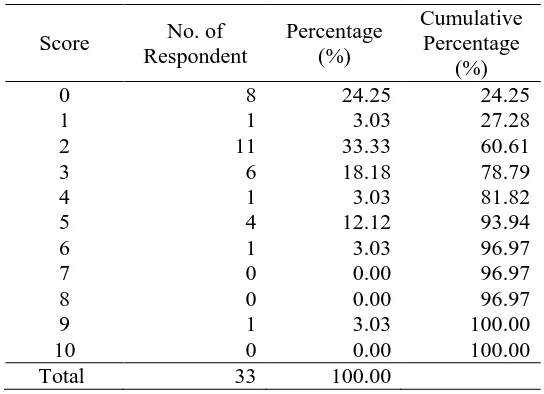
Section B contains questions to test the level of awareness of the respondents on EVM. Table 1 below illustrates the scoring of the respondents for answering those questions correctly.
7
Table 1: Scoring of the Respondents
Score No. of Respondent
Percentage (%)
Cumulative Percentage
(%) 0 8 24.25 24.25 1 1 3.03 27.28 2 11 33.33 60.61 3 6 18.18 78.79 4 1 3.03 81.82 5 4 12.12 93.94 6 1 3.03 96.97 7 0 0.00 96.97 8 0 0.00 96.97 9 1 3.03 100.00 10 0 0.00 100.00 Total 33 100.00
From Table 1, there are 11 out of 33 respondents (33.33%) answered 2 out of 10 questions correctly. Besides that, there are 8 out of 33 respondents (24.24%) score 0, 6 out of 33 of the respondents (18.18%) score 3 and 4 out of 33 respondents (12.12%) score 5 in this section. Other respondents score 1 (3.03%; 1 out of 33 respondents), score 4 (3.03%; 1 out of 33 respondents), score 6 (3.03%; 1 out of 33 respondents) and score 9 (3.03%; 1 out of 33 respondents). Cumulatively, there are 27 out of 33 respondents (81.82%) score 4 and below while 6 out of 33 respondents (18.18%) score 5 and above.
The awareness of the respondents was analyzed based on how many questions the respondents answered correctly. The details of the analysis are as shown in Table 2 below.
Table 2: Rating of Awareness
No. of Correct Answer/s Level of Awareness 0 – 2 Very Low 3 – 4 Low 5 – 6 Moderate 7 – 8 High 9 – 10 Very High
Table 3 below shows the level of awareness of the respondents on EVM. It can be seen that 60.6% (20 no. of respondents) out of the 33 respondents have very low level of awareness, 21.2% (7 no. of respondents) have low level of awareness, 15.2% (5 no. of respondents) have moderate level of awareness and only 3.0% (1 no. of respondent) out of 33 respondents has very high level of awareness on EVM.
Table 3: Level of Awareness of the Respondents on EVM
Level of Awareness No. of Respondent Percentage (%) Cumulative Percentage (%)
Very Low 20 60.61 60.61
Low 7 21.21 81.82
Moderate 5 15.15 96.97
High 0 0.00 0.00
Very High 1 3.03 100.00
Total 33 100.00
8
low level of awareness on EVM. This finding opposes to the literature review where EVM is well-known as project measurement method (Acebes et al., 2013) in other countries especially United States and is acknowledged by the South African project team (Vertenten, Pretorius, & Pretorius, 2009).
The low level of awareness of the key players on EVM may be due to the least application of the method in Malaysia construction industry. They might have used some parts of EVM concept indirectly by using other terms. Therefore, the key players do not aware of the terms used in EVM as stated by Fleming and Koppelman (2002).
5.2
The Status of Application of EVM in Construction Projects
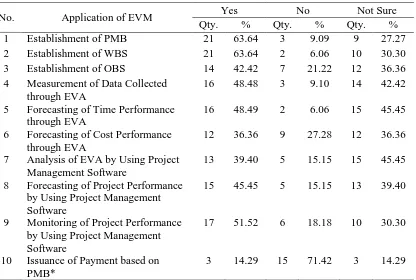
The third section; Section C of this questionnaire survey form was designed to achieve the second research objective which is to investigate whether EVM is applied in Malaysia construction projects. The questions comprise of the application of EVM in construction project management.
Table 4: General Application of EVM (based on all respondents)
No. Application of EVM Yes No Not Sure Qty. % Qty. % Qty. % 1 Establishment of PMB 21 63.64 3 9.09 9 27.27 2 Establishment of WBS 21 63.64 2 6.06 10 30.30 3 Establishment of OBS 14 42.42 7 21.22 12 36.36 4 Measurement of Data Collected
through EVA
16 48.48 3 9.10 14 42.42
5 Forecasting of Time Performance through EVA
16 48.49 2 6.06 15 45.45
6 Forecasting of Cost Performance through EVA
12 36.36 9 27.28 12 36.36
7 Analysis of EVA by Using Project Management Software
13 39.40 5 15.15 15 45.45
8 Forecasting of Project Performance by Using Project Management Software
15 45.45 5 15.15 13 39.40
9 Monitoring of Project Performance by Using Project Management Software
17 51.52 6 18.18 10 30.30
10 Issuance of Payment based on PMB*
3 14.29 15 71.42 3 14.29
*applicable to consultant and client organizations only (21 no. of respondents)
Table 4 above shows the application of EVM in construction industry based on all respondents. From the table, there are 3 general applications of EVM in construction projects that have been adopted by more than 50.00% respondents. The applications are the establishment of performance measurement baseline (PMB) which obtains 63.64% (21 no. of respondents), the establishment of work breakdown structure (WBS) which obtains 63.64% (21 no. of respondents) and the monitoring of project performance by using Microsoft Project which obtains 51.52% (17 no. of respondents). On the other hand, there are 15 out of 21 respondents (71.42%) that do not issue payment based on the PMB.
9
planning process (60.00%; 3 out of 5 respondents) and the forecasting of project performance by using project management software (60.00%; 3 out of 5 respondents).
For the respondents from contractor organization, the general applications of EVM that obtain more 50.00% are the establishment of PMB (66.67%; 8 out of 12 respondents) and WBS (66.67%; 8 out of 12 respondents) during planning process, the measurement of the data collected during execution process by using earned value analysis (50.00%; 6 out of 12 respondents),the analysis of earned value by using project management software (50.00%; 6 out of 12 respondents), forecasting of project performance by using project management software (58.33%; 7 out of 12 respondents), and the monitoring of project performance by using project management software (58.33%; 7 out of 12 respondents).
Then, for consultant organization, the general applications of EVM that obtain more 50.00% are the establishment of PMB (65.50%; 10 out of 16 respondents) and WBS (68.75%; 11 out of 16 respondents), the measurement of data collected through earned value analysis (50.00%; 8 out of 16 respondents), the forecasting of the project time performance through earned value analysis (65.50%; 10 out of 16 respondents), and the monitoring of project performance by using project management software (50.00%; 8 out of 16 respondents).
These results show that the contractor organizations apply more general applications of EVM in the construction projects as compared to the client and consultant organizations. On the other hand, the client organizations apply the least as compare to the other organizations.
Based on the analysis, the results and findings for the first research objective show that most of the key players in construction industry have very low (60.61%; 20 no. of respondents) level of awareness on EVM. Cumulatively, 81.8% of the respondents have low and very low level of awareness on EVM. This is the opposite to the literature review where EVM is well-known as project measurement method (Acebes et al., 2013) in other countries especially United States and is acknowledged by the South African project team (Vertenten, Pretorius, & Pretorius, 2009).
For second research objective, it has been identified that the key players in Malaysia construction industry have applied some parts of EVM concepts during construction projects. This finding is similar to the finding found by Vertenten et al. (2009). They found that only some part of the concept of EV is being used in construction projects but not the EVM as a whole. The application of EVM in Malaysia construction industry was found to be at infancy stage.
6.0 Conclusions
10
References
Abdul Azis, A., Memon, A., Abdul Rahman, I., & Abd. Karim, A. (2013). Controlling cost overrun factors in construction projects in Malaysia. Research Journal of Applied Sciences, Engineering and Technology, 2621-2629.
Acebes, F., Pajares, J., Galán, J. M., & López-Paredes, A. (2013). Beyond earned value management: A graphical framework for integrated cost, schedule and risk monitoring. Procedia-Social and Behavioral Sciences, 74, 231-239.
Ali, A. S., & Rahmat, I. (2010). The performance measurement of construction projects managed by ISO-certified contractors in Malaysia. Journal of Retail & Leisure Property, 9(1), 25-35.
Alvarado, C. M., Silverman, R. P., & Wilson, D. S. (2005). Assessing the performance of construction projects: implementing earned value management at the general services administration. Journal of Facilities Management, 3(1), 92-105.
Anbari, F. T. (2003). Earned value project management method and extensions. Project Management Journal, 34(4), 12-23.
Bhosekar, S. K., & Vyas, G. (2012). Cost controlling using earned value analysis in construction industries. Internatioinal Journal of Enginering and Innovative Technology, 1(4), 324-332.
Chen, M.T. (2008). The ABCs of earned value application. Conference Proceedings of AACE International Transactions.
Chou, J. S., Chen, H. M., Hou, C. C., & Lin, C. W. (2010). Visualized EVM system for assessing project performance. Automation in Construction, 19(5), 596-607.
Cleland, D.I. and Ireland, L.R. (2007), Project Management: Strategic Design and Implementation, McGraw-Hill, New York, NY.
De Marco, A., & Narbaev, T. (2013). Earned value-based performance monitoring of facility construction projects. Journal of Facilities Management, 11(1), 69-80.
Dissanayake, P. (2010). Earned value management system as a project management tool for major multi-disciplinary project. International Conference on Sustainable Built Environment, pp. 14-21. Kandy. Fleming, Q., & Koppelman, J. (2002, March - April). Earned value management - mitigating the risks
associated with construction projects. Program Manager, pp. 90-95.
Frimpong, Y., Oluwoye, J., & Crawford, L. (2003). Causes of delay and cost overruns in construction of groundwater projects in a developing countries; Ghana as a case study. International Journal of Project Management, 321-326.
Garrett, G. A. (2006). Earned value management. Contract Management, 49-51.
Gowan, J. A., Mathieu, R. G., & Hey, M. B. (2006). Earned value management in a data warehouse project. Information Management & Computer Security, 14(1), 37-50.
Humphreys & Associates (2012). Basic Concepts of Earned Value Management (EVM). Retrieved March 3, 2014 from https://www.humphreysassoc.com/evms/basic-concepts-earned-value-management-evm-ta-a-74.html.
Hunter, H., Fitzgerald, R., & Barlow, D. (2014). Improved cost monitoring and control through the Earned Value Management System. Acta Astronautica, 93, 497-500.
Ibrahim, A. R. B., Roy, M. H., Ahmed, Z., & Imtiaz, G. (2010). An investigation of the status of the Malaysian construction industry. Benchmarking: An International Journal, 17(2), 294-308.
Kim, E., Wells Jr, W. G., & Duffey, M. R. (2003). A model for effective implementation of earned value management methodology. International Journal of Project Management, 21(5), 375-382.
Le-Hoai, L., Lee, Y. D., & Lee, J. Y. (2008). Delay and cost overruns in Vietnam large construction projects: a comparison with other selected countries. KSCE Journal of Civil Engineering, 12(6), 367-377.
Lorenz, A., Bosch, H., & Kuttler, K. (2012). Implementation of earned value management tools in the Wendelstein 7-X Project. Plasma Science, IEEE Transactions on, 40(12), 3560-3565.
Marshall, R. A., Ruiz, P., & Bredillet, C. N. (2008). Earned value management insights using inferential statistics. International Journal of Managing Projects in Business, 1(2), 288-294.
Memon, A., Abdul Rahman, I., & Abdul Azis, A. (2012). Time and cost performance in construction projects. International Journal of Advances in Applied Sciences, 45-52.
Meng, X., & Gallagher, B. (2012). The impact of incentive mechanisms on project performance. International Journal of Project Management, 30, 352-362.
Naderpour, A., & Mofid, M. (2011). Improving construction management of an educational center by applying earned value technique. Procedia Engineering, 14, 1945-1952.
11
Olawale, Y. A., & Sun, M. (2010). Cost and time control of construction projects: inhibiting factors and mitigating measures in practice. Construction Management and Economics, 28(5), 509-526. Pajares, J., & Lopez-Paredes, A. (2011). An extension of the EVM analysis for project monitoring: the cost
control index and the schedule control index. International Journal of Project Management, 29(5), 615-621.
PMI (2013). A Guide to the Project Management Body of Knowledge (PMBOK@ Guide) – Fifth Edition. Newtown Square, Pennsylvania: Project Management Institute.
Pratt, M. K. (2006). Earned value management. Computer World, 48-49.
Raby, M. (2000). Project management via earned value. Work Study, 49(1), 6-10.
Sambasivan, M., & Soon, Y. W. (2007). Causes and effects of delays in Malaysian construction industry. International Journal of Project Management, 517-526.
Vandevoorde, S., & Vanhoucke, M. (2006). A comparison of different project duration forecasting methods using earned value metrics. International Journal of Project Management, 24(4), 289-302.
Vanhoucke, M. (2012). Project management with dynamic scheduling. Earned Value Management. Berlin Heidelberg: Springer-Verlag. pp.215-238.
Vertenten, M., Pretorius, L., & Pretorius, J. H. C. (2009). Earned value as a performance measurement tool for small and large construction projects in a South African environment. AFRICON, IEEE, 1-5. Zhong, S., & Wang, X. (2011). Improvement and application of earned value analysis in coal project