GSJ: Volume 7, Issue 1, January 2019, Online: ISSN 2320-9186
www.globalscientificjournal.com
A
PPLICATION OF
A
RTIFICIAL
N
EURAL
N
ETWORK
A
ND
M
ULTIPLE
L
INEAR
R
EGRESSION
M
ODEL
FOR
F
ORECASTING OF
C
ONTAINER
T
HROUGHPUT
I
N
APM
T
ERMINALS
A
PAPA
P
ORT
A
C
OMPARATIVE
A
PPROACH
H.C. Iwu
1H.C. Uchendu
11
Department of Statistics, Federal University of Technology, Owerri, Imo State, Nigeria
---ABSTRACT ---
This study is concerned with forecasting of container throughput volume in APM Terminals Apapa Lagos, Nigeria.
Using macro-economic variables as the explanatory variables, namely number of container goods, Inflation Rate,
Exchange Rate and GDP. The data were obtained from APM Terminals Apapa Port, Central Bank of Nigeria (CBN)
and World Bank. Two forecasting methods were compared, namely linear regression model and Artificial Neural
Network model, with the purpose of searching among the two models, the model that can provide the most accurate
prediction for container throughput. The predicted results were compared using coefficient of determination( ),
root mean squared error (RMSE). It was found out that, in general the multilayer perceptron (MLP) trained with
backpropagation algorithm of feed-forward Neural Network was the better model for forecasting container
throughput with of 0.94 as against 0.61, of the multiple linear Regression (MLR).The result of this study may
be helpful to APM terminals for predicting short term demand for container throughput. R statistical software was
used as a statistical tool for this research study.
KEYWORDS;- Multiple Linear Regression (MLR),Artificial Neural Network (ANN), Multi-Layer Perceptron
(MLP)
---
Date of Submission: xx-xx-xxxx Date of acceptance: xx-xx-xxxx
---I. INTRODUCTION
Over 90% of world trade is carried by shipping industry (Shipping Facts 2012). Liner shipping is considered as a
scheduled shipping service of containerized cargo between this challenges, it is indispensable to use new
technologies and facilitate different Ports in different countries and is viewed as the most economical way to
transport large volumes of goods worldwide. According to (Agarwal & Ergun 2008) a constant growth of freight transport can be observed up to the world‟s crisis in 2009. To align with this growth, decision makers need to know
the right time to invest in order to handle growth, appropriately. The main challenge is the analysis of vast amount
of data comprising of technical and economic data. To overcome, accelerate and increase the accuracy of decision
making.
Recent studies have shown that many economic relations are usually linear in either parameters or even non-stationary (Assem,2011). Nonlinear least squares methods seems to be the most commonly used in order to obtain the parameters in the non-linear models. However it is very difficult to draw a standard formula for the parameters in these models,(Assem,2011).
The researcher found that there are other techniques that can be applied to such cases and may overcome the problems of non-linearity and non-stationarity. These techniques include Artificial Neural Networks (ANN) methods. This technique has been used in forecasting in many fields and especially in the field of economics. The use of ANN in this domain increased because of their ability to form a complex non-linear systems based on sample data, (Assem,2011).
Interest in neural networks is evident from the growth in the number of papers published in journals of diverse scientific disciplines,(Assem,2011). A neural network is able to work parallel with input variables and consequently handle large sets of data quickly. The principal strength with the network is its ability to find patterns (Chou, Chang, Chub, and Liang (2008)). ANNs provide a promising alternative tool for forecasters. The inherently nonlinear structure of neural networks is particularly useful for capturing the complex underlying relationship in many real world problems. One of the major application areas of ANNs is forecasting.
APM Terminals Apapa Limited is a container terminal and a branch of AP Moller-Maersk Sea Line Group. It is located inside National Ports Authorities NPA at Wharf road Apapa, Lagos State, Nigeria. Due to Port reform and modernization strategy embarked upon by Federal Government of Nigeria in 2004. The Federal Government decided to transfer the management and operation of the major Port terminals including the container terminal at Apapa Port from the Nigerian Ports Authority to the private sector through a series of operating leases.
Unfortunately, there is no published study to the writers’ knowledge that has dealt with forecasting the demand of container throughput in APM Terminals Apapa Port Lagos, which has resulted in financial losses on investment in Port construction and facility enhancement projects (Yitnoe, 1999). According to Peng and Chu (2009), building Port structures usually means a huge loss of time in Port usage or limited access to Port facilities during construction.
Many researchers and scholars have been interested in the relationship between
factors of economics and the volumes of import and export. Dollar (1976-1985)
studied the regression method to analyze the relationship between the outward orientation and per capita GDP growth. The results have implied that trade liberalization and exchange rate could improve growth performance in many poor countries. Greenaway and Nam (1988) analyzed the various indicators of industrialization and macroeconomic. Ram (1985) used a regression model to analyze the relationship between the exports and economic growth. Their study has confirmed the strong relationship of the export performance and the economic growth. Chou, Chub and Liang (2008) presented the importance of the non-stationary relationship between the volumes of containers and the macro-economic variables. They used volumes of export containers, volumes of import containers, population, industrial production index, GNP, GNP per capita, wholesale GDP, agricultural GDP, industrial GDP and service GDP for the factors in the regression analysis.
Thus this study is based on the absence of reference model for forecasting container throughput in APM Terminals
Apapa Port and also according to
Peng and Chu [2009]. They suggested exploring other forecasting methods which apply the latest technologies such as neural, network, artificial intelligence and advance data mining to predict container throughput volume. As there is no existing forecasting technique for container throughput volume in APM Terminals Apapa Port, the comparison of linear regression and artificial neural network model is necessary to find the most appropriate for predicting the container throughput in APM terminal.
The commercial shipping industry has experienced the increasing size of vessels and this presents the Port with a challenge in terms of infrastructure to accommodate larger vessels (Ng, 2003). Several Ports are planning to upgrade their facilities and APM Terminals Apapa is faced with the same challenge. Furthermore Since there is absence of forecasting method. Therefore, this study strives to search among two models, for a model that is capable of generating the most accurate prediction of container throughput useful for Port authorities in a short time which can be achieved through;
1. Identifying Nigeria’s macro-economic variables that affect container throughput of cargo goods. 2. Finding a better linear regression model
3. Finding the most suitable ANN model.
4. Comparing the two methods based on their coefficient of determination (R-square) and the Root Mean Square Error (RMSE).
5. Give the relevant recommendations based on the results of the comparison that we obtained above.
II. METHODOLOGY
This section describes the process of the research, which is divided into the following steps
Data Source and Collection Method
a) Dependent Factor
Volume of container throughput: Port container traffic (throughput) measures the flow of containers from land to sea transport modes, and vice versa, in twenty-foot equivalent units (TEUs), a standard size container Transhipment
traffic is counted as two lifts at the intermediate port (once to off-load and again as an outbound lift) and includes
empty units)Annual data from APM Terminals Apapa Lagos, Nigeria.
Unit: in TEU (Twenty-foot equivalent unit)
Source: Cargo Statistics, Planning Department APM Terminals Apapa Port, Nigeria.
b) Independent Factors
GDP: Gross Domestic Product is the sum of gross value added by all resident producers in the economy of Nigeria plus any product taxes and minus any subsidies not included in the value of the products. It is calculated without making
deductions for depreciation of fabricated assets or for depletion and degradation of natural resources. Data are in
constant local currency (Naira).
Unit: Billion Nigeria Naira, Gross domestic product include; Agricultural GDP, Industrial GDP, Service GDP, private consumption index and other GDP‟s.
Source: Central Bank of Nigeria website
http://www.cbn.gov.ng/documents/Statbulletin.asp
Inflation rate: Inflation refers to an overall increase in the Consumer Price Index (CPI), which is a weighted average of prices for different goods. The set of goods that make up the index depends on which are considered representative
of a common consumption basket. Therefore, depending on the consumption habits of the majority of the
population of Nigeria, the index will comprise different goods. Some goods might record a drop in prices, whereas
others may increase, thus the overall value of the CPI will depend on the weight of each of the goods with respect
to the whole basket. Annual inflation, refers to the percent change of the CPI compared to the same month of the
previous year.
Unit: Average annual (%)
Source: World Bank Data development website
http://data.worldbank.org/data-catalog/world-development-indicators
Exchange Rate: Official exchange rate refers to the exchange rate determined by national authorities or to the rate determined in the legally sanctioned exchange market. It is calculated as an annual average based on monthly
averages.
Unit: Nigeria Naira currency units relative to the U.S. dollar.
Source: World Bank Data development website
III. METHOD OF DATA ANALYSIS
Multilayer Perceptron (MLP)
Trained with backpropagation algorithm of Artificial Neural Network (ANN) forecasting techniques.
Networks that contain more than one layer of artificial neurons, which allows only unidirectional forward connections of inputs and outputs, are called multi-Layer Perceptrons (MLP) or multi-layered feed-forward Neural Networks. The underlying structure of a MLP consist of neurons and synapses (Haykin,2008). The neurons are organized in layers, which are usually fully connected by synapses. The input layer consists of all covariates in separate neurons and the output layer consists of the response variables. The layers in between are referred to as hidden layers, as they are not directly observable. Input layer and hidden layers include a constant neuron relating to intercept synapses or bias, (i.e. synapses that are not directly influenced by any covariate called the intercept). Figure 2 gives an example of a neural network with one hidden layer that consists of three hidden neurons. This neural network models the relationship between the two covariates A and B and the response variable Y and it is called a MLP feed-forward Neural Network.
Fig.2. Architectural graph of Multilayer Perceptron with one hidden layer.
Source: The R Journal Vol. 2/1, June 2010
To each of the synapses, a weight is attached indicating the effect of the corresponding neuron, and all data pass the neural network as signals. The signals are processed first by combining all incoming signals and second by the activation function transforming the output of the neuron. The MLP with one hidden layer can be represented mathematically as:
Where denotes the intercept of the output neuron and denote the intercept of the jth hidden neuron.
Additionally, denotes the synaptic weights corresponding to the weights starting at the jth hidden neuron and
leading to the output neuron, the vector of all synaptic weights corresponding to the synapses
leading to the jth hidden neuron, and the vector of all explanatory variables.
Although more hidden units in the system normally result in better forecast, more hidden units may lead to over-fitting on sample data. Limit the number of hidden layers is based on trial and error. (Kamruzzaman, Begg, and Sarker, (2006).
For our research purpose, we will make use of one hidden layer, with hidden neuron increased from 1 through 5 units (neurons) and a sigmoid activation function.
Parameters of MLP for the research Study
No. of Inputs = 3 Hidden layer =1 Hidden neuron: 1- 5 No. of Output =1
Learning rate=0.1,0.05 and 0.01 Epoch or No. of Repetition = 5 cycles Threshold =0.01
Algorithm = backpropagation Activation function = sigmoid (logistic) function
The back-propagation algorithm for the MLP adopted for finding a better MLR is given below
Backpropagation Algorithm
The backpropagation approach consists of four steps:
I. The Algorithm determines a random value of initial parameters .
II. The calculation of the difference between the output and the target value. The gradient of the error function is
propagated backward respectively from the output layer to hidden layer.
III. Updating the network weights to reduce the error using the Equation.
IV. Repeat (2-3) until the gradient of the error function gets close to zero.
Backpropagation is based on three factors: The learning rate a, the distance between the actual output and
predicted output and the activation function
.
2.1
Where are called regression coefficients, and is called the disturbance or error term, the
parameters represents the expected change in the response per unit change in the when all the remaining
independent variables are held constant. The term `linear‟ because the equation (3.24) is a linear
function of the unknown parameters .
Procedure for obtaining a better Multiple Linear regression Model is outlined below: Stage 1: Correlation between Dependent variable and each Independent variables.
Stage 2: Fit the MLR model using the whole explanatory variables (GDP, exchange rate
and Inflation Rate).
Stage 3: Test the slope of the model coefficients (T-test and F-test)
Stage 4: If both T-test and F-test in Stage 3 is significant, the variable under consideration is excluded from the model.
Stage 5: F-test is significant and the t-test is not, check for the presence of multicollinearity using
VIF (Douglas and George 2014).
Stage 6: If the square root of the VIF for a given coefficient is greater than 2, the
variable is excluded.(Robert 2011).
Stage7: Go back to stage 2, using the remaining variable, and if all satisfied
Stage 8: Diagnostic check to verify the assumptions of a classical linear regression model such as normality
test of the residual, serial correlation test of the error term, heteroscedasticity and test of linear
functional form.
Stage9: If stage(3-8) is satisfied, the model is selected as the better model for our research study.
Model Accuracy Measurement
There are several statistical methods available to evaluate forecast performance (Makindakis et al 1998).
Among the commonly used forecast accuracy measures, two techniques were selected for this research; the
Coefficient of determination and the Root Mean Squared Error (RMSE), the Equation of R2 and the RMSE are
shown as follows:
2.2
2.3
Where and are the actual and predicted container throughput volume. And n is the number of observation,
2.4
The value of is between -1< <+1, the + and – signs are used to denote positive and negative correlation
respectively.
Thus, the model with lower R-square and RMSE is chosen to be more precise, (Brooks,2010).
Normalization
Transformation using min-max normalization function was applied on the original data since ANN fit well
when the data is scaled to [0,1]range(Brett Lantz (2015)). Also to enable equal comparison of error and model
performance, the same scaled data was used for both linear regression and ANN model. The function is given by:
2.5
Where: is the data after being normalized, is the current data to normalize, is the minimum
value of the data and is the maximum value of the data to be normalized. We note that any
transformation applied to the data prior to training the model will have to be applied in reverse later, in order to
convert back to the original units of measurement. Thus, R provides a rescaling function which is given by:
2.6
where: is the original data, is the minimum value of the normalized data and is the
IV. RESULTS AND DISCUSSION
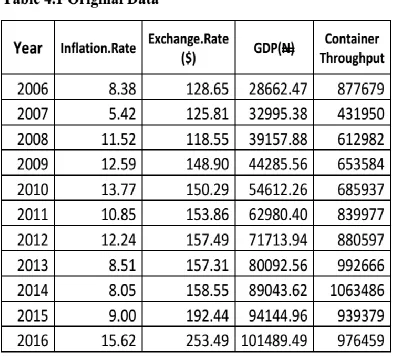
Data Presentation:
Result Presentation
The results are presented in the order of the stated Objectives of the study,
i. Identifying Nigeria„s macro-economic variables that affect container throughput of cargo goods in APMT.
RESULT: Bivariate correlation matrix, see Figure 4.2 below
ii. Finding a better linear regression model.
RESULT: After satisfying all the assumptions, the variable exchange rate was excluded (VIF=4), a better model was found with R2 = 0.61 to be expressed as:
Where Y=Container Throughput, X1= GDP and X2= Inflation rate.
iii. A comparison of predicted and actual volume of container throughput in APMT using MLR model is
iv. Finding the most suitable ANN model
COMPARISON OF THE TWO FORECASTING METHODS
Discussion Of Results
V. CONCLUSION
The performance of a model depends on how properly independent variables are used in the model. Since in the case of the MLR model, multicollinearity was a major issue as seen in the research, the variable Exchange rate was
deleted.Proper explanatory variables for generating model should be related to the demand and business activity in
the country, which was indicated by the high correlation between container throughput and GDP (0.78). Before
generating a forecasting model, the test of correlation between independent variables and dependent variable should be made.
Moreover, the result of the forecast is also consistent with the economic viewpoint as the value of the Gross Domestic Product (GDP) of a country increases; the value of container throughput also increases. Also if exchange rate is high, import and export of cargo goods tends to be high, as seen from the correlation matrix. The ANN model used backpropagation algorithm with five (5) units in the hidden layer and the learning rate equals 0.01 is the best model for forecasting container throughput based on the findings from the research. The use of linear regression models in forecasting economic data does not give results with high efficiency, since most economic variables are non-linear in nature. The ANN model performs very well in economic data, since the use of a differentiable activation function of the network which applies a linear to non-linear mapping between input variables is a major advantage of the method as compared to other forecasting techniques.
REFERENCE
[1]. (UNCTAD) (1976). Port Performance Indicator. Monographs on Port Management, PP 1-23.
[2]. Abdel K, M. Baarch, Alaa F. Sheta and Khaled Al Khaifes(2006),”Forecasting River Flow in the USA: A Comparison between Auto-Regression and Neural Network Non-Parametric models,” Journal of Computer Science, Vol 2, pp. 775-750
[3]. Agarwal, R. & Ergun, O., (2008). Ship scheduling and network design for cargo routing in liner shipping.
Transportation Science, 42(2), pp.175–196
[4]. Assem, A. Y. (2011). Comparative Study of Artificial Neural Network and ARIMA Models for
Economic Forecasting (Master's thesis, Al-Azhar University-Gaza),pp.2-5
[5]. Box, G. E. P. Jenkins, G. M. and Reinsel, G. C; (1994); Time Series Analysis:
Forecasting and Control; 3rd edition; Prentice Hall: Englewood Cliffs, New Jersey.
[6]. Brett Lantz (2015), Machine Learning with R 2nded.Birmingham-Mumbai, Packt Publishing.
[7]. Brooks, C. (2010), Introductory econometrics for finance. Cambridge: Cambridge Univ. Press.
[8]. Chen, S., & Chen, J. (2010). “Forecasting container throughputs at ports using genetic programming”.
Expert Systems with Applications,37(3), 2054-2058.doi:10.1016/j.eswa.2009.06.054
[9]. Chou, Chang C., Chub, Wuc., LIANG, Shuh G. (2008), “A modified regression model for forecasting the
volumes of Taiwan‟s import containers”, Mathematical and Computer Modeling 47, pp. 797-807.
[10]. Dollar, D. (1992), “Outward-Oriented developing economies: Evidence from 95 LDCs 1976-1985”,
Economic Development and Cultural Change 40(3) pp.523-544.
[11]. Douglas C. Montgomery and George C. Runger (2014), Applied Statistics and Probability for Engineers.
6th ed Arizona State University.
[12]. Frauke G. and Stefan F. (2010), “Training of Neural Networks”. The R Journal Vol. 2/1, pp.30
[13]. Ghalayini, L. (2011). “The interaction between oil price and economic growth”.
Retrieved from https://www.researchgate.net/publication/235939209_The_Int eraction_between_Oil_Price_and_Economic_Growth.
[14]. Gosasang, V., Chandraprakaikul, W., & Kiattisin, S. (2011). “A Comparison of
Traditional and Neural Networks Forecasting Techniques for Container Throughput at Bangkok Port”. The Asian Journal of Shipping and Logistics,27(3), 463-482. doi:10.1016/s2092-5212(11)80022-2
[15]. Greenaway. D. Nam, C.H., (1988), “Industrialization and macro-economic Performance in
Developing countries ”, 41(1988) pp. 419-435
[16]. Gurney,K. (1997), An introduction to neural networks, University of Sheffield, London and New York.
[17]. Hansen, J.V. McDonald, J.B. and Nelson, R.D; (1999); " Time Series Prediction With Genetic -
Algorithm
Designed Neural Networks : An Empirical Comparison With Modern Statistical Model s"; Computational Intelligence, 15, pp.171-184.
[18]. Hawa. M.S. George. K. V. (2015), “Forecasting Container Throughput at the Doraleh Port in Djibouti
Through Time Series Analysis”, Conference Paper, Shanghai Maritime University China.
[19]. History of APM Terminals Apapa Port Lagos, URL “ www.apmterminals.com /[Accessed on 30th
October 2016].
[20]. I, S., Kuroda, K., & Takebayashi, M. (2005). “Forecasting the demand of containerthroughput in
Indonesia”. Memoirs of Construction Engineering ResearchInstitute, 47, 1-10. Retrieved from
http://syafii.staff.uns.ac.id/files/2010/02/forecasting-of-container-throughput inindonesia.pdf
[21]. I.Pulido-Calvo, P. Montesinos, J. Roldan (and F.Ruiz-Navarro (2007),“Linear Regression and Neural Network Approach to Water demand forecasting in irrigation district with telemetry systems”Biosystem Engineering, 97, pp.283-293
[22]. Jansen, M. (2014). Forecasting container cargo throughput in ports (Master's thesis, Erasmus University
Rotterdam, 2014). Erasmus University Rotterdam.Retrieved from
https://thesis.eur.nl/pub/16985/MA-thesis-M.- Jansen-386267.pdf
[23]. Junoh, M. Z; (2004);"Predicting GDP Growth in Malaysia Using Knowledge-Based Economy
Indicators: A Comparison Between Neural Network and Econometric Approach"; Sunway College Journal, 1, pp.39-50.
[24]. K. Hornik, M. Stichcombe, and H. White (1989). Multilayer feedforward networks are universal
approximators. Neural Networks, pp.359–366.
[25]. Kabundi, A; (2002); "Macroeconomic Forecasting : A Comparison Between Artificial Neural Networks
and Eeconometric Models"; MA. thesis, Rand Afrikan University.
manufacturing; Idea Group Publishing; Melbourne.
[27] Kasypi Mokhtar (2010), Regression Model Analysis for Vessel Service Time(Master‟s thesis,
University of
Technology Malaysia). pp.3-5
[28] Kermanshahi, B. and Iwamiya, H. (2002); "Up to year 2020 load forecasting using neural net " Electrical
Power& Energy System24, pp.789-797.
[29] Kohzadi, N., M. S. Boyd, I. Kaastra, B. S. Kermanshahi, and D. Scuse (1995);" Neural Networks for
Forecasting: An Introduction"; Canadian Journal of Agricultural Economics, 43, pp.463-474.
[30] Kuan,C. M. and White, H; (1994); "Artificial Neural Networks: An Econometric Perspective";
Econometric Reviews; pp.13:1-91; Marcel Dekker; New York.
[31] Liu, L., & Park, G. (2011).” Empirical Analysis of Influence Factors to Container Throughput in
Korea and China Ports”. The Asian Journal of Shipping and Logistics, 27(2), 279-303. doi:10.1016/s2092-5212(11)80013-1
[32] Ng, W. C. (2003). “Crane Scheduling In Container Yards With Inter-Crane
Interference. Journal of Operational Research. 20 (1): pp.1-15
[33] Odland, J., & Kaltea, F. (2011). Forecasting model for dry bulk sea freight(Master's thesis,
Sweden/Lund University). Lund: Lund University. doi:lup.lub.lu.se/student-papers/record/1979787/file/1979790.pdf
[34] OECD. (2015). Impact of ports in their cities. In The competitiveness of global port cities (pp. 35-36).
Paris: OECD Publishing.doi: URL “https://books.google.se/books?isbn=9264205276.
[35] P. McCullagh and J. Nelder. (1983) Generalized Linear Models.
Chapman and Hall, London.
[36] Peng. W.Y.,CHU, C.W. (2009), “A Comparison of Univariate methods for Forecasting Container
Throughput Volumes”, Mathematical and Computer Modelling 50, pp.1045-1057.
[37] Pitinoot Kotcharant (2016), “A Forecasting Model for Container Throughput:
empirical research for Laem Chabang Port, Thailand”, World Maritime University Dissertations, Retrieved
from http://commons.wmu.se/cgi/viewcontent.cgi?article=1537&context=all_dissertations.
[38] Ram. R. (1987), “Exports and Economic Growth in Developing Countries”, Evidence from time-series
and cross-section data, 36(1) pp.51-72
[39] Remus, W. & O‟Connor, M., (2001). “Neural Networks for Time-Series
Forecasting”. Principles of Forecasting. pp.245–256.
[40] Robert I. Kabacoff.(2011), R in Action, Data Analysis and Graphics with R, Shelter Island.
[41] Rumelhart, D.E. Hinton, G.E. and Williams, R.J; (1986); "Learning Internal Representations by Error
Propagation"; Cambridge: MA:MIT. Press; 1, pp.318-362.
[42] Schulze, P. M., & Prinz, A. (2009). Forecasting container transshipment in
Germany. Applied Economics, 41(22), pp.2809-2815. doi:10.1080/00036840802260932
[43] ShippigFacts, 2012. Shipping and World Trade : Key Facts. Available at:
http://www.marisec.org/shippingfacts/worldtrade/ [Accessed August 29, 2016].
[44] Simon, Haykin (2008), Neural Network and Learning Machines, 3rd ed McMaster University,
Hamilton, Ontario, Canada.
[45] Tkacz, G. and Hu, S., (1999); "Forecasting GDP Growth Using Artificial Neural Networks";
Working Paper / Bank of Canada, 3,pp.1-24.
[46] Xiaolin, W. (2014). The impact of economic crisis on ports in post-crisis period(Master's thesis,
Rotterdam/Erasmus University). Rotterdam: Erasmus University. Retrieved from
https://thesis.eur.nl/pub/16633/MA-thesis- Y.Wang.pdf
[47] Yitnoe, Nda-Magaji (1999), "Towards transforming Apapa port to the status of hub for the West
African region", World Maritime University Dissertations. 314. URL”
htp://commons.wmu.se/all_dissertations/314
[48] Zhang,G. P; (2003); "Time Series Forecasting Using A Hybrid ARIMA and Neural Network Model";