Effect of thickness on dynamic parameters
of bi woven epoxy glass composite through
Modal Testing
SATISH.N
Research Scholar
Department of Mechanical Engineering
R & D Center, U V College of Engineering, Bangalore-04 [email protected]
Dr.P.VIJAYA KUMAR
PROFESSOR
Department of Mechanical Engineering
R & D Center, U V College of Engineering, Bangalore-04
Dr.H.K.SHIVANAND
ASSOCIATE PROFESSOR Department of Mechanical Engineering
R & D Center, U V College of Engineering, Bangalore-04
Abstract
Laminated plates are widely used in aircraft and space systems because of their advantages over isotropic plates in the higher stiffness-to-weight and strength-to-weight ratios. However, the analysis of layer plates is more difficult due to their complex mechanical characteristics. Dynamic response of composite laminates has received a great deal of attention in recent years. In this, paper free vibration parameters of laminated composites are evaluated experimentally. Bi-woven glass cloth with epoxy resin as matrix is made use of to prepare the laminates. Vacuum bagging method was employed in the fabrication of specimens. Specimens were prepared with two different thicknesses and tested for three different boundary conditions. Traditional “strike method” was employed which consists of impact hammer, accelerometer and four channel FFT analyzer. Vibration parameters such as natural frequencies, modal damping and the corresponding mode shapes were extracted and results are presented. It is observed that the dynamic parameters increase with increase in thickness of the specimens for the same configuration tested.
Keywords: Frequency, Mode Shape, Damping, FFT, FRP 1) Introduction
Most of the structural components are generally subjected to dynamic loadings in their working life. Very often these components may have to perform in severe dynamic environment where in the maximum damage results from the resonant vibrations. Susceptibility to fracture of materials due to vibration is determined from stress and frequency. Maximum amplitude of the vibration must be in the limited for the safety of the structure. Hence vibration analysis has become very important in designing a structure to know in advance its response and to take necessary steps to control the structural vibrations and its amplitudes. Fiber-reinforced composites, due to their high specific strength, and stiffness, which can be tailored depending on the design requirement, are fast replacing the traditional metallic structures in the weight sensitive aerospace and aircraft industries [1]. Indeed, composite materials present considerable potential for wide use in aircraft structures in the future, especially because of their advantages of improved toughness, reduction in structural weight, reduction in fatigue and corrosion problems [2].
changing its geometry drastically or increasing its weight.
From the above, it is evident that there is no single source of literature available on effect of thickness on dynamic parameters of FRP based laminated composites for varying boundary conditions. To this end, in this work an experimental modal testing of biwoven epoxy glass cloth laminates with two different thicknesses & for different boundary conditions was tested and the results are recorded and discussed.
2) Experimental Procedure
2.1) Materials Required for Fabrication of Laminates
The constituent materials used for fabricating the epoxy/glass fiber laminates are: E-Glass woven as reinforcement, Epoxy as resin, Hardener as catalyst (10% of the weight of epoxy), polyvinyl alcohol as a releasing agent.
2.2) Fabrication Procedure
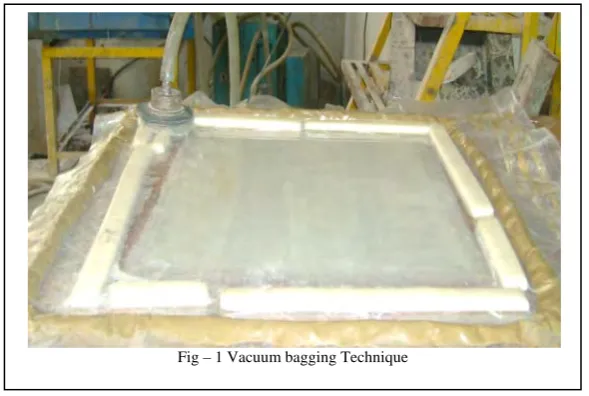
The composite plate specimens used in this work were made from 0/90 woven glass fiber with epoxy matrix. Specimens were fabricated by hand layup technique [8]. The first layer of bi-woven glass fiber cloth (ranging from 0.25 mm to 0.35 mm) is laid and resin is spread uniformly over the cloth by means of brush. The second layer of the cloth is laid and resin is spread uniformly over the cloth by means of brush. After second layer, to enhance wetting and impregnation, a teethed steel roller is used to roll over the fabric before applying resin. Also resin is tapped and dabbed with spatula before spreading resin over fabric layer. This process is repeated till all the 10 layers (2 mm thickness) and 16 layers (4 mm thickness) are placed. No external pressure is applied while casting and curing because uncured matrix material can squeeze out under high pressure. This results in surface waviness (non-uniformed thickness) in the model material. The casting is cured at oven temperature of about 100º C up to 2 hrs & finally removed from the mould to get a fine finished composite plate as shown in the fig 1 below.
Fig – 1 Vacuum bagging Technique
3) Experimental Setup and Test Procedure for Modal Test
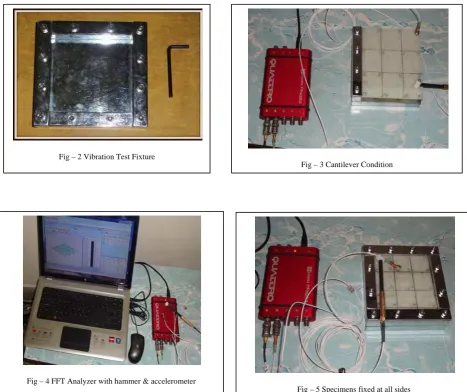
To simulate different boundary conditions, vibration test fixture was designed and fabricated as shown in fig 2 below. One edge of the laminated was fixed to obtain cantilever condition plate as shown in figure 3. The connections of FFT analyzer, laptop, transducers, modal hammer, and cables to the system were done as per the guidance manual shown in fig.4. The plate was excited in a selected point by means of Impact hammer. The resulting vibrations of the specimens on the selected point were measured by an accelerometer (PCB Make)
4) Results & Discussions
Table – 1 Results of Modal testing of bi-woven epoxy/glass fiber
Boundary Conditions
Frequency, Hz & % Damping
2 mm thick laminate 4 mm thick laminate
Mode 1 Mode 2 Mode 3 Mode 1 Mode 2 Mode 3
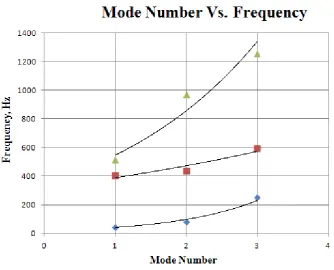
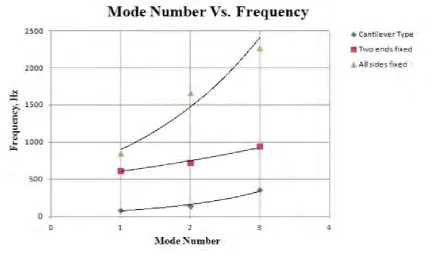
Cantilever Type 45.6 (0.48%) 82.6 (1.23%) 251 (2.35%) 77.8 (0.35%) 141 (0.31%) 358 (0.43%)
Two ends fixed 404 (1.25%) 439 (0.91%) 594 (1.88%) 616 (1.91%) 721 (0.76%) 941 (1.18%)
All sides fixed 513 (2.17%) 971 (3.83%) 1257 (1.98%) 846 (1.53%) 1660 (1.67%) 2267 (1.86%)
(numbers in the bracket indicates % damping)
Fig – 2 Vibration Test Fixture
Fig – 3 Cantilever Condition
Fig – 4 FFT Analyzer with hammer & accelerometer
Fig – 8 Graph of Mode Number vs. Frequency for Glass fiber – 2 mm thick
Fig – 9 Graph of Mode Number vs. Frequency for Glass fiber – 4 mm thick
Experimental Modal Testing of epoxy/glass composite specimens with two thicknesses 2mm and 4mm with three different boundary conditions was investigated and the results are tabulated as shown in Table 1. The following observations were made from the composite specimens when tested.
1. Composite specimen with glass fibers with 4 mm thick appears to improve the modal parameters as compared to specimen with 2 mm thick.
2. There has been increment in the frequency values from the 1st mode to 2nd mode with all types of boundary conditions for both 2mm and 4 mm thick specimens as observed from figs 8 & 9 above.
3. Figs 6 & & 7 describes the FRF’s of all the locations for both specimens with different boundary conditions along with the Fundamental Mode shape. The damping corresponds to 0.48% in case of specimen with 2mm thick for Mode 1 whereas the value decreases to 0.35 % in case Mode 1 for 4mm thick laminate, this is very evident that damping capability of Glass fibers are lower at higher modes when compared to lower modes.
4. Similarly, the fundamental mode shape of Glass fiber for both types of specimens with various boundary conditions behaves in similar fashion.
5. It can be observed from table -1 that there is significant frequency shift from cantilever condition to all sides fixed which indicates the improvement in the modal parameters [9] with the Glass fibers. This is due to the fact, as boundary conditions are imposed from one end to two ends and similarly from two ends to all sides fixed, the stiffness of the structures increase appreciably and there will be monotonic increase in the frequencies.
5) Conclusions
Two types of laminated composite plates with bi- woven glass fibers of 2mm and 4mm thick specimens were fabricated and their vibration characteristics are investigated by modal impact tests. The following conclusions are drawn and presented below:
At the same time, the natural frequencies of higher order modes increase slightly with the change in boundary conditions. . The frequencies of the symmetric bending mode and the antisymmetric mode of one order higher than the symmetric one may cross over for the specimen with the clamped edges when the specimen curvature increases [10].
The simplicity of the design too, seems to have played a role in obtaining good experimental results between Glass fibers with two different thicknesses. Hence, this method of fabrication proves to be accurate enough in laminated specimens to improve their dynamic performance without much sacrificing to the weight.
6) Acknowledgements
Authors thankfully acknowledge the Principal and Chairman, Department of Mechanical Engineering of their institution for the constant encouragement and support extended by them during this work.
7) References
[1] Abir, Humayun R.H. “On free vibration response and mode shapes of arbitrarily laminated rectangular plates” Composite Structures
65 (2004) 13–27.
[2] Mei, C. “Finite element displacement method for large amplitude free flexural vibrations of beams and plates” Computers &
Structures, Vol. 3, pp. 163-174. Pergamon Press 1973. Printed in Great Britain.
[3] Houmat, A. “Large amplitude free vibration of shear deformable laminated composite annular sector plates by a sector p-element
“International Journal of Non-Linear Mechanics 43 (2008) 834 – 843.
[4] Bhimaraddi, A. and Chandrasekhara, K.” Nonlinear vibrations of heated antisymmetric angle-ply laminated plates” Int. J. Solids
Structures Vol. 30, No. 9, pp. 1255-1268, 1993.
[5] Amabili, M. “Nonlinear vibrations of rectangular plates with different boundary conditions theory and experiments” Computers and
Structures 82 (2004) 2587–2605.
[6] Singh, G. and Venkateswara Rao, G. “Nonlinear oscillations of laminated plates using an accurate four-node rectangular shear flexible
material finite element” Sadhana, Vol. 25, Part 4, August 2000, pp. 367-380.
[7] Tsai, S. W. and Hanh, H. T., 1980, “Introduction to Composite materials”, Technomic, Lancaster.
[8] Dow M.B., Dexter H.B., Development of stitched, braided and woven composite structures in the ACT program and at Langley
Research Center (1985 to 1997): summary and bibliography. NASA/TP-97-206234, 1997.
[9] Maheri, M.R. and Adams, R.D. (1998). On the Flexural Vibration of Timoshenko Beams, and the Applicability of the Analysis to a
Sandwich Configuration, Journal of Sound and Vibration, 209(3): 419–442.
[10] He, L., Wang, I. and Tang, D., 1993, “Dynamic responses of aircraft wing made of composite materials”, Proceedings of the 11th