Recognition of Real or Picture Face Using Skin
Colour Detection and Depth Map Information
1
Chanchal MahadevPatil, 2 K. P. Paradeshi
1,2
Department of Electronics Engineering, P. V. P. Institute of Technology, Budhgaon (Sangli), Maharashtra, India
Abstract - In today’s world security of data, person and information is very important aspects. So biometric systems for user authentication are becoming increasingly popular due to the security control requirement in identity verification, access control, and surveillance applications. An effective method with high accuracy and security for user authentication using skin color and depth information is presented. The aim of this review paper is to introduce an intelligent algorithm for face detection and recognition. For accurate face detection template matching method, haar cascade feature, adaboost algorithm are use-full. Depth value helps to determine real or fake (picture) face.
Keywords - Real Face, Picture Face, Skin Colour Detection, Haar features, Depth Map, Adaboost Algorithm.
1.
Introduction
User authentication is becoming increasingly popular due to the security control requirement inidentity verification, access control, and surveillance applications. Face recognition, among other conventional biometric authentication techniques is most suitable alternative because it is non-intrusive and economic with low cost cameras and embedded systems. Over the past few years, extensive research works on various aspects of face recognition by human and machines have been conducted by psychophysicists, neuroscientist and engineering scientists.
Face recognition is one of the most studied topicsin computer vision and one of the most successful applications of image analysis, pattern recognition and machine learning. Although there are many successful applications already, face recognition is still a challenge. This is due to the variance in face images, such as viewpoint, illumination, expression, occlusion, makeup and even aging. There are mainly two approaches for face recognition, content based and face based. In content based approach, recognition depends of the relationship
between human facial features such as eyes, mouth, nose, profile silhouettes and face boundary. Face based approach attempts to capture and define the face as a whole.
There are various methods for face recognition using different algorithms. But these methods do not give best solution. These methods operate individually in particular conditions. Hence to obtain best solution the combined algorithm can be formed which extracts advantage of all these methods.
The face provides different important information, as it reflects the identity and emotional states of individuals. Face detection is a preliminary step to face recognition, tracking, and many other applications. This topic was the subject of several studies. Different solutions are proposed that may be separated into four categories: Knowledge based, Invariant features approach, Template matching approach, learning techniques [1].
The difficulties in face recognition arise when the image of the subject to be recognized cannot be captured in a controlled environment. All face recognition algorithms try to eliminate the effects of variances in pose and illumination. The approach given by ErolSeke puts no limits on illuminants. To reduce complexity select only sampling points instead of selecting whole face. For that combination of two criteria is used higher intensity variance with illumination changes and lower intensity variance with face changes [7].
2.
Skin Colour Based Face Detection Using
HSV Color Space
The distribution of skin colour of different people has proven to be assembled into a small area of the colour space [10]. To create colour model it is important to choose proper colour space, available colour spaces are YUV(Y- luminance component, U and V chrominance component), YCbCr(Y- luminance, Cb- blue chrominance, Cr-red chrominance), RGB(red, green, blue), Normalised RGB(normalised red, green, blue), HSV(hue saturation value) [5]. Skin colour distribution of the same person under different lighting conditions differs. Changes in lighting have a great impact on skin detection effect, so a successful skin-color model should have good skill of adjusting to the changes in lighting and the viewing environment [7]. Using the raw input image in the RGB colour space is not suitable tool for skin detection. This is due to that the RGB colour space is highly sensitive to intensity difference [4]. The YCbCrand HSV colour space are commonly used in image processing. YCbCr separates the luminance, in Y component, form the chrominance described through Cb(chrominance of blue) and Cr(chrominance of red) components [10].
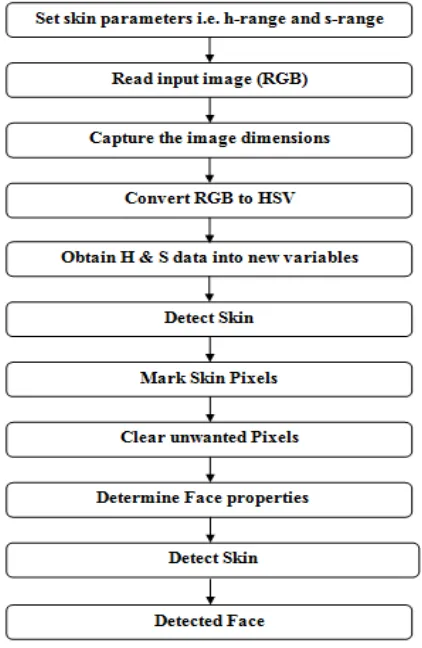
Fig.1 Flowchart of face detection using skin color
Hue, Saturation, Value or HSV is a color model that describes colors (hue or tint) in terms of their shade (saturation or amount of gray) and their brightness (value or luminance).Hue is expressed as a number from 0 to 360 degrees representing hues of red (starts at 0), yellow (starts at 60), green (starts at 120), cyan (starts at 180), blue (starts at 240), and magenta (starts at 300).Saturation is the amount of gray (0% to 100%) in the color.Value (or Brightness) works in conjunction with saturation and describes the brightness or intensity of the color from 0% to 100%.
Above flowchart shows step by step procedure for face detection using skin color. For the experiment take images taken by stereo pair of camera i.e. left and right image.Face situation can be determined through skin points in image. To determine skin points, first human skin color is calculated through HSV color space. Many more experiments show different ranges for Hue (H-range) and Saturation (S-range). In this method, H- rage0-0.1000 and S- range 0.2500-1.4000 is selected by performing various experiments these values are taken. First step of presented method is to set skin parameters in terms of H-range and S-range. Next take input image specify its parameter (i. e. height and weight). Next convert input image which is in the form of RGB to HSV. In this step stores H and S data into new variables. Now using new data available detect the skin pixel from predetermined h-range and s-range values. Mark the skin pixel obtained from entire image using red mark and also form binary image. Remove the unwanted pixels from image. After this we can get many object in specified area calculate the area of all objects.Select the region which has maximum area as a face area.
Fig. 2. Skin Colour Based Face Detection
3. Face Detection Using Adaboost Algorithm
retrieval). In such domains a cascade of simple classifiers each trained to achieve high detection rates and modest false positive rates can yield a final detector with many desirable features: including high detection rates, very low false positive rates, and fast performance. Achieving extremely high detection rates, rather than low error, is not a task typically addressed by machine learning algorithms. They propose a new variant of AdaBoost as a mechanism for training the simple classifiers used in the cascade. Experimental results in the domain of face detection show the training algorithm yields significant improvements in performance over conventional AdaBoost.
The final face detection system can process 15 frames per second, achieves over 90% detection, and a false positive rate of 1 in a 1,000,000. He worked on new image representation called an integral image that allows for very fast feature evaluation [13]. Basic motivation in part by the work of Papa Georgiou et al. his detection system did not work directly with image intensities. Due to this he used set of features which are reminiscent of Haar Basis functions. In order to compute these features very rapidly at many scales he introduces the integral image representation for images. The integral image can be computed from an image using a few operations per pixel. Once computed, any one of these Harr-like features can be computed at any scale or location in constant time. Then he constructed a classifier by selecting a small number of important features using Adaboost.
The Adaboost algorithm was often used to detect face area in an image. Adaboost is widely used machine learning algorithm. The main idea of Adaboost algorithm is to boost up large no. of generally weak classifier to form strong classifier and has strong classification ability. A very small number of features can be combined to form an effective classifier. Adaboost is short form for Adaptive Boosting, and it is used in conjunction with other learning algorithms to improve the performance. Adaboost constructs a collection of weak classification functions which is called as a Strong Classifier. Each feature is considered to be a potential weak classifier which correctly classifies in little more than half of the cases.
Adaboost is used both to select the features and train the classifier Weak learner: a single rectangle feature that best separates positive and negative examples; so weak classifier is a thresholded single feature (can be viewed as a single node decision tree).
Fig3. Face Detection using Haar Features
4.
Depth Map Generation And Recognition
Of Real And Picture Face
Here region based stereo matching algorithms developed for extraction depth information from two colour stereo image pair and originally designed by BarısBaykant ALAGÖZ is used for calculating depth values of each pixel in image [14]. A filter eliminating unreliable disparity estimation is used for increasing reliability of the disparity map. This approach present method to calculate depth of particular scene here we used this to obtain depth map of human face.
Obtaining reliable depth maps, indicating distance of surface from the stereo camera pair, have importance in robotic applications and autonomous systems. Intelligent systems, which can move around by itself, could be developed by obtaining depth information from the sensors. Stereovision is the one of methods that can yield depth information of the scene. It uses stereo image pairs from two cameras to produce disparity maps that can be easily turn into depth maps. Reliability of depth maps and computational cost of algorithm is key issue for implementing real time robust applications.
HereDi (i=1…N) is the depth value of the ith pixel in the face area, where N is the total number of pixels in the face
area. Generally, the depth values of a real face has a much larger varied range than that of a picture face for plane of face. Considering this, we can define the average value of depth of all skin pixels, AvgD, as:
(1)
Then the variance of depth values of the face can be calculated as:
(3)
In formula (1), di represents the difference between the depth value of each skin pixel and the average depth value,
S gives the variance decision value of the detection result.
Generally, the di varies much on a real face compared with a picture face for the same average value. So, the value S
in formula (3) is appropriate for decision which we used for recognition of real face and picture face.
Following are the results for Depth map calculation.
Fig.4. Depth Map of Real Face(S=408.221546705197)
Fig.5. Recognition of Real Face
Fig.6. Depth Map of Picture Face(S=0)
Fig.7. Recognition of Picture (Fake) Face
5.
Conclusion and Future Work
The problem of automatic face recognition is complex task that involves recognition of human face sin cluttered background. The goal of face recognition is to provide high accuracy and security for biometrics authentication. Face recognition techniques includes detection of face, match it with database and give accurate recognition. Now days, biometrics authentication is used for various purpose. So because of that only one method of detection or recognition is not useful. So, we use combination of method for detection and recognition. This technique achieves good performance by combining different algorithms for detection and recognition of real and fake (picture) face. This algorithm is fast and simple for implement and gives higher accuracy and security.
References
[1] S. Kherchaoui and A. Houacine, “Face Detection Based On A Model Of The Skin Colour With Constraints And Template Matching”, 2010 International Conference on Machine and Web Intelligence (ICMWI), 2010 IEEE, Page(s): 469-472. [2] JunfengQian, Shiwei Ma, ZhonghuaHao, YujieShen ,
”Face Detection and Recognition Method Based On Skin Colour and Depth information”, 2011 International Conference on Consumer Electronics Communication and Networks (CECNet) , 2011 IEEE, Page(s): 345-348.
[3] Shou-Jen Lin, Chao-Yang Lee, Mei-Hsuan Chao, Chi-SenChiou, Chu-Sing Yang, “The Study and Implementation of Real-Time Face Recognition and Tracking System”, Proceedings of the Ninth International Conference on Machine Learning and Cybernetics (ICMLC), Qingdao, 11-14 July 2010, 2010 IEEE, Page(s): 3050-3055.
[4] Dan Xu, Yen-Lun Chen, Xinyu Wu, YongshengOu and YangshengXu, “Integrated Approach of Skin-colour Detection and Depth Information for Hand and Face Localization”, Proceedings of the 2011 IEEE International Conference on Robotics and Biometrics (ROBIO) December 7-11, 2011 IEEE, Page(s): 952-956.
[5] C. E. Erdem, S. Ulukaya. A. Karaali, A. T. Erdem, “Combining Haar Feature and Skin Colour Based Classifiers For Face Detection”, 2011 International conference on Acoustic, Speech and Signal Processing (ICASSP), 2011 IEEE, Page(s): 1497-1500.
[6] AlaaSagheer and SalehAly, “An Effective Face Detection Algorithm based on Skin Colour Information”, 2012 Eighth International Conference on Signal Image Technology and Internet Based Systems (SITIS), IEEE 2012, Page(s): 90-96.
[7] ErolSeke, “Determining Illumination Sources in Frontal Face Images using Salient Samples from a Face Depth Map”, 2011 International Symposium on Innovation in Intelligent System and Application (INISTA), 2011 IEEE, Page(s): 173-176.
[8] Gang Pan, Shi Han, Zhaohui Wu and Yueming Wang, “3D Face Recognition using Mapped Depth Images”, Proceedings of the 2005 IEEE Computer Society Conference on Computer Vision and Pattern Recognition (CVPR’05), 2005 IEEE, Page(s): 175-181.
[9] RenMeng , Zhang Shengbing , Lei Yi , Zhang Meng, “ CUDA-based Real-time Face Recognition System”, 2014 Fourth International Conference on Digital Information and Communication Technology and It’s Application (DICTAP), 2014 IEEE, Page(s): 237-241. [10] Xiaoping Li and Yinxing Li, “Study and Realization Of
Face Detection Based on Skin Segmentation and Template Matching”, 2010 Fourth International Conference On New Trends In Information Science and Service Science (NISS), 2010 IEEE, Page(s): 375-378.
[11] Swapnil V Tathe and Sandipan P Narote, “Face detection using colour models”, Proceedings of "Conference on Advances in Communication and Computing (NCACC'12)”, World Journal of Science and Technology 2012, ISSN: 2231 – 2587, Page(s): 182-185.
[12] Ankita Jain, Krishnan Kutty and Suresh Yerva, “GMM Based Approach for Human Face Verification using Relative Depth Features”, 2013 International Conference On Advances In Computing Communicating and Informatics (ICACCI), 2013 IEEE, Page(s): 675-680.
[13] Paul Viola and Michael Jones,“Fast and Robust Classification using Asymmetric
[14] AdaBoost and a Detector Cascade”, Mistubishi Electric Research Lab Cambridge, [email protected] [email protected]