A STUDY ON FACT ANALYSIS ON INFLUENCING OF NON-TRADE CONSUMER
PREFERENCE OF PURCHASING CEMENT
Dr.T.K.Senthilkumar, M.Manivannan,
Assistant Professor, Ph.D., Scholar (Part-time)
Department of Commerce, Department of Commerce,
Annamalai University, Annamalai University,
Chidambaram. Chidambaram.
ABSTRACT
INTROUDCTION
Cement is one of the core industries which plays a vital role in the growth and expansion of a nation. It is
basically a mixture of compounds, consisting mainly of silicates and aluminates of calcium, formed out
of calcium oxide, silica, aluminum oxide and iron oxide. The demand for cement depends primarily on
the pace of activities in the business, financial, real estate and infrastructure sectors of the economy.
Cement is considered preferred building material and is used worldwide for all construction works such
as housing and industrial construction, as well as for creation of infrastructures like ports, roads, power
plants, etc. Indian cement industry is globally competitive because the industry has witnessed healthy
trends such as cost control and continuous technology up gradation. The Indian cement industry is
extremely energy intensive and is the third largest user of coal in the country. It is modern and uses
latest technology, which is among the best in the world. Also, the industry has tremendous potential for
development as limestone of excellent quality is found almost throughout the country.
Statement of the Problem: The purchasing preference of cement by Non-trade customer has involved
many factors. These factors are usually classified in to two, namely internal factor and External Factor.
However many study has attempt to analyses the factors influencing for purchasing cement for
non-trade customer, but not predict the dimension for preferential factors for purchasing cement. This study
has focused on dimensions of purchasing preference of cement by non-trade consumer.
Scope of the Study: the consumer of purchasing cement has classified into two. There are Trade
consumer and Non-trade consumer. This study has concentrate only on Non-trade consumer. This study
is also conducted in four major cities in Tamilnadu. The populations of the study are Architects and
Review of Literature:
Baradaran Kazemzadeh, R. (2005) believe “Customer satisfaction occurs as a result of customer
perception during a trade and the relationship is valued so that the price equals the proportion of the
quality of a given service with the customer prices and casts”. *Baradaran Kazemzadeh, R. (2005). Mass
parameters to increase of customer satisfaction. Bimonthly official publication of Shahed university,
71-78.] According to Zeithmal (1990)Brand perception i.e Perceived quality of a Brand is the customer’s
judgment about a product’s overall excellence or superiority that is different from objective quality
(Zeithaml 1988, pp. 3 and 4). Objective quality refers to the technical, measurable and verifiable nature
of products/services, processes and quality controls. [Zeithaml, A, Pasuraman, A., Berry, L. (1990).
„‟Delivering Quality Service: Balancing Customer Perceptions and Expectations‟‟. New York: The Free
Press Division of Macmillan, Inc.] Jobber, D (2007) states the objective is to identify groups of customers
with similar requirements so that they can be served effectively while being of sufficient size for the
products or services to be supplied sufficiently. [Jobber, D (2007). ‟Principles and practice of marketing’’
.5th edition. Berkshire: McGraw Hill, Chapter 1,3,8.], Kotler (2002) present four major segmentation
variables for consumer markets: geographic, Demographic, psychographics and behavioral variables
[Philip Kotler, ‟Marketing Management’’, pg 223-25 Edition: 11th ed. Publisher: Prentice Hall, Date
published: 2002 ISBN-13: 9780130336293 ISBN: 0130336297]. Market segments must meet the
following criteria: Measurable, substantial, Accessible, Differentiable and Actionable. Doyle (1998)
states that targeting Strategies - Once the organization has identified its market – segments
opportunities, it has to decide how many and which ones to target. Market segmentation is a means to
end: target marketing.[25]
Objectives of the study: The study has an objective of classifying the variables involved in purchasing
1. To study the present scenario of Cement Industries
2. To study the factor responsible for buying preference of cement for Non-trade consumers.
Sample Design: The present research is descriptive in nature that describes demographic profile and
describes the influencing factors of customer preference of cement. The researcher has used both
primary and secondary data. Primary data was collected by using Questionnaire and secondary data was
collected from books and journals.
Sampling Procedure: Random sampling has been used in this study. Random sampling is used for
selection of homogeneous sample for the study. It refers to selecting a sample of study objects on
randomly. Thus research study may include study objects and research findings based on random
sampling, however cannot be generalized.
Instrument of Research: The research instrument used in this study is a structured questionnaire.
Structured questionnaire are those questionnaire in which are definite concrete and predetermined
questions relating to the aspect, favor which the researcher collects data. The questions are presented
with exactly the same order to all the respondents. The structured questionnaires that were framed and
designed consist of close ended, open ended, multiple chose and liker rating questions.
Size of the sample: the survey was descriptive and sample chosen was mainly on the judgments of the
researcher with the help and proper consultation of research advisor. In this kind of sampling method,
the population elements are based on the judgments of the researcher. 300 Non-trade consumers are
involved in the study.
Analysis of Data: After the data collection was over the researcher analyzed the collected data with the
with principal component has been done in order to classify the influencing variables in to different
factors for Non-trade consumer.
Fact analysis of Influencing factor of buying cement of Non-trade consumer (Architects and engineers,
Industrial bulk consumer and general consumer): In order to factor determining purchasing cement in
the sample study of four area of Tamilnadu, it is important to reduce the parameters so that there is a
limited set of parameters that represent the total consideration set. A statistical approach –‘t’ Test and
factor analysis has been used for the study. Finally, practical implications concerning the influencing
variables have been highlighted. The factor influencing purchasing decision of particular brand of
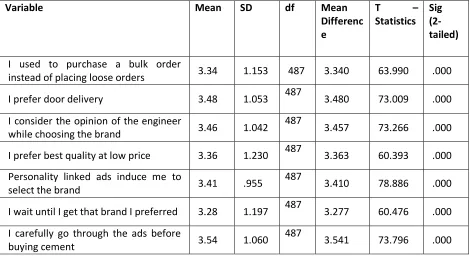
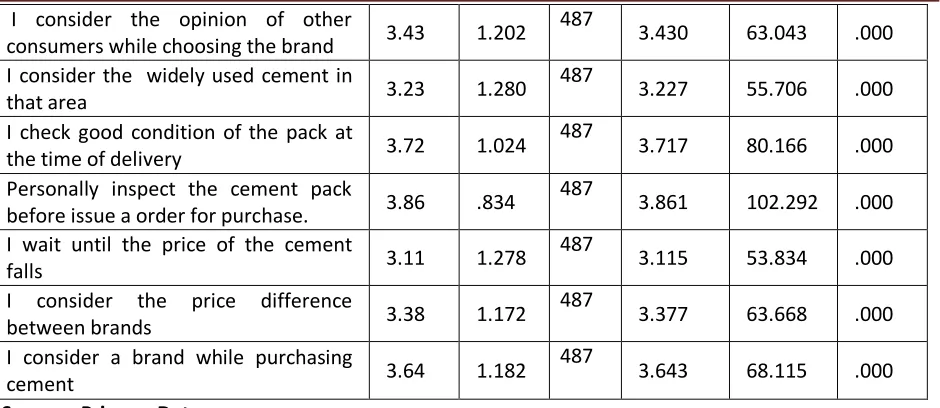
cement by rating them by five point scale and its significant t value are given in table No.1 The
significance of the sample is tested through ‘t’ value which shows that all the factors are statistically
significant at 0.05 level. This means that the sample size is the true representation of the population
(p-value is less than 0.05 in all cases)
Table No.1 One-Sample Test for testing the influencing variables of preferring cement for non-trade consumer
Variable Mean SD df Mean
Differenc e
T –
Statistics Sig (2-tailed)
I used to purchase a bulk order
instead of placing loose orders 3.34 1.153 487 3.340 63.990 .000
I prefer door delivery 3.48 1.053 487 3.480 73.009 .000
I consider the opinion of the engineer
while choosing the brand 3.46 1.042
487
3.457 73.266 .000
I prefer best quality at low price 3.36 1.230 487 3.363 60.393 .000
Personality linked ads induce me to
select the brand 3.41 .955
487
3.410 78.886 .000
I wait until I get that brand I preferred 3.28 1.197 487 3.277 60.476 .000
I carefully go through the ads before
buying cement 3.54 1.060
487
I consider the opinion of other
consumers while choosing the brand 3.43 1.202
487
3.430 63.043 .000
I consider the widely used cement in
that area 3.23 1.280
487
3.227 55.706 .000
I check good condition of the pack at
the time of delivery 3.72 1.024
487
3.717 80.166 .000
Personally inspect the cement pack
before issue a order for purchase. 3.86 .834
487
3.861 102.292 .000
I wait until the price of the cement
falls 3.11 1.278
487
3.115 53.834 .000
I consider the price difference
between brands 3.38 1.172
487
3.377 63.668 .000
I consider a brand while purchasing
cement 3.64 1.182
487
3.643 68.115 .000
Sources: Primary Data
The explanatory factor analysis is used to identify the factors influencing the purchasing decision of
cement among the Architects and engineers, Industrial bulk consumer and general consumer in the
four district of Tamilnadu. To test the suitability of the data for factor analysis, the following steps have
been taken. The correlation matrices are computed and examined. It reveals that there are enough
correlations to go ahead with factor analysis. Anti-image correlations were computed. These showed
that partial correlations were low, indicating that true factors existed to the data.
Table No.2 Result of KMO and Bartlett's Test of sampling adequacy.
Kaiser-Meyer-Olkin Measure of Sampling Adequacy. .715
Bartlett's Test of Sphericity
Approx. Chi-Square 1290.842
df 91
Sig. .000
Kaiser-Meyer-Olking Measure of Sampl9ng Adequacy (MSA) for individual variables is studied from the
diagonal of partial correlation matrix (table 2). It is found to be sufficiently high for all variables. The
measure can be interpreted with the following guidelines: 0.90 or above, marvelous: 0.080 or above,
meritorious; 0.70 or above, middling, 0.60 or above, mediocre; 0.50 or above miserable, and below 0.50,
(MSA) is computed, which is found to be 0.707. it is indicated that the sample is good enough for
sampling. The overall significance of correlation matrix is tested with the Bartlett test of Sphericity for
unbalancing factors affecting Work-life balance of respondents (approx.. chi-square = 1297.3, which is
significant at 0.000) as well as support for the validity of the factor analysis of the data set. Hence, all
these standards indicate that the data is suitable for factor analysis. For extracting factors the principal
components analysis and latent root criterion, rotation methods, orthogonal rotation with varimax were
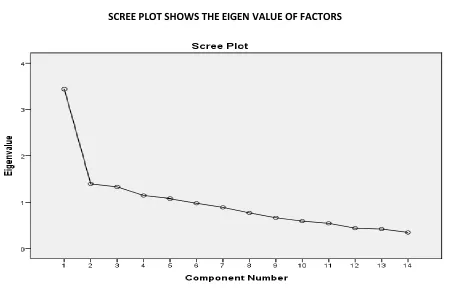
also applied. As per the talent root criterion, only the factors having latent roots or Eigen values greater
than 1 are considered significant, and all the other factors with latent roots less than 1 are considered
insignificant and disregarded.
Factors influencing purchasing decision of Cement among the Architects and engineers, Industrial bulk consumer and General consumer:
After the standards indicated that the data are suitable of factor analysis principal components analysis
was employed for extracting the data which allowed determining the factor underlying the relationship
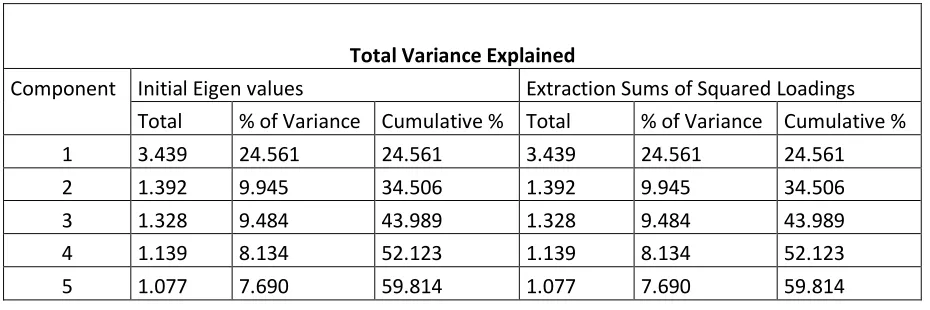
between a numbers of variables. The total variable explained suggests that it extracts one factor
accounts for 63.2247%. Per cent of the variance of the relationship between variable (Table4).
Table No. 3 Total variance Explained – Extraction sums of squared loadings
Total Variance Explained
Component Initial Eigen values Extraction Sums of Squared Loadings
Total % of Variance Cumulative % Total % of Variance Cumulative %
1 3.439 24.561 24.561 3.439 24.561 24.561
2 1.392 9.945 34.506 1.392 9.945 34.506
3 1.328 9.484 43.989 1.328 9.484 43.989
4 1.139 8.134 52.123 1.139 8.134 52.123
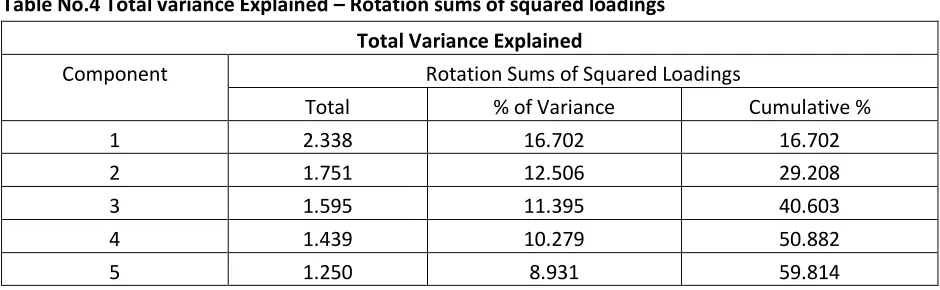
Table No.4 Total variance Explained – Rotation sums of squared loadings Total Variance Explained
Component Rotation Sums of Squared Loadings
Total % of Variance Cumulative %
1 2.338 16.702 16.702
2 1.751 12.506 29.208
3 1.595 11.395 40.603
4 1.439 10.279 50.882
5 1.250 8.931 59.814
The purpose of the analysis is to obtain a small number of factors which account for most of the
variability in the 15 variables. In this case, 5 factors have been extracted, since 5 factors had Eigen
values greater than or equal to 1.0. Together they account for 63.2247% of the variability in the original
data. Loading on factor can be positive or negative. A negative loading indicates that this variable has an
inverse relationship with the rest of the functions. However, comfrey suggested that anything above
0.44 counts be considered salient, with increased loading becoming more vital determining the factor.
All the loading in the research are positive.
Rotation is necessary when extraction technique suggests that there is two or more function. The
rotation of factors is designed to give an idea of how the factor unlimited extracted differ from each
other and to provide a clear picture of which items load on which factors.. The Eigen value five functions
were 4.15844, 1.80695, 1.444688, 1.06139 and 1.01005 respectively (table No 4). The percentage of
total variance is used as an index to determine how well the total factors solution accounts of r what the
variable together represent index for present solution accounts for 63.225 percent of the total variation
for influencing factor of preference of cement for among the Architects and engineers, Industrial bulk
consumer and general consumer. It is pretty good extraction as it can economies on the number of
explained by factors one to five factors affecting the work-life balance are 27.723,
12.046,9.646,7.076 and 6.734 respectively (table above). The above table tells as that after five
factors are extracted, is retained, the communalities are 0.536039 for variable 1, 0.726331 for variable 2
and so on. It means that 53.6% percentage of the variance of variable 1 is being accounted by the five
extracted factors together.
Table No.5
Result of Rotated component matrix explained the factor
Rotated Component Matrixa
Component
1 2 3 4 5
I used to purchase a bulk order instead of
placing loose orders .752 .267 -.073 .180 .034
I prefer door delivery .721 -.025 .265 .089 .040
I consider the opinion of the engineer while
choosing the brand .646 .078 .170 -.067 -.099
I prefer best quality at low price .517 .391 .243 .023 -.372
Personality linked ads induce me to select the
brand .318 .713 .012 .011 .084
I wait until I get that brand I preferred .016 .598 .135 -.051 -.214
I carefully go through the ads before buying
cement .012 .543 .036 .471 .451
I consider the opinion of other consumers
while choosing the brand .080 .067 .820 .022 -.087
I consider the widely used cement in that area .297 -.025 .655 .046 .069
I check good condition of the pack at the time
of delivery .008 .386 .524 -.010 .107
Personally inspect the cement pack before
issue a order for purchase. .070 .313 .078 -.785 .150
I wait until the price of the cement falls .249 .309 .167 .733 -.010
I consider the price difference between brands .345 .108 -.043 .097 -.667
I consider a brand while purchasing cement .430 .036 .041 -.062 .593
been accounted for by the factor locution. Varimax rotated factor analytic results for factor determining
the influencing factor of preference of cement for among the Architects and engineers, Industrial bulk
consumer and general consumer is shown in below table.
Chart No.1
SCREE PLOT SHOWS THE EIGEN VALUE OF FACTORS
Table No.6
Name of the factors influencing of preference of cement for among the Architects and engineers, Industrial bulk consumer and general consumer (Non-Trade consumer)
Naming Of Factors
Name of the dimensions
Label Loading
Name of the
Unbalancing variables
Factor Loading
F1 External influence
V1 I used to purchase a bulk order instead of
placing loose orders .752
V2 I prefer door delivery .721
V3 I consider the opinion of the engineer
while choosing the brand .646
V4 I prefer best quality at low price .517
factors the brand
V6 I wait until I get that brand I preferred .598
V7 I carefully go through the ads before
buying cement .543
F3 Core factors
V8 I consider the opinion of other consumers
while choosing the brand .820
V9 I consider the widely used cement in that
area .655
V10 I check good condition of the pack at the
time of delivery .524
F4 Rational factors
V11 Personally inspect the cement pack before
issue a order for purchase. -.785
V12 I wait until the price of the cement falls .733
F5 Personal Concern variable
V13 I consider the price difference between
brands -.667
V14 I consider a brand while purchasing cement .593
Conclusion: Purchasing cement has involved many external and internal factors. The above study clearly
identified that there are five factors are classified and named as External influence, Reputation factors,
Core factors, rational factors and personal Concern variables. Based on the classification further analysis
Reference:
Bearden, William O. and Michael J. Etzel, (1982). Reference Group Influence on Product and Brand Purchase Decisions, Journal of Consumer Research, 9 (September), pp. 183-194.
Cattell, R. B. (1978), the Scientific Use of Factor Analysis. Plenum, New York.
Escalas, Jennifer Edson and James R. Bettman, (2003). You Are What You Eat: The Influence of Reference Groups on Consumers’ Connections to Brands, Journal of Consumer Psychology, 13 (3), pp. 339-348.
Jean-Marie Choffray, Gary L. Lilien Industrial market segmentation by the structure of the purchasing process, Industrial Marketing Management, Volume 9, Issue 4, October 1980, Pages 331-342.
RNCOS report (Apr 2011), Indian Cement Industry Forecast to 2012., New Delhi: Bharat Book Bureau.