Iran J Public Health, Vol. 45, No.6, Jun 2016, pp.729-738
Original Article
Are Women of East Kazakhstan Satisfied with the Quality of
Maternity Care? Implementing the WHO Tool to Assess the Quality of
Hospital Services
*Marzhan DAULETYAROVA
¹
, Yuliya SEMENOVA
¹
, Galiya KAYLUBAEVA
¹
, Gulshat
MANABAEVA
¹
, Zayituna KHISMETOVA
¹
, Zhansulu AKILZHANOVA
¹
, Akylbek
TUSSUPKALIEV
²
, Zhazira ORAZGALIYEVA
¹
1. Semey State Medical University, Semey, Kazakhstan 2. Marat Ospanov State Medical University, Marat Ospanov, Kazakhstan
*Corresponding Author: Email: [email protected]
(Received 06 Aug 2015; accepted 20 Nov 2015)
Introduction
Over the last decades the world has witnessed how the character and the priority status of maternal and child health have changed. Previously, mothers and children were considered target audience for object-oriented programs, while now they demand quality medical and social aid in their status of rights-holders, guaranteed by the state. Thus, qual-ity care should be a key component for develop-ment and impledevelop-mentation of all programs and
strategies targeting women and children, particu-larly in the field of perinatal care (1).
In order to promote maternal and child health in Kazakhstan, in 2002 WHO started implementing effective perinatal technologies within the frame-work of Safe Motherhood initiative (2). Quality of care assessments were continuously performed in a number of tertiary level obstetrical hospitals in Ka-zakhstan within a period of about three years (Nov 2009 and Apr 2011). Still, these assessments only
Abstract
Background: To evaluate the satisfaction of mothers with the quality of care provided by maternity institutions in East Kazakhstan on the basis of the “Quality of hospital Care for mothers and newborn babies, assessment tool” (WHO, 2009).
Methods: This cross-sectional study took place in 2013 and covered five maternity hospitals in East Kazakhstan (one referral, two urban and two rural). To obtain information, interviews with 872 patients were conducted. The standard tool covered 12 areas ranging from pregnancy to childcare. A score was assigned to each area of care (from 0 to 3). The assessment provided the semi-quantitative data on the quality of hospital care for women and newborns from the perception of mothers.
Result: The average satisfaction score was 2.48 with a range from 2.2 to 2.7. The mean age of women was 27.4 yr. Forty-two percent were primiparas. Mean birth weight was 3455.4 g. All infants had „skin to skin‟ contact with their mothers immediately after birth. Mean number of antenatal visits to family clinics was 8.6. Only 42.1% of the respon-dents used contraceptives while the rest were not aware of contraception, never applied it and could not distinguish between different methods and devices.
Conclusion: The quality of care was substandard in all institutions. To improve the quality of care, WHO technolo-gies in perinatal care could be applied.
covered South Kazakhstan, which is predominant-ly agricultural and is characterized by more tradi-tional way of life. Although not more than 10 mothers were interviewed in each facility, these assessments helped to identify the problematic areas in management of normal labor, postpartum hemorrhage, and in basic care for newborns, in-cluding thermal regulation (3).
Inadequate prenatal care is associated with adverse pregnancy outcomes (4). The systematic review evaluating evidence for the determinants of prena-tal healthcare utilization demonstrated the lack of studies to ensure adequate prenatal care for preg-nant women at risk (5).
To enable assessment of health care performance, the WHO Regional Office for Europe developed the “Quality of hospital Care for mothers and newborns babies (QoMNC), WHO assessment tool” (from here Tool) in order to provide support for systematic evaluation of quality of care in a number of European countries, including Com-monwealth of Independent States. In addition, this Tool was designed to reveal topics that require prompt consideration and priority actions for qual-ity improvement. The Tool was designed in 2009, and in 2014, it was revised and amended to include major changes, based on the latest WHO recom-mendations and other international standards (6). In this study, we used the first edition of the Tool as we finished the data collection in Nov 2013. This study was conducted to evaluate the satisfac-tion of mothers with the quality of hospital servic-es in East Kazakhstan is relevant for an interna-tional audience working in maternity care and childbirth because it reveals how programs and instruments designed and tailored for global use could be effectively implemented at the local level.
Materials and Methods
The study was conducted in East-Kazakhstan re-gion with a population of 1,393,619 people (7). Data on regional population were obtained from web sites of the Agency of the Republic of Ka-zakhstan on Statistics (8) and the Department of Statistics of East Kazakhstan region (7). Semey is a city located in the Northeast of Kazakhstan; it is
one of the largest industrial cities in the country and is internationally known for being a centre of Soviet nuclear weapons testing. Kalbatau is a big village in northeastern Kazakhstan and Zyryanovsk is a small town in eastern Kazakhstan, located al-most at the border with Russian Federation. Obstetrical services included in this study are pre-sented by five maternity facilities of East-Kazakh-stan region: two urban maternity hospitals and Per-inatal Centre (the tertiary referral maternity hospit-al with Neonathospit-al Intensive Care Unit) located in Semey City and two maternity facilities of rural hospitals located in Kalbatau and Zyryanovsk. The requirement for this selection was the inclusion of two city-level maternity hospitals, two rural mater-nity facilities and one referral/teaching matermater-nity hospital.
The quality of hospital care for mothers and new-born babies was evaluated with the help of the As-sessment tool, designed by the Institute of Child Health, Trieste, Italy in collaboration with the WHO Regional Office for Europe. This Assess-ment tool was constructed in order to carry out as-sessments of perinatal health care provided at a fa-cility level (9). Although the standard-based Tool provides a semi-quantitative assessment of quality of care in a variety of key areas ranging from sup-portive services to case management, we only used the Section related to semi-structured interviews with mothers. The purpose of these interviews was to collect information on the quality of contact be-tween mothers and their caregivers and to assess if the information and advice provided to them were appropriate. In addition, these interviews allowed us to understand what could be done to improve the well-being of mothers and their babies.
All women were interviewed individually, and the presence of other patients or health workers was avoided to prevent influence on interview out-comes.
birth, immediate postpartum, psychological sup-port, baby, breastfeeding, maternity stay, satisfac-tion and psychological impact, instrucsatisfac-tions for home care, contraception and fertility regulation. All questions were formulated in such a way that the respondent could give a clear answer (yes or no).
Evaluation of each item was performed based on information gathered from different sources to reach an overall score for each main area of care. When scoring was considered, numbers from 3 to 0 were allocated to each item considering the fol-lowing criteria: 3= good or standard care corre-sponding to international standards (no need for improvement or need for subtle improvement); 2= substandard care but no significant hazard to health or violation of human rights (some need for improvement is present); 1= inadequate care with significant health hazards (need for substantial im-provement); 0= very poor care with severe hazards to the health of mothers and/or newborns (need for very substantial improvements of the structure, organization, procedures and case management re-lated to specific items or to the whole area). Sampling was performed with the help of random number generator with regard to the sample size, and respondents were chosen according to their number in emergency room list.
All interviews took place on the second postpar-tum day, in the Postnatal Departments of all ma-ternity facilities. The overall number of women interviewed within three months of 2013 (from Sep to Nov) was equal to 872. Of them, 137 wom-en were interviewed in Kalbatau village, 189 in
Zy-ryanovsk town, 170 and 173 in maternity hospitals No. 2 and No. 3 of Semey City, and 203 women were interviewed in Perinatal Centre.
Statistical management of the information gathered was performed using SPSS, Version 17.0 (Chicago, IL, USA). Quantitative data were expressed as mean±SD, while qualitative data were presented as number and percentage. Univariable relationships between an outcome variable and covariates were assessed by χ2 test. Statistical significance was con-sidered as P value of less than 0.05.
A detailed analysis of the findings was performed per each institution.
Results
The assessment covered facilities providing care to an average of 26.8% women residing in East-Ka-zakhstan region in 2013; the total number of deliv-eries in these facilities were 7215. The number of deliveries per hospital ranged from 579 (Kalbatau maternity facility) to 2786 (Perinatal Centre in Se-mey City).
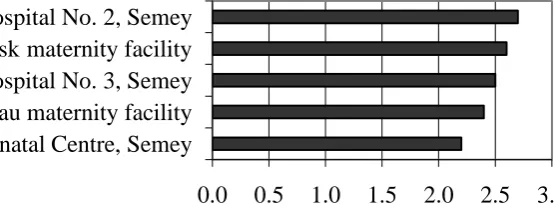
Overall, the quality of care was substandard in all institutions. Average satisfaction score was 2.48 with a range from 2.2 (Perinatal Centre is Semey city) to 2.7 (Maternity Hospital No. 2 in Semey). Surprisingly, the only referral hospital included in this study had the lowest satisfaction score. Still, the quality of care in this hospital could be classi-fied as substandard, based on interviews with mothers. Fig. 1 presents comparison of findings per each maternity facility.
Fig. 1:Comparison of summary scores of interviews with mothers between five maternity facilities
0.0 0.5 1.0 1.5 2.0 2.5 3.0 Perinatal Centre, Semey
The quality of care was considered to be good with no need for further improvement by 452 (51.8%) respondents, still 389 (44.6%) stated that subtle improvements are required, while 31 (3.6%) women believed that substantial improvement is needed. Noteworthy, no woman considered the
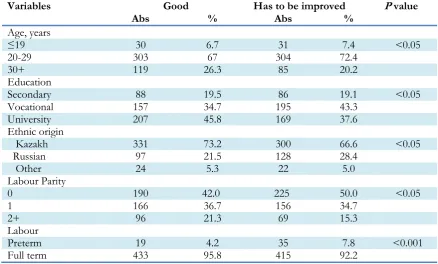
quality of care to be very poor requiring very sub-stantial improvements. Table 1 presents socio-demographic characteristics of study participants based on the type of quality of care. The findings for “substandard” and “inadequate” care are pre-sented together as “has to be improved”.
Table 1:Univariate analysis of socio-demographic and obstetric characteristics of women by type of quality of care
Variables Good Has to be improved P value
Abs % Abs %
Age, years
≤19 30 6.7 31 7.4 <0.05
20-29 303 67 304 72.4
30+ 119 26.3 85 20.2
Education
Secondary 88 19.5 86 19.1 <0.05
Vocational 157 34.7 195 43.3
University 207 45.8 169 37.6
Ethnic origin
Kazakh 331 73.2 300 66.6 <0.05
Russian 97 21.5 128 28.4
Other 24 5.3 22 5.0
Labour Parity
0 190 42.0 225 50.0 <0.05
1 166 36.7 156 34.7
2+ 96 21.3 69 15.3
Labour
Preterm 19 4.2 35 7.8 <0.001
Full term 433 95.8 415 92.2
The mean age of women was equal to 27.4 yr (95% CI 25.81-28.99). Most women (688 – 78.9%) gave birth vaginally, while 21.1% were undergone to Ce-sarean section. The rate of abdominal delivery in East-Kazakhstan region exceeds WHO-recom-mended level (10). Assisted vaginal delivery (for-ceps, vacuum) was used in no case.
Semi-structured interviews with women enabled deeper understanding of a broad range of issues in-cluding access to maternity facility, coordination and continuity of care given, perceived quality of care, information received at admission during hospital stay and at discharge, physical comfort, psychological support, involvement of mothers and families in decision-making.
Questions from the first area–pregnancy (of 12 ar-eas of the Interview with mothers) showed that the
mean number of prenatal visits was equal to 8.6±3.39. The vast majority of women stated that they did not receive information about delivery or breastfeeding during antenatal visits. Of those who got counseling, 5.6% (49) of respondents received information about delivery and 7.7% (67) of re-spondents were advised on breastfeeding. Notably, those women followed-up by two rural maternity facilities were counselled on delivery and breast-feeding more frequently: 9.5% and 12.9%, respec-tively. Probably, smaller health institutions main-tain closer contact with their caretakers.
accom-panied by a family member or a friend, but the ac-companying person was let into the emergency room to assist a patient only in 38.9% of cases. Still, 767 (87.9%) women felt themselves comfort-ably during admission procedures.
Questions concerning clinical aspects of labor (area 3) were uneasy for all respondents as the ma-jority of them were not informed about labor in advance and thus, could not distinguish between different labor stages and their time periods. In this area of questions, the most important were those related to obtaining of informed consent. In 56.1% (489) of cases the consent was asked prior to vaginal examination was performed. All women interviewed felt themselves comfortably in the de-livery room, although 52.3% (456) of respondents underlined that the hospital staff did not ask for their permission to enter the delivery room. The majority (71.7%) noted that a staff member was present at the room almost during all their labor stages.
We were interested to know more about proce-dures related to pain relief, in particular if our re-spondents were offered epidural anesthesia. The vast majority of our respondents (807–92.6%) gave negative answer; epidural anesthesia was used only in one maternity facility: referral hospital (Perinatal Centre). However, other facilities practiced non-pharmacologic comfort measures for pain relief: massage, stroking, balls.
The forth area of questions concentrated on differ-ent aspects of birth. Of those women who gave birth by means of vaginal delivery (689 –78.9%), the majority (536–77.8%) gave birth in classical su-pine or lithotomy position. No difference was ob-served between urban and rural institutions.
When we asked mothers if any person from the staff pressed uterus from the abdomen to help ba-by go down, 30.9% of respondents gave positive answer, although this method is officially prohi-bited in all maternity facilities.
Questions of area 5 cover immediate postpartum period. All respondents noted that they received injections in immediate post-partum period but 64.4% (562) of them were not aware what medica-tion was injected and what were the indicamedica-tions for the injection. Patients were uneasy to answer ques-tions related to the third stage of labor, which ex-plains limited information available for the analysis. As for the issues related to psychological support (area 6 of the Interview with mothers), 100% (872) of respondents believed that the support provided to them was effective. It was interesting to hear that in most cases (558–64%) emotional support was provided by a medical staff member in con-trast with 36% (314) of cases when the support was provided by a partner. There was a slightly higher proportion of partner support in two rural maternity facilities (143–44%) as compared to ur-ban settings.
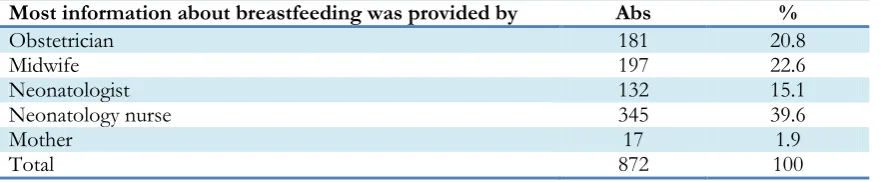
Questions from area 7 focus on child issues. Al-most all women interviewed (870–99.8%) said that they gave birth to a healthy infant. Two children (0.2%) were born with congenital anomalies: one child had Down‟s syndrome and another had a cleft lip. The mean baby weight was 3455.4±483.1 grams (95% CI 3423.3-3487.5). All newborns got “skin-to-skin” contact immediately after birth. Breastfeeding (area 8 of the Interview) was exclu-sively practiced by all respondents in this study. Table 2 gives more details about breastfeeding-related information presented to mothers in
ma-ternity facilities.
Table 2:Provision of information about breastfeeding
Most information about breastfeeding was provided by Abs %
Obstetrician 181 20.8
Midwife 197 22.6
Neonatologist 132 15.1
Neonatology nurse 345 39.6
Mother 17 1.9
In our study 371 (42.5%) mothers interviewed planned to breastfeed their babies for one year and longer, which corresponded with WHO rec-ommendations on breastfeeding. Sixty four moth-ers (7.4%) planned to breastfeed for less than 2 months, seventeen mothers (1.9%) said they were going to breastfeed from 2 months to half a year, one hundred and sixty one (18.4%) planned to breastfeed for more than half a year, while 259 (29.7%) women planned to breastfeed their babies for up to one year. Most women (241–27.6%) who planned to breastfeed their children for more than a year resided in two rural settings (Kalbatau village and Zyryanovsk town). This could be ex-plained by higher unemployment rate in rural area of East Kazakhstan as compared to urban, which makes mothers to stay home with their children and to breastfeed for a long time.
Area 9 of the Tool reflected maternity stay. All women stated that their children stayed with them all the time they spent in maternity unit and were always examined in their presence. All mothers considered their room clean enough but they lacked personal hygiene facilities: shower cabins or bathrooms were not available in all maternity units. The average time spent by a mother with any healthcare staff member was 9.9±3.1 min per day. Most women (749–85.9%) believed it was not enough and would like to get more attention from the doctor‟s side during his/her routine visits to the ward as these visits were mostly formal and little
Attention was paid to a woman and her baby. All services in all maternity facilities were provided free.
Questions belonging to area 10 were focused on satisfaction and psychological impact (Table 3).
Table 3:Overall satisfaction and psychological impact
Questions Positive answer
Abs %
Do you feel happy with maternity experience? 872 100
Would you repeat? 444 50.9
Do you feel sad? 140 16.0
Do you feel you did not find staff support you needed? 184 21.1 Do you remember continuously some moment you felt very
frightened? 229 26.3
Did maternity staff make you feel inadequate sometime? 16 1.8
Did they respect your cultural and religious concerns? 826 94.7
Is it difficult for you to attend the baby? 64 7.3
Do you sometimes think you were not good enough helping
your baby being born? 218 25
As many as 140 (16.0%) mothers interviewed felt themselves sad and 229 (26.3%) women continu-ously recalled some moment they felt very fright-ened, indicating the need for professional psycho-logical support. However, our study identified that of all facilities involved, the only psychologist worked in the maternity hospital No. 3 in Semey city. Out of 140 women who felt sadness, 51 (36.4%) were patients of the referral hospital, which was not surprising to see as this facility mostly accumulates cases of complicated preg-nancy and/or delivery.
rural settings (89–27.3%) reflecting traditional mode of living and mentality.
Contraception and fertility regulation are an inte-gral part of post-partum care (area 12). This study showed that 367 (42.1%) respondents practiced contraception before pregnancy, while the rest never applied it and were not aware which contra-ceptives exist and how they differ from each other. It was interesting to ask about previous abortions: almost every third woman (260–29.8%) answered positively.
We went further, asking questions related to coun-selling on contraception and fertility regulation provided by the healthcare staff in maternity facili-ties. The issues of contraception was discussed with patients just in 84 (9.6%) cases, which con-firms the fact that the vast majority of medical professionals ignore such an important issue and dedicate little or no time to counselling. The issue of contraception and fertility regulation must no longer be neglected by the medical staff of mater-nity units.
Most respondents (795–91.2%) planned to use contraception in the future to avoid undesirable pregnancy within at least two years postpartum. However, when we asked them “Which contra-ception would you like to use?” the majority failed to reply, making final choice in favour of intraute-rine device (587–67.3%) and being unaware of other contraception modalities or knowing little about them. The reason for choosing intrauterine device is primarily economic as this is a cheap and effective method of contraception with very little impact on breastfeeding. Surprisingly, only 9.6% (84) of women selected oral hormonal contracep-tion mainly because of widespread prejudices that it suppresses milk secretion and leads to weight gain. Still, all women were eager to learn more about postpartum contraception, mode of action and side effects of different contraceptives. We failed to establish difference between urban and rural population in this regard.
Discussion
The quality of medical care and prenatal manage-ment directly affects the labor outcomes (11).
There is a direct relationship between prenatal care and the outcome of pregnancy in low-risk pregnancies (12). In 2009 WHO launched the bi-ennial project targeted on development of health-care system in Kazakhstan, assuring the good quality of medical care for pregnant women, mothers and newborns (13).
In our study, mothers‟ perception of the quality of hospital care is substandard, ranging from 2.2 to 2.7 in 0-3 grading scale. According to women in-terviewed, the lowest quality of care was observed in the only referral hospital included in this study – Perinatal Centre in Semey City. This amazing fact has the only possible explanation: referral hospital predominantly admits patients with preg-nancy and delivery-related complications, which probably reflects their individual perception of the quality of services consumed. This consideration is indirectly supported by another finding of our study: referral hospital showed the highest rate of women (25.1% or 51 out of 203 interviewed) suf-fering from certain degree of postpartum depres-sion. All these facts indicate the strong need for recruitment of clinical or counselling psychologist, especially because the workload in this facility was the highest of the observed: 2786 deliveries in 2013.
Most problems revealed by this study were associ-ated with the following areas of hospital care: pregnancy, admission of the mother, birth,
Psychological support, maternity stay, satisfaction, psychological impact contraception and fertility regulation. Major concern in Pregnancy area is caused by the absence of adequate information on labor and breastfeeding, reflected in other previ-ously published papers (14). Another concern is the average number of prenatal visits, which was equal to 8.6 ±3.39. However, the clinical protocol approved by the Order No. 239 of the Ministry of Health, Kazakhstan, dated 7.04.2010, mends 6-7 prenatal visits, while WHO recom-mends even 4 prenatal visits (15). According to our study, private clinics and rural hospitals tend to have even higher rates of pregnancy-related visits.
man-agement and principles of optimal breastfeeding (15). However, this study showed that existing clinical protocol regulating prenatal care is not fully implemented yet. For example, based on this protocol, labor plan has to be developed during forth-prenatal visit and informed consent shall be obtained from a future mother. In this study, 100% of respondents said they knew nothing about pro-posed labor plan and that no relevant information was provided to them before delivery.
Although all maternity units provided some basic amenities and services, like availability of cold and warm water, toilets and basic supplies such as soap and antiseptics, shower cabins and bath-rooms were universally absent, making personal hygiene an uneasy task.
The most problematic aspect of Birth area is a high prevalence of traumatic manipulations, such as fundal pressure, which is now internationally prohibited, but it was noted almost by one third of women (30.9%). Obviously, there is a need for continuing education programs translating mod-ern scientifically approved knowledge into clinical routine, to upgrade qualification of both obstetri-cians and midwives in East Kazakhstan.
Inadequate psychological support from the side of a partner could be probably explained by the fact that labor partnership is an entirely new concept for Kazakhstani practice and local labor partners know little or nothing how to behave themselves in labor. Obviously, the best way to overcome this barrier would be to open the birth schools where labor partners would be equipped with knowledge and techniques how to actively take care of a mother. Unfortunately, birth schools are not common in Kazakhstan and one of the outcomes of this study was the establishment of regular birth classes based on maternity hospital No. 3 in Semey City.
As 16% of women, demonstrated signs of post-partum depression, and another 26.3% conti-nuously recalled some moment they felt very frightened, there is a need to make psychology counseling available in all maternity facilities of the region (16).
Another striking finding of this study was the low awareness of local women about modern methods
of contraception and fertility regulation. Not more than 9.6% of women interviewed had previously discussed the principles and methods of postpar-tum contraception with healthcare staff. Unfortu-nately, very few medical professionals pay ade-quate attention to this important aspect. For this reason, it is not surprising to see the high abortion rates in the country: every 8th woman makes abor-tion within a year after delivery (17). Kazakhstani women often consider abortion to be one of the contraception techniques. One study from the USA showed that most women prefer to have reg-ular short-term consultations regarding contracep-tion in postpartum period with more frequent counseling in the maternity facility (18).
Generally, our findings show that maternity care is good or standard in the number of key areas (La-bor, Immediate postpartum, Baby, Breastfeeding and Instructions for home care), as many appro-priate procedures were adopted and the inappro-priate ones were eliminated. For instance, episiot-omy is practiced seldom, enema is not provided routinely, women are allowed to choose labor po-sition and are no longer separated from their ba-bies, and exclusive breastfeeding is encouraged. Still, certain areas of maternity and childcare could be substantially improved, like adoption of WHO and international clinical guidelines and making them available for uptake, development of local protocols and case reviews not demanding sophis-ticated infrastructure and equipment.
The fact that most of problems identified, such as introduction of additional amenities, training of medical staff and establishments of birth schools, could be successfully solved at the local level is a promising opportunity. At the same time, other problems, like development and/or adoption of clinical guidelines and protocols, require primarily action at the level of the Ministry of Health. The limitations of this study are related to the fact that only one part of the Assessment Tool was utilized, i.e. Interview with mothers, but quite of-ten the evidence presented by patients could serve as a more valuable
cross-sec-tional study with no continuity. To overcome this limitation the study team plans to undertake an-other evaluation in 2-year time to monitor the im-provements based on elimination of problems identified and on prompted quality management cycles. A possible bias that may arise from low comparability of the findings from different ma-ternity facilities was addressed by the scoring sys-tem based on clear criteria, and brief training pro-vided to the evaluation team members before data collection started. The sample of hospitals was made with intention to include institutions from different levels of healthcare and, thus, to avoid the possible bias towards the better performing facilities.
Conclusion
The quality of hospital care in East Kazakhstan is being substandard, while to achieve the Millen-nium Development Goal 5, the quality gap in ma-ternity care needs to be more effectively addressed. This is the reason why WHO technologies of pre-natal care, labor, delivery and postpartum man-agement are highly demanded by women and their families. They need to become an integral part of routine obstetrical practice, as patients‟ satisfac-tion with services provided along with maternity health protection and birth of a healthy baby are the major indicators of the quality management activities.
Ethical considerations
Ethical issues (Including plagiarism, Informed Consent, misconduct, data fabrication and/or fal-sification, double publication and/or submission, redundancy, etc) have been completely observed by the authors.
Acknowledgements
The authors would like to thank all women who participated in this study as well as staff of mater-nity facilities involved. Special thanks go to the ad-ministration of Semey State Medical University,
Kazakhstan for funding this research. The authors declare that they have no competing interests.
References
1. Van den Broek NR, Graham WJ (2009). Quality of care for maternal and newborn health: the neglected agenda. BJOG, 116(1): 18-21. 2. WHO Regional Office for Europe (2008).
Euro-pean Strategic Approach for Making Pregnancy Safer: Improving Maternal and Perinatal Health. Copen-hagen.
3. An Z, Maishina M (2011). Development of health policy in Kazakhstan, Entre Nous. The European Magazinefor sexual and reproductive health, 74: 10-11.
4. Heaman MI, Newburn-Cook CV, Green CG, El-liott LJ, Helewa ME (2008). Inadequate prena-tal care and its association with adverse preg-nancy outcomes: a comparison of indices.
BMC Pregnancy Childbirth, 8: 15.
5. Feijen-de Jong EI, Jansen DE, Baarveld F, van der Schans CP, Schellevis FG, Reijneveld SA (2012). Determinants of late and/or inade-quate use of prenatal healthcare in high-income countries: a systematic review. Eur J Public Health, 22(6): 904-13.
6. WHO Regional Office for Europe (2014). Hospit-al care for mothers and newborn babies: quHospit-ality assess-ment and improveassess-ment tool. Copenhagen.
7. Statistics Department of East Kazakhstan Region Government (2013). Available from: http://stat.gov.kz/getImg?id=ESTAT091583. 8. Agency of Statistics, Republic of Kazakhstan
(2013). Available from:
http://www.stat.gov.kz/getImg?id=WC16200 032251.
9. WHO Regional Office for Europe (2009). Making Pregnancy Safer – Assessment tool for the quality of hospital care for mothers and newborn babies. Copen-hagen.
10. WHO (2012). WHO recommendations for the preven-tion and treatment of postpartum haemorrhage. Gene-va, Switzerland.
11. Ashraf-Ganjoei T, Mirzaei F, Anari-Dokht F (2011). Relationship between prenatal care and the outcome of pregnancy in low-risk preg-nancies. OJOG, 1(3): 109-112.
on Pregnant Women in Ohio: A Cohort Anal-ysis. Health Serv Res.: 39(4 Pt 1): 825–46.
13. WHO Regional Office for Europe (2009). Assess-ment tool for the quality of hospital care for mothers and newborn babies. Copenhagen. Available from:
http://www.euro.who.int/__data/assets/pdf_file/00 08/98792/E93128.pdf.
14. Tamburlini G, Siupsinskas G, Bacci A, Maternal and Neonatal Care Quality Assessment Work-ing Group (2011). Quality of Maternal and Neonatal Care in Albania, Turkmenistan and Kazakhstan: A Systematic, Standard-Based, Participatory Assessment. PLoS ONE, 6(12): e28763.
15. Ministry of Healthcare, Republic of Kazakhstan (2010). Decree № 239 dated April 7, 2010. Available from: http://online.zakon.kz/Docume-nt/?doc_id=30851845#pos=28;-330.
16. Kathree T, Selohilwe OM, Bhana A, Petersen I (2014) Perceptions of postnatal depression and health care needs in a South African sample: the “mental” in maternal health care. BMC Women's Health. 14:140.
17. Ministry of Healthcare, Republic of Kazakhstan (2010). Decree № 368, dated May 20, 2010. Available from:
http://adilet.zan.kz/rus/docs/V100006305. 18. Yee L, Simon M (2011). Urban minority women‟s
perceptions of and preferences for postpartum contraceptive counseling. J Midwifery Womens Health. 56(1): 54–60.
19. WHO (2005). The world Health Report 2005: Make every mother and child count. Geneva, Switzerland. Available from: