13
Fast Algorithms For Mining Association Rules In
Datamining
P. Usharani
Abstract: We consider the problem of discovering association rules between items in a large database of sales transactions. We present two new algorithms for solving this problem that are fundamentally di erent from the known algo-rithms. Empirical evaluation shows that these algorithms outperform the known algorithms by factors ranging from three for small problems to more than an order of mag-nitude for large problems. We also show how the best features of the two proposed algorithms can be combined into a hybrid algorithm, called AprioriHybrid. Scale-up experiments show that AprioriHybrid scales linearly with the number of transactions. AprioriHybrid also has ex-cellent scale-up properties with respect to the transaction size and the number of items in the database.
————————————————————
1 Introduction
Progress in bar-code technology has made it possi-ble for retail organizations to collect and store mas-sive amounts of sales data, referred to as the basket data. A record in such data typically consists of the transaction date and the items bought in the trans-action. Successful organizations view such databases as important pieces of the marketing infrastructure. They are interested in instituting information-driven marketing processes, managed by database technol-ogy, that enable marketers to develop and implement customized marketing programs and strategies [6]. The problem of mining association rules over basket data was introduced in [4]. An example of such a rule might be that 98% of customers that purchase Visiting from the Department of Computer Science, Uni-versity of Wisconsin, Madison. Permission to copy without fee all or part of this material is granted provided that the copies are not made or distributed for direct commercial advantage, the VLDB copyright notice and the title of the publication and its date appear, and notice is given that copying is by permission of the Very Large Data Base Endowment. To copy otherwise, or to republish, requires a fee and/or special permission from the Endowment. tires and auto accessories also get automotive services done. Finding all such rules is valuable for cross-marketing and attached mailing applications. Other applications include catalog design, add-on sales, store layout, and customer segmentation based on buying patterns. The databases involved in these applications are very large. It is imperative, therefore, to have fast algorithms for this task. The following is a formal statement of the problem [4]: Let I = fi1; i2; . . .; img be a set of literals, called items. Let D be a set of transactions, where each transaction T is a set of items such that T I . Associated with each transaction is a unique identi er, called its TID. We say that a transaction T contains X, a set of some items in I, if X T . An association rule is an implication of the form
X =) Y , where X I, Y I, and X \ Y = ;. The rule X =) Y holds in the transaction set D with con dence c if c% of transactions in D that contain
X also contain Y . The rule X =) Y has support s
in the transaction set D if s% of transactions in D contain X [ Y . Our rules are somewhat more general than in [4] in that we allow a consequent to have more than one item. Given a set of transactions D, the problem of min-ing association rules is to generate all association rules that have support
discuss these issues in this paper, except to point out that these are necessary features of a rule discov-ery system that may use our algorithms as the engine of the discovery process.
1.1Problem Decomposition and Paper Organization
The problem of discovering all association rules can be decomposed into two subproblems [4]:
1. Find all sets of items (itemsets) that have transac-tion support above minimum support. The support for an itemset is the number of transactions that contain the itemset. Itemsets with minimum sup-port are called large itemsets, and all others small itemsets. In Section 2, we give new algorithms, Apriori and AprioriTid, for solving this problem.
2. Use the large itemsets to generate the desired rules. Here is a straightforward algorithm for this task. For every large itemset l, nd all non-empty subsets of l. For every such subset a, output a rule of the form a =) (l , a) if the ratio of support(l) to support(a) is at least minconf. We need to consider all subsets of l to generate rules with multiple consequents. Due to lack of space, we do not discuss this subproblem further, but refer the reader to [5] for a fast algorithm.
In Section 3, we show the relative performance of the proposed Apriori and AprioriTid algorithms against the AIS [4] and SETM [13] algorithms. To make the paper self-contained, we include an overview of the AIS and SETM algorithms in this section. We also describe how the Apriori and AprioriTid algorithms can be combined into a hybrid algorithm, AprioriHybrid, and demonstrate the scale-up properties of this algorithm. We conclude by pointing out some related open problems in Section 4.
2 Discovering Large Itemsets
Algorithms for discovering large itemsets make mul-tiple passes over the data. In the rst pass, we count the support of individual items and determine which of them are large, i.e. have minimum support. In each subsequent pass, we start with a seed set of itemsets found to be large in the previous pass. We use this seed set for generating new potentially large itemsets, called candidate itemsets, and count the actual sup-port for these candidate itemsets during the pass over the data. At the end of the pass, we determine which of the candidate itemsets are actually large, and they become the seed for the next pass. This process con-tinues until no new large itemsets are found. The Apriori and AprioriTid algorithms we propose di er fundamentally from the AIS [4] and SETM [13] algorithms in terms of which candidate itemsets are counted in a pass and in the way that those candidates are generated. In both the AIS and SETM algorithms, candidate itemsets are generated on-the- y during the pass as data is being read. Speci cally, after reading a transaction, it is determined which of the itemsets found large in the previous pass are present in the transaction. New candidate itemsets are generated by extending these large itemsets with other items in the transaction. However, as we will see, the disadvantage is that this results in unnecessarily generating and counting too many candidate itemsets that turn out to
be small. The Apriori and AprioriTid algorithms generate the candidate itemsets to be counted in a pass by using only the itemsets found large in the previous pass {without considering the transactions in the database. The basic intuition is that any subset of a large itemset must be large. Therefore, the candidate itemsets having k items can be generated by joining large itemsets having k , 1 items, and deleting those that contain any subset that is not large. This procedure results in generation of a much smaller number of candidate itemsets. The AprioriTid algorithm has the additional prop-erty that the database is not used at all for count-ing the support of candidate itemsets after the rst pass. Rather, an encoding of the candidate itemsets used in the previous pass is employed for this purpose. In later passes, the size of this encoding can become much smaller than the database, thus saving much reading e ort. We will explain these points in more detail when we describe the algorithms. Notation We assume that items in each transaction are kept sorted in their lexicographic order. It is straightforward to adapt these algorithms to the case where the database D is kept normalized and each database record is a <TID, item> pair, where TID is the identi er of the corresponding transaction. We call the number of items in an itemset its size, and call an itemset of size k a k-itemset. Items within an itemset are kept in lexicographic order. We use the notation c[1] c[2] . . . c[k] to represent a k-itemset c consisting of items c[1]; c[2]; . . .c[k], where
c[1] < c[2] < . . . < c[k]. If c = X Y and Y is an m-itemset, we also call Y an m-extension of
X. Associated with each itemset is a count eld to store the support for this itemset. The count eld is initialized to zero when the itemset is rst created. We summarize in Table 1 the notation used in the algorithms. The set Ck is used by AprioriTid and will be further discussed when we describe this algorithm.
2.1 Algorithm Apriori
15
Table 1: Notation
k-itemset An itemset having k items.
Set of large k-itemsets k
(those with minimum support). L
Each member of this set has two elds:
i) itemset and ii) support count.
Set of candidate k-itemsets k
(potentially large itemsets). C
Each member of this set has two elds:
i) itemset and ii) support count.
Set of candidate k-itemsets when the TIDs
of the generating transactions are kept Ck
associated with the candidates.
given transaction t. Section 2.1.2 describes the subset function used for this purpose. See [5] for a discussion of bu er management.
1) L1 = flarge 1-itemsetsg;
2) for ( k = 2; Lk,1 6= ;; k++ ) do begin
3) Ck = apriori-gen(Lk,1 ); // New candidates
4) forall transactions t 2 D do begin
5) Ct = subset(Ck , t); // Candidates contained in t
6) forall candidates c 2 Ct do
7) c:count++;
8) end
9) Lk = fc 2 Ck j c:count minsupg
10)end
11)Answer = Sk Lk ;
Figure 1: Algorithm Apriori
2.1.1 Apriori Candidate Generation
The apriori-gen function takes as argument Lk,1, the set of all large (k , 1)-itemsets. It returns a superset of the set of all large k-itemsets. The function works as follows. 1 First, in the join step, we join Lk,1 with Lk,1 :
insert into Ck
select p.item1, p.item2, ..., p.itemk,1, q.itemk,1 from Lk,1 p, Lk,1 q
where p.item1 = q.item1, . . ., p.itemk,2 = q.itemk,2,
p.itemk,1 < q.itemk,1;
Next, in the prune step, we delete all itemsets c 2 Ck such that some (k,1)-subset of c is not in Lk,1:
1
Concurrent to our work, the following two-step candidate generation procedure has been proposed in [17]:
Ck0 = fX [ X0jX; X0 2 Lk,1; jX \ X0j = k , 2g
Ck = fX 2 Ck0 jX contains k members of Lk,1g
These two steps are similar to our join and prune steps respectively. However, in general, step 1 would produce a superset of the candidates produced by our join step.
forall itemsets c 2 Ck do forall (k,1)-subsets s of c do
if (s 62Lk,1) then delete c from Ck ;
cost of scanning the database.
2.1.2 Subset Function
Candidate itemsets Ck are stored in a hash-tree. A node of the hash-tree either contains a list of itemsets (a leaf node) or a hash table (an interior node). In an interior node, each bucket of the hash table points to another node. The root of the hash-tree is de ned to be at depth 1. An interior node at depth d points to nodes at depth d+1. Itemsets are stored in the leaves. When we add an itemset c, we start from the root and go down the tree until we reach a leaf. At an interior node at depth d, we decide which branch to follow by applying a hash function to the dth item of the itemset. All nodes are initially created as leaf nodes. When the number of itemsets in a leaf node exceeds a speci ed threshold, the leaf node is converted to an interior node. Starting from the root node, the subset function nds all the candidates contained in a transaction t as follows. If we are at a leaf, we nd which of the itemsets in the leaf are contained in t and add references to them to the answer set. If we are at an interior node and we have reached it by hashing the item i, we hash on each item that comes after i in t and recursively apply this procedure to the node in the corresponding bucket. For the root node, we hash on every item in t. To see why the subset function returns the desired set of references, consider what happens at the root node. For any itemset c contained in transaction t, the rst item of c must be in t. At the root, by hashing on every item in t, we ensure that we only ignore itemsets that start with an item not in t. Similar arguments apply at lower depths. The only additional factor is that, since the items in any itemset are ordered, if we reach the current node by hashing the item i, we only need to consider the items in t that occur after i.
2.2 Algorithm AprioriTid
The AprioriTid algorithm, shown in Figure 2, also uses the apriori-gen function (given in Section 2.1.1) to determine the candidate itemsets before the pass begins. The interesting feature of this algorithm is that the database D is not used for counting support after the rst pass. Rather, the set Ck is used
for this purpose. Each member of the set Ck is
of the form < TID; fXkg >, where each Xk is a
potentially large k-itemset present in the transaction with identi er TID. For k = 1, C1 corresponds to the database D, although conceptually each item i is replaced by the itemset fig. For k > 1, Ck is generated by the algorithm (step 10). The member
of Ck corresponding to transaction t is <t:TID,
fc 2 Ckjc contained in tg>. If a transaction does
we generate C4 using L3, it turns out to be empty, and we terminate. not contain any candidate k-itemset, then Ck will not have an entry for this transaction. Thus, the number of entries in Ck may be smaller than the number of transactions in the database, especially for large values of k. In addition, for large values of k, each entry may be smaller than the corresponding transaction because very
few candidates may be contained in the transaction. However, for small values for k, each entry may be larger than the corresponding transaction because an entry in Ck includes all candidate k-itemsets contained in the transaction. In Section 2.2.1, we give the data structures used to implement the algorithm. See [5] for a proof of correctness and a discussion of bu er management.
Database
1) L1 = flarge 1-itemsetsg; 2) C1 = database D;
3) for ( k = 2; Lk,1 =6 ;; k++ ) do begin 4) Ck = apriori-gen(Lk,1 ); // New candidates 5) Ck = ;;
6) forall entries t 2 Ck,1 do begin
7) // determine candidate itemsets in Ck contained // in the transaction with identi er t.TID
Ct = fc 2 Ck j (c , c[k]) 2 t:set-of-itemsets ^ (c , c[k,1]) 2 t.set-of-itemsetsg;
8) forall candidates c 2 Ct do
9) c:count++;
10) if (Ct 6= ;) then Ck += < t:TID; Ct >;
11) end
12) Lk = fc 2 Ck j c:count minsupg
13) end
14) Answer = Sk Lk ; TID Items
100 1 3 4
200 2 3 5
300 1 2 3 5
400 2 5
L1
Itemset Support
f1g 2
f2g 3
f3g 3
f5g 3
C1
TID Set-of-Itemsets 100 f f1g, f3g, f4g g 200 f f2g, f3g, f5g g 300 f f1g, f2g, f3g, f5g g 400 f f2g, f5g g
C2
Itemset Support f1 2g 1 f1 3g 2 f1 5g 1 f2 3g 2 f2 5g 3 f3 5g 2
C2
TID Set-of-Itemsets 100 f f1 3g g
200 f f2 3g, f2 5g, f3 5g g 300 f f1 2g, f1 3g, f1 5g,
f2 3g, f2 5g, f3 5g g 400 f f2 5g g
L2
17 Figure 2: Algorithm AprioriTid
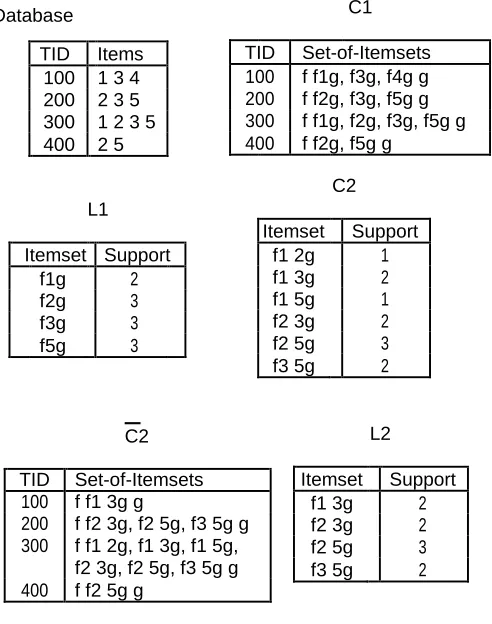
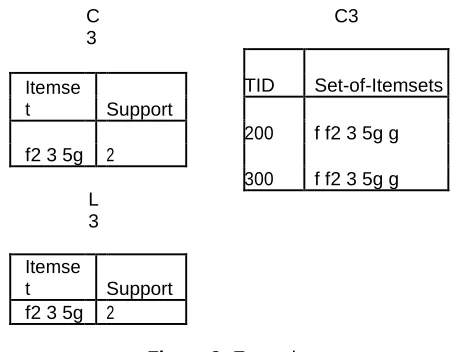
Example Consider the database in Figure 3 and assume that minimum support is 2 transactions. Calling apriori-gen with L1 at step 4 gives the candidate itemsets C2. In steps 6 through 10, we count the support of candidates in C2 by iterating over the entries in C1 and generate C2. The rst entry in C1 is f f1g f3g f4g g, corresponding to transaction 100. The Ct at step 7 corresponding to this entry t is f f1 3g g, because f1 3g is a member of C2 and both (f1 3g - f1g) and (f1 3g - f3g) are members of t.set-of-itemsets. Calling apriori-gen with L2 gives C3. Making a pass over the data with C2 and C3 generates C3. Note that there is no entry in C3 for the transactions with TIDs 100 and 400, since they do not contain any of the itemsets in C3 . The candidate f2 3 5g in C3 turns out to be large and is the only member of L3. When
C 3
C3
TID Set-of-Itemsets Itemse
t
Support
200 f f2 3 5g g f2 3 5g
2
300 f f2 3 5g g L
3 Itemse
t Support f2 3 5g 2
Figure 3: Example
2.2.1 Data Structures
We assign each candidate itemset a unique number, called its ID. Each set of candidate itemsets Ck is kept in an array indexed by the IDs of the itemsets in Ck . A member of Ck is now of the form < TID; fIDg >. Each Ck is stored in a sequential structure. The apriori-gen function generates a candidate k-itemset ck by joining two large (k, 1)-itemsets. We maintain two additional elds for each candidate itemset: i) generators and ii) extensions. The generators eld of a candidate itemset ck stores the IDs of the two large (k , 1)-itemsets whose join
generated ck. The extensions eld of an itemset
ck stores the IDs of all the (k + 1)-candidates that
are extensions of ck . Thus, when a candidate ck is generated by joining lk1,1 and lk2,1, we save the IDs of lk1,1 and lk2,1 in the generators eld for ck. At the same time, the ID of ck is added to the extensions eld of lk1,1. We now describe how Step 7 of Figure 2 is implemented using the above data structures. Recall that the t.set-of-itemsets eld of an entry t in Ck,1 gives the IDs of all (k , 1)-candidates contained in transaction t.TID. For each such candidate ck,1 the extensions eld gives Tk , the set of IDs of all the candidate k-itemsets that are extensions of ck,1. For each ck in Tk, the generators eld gives the IDs of the two
itemsets that generated ck. If these itemsets are present in the entry for t.set-of-itemsets, we can conclude that ck is present in transaction t.TID, and add ck to Ct.
3 Performance
To assess the relative performance of the algorithms for discovering large sets, we performed several experiments on an IBM RS/6000 530H workstation with a CPU clock rate of 33 MHz, 64 MB of main memory, and running AIX 3.2. The data resided in the AIX le system and was stored on a 2GB SCSI 3.5" drive, with measured sequential throughput of about 2 MB/second. We rst give an overview of the AIS [4] and SETM [13] algorithms against which we compare the per-formance of the Apriori and AprioriTid algorithms. We then describe the synthetic datasets used in the performance evaluation and show the performance re-sults. Finally, we describe how the best performance features of Apriori and AprioriTid can be combined into an AprioriHybrid algorithm and demonstrate its scale-up properties.
3.1 The AIS Algorithm
Candidate itemsets are generated and counted on-the- y as the database is scanned. After reading a transaction, it is determined which of the itemsets that were found to be large in the previous pass are contained in this transaction. New candidate itemsets are generated by extending these large itemsets with other items in the transaction. A large itemset l is extended with only those items that are large and occur later in the lexicographic ordering of items than any of the items in l. The candidates generated from a transaction are added to the set of candidate itemsets maintained for the pass, or the counts of the corresponding entries are increased if they were created by an earlier transaction. See [4] for further details of the AIS algorithm.
3.2 The SETM Algorithm
for candidate itemsets at the end of the pass, Ck is in the wrong order and needs to be sorted on itemsets. After counting and pruning out small candidate itemsets that do not have minimum support, the resulting set Lk needs another sort on TID before it can be used for generating candidates in the next pass.
3.3 Generation of Synthetic Data
We generated synthetic transactions to evaluate the performance of the algorithms over a large range of data characteristics. These transactions mimic the transactions in the retailing environment. Our model of the \real" world is that people tend to buy sets of items together. Each such set is potentially a maximal large itemset. An example of such a set might be sheets, pillow case, comforter, and ru es. However, some people may buy only some of the items from such a set. For instance, some people might buy only sheets and pillow case, and some only sheets. A transaction may contain more than one large itemset. For example, a customer might place an order for a dress and jacket when ordering sheets and pillow cases, where the dress and jacket together form another large itemset. Transaction sizes are typically clustered around a mean and a few transactions have many items. Typical sizes of large itemsets are also clustered around a mean, with a few large itemsets having a large number of items. To create a dataset, our synthetic data generation program takes the parameters shown in Table 2.
Table 2: Parameters
jDj Number of transactions
jTj Average size of the transactions jIj Average size of the maximal potentially
large itemsets
jLj Number of maximal potentially large itemsets N Number of items
We rst determine the size of the next transaction. The size is picked from a Poisson distribution with mean equal to jT j. Note that if each item is chosen with the same probability p, and there are N items, the expected number of items in a transaction is given by a binomial distribution with parameters N and p, and is approximated by a Poisson distribution with mean Np. We then assign items to the transaction. Each transaction is assigned a series of potentially large itemsets. If the large itemset on hand does not t in the transaction, the itemset is put in the transaction anyway in half the cases, and the itemset is moved to the next transaction the rest of the cases. Large itemsets are chosen from a set T of such itemsets. The number of itemsets in T is set to jLj. There is an inverse relationship between jLj and the average support for potentially large itemsets. An itemset in T is generated by rst picking the size of the itemset from a Poisson distribution with mean equal to jIj. Items in the rst itemset are chosen randomly. To model the phenomenon that large itemsets often have common items, some fraction of items in subsequent itemsets are chosen from the previous itemset generated. We use an exponentially distributed random variable with mean equal to the correlation level to decide this fraction for each itemset. The remaining items are picked at random. In the datasets used in the experiments, the correlation level
was set to 0.5. We ran some experiments with the correlation level set to 0.25 and 0.75 but did not nd much di erence in the nature of our performance results. Each itemset in T has a weight associated with it, which corresponds to the probability that this itemset will be picked. This weight is picked from an exponential distribution with unit mean, and is then normalized so that the sum of the weights for all the itemsets in T is 1. The next itemset to be put in the transaction is chosen from T by tossing an jLj-sided weighted coin, where the weight for a side is the probability of picking the associated itemset. To model the phenomenon that all the items in a large itemset are not always bought together, we assign each itemset in T a corruption level c. When adding an itemset to a transaction, we keep dropping an item from the itemset as long as a uniformly distributed random number between 0 and 1 is less than c. Thus for an itemset of size l, we will add l items to the transaction 1 , c of the time, l , 1 items c(1 , c) of the time, l , 2 items c2(1 , c) of the time, etc. The corruption level for an itemset is xed and is obtained from a normal distribution with mean 0.5 and variance 0.1. We generated datasets by setting N = 1000 and jLj = 2000. We chose 3 values for jT j: 5, 10, and 20. We also chose 3 values for jIj: 2, 4, and 6. The number of transactions was to set to 100,000 because, as we will see in Section 3.4, SETM could not be run for larger values. However, for our scale-up experiments, we generated datasets with up to 10 million transactions (838MB for T20). Table 3 summarizes the dataset parameter settings. For the same jT j and jDj values, the size of datasets in megabytes were roughly equal for the di erent values of jIj.
Table 3: Parameter settings
Name jT j jIj jDj Size in Megabytes T5.I2.D100K 5 2 100K 2.4
T10.I2.D100K 10 2 100K 4.4 T10.I4.D100K 10 4 100K T20.I2.D100K 20 2 100K 8.4 T20.I4.D100K 20 4 100K T20.I6.D100K 20 6 100K
3.4 Relative Performance
Table 4: Execution times in seconds for SETM
Algorithm Minimum Support
2.0% 1.5% 1.0% 0.75% 0.5%
Dataset T10.I2.D100K
SETM 74 161 838 1262 1878
Apriori 4.4 5.3 11.0 14.5 15.3
Dataset T10.I4.D100K
SETM 41 91 659 929 1639
Apriori 3.8 4.8 11.2 17.4 19.3
Apriori beats AIS for all problem sizes, by factors ranging from 2 for high minimum support to more than an order of magnitude for low levels of support. AIS always did considerably better than SETM. For small problems, AprioriTid did about as well as Apriori, but performance degraded to about twice as slow for large problems.
3.5 Explanation of the Relative Performance
To explain these performance trends, we show in Figure 5 the sizes of the large and candidate sets in di erent passes for the T10.I4.D100K dataset for the minimum support of 0.75%. Note that the Y-axis in this graph has a log scale.
Figure 5: Sizes of the large and candidate sets (T10.I4.D100K, minsup = 0.75%)
The fundamental problem with the SETM algo-rithm is the size of its Ck sets. Recall that the size of the set Ck is given by
X support-count(c): candidate itemsets c
Thus, the sets Ck are roughly S times bigger than the corresponding Ck sets, where S is the average support count of the candidate itemsets. Unless the problem size is very small, the Ck sets have to be written to disk, and externally sorted twice, causing the SETM algorithm to perform poorly.2 This explains the jump in time for SETM in
Table 4 when going from 1.5% support to 1.0% support for datasets with transaction size 10. The largest dataset in the scale-up experiments for SETM in [13] was still small enough that Ck could t in memory; hence they did not encounter this jump in execution time. Note that for the same minimum support, the support count for candidate itemsets increases linearly with the number of transactions. Thus, as we increase the number of transactions for the same values of jT j and jIj, though the size of Ck does not change, the size of Ck goes up linearly. Thus, for datasets with more transactions, the performance gap between SETM and the other algorithms will become even larger. The problem with AIS is that it generates too many candidates that later turn out to be small, causing it to waste too much e ort. Apriori also counts too many small sets in the second pass (recall that C2 is really a cross-product of L1 with L1). However, this wastage decreases dramatically from the third pass onward. Note that for the example in Figure 5, after pass 3, almost every candidate itemset counted by Apriori turns out to be a large set. AprioriTid also has the problem of SETM that Ck tends to be large. However, the apriori candidate generation used by AprioriTid generates signi cantly fewer candidates than the transaction-based candi-date generation used by SETM. As a result, the Ck of AprioriTid has fewer entries than that of SETM. Apri-oriTid is also able to use a single word (ID) to store a candidate rather than requiring as many words as the number of items in the candidate.3 In addition, unlike SETM, AprioriTid does not have to sort Ck . Thus, AprioriTid does not su er as much as SETM from maintaining Ck. AprioriTid has the nice feature that it replaces a pass over the original dataset by a pass over the set Ck. Hence, AprioriTid is very e ective in later passes when the size of Ck becomes small compared to the 2The cost of external sorting in SETM can be reduced somewhat as follows. Before writing out entries in Ck to disk, we can sort them on itemsets using an internal sorting procedure, and write them as sorted runs. These sorted runs can then be merged to obtain support counts. However, given the poor performance of SETM, we do not expect this optimization to a ect the algorithm choice. 3For SETM to use IDs, it would have to maintain two additional in-memory data structures: a hash table to nd out whether a candidate has been generated previously, and a mapping from the IDs to candidates. However, this would destroy the set-oriented nature of the algorithm. Also, once we have the hash table which gives us the IDs of candidates, we might as well count them at the same time and avoid the two external sorts. We experimented with this variant of SETM and found that, while it did better than SETM, it still performed much worse than Apriori or AprioriTid. size of the database. Thus, we nd that AprioriTid beats Apriori when its Ck sets can t in memory and the distribution of the large itemsets has a long tail. When Ck doesn't t in memory, there is a jump in the execution time for AprioriTid, such as when going from 0.75% to 0.5% for datasets with transaction size 10 in Figure 4. In this region, Apriori starts beating AprioriTid.
3.6 Algorithm AprioriHybrid
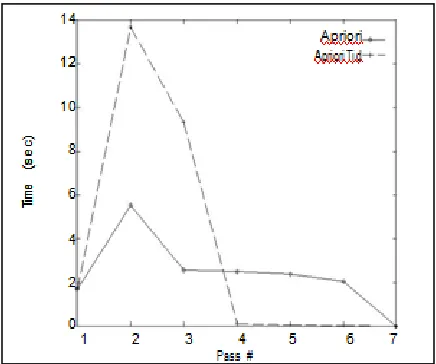
21 T10.I4.D100K. In the earlier passes, Apriori does better
than AprioriTid. However, AprioriTid beats Apriori in later passes. We observed similar relative behavior for the other datasets, the reason for which is as follows. Apriori and AprioriTid use the same candidate generation procedure and therefore count the same itemsets. In the later passes, the number of candidate itemsets reduces (see the size of Ck for Apriori and AprioriTid in Figure 5). However, Apriori still examines every transaction in the database. On the other hand, rather than scanning the database, AprioriTid scans Ck for obtaining support counts, and the size of Ck has become smaller than the size of the database. When the Ck sets can t in memory, we do not even incur the cost of writing them to disk.
Figure 6: Per pass execution times of Apriori and AprioriTid (T10.I4.D100K, minsup = 0.75%)
Based on these observations, we can design a hybrid algorithm, which we call AprioriHybrid, that uses Apriori in the initial passes and switches to AprioriTid when it expects that the set Ck at the end of the pass will t in memory. We use the following heuristic to estimate if Ck would t in memory in the next pass. At the end of the current pass, we have the counts of the candidates in Ck. From this, we estimate what the size of Ck would have been if it had been generated. This
size, in words, is (
Pcandidates c 2 Ck support(c) + number of transactions). If Ck in this pass was small
enough to t in memory, and there were fewer large candidates in the current pass than the previous pass, we switch to AprioriTid. The latter condition is added to avoid switching when Ck in the current pass ts in memory but Ck in the next pass may not. Switching from Apriori to AprioriTid does involve a cost. Assume that we decide to switch from Apriori to AprioriTid at the end of the kth pass. In the (k + 1)th pass, after nding the candidate itemsets contained in a transaction, we will also have to add their IDs to Ck+1 (see the description of AprioriTid in Section 2.2). Thus there is an extra cost incurred in this pass relative to just running Apriori. It is only in the (k +2)th pass that we actually start running AprioriTid. Thus, if there are no large (k+1)-itemsets, or no (k + 2)-candidates, we will If
incur the cost of switching without getting any of the savings of using AprioriTid. Figure 7 shows the performance of AprioriHybrid relative to Apriori and AprioriTid for three datasets. AprioriHybrid performs better than Apriori in almost all cases. For T10.I2.D100K with 1.5% support, AprioriHybrid does a little worse than Apriori since the pass in which the switch occurred was the last pass; AprioriHybrid thus incurred the cost of switching without realizing the bene ts. In general, the advantage of AprioriHybrid over Apriori depends on how the size of the Ck set decline in the later passes. Ck remains large until nearly the end and then has an abrupt drop, we will not gain much by using AprioriHybrid since we can use AprioriTid only for a short period of time after the switch. This is what happened with the T20.I6.D100K dataset. On the other hand, if there is a gradual decline in the size of Ck , AprioriTid can be used for a while after the switch, and a signi cant improvement can be obtained in the execution time.
3.7 Scale-up Experiment
Figure 7: Execution times: AprioriHybrid
graph and with respect to the 1 million transaction dataset in the second. As shown, the execution times scale quite linearly.
Figure 8: Number of transactions scale-up
23 Figure 9: Number of items scale-up
Figure 10: Transaction size scale-up
database roughly constant by keeping the product of the average transaction size and the number of transactions constant. The number of transactions ranged from 200,000 for the database with an average transaction size of 5 to 20,000 for the database with an average transaction size 50. Fixing the minimum support as a percentage would have led to large increases in the number of large itemsets as the transaction size increased, since the probability of a itemset being present in a transaction is roughly proportional to the transaction size. We therefore xed the minimum support level in terms of the number of transactions. The results are shown in Figure 10. The numbers in the key (e.g. 500) refer to this minimum support. As shown, the execution times increase with the transaction size, but only gradually. The main reason for the increase was that in spite of setting the minimum support in terms of the number of transactions, the number of large itemsets increased with increasing transaction length. A secondary reason was that nding the candidates present in a transaction took a little longer time.
4 Conclusions and Future Work
We presented two new algorithms, Apriori and Apri-oriTid, for discovering all signi cant association rules between items in a large database of transactions. We compared these algorithms to the previously known algorithms, the AIS [4] and SETM [13] algo-rithms. We presented experimental results, showing that the proposed algorithms always outperform AIS and SETM. The performance gap increased with the problem size, and ranged from a factor of three for small problems to more than an order of magnitude for large problems. We showed how the best features of the two pro-posed algorithms can be combined into a hybrid al-gorithm, called AprioriHybrid, which then becomes the algorithm of choice for this problem. Scale-up ex-periments showed that AprioriHybrid scales linearly with the number of transactions. In addition, the ex-ecution time decreases a little as the number of items in the database increases. As the average transaction size increases (while keeping the database size con-stant), the execution time increases only gradually. These experiments demonstrate the feasibility of us-ing AprioriHybrid in real applications involving very large databases. The algorithms presented in this paper have been implemented on several data repositories, including the AIX le system, DB2/MVS, and DB2/6000. We have also tested these algorithms against real customer data, the details of which can be found in [5]. In the future, we plan to extend this work along the following dimensions:
Multiple taxonomies (is-a hierarchies) over items are often available. An example of such a hierarchy is that a dish washer is a kitchen appliance is a heavy electric appliance, etc. We would like to be able to nd association rules that use such hierarchies.
We did not consider the quantities of the items bought in a transaction, which are useful for some applications. Finding such rules needs further work.
The work reported in this paper has been done in the context of the Quest project at the IBM Al-maden Research Center. In Quest, we are exploring the various aspects of the database mining problem. Besides the problem of discovering association rules, some other problems that we have looked into include the enhancement of the database capability with clas-si cation queries [2] and similarity queries over time sequences [1]. We believe that database mining is an important new application area for databases, com-bining commercial interest with intriguing research questions. Acknowledgment We wish to thank Mike Carey for his insightful comments and suggestions.
References
[1]. R. Agrawal, C. Faloutsos, and A. Swami. Ef-cient similarity search in sequence databases. In Proc. of the Fourth International Conference on Foundations of Data Organization and Algo-rithms, Chicago, October 1993.
[3]. R. Agrawal, T. Imielinski, and A. Swami. Database mining: A performance perspective. IEEE Transactions on Knowledge and Data En-gineering, 5(6):914{925, December 1993. Special Issue on Learning and Discovery in Knowledge-Based Databases.
[4]. R. Agrawal, T. Imielinski, and A. Swami. Mining association rules between sets of items in large databases. In Proc. of the ACM SIGMOD Conference on Management of Data, Washington, D.C., May 1993.
[5]. R. Agrawal and R. Srikant. Fast algorithms for mining association rules in large databases. Re-search Report RJ 9839, IBM Almaden ReRe-search Center, San Jose, California, June 1994.
[6]. D. S. Associates. The new direct marketing. Business One Irwin, Illinois, 1990.
[7]. R. Brachman et al. Integrated support for data archeology. In AAAI-93 Workshop on Knowledge Discovery in Databases, July 1993.
[8]. L. Breiman, J. H. Friedman, R. A. Olshen, and C. J. Stone. Classi cation and Regression Trees. Wadsworth, Belmont, 1984.
[9]. P. Cheeseman et al. Autoclass: A bayesian classi cation system. In 5th Int'l Conf. on Machine Learning. Morgan Kaufman, June 1988.
[10]. D. H. Fisher. Knowledge acquisition via incre-mental conceptual clustering. Machine Learning, 2(2), 1987.
[11]. J. Han, Y. Cai, and N. Cercone. Knowledge discovery in databases: An attribute oriented approach. In Proc. of the VLDB Conference, pages 547{559, Vancouver, British Columbia, Canada, 1992.
[12]. M. Holsheimer and A. Siebes. Data mining: The search for knowledge in databases. Technical Report CS-R9406, CWI, Netherlands, 1994.
[13]. M. Houtsma and A. Swami. Set-oriented mining of association rules. Research Report RJ 9567, IBM Almaden Research Center, San Jose, Cali-fornia, October 1993.
[14]. R. Krishnamurthy and T. Imielinski. Practi-tioner problems in need of database research: Re-search directions in knowledge discovery. SIG-MOD RECORD, 20(3):76{78, September 1991.
[15]. [15] P. Langley, H. Simon, G. Bradshaw, and J. Zytkow. Scienti c Discovery: Computational Explorations of the Creative Process. MIT Press,1987.
[16]. H. Mannila and K.-J. Raiha. Dependency inference. In Proc. of the VLDB Conference, pages 155{158,
Brighton, England, 1987.
[17].H. Mannila, H. Toivonen, and A. I. Verkamo. E cient algorithms for discovering association rules. In KDD-94: AAAI Workshop on Knowl-edge Discovery in Databases, July 1994.
[18].S. Muggleton and C. Feng. E cient induction of logic programs. In S. Muggleton, editor, Inductive Logic Programming. Academic Press, 1992.
[19].J. Pearl. Probabilistic reasoning in intelligent systems: Networks of plausible inference, 1992.
[20].G. Piatestsky-Shapiro. Discovery, analysis, and presentation of strong rules. InG. Piatestsky-Shapiro, editor, Knowledge Discovery in Databases. AAAI/MIT Press, 1991.
[21].G. Piatestsky-Shapiro, editor. Knowledge Dis-covery in Databases. AAAI/MIT Press, 1991.