http://www.ijcmph.com pISSN 2394-6032 | eISSN 2394-6040
Original Research Article
Quality of life among patients with arthritis seeking outpatient care at a
government secondary health care centre, Anekal taluk
Christy Vijay, Melvin Kumar G.*, Anand K., Paul Peter, Annisa M. T.,
Farah Naaz Fathima, Rajitha K., Naveen Ramesh
8INTRODUCTION
Arthritis means inflammation of the joints. Arthritis can be caused due a variety of local and systemic illnesses, the most common among them being osteoarthritis and rheumatoid arthritis. Arthritis can affect men, women and children. Arthritis is an important problem which has been reported worldwide. Worldwide estimates are that 9.6% of men and 18% of women aged over 60 years have symptomatic osteoarthritis.1 A large majority (80%) of those with osteoarthritis will have limitations in movement and 25% cannot perform their major daily
activities of life.1 In India it was found that 28.7% adults suffer from osteoarthritis of knee.2
Arthritis mainly causes pain around joints. Patients might also have swollen or stiff joints, joints tenderness, trouble in joint moving and may have problem doing everyday tasks. The impairments associated with arthritis are chronic pain, deformity and incomplete use of limbs.3 Arthritis also affects mental health. It can lead to depression, anxiety, feeling helpless, limitation in routine activities and work related activities.4 These individuals often need to seek help for routine activities, which
ABSTRACT
Background: Arthritis means inflammation of the joints. Arthritis can be caused due a variety of local and systemic illnesses, the most common among them being osteoarthritis and rheumatoid arthritis. Arthritis can affect men, women and children. Determining the quality of life among osteoarthritis patients will provide important information for planning future cost effective preventive strategies and health care services.
Methods: This was a cross-sectional study conducted among 199 symptomatic arthritis patients. Arthritis impact measurement scale 2 (AIMS 2) was administered to assess Health-related quality of life (HRQoL) of the participants.
Results: Total of 199 subjects was included in the study. The mean age of study subjects was 62.1±14.8 years. When looked into the 12 component model of AIMS 2 it was evident that arthritis pain had the highest negative impact on quality of life with a median score of 7.12. This was followed by difficulty in walking and bending (median score 6.6) and tension in life (median score 6.06). Arthritis had low impact in the domains of work, arm movements, household tasks, hand and finger function and self-care tasks. The five component model also reemphasizes the above finding with „symptoms‟ of arthritis contributing the most to quality of life whereas the domain of „role‟ contributing the least to quality of life.
Conclusions: Over all arthritis had a significant impact on quality of life. Arthritis pain had the highest negative impact on quality of life. This was followed by difficulty in walking and bending and tension in life.
Keywords: Arthritis, Arthritis impact measurement scale, Quality of life
Department of Community Medicine, St John‟s Medical College, Bengaluru, Karnataka, India
Received: 21 February 2018
Accepted: 20 March 2018
*Correspondence:
Dr. Melvin Kumar G.,
E-mail: [email protected]
Copyright: © the author(s), publisher and licensee Medip Academy. This is an open-access article distributed under the terms of the Creative Commons Attribution Non-Commercial License, which permits unrestricted non-commercial use, distribution, and reproduction in any medium, provided the original work is properly cited.
effects their self-esteem and self-image. The burden placed by some of these conditions on the person with
arthritis and their family members are pervasive.1
Activities of daily living (ADL) or activities of life are central to independent living. These include self-care (showering, toileting and dressing), mobility (transferring from bed/chair, walking around the house) and communication. Individuals with arthritis often have difficulty in performing these activities.3 While the cause of arthritis is mostly unknown, factors such as age, excess weight gain, injuries, infection and work related stress are known to cause arthritis. Arthritis is always associated with persistent difficulty in mobility and persistent difficulty in ADL function.5
Health related quality of life (HRQoL) refers to the perceived physical and mental, health over time, of a person or a group. It covers a variety of domains including health perceptions, pain, energy/fatigue, loss of functional capacity and psychological well-being. Arthritis and musculoskeletal conditions have been ranked third in their impact on the quality of life, after ischemic heart disease and stroke.3
It is important that we assess the quality of life among arthritis patients so as to be able to help improve it. Osteoarthritis is strongly associated with aging and heavy physical occupational activity, a required livelihood for many people living in rural communities in developing countries. Determining the quality of life among osteoarthritis patients will provide important information for planning future cost effective preventive strategies and health care services. On literature search there were no studies in India with regard to arthritis and quality of life. So, this study aimed to assess the quality of life among patients with arthritis seeking outpatient care at a Government secondary health care centre.
METHODS
This was a cross-sectional study conducted at a government Taluk Hospital, Anekal, Bangalore Urban District among patients with symptomatic arthritis between January and February 2017. All the adult patients seeking out patient care with symptomatic arthritis were included in the study. Subjects were considered to have symptomatic arthritis if they reported – joint pain either continues or intermittent, joint stiffness or joint swelling, were currently on medications for arthritis or rheumatism, or had sought doctors‟ advice for arthritis or rheumatism in the preceding 12 months. Severely ill patients and pregnant women were excluded from the study. After obtaining written informed consent, the study tool, Arthritis Impact Measurement Scale 2 (AIMS 2) was administered to the participants by trained research assistant in the local language and also socio-demographic details were obtained.
Arthritis impact measurement scale 2 (AIMS 2) was used to measure the HRQoL. Permission was obtained from
concerned authors to use AIMS 2. Main domains of AIMS 2 are mobility level, walking and bending, hand and finger function, arm function, self- care tasks, household tasks, social activity, support from family and friends, arthritis pain, work, level of tension and mood. Reliability of the test varies from 78% to 94%. All scores are expressed in the range 0–10, with 0 representing good health status and 10 representing poor status. In this way, 12 health status scale scores ranging from 0–10 can be obtained. An overall satisfaction scale computed from the response to item 58. This information was used as a quantitative measure of health outcome as judged by the individual respondents. The 12 component AIMS 2 was again simplified in to 5 component score, which were physical (mobility level + walking and bending + hand and finger function + arm function + self-care + household tasks), affect (level of tension + mood), symptom (arthritis pain), social interaction (social activity + support from family) and role (work).
The sample size was estimated based on the results of a study done by Kenneth et al, in California titled “Effect of Arthritis in Middle age On Older Age Functioning” who reported that 34% subjects had difficulty in mobility. Using this (34%) as an estimate of the expected prevalence of arthritis, at a relative precision of 20% and α of 5%, we estimated that the minimum sample size required for our study was 186. However, a total of 199 patients with arthritis presenting to the hospital during the study period were included. Data were entered in Microsoft excel and analysed with SPSS Version 16. Frequencies and measures of central tendency and dispersion (standard deviation and interquartile range), were used to describe the outcome variable and explanatory variables as applicable. The outcome variable in this study was the AIMS 2 score depicting the quality of life among patients with arthritis. Normality of the data was checked by using statistical tests for continuous variable. Bivariate comparisons between the outcome variable was made by using Mann Whitney u test and Kruskal Wallis test. A p value of <0.05 was considered as significant for all analyses.
RESULTS
A total of 199 subjects were included in the study. About a third of the study subjects 58 (29.1%) were between the age group 61 to 70 years with a mean age of 62.1±14.8 years. Majority of our study subjects were females (63.8%), married (76.4%), belonged to lower class (44.7%) according to the modified BG Prasad classification, had completed primary/secondary school education (47.2%) and were unemployed (48.7%). Table 1 depicts the socio-demographic characteristics of the study subjects.6
(median score 6.6) and tension in life (median score 6.06). Arthritis had low impact in the domains of work, arm movements, household tasks, hand and finger function and self-care tasks.
Table 1: Sociodemographic details.
n (%)
Gender Male 72 (36.2)
Female 127 (63.8)
Age
≤40 years 21 (10.6)
41 – 60 years 70 (35.2)
61 – 80 years 89 (44.7)
>80 years 19 (9.5)
Marital Status
Married 152 (76.4)
Divorced/separated 22 (11.1)
Widowed 25 (12.6)
Religion Hindu 188 (94.5)
Others 11 (5.5)
Occupation
Salaried 13 (6.5)
Self employed 14 (7)
Daily wage worker 33 (16.6)
Agriculture 42 (21.1)
Unemployed 97 (48.7)
Education
No education 74 (37.2)
Primary/secondary 94 (47.2)
High school and
above 31 (15.6)
Socio economic status (BG Prasad Classification)
Upper class 3 (1.5)
Upper middle class 13 (6.5)
Middle class 30 (15.1)
Lower middle class 64 (32.2)
Lower class 89 (44.7)
Figure 1: AIMS 2 12 component score.
Figure 2: AIMS 2 five component model.
The five component model (Figure 2) also reemphasizes the above finding with „symptoms‟ of arthritis contributing the most to quality of life whereas the domain of „role‟ contributing the least to quality of life.
When asked how dissatisfied the participants were with their health at the point in time 99 (49.2%) responded to be very dissatisfied and 73 (36.7%) said that they were somewhat dissatisfied. When probed further 140 (70.4%) responded that their poor health status was entirely due to their arthritis. When asked about their expectation of the future i.e. how would they perceive their arthritis to be in the coming 10 years, 118 (59.3%) responded as fair while a good number had a positive attitude where in 66 (33.2%) responded of having a good expectation that their arthritis would resolve. When further probed on the same matter it was noticed that 75 (37.7%) and 113 (56.8%) felt that in coming 10 years they would feel that their arthritis to be a minor to moderate problem respectively. The majority of the participants felt that they need improvement in mobility 183 (92%), decrease in their arthritis pain 151 (75.9%), able to walking and bending 86 (43.2%) and improved mood 86 (43.2%) which they identified as the major aspects of health they needed improvement.
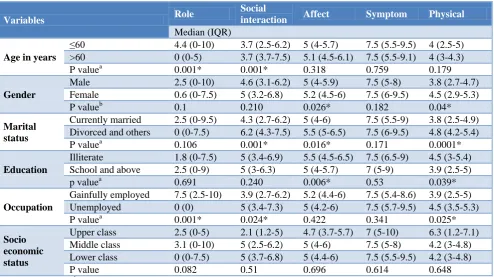
On comparing five components AIMS 2 score with socio-demographic details the results were as follows. „Role‟ was more affected among younger age group and „social interaction‟ was more affected among older age group people. Females were more affected in „physical activity‟ and „affect components‟. The components like „social interaction‟, „physical activity‟ and „affect‟ were more affected among separated or widowed subjects. Illiterate subjects had more negative impact on „affect‟ and „physical activity‟ due to arthritis. Among gainfully employed subjects „role‟ was affected more and „social interaction‟ and „physical activity‟ were more affected among unemployed subjects. There was no significant difference between socio economic status and AIMS 2 five component score.
1.875 4.25
5 5
7.5
0 5 10
ROLE PHYSICAL
AFFECT SOCIAL INTERACTION
SYMPTOM
MEDIAN
Table 2: Association of outcome with socio demographic scale.
Variables Role
Social
interaction Affect Symptom Physical
Median (IQR)
Age in years
≤60 4.4 (0-10) 3.7 (2.5-6.2) 5 (4-5.7) 7.5 (5.5-9.5) 4 (2.5-5)
>60 0 (0-5) 3.7 (3.7-7.5) 5.1 (4.5-6.1) 7.5 (5.5-9.1) 4 (3-4.3)
P valuea 0.001* 0.001* 0.318 0.759 0.179
Gender
Male 2.5 (0-10) 4.6 (3.1-6.2) 5 (4-5.9) 7.5 (5-8) 3.8 (2.7-4.7)
Female 0.6 (0-7.5) 5 (3.2-6.8) 5.2 (4.5-6) 7.5 (6-9.5) 4.5 (2.9-5.3)
P valueb 0.1 0.210 0.026* 0.182 0.04*
Marital status
Currently married 2.5 (0-9.5) 4.3 (2.7-6.2) 5 (4-6) 7.5 (5.5-9) 3.8 (2.5-4.9)
Divorced and others 0 (0-7.5) 6.2 (4.3-7.5) 5.5 (5-6.5) 7.5 (6-9.5) 4.8 (4.2-5.4)
P valuea 0.106 0.001* 0.016* 0.171 0.0001*
Education
Illiterate 1.8 (0-7.5) 5 (3.4-6.9) 5.5 (4.5-6.5) 7.5 (6.5-9) 4.5 (3-5.4)
School and above 2.5 (0-9) 5 (3-6.3) 5 (4-5.7) 7 (5-9) 3.9 (2.5-5)
p valuea 0.691 0.240 0.006* 0.53 0.039*
Occupation
Gainfully employed 7.5 (2.5-10) 3.9 (2.7-6.2) 5.2 (4.4-6) 7.5 (5.4-8.6) 3.9 (2.5-5)
Unemployed 0 (0) 5 (3.4-7.3) 5 (4.2-6) 7.5 (5.7-9.5) 4.5 (3.5-5.3)
P valuea 0.001* 0.024* 0.422 0.341 0.025*
Socio economic status
Upper class 2.5 (0-5) 2.1 (1.2-5) 4.7 (3.7-5.7) 7 (5-10) 6.3 (1.2-7.1)
Middle class 3.1 (0-10) 5 (2.5-6.2) 5 (4-6) 7.5 (5-8) 4.2 (3-4.8)
Lower class 0 (0-7.5) 5 (3.7-6.8) 5 (4.4-6) 7.5 (5.5-9.5) 4.2 (3-4.8)
P value 0.082 0.51 0.696 0.614 0.648
a
Kruskal Wallis test, bMann Whitney test; *statistically significant at α=5%.
DISCUSSION
In our study it was found that most of the study subjects were affected by arthritis pain followed by problem of walking and bending, level of tension and social activity. Work, household tasks, arm function and finger movements were not much affected. Majority of women tend to continue their household tasks with arthritis pain. In five component score, affect and social interaction were more affected and role was least affected. It was noticed that very few Indian studies were done on the basis of health related issues faced by arthritic patients. It was deduced that our study was in comparison to a French and German study. The French study with a higher proportion of women (70%) and the mean age was 54.6 years and with RA being the most common diagnosis and five components AIMS 2, the symptom score was 6.9. Our study had a similar response, more females 127 (63.8) and mean age was 62.41. In our study we also assessed most common cause of arthritis and found majority were suffering from Osteoarthritis (OA). The symptom mean for our study population mounted to be 7.1, which was high. This is possibly due to the varied ethnicity, type of arthritis, type of work and type of genetic make-up that exists between the populations which plays an impact of arthritis on life of the patient. A study from United States, found that the study population was burdened by rheumatoid arthritis (RA), and systemic lupus erythematous (SLE) arthritis).7 In another study done in United States said that OA followed by
polymyalgia and gout were the major causes of arthritis.8
In one more study in USA said that body pains and
musculoskeletal pains were the most prevalent in its study population.9 In comparison to the above studies our study shows that OA followed by pain due to post chikungunya arthritis, low back pain, SLE and RA.
direction for future research in the field of arthritis and assessing the quality of life.
CONCLUSION
Over all arthritis had a significant impact on quality of life. Arthritis pain had the highest negative impact on quality of life with a mean score of 7.12. This was followed by difficulty in walking and bending (median score 6.6) and tension in life (mean score 6.06). Our results also show that arthritis had low impact on the quality of life in the domains of work and arm movements, self-care and household activities.
Limitations
AIMS 2 score is mainly used for rheumatoid arthritis patients but in our study we administered to osteoarthritis patients. This scale was not used in our settings. It is first time used in our study setting and in our country.
Funding: No funding sources Conflict of interest: None declared
Ethical approval: The study was approved by the Institutional Ethics Committee
REFERENCES
1. WHO, Chronic diseases and health promotion.
Available at: http://www.who.int/chp/topics/
rheumatic/en/. Accessed on 05 February 2017. 2. Pal CP, Singh P, Chaturvedi S, Pruthi KK, Vij A.
Epidemiology of knee osteoarthritis in India and related factors. Indian J Orthop. 2016;50(5):518-22.
3. World Health Organization. How to use the ICF: A
practical manual for using the International Classification of Functioning, Disability and Health (ICF). Exposure draft for comment. October 2013. Geneva: WHO. Available at: http://www.who.int/
classifications/drafticfpracticalmanual.pdf. Accessed on 05 February 2017.
4. Australian Institute of Health and Welfare 2008.
Australia‟s health 2008. Cat. no. AUS 99. Canberra: AIHW. Available at: http://library.bsl.org.au/jspui/ bitstream/1/975/1/Australia's_Health_2008.pdf. Accessed on 05 February 2017.
5. Covinsky KE, Lindquist K, Dunlop DD, Gill TM,
Yelin E. Effect of Arthritis in Middle Age on
Older-Age Functioning. J Am Geriatrics Soc.
2008;56(1):23-8.
6. Sharma R. Online interactive calculator for
real-time update of the Prasad‟s social classification. Available at: www.prasadscaleupdate.weebly.com. Accessed on 05 February 2017.
7. Helmick CG, Felson DT, Lawrence RC, Gabriel S,
Hirsch R, Kwoh CK, et al. Estimates of the prevalence of arthritis and other rheumatic conditions in the United States: Part I. Arthritis Rheumat. 2008;58:15–25.
8. Reva C. Lawrence, David T Felson et al. Estimates
of the prevalence of arthritis and other rheumatic condition in the United States part II. National Arthritis Data Work Group. 2008;58(1):26–35.
9. Ma VY, Chan L, Carruthers KJ. The Incidence,
Prevalence, Costs and Impact on Disability of Common Conditions Requiring Rehabilitation in the US: Stroke, Spinal Cord Injury, Traumatic Brain
Injury, Multiple Sclerosis, Osteoarthritis,
Rheumatoid Arthritis, Limb Loss, and Back Pain. Arch Physical Med Rehabilitation. 2014;95(5):986-95.
Cite this article as: Christy V, Melvin KG, Anand K, Paul P, Annisa MT, Farah NF, et al.Quality of life among patients with arthritis seeking outpatient care at a government secondary health care centre, Anekal taluk. Int J Community Med Public Health