Original Research Article
Awareness of breast cancer and estimation of its predicted future
risk among females of urban slums of or above 35 years of age:
a cross sectional study
Sheetal K. Aurangabadkar
1*, Ashwini A. Dangi
2, Medha V. Deo
3INTRODUCTION
Breast cancer is one of the most common cause of mortality and morbidity among females all over the world. According to GLOBOCON 2012, India along with United States and China collectively accounts for almost one third of global breast cancer burden.1 India is facing challenging situation due to 11.54% increase in incidence and 13.82% increase in mortality due to breast cancer during 2008-2012.2,3 Breast cancer projection for India during time period 2020, suggests that the number of
incidence will go as high as 1797900.1 In India although age adjusted incidence rate of breast cancer is lower (25.8/100000) than United Kingdom (95/100000) but mortality is at par (12.7 vs. 17.1 per 100000) with UK.4 Rapid modernisation and urbanisation has further contributed to increased incidence of breast cancer. With rising breast cancer incidence in India, it is essential to understand the level of cancer literacy especially since average age at diagnosis is ten years younger than women
in western countries.Indian women having breast cancer
are found a decade younger in comparison to western
ABSTRACT
Background: Early detection and identification of the risk factors is crucial in minimizing morbidity and mortality arising due to breast cancer. Research has proven that, physiotherapist as a part of multidisciplinary team, plays an important role in treating these patients after surgery. However, evidence suggesting the role of physiotherapist in the domain of health promotion and prevention is limited. Thus an effort is made in this study to explore the level of awareness about the risk factors and prevention and to predict the percent risk of having breast cancer in future five years.
Methods: A cross sectional study was conducted in the urban slums of Turbhe. 200 females aged 35 years and above were selected. A self structured questionnaire was formed using Gail’s model. The questionnaire was validated and a house to house survey was conducted.
Results: 67.5% females thought that alcohol/tobacco consumption carried the highest risk of breast cancer. 61.5% females were aware of lack of breast feeding as the risk factor for breast cancer. 74% females did not know about breast self – examination while 78.5% had not heard about mammography as screening methods for breast cancer prevention. 14.5% females carried a high risk of getting breast cancer in the future five years.
Conclusions: Awareness of study participants about breast cancer was very poor. There is a need for awareness programs to educate women about risk factors and promotion of early detection of breast cancer.
Keywords: Breast cancer, Gail’s model, Prediction risk, Urban slums
1
Assistant Professor, Department of Community Physiotherpy, 2Associate Professor, Department of Cardiovascular
and Pulmonary Physiotherapy, 3Professor, Department ofMusculoskeletal Physiotherpy, Terna Physiotherapy College,
Nerul, Navi Mumbai, Maharashtra, India
Received: 15 January 2019
Revised: 02 February 2019
Accepted: 04 February 2019
*Correspondence:
Dr. Sheetal K. Aurangabadkar, E-mail: [email protected]
Copyright: © the author(s), publisher and licensee Medip Academy. This is an open-access article distributed under the terms of the Creative Commons Attribution Non-Commercial License, which permits unrestricted non-commercial use, distribution, and reproduction in any medium, provided the original work is properly cited.
women suggesting that breast cancer occurs at younger premenopausal age in India.5
Also breast cancer incidences rate within India show three to four fold variation across country, highest rate being observed in North East and major metropolitan cities like Mumbai. Reasons for variation include differences in demographic, reproductive, anthro-pometric, life style factors, limited access to regional treatment centres and management.1 Thus it becomes necessary that people are made aware of early signs and symptoms so they get appropriate intervention at proper time.
Substantial advances have been made in the treatment of breast cancer but introduction of methods to protect women at elevated risk and to prevent the disease has been less successful. Several statistical models have been developed to predict the risk of breast cancer over a period of time, Gail’s model being one of them. Based on the Gail model, the BCRAT combines medical, reproductive, family history to estimate a woman’s 5 year and life time risk.6
Early detection and identification of risk factors has been crucial in preventing the level of mortality and morbidity in treatment of breast cancer. Most widely used tools for breast cancer screening are mammography, clinical breast examination and breast self examination. But screening techniques like mammography can be expensive for most of the people in India. Though breast self examination has been found to be most feasible approach, many females are unaware about it. Several studies have shown that health seeking behaviour among Indian Women is mainly governed by their emotional status and may not be influenced by health related knowledge. So to overcome these problems we need to have many community outreach awareness programmes, from tertiary to primary health care facilities and even at door steps of beneficiaries. Community physiotherapist, being a part of multidisciplinary team, can play an important role in dissemination of breast cancer knowledge among the society. Thus efforts were made in this study to conduct a survey in urban slums of Turbhe, Mumbai, to explore the level of awareness of the risk factors, screening techniques and to estimate the future risk of having breast cancer among the study participants.
Aim
To study the level of awareness about risk factors of
breast cancer among females of 35 years and above in urban slums of Turbhe.
Objectives
To explore the level of awareness about the risk factors, screening and prevention of breast cancer.
To predict the estimated risk of having breast
carcinoma in study population in future five years by using Gail model.
METHODS
A pretested self structured questionnaire, breast cancer risk assessment tool (Gail model).
Questionnaire
Literature search was done regarding risk factors of breast cancer and self structured questionnaire was prepared. The questionnaire consisted questions related to breast cancer risk assessment tool, sociodemographic factors, age, education level, occupation, family income, their knowledge about the risk factors, the screening methods available and its prevention. Content validity of the questionnaire was done. This questionnaire was used for data collection by interviewing women from each house by doing house to house survey.
Breast cancer risk assessment tool
Breast cancer risk was calculated using the National Cancer Institute s online Breast Cancer Risk Assessment tool (BCRA) or Gail Risk Assessment tool (Available at http://bcrisktool. cancer.gov/calculator.html by Gail.7 This model provides the five year and lifetime (upto age 90) breast cancer empiric risk for women >35 years.This model considers following risk factors for five years or lifetime risk estimation of having breast cancer –current age, age of menarche, previous breast biopsies, including the number and presence of atypical hyperplasia, age of the female at first live birth, family history of breast cancer in first degree relatives, race, ethnicity. According to this model, women with breast cancer risk of greater than 1.66% were considered as high risk for having breast cancer within future five years. The Gail risk assessment tool is useful to guess the approximate number of women with a life time risk of >20% in the general population.8 The projected breast cancer risk (calculated risk) was determined using the modified Gail model.
This community based cross sectional study was conducted among married females aged thirty five years and above residing in urban slums of Turbhe, which is an urban field practice area of Urban Health Centre, attached to tertiary care hospital, Nerul, Navi Mumbai. The Urban Health Centre covers a population of around 30,000 and provides quality primary health care to the urban slum dwellers.
Pre study
Present study
After the pilot study, present study was conducted for a period of six months from September–December, 2017. The study was carried out by interviewing women above thirty five years of age, by using tested proforma after signing a written consent form on voluntary basis and confidentiality was assured before data collection was started.
A house to house survey, using convenience sampling was done, case identification was done with the help of medical social workers equipped with proforma.
A total of 200 women in the study were surveyed. Relevant details were recorded in the pre tested proforma covering socio demographic characteristics like age, occupation, literacy status, socioeconomic status and knowledge regarding their awareness of the risk factors for breast cancer and questions related to breast cancer risk assessment tool.
Statistical analysis
Using descriptive statistics, percentage risk of having breast cancer in future five years using Gail model (BCRA tool online) and awareness of risk factors for breast cancer was calculated using SPSS version 20.0.
RESULTS
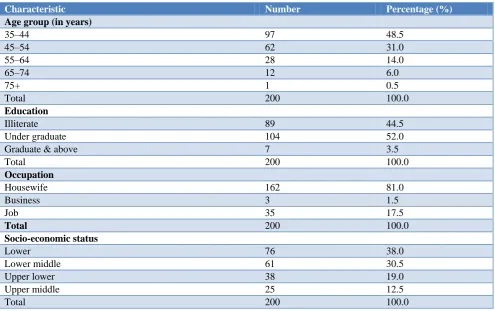
It was found that maximum 97 females (48.5%) were in age group 35-44 years and 104 (52%) had completed higher education. Almost 162 females (81%) women were house wives and 76 (38%) were from low
socioeconomic status according to Kupuswami
classification (Table 1).
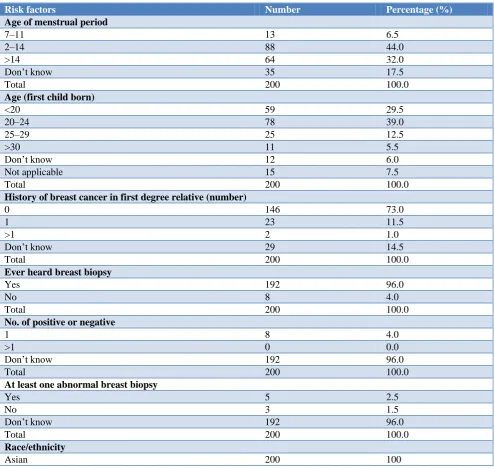
When enquired regarding questions related to breast cancer risk assessment tool, 16 females (8%) were nulliparous, 13 females had menarche age of 7-11 years, 59 females (29.5%) said that their age was less than 20 years when the first child was born. 23 females (11.5%) reported history of breast cancer in first degree relatives and only 8 females (4%) had undergone breast biopsy (Table 2).
When asked about risk factors responsible for breast cancer, 135 females (67.5%) felt addictions, 61.5% felt lack of breast feeding and 79 females (37.5%) felt positive family history (Table 3).
When asked about the screening techniques and their knowledge regarding breast cancer prevention, 74% females did not know about breast self examination but 61 females out of total population said it can be prevented (Table 4).
Table 1: Socio demographic characteristics of study population.
Characteristic Number Percentage (%)
Age group (in years)
35–44 97 48.5
45–54 62 31.0
55–64 28 14.0
65–74 12 6.0
75+ 1 0.5
Total 200 100.0
Education
Illiterate 89 44.5
Under graduate 104 52.0
Graduate & above 7 3.5
Total 200 100.0
Occupation
Housewife 162 81.0
Business 3 1.5
Job 35 17.5
Total 200 100.0
Socio-economic status
Lower 76 38.0
Lower middle 61 30.5
Upper lower 38 19.0
Upper middle 25 12.5
Table 2: Questionnaire for risk factors using BCRA tool.
Risk factors Number Percentage (%)
Age of menstrual period
7–11 13 6.5
2–14 88 44.0
>14 64 32.0
Don’t know 35 17.5
Total 200 100.0
Age (first child born)
<20 59 29.5
20–24 78 39.0
25–29 25 12.5
>30 11 5.5
Don’t know 12 6.0
Not applicable 15 7.5
Total 200 100.0
History of breast cancer in first degree relative (number)
0 146 73.0
1 23 11.5
>1 2 1.0
Don’t know 29 14.5
Total 200 100.0
Ever heard breast biopsy
Yes 192 96.0
No 8 4.0
Total 200 100.0
No. of positive or negative
1 8 4.0
>1 0 0.0
Don’t know 192 96.0
Total 200 100.0
At least one abnormal breast biopsy
Yes 5 2.5
No 3 1.5
Don’t know 192 96.0
Total 200 100.0
Race/ethnicity
Asian 200 100
Table 3: Perception about the risk factors leading to breast cancer.
Various risk factors leading to breast cancer No. of females Percentage (%)
Age >55 years 13 6.5
Positive family history of breast cancer 79 39.5
Onset of menstruation before the age of 12 years 2 1.0
Menopause after the age of 55 years 31 15.0
White (Caucasian) women 0 0.0
Excessive exposure of radiations over the chest 35 17.5
Lack of breast feeding 123 61.5
Having no children 57 28.5
Overweight or obesity 39 19.5
Prolonged use of oral contraceptive pills 11 5.5
Alcohol/tobacco addiction/cigarette smoking 135 67.5
Sedentary lifestyle 22 11.0
Table 4: Knowledge regarding breast cancer prevention.
Questions Yes No Don’t know Total
Is breast cancer preventable? 61 16 123 200
Do you know how to do breast self examination? 52 148 - 200
Can patients of breast cancer recover completely if it is diagnosed early? 51 16 153 200
Table 5: Standard deviation of percentage risk.
Parameter N Minimum Maximum Mean Std. Deviation
Risk 200 0.20 3.90 0.90 0.6503
Table 6: Calculation of percentage risk in future five years.
Risk No. of females Percentage (%)
High (≥1.6) 29 14.5
Low (<1.6) 171 85.5
Total 200 100.0
Table 5 and 6 are related to calculations of the predicted percentage risk in future five years using BCRA.
DISCUSSION
This study revealed that awareness about the risk factors of breast carcinoma among the study population was low. The sample size included females aged thirty years and above because we were using Gail model as a breast cancer risk assessment tool which is applicable for females aged thirty five years and above. In our study majority of responders felt that alcohol and tobacco addiction followed by lack of breast feeding was a major risk factor for having breast cancer. Among the study population, awareness about modifiable risk factors like prolonged use of oral contraceptives, sedentary life style, obesity was low. Similar studies have been conducted to know the perception about the risk factors, screening and prevention in urban slums of Mumbai, but the age group selected was mostly in reproductive age. Study done by Patel et al revealed that majority of women had no knowledge regarding risk factors and screening method of breast carcinoma.9 The reason for low awareness in our study could be because it was conducted in slum area where most of the females were not educated, these females tend to neglect their own health due to the family obligations and existing cultural barriers and were over dependent on other members of family to seek medical help.
In our study we had used BCRA Gail model to predict the percentage risk of having breast cancer in future five years. This study revealed that 14.5 percent of females were at risk of having breast cancer in future five years. The reason for choosing Gail model in our study was because it is readily available computerised tool to calculate the estimated risk and is feasible to use. But the risk predicted by using Gail model is group specific so we cannot exactly discriminate which individual is at risk
of having breast cancer in future five years among the study population. Also Gail model does not include other risk factors like obesity, history of other cancers like cervical cancer, use of oral contraceptives which could be more relevant for Indian population.
Several studies have been done using Gail model for estimation of percentage risk of having breast cancer in future five years but the results are not consistent. A study done by Messersmith et al revealed that BCRAT can aid physician in identifying women at increased risk of breast cancer.6 But in a study conducted by Augustine et al it was found that Gail model cannot be used to predict high risk women for breast cancer among their study population in Kerala, India.10 However in a community where resources are limited and infrastructure is limited, Gails model can help in predicting future risk of breast carcinoma among the population. A Turkish study done by Erbil et al found that BCRAT can help in clinical management of patients seeking advice concerning screening and prevention.8 Thus it was used in our study with the intention that it will help the identified cases to go for further investigations which will lead to their early diagnosis and intervention related to breast cancer.
CONCLUSION
Breast Cancer continues to be a major health problem for women. There is urgent need to increase the level of awareness about breast cancer risk factors and its prevention methods in the study population. BCRA tool can help in clinical management of patients seeking advice concerning screening and prevention.
Limitation of study
Recommendations
Standard calibrated model considering other risk factors like young age, obesity, genetic mutations in BRCA1 and BRCA2 which are more relevant for Indian population should be designed and implemented for calculating the percentage risk in future five years or for lifetime.
Spreading awareness about risk factors and prevention should be first priority in cancer rehabilitation.
ACKNOWLEDGEMENTS
We are extremely thankful to all the women who participated in the study, medical social workers, statistician for their cooperation and timely help throughout the study period.
Funding: No funding sources Conflict of interest: None declared Ethical approval: Not required
REFERENCES
1. Malvia S, Bagadi SA, Dubey US, Saxena S.
Epidemiology of breast cancer in Indian women, Asia Pacific J Clin Oncol. 2017;13:289-95.
2. Ferlay J, Soerjomataram I, Dikshit R. Cancer
Incidence and mortality worldwide: sources, methods and major patterns in GLOBOCAN 2012. Int J Cancer. 2015:136:359-86.
3. Ferlay J, Shin HR, Brany F, Forman D, Mathers C,
Parkin DM. Estimates of worldwide burden of Cancer in 2008:GLOBOCON 2008. Int J Cancer. 2010;127:2893-917.
4. Gupta A, Shridhar K, Dhillon PK. A review of
breast cancer awareness among women in India:
Cancer literate or awareness defecit? Eur J Cancer. 2015:51:2058-66.
5. Chopra B, Kaur V, Singh K, Verma M, Singh S,
Singh A. Age shift –breast cancer is occurring in younger age group –is it true? Clin Cancer Investing J. 2014:3:526-9.
6. Messersmith L, Singer J, Ciesemier G. Utilisation of
breast cancer risk assessment tool in the identification and screening of women at increased risk of breast cancer. J Womens Health Care. 2015;4:5.
7. National Cancer Institute: Breast cancer risk
assessment tools. Available at: http://bcrisktool.
cancer.gov/calculator.html. Accessed on 09
November 2017.
8. Nulufer E, Nursil D, Cigdem I, Nurgul B. Breast Cancer Risk Assessment Using the Gail Model a Turkish study. Asian Pacific J Cancer Prevention. 2015;16(1):303-6.
9. Patel NA, Pandit D, Khanolkar A, Surve S. Kiri S. A Study on awareness of Breast Carcinoma amongst the women aged 15 years and above in Urban slums of Turbhe, Navi Mumbai. J Res Med Dent Sci. 2014;2(1).
10. Augustine P, Jose R, Amrithlal A, Miyum ZT, Peter
A, Haran JC. Usefulness of Gail Model Breast Cancer Risk Assessment Tool in estimating the risk for development of Breast Cancer in women of Kerala, India. Acad Medl J India. 2015,28;3(4):117-22.
Cite this article as: Aurangabadkar SK, Dangi AA,
Deo MV.Awareness of breast cancer and estimation