Abstract— The paper proposes a multi agent system for the urban undisciplined traffic. The paper explains two systems: one is Intelligent Traffic Light Controller System and other is Intelligent Traffic Deviation System. The light control system measures the traffic parameters such as vehicle counting, vehicle classification, vehicle speed and vehicle length to reduce the traffic queue size. The traffic deviation system helps in deviating the vehicles before the traffic congestion occurs. This framework makes use of intelligent vehicle measurement and traffic light control system which serves as the input for traffic deviation system. Euler’s path approach is used for converting any traditional city map to planar graph for route pattern identification. Validation is done using the Nagle- Schreckenberg model. The performance of the system when compared with the existing systems is found to be satisfactory in terms of cost, time, maintenance, expense and performance.
Keywords— Deviation System, Intelligent Systems, Multi-agent System, Traffic Light Controller.
I. INTRODUCTION
The advancement in Intelligent System and Computing has led to a lot of innovations in engineering, medical and traffic applications. Intelligent systems make use of computational intelligence, neural networks, evolutionary computing, fuzzy systems, ambient intelligence, cognitive science, perception and recommended systems for solving critical problems in computational domain. The impact of intelligent system in traffic management is on the rise and many intelligent based traffic solutions are received.
Several mechanisms are available for reducing the traffic congestion like fixed time controller [10], supervisor agent system for urban traffic monitoring [9], policy based multi agent system [7], intelligent cross road management system
Balamurugan Baluamy is with VIT University, vellore, India. He has completed his B.E computer science and engineering from Bharathidasan Universty and M.E Computer science from Anna University. He is pursuing his PH.D in VIT University. phone: 914162202247; fax:04662202247; (e-mail: [email protected]).
Dr. P. Venkata Krishna is a Professor at School of Computing Science and Engineering, VIT University, Vellore, India.
UmaMageshwari R and Gomathi P are PG scholars in VIT University.
emails:[email protected],[email protected] .[5] and classification based on speed and length parameters [3, 4]. But most of the proposals are developed for single loop detector system. While promoting a single loop detector system to dual loop, it becomes complex because of the heavy traffic flow operation which results in an expensive cost. Subsequently, wireless magnetic sensor [3] will be a good solution for this issue. Wireless Magnetic sensor is a common type of sensor used for speed, linear angle and position measurements in automotive, industrial and customer applications. The availability of several intelligent solutions for Traffic management hasn’t reduced the exponential growth of traffic issues prevailing in current undisciplined traffic scenarios.
The paper proposes a framework for vehicle measurement and traffic light control for heavy traffic in any Metropolitan city. The vehicles can be measured by various traffic parameters such as vehicle counting, vehicle classification, vehicle speed measurements and probability of the traffic arriving effectively. This Intelligent Traffic Deviation System is used to deviate the vehicles, and in increasing traffic fluency and to normalize traffic by deviating the vehicles.
II. RELATEDWORK
Based on national Electrical Manufactures Association there are two different types of controllers available. They are: fixed controller and traffic response controller. Most of the models, algorithms and schemas available are to avoid traffic problems based upon fixed cyclic time controller and in [1] they altered that fixed type controller approach. The fixed cyclic time controller has been programmed to operate for a fixed time for each and every cycle. This approach acts similarly for different type of traffic scenarios like heavy undisciplined and accepted traffic. Many research algorithms already exist to avoid the fixed cyclic controller system. Therefore there is a need for an Intelligent System to adopt the real time systems. But traffic issues will not be solved by targeting any single issue. Many issues will be created based on different parameters. So, we have to concentrate on all the parameters to solve those issues.
The most important factor in the traffic system is the speed and length of the vehicle. In [2] explained a scheme based on the estimation of length of the vehicle by its speed. It is analyzed the weakness of Mean Effective Vehicle Length
Prevention Techniques for Traffic Congestion
Based On Intelligent Light Control and
Deviation System
Balamurugan B Venkatakrishna P UmaMageshwari R Gomathi P
VIT University VIT University VIT University VIT University
Vellore, India. Vellore, India. Vellore, India. Vellore, India.
(MEVL) and introduced Typical Effective Vehicle Length (TEVL). This method provides an excellent solution for the single loop detector. Hence, this paper proposes calculating the vehicle length based on the velocity of the vehicle. In [3], a vehicle classification approach was proposed based on the hill pattern of magnetic signatures from a single magnetic sensor, which is used to measure the earth’s magnetic field (mag(z)) in both the vertical direction and to the direction of vehicles, each sampled at 64 times per second. After processing, they deduce two information, both the larger and smaller values are compared with the threshold values. They then classify the vehicles into 7 types. But this approach is not efficient and reliable as only 63% has been classified correctly.
A classification approach based on magnetic length is proposed in [4]. It classified the vehicles into 4 classes and it overcomes the above disadvantage. Using magnetic length, it is possible to measure the length of the vehicle. They then compared the class I and II vehicles with the class III and class IV vehicles, because of difference in length. Since, the class I and class II vehicles are same in length in the same way class III and class IV vehicles are same in length, this methodology is used in this paper to classify the vehicles. In [5] paper, they calculated the total traffic weight based on the priority and sum of the sensor placed in each road. And, they provided a solution as integrated intelligent system. But, this system has controlled the light control system based on the relative weight of the vehicles. So, our proposal is about calculating the total traffic weight based on its relative weight, length of the vehicle and speed of the vehicle to improve the efficiency of the system.
III. INTELLIGENTTRAFFICSYSTEM
This section describes the intelligent traffic light control approach, intelligent traffic deviation system and includes vehicle detection and counting, vehicle classification, calculation of the speed of the vehicle and length of the vehicle. This will be a better and effective approach to face the traffic issues. In [9] a supervisor agent system provides a solution as intelligent agent system. But, it is not efficient because two agents have to monitor the whole process. One agent is controller and other agent is supervisor. In [7] they introduced a multi agent system to overcome the above issues .There is also a need for a safe and secure system. Our approach is a multi agent system.
In this hierarchical approach, an agent is assigned for every activity such as data collection, data processing, and a secret supervisor agent it has been tiered in an order. The data collector agent has to do the vehicle counting and classification. Data processor agent must do the estimation of length, speed and probability of relative weight of the vehicle. And finally a secret supervisor agent has to control the light based on the data processed. But this is not a complete solution to avoid the traffic congestion problems; it will be used to reduce the traffic congestion. Therefore, we are introducing another approach called deviation approach.
Figure 1. Detailed Architecture for Intelligent Traffic System
A. Components of the proposed framework
In this segment, the components of the proposed model and its functionalities and quality are explained.
1. Sensors
In this paper, wireless magnetic sensor is preferred for the traffic sensor based on its flexibility, lower installation and maintenance costs, and reliability inductive loop detector systems. There are four sensors used here (S0, S1, S2, S3). Each and every sensor is distributed appropriately prior to the traffic, where one sensor will be directed towards the traffic lights. The distances between the sensors and sensors location must be decided by the traffic administration for traffic areas. Another one sensor will be placed in the deviation signal system to receive the signal.
2. Data collector Agent
Data collector is a kind of component in the proposed traffic system, which is part of the system. In the multi agent approach this agent acts as first agent. The data collector agent has to analyze the data collected by the sensors i.e. vehicle counting and vehicle classification.
3. Data processor Agent
Data Processor acts as a kind of component in the proposed traffic system, which is the part of the system. It acts as a second agent in the traffic system. It has to manipulate the vehicle length, vehicle speed and relative weight of traffic. Data processor has to manipulate the traffic data and give the input to the Intelligent Traffic Light Controller. Here the data collector agent and data processor agent can do their task independently. Both are independent of each other.
4. Intelligent Traffic Light Controller
5. Intelligent Traffic Deviation System
This system will be active whenever it is needed. If the traffic congestion problem going to occur then deviating signal will be sent to the deviation system through the wireless communication signal. The Intelligent traffic Deviation System will have another sensor, which will receive the deviating signal form the Intelligent traffic Light Control System. If it receives any deviation signal immediately it will not allow the vehicle to travel on the same road.
B. Vehicle Detection and Counting
Wireless magnetic sensor is a substitute for an inductive loops and it has enhanced measurement capability. Wireless magnetic sensors provide more flexibility, lower installation and maintenance costs, and reliable inductive loop detector systems. So, wireless magnetic sensor will be more useful for detecting the vehicles, counting the vehicles and for communication between the sensor plates.
As mentioned above, counting the number of vehicles arriving on the road side is a random process. According to the mathematical approach, if the number of random variables is a positive integer, then number of vehicles arriving in a given interval is also a positive integer. Poisson distribution is used to find the number of vehicles arriving in an interval of time T (where, t1, t2...). The probability density function of a Poisson distribution is:
𝑝(𝑘) = 𝜆𝑘𝑒−𝜆/𝑘!
Where,
k indicates the vehicles,
P(k) is the probability for the event k, λ is the expected rate of vehicles.
This will be calculated for every time period (T), where T=t1, t2, t3….
If k=0, then p (k=0) =e^ (-λ),
If k=1, then p (k=1) =λe^ (-λ)/1,
If k=n, then p (k=n) = (λ/n).p (k=n-1).
Assume, the flow rate (λ),
λ =240vehicles/h=240/60=4vehicles/mints.
Then the probability of vehicles is represented in Table1, where N indicates the number of vehicles traveled for an hour.
Figure 2. Probability of Vehicles
The Figure 2 Shows the probability of vehicles arrival, where X-axis indicates the Number of Vehicles and Y-axis indicates the probability of the Vehicles.
C. Vehicle Classification
Vehicle classification plays a vital role in the traffic management applications like road design, maintenance and management, multimode traffic model development, traffic signal design, traffic light control system etc.
Estimation of vehicle classification helps us find out the volume of vehicle on each side. Individual vehicle classification needs exact measurement.
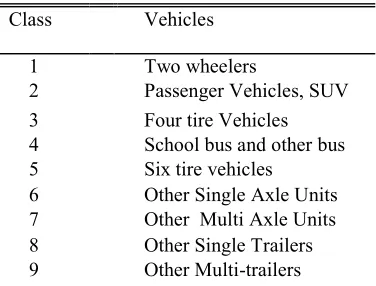
In our proposal, the vehicles are classified into 9 classes based on the FHWA highway classifications using wireless magnetic sensor.
TABLE II classifies the vehicles into classes. For analysis basis, it provides a better solution for traffic issues.
TABLE I PROBABILITY OF VEHICLES N
0 0.01832 1.09896
1 0.07326 4.3956
2 0.14652 8.7917
3 0.19538 11.722
4 0.19538 11.722
5 0.15629 9.378
6 0.10420 6.252
7 0.05954 3.564
8 0.02977 1.7863
9 0.01323 0.7939
TABLE II
Classification of Vehicles
D. Estimating Vehicle length based on its velocity
Length of the vehicle is a vital parameter in the traffic flow conditions. It helps us to find the length of the vehicle to avoid the congestion problems because of Length. It is a central research in Intelligent Transportation System (ITS).
In [3], they measured the length of the vehicle only during the red cycle and green cycle in the same period. But it is not efficient to calculate the length of the vehicle only at the same period. In this paper, the length of the vehicle can be calculated by its velocity; hence the arrival rate of vehicle is a random process, so the velocity of the vehicle cannot be calculated randomly because it increases the cost. The vehicle must be calculated for certain time period but not in fixed time period, it must vary according the traffic flow which will be valuable on cost basis and system effectiveness. When the traffic flow increases it must calculate the velocity for nearby time period which increases the accuracy and reduces the delays. Hence, this paper proposes calculating the vehicle length based on the velocity of the vehicle by using wireless magnetic sensor.
Here,
𝑡 = ∆𝑇𝐹𝑖𝑛𝑎𝑙− ∆𝑇𝐼𝑛𝑖𝑡𝑖𝑎𝑙
The velocity of the vehicle can be calculated by, 𝑣𝑎𝑣𝑔=(∆𝐷𝐹𝑖𝑛𝑎𝑙−∆𝐷𝐼𝑛𝑖𝑡𝑖𝑎𝑙)
𝑡
Where,
𝑣𝑎𝑣𝑔 Average Velocity
∆𝐷𝐹𝑖𝑛𝑎𝑙 Destination Distance
∆𝐷𝐼𝑛𝑖𝑡𝑖𝑎𝑙 Initial Distance
∆𝑇𝐹𝑖𝑛𝑎𝑙 The time to reach the destination
∆𝑇𝐼𝑛𝑖𝑡𝑖𝑎𝑙 The time start from initial stage
t Time period value (i.e., t value will be vary according to the traffic flow)
Here, the length of the vehicle can be calculated by, L=T*v
Where,
L Length of the vehicle (L=∑3𝑖=0𝑙𝑖), T Time interval (T=t1+ t2+ t3+…),
Vvelocity of the vehicle (measured in milliseconds).
If length of the vehicle is known, it is easy to calculate the speed of the vehicle. The speed of the vehicle can be calculated by,
s=N/L Where,
s speed of the vehicle, NNumber of vehicles, L Length of the vehicles.
E. Vehicle Measurement and Light Control System
In [5], the final Total Weight is calculated by the summation of sensors placed in three sides of each road in addition to the relative weight of the vehicles on road. This approach is good if every vehicle is arriving at the same speed and same length. Unfortunately, traffic flow is a random process where vehicles also will arrive randomly. So, it is required to calculate using some traffic parameters.
The Traffic Data Collectors collect the Traffic information and it will be stored. The Traffic Light Controller agent acts as a secret supervisor agent to control the traffic light signal using the traffic data which has been transferred to the secret supervisor agent. Data processor will then process the data and make it as an input to the TLC controller agent.
Finally, the Intelligent Light Control System can be achieved effectively by calculating the Total Average Weight, the length of the vehicle and speed of the vehicle along with its summation of the sensors and probability of the relative weight of the vehicles on each road as:
𝑇𝐴𝑊(𝑅𝑗)𝑗=1→4= ∑ 𝑆𝑖+ 𝑃𝑗+ 𝑠𝑗+ 𝐿𝑗 3
𝑖=0
Where,
TAW (Rj) Total Average Weight of the traffic for all four side roads (where j=1->4),
Si Sensor placed in the road side (where three sensor on one side),
Pj Probability of the relative weight of the traffic (where j=1->4),
Sj vehicle speed (where j=1->4), Lj vehicle Length (where j=1->4).
F. Intelligent Traffic Deviation System
After the processing of Intelligent Traffic Light Control System, the traffic issues will reduce but not completely. The traffic issues will not be solved but can be prevented by using Intelligent traffic Deviation System.
Intelligent Traffic Deviation System deviates the traffic into some other routes to prevent the traffic congestion problems before it occurs. This system plays a vital role in the traffic system to avoid the traffic issues. This system will be applicable for some set of geographical areas. Therefore we can use this model, mainly outside of the city or high traffic
Class Vehicles
1 Two wheelers
2 Passenger Vehicles, SUV 3 Four tire Vehicles 4 School bus and other bus 5 Six tire vehicles
issue areas to avoid the traffic congestion before the vehicles are entering into the traffic. Through this we can completely prevent the traffic congestion problems.
Figure 3. Sample Route Map
In the above figure3, border route of Chennai has taken as sample route. Violet color represents the route to reach Chennai and the red color represents the deviation route. The above route is a simple example for deviating the vehicle. Hence, this intelligent traffic deviation system can be used in specific areas which have deviating route ability. Now a day, it is not possible to construct many roads to avoid traffic problems, but vehicles can be deviated to avoid traffic congestion problems.
A vehicle takes t1 time to reach B from A (where, distance from A to B is x). When there is traffic congestion then the travel time will be increased, t1+µ time to reach B (where, µ will be the delayed time). Traffic congestion is unavoidable. Therefore deviation of vehicles will be a better solution to avoid the traffic congestion problems. Here, deviating the vehicles takes t2 time to reach B form A (where this vehicle is deviated from a deviating signal). The deviation route takes a longer distance to reach the destination but it increases the speed of the vehicle to reach the destination quickly.
G. Map to Graph Conversion
The Euler fascinating discovery will make graph using six color theorem possible. First, let us consider the graphs and convert it to number of vertices and edges by mathematical jaunt.
In [8], “Euler has proved in a different manner, where In
[8], “Euler has proved in a different manner, where number
of vertices minus the number of edges plus the number of faces
of a polyhedron is always equal to two”.
In [8], “Any planar graph has Euler characteristic equal to
2”.
𝑋 = 𝑉 − 𝐸 + 𝐹
Where,
V vertices of the map E Edges of the map FFaces of the map
If a graph has a single vertex, then the value of X equal to 2 (V-E+F=1-0+1). So, attach additional vertices to each edge for each vertex, and then it always remains 2.
Figure 5. Converted graph form Map
Figure 5 shows the Chennai map conversion to graph with the help of six color theorem. Six places are pointed as six color nodes; every node is connected with the Chennai root node. This figure shows that different routes are entering into the Chennai city. Before the city limit starts the population of the vehicles is calculated, then deviated to different routes inside the city.
IV. VALIDATION AND PROOF
This proposed system has been evaluated based on various types of issues such as the amount of time taken by a vehicle stand in traffic queue, wastage of fuel and wastage of time. If we apply this traffic deviation system it helps us to reduce the traffic queue, wastage of fuel and time. The Figure 6 explains the performance evaluation of the available related systems. The systems are compared in terms of cost, the system by cheung et al., making use of a single magnetic sensor[3]and it has 63 per cent result which reduces the traffic cost. Next Taghvaeeyan et al., [4] has achieved 95 per cent making use of sensing system and coifman et al., [22] has achieved 85 per cent in calculating the individual vehicle lengths. Based on the prior works, everyone has solved the issues only for the sole parameters but this paper integrates all the parameters and provide solutions for traffic problems. The proposed system had been tested using the Netlogo [24], taking into the real of Chennai traffic flow dataset [23]. The system contains two solutions traffic system, one is traffic light control system and the other is traffic deviation system. So, the challenge of the system is if any over detection occurs in the light control system that can be solved using traffic deviation system. Accodring to [25], the test statistic used by the proposition is given by Z-test calculation:
𝐙 =
𝐝 𝐒𝐝√𝐧
Figure 6. Performance evaluation of the System
Figure 6 explains the performance evaluation of the system with the existing systems. In that cost, time, performance, expense and maintenance of the system are taken as a key factor and compared with the other proposed approach. The cost factor analyzes the average waiting time and time delay, the time taken by the person to stand in a traffic queue, the overall performance of the system, the expense of the system and the maintenance of the system. As specified in [26], the magnetic wireless sensor has some limitation in a signal processing like facing noisy situation.
Poisson distribution helps us to find the vehicle count within a time interval and can be validated using the Nagel– Schreckenberg model, which is a theoretical model for the freeway traffic. This model is applicable only to the traffic congestion emerging without any external influences. Many researchers have developed the algorithm for a particular factor like vehicle classification, vehicle length, speed of the vehicle etc. which are deficient in traffic system. This paper combines several other factors like vehicle classification, vehicle length and speed of the vehicle to make the system work more efficiently. And a new deviation approach is introduced to prevent the traffic congestion completely.
Figure7 shows the Traffic density of the system before deviation. Hence, the values of Average Velocity of the Vehicles are assumptions taken under the normal calculation of the traffic flow.
Figure 7. Traffic Density before Deviation
Figure 8. Traffic Density after Deviation
In the above given Fig8 shows the traffic density of the system after deviation. The values are calculated same as the above assumptions. This graph shows us that after deviating the vehicles the traffic density is start to reduce at the flow rate. These graphs are drawn based on the analysis of the traffic system.
V. CONCLUSION
References
[1] Chiu, Stephen; Chand, S., "Self-organizing traffic control via fuzzy logic," Decision and Control, 1993., Proceedings of the 32nd IEEE Conference on , vol., no., pp.1897,1902 vol.2, 15-17 Dec 1993 doi: 10.1109/CDC.1993.325523
[2] Lili Zhu; Sheng Jin, "Speed estimation with single loop detector using typical effective vehicle length," Multimedia Technology (ICMT), 2011 International Conference on , vol., no., pp.4096,4099, 26-28 July 2011 doi: 10.1109/ICMT.2011.6003177
[3] Cheung, Sing Yiu, Coleri, Sinem, Dundar, Baris, Ganesh, Sumitra, Tan, Chin-Woo, Varaiya, Pravin, “Traffic Measurement and Vehicle Classification with a Single Magnetic Sensor”, T ransportation Research Record: Journal of the Transportation Research Board Issue Number: 1917 Publisher: Transportation Research Board ISSN: 0361-1981, 2005.
[4] Taghvaeeyan, S.; Rajamani, R., "Portable Roadside Sensors for Vehicle Counting, Classification, and Speed Measurement," Intelligent Transportation Systems, IEEE Transactions on , vol.15, no.1, pp.73,83, Feb. 2014 doi: 10.1109/TITS.2013.2273876
[5] Salama, A.S.; Saleh, B.K.; Eassa, M.M., "Intelligent cross road traffic management system (ICRTMS)," Computer Technology and Development (ICCTD), 2010 2nd International Conference on , vol., no., pp.27,31, 2-4 Nov. 2010 doi: 10.1109/ICCTD.2010.5646059
[6] Introduction to Contemporary Mathematics. 4th edition (December 1997). W.H. Freeman &Co.; ISBN: 0716728419.
[7] Guerrero-Ibáñez, A.; Contreras-Castillo, J.; Buenrostro, R.; Marti, A.B.; Muñoz, A.R., "A policy-based multi-agent management approach for intelligent traffic-light control," Intelligent Vehicles Symposium (IV), 2010 IEEE , vol., no., pp.694,699, 21-24 June 2010 doi: 10.1109/IVS.2010.5548133
[8] Introduction to Contemporary Mathematics. 4th edition (December 1997). W.H. Freeman &Co.; ISBN: 0716728419.
[9] Iscaro, G.; Nakamiti, G., "A supervisor agent for urban traffic monitoring," Cognitive Methods in Situation Awareness and Decision Support (CogSIMA), 2013 IEEE International Multi-Disciplinary Conference on , vol.,
no., pp.167,170, 25-28 Feb. 2013
doi: 10.1109/CogSIMA.2013.6523842
[10] Patel, M.I.; Ranganathan, N., "An intelligent system architecture for urban traffic control applications," Parallel and Distributed Processing, 1996., Eighth IEEE Symposium on , vol., no., pp.10,17, 23-26 Oct 1996 doi: 10.1109/SPDP.1996.570311
[11] Saeed Samadi1, Ali Pajoumand Rad2, Farhad Mohammad Kazemi3, Hamed Jafarian2, “Performance Evaluation of Intelligent Adaptive Traffic Control Systems: A Case Study “ - Journal of Transportation Technologies, 2012, 2, 248-259.
[12] Sheik Mohammed Ali, S.; George, B.; Vanajakshi, L., "An Efficient Multiple-Loop Sensor Configuration Applicable for Undisciplined Traffic,"
Intelligent Transportation Systems, IEEE Transactions on , vol.14, no.3, pp.1151,1161, Sept. 2013 doi: 10.1109/TITS.2013.2255038
[13] Kaewkamnerd, S.; Chinrungrueng, J.; Pongthornseri, R.; Dumnin, S., "Vehicle classification based on magnetic sensor signal," Information and Automation (ICIA), 2010 IEEE International Conference on , vol., no., pp.935,939, 20-23 June 2010 doi: 10.1109/ICINFA.2010.5512140
[14] Cai Yingfeng; Zhang Weigong; Wang Hai, "Measurement of Vehicle Queue Length Based on Video Processing in Intelligent Traffic Signal Control System," Measuring Technology and Mechatronics Automation (ICMTMA), 2010 International Conference on , vol.2, no., pp.615,618, 13-14 March 2010 doi: 10.1109/ICMTMA.2010.354
[15] Google Maps and SAS/GRAPH, Darrell Massengill, SAS Institute Inc., Cary, NC.
[16] Deng-Yuan Huang, , Chao-Ho Chen , Wu-Chih Hu, Shu-Chung Yi and Yu-Feng Lin, “Feature-Based Vehicle Flow Analysis and Measurement for a Real-Time Traffic Surveillance System”, Journal of Information Hiding and Multimedia Signal Processing 2012, Volume 3, Number 3, July2012. [17] Benjamin Coifman, David Beymer, Philip McLauchlan,Jitendra Malik, “A real-time computer vision system for vehicle tracking and traÅc Surveillance”, Transportation Research Part C 6 (1998) 271±288
[18] Xinting Pan; Yunlong Guo; Aidong Men, "Traffic Surveillance System for Vehicle Flow Detection," Computer Modeling and Simulation, 2010. ICCMS '10. Second International Conference on , vol.1, no., pp.314,318, 22-24 Jan. 2010 doi: 10.1109/ICCMS.2010.75
[19] Saima Maqbool, Ulya Sabeel, Nidhi Chandra, Rouf, Ul, Alam Bhat, “Smart Traffic Light Control and Congestion Avoidance System During Emergencies Using Arduino and Zigbee 802.15.4, International Journal of
Advanced Research in Computer Science and Software Engineering, Volume3, Issue 6, June 2013
[20] Kamijo, S.; Matsushita, Y.; Ikeuchi, K.; Sakauchi, M., "Traffic monitoring and accident detection at intersections," Intelligent Transportation Systems, IEEE Transactions on , vol.1, no.2, pp.108,118, Jun 2000 doi: 10.1109/6979.880968
[21] Baskar, L.D.; De Schutter, B.; Hellendoorn, J.; Papp, Z., "Traffic control and intelligent vehicle highway systems: a survey," Intelligent Transport Systems, IET , vol.5, no.1, pp.38,52, March 2011 doi: 10.1049/iet-its.2009.0001
[22] B. Coifman, “Improved Velocity Estimation Using Single Loop Detectors,” Transportation Research Part A, Vol. 35, pp. 863–880, 2001. [23] http://chennaicityconnect.com/chennai-pedia/statistics/chennai-traffic-statistics/
[24]https://www.google.co.in/url?sa=t&rct=j&q=&esrc=s&source=web&cd= 2&cad=rja&uact=8&ved=0CCMQjBAwAQ&url=https%3A%2F%2Fccl.nort hwestern.edu%2Fnetlogo%2Fdownload.shtml&ei=6wW1U5roLcSRuASTgo LQDg&usg=AFQjCNFLSKdHuWLw6QCbe6WEwGSGJNReCA&sig2=md8 nfUk6jFRuAaj4aoryDw
[25] B. Anil Kumara, Lelitha Vanjakshi, Shankar C. Subramanian, “Day-wise travel time pattern analysis under heterogeneous traffic conditions”, second Conference of Transportation Research Group of India (2nd CTRG),Procedia - Social and Behavioral Sciences 104 ( 2013 ) 746 – 754.